
Memorial of Saint Alphonsus Liguori, Bishop and Doctor of the Church
Tuesday of the Seventeenth Week in Ordinary Time
August 1, 2023
Today’s Readings:
https://bible.usccb.org/bible/readings/080123.cfm

Today, in God’s Lavish Mercy, Moses goes on a rigorous forty day retreat:
So Moses stayed there with the LORD for forty days and forty nights,
Exodus 33:28
without eating any food or drinking any water,
and he wrote on the tablets the words of the covenant,
the ten commandments.
The purpose of this intense retreat was for Moses to codify God’s law in his own heart. He is to be a witness and leader for God among the people. It was a law of relationship, written in stone for the people, but written in fire for Moses. If God’s intentions are not embedded in Moses’s own heart, his ministry will fail.
In our Gospel, the disciples go on a kind of retreat too. The crowds have been dismissed, and Jesus’s close friends sit down with him for an in-depth instruction in the meaning of his parables. They want to understand the mind and heart of Christ so that they can pattern their own on his Word.
A good retreat is like a spiritual spa experience. It can provide us with rest, clarity, nourishment, and stabilization. And good retreat direction, either through a spiritual guide or through the discipline of solitude, is invaluable to such a pursuit.
But while we can’t be on a formal retreat every day of our lives, we still need a daily “coming away” with God to center our spirits and to keep alive the holy fire within them.
Today might be a good day to evaluate those processes in our lives. Are they working for us? Or might our prayer and reflection time have become so routine as to lose its snap. Have we let life’s concerns slip into our solitude to the point of no longer hearing God’s whisperings? Or have we even truncated that time to meet those ever-expanding concerns?
We may feel so overwhelmed by life that we think we don’t have time for deep prayer. That’s like saying we don’t have time to breathe! If we don’t make the time for both of them, we will die. It’s that simple.
Sixty years ago, my Novice Director gave me a wonderful book. I return to it frequently to consider the spiritual discipline of my life. Here are two excerpts which seem to have bearing on today’s reflection and might inspire your considerations today:
When silence takes possession of you; when far from the racket of the human highway the sacred fire flames up in the stillness; when peace, which is the tranquillity of order, puts order in your thoughts, feelings, and investigations, you are in the supreme disposition for learning; you can bring your materials together; you can create; you are definitely at your working point; it is not the moment to dwell on wretched trifles, to half live while time runs by, and to sell heaven for nothings.
Retirement (retreat) is the laboratory of the spirit; interior solitude and silence are its two wings. All great works were prepared in the desert, including the redemption of the world
A.D. Sertillanges, The Intellectual Life: Its Spirit, Conditions, Methods
Poetry: The Stolen Child – William Butler Yeats
Using his love for Celtic lore and fantasy, Yeats imagines a return to innocence at the hands of magical creatures, the faeries. With imagery rich in natural wonder, the reader is invited to “come away” from a world impossible to understand, and to be restored in spiritual truth. Sounds like a retreat to me!
Where dips the rocky highland
Of Sleuth Wood in the lake,
There lies a leafy island
Where flapping herons wake
The drowsy water rats;
There we've hid our faery vats,
Full of berrys
And of reddest stolen cherries.
Come away, O human child!
To the waters and the wild
With a faery, hand in hand,
For the world's more full of weeping than you can understand.
Where the wave of moonlight glosses
The dim gray sands with light,
Far off by furthest Rosses
We foot it all the night,
Weaving olden dances
Mingling hands and mingling glances
Till the moon has taken flight;
To and fro we leap
And chase the frothy bubbles,
While the world is full of troubles
And anxious in its sleep.
Come away, O human child!
To the waters and the wild
With a faery, hand in hand,
For the world's more full of weeping than you can understand.
Where the wandering water gushes
From the hills above Glen-Car,
In pools among the rushes
That scarce could bathe a star,
We seek for slumbering trout
And whispering in their ears
Give them unquiet dreams;
Leaning softly out
From ferns that drop their tears
Over the young streams.
Come away, O human child!
To the waters and the wild
With a faery, hand in hand,
For the world's more full of weeping than you can understand.
Away with us he's going,
The solemn-eyed:
He'll hear no more the lowing
Of the calves on the warm hillside
Or the kettle on the hob
Sing peace into his breast,
Or see the brown mice bob
Round and round the oatmeal chest.
For he comes, the human child,
To the waters and the wild
With a faery, hand in hand,
For the world's more full of weeping
than he can understand.
Music: Inner Peace – Hennie Bekker
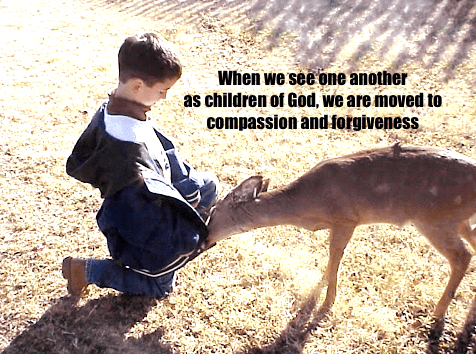


 Lavish Mercy