Anno Domini – New Year’s Day

January 1, 2022
The Octave Day of Christmas – Solemnity of the Blessed Virgin Mary, the Mother of God

Happy New Year, everyone!
Today, in God’s Lavish Mercy, we celebrate Mary, Mother of Jesus.
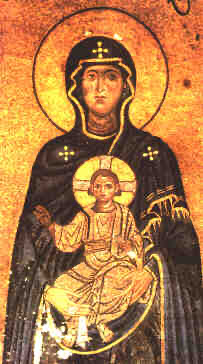
Theotokos, a mosaic mural from the Gelati Monastery, Georgia, (1125-1130 AD)

I begin my prayer today by asking a question posed by distinguished theologian, Elizabeth Johnson, CSJ:

What would be a theologically sound, spiritually empowering and ethically challenging theology of Mary, mother of Jesus the Christ, for the 21st century? This question has no simple answer, for the first-century Jewish woman Miriam of Nazareth, also held in faith to be Theotokos, the God-bearer, is arguably the most celebrated woman in the Christian tradition. One could almost drown surveying the ways different eras have honored her in painting, sculpture, icons, architecture, music and poetry; venerated her with titles, liturgies, prayers and feasts; and taught about her in spiritual writings, theology and official doctrine.


In my own prayer today, though, I am not reaching for a deeper theological understanding of Mary. I simply want to talk with her as my Mother, my older Sister, my Friend. I want to seek her guidance and her inspiration. I want to thank her for her continual willingness to bear Christ into the world, and into my life.


How significant it is that the Church begins the year inviting us all to Mary’s Light! Our first reading blesses us in a way that Mary might bless us:

The LORD bless you and keep you!
The LORD let his face shine upon you,
and be gracious to you!
The LORD look upon you kindly
and give you peace!

Mary was all about giving us the LORD, not giving us herself. We see Mary best when we see her holding Christ toward us – the “God-bearer” or “Theotokos”.

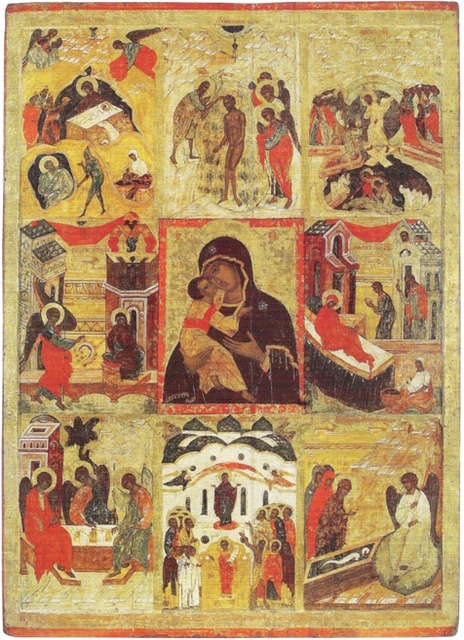
Theotokos Vladimirskaya icon, Vologda, Vladimirskaya Church, mid-end 16 century

This title, used especially in Eastern Christianity, originated in the 3rd century Syriac tradition. It affirms Mary as the Mother of Jesus, Who was both human and divine in nature.

Our reading from Galatians assures us that we too, by our Baptism, are the daughters and sons of God – thus becoming Mary’s own. She is our Mother too by the power of this sacrament.


Our Gospel reveals the spirituality of Mary who “pondered” all the mysterious workings of God deep in her heart. This Mary is my revered sister, guiding me as I meet the unfolding of God in my own life.

Today, let us pray with Mary, our Mother, our Sister, Bearer of God. Let us pray for the whole Church, the whole world – all of whom she tenderly loves.


Poetry: Mary Poems – Lucille Clifton (1936 –2010) was an American poet, writer, and educator from Buffalo, New York. She was Poet Laureate of Maryland and twice a finalist for the Pulitzer Prize for poetry.

Clifton traced her family’s roots to the West African Kingdom of Dahomey, now the Republic of Benin. Growing up, she was told by her mother, “Be proud, you’re from Dahomey women!”. (You will catch some of her Creole cadence in the verses below.)

Her uniquely insightful poems about Mary capture aspects of Mary’s humanity, vulnerability and womanhood that we might otherwise not consider in a religious tradition that highly spiritualizes Mary.


A Song of Mary

somewhere it being yesterday.
i a maiden in my mother’s house.
the animals silent outside.
is morning.
princes sitting on thrones in the east
studying the incomprehensible heavens.
joseph carving a table somewhere
in another place.
i watching my mother.
i smiling an ordinary smile.

****************

Mary’s Dream

winged women was saying
"full of grace" and like.
was light beyond sun and words
of a name and a blessing.
winged women to only i.
i joined them, whispering
yes.

****************

Holy Night

Joseph, I afraid of stars,
their brilliant seeing.
so many eyes, such light.
joseph, I cannot still these limbs,
I hands keep moving toward I breasts,
so many stars. so bright.
joseph, is wind burning from east
joseph, I shine, oh joseph, oh
illuminated night.

****************

Island Mary

after the all been done and i
one old creature carried on
another creature's back, i wonder
could i have fought these thing?
surrounded by no son of mine save
old men calling Mother like in the tale
the astrologer tell, i wonder
could i have walk away when voices
singing in my sleep? i one old woman.
always i seem to worrying now for
another young girl asleep
in the plain evening.
what song around her ear?
what star still choosing?


Music: A Peaceful Hymn to the Theotokos – Nuns of the Carmazani Monastery in Romania

Our Lady of the Rosary

Memorial of Our Lady of the Rosary

October 7, 2020

Today, in God’s Lavish Mercy, we pray with Psalm 117. Since it is also the Memorial of Our Lady of the Holy Rosary, I’ll refer you to a previous post on Psalm 117.


For today, the Feast of the Holy Rosary, we may wish to focus on that venerable prayer which had its origins in the very early Church. In fact, those early versions of a rosary are connected to the Psalms:

Prayers with beads like the rosary may have begun as a practice by the laity to imitate the Christian monasticism of the Liturgy of the Hours during the course of which the monastics prayed the 150 Psalms daily. As many of the laity could not read, they substituted 150 repetitions of the Our Father for the Psalms, sometimes using a cord with knots on it to keep an accurate count.
(The Catholic Encyclopedia)


The shape of the rosary as we pray it today emerged more clearly in the 13th century as Marian devotion blossomed in the Church. The tendency of that devotion was to place Mary, and other saints, between us and God. They, having already gained heaven, were deemed to have intercessory power we lacked. So praying the rosary became an “asking prayer” rather than a meditation on the whole of Christ’s life. In many ways, our relationship with Mary also took on a sentimentalism which lessened her true and unique power as witness and companion in the Communion of Saints.


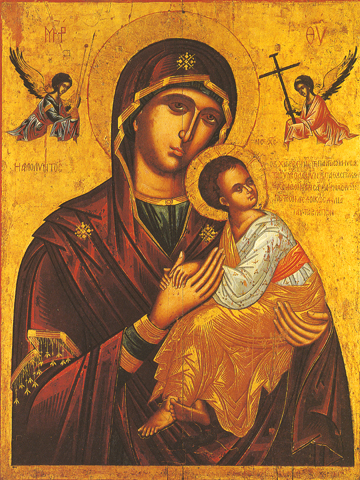
Theotokos of the Passion – 17th century

Today, Marian theology, as well as rosary devotion, looks to a clearer understanding of Mary’s role as participant in the continuing redemptive act of Jesus. Praying with her, in any form, is an opportunity to experience Jesus from her perspective and to apply that grace to our own life and world.

“Remembering Mary as a friend of God and prophet in the communion of saints, a woman who is truly sister to our strivings, allows the power of her life to play in the religious consciousness of the church, encouraging ever-deeper relationship with the living God in whom our spirits rejoice, and allying us with God’s redemptive designs for the hungry, the lowly, and all those who suffer, including in an unforgettable way women with their children in situations of poverty, prejudice, and violence.”

Elizabeth Johnson, CSJ – Truly Our Sister

I try, as I pray the rosary, to imagine Mary within each particular mystery or circumstance of Christ’s life. What did she experience? How did she grow in grace? What is she guiding me toward in my relationship with God?

I also ask Mary to allow those graces and insights to bless and heal not only my life but the life of the world, particularly where there is great pain or suffering for women and children.


In Whom We Live and Move and Have Our Being
~ Denise Levertov
(Reading this poem, we may think of our prayer as a “breathing” enveloped in the Presence of God. The “holy ones”, like Mary, easily ride that breath of prayer. When we pray with them, as in the Rosary, they “rock” us into the silent rhythm of God.)

Photographer: Johannes Plenio
Birds afloat in air's current,
sacred breath?  No, not breath of God,
it seems, but God
the air enveloping the whole
globe of being.
It's we who breathe, in, out, in, in the sacred,
leaves astir, our wings
rising, ruffled -- but only the saints
take flight.  We cower
in cliff-crevice or edge out gingerly
on branches close to the nest.  The wind
marks the passage of holy ones riding
that ocean of air.  Slowly their wake
reaches us, rocks us.
But storms or still, 
numb or poised in attention,
we inhale, exhale, inhale,
encompassed, encompassed.

Music: Beneath Your Compassion (Sub Tuum Praesidium) performed here in Russian by the PaTRAM Institute Singers

The oldest known devotion to Mary can be found in the words of a hymn that is documented to have existed and been sung before the middle of the 3rd century. 

Beneath your compassion,
We take refuge, O Theotokos:
do not despise our petitions in time of trouble;
but rescue us from dangers,
only pure, only blessed one.

Mary, Full of Grace

The Octave Day of Christmas

Solemnity of the Blessed Virgin Mary, the Mother of God

IMG_2003
Theotokos, a mosaic mural from the Gelati Monastery, Georgia, (1125-1130 AD)

January 1, 2020

Click here for readings

Today, in Mercy, we celebrate Mary, Mother of Jesus.

I begin my prayer today by asking a question posed by distinguished theologian, Elizabeth Johnson, CSJ:

What would be a theologically sound, spiritually empowering and ethically challenging theology of Mary, mother of Jesus the Christ, for the 21st century? This question has no simple answer, for the first-century Jewish woman Miriam of Nazareth, also held in faith to be Theotokos, the God-bearer, is arguably the most celebrated woman in the Christian tradition. One could almost drown surveying the ways different eras have honored her in painting, sculpture, icons, architecture, music and poetry; venerated her with titles, liturgies, prayers and feasts; and taught about her in spiritual writings, theology and official doctrine.

To see Sister Elizabeth Johnson’s excellent article, click here.


In my own prayer today, though, I am not reaching for a deeper theological understanding of Mary. I simply want to talk with her as my Mother, my older Sister, my Friend. I want to seek her guidance and her inspiration. I want to thank her for her continual willingness to bear Christ into the world, and into my life.

How significant it is that the Church begins the year inviting us all to Mary’s Light! Our first reading blesses us in a way that Mary might bless us:

The LORD bless you and keep you!
The LORD let his face shine upon you, and be gracious to you!
The LORD look upon you kindly and give you peace!

Mary was all about giving us the LORD, not giving us herself. We see Mary best when we see her holding Christ toward us – the “God-bearer” or “Theotokos”.

IMG_2004
Theotokos Vladimirskaya icon, Vologda, Vladimirskaya Church, mid-end 16 century

This title, used especially in Eastern Christianity, originated in the 3rd century Syriac tradition. It affirms Mary as the Mother of Jesus, Who was both human and divine in nature.

Our reading from Galatians assures us that we too, by our Baptism, are the daughters and sons of God – thus becoming Mary’s own. She is our Mother too by the power of this sacrament.

Our Gospel reveals the spirituality of Mary who “pondered” all the mysterious workings of God deep in her heart. This Mary is my revered sister, guiding me as I meet the unfolding of God in my own life.

Today, let us pray with Mary, our Mother, our Sister, Bearer of God. Let us pray for the whole Church, the whole world – all of whom she tenderly loves.

Music: Two selections today.

A Peaceful Hymn to the Theotokos – Nuns of the Carmazani Monastery in Romania
Prayer of Pure Love – Leddy Hammock and Sue Riley

Mary, Sacred Chamber

Sunday, December 23, 2018

 Click here for Readings

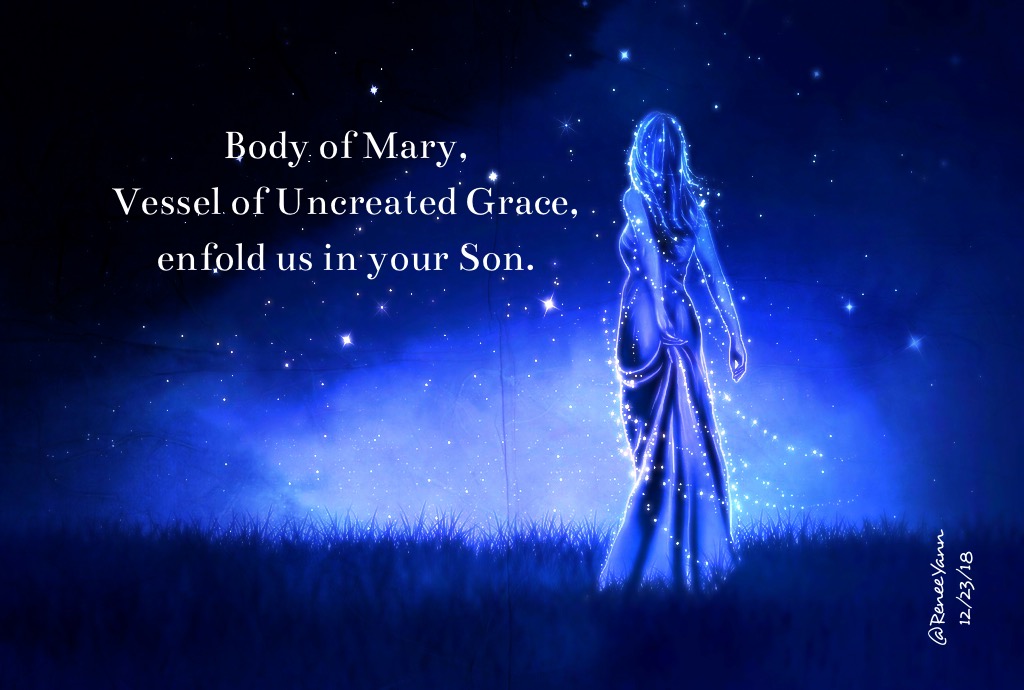
MAry 12_23

Today, in Mercy, our readings offer a harmonious exultation of Mary, beloved mother of Jesus.

The prophet Micah foretells the time “when she who is to give birth has borne.”

Even the ancient voices spoke of Mary, long before time knew her name. Their hope depended on her cosmic “Yes”, long before she spoke her first childish word.

Hebrews speaks of the Body of Christ, that physical place where the grandeur of God took flesh, that tabernacle woven of Mary’s own body and blood, that temple made possible by her “Fiat”.

The Gospel gives us two loving women, Elizabeth and Mary, rejoicing in God’s power manifested in their lives. They need no proclamations, executive orders, bills, or injunctions. Just a soft greeting, a leap within, a confirmed trust carried in each other’s eyes.

This poem by Mark Strand captures their moment for me. These two women had waited with all Creation for the redeeming Messiah. Now it was about to happen within their lives:

The Coming of Light
Even this late it happens:
the coming of love, the coming of light.
You wake and the candles are lit as if by themselves,
stars gather, dreams pour into your pillows,
sending up warm bouquets of air.
Even this late the bones of the body shine
and tomorrow’s dust flares into breath.

Music: Agni Parthene (Greek: Ἁγνὴ Παρθένε), rendered “O Virgin Pure”, is a Greek Marian Hymn composed by St. Nectarios in the late 19th century. The dulcet melody is sung here in both Greek and English. Lyrics are below.

O Virgin Pure
by St. Nectarios

Refrain: O Rejoice, Bride Unwedded.

O Virgin pure, immaculate/ O Lady Theotokos
O Virgin Mother, Queen of all/ and fleece which is all dewy
More radiant than the rays of sun/ and higher than the heavens
Delight of virgin choruses/ superior to Angels.
Much brighten than the firmament/ and pure than the sun’s light
More holy than the multitude/ of all the heav’nly armies.
O Rejoice, Bride Unwedded.

O Ever Virgin Mary/ of all the world, the Lady
O bride all pure, immaculate/ O Lady Panagia
O Mary bride and queen of all/ our cause of jubilation
Majestic maiden, Queen of all/ O our most holy Mother
More hon’rable than Cherubim/ beyond compare more glorious
than immaterial Seraphim/ and greater than angelic thrones.

O Rejoice, Bride Unwedded.

Rejoice, O son of Cherubim/ Rejoice, O hymn of angels
Rejoice, O ode of Seraphim/ the joy of the archangels
Rejoice, O peace and happiness/ the harbor of salvation
O sacred chamber of the Word/ flower of incorruption
Rejoice, delightful paradise/ of blessed life eternal
Rejoice, O wood and tree of life/ the fount of immortality

O Rejoice, Bride Unwedded.

I supplicate you, Lady/ now do I call upon you
And I beseech you, Queen of all/ I beg of you your favor
Majestic maiden, spotless one/ O Lady Panagia
I call upon you fervently/ O sacred, hallowed temple
Assist me and deliver me/ protect me from the enemy
And make me an inheritor/ of blessed life eternal.

O Rejoice, Bride Unwedded.