Psalm 32: Forgiveness

Friday of the Fifth Week in Ordinary Time

February 12, 2021

Today, in God’s Lavish Mercy, we pray with Psalm 32, a classic penitential psalm.
It is an uncomplicated description of repentance and forgiveness which, nevertheless, discloses profound insights into the human spirit.

Blessed is the one whose fault is taken away,
    whose sin is covered.
Blessed the one to whom the LORD imputes not guilt,
    in whose spirit there is no guile. 

Psalm 32:1-2

This relational sequence of confession and forgiveness is probed in depth in Psalm 32 (where) the speaker describes his silence and his consequent bodily disability (vv. 3–4). One can observe in the psalm an inchoate theory of repression that became definitive for Sigmund Freud. Repression immobilizes, says the psalmist! The abrupt move in verse 5 concerns the process of making his sin known, saying it aloud, confessing it.

It is confession that makes forgiveness possible. It is denial that precludes assurance and that immobilizes the perpetrator.

Walter Brueggemann, From Whom No Secrets Are Hid

Praying with Psalm 32 this morning reminded me of a story I wrote a few years ago.

The Earring

Young Emma, skewered by indecision, had stared into her mother’s jewelry box. She had always loved those silver earrings, a gift to her mother from her grandmother—an heirloom now, a treasure beyond price. She wanted so to wear them on this special date, but they were “hands off” and she knew it. Still, her mother at work and unaware of her desire, Emma had succumbed to temptation.

The dance had been wonderful, a whirlwind of such delight that Emma had not noticed when her left earring had brushed against her partner’s shoulder, tumbling hopelessly under the dancers’ trampling feet. Only at evening’s end, approaching her front door exhausted and dreamy, had she reached up to unclip the precious gems.

Her mother sat waiting for her in the soft lamplight, having already noticed the earrings missing from her dresser. Awaiting retribution, Emma knelt beside her mother and confessed the further sacrilege of loss. But her mother simply cupped Emma’s tearful face in her hands, whispering, “You are my jewel. Of course I forgive you.”  Though accustomed to her mother’s kindness, this act of compassion astonished Emma, filling her with an indescribable, transformative gratitude.

As we pray Psalm 32, there may be a great forgiveness we are thankful for, or just the small kindnesses that allow us to rise each morning with joy and hope. Perhaps there is a memory of compassion, like Emma’s, that we treasure—one that in turn has made us kinder and more honest.

But maybe, on the other hand, there is a “lost earring”, never acknowledged. With time, that unacknowledgement burrows deeper into the spirit restricting our capacity to love.

Psalm 32 reminds us that God is our Mother waiting in the lamplight to cup our face with love, to receive our joyful thanks for divine mercies. 

For this shall every faithful soul pray to you 
    in time of stress.
Though deep waters overflow,
    they shall not reach us. 

Psalm 32:6

Like Emma, we may be astonished at the graciousness that has been given to us. We may respond by pouring out our thanks to God in a silent act of prayer.

May we also have the courage to become like our merciful God, anticipating the other’s need for our forgiveness. May we seek the strength not to harbor injury, but too release it to make room for further grace in our hearts.


Poetry: FIRST FORGIVENESS - Irene Zimmerman
The usually mild evening breeze
became a wailing wind
when the gates clanged shut behind them. 
They shivered despite their leathery clothes
as they searched for the fragrant blossoms
they’d grown accustomed to sleep on,
but found only serpentine coils
that bit and drew blood from their hands. It was Eve who discovered the cave.
When she emerged, she saw Adam
standing uncertainly at the entrance. A river of fire flooded her face
as she remembered his blaming words—
“The woman you gave me,
she gave me fruit from the tree,
and I ate.”

“Spend the night wherever you choose,”
she told him bitterly.
“You needn’t stay with me.” Long afterwards, when even the moon’s
cold light had left the entrance
and she’d made up a word
for the hot rain running from her eyes,
she sensed Adam near her in the dark. His breath shivered on her face.
“Eve,” he moaned,
“I’m sorry. Forgive me.” In the darkness between them
the unfamiliar words
waited, quivering.
She understood their meaning
when she touched his tears.

Music: Father, I Have Sinned – Eugene O’Reilly

Our story above was about a “prodigal daughter”. Our music is about a “prodigal son”.

Psalm 128: Fear?

Thursday of the Fifth Week in Ordinary Time

February 11, 2021


Today, in God’s Lavish Mercy, we pray with Psalm 128 which some describe as a blueprint for a happy home.

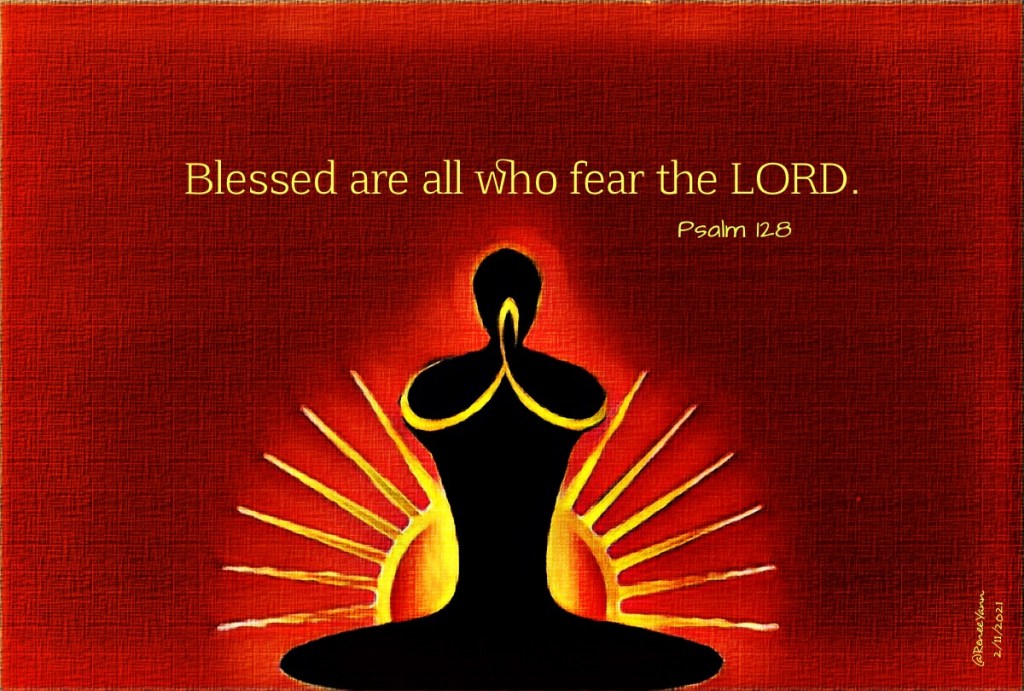
Happy are they all who fear the Lord, 
and who follow in the ways of God!
You shall eat the fruit of your labor;
happiness and prosperity shall be yours.
Your wife shall be like a fruitful vine 
within your house, 
your children like olive shoots 
round about your table.

Psalm 128, Canadian Inclusive Psalter

As lovely as it is, this interpretation may be overly simple. 


Psalm 128, written in the post-exilic period, is the people’s song of gratitude for the chance to return to their homeland after the Babylonian captivity.

For Israel, the captivity was the result of their faithlessness to their covenant with God. The core sentiment of the psalm is awareness, repentance, and conviction to live life more intentionally – to live in fear of the Lord and thus preserve oneself from future calamity:

Blessed are you who fear the LORD,
    who walk in the Lord’s ways!


For us, that word “fear” is a tough one. It seems to contradict our desired relationship with the God who is Love, the God we have met in the person of Jesus Christ. How do we reconcile the contradiction?

Proverbs tells us this:

The fear of the LORD is the beginning of wisdom,
and knowledge of the Holy One is understanding.

Proverbs 9:10

So this “fear” is significantly different from the emotion we might feel when, for example, we hear an unfamiliar noise in our darkened house.

Thus the ‘fear of the Lord’ is a relational term signifying the Israelites’ response to God’s grace displayed in salvation (especially the Exodus). As Walter Brueggemann has aptly written, it means: to take God with utmost seriousness as the premise and perspective from which life is to be discerned and lived. That ‘utmost seriousness’ requires attentiveness to some things rather than others, to spend one’s energies in response to this God who has initiated our life.

Mark J. Boda, Professor of Old Testament, McMaster Divinity College

This, in fact, is the rich sentiment underlying Psalm 128, and that will yield the security of an intimate relationship with God

May the LORD bless you from Zion;
may you see Jerusalem’s prosperity
all the days of your life,
and live to see your children’s children.
Peace upon Israel!

Psalm 128: 4-5
…as our life unfolds in God’s grace.

The psalmist’s “fear” might be more akin to awe, reverence, glad obedience to our God who loves us and wills our good. It is a virtue rooted in our search for a holy awe and wisdom as our life unfolds in God’s Grace:

Old Testament scholar, Walter Brueggemann, says we live in a technological society that has grossly confused knowledge and wisdom. He says wisdom is the mystery, held by God, about how and why life works…how creation holds together…and how human reason has its limits. Wisdom is God’s secret and even our bold Enlightenment expectations barely lay a finger on that secret. Wisdom involves recognizing limits before the mystery of God. Knowledge has to do with control, says Brueggemann. Wisdom has to do with awe.

William M. Klein, Pastor, Lexington Presbyterian Church

Poem: I Am Bending My Knee
Originally from the Carmina Gadelica I, 3. Taken from Esther de Waal, editor, The Celtic Vision (Liguori, MO: Liguori/Triumph, 1988, 2001), p. 7.

I am bending my knee
In the eye of the Father who created me,
In the eye of the Son who purchased me,
In the eye of the Spirit who cleansed me,
In friendship and affection.
Through Thine own Anointed One, O God,
Bestow upon us fullness in our need,
Love towards God,
The affection of God,
The smile of God,
The wisdom of God,
The grace of God,
The fear of God,
And the will of God
To do on the world of the Three,
As angels and saints
Do in heaven;
Each shade and light,
Each day and night,
Each time in kindness,
Give Thou us Thy Spirit.

Music: The Fear of the Lord – First Baptist Dallas (Wow! How about this music ministry!)

Gospel Verse: Truth

Memorial of Saint Scholastica, Virgin

February 10, 2021


Today, in God’s Lavish Mercy, we once again meet Psalm 104. Since we have had a very recent reflection on this psalm, we might instead like to reflect on our Gospel verse for today:

“Truth”, which would appear to be an evident reality, is in fact quite elusive. In his master work Summa Theologica, Thomas Aquinas writes extensively, and some might say exhaustively 🧐, in an effort to define truth.

For this reason truth is defined by
the conformity of intellect and thing;
and hence to know this conformity is to know truth.


Reflecting on the concept of Truth today, I remember Jesus’s self-description:

I am the Way and the Truth and the Life. 
No one comes to the Father except through Me.

John 14:6

By journeying through life with Jesus, we come to comprehend truth more clearly – both the truth around us and the truth within us. It is an unfolding which brings us ever closer to God’s complete imagination for us when we were created.

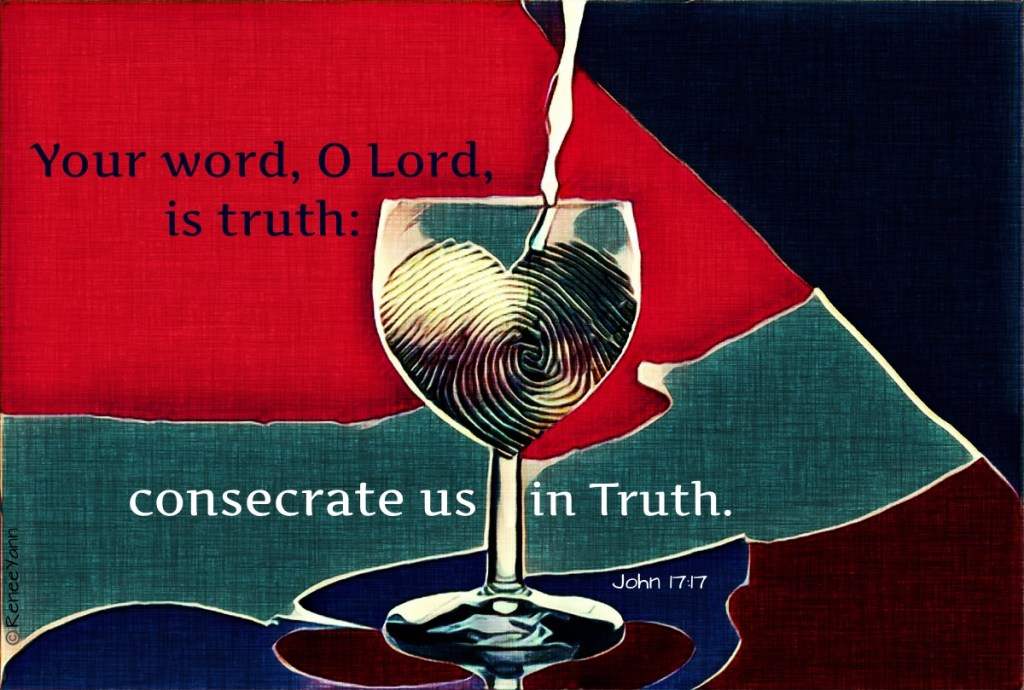
It is as if God’s fingerprint, first poured into on souls at our conception, becomes ever clearer in our lives. Let us pray each day to be consecrated in that Truth.

Poetry: truth by Gwendolyn Brooks
And if sun comes
How shall we greet him?
Shall we not dread him,
Shall we not fear him
After so lengthy a
Session with shade?

Though we have wept for him,
Though we have prayed
All through the night-years—
What if we wake one shimmering morning to
Hear the fierce hammering
Of his firm knuckles
Hard on the door?

Shall we not shudder?—
Shall we not flee
Into the shelter, the dear thick shelter
Of the familiar
Propitious haze?

Sweet is it, sweet is it
To sleep in the coolness
Of snug unawareness.

The dark hangs heavily
Over the eyes.

Music: Heaven’s Window – Peter Kater (Angels of Hope)

Psalm 8: God’s Handiwork

Tuesday of the Fifth Week in Ordinary Time

Tuesday, February 9, 2021

Today, in God’s Lavish Mercy, we pray with Psalm 8 which, in keeping with our first reading from Genesis, describes our Creator God in terms we can humanly understand.

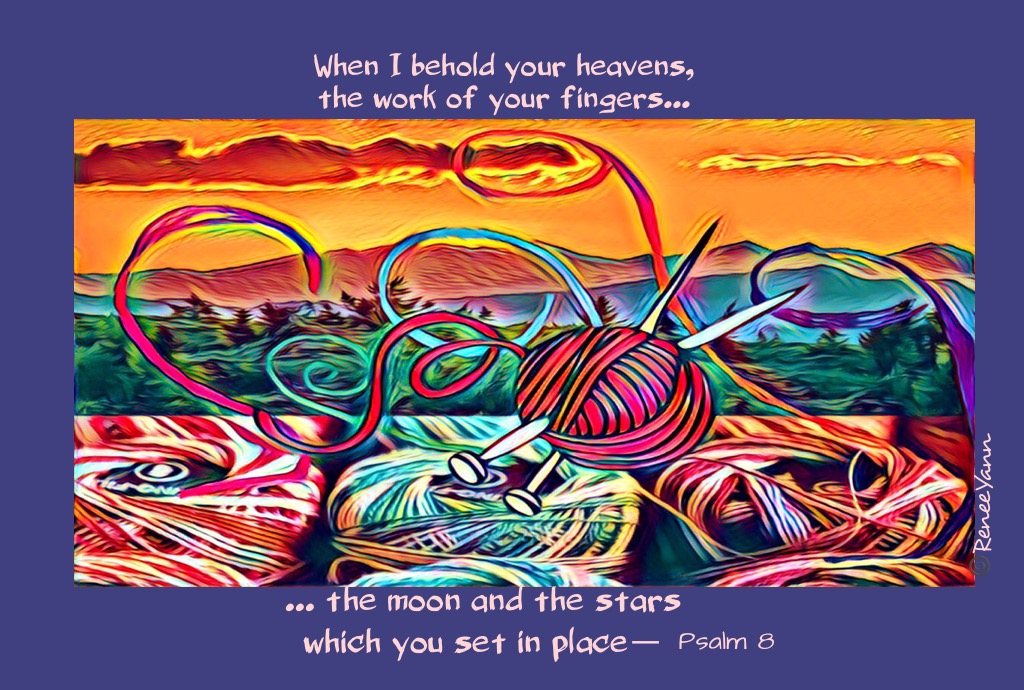
I have always thought of these verses as the “Psalm of the Knitting God” who weaves the cloth of Creation to clothe us:

When I behold your heavens, the work of your fingers,
    the moon and the stars which you set in place—
What are we that you should be mindful of us ,
    or that you should care for us?

Psalm 8:4

As beautiful as its images are, Psalm 8 contains a challenging verse which some, over time, have interpreted to support human domination of all creation:

You have made humans little less than the angels,
    and crowned them with glory and honor.
You have given them rule over the works of your hands,
    putting all things under their feet.

Psalm 8:6-7

Elephant Trophy Hunting

The verse has been manipulated to justify an attitude of supremacy rather than unity and cooperation with nature. That misinterpretation supports such activities as uncontrolled extraction mining, land seizure, trophy hunting and many other forms of natural exploitation.

More recent theology has helped to understand our role in Creation in a humbler, truer light, as stated in the introduction to Laudato Sí:


LAUDATO SI’, mi’ Signore” – “Praise be to you, my Lord”. In the words of this beautiful canticle, Saint Francis of Assisi reminds us that our common home is like a sister with whom we share our life and a beautiful mother who opens her arms to embrace us. “Praise be to you, my Lord, through our Sister, Mother Earth, who sustains and governs us, and who produces various fruit with coloured flowers and herbs”.

This sister now cries out to us because of the harm we have inflicted on her by our irresponsible use and abuse of the goods with which God has endowed her. We have come to see ourselves as her lords and masters, entitled to plunder her at will. The violence present in our hearts, wounded by sin, is also reflected in the symptoms of sickness evident in the soil, in the water, in the air and in all forms of life. This is why the earth herself, burdened and laid waste, is among the most abandoned and maltreated of our poor; she “groans in travail” (Rom 8:22). We have forgotten that we ourselves are dust of the earth (cf. Gen 2:7); our very bodies are made up of her elements, we breathe her air and we receive life and refreshment from her waters.


To prepare for prayer this morning, I reflected on “The Way of Beauty”, Stations of the Cross composed by Gilbert Choondal, SDB, a Salesian Priest of Don Bosco. He holds a PhD in Catechetics and Youth Ministry from the Salesian Pontifical University, Rome. Presently he is the president of the Indian Catechetical Association.
You may find these prayerful reflections helpful, especially as we approach the season of Lent. (You may have to double-click the picture of the Good Shepherd to make the document come up.)


Poetry: Hovering – Joseph Stroud

(for Tom Marshall)
Tom and I are walking Last Chance Road
down from the mountain where we had been
hunting mushrooms under a stand of coast oaks,
walking down and looking out to the Pacific
shimmering in the late fall sun, the light
on the surface like glittering flakes of mica,
when we see a white-tailed kite hovering
in the air, hovering over a green pasture,
hovering over the day, over the two of us,
our very lives hovering as well, there
on the California coast, in the fall, in the sun,
on our way home, with a sack of chanterelles,
with our love for this world, with so much time,
and so little time—all of it—hovering—
and hovering still.


Music: Take Care of the Planet – a delightful reminder from Australia🤗

Psalm 104: Beautiful Creator

Monday of the Fifth Week in Ordinary Time

Monday, February 8, 2021


Today, in God’s Lavish Mercy, we pray with Psalm 104, a lyrical hymn of praise for the wonders of Creation. As I write this morning, an ermine snow coats the evergreens in soft white feathers. There is a quiet whisper in the trees, like God might make while sleeping

To prepare for prayer, I turn to my favorite theologian who writes extensively about Psalm 104 in his book, From Whom No Secrets Are Hid: Introducing the Psalms.

I have outlined my reading here for those who might like to approach Psalm 104 from Brueggemann’s perspective. If you benefit from his work, I highly recommend his book:

From Walter Brueggemann:

Psalm 104 divides roughly into two parts. The first part (vv. 1–24) provides an inventory of the components of creation, framed by a doxological formula. I suggest that inventory framed by doxology (praise prayer) is a good way to begin our thinking about creation.


In the second half of the poem, verses 25–35, we are offered four themes that may serve as reference points as we trace the paradigmatic power and significance of creation:

  1. Creation and Chaos
    These verses attest to the reliable, generative ordering of creation that makes use of all available creaturely possibilities.

There is the sea, great and wide!
It teems with countless beings,
living things both large and small.
There ships ply their course
and Leviathan,* whom you formed to play with.

Psalm 104: 25-26
  1. Creation and Provision

The creator “gives, gives, opens”; the creatures “gather, receive, eat,” and “are filled.” This transaction between the giver and the recipients is endless, reliable, and necessary. The creatures are always on the receiving end of the generous giving of the creator.

These all look to you to give them their food in due season;
when you give it to them, they gather it up;
when you open your hand,
they are filled with good things.

Psalm 104: 27-28
  1. Creation and Ruach

“Rauch” is a Hebrew word which images God as a breath, a wind, or a life force that sustains all living things, human beings included. in Psalm 104, “rauch” describes God’s generous, life-initiating, life-sustaining gift of vitality without which no creature can live:

When you hide your face, they panic.
Take away their breath, they perish
and return to the dust.
Send forth your spirit, they are created
and you renew the face of the earth.

Psalm 104: 29-30
  1. Creation and Righteous Judgement 

Righteousness is glad acceptance of the good ordering of reality given and guaranteed by the creator, an ordering that culminates in confident Sabbath from all our destructive drives for self-worth.

May sinners vanish from the earth,
and the wicked be no more.
Bless the LORD, my soul! Hallelujah!

Psalm 104: 35

My humble prayer, wrought in light of Brueggemann’s elegant theology is this:

I praise and thank You, God, for the wonder of Creation.
I am in awe of your Power to order all things toward Beauty.
From that balance of beauty and power,
you offer me the joys and challenges of life.
You sustain and nourish me, even in the overwhelming times.
I want to respond fully and gratefully
to your creative power in my life and in our world.
Please give me clarity and courage
to live within your life-giving creative Grace.

Amen


Poetry: The Creation by James Weldon Johnson (1871-1938)


And God stepped out on space,
And he looked around and said:
I’m lonely—
I’ll make me a world.

And far as the eye of God could see
Darkness covered everything,
Blacker than a hundred midnights
Down in a cypress swamp.

Then God smiled,
And the light broke,
And the darkness rolled up on one side,
And the light stood shining on the other,
And God said: That’s good!

Then God reached out and took the light in his hands,
And God rolled the light around in his hands
Until he made the sun;
And he set that sun a-blazing in the heavens.
And the light that was left from making the sun
God gathered it up in a shining ball
And flung it against the darkness,
Spangling the night with the moon and stars.
Then down between
The darkness and the light
He hurled the world;
And God said: That’s good!

Then God himself stepped down—

And the sun was on his right hand,
And the moon was on his left;
The stars were clustered about his head,
And the earth was under his feet.
And God walked, and where he trod
His footsteps hollowed the valleys out
And bulged the mountains up.

Then he stopped and looked and saw
That the earth was hot and barren.
So God stepped over to the edge of the world
And he spat out the seven seas—
He batted his eyes, and the lightnings flashed—
He clapped his hands, and the thunders rolled—
And the waters above the earth came down,
The cooling waters came down.

Then the green grass sprouted,
And the little red flowers blossomed,
The pine tree pointed his finger to the sky,
And the oak spread out his arms,
The lakes cuddled down in the hollows of the ground,
And the rivers ran down to the sea;
And God smiled again,
And the rainbow appeared,
And curled itself around his shoulder.

Then God raised his arm and he waved his hand
Over the sea and over the land,
And he said: Bring forth! Bring forth!
And quicker than God could drop his hand,
Fishes and fowls
And beasts and birds
Swam the rivers and the seas,
Roamed the forests and the woods,
And split the air with their wings.
And God said: That’s good!

Then God walked around,
And God looked around
On all that he had made.
He looked at his sun,
And he looked at his moon,
And he looked at his little stars;
He looked on his world
With all its living things,
And God said: I’m lonely still.

Then God sat down—
On the side of a hill where he could think;
By a deep, wide river he sat down;
With his head in his hands,
God thought and thought,
Till he thought: I’ll make me a man!

Up from the bed of the river
God scooped the clay;
And by the bank of the river
He kneeled him down;
And there the great God Almighty
Who lit the sun and fixed it in the sky,
Who flung the stars to the most far corner of the night,
Who rounded the earth in the middle of his hand;
This great God,
Like a mammy bending over her baby,
Kneeled down in the dust
Toiling over a lump of clay
Till he shaped it in is his own image;

Then into it he blew the breath of life,
And man became a living soul.
Amen. Amen.

Music: Creation Song – Fernando Ortega

Psalm 147: Brokenhearted?

Fifth Sunday in Ordinary Time

Sunday, February 7, 2021


Today, in God’s Lavish Mercy, we pray with Psalm 147 which invites us to:

Praise the LORD, for he is good;
    sing praise to our God, Who is gracious;
    Whom it is fitting to praise.

It is a psalm for the left-brained who, like Job in our first reading, might need some explanation about just why we should praise when life seems so unpraiseworthy at times!

Job spoke, saying:
Is not man’s life on earth a drudgery?
    Are not his days those of hirelings?
He is a slave who longs for the shade,
    a hireling who waits for his wages.
So I have been assigned months of misery,
    and troubled nights have been allotted to me.

Job 7: 1-4

Job, like many of us when we suffer, feels crushed under life’s burdens. However, an extended reading of the Book of Job reveals that humility and repentance allow Job to “see God”, and to rediscover the richness and flavor of his life.

Calling us to the same kind of awareness, Psalm 147 presents a series of reasons for praising God, including God’s continual attention to the city of Jerusalem, to brokenhearted and injured individuals, to the cosmos, and to nature.

For me, the most moving of these reasons comes in verse 3:

The Lord heals the brokenhearted
    and binds up their wounds.
The Lord tells the number of the stars;
    calling each by name.


This is a beautiful picture of our infinitely compassionate God who is able to recognize our broken-heartedness. 

This loving God, who knows the stars by name, knows us as well. We, like Job, begin to heal within the divine lullaby God patiently sings over our broken hearts.

Jesus is that Healing Song, the Word hummed over the world by the merciful Creator. In today’s Gospel, we see that Melody poured out over the suffering:

When it was evening, after sunset,
they brought to him all who were ill or possessed by demons.
The whole town was gathered at the door.
He cured many who were sick with various diseases,
and he drove out many demons,
not permitting them to speak because they knew him.

Mark 1: 32-34

As we pray today,

let us hear God’s song of mercy
being sung over all Creation.
Let us rest our own brokenness
there in its compassionate chords.
Let us bring the world’s pain to our prayer.

Poetry: A Cure Of Souls by Denise Levertov

The pastor
of grief and dreams
guides his flock towards
the next field
with all his care.
He has heard
the bell tolling
but the sheep
are hungry and need
the grass, today and
every day. Beautiful
his patience, his long
shadow, the rippling
sound of the flocks moving
along the valley.

Music: God Heals My Broken Heart – Patty Felker

If Job were singing his sadness today, it might sound like this song.

Psalm 23: Ever Comforting

Memorial of Saint Paul Miki and Companions, Martyrs

Saturday, February 6, 2021


Today, in God’s Lavish Mercy, we pray with Psalm 23, that lovingly familiar song which, over the ages, has comforted so many.

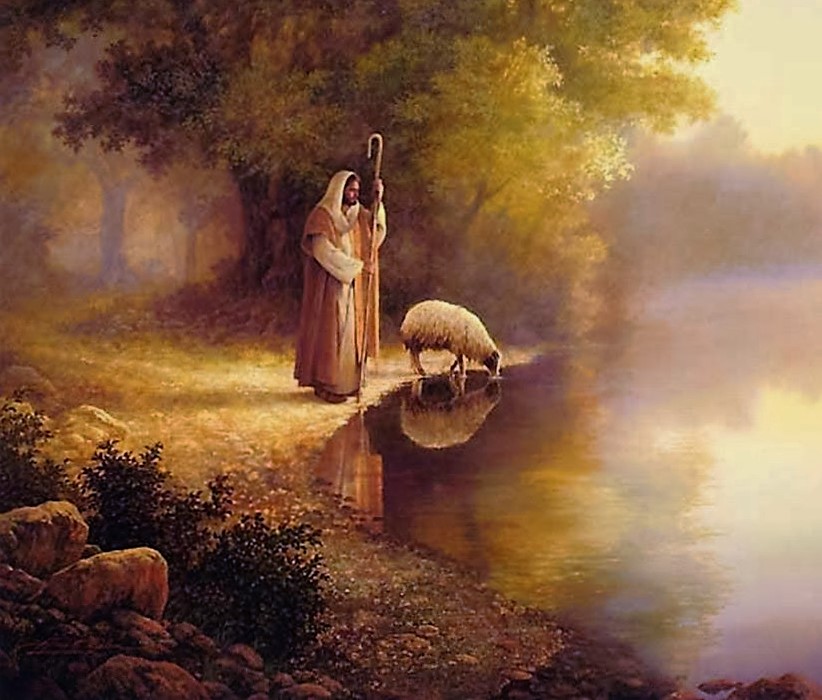
Beside Still Waters by Greg Olsen

We may wish to simply pray this psalm gently and slowly, remembering the many times it has comforted us.

(Below is the inclusive language translation from the Inclusive Language Liturgical Psalter of the Canadian Anglican Synod. Other inclusion collections include Evangelical Lutheran Worship, the Psalter for the Christian People, The Saint Helena Psalter and the Canadian publication, Songs for the Holy One.)

Psalm 23 (Dominus regit me)
The Lord is my shepherd; I shall not be in want.
You make me lie down in green pastures 
and lead me beside still waters.
You revive my soul 
and guide me along right pathways 
for your name’s sake.
Though I walk through the valley of the shadow of death, 
I shall fear no evil;
for you are with me;
your rod and your staff, they comfort me.
You spread a table before me
in the presence of those who trouble me;
you have anointed my head with oil, 
and my cup is running over.
Surely goodness and mercy shall follow me 
all the days of my life, 
and I will dwell in the house of the Lord for ever.


Music: Shepherd Me, O God – Marty Haugen

Psalm 27: Unchained Psalmody

Memorial of Saint Agatha, Virgin and Martyr

February 5, 2021


Today, in God’s Lavish Mercy, we pray with Psalm 27, a song of intimate relationship with God. The psalmist is suffused with God’s Presence in the way morning light permeates the shadows.

The LORD is my light and my salvation;
    whom should I fear?
The LORD is my life’s refuge;
    of whom should I be afraid? 

Psalm 27:1

Because of this deeply abiding Love,  the psalmist fears nothing – not armies, nor any other threat to peace and grace-filled confidence.

Though an army encamp against me,
    my heart will not fear;
Though war be waged upon me,
    even then will I trust.

Psalm 27:3

We have little, or maybe big, wars at times, don’t we? Armies of pain, or sadness, struggle or confusion standing at the border of our hearts? In such times, Psalm 27 invites to remember and trust:

For God will hide me in the holy abode
    in the day of trouble;
will conceal me in the shelter of God’s tent,
    will set me high upon a rock.

With the psalmist, we pray with longing – we implore God to show us this comforting, protective love.

Your presence, O LORD, I seek.
Hide not your face from me;
    do not in anger repel your servant.
You are my helper: cast me not off.


Poetry: from The Spiritual Canticle – John of the Cross

Oh, then, soul, 
most beautiful among all creatures, 
so anxious to know 
the dwelling place of your Beloved 
so you may go in search of him 
and be united with him, 
now we are telling you that 
you yourself are his dwelling 
and his secret inner room and hiding place. 
There is reason for you to be elated 
and joyful in seeing that all your good and hope 
is so close as to be within you, 
or better, that you cannot be without him. 
Behold, exclaims the Bridegroom, 
the kingdom of God is within you.

Music: Unchained Melody – sung by Susan Boyle

Psalm 27 reminds me of this modern classic which, no doubt, was written about a different kind of love. But listening to the song as a prayer, a holy longing can be unchained in our spirits.

Mercy Associates Retreat – Session Four

Springtime – Dawn – Morning

Theme: Delivered to Life


1. Introduction: Spring – Morning

Please click the arrowhead in the center of the video to hear the Introduction

2. A Spring Time Story

Spend a little time now reflecting on,
or re-listening to the story.
Does it awaken any spiritual thought
or prayer in your heart?

3. Sister Kate on Springtime and Dawn

4. Praying with Scripture

For our scripture reading this session, we return to John 10 and the familiar story of the Woman at the Well. The story is fill with symbols of new life – the well and its cool water; the request for a refreshing drink; the sharing of life stories; the telling of truth, and the gift of forgiveness.

In this passage, we see the many moods of Jesus: he is at times in the story needy, a bit sarcastic, feisty, wise, and gentle. Engaging the woman through these many moods, he brings her to new life.

How is God bringing the spring time of new life to our spirits?

5. Reflection Nuggets: Dawn – Spring

6. Poetry:

Hope – Lisel Mueller
It hovers in dark corners
before the lights are turned on,
it shakes sleep from its eyes
and drops from mushroom gills,
it explodes in the starry heads
of dandelions turned sages,
it sticks to the wings of green angels
that sail from the tops of maples.
It sprouts in each occluded eye
of the many-eyed potato,
it lives in each earthworm segmentsurviving cruelty,
it is the motion that runs
from the eyes to the tail of a dog,
it is the mouth that inflates the lungs
of the child that has just been born.
It is the singular gift
we cannot destroy in ourselves,
the argument that refutes death,
the genius that invents the future,
all we know of God.
It is the serum which makes us swear
not to betray one another;
it is in this poem, trying to speak.

Spring – Mary Oliver

Somewhere
a black bear
has just risen from sleep
and is staring

down the mountain.
All night
in the brisk and shallow restlessness
of early spring

I think of her,
her four black fists
flicking the gravel,
her tongue

like a red fire
touching the grass,
the cold water.

There is only one question:

how to love this world.
I think of her 
rising
like a black and leafy ledge

to sharpen her claws against 
the silence
of the trees.
Whatever else

my life is
with its poems
and its music
and its cities,

it is also this dazzling darkness
coming 
down the mountain,
breathing and tasting;

all day I think of her –
her white teeth,
her wordlessness, 
her perfect love.

Closing Music: Thank God for the Promise of Spring

Can’t beat a little “country” to put the final ribbon on our retreat! 🙂

Thank God for the Promise of Spring
The sky seems gray above me
And I can’t see the light of day
There’s a ray breaking through the shadows
And the smile can’t be far away
Thank God for the promise of springtime
Once again my heart will sing
There’s a brand new day a-dawning
Thank God for the promise of spring
Though the earth looks bleak and barren
And the seeds lay brown and dead
But the promise of life grows within them
And I know spring is just ahead
Thank God for the promise of springtime
Once again my heart will sing
There’s a brand new day a-dawning
Thank God for the promise of spring

Virtue/Gift to pray for: Joy

Dear God,
We pray for the gift of joy
in the promise of ever-renewing grace.  
Refresh our spirits with your warm gifts
of peace, hope, enthusiasm, and delight.
Give us springtime hearts.
No matter the season,
may our souls be rooted in Easter,
blossoming with love for You
and for all Creation.
We ask this in Mercy. Amen.

Mercy Associates Retreat – Session Three

Winter Time – Night

Theme: Union with God


1. Introduction: Winter – Night

Please click the arrowhead in the center of the video to hear the Introduction.


2. A Winter Story

Spend a little time now reflecting on,
or re-listening to the story.
Does it awaken any spiritual thought
or prayer in your heart?

3. Sister Kate’s Thoughts on Night and Winter

4. Praying with Scripture

In our Gospel passage today, we join Jesus at the Temple in Jerusalem.  It is winter, and he is “walking about” in the open area.  Perhaps there is a small fire where he and others might warm themselves. What’s on Jesus’s mind as he paces this sacred ground? 

We know , from reading the Gospels, that it is also the “winter” of his life, the time when the Father is gathering all to completion. 

In this reading, we see that some hearts remain cold to his life-giving Word. It is painful for Jesus to realize this. But despite this heartache, remains ever confident in the Father’s love.

For this session, focus on John 10:22-30 – The Feast of the Dedication

Take some quiet time to reflect on this passage.
Allow yourself to be in the scene beside Jesus.

5. Reflection Nuggets: Winter – Night


6. Poetry

Please enjoy these beautiful poems evoking the sentiments of winter, stillness, patience, deepening. You may want listen to this lovely music as you read the poems.

These Things – Renee Yann, RSM
You must tell yourself
these things will happen
before they happen:
the deep winter you will spend,
essentially, alone:
The falling into love
that will not catch you;
the death that rends you
into half of what you were:
the triumph, finally claimed,
bereft of meaning.
 
Otherwise,
when these things happen,
as they will,
you will be swallowed by them
as if you had not ever been
outside these things,
the way an ocean swallows
hail inside the storm.
 
You will be nearly cleaved:  
a raw, green peach 
whose freestone falls away in frost,
because these things are separating,
colder than the loneliness
of ice blue space,
and you are farther from yourself
within them than it is safe to ever be.
 
There is no climbing back
from these things.
You will bring their distance with you.
In the thinnest, splintered space
that separates the stone from peach flesh,
cold universes can insert themselves.
  
Instead, enter these things,
down the long cold slope inside them.
Inside even inverse passion,
there is cobalt fire,
though it masquerades in ice.
~ Renee Yann, RSM
 
Winter: Tonight: Sunset – David Budbill
Tonight at sunset walking on the snowy road,
my shoes crunching on the frozen gravel, first
 
through the woods, then out into the open fields
past a couple of trailers and some pickup trucks, I stop
 
and look at the sky. Suddenly: orange, red, pink, blue,
green, purple, yellow, gray, all at once and everywhere.

Closing Music: Seasons by Ben Tan

Virtue/Gift to pray for: Fidelity

Dear God,

We pray for the gift of fidelity. 
 Let us bravely live our winter times.
Give us a great trust in your Presence,
even in the dark moments of our lives.
Beyond that, let us find the soul-secrets
only darkness can reveal
– that You are ever faithful to us,
that in sorrow, loss and seeming emptiness,
still You and I are one.
We ask this in Mercy. Amen