No More War… Never Again

February 19, 2022
Saturday of the Sixth Week in Ordinary Time

Today, in God’s Lavish Mercy, I pause in my scriptural reflections to ask all of you to join in prayer for peace in Ukraine. As I typed today’s date, it hit me that we can’t just watch the evolution of this crisis on the news, as if it were a movie that isn’t really happening. We have a responsibility to be active peacemakers in our volatile world, and to foster a resolution that honors all human life.


I’ll tell you why Saturday’s date struck my heart so forcibly.

February 19, 1945

I was not even alive yet. I was kicking around inside my Mom and waiting to be born exactly two months later. There was joyful expectation in my family that afternoon, as you can imagine. What they did not expect was that at that very moment, my mother’s nineteen year old brother had bled to death on the shores of Iwo Jima.

When the word finally reached my family, Jimmy had already been buried at sea. The coordinates are noted in the WWII War Logs: 21°N latitude; 111° E longitude. That’s where he is buried, somewhere in the middle of the Philippine Sea. It feels so very lonely when you look at it on a map.

His death, his slaughter, wounded my mother so deeply that it reached into my incipient spirit. I never knew him, but have never forgotten, my Uncle Jim. Some of you will understand how that can be.

No young man or woman should be left alone forever at the bottom of the sea, or in an mountain gorge, or under the flaming sand. No human being should suffer and die because of war, because of the bloated egos and stunted imaginations of undraftable world leaders who pretend it is the means to peace.

It may seem that we can do little to prevent these travesties, but that’s not true. We can vote; we can lobby; we can advocate for international justice and equity that ameliorate the catalysts to war: poverty, hunger, and political and economic domination.

And we can pray.

We have the power through prayer and political action to fuel the demand for peaceful and diplomatic relationships in our world. These powerful interventions can confront our unexamined militarism and transform it.


Pope Francis has said:

“The news coming out of Ukraine is very worrying. I entrust to the intercession of the Virgin Mary, and to the conscience of political leaders, every effort on behalf of peace. Let us pray in silence.”

Mother of Sorrows – Batolome Murillo

But the responsibility belongs to us as well. Will you join me on this Saturday of the Blessed Virgin Mary to ask her powerful intercession in this outrageous situation in Ukraine?

The following prayer was very meaningful to me and you may want to pray with it:

It’s Not Easy

February 18, 2022
Friday of the Sixth Week in Ordinary Time

Today, in God’s Lavish Mercy, James actually made me chuckle out loud! In today’s celebrated passage about faith and works, James – ever direct and uncompromising – really takes it home. Get this verse:

Do you want proof, you ignoramus,
that faith without works is useless?

James 2:20

OK, James! Tell us what you really think!😂

Well, here’s what he really thinks:

For just as a body without a spirit is dead,
so also faith without works is dead.

James 2:26

In our Gospel, Jesus says that living a life of good works is hard. He did it through the Cross and says we must follow his example:

Whoever wishes to come after me must deny himself,
take up his cross, and follow me.
For whoever wishes to save his life will lose it,
but whoever loses his life for my sake
and that of the Gospel will save it.

Mark 8:34-35

The Gospel Jesus is talking about, and the “works” James refers to,  are summarized like this:

Corporal Works of Mercy

feed the hungry.
give water to the thirsty.
clothe the naked.
shelter the homeless.
visit the sick.
visit the imprisoned, ransom the captive.
bury the dead.

Spiritual Works of Mercy

instruct the ignorant.
counsel the doubtful.
admonish the sinners.
bear patiently those who wrong us.
forgive offenses.
comfort the afflicted.
pray for the living and the dead.


If we live by these admonitions,
we will find the Cross
– but we will also surely find the Crown.


Poetry: Listen to RS Thomas read his own poem about the struggle to live a Christian life:


Music: Lose My Soul – TobyMac, a multi-award winning Christian hip-hop singer.

Living the Cross

February 17, 2022
Thursday of the Sixth Week in Ordinary Time

Today, in God’s Lavish Mercy, two disciples of Jesus are our teachers. James advises us on what to do. Beloved Peter, as so often is the case, shows us what not to do.

James tells us to show no partiality. He makes clear that he is talking about impartiality toward those who are materially poor. It’s a maxim that Jesus gave us time and again in the Gospel.

James reminds us that Jesus is not just impartial toward those who are poor, he actually has a preferential love for them. So Jesus was partial to the poor, right? Hmm!

Yes, I think that’s right. In order to balance our human inclination to the richest, best, strongest, etc., Jesus teaches us to go all out in the other direction.

It’s like this great cartoon that popped up on Facebook a while ago:


Our Gospel picks up the theme.

Because of his great love for the poor and his passion for mercy, Jesus tells his followers that suffering is coming. Peter doesn’t like hearing that. Can you see Peter take Jesus aside and say, “Listen, Jesus, negative talk is going to hurt your campaign. You’re God! You can just zap suffering out of your life!”


Jesus responds to Peter definitively: “Get thee behind me, Satan!”

James Tissot: Get Thee Behind me, Satan

Wow! That must have stung! But that’s how important it was to Jesus that his followers understood his mission: to preach Mercy to the poor, sick, and broken by sharing and transforming their experience.

Jesus wants us to understand that too.


Prose: from St. Oscar Romero

It is no honor for the Church 
to be on good terms with the powerful.
The honor of the Church consists in this,
that the poor feel at home in her,
that she fulfils her mission on earth,
that she challenges everyone,
the rich as well,
to repent and work out their salvation,
but starting from the world of the poor,
for they, they alone are the ones who are blessed.

Music: Beauty for Brokenness – Graham Kendrick

Seeing Clearly

February 16, 2022
Wednesday of the Sixth Week in Ordinary Time

Today, in God’s Lavish Mercy, our readings are around the theme of our spiritual senses.

James tells us to listen, look, see, and act on the Word planted within our hearts. Once again, he gives us great images to help our understanding.

For if anyone is a hearer of the word and not a doer,
he is like a man who looks at his own face in a mirror.
He sees himself, then goes off and promptly forgets
what he looked like.

James 1:3-24

If anyone thinks he is religious
and does not bridle his tongue
but deceives his heart, his religion is vain.

James 1: 26

In our Gospel, once again our dear, earthy Jesus heals someone in a deeply human way. Jesus takes the blind man aside, holding his hand to lead him. As he did in a passage recently, Jesus spits on his fingers and massages the blind man’s eyes.

The man tries to work with Jesus, exclaiming that he sees “people like trees walking”.

I’ve always loved that line because it makes me feel like I’m right there, in that little dusty village of Bethsaida, listening like the rest of the stunned crowd to the man’s amazement!


As we pray this morning, we might wonder what Jesus said back to that overwhelmed man as they sat together, helping him to learn how to see. What might Jesus say to us as he lifts one of our many blindnesses from our hearts?


Prose: from Pilgrim at Tinker Creek by Annie Dillard

(This passage is from one of my all-time favorite books written by Annie Dillard whom I think of as the “Mary Oliver” of prose. Here’s the way wikipedia describes the book:)

Pilgrim at Tinker Creek is a 1974 nonfiction narrative book by American author Annie Dillard. Told from a first-person point of view, the book details an unnamed narrator's explorations near her home, and various contemplations on nature and life. The title refers to Tinker Creek, which is outside Roanoke in Virginia's Blue Ridge Mountains. Dillard began writing Pilgrim in the spring of 1973, using her personal journals as inspiration. Separated into four sections that signify each of the seasons, the narrative takes place over the period of one year.
The book records the narrator's thoughts on solitude, writing, and religion, as well as scientific observations on the flora and fauna she encounters. Touching upon themes of faith, nature, and awareness, Pilgrim is also noted for its study of theodicy and the inherent cruelty of the natural world. The author has described it as a "book of theology", and she rejects the label of nature writer.

I think this is a great book to pick up at the beginning of any season of nature or life. The excerpt I chose for today, in honor of the Gospel, is from a chapter entitled ” Seeing”:

A fog that won’t burn away drifts and flows across my field of vision. When you see fog move against a backdrop of deep pines, you don’t see the fog itself, but streaks of clearness floating across the air in dark shreds. So I see only tatters of clearness through a pervading obscurity. I can’t distinguish the fog from the overcast sky; I can’t be sure if the light is direct or reflected. Everywhere darkness and the presence of the unseen appalls. We estimate now that only one atom dances alone in every cubic meter of intergalactic space. I blink and squint. What planet or power yanks Halley’s Comet out of orbit? We haven’t seen that force yet; it’s a question of distance, density, and the pallor of reflected light. We rock, cradled in the swaddling band of darkness. Even the simple darkness of night whispers suggestions to the mind.

The secret of seeing is, then, the pearl of great price. If I thought he could teach me to find it and keep it forever I would stagger barefoot across and hundred deserts after any lunatic at all. But although the pearl may be found, it may not be sought. The literature of illumination reveals this above all: although it comes to those who wait for it, it is always, even to the most practiced and adept, a gift and a total surprise. I return from one walk knowing where the killdeer nests in the field by the creek and the hour the laurel blooms. I return from the same walk a day later scarcely knowing my own name. Litanies hum in my ears; my tongue flaps in my mouth Ailinon, alleluia! I cannot cause light; the most I can do is try to put myself in the path of its beam. It is possible, in deep space, to sail on solar wind. Light, be it particle or wave, has force: you rig a giant sail and go. The secret of seeing is to sail on solar wind. Hone and spread your spirit till you yourself are a sail, whetted, translucent, broadside to the merest puff.

Music: I Can See Clearly Now – Jimmy Cliff

The Greatest Sin

February 15, 2022
Tuesday of the Sixth Week in Ordinary Time

Today, in God’s Lavish Mercy, James continues with his spiritual encouragements.

For one thing, he makes it clear that God doesn’t tempt us. Some of us make the mistake of thinking that, saying things like, “God is testing me.”

James, outlining a perfect way to examine one’s conscience, says this:

No one experiencing temptation should say,
“I am being tempted by God”;
for God is not subject to temptation to evil,
and God himself tempts no one.
Rather, each person is tempted when lured and enticed by his own desire.
Then desire conceives and brings forth sin,
and when sin reaches maturity it gives birth to death.

James 1:13-15

Sin is an uncomfortable topic, and it’s an elusive one. Most of us aren’t outright blatant sinners. I think most of our sins are quiet indifferences, failures to love, unacknowledged greeds, self-imposed blindnesses to our responsibilities toward one another. These generate excuses that allow us to gossip, judge, blame, ignore, hurt and even use others both in our immediate world and in the larger global community.

In my experience, these desires are usually disguised, pretending to be beneficial for us at first sight. But underneath, they are rooted in selfishness and excess, diverting us from our center in God.

So if we have some little labyrinths of temptation and sinful habits ensnaring us, we should listen to James. He encourages us to examine and check our own concupiscent desires as they are the seeds of our spiritual undoing.


In the second part of this passage, James takes the tone up a notch. He reminds us that, once centered on God, we realize that only good things come from God.

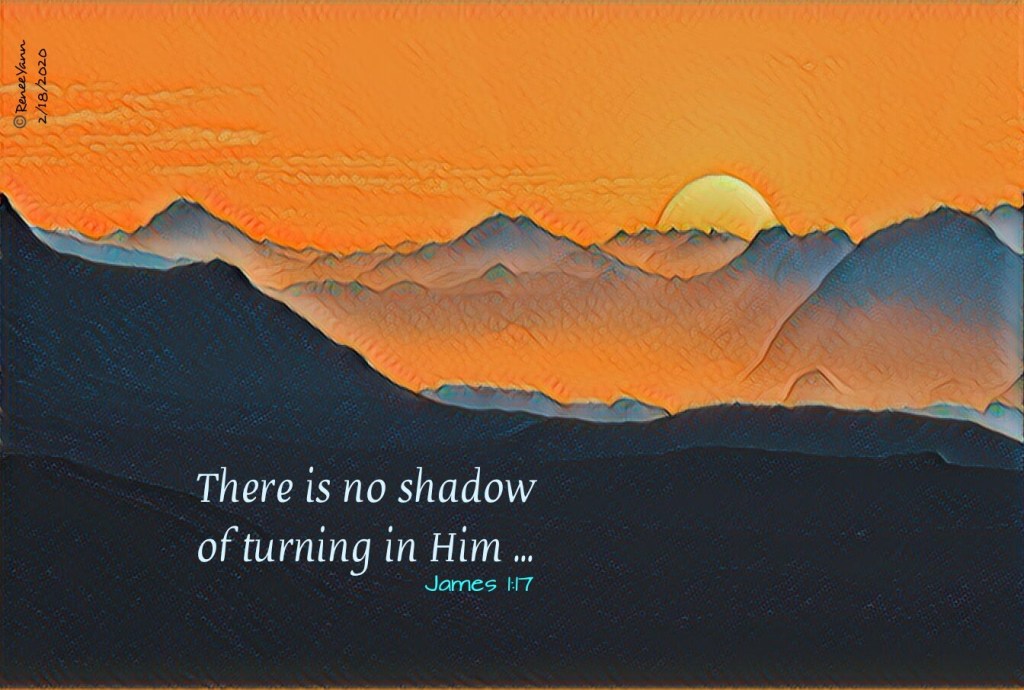
All good giving and every perfect gift is from above,
coming down from the Father of lights,
with whom there is no alteration or shadow caused by change.

James :17

I particularly love that last phrase, rendered in our hymn today like this:

It’s beautiful to see how James, as a real spiritual leader, is so aware of his flock’s human struggles. No doubt, he shares them. What a blessing that his wise and loving guidance has come down through the ages to us!


Prose: from Carl Jung

The worst sin is unconsciousness,
but it is indulged in with the greatest piety
even by those who should serve humankind
as teachers and examples.


Music: Great Is Thy Faithfulness – sung by Chris Rice

Joyful Calculation

February 14, 2022
Monday of the Sixth Week in Ordinary Time

Today, in God’s Lavish Mercy, Lent is just a little over two weeks away. We will spend the intervening time in good company with daily insights from James, Peter and Mark. Today we begin the Epistle of James.

The Epistle of James- Chapter 1: Illustration provided to Wikimedia Commons by Distant Shores Media/Sweet Publishing as part of a cooperation project. Sweet Publishing released these images, which are taken from now-out-of-print Read’n Grow Picture Bible Illustrations (Biblical illustrations by Jim Padgett, courtesy of Sweet Publishing, Ft. Worth, TX, and Gospel Light, Ventura, CA. Copyright 1984.), under new license, CC-BY-SA 3.0

This letter is one of the very earliest of the New Testament. Scholars are mixed about exactly which “James” wrote it, but agree that it was one of several who were very close to Jesus – perhaps one of “the brothers of Jesus” mentioned in several New Testament passages:

  • Matthew 12:46-50
  • Mark 3:31
  • Luke 8:19
  • John 2:12
  • Acts 1:14
  • 1 Corinthians 9:5
  • and specifically “the Lord’s brother James” in Galatians 1:19

James writes in the style of Wisdom Literature, those Old Testament books that give advice, proverbs, and insights for living a holy life. His immediate audience was a community of dispersed Christian Jews whose world was filled with increasing upheaval and persecution.


When I read the following description I thought how germane James’s letter could be for our world today. His themes echo the teachings of Pope Francis for our chaotic time:

The epistle is renowned for exhortions on fighting poverty and caring for the poor in practical ways (1:26–27; 2:1-4; 2:14-19; 5:1-6), standing up for the oppressed (2:1-4; 5:1-6) and not being “like the world” in the way one responds to evil in the world (1:26-27; 2:11; 3:13-18; 4:1-10). Worldly wisdom is rejected and people are exhorted to embrace heavenly wisdom, which includes peacemaking and pursuing righteousness and justice (3:13-18).

Jim Reiher, “Violent Language – a clue to the Historical Occasion of James.”Evangelical Quarterly. Vol. LXXXV No. 3. July 2013

Here is the golden advice James gives us today:

  • Be joyful in trials.
  • Let trials increase your perseverance not discourage you.
  • Doing this is a sign of wisdom.
  • When your wisdom is depleted, ask God for more with an open and trusting heart.
  • Honor all people, high or low in circumstances
  • Don’t be fooled by riches. They fade away.

In our Gospel, Jesus is frustrated with the Pharisees who insincerely demand a magical sign from him. They demonstrate none of the spiritual wisdom and openness to grace that James describes.

When we think about our own faith, where does it fall on the scale of sincerity, on the spectrum joy, justice, and faithful perseverance?


Poetry: On Joy and Sorrow – Kahlil Gibran

Then a woman said, Speak to us of Joy and Sorrow.
And he answered:
Your joy is your sorrow unmasked.
And the selfsame well from which your laughter rises 
was oftentimes filled with your tears.
And how else can it be?
The deeper that sorrow carves into your being, 
the more joy you can contain.
Is not the cup that holds your wine 
the very cup that was burned in the potter’s oven?
And is not the lute that soothes your spirit, 
the very wood that was hollowed with knives?
When you are joyous, look deep into your heart 
and you shall find it is only that which has given you sorrow 
that is giving you joy.
When you are sorrowful look again in your heart, 
and you shall see that in truth you are weeping for 
that which has been your delight.
Some of you say, “Joy is greater than sorrow,” 
and others say, “Nay, sorrow is the greater.”
But I say unto you, they are inseparable.
Together they come, 
and when one sits alone with you at your board, 
remember that the other is asleep upon your bed.
Verily you are suspended like scales 
between your sorrow and your joy.
Only when you are empty 
are you at standstill and balanced.
When the treasure-keeper lifts you 
to weigh his gold and his silver, 
needs must your joy or your sorrow rise or fall.

Music: Count It All Joy

Three Holy Secrets

February 13, 2022
Sixth Sunday in Ordinary Time

Today, in God’s Lavish Mercy, hidden in our readings, are three challenges:

Where do we place our FAITH?
How do we fire our HOPE?
How do we LOVE?


In our Jeremiah reading, an unfortunate person has placed faith in an untrustworthy “friend”, and the results – typical of Jeremiah – are dire. But the prophet goes on to say that the one who puts trust and faith in the Lord will flourish like a tree near running water.

In the reading from Corinthians, Paul has some strong words about hope:

If for this life only we have hoped in Christ,
we are the most pitiable people of all.

1 Corinthians 15:19

That sentence is powerful! It can be a life-long meditation.

In other words, where is our hope focused? Do we hope for comfort, success, healing, peace only for this earthly life? If so, we are missing the point, Paul says. Our one true hope is to be united with God in eternal life and our choices should lead to that fulfillment.


In our Gospel, Jesus shows us how to love by placing before us the “least ones” whom he loves best. We too are to love and comfort those who are poor, hungry, bereaved and despised by the heartless.


Today’s readings invite us to look at our life. Is it blossoming with joy, grace and spiritual vitality? Or are we struggling with all the doubts, worries, dramas and depression that come from a self-absorbed life?

Maybe, like me, you sometimes look at a person carrying great difficulty in their lives and wonder at their joy. How can they maintain that trust and joy in the midst of their challenges? These readings offer an answer. They have put their faith and hope in the right place. They have learned to love like God loves.


St. John of the Cross

Poetry: Bernard of Clairvaux, On the Song of Songs, vol. 4, 83.2.4.

I love because I love:
I love that I may love…
Love is the only one of the motions of the soul,
of its senses and affections,
in which the creature can respond to its Creator,
even if not as an equal,
and repay God’s favor in some similar way …


Music: Faith, Hope and Love ~ David Ogden ( Lyrics below)

Faith, hope, and love: let these remain among you.
Faith, hope, and love: the greatest of these is love.

The love of Christ has gathered us together; let us rejoice and be glad in him.
Let us fear and love the living God, and love each other from the depths of the heart.

When we are together, we should not be divided in mind;
Let there be an end to bitterness and quarrels, and in our midst be Christ our God.

In company with the blessed, may we see your face in glory,
pure and unbounded joy for ever and ever.

I give you a new commandment, love one another as I have loved you.
Faith, hope, and love, let these remain among you.
Faith, hope and love; the greatest of these is love.

Giving or Grabbing?

February 12, 2022
Saturday of the Fifth Week in Ordinary Time

Today, in God’s Lavish Mercy, our readings stand in stark contrast to each other.

In our first reading, we meet the two adversarial kings of the now split kingdom of Israel – so cooly named King Rehoboam and King Jeroboam. They were grasping, grabbing and trying to hold on to power over each other’s terrain. Using idols, Jeroboam tried to lure the people away from their covenanted practice of going up to Jerusalem to worship.


Our Gospel demonstrates that Jesus is a very different kind of king. His concern is for the wholeness of his people, not for the increase of his own power and standing.

Jesus summoned the disciples and said,
“My heart is moved with pity for the crowd,
because they have been with me now for three days
and have nothing to eat.
If I send them away hungry to their homes,
they will collapse on the way,
and some of them have come a great distance.”

Matthew 8:1-4

This morning I can’t help thinking that many of us have come a long way with Jesus too. But still we find ourselves in spells of hunger — hungers of all kinds. Jesus sees our true needs, has compassion for, and presence with us in the pangs of any human experience.

He ordered the crowd to sit down on the ground.
Then, taking the seven loaves he gave thanks, broke them,
and gave them to his disciples to distribute,
and they distributed them to the crowd.

Matthew 8: 6

Let’s just sit down with Jesus today as we pray, laying out before him our deepest hungers, worries, regrets, doubts and hopes. Let’s wait for the gift of God’s beautiful and miraculous Bread – broken for each one of us.

Poetry: Gratitude – Henry Van Dyke

“Do you give thanks for this? — or that?”
No, God be thanked
I am not grateful
In that cold, calculating way, with blessing ranked
As one, two, three, and four, — that would be hateful.

I only know that every day brings good above”
My poor deserving;
I only feel that, in the road of Life, true Love
Is leading me along and never swerving.

Whatever gifts and mercies in my lot may fall,
I would not measure
As worth a certain price in praise, or great or small;
But take and use them all with simple pleasure.

For when we gladly eat our daily bread, we bless
The Hand that feeds us;
And when we tread the road of Life in cheerfulness,
Our very heart-beats praise the Love that leads us.

Music: Bread of Life – rory Cooney

I myself and the bread of life.
You and I are the bread life,
Taken and blessed,
Broken and shared by Christ that the world might live.

This bread is spirit, gift of the maker’s love,
And we who share it know we can be one:
A living of God in Christ.

I myself and the bread of life.
You and I are the bread life,
Taken and blessed,
Broken and shared by Christ that the world might live.

Here is God’s kingdom given to us as food.
This is our body, this is our blood:
A living sign of God in Christ.

I myself and the bread of life.
You and I are the bread life,
Taken and blessed,
Broken and shared by Christ that the world might live.

Lives broken open, stories shared aloud,
Become a banquet, a shelter for the world:
A living sign of God in Christ.

I myself am the bread of life.
I myself am the bread of life

Down, Dirty, and Divine!

February 11, 2022
Friday of the Fifth Week in Ordinary Time

Today, in Mercy, our Gospel gives us one my favorite portrayals of Jesus. It’s what I think of as “down in the dirt with us” Jesus. Let me give you some background on the image.

Me and Petey 😉 1955, looking a lot cleaner and official than we really were!

When I was a kid in North Philly, my buddy’s dog was hit by a car. We were playing baseball in a cinder lot (that’s where the railroad dumped its ashes in the old days when trains ran on coal). We were about a half block away when we heard the screeching. We turned and watched the guilty car speed off without a moment’s hesitation.

Petey ran screaming toward his dog, the rest of us cinder-dusty kids streaming behind him. I can still see Petey lie down beside that whimpering mutt who had been tossed into a muddy gully along Philip Street. He cradled the bruised head and whispered to the frightened eyes. Then Petey quietly said, “Get my Dad”, as he stroked Lightening’s heaving back.


As I remember that moment today, Petey reflects the image of the Divine Healer who – muddied and bloodied — has taken a place beside all of us as we suffer. He is unafraid of our mud and cinders. He is touched by our mumblings and tears.

In today’s Gospel, there is stunning humanness. The suffering man doesn’t just ask for a miracle. He asks for a hand to be laid on him, for a touch, for a connection he can feel. And Jesus hears his deep human need.

People brought to Jesus a deaf man who had a speech impediment
who begged him to lay his hand on him.

Mark 7:32
Be Opened – Thomas Davidson (1872)

Some miracles are accomplished by a fleshless, electric word shot through the air. But not this one.

With this lonely, isolated man, feel Jesus caress your head, perhaps finger the ears that have heard so much criticism and frustration. Feel Jesus touch your tongue, twisted sometimes in its attempts to speak your meaning into the world. Receive the surprising gift of Divine spittle that intends to insure, “I am part of you now. You will never be alone again.”

Hear Christ’s groan as he prays for you in sounds that plead, “Get my Dad. ABBA, Father.”

He took him off by himself away from the crowd.
He put his finger into the man’s ears
and, spitting, touched his tongue;
then he looked up to heaven and groaned, and said to him,
“Ephphatha!” (that is, “Be opened!”)

Mark 7:32-34

Hear the definite pronouncement of your liberation
from anything that tongue-ties, heart-ties,
soul-ties your life:
“Ephphatha!” (that is, “Be opened!”)

Poetry: I believe in all that has never been spoken – Rainer Maria Rilke
~ from Rilke’s Book of Hours: Love Poems to God, translated by Anita Barrows and Joanna Macy

I believe in all that has never yet been spoken.
I want to free what waits within me
so that what no one has dared to wish for
may for once spring clearwithout my contriving.
If this is arrogant, God, forgive me,
but this is what I need to say.
May what I do flow from me like a river,
no forcing and no holding back,
the way it is with children.
Then in these swelling and ebbing currents,
these deepening tides moving out, returning,
I will sing you as no one ever has,
streaming through widening channels
into the open sea.

Music: Ephphatha – Fill Me – Carrie Allwine

Things Change; God Doesn’t

February 10, 2022
Thursday of the fifth Week in Ordinary Time
Memorial of Saint Scholastica

Today, in God’s Lavish Mercy, our readings leave me wondering about what makes God tick.

In our first reading, God exacts justice for Solomon’s unfaithfulness, but God does it sort of like a prosecutor in a plea bargain.

I will deprive you of the kingdom … but not during your lifetime
It is your son whom I will deprive … but I won’t take away the whole kingdom.

1 Kings 11:11-13

What’s going on with God in this reading? Well, it’s more like “What’s going on with the writer as s/he tries, retrospectively, to interpret God’s role in Israel’s history?”

The passage is much more than a report on exchanges between God and Solomon.

It is a testament to Israel’s unwavering faith that God is intimately involved in their lives. In every circumstance, the believing community returns to the fact that experience leads to God and not away from Him.

So “Solomon … had TURNED his heart to strange gods”
BUT God had not turned from Solomon.
Nor would God EVER turn because
God has CHOSEN Israel.


In our Gospel, the Syrophoenician woman tries to get the favor of Jesus to turn toward her. And actually, Jesus sounds pretty mean and stingy about it.

Again the writer Mark is portraying, retrospectively, a significant time in Christ’s ministry. Jesus has really gone into hiding in a remote place. Apparently, he wants space to figure some things out. The story indicates that one of those things might be whether or not his ministry should embrace the Gentiles.

The persistence of this woman’s faith is a turning point for Jesus Who evolved, as we all do, in his understanding of his sacred role and meaning in the world.

These passages encourage us to constantly turn toward God Who lives our life with us. Day to day, our lives change and challenge us. But throughout, we must stay centered on our God who does not change. This sacred relationship is essential to our spiritual growth. As we become bigger in heart and soul, so does our concept of God and what God’s hope is for us.


Poetry: All this “turning” brought to mind some favorites lines from T.S. Eliot

At the still point of the turning world. Neither flesh nor fleshless;
Neither from nor towards; at the still point, there the dance is,
But neither arrest nor movement. And do not call it fixity,
Where past and future are gathered. Neither movement from nor towards,
Neither ascent nor decline. Except for the point, the still point,
There would be no dance, and there is only the dance.

from Burnt Norton

Music: Perfect Wisdom of Our God – The Gettys