Today, in God’s Lavish Mercy, Jesus asks his disciples, “Why do questions arise in your heart?”
We might stand beside them with our own prayer:
Honestly, Lord? How could they not have questions arise? You have, after all, just RISEN FROM THE DEAD! We’re not used to that, and we’re not sure how to handle it!
And about that Last Supper, when you said the bread and wine were your Body and Blood? It’s a pretty amazing statement, and we’re still trying to comprehend it.
Besides all that, Lord, just now the whole world is languishing in the midst of violence, war, and disease and we’re not sure exactly where You are!
We’re just human beings, Lord. Our minds naturally work to solve problems. That’s why we have questions – we like answers.
Only now, as Resurrection People, are we beginning to learn that you are much more the “The Answer”.
You will always be “The Mystery” – the Infinity we are invited to – where there is no end, only deeper, always deeper.
Help us to learn that our faith and our doubts are the same thing – they are our attempts to embrace the Question. Help us transform our doubts to faith by our unequivocal trust in your unfolding Mystery.
For God does not want to be believed in, to be debated and defended by us, but simply to be realized through us.” ― Martin Buber
Mystery is not to be construed as a lacuna in our knowledge, as a void to be filled, but rather as a certain plentitude. — Gabriel Marcel
Today, in God’s Lavish Mercy, our passage from Acts describes a sacred practice of the early Church – the invocation of the Name of Jesus as a source of spiritual power.
Peter said, “I have neither silver nor gold, but what I do have I give you: in the name of Jesus Christ the Nazorean, rise and walk.”
These first Christians were so invested in the Gospel of Jesus Christ that they claimed the right to act in his Name. They also clearly believed that they had no power themselves, but only in that blessed Name.
To call someone by their given name is an act of familiarity, if not intimacy. For those closest to us, we often have nicknames or pet names, conveying a unique understanding of each other.
Calling God by name is an act of both intimacy and worship. In the book of Exodus, God takes the first step in that deeper friendship:
God also said to Moses, “I am the Lord. I appeared to Abraham, to Isaac and to Jacob as God Almighty, but by my name “the Lord” I did not make myself fully known to them.
With the Incarnation of Jesus, God took the ultimate step in loving friendship with us. To help us understand the nature of this friendship, Jesus gives himself some “nicknames” throughout the Gospel:
Good Shepherd
Lamb of God
the Vine
the Way, the Truth, the Life
the Bread of Life
the Light of the World
Each of these names helps us to enter more deeply into the infinite love God has for us.
Do you have a special name for God? Sometimes, early in the morning when First Light touches my window, I pray with that Name. I ask my Bright God to light my life and the lives of those I love this day. At night, that same window is full of Sweet Darkness, a Name I call God as I ask that we all find a peaceful, protected sleep.
We might also ask if God has a special name for us. At different moments and moods of your life, does God speak to you with a personal, loving “nickname”? If you haven’t heard it yet, why not ask God to whisper it to you in your next prayer?
Prose Poem: from Rumi
“All night, a man called out “God! God!” Until his lips were bleeding. Then the Adversary of mankind said, “Hey! Mr Gullible! … How come you’ve been calling all night And never once heard God say, “Here, I AM”? You call out so earnestly and, in reply, what? I’ll tell you what. Nothing!”
The man suddenly felt empty and abandoned. Depressed, he threw himself on the ground And fell into a deep sleep. In a dream, he met an angel, who asked, “Why are you regretting calling out to God?”
The man said, “ I called and called But God never replied, “Here I AM.”
The Angel explained, “God has said, “Your calling my name is My reply. Your longing for Me is My message to you. All your attempts to reach Me Are in reality My attempts to reach you. Your fear and love are a noose to catch Me. In the silence surrounding every call of “God” Waits a thousand replies of “Here I AM.”
Music: Jesus the Lord
Jesus, Jesus Let all creation bend the knee to the Lord.
In Him we live, we move and have our being; In Him the Christ, In Him the King! Jesus the Lord.
Though Son, He did not cling to Godliness, But emptied Himself, became a slave! Jesus the Lord.
He lived obediently His Father’s will Accepting His death, death on a cross! Jesus the Lord.
Today, in God’s Lavish Mercy, our readings present us with a picture of the nascent Church as it works toward understanding itself in the physical absence of Jesus.
Throughout the Gospels, we see a Christian community forming around a Leader they can see, hear and touch. Acts reveals how that community awakens to itself when Jesus is no longer materially present.
Acts shows us a Church like us. We have never seen Christ, nor heard him, nor touched him. And yet we believe, or want to believe.
In our reading today, Peter preaches with brutal honesty:
Let the whole house of Israel know for certain that God has made him both Lord and Christ, this Jesus whom you crucified.
Acts 2:26
Peter’s message gets through to the assembly, to the point that, when they hear it, they are “cut to the heart”. This phrase indicates a profound conversion in the way they believed. Peter tells them that their faith, like Jesus’ life, must now become a sign of contradiction to a “corrupt generation “.
What might this powerful passage say to us?
For one thing, the reading calls us to be honest about the sincerity of our faith.
Is it the core of our lives?
Or is it, at best, a Sunday hobby?
Does it pervade our relationships and choices, giving witness to Christ’s commission to love?
Or is it a tool to judge and vilify those who differ from us?
The reading doesn’t demand that we “preach our faith out loud”. It calls us to a much deeper and more courageous witness:
to be Truth in a world of lies
to be Peace in violence
to be Justice in the face of abuse and domination
to be Servant rather than be served
to be Love for those deemed unlovable
in other words, to be like Jesus
And to do it all because we have been “cut to the heart” by the witness of the Cross and Resurrection.
Poetry: attributed to St. Teresa of Ávila
Christ has no body but yours, No hands, no feet on earth but yours, Yours are the eyes with which He looks Compassion on this world, Yours are the feet with which He walks to do good, Yours are the hands, with which He blesses all the world. Yours are the hands, yours are the feet, Yours are the eyes, you are His body. Christ has no body now but yours, No hands, no feet on earth but yours, Yours are the eyes with which he looks compassion on this world. Christ has no body now on earth but yours.
Today, in God’s Lavish Mercy, we enter the Easter Season which will last until June 4th. The next day we will celebrate Pentecost.
Throughout these several weeks, we will have a thorough reading of the Acts of the Apostles.
Theologian Walter Brueggemann says this about Acts:
In the Book of Acts the church is a restless, transformative agent at work for emancipation and well-being in the world.
As Easter People, transformed by the Resurrection of Jesus, that’s what we’re all called to be:
transformative agents at work for emancipation and well-being in the world.
Our models and inspiration will be found in these early women and men we read about over the next few weeks. This was a community fully committed and learning to be disciples. This was a community that acted – within a culture of death – for an alternative, life-giving world.
“The whole book of Acts is about power from God that the world cannot shut down. In scene after scene, there is a hard meeting between the church and worldly authorities, because worldly authorities are regularly baffled by this new power and resentful of it.” At one point, in chapter 17, the followers of Jesus are accused of “turning the world upside down.” (Brueggemann)
Our world sorely needs such an active Church, speaking clearly to the issues that threaten and limit human life and wholeness in God. It’s not easy to be that witness, but it is critical. Our Gospel suggests the difficulty, but also defines the motivation:
Mary Magdalene and the other Mary went away quickly from the tomb, fearful yet overjoyed, and ran to announce the good news …
May we, though sometimes fearful, choose to be agents of the joyful Good News for our times. By our choices, attitudes and actions, may we be brave in witnessing Christ, even in trying circumstances!
Prose: from Deitrich Bonhoeffer
Discipleship never consists in this or that specific action: it is always a decision either for or against Jesus Christ.
Music: Mozart’s Exsultate Jubilate – sung by Regula Mühlemann
Be sure to wait after the applause for the Alleluia segment.
Exsultate, jubilate, o vos animae beatae! Dulcia cantica canendo, cantui vestro respondendo, psallant aethera cum me.
Fulget amica dies, iam fugere et nubila et procellae; exortus est justis inexspectata quies. Undique obscura regnabat nox; surgite tandem laeti, qui timuistis adhuc, et iucundi aurorae fortunatae frondes dextera plena et lilia date.
Tu, virginum corona, tu nobis pacem dona. Tu consolare affectus, unde suspirat cor. Alleluia.
Exult, rejoice, o blessed souls! Singing sweet songs, singing your song, the heavens sing praise with me.
A friendly day shines forth, clouds and thunderstorms recede; unforeseen peace has come to the righteous. Darkness was all over the world; arise joyfully at last you, who were hitherto in fear, and, leaning to the blissful morning light lavishly present wreaths of leaves and lilies.
You, the Virgin’s garland , grant us peace. Dull the grief, which makes our heart sigh. Halleluja.
A blessed and happy Easter, dear friends! May you find great confidence and hope in the fact that Christ is risen!
Let’s begin with some beautiful Easter music:
This is the day the Lord has made. Let us rejoice and be glad. Alleluia! Psalm 118
Two very good friends once told this part of their story:
They woke up one morning beside each other as they had for fifteen years. The scent of last night’s acrid argument lingered in the corners of the room. After a few moments, he turned to her and said, “We need to learn how to love each other again. Can we try?”
Over the course of long-term relationships, the parties change. Phil and Judy wanted to remain committed to their marriage, but they found themselves strangled by years of unpruned misunderstandings. All heart commitments meet similar challenges. All dreams fray a little on their way to fulfillment.
We have followed Jesus through Holy Week on such a road. Passover Sunday filled his spirit with the fresh scent of palms and possibilities. But as the week waned, the Father led Jesus in a daunting direction. He asked his Son to pay the ultimate price for love.
Our lives too will teach us this: every ride on a palm-strewn road meets a fork toward Gethsemane. There is no true love without sacrifice. But the road does not end at the foot of the cross. Loving sacrifice lifts us to see this morning’s Easter sunrise. The life that had lain hidden in darkness now rises triumphant in our hearts.
Today, we are offered the grace to live this mystery on our own journeys. Amazingly, Easter invites us to fall in love again with God and to begin our lives anew.
As we try to live good lives in the midst of global shadows, may the Easter Light strengthen us to deepen in faith, hope and love. Yes, darkness can feel like a place of undefined danger, but it can also be the cocoon where the bulb gathers power to break forth in unimagined Life.
Poetry: An Easter Prayer – Helen Steiner Rice, not a sophisticated poem, but lovely in its simplivcity.
God, give us eyes to see the beauty of the Spring, And to behold Your majesty in every living thing.
And may we see in lacy leaves and every budding flower The Hand that rules the universe with gentleness and power.
And may this Easter grandeur that Spring lavishly imparts Awaken faded flowers of faith Lying dormant in our hearts.
And give us ears to hear, dear God the Springtime song of birds With messages more meaningful than man’s often empty words.
Telling harried human beings who are lost in dark despair ‘Be like us and do not worry for God has you in his care.’
Music: I Know That My Redeemer Liveth – George Frideric Handel
I know that my redeemer liveth And that he shall stand At the latter day, upon the earth I know that my redeemer liveth And that he shall stand At the latter day, upon the earth Upon the earth
I know that my redeemer liveth And he shall stand Stand at the latter day, upon the earth Upon the earth
And though worms destroy this body Yet in my flesh shall i see God Yet in my flesh shall i see God
I know that my redeemer liveth And though worms destroy this body Yet in my flesh shall i see God Yet in my flesh shall i see God Shall i see God
I know that my redeemer liveth For now is Christ risen from the dead The first fruits of them that sleep Of them that sleep The first fruits of them that sleep For now is Christ risen For now is Christ risen from the dead The first fruits of them that sleep
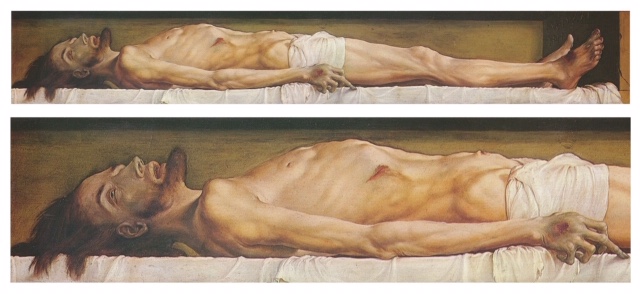
The Body of the Dead Christ in the Tomb by Hans Holbein (c. 1522)
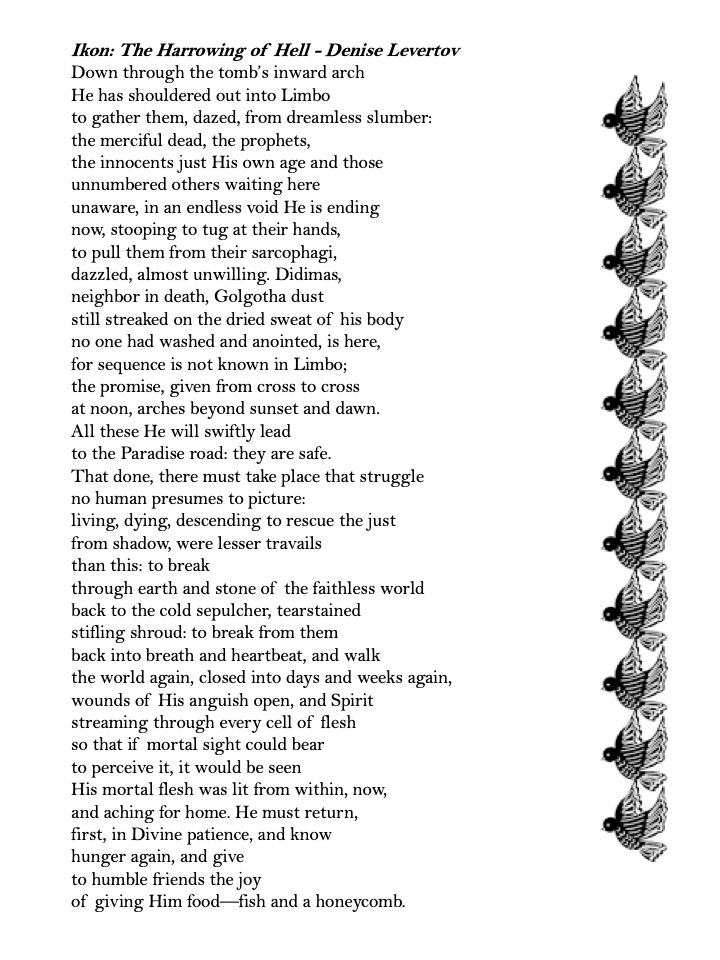
Today, in God’s Lavish Mercy, we wait, entombed with Jesus. The waiting has a surreal sense every year as we commemorate this day with no liturgy of its own. Within our Holy Saturday prayer, there is a depth of meaning that eludes words. So, let us turn to poetry as we daily do:
Here are two poems that may help us explore the spiritual dimensions of Holy Saturday.
Today, in in God’s Lavish Mercy, we pray within the incomprehensible Love Who is Jesus Christ.
A most beautiful hymn from the Good Friday liturgy is the Popule Meus.
Popule Meus, also known as the ‘Improperia‘ or the ‘Reproaches,‘ is the hymn sung after the Adoration of the Cross on Good Friday. Christ reproaches the People, contrasting the innumerable favors God has bestowed upon them with the injuries He has received from their hands. Where God led them to the Chosen Land, the Peole led Him to the Cross. Where God gave a royal scepter, the People returned a crown of thorns.
This prayer focuses us on our own relationship with God. We too are Children of the Promise. How have we responded? How do we find ourselves as we kneel before the Cross?
The Trisagion prayer is an ancient chant repeated within the Popule Meus. It is a verse we can repeat as a mantra whenever we meditate on the Cross.
Ágios o Theos. Ágios íschyros. Ágios athánatos, eléison imas.
Holy God, Holy Mighty One, Holy Immortal One, have mercy on us.
Poetry: Good Friday – Christina Rossetti
Am I a stone, and not a sheep, That I can stand, O Christ, beneath Thy cross, To number drop by drop Thy blood’s slow loss, And yet not weep?
Not so those women loved Who with exceeding grief lamented Thee; Not so fallen Peter weeping bitterly; Not so the thief was moved;
Not so the Sun and Moon Which hid their faces in a starless sky, A horror of great darkness at broad noon – I, only I.
Yet give not o’er, But seek Thy sheep, true Shepherd of the flock; Greater than Moses, turn and look once more And smite a rock.
Today, in God’s Lavish Mercy, as supper time falls slowly from east to west over the Earth, so will Christians worldwide seek communion with Christ and the believing community.
A great surge of intentional communion will join us in an irrepressible wave of faith. The evening skies will echo with the precious words that, despite whatever distances, gather us into one people in Christ:
Jesus took bread, and, after he had given thanks, broke it and said, “This is my body that is for you. Do this in remembrance of me.” In the same way also the cup, after supper, saying, “This cup is the new covenant in my blood. Do this, as often as you drink it, in remembrance of me.
Our Gospel reminds us that there are two equally significant dimensions to a full understanding of Eucharist:
the Body and Blood we share in Eucharist
the sacrificial service we live daily among the People of God who are the living Body of Christ for us.
In these times of worldly suffering and war, that second dimension sustains us.
Eucharist is offered when we wash the feet of our sisters and brothers:
by those who tend and comfort the sick, poor, war ravaged, and desolate.
by the suffering themselves who endure in faith and hope
by those who serve other’s needs for sustenance and safety
by those who pray for the healing, courage and restoration of all Creation
by each one of us as we turn from self toward the good of the Whole
As Jesus leans to wash the feet of his disciples, so may we lean in service over our suffering world. Jesus asks us:
Do you realize what I, your Lord and Master, have done for you?
We do not realize fully, Lord, what You have done for us.
But we are daily learning a new depth of understanding.
The realization rises like a slow dawn over the shadows of our selfishness. It is a sunrise which continues throughout our lives. Please help us to rise with You no matter how the darkness weighs on us.
Like the fragile bread and fluid wine which hide your Omnipotent Presence, may we become holy nourishment and joy for one another – a true and living memorial to your infinite act of love for us.
Prose Prayer: excerpts from Mass on the World – Pierre Teilhard De Chardin, SJ
Receive, O Lord, this all-embracing host which your whole creation, moved by your magnetism, offers you at this dawn of a new day.
This bread, our toil, is of itself, I know, but an immense fragmentation; this wine, our pain, is no more, I know, than a draught that dissolves. Yet in the very depths of this formless mass you have implanted — and this I am sure of, for I sense it — a desire, irresistible, hallowing, which makes us cry out, believer and unbeliever alike: ‘Lord, make us one.’
You have come down, Lord, into this day which is now beginning. But alas, how infinitely different in degree is your presence for one and another of us in the events which are now preparing and which all of us together will experience! In the very same circumstances which are soon to surround me and my fellow-men you may be present in small measure, in great measure, more and more or not at all. Therefore, Lord, that no poison may harm me this day, no death destroy me, no wine befuddle me, that in every creature I may discover and sense you, I beg you: give me faith.
Music: Pange Lingua – Chant of the Mystics Written by St. Thomas Aquinas in the 13th century English lyrics below
Sing, my tongue, the Saviour’s glory, Of His Flesh, the mystery sing; Of the Blood, all price exceeding, Shed by our Immortal King, Destined, for the world’s redemption, From a noble Womb to spring.
Of a pure and spotless Virgin Born for us on earth below, He, as Man, with man conversing, Stayed, the seeds of truth to sow; Then He closed in solemn order Wondrously His Life of woe.
On the night of that Last Supper, Seated with His chosen band, He, the Paschal Victim eating, First fulfils the Law’s command; Then as Food to all his brethren Gives Himself with His own Hand.
Word-made-Flesh, the bread of nature By His Word to Flesh He turns; Wine into His Blood He changes: What though sense no change discerns. Only be the heart in earnest, Faith her lesson quickly learns.
Down in adoration falling, Lo, the sacred Host we hail, Lo, o’er ancient forms departing Newer rites of grace prevail: Faith for all defects supplying, When the feeble senses fail.
To the Everlasting Father And the Son who comes on high With the Holy Ghost proceeding Forth from each eternally, Be salvation, honor, blessing, Might and endless majesty. Amen.
Today, in God’s Lavish Mercy, the betrayal of Jesus continues, as does his mounting courage to endure its consequences.
In our first reading, the experience of the prophet Isaiah foreshadows that of Jesus. We can hear Jesus praying in Isaiah’s words:
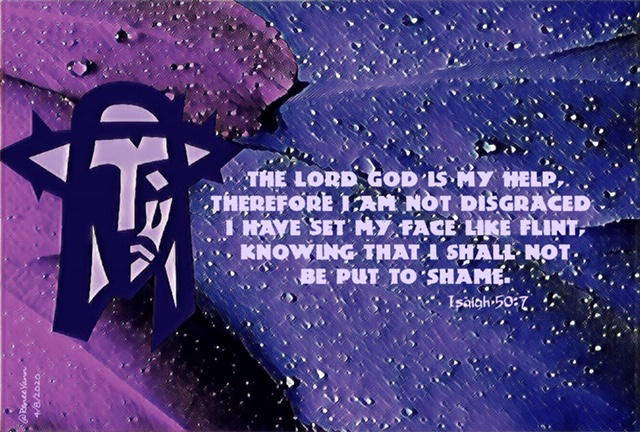
The Lord GOD is my help, therefore I am not disgraced; I have set my face like flint, knowing that I shall not be put to shame. He is near who upholds my right; if anyone wishes to oppose me, let us appear together. Who disputes my right? Let him confront me. See, the Lord GOD is my help; who will prove me wrong?
Isaiah 50:7-8
We hear Christ’s transcendent openness to the Father’s accompaniment:
Morning after morning God opens my ear that I may hear; And I have not rebelled, have not turned back.
We hear Christ’s courage to face what life unfolds before him:
I gave my back to those who beat me, my cheeks to those who plucked my beard; My face I did not shield from buffets and spitting.
We hear Christ’s utter commitment, despite suffering, to the Father’s Presence:
The Lord GOD is my help, therefore I am not disgraced; I have set my face like flint, knowing that I shall not be put to shame.
As we pray with Jesus today, may we:
hear God’s purpose in our lives.
see grace unfold in all our circumstances
set our hearts, like flint, upon faith and trust in God
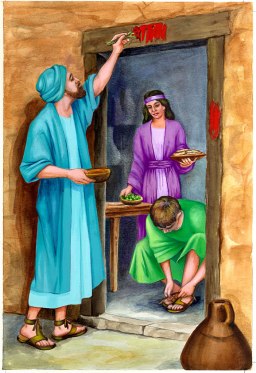
As our Jewish sisters and brothers will begin the Passover celebration this Friday, their rich faith heritage inspires us always to find God in the journey, no matter where it leads us.
In the Gospel’s Passover moment, Jesus walks toward the painful experience of Gethsemane. He invites us to come and receive the reassuring blessing of his Father even as the night shadows fall.
Poetry: The Garden of Gethsemane – by Boris Pasternak who won the Nobel Prize for Literature after writing Dr. Zhivago
Indifferently, the glimmer of stars Lit up the turning in the road. The road went round the Mount of Olives, Below it the Kedron flowed.
The meadow suddenly stopped half-way. The Milky Way went on from there. The grey and silver olive trees Were trying to march into thin air.
There was a garden at the meadow’s end. And leaving the disciples by the wall, He said: ‘My soul is sorrowful unto death, Tarry ye here, and watch with Me awhile.’
Without a struggle He renounced Omnipotence and miracles As if they had been borrowed things, And now He was a mortal among mortals.
The night’s far reaches seemed a region Of nothing and annihilation. All The universe was uninhabited. There was no life outside the garden wall.
And looking at those dark abysses, Empty and endless, bottomless deeps, He prayed the Father, in a bloody sweat, To let this cup pass from His lips.
Assuaging mortal agony with prayer, He left the garden. By the road he found Disciples, overcome by drowsiness, Asleep spreadeagled on the ground.
He wakened them: ‘The Lord has deemed you worthy To live in My time. Is it worthiness To sleep in the hour when the Son of Man Must give Himself into the hands of sinners?’
And hardly had He spoken, when a mob Of slaves, a ragged multitude, appeared With torches, sowards, and Judas at their head Shaping a traitor’s kiss behind his beard.
Peter with his sword resisted them And severed one man’s ear. But then he heard These words: ‘The sword is no solution. Put up your blade, man, in its scabbard.
Could not My Father instantly send down Legions of angels in one thunderous gust? Before a hair of my head was touched, My enemies would scatter like the dust.
But now the book of life has reached a page Most precious and most holy. What the pen Foretold in Scripture here must be fulfilled. Let prophecy come to pass. Amen.
The course of centuries is like a parable And, passing, can catch fire. Now, in the name Of its dread majesty, I am content To suffer and descend into the tomb.
I shall descend and on the third day rise, And as the river rafts float into sight, Towards My Judgement like a string of barges The centuries will float out of the night.’
Music: I Come to the Garden Alone – Sean Clive
I come to the garden alone while the dew is still on the roses, And the voice I hear falling on my ear, The Son of God discloses
And He walks with me and He talks with me, And He tells me I am his own; And the joy we share as we tarry there, None other has ever known
He speaks, and the sound of his voice is so sweet The birds hush their singing, And the melody that He give to me Within my heart is to ringing.
And He walks with me and He talks with me, And He tells me I am his own; And the joy we share as we tarry there, None other has ever known
I stay in the garden with Him, Though the night around me is falling. But He bids me go; through the voice of woe His voice to me is calling.
And He walk with me and He talks with me, And He tells me I am His own; And the joy we share as we tarry there, None other has ever known.
Today, in God’s Lavish Mercy, our Gospel tells the sad story of Jesus’s betrayal by his closest friends.
“Amen, amen, I say to you, one of you will betray me.” The disciples looked at one another, at a loss as to whom he meant. One of his disciples, the one whom Jesus loved, was reclining at Jesus’ side. So Simon Peter nodded to him to find out whom he meant. He leaned back against Jesus’ chest and said to him, “Master, who is it?” Jesus answered, “It is the one to whom I hand the morsel after I have dipped it.” So he dipped the morsel and took it and handed it to Judas, son of Simon the Iscariot. After Judas took the morsel, Satan entered him.
The Last Supper (1630–1631) is an oil painting by Peter Paul Rubens. The painting depicts Jesus and the Apostles during the Last Supper, with Judas dressed in blue turning back towards the viewer and away from the table. Other than Jesus, the most prominent figure is Judas. Judas holds his right hand to his mouth with his eyes avoiding direct contact with the other figures in the painting creating a nervous expression. (Wikipedia)
Pope Francis, in his 2020 Palm Sunday homily, reflected on the depth of these betrayals:
Jesus suffered betrayal by the disciple who sold him and by the disciple who denied him. He was betrayed by the people who sang hosanna to him and then shouted: “Crucify him!” He was betrayed by the religious institution that unjustly condemned him and by the political institution that washed its hands of him.
We can think of all the small or great betrayals that we have suffered in life. It is terrible to discover that a firmly placed trust has been betrayed. From deep within our heart a disappointment surges up that can even make life seem meaningless. This happens because we were born to be loved and to love, and the most painful thing is to be betrayed by someone who promised to be loyal and close to us. We cannot even imagine how painful it was for God who is love.
These first three days of Holy Week are like the days in our lives when we know there is a wave of suffering coming but it hasn’t quite broken over us. Something just isn’t right in our bodies, minds, spirits, or in the world around us. In such times, the actual pain might be muted, but the fear, loneliness, anxiety and dark imaginations can be acute.
It’s hard to be with ourselves or with another in this kind of suffering. We see in our Gospel how hard it was for the disciples.
All one really has in such moments are the faith and trust that God ever abides with us. It is the kind of assurance Jesus had with the Father.
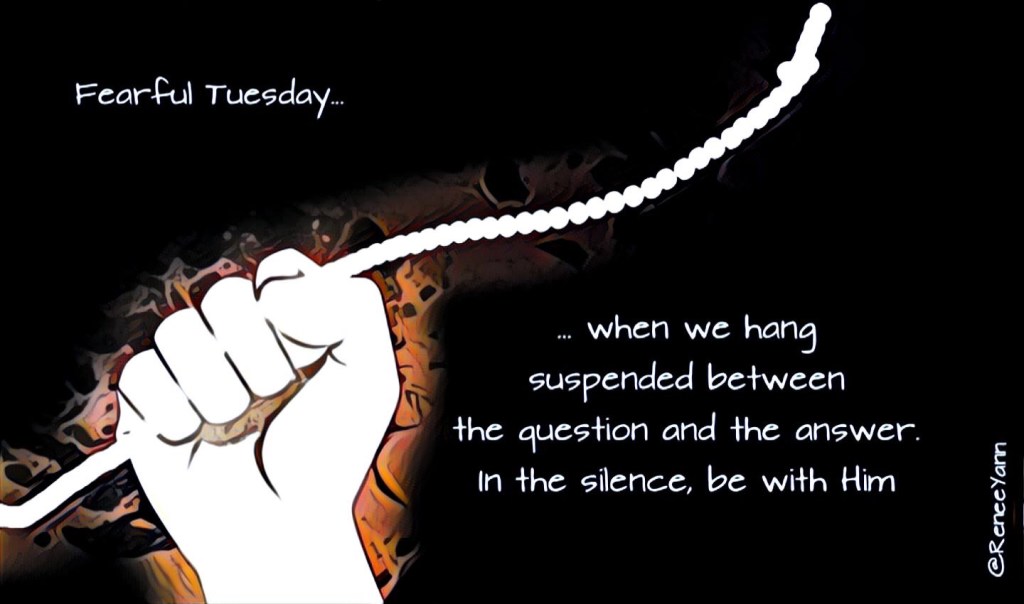
As we walk beside Jesus on this Fearful Tuesday, let us confide our sufferings, current or remembered, asking to be gracefully transformed by them. Let us listen to Jesus’s pain and heart-break, asking to be a source of comfort and love to Him.
With Jesus, may we carry in our prayer all those throughout the world suffering abandonment, fear, loss, or betrayal at this painful time.
Saint Judas – James Wright
When I went out to kill myself, I caught
A pack of hoodlums beating up a man.
Running to spare his suffering, I forgot
My name, my number, how my day began,
How soldiers milled around the garden stone
And sang amusing songs; how all that day
Their javelins measured crowds; how I alone
Bargained the proper coins, and slipped away.
Banished from heaven, I found this victim beaten,
Stripped, kneed, and left to cry. Dropping my rope
Aside, I ran, ignored the uniforms:
Then I remembered bread my flesh had eaten,
The kiss that ate my flesh. Flayed without hope,
I held the man for nothing in my arms.
Music: I Will Carry You – Sean Clive You might hear this song in many ways. Perhaps Jesus comforts you with it. Or you might comfort Jesus in his escalating suffering. Or together, Jesus and you may sing it over a suffering world. (Lyrics below)
I will carry you when you are weak. I will carry you when you can’t speak. I will carry you when you can’t pray. I will carry you each night and day.
I will carry you when times are hard. I will carry you both near & far. I’ll be there with you whenever you fall. I will carry you through it all.
My arms are wider than the sky, softer than a little child, stronger than the raging, calming like a gentle breeze. Trust in me to hold on tight because
I will carry you when you can’t stand. I’ll be there for you to hold your hand. And I will show you that you’re never alone. I will carry you and bring you back home.
Not pain, not fear, not death, no nothing at all can separate you from my love. My arms and hands will hold you close. Just reach out and take them in your own. Trust in me to hold on tight. I will carry you.















 Lavish Mercy