On the Road Together

Wednesday in the Octave of Easter
April 12, 2023

Today’s Readings:

https://bible.usccb.org/bible/readings/041223.cfm

Today, in God’s Lavish Mercy, we enfold ourselves in some of our favorite post-Easter stories. They warm our hearts with their humanness. They help us understand how people just like us processed the astounding news of the Resurrection.

Two of our beloved senior sisters … on the road together with Him…


In Acts, we find Peter and John, the same ones Mary had summoned to the empty tomb. Now, in place of their tentative searching, ministerial confidence pours out of them. The long-crippled man wants only a coin but Peter yearns to give the treasure he now knows he possesses. 

By faith, Peter’s heart has risen from death with Christ, and he is compelled to share that redemption with the world:

Peter said, “I have neither silver nor gold,
but what I do have I give you: 
in the name of Jesus Christ the Nazorean, rise and walk.”

Acts 3: 6-7

Listen, this is the same guy who, on the way to Jerusalem, begged Jesus not even to mention Calvary. This is the guy who, on Good Friday eve, cowered by the fire and denied he even knew Jesus. 

Look what Easter faith can do
for a doubtful, frightened heart!

ALLELUIA!

In our beautiful Gospel, a miracle dose of this faith was given to two journeying friends. Can’t you see them – perhaps two old men or women. Arm in arm, they trudge along the dusty road, gabbing their weary heads off. As evening falls, they are slowly wrapped in all kinds of inner and outer shadows:

  • Has this all really happened?
  • Wasn’t He the One we thought he might be?
  • Have our dearest hopes all been in vain?

When Jesus joins them, he wants to hear their mumbled questions. By his abiding, honest,and patient Presence, he walks them out of doubtful logic into faith’s freedom:

He asked them, 
“What are you discussing as you walk along?”
They stopped, looking downcast.
One of them, named Cleopas, said to him in reply,
“Are you the only visitor to Jerusalem
who does not know of the things
that have taken place there in these days?”….

And he said to them, “Oh, how foolish you are!
How slow of heart to believe all that the prophets spoke!
Was it not necessary that the Christ should suffer these things
and enter into his glory?”
Then beginning with Moses and all the prophets,
he interpreted to them what referred to him
in all the Scriptures.

Luke 24: 17-18; 25-27

Jesus is listening and walking with us too. He wants to give us the same confidence Peter had as we proclaim our faith by the merciful actions of our life. Just like the Emmaus friends, let’s invite him to stay with us as evening falls.


Poetry: The Servant Girl at Emmaus (A Painting by Velázquez) by Denise Levertov

The Kitchen Maid, Diego Velazquez, National Gallery of Ireland

She listens, listens, holding
her breath. Surely that voice
is his—the one
who had looked at her, once, across the crowd,
as no one ever had looked?
Had seen her? Had spoken as if to her?
Surely those hands were his,
taking the platter of bread from hers just now?
Hands he'd laid on the dying and made them well?
Surely that face—?
The man they'd crucified for sedition and blasphemy.
The man whose body disappeared from its tomb.
The man it was rumoured now some women had seen this morning, alive?
Those who had brought this stranger home to their table
don't recognise yet with whom they sit.
But she in the kitchen, absently touching
           the winejug she's to take in,
a young Black servant intently listening,
swings round and sees
the light around him
and is sure.

Music: I Can See (The Road To Emmaus) Steve Green

Turn toward Light!

Tuesday in the Octave of Easter
April 11, 2023

Today’s Readings:

https://bible.usccb.org/bible/readings/041123.cfm

Today, in God’s Lavish Mercy, we share the heartfelt experience of the early disciples captured in a few poignant comments.

Sometimes words are so full of meaning that they burst in your heart when you read them — when you hear them

Two such phrases rise up from our readings today: 

Cut to the heart

In our first reading, the Easter-liberated Apostles preach the Gospel with gusto! They tell it – exactly like it is- to the crowd gathered in Jerusalem:

On the day of Pentecost, Peter said to the Jewish people,
“Let the whole house of Israel know for certain
that God has made him both Lord and Christ,
this Jesus whom you crucified.”

Acts 2:36

….” this Jesus whom you crucified..”

For those in that crowd, these were shattering words to hear! The feeling is like when you drop a precious vase and it crumbles at your feet! What do you do now? It is too late to redeem the brokenness! They were “cut to the heart” by the realization.

But that is the wonder of the Resurrection. It is never too late! Our life in God is never irrevocably broken!

Peter, motivated by Jesus’ own act of forgiveness from the cross, said to them,

“Repent and be baptized, every one of you,
in the name of Jesus Christ, for the forgiveness of your sins;
and you will receive the gift of the Holy Spirit.
For the promise is made to you and to your children
and to all those far off,
whomever the Lord our God will call.”

Acts 2:38-39

Rabbouni 

Our Gospel extends this theme of restoration and hope. As we pray with its grace-filled drama, we thank John for being the only Evangelist to record this poignant moment between Jesus and Mary.

After Mary had discovered the empty tomb, and summoned the other disciples to see it, she lingers there once they have returned the city. 

She doesn’t know what to do! Feel her confusion, her distress. Easter faith has not yet dawned in her. She thinks the precious body of Jesus has been stolen, perhaps desecrated – again, like a beautiful vessel splintered and lost forever.

Then she turns toward the Light – as we all must do when we are overshadowed in doubt.

She said to the angels, “They have taken my Lord,
and I don’t know where they laid him.”
When she had said this, she turned around and saw Jesus there…

John 20:14

Still, she doesn’t fully recognize him until he lovingly speaks her name. Then she in turn utters the word so full of devotion and love: Rabbouni 

Noli Me Tangere – Antonio Corregio

Think about it! You can imagine how she felt when she said it – just like you would feel if you thought you had lost a Beloved but they returned to you alive and transformed!

Let’s be with Jesus and Mary in this sacred moment, hearing our own name spoken by our Beloved, responding in amazed tenderness from the depths of our heart.


Poetry: Rabboni! by John Banister Tabb (1845 – 1909) an American poet, Roman Catholic priest, and professor of English.

"I bring thee balm, and, lo, Thou art not here!
Twice have I poured mine ointment on Thy brow,
And washed Thy feet with tears. Disdain'st Thou now
The spikenard and the myrrh?"
“Has Death, alas, betrayed Thee with a kiss
That seals Thee from the memory of mine?”
“Mary!” It is the self-same Voice Divine.
"Rabboni!" -- only this.

Music: Rabboni – Ken Young

You were there when the world had turned against me.
When the darkness had possessed my soul,
Your tender mercy made me whole.
When I followed You, my life was filled with meaning
From the morning to the evening.
I’ve seen the face of God.

Chorus:
Rabboni! My Teacher and my God!
You’re alive and my burdens melt away.
Rabboni! Sweet Son of God Most High!
I know death has lost its power
And Your glory’s here to stay. (repeat).

When I close my eyes
I can hear Your voice so clearly saying,
“Father, please forgive them,
For they know not what they do.”
What good reason did they have to do
The things they did to You?

So I come once again bringing all I have to offer,
Just to find a dark and empty tomb,
Your holy frame somehow exhumed.
Then I hear someone say,
“Why are tears so freely falling?
Can’t You hear the voice that’s calling?
A voice that knows Your name.”

The Other Mary

Monday in the Octave of Easter
April 10, 2023

Today’s Readings:

https://bible.usccb.org/bible/readings/041023.cfm

Today, in God’s Lavish Mercy, our readings remind us that the witness of others, and their faithful companionship, are incalculable gifts to strengthen our faith.


In the passage from Acts, Peter summons the ancient witness of David in attestation to the Resurrection. David is the perfect exponent, because Peter is speaking to the Jews whose faith is built on David’s heritage.

My brothers and sisters, one can confidently say to you
about the patriarch David that he died and was buried,
and his tomb is in our midst to this day.
But since he was a prophet and knew that God had sworn an oath to him
that he would set one of his descendants upon his throne,
he foresaw and spoke of the resurrection of the Christ,
that neither was he abandoned to the netherworld
nor did his flesh see corruption.

Acts 2: 29-31

Our Responsorial Psalm recalls David’s Resurrection testimony, particularly these lines:

Therefore my heart is glad and my soul rejoices,
my body, too, abides in confidence;
Because you will not abandon my soul to the nether world,
nor will you suffer your faithful one to undergo corruption.

You will show me the path to life,
fullness of joys in your presence,
the delights at your right hand forever.

Psalm 16: 9-11

Matthew’s Gospel retells the witness scene John gave us, allowing us a slightly different slant on the story:

Mary Magdalene and the other Mary went away quickly from the tomb,
fearful yet overjoyed,
and ran to announce the news to his disciples.
And behold, Jesus met them on their way and greeted them.
They approached, embraced his feet, and did him homage.
Then Jesus said to them, “Do not be afraid.
Go tell my brothers to go to Galilee, 
and there they will see me.”

Matthew 28:7-10

The Two Marys Watch the Tomb – James Tissot


Matthew incorporates the “other Mary” as a first witness to the Resurrection. How wonderful for that faithful disciple whoever she was!

We may not know her full name but we can be rather certain of this – she was Mary Magdalen’s treasured friend. “Other Mary” was the one Magdalen went to when she was just a little too afraid to go find Jesus all by herself. And “Other Mary” was close enough to Jesus that he chose her too to be a “First Witness” of the Resurrection.

“Other Mary” didn’t have the notoriety that Mary Magdalen had. Magdalen was prominent enough that she carried the name of her hometown. “Other Mary” didn’t have such a designation. She was probably a quieter, less recognized, but nevertheless invaluable contributor to the early Christian community.

We know the kind of person “Other Mary” was. We may be blessed with such friends and companions in our own lives, always there, always supportive, always faithful.

Perhaps we want to spend a little time in prayer with “Other Mary”, asking her to help us gratefully recognize those who have companioned us in our faith life.

We might ask her too to help us deepen our own steadfast presence to others in faith, hope and love.


Poetry: An Easter Flower Gift – John Greenleaf Whittier

O dearest bloom the seasons know,
Flowers of the Resurrection blow,
Our hope and faith restore;
And through the bitterness of death
And loss and sorrow, breathe a breath
Of life forevermore!

The thought of Love Immortal blends
With fond remembrances of friends;
In you, O sacred flowers,
By human love made doubly sweet,
The heavenly and the earthly meet,
The heart of Christ and ours!

Music: Bridge Over Troubled Waters – Simon and Garfunkel

Don’t Be Afraid

Monday in the Octave of Easter
April 10, 2023

Today’s Readings:

https://bible.usccb.org/bible/readings/041023.cfm

Today, in God’s Lavish Mercy, we begin to read and relish the post-Resurrection stories.

As I begin my prayer with these stories, I am reminded of a sweet cartoon I recently saw on Facebook. The illustration showed an elderly couple relaxing outside a simple home. The woman is shelling peas; the man whittling some wood. The comment below the picture reads, “If only I could visit my grandparents one more time!”. 

Haven’t we all felt that way about someone dear who has died.  If only we could be with them one more time!


Well, that’s exactly what happens in these post-Resurrection stories. The disciples, and we, get to be with Jesus one more time:

  • to re-hear his Truth more clearly in the light of the Resurrection 
  • to get right the Gospel imperatives we might have missed in our distractions 
  • to heal the doubts which his suffering, and ours, may have caused us
  • to have our faith irrevocably affirmed by his real and transformed Presence

The Three Marys at the Tomb – WILLIAM-ADOLPHE BOUGUEREAU


Mary Magdalene and the other Mary went away quickly from the tomb,
fearful yet overjoyed,
and ran to announce the news to his disciples.
And behold, Jesus met them on their way and greeted them.
They approached, embraced his feet, and did him homage.
Then Jesus said to them, “Do not be afraid.
Go tell my brothers to go to Galilee, 
and there they will see me.”

Mark 28:8-10

Like Mary Magdalen and the “other Mary”, we too might be “fearful but overjoyed” at moments in our faith life – those moments when we are confronted with our own small Calvaries. 

But Jesus, filled with the glory of Resurrection, greets us on our way. He tells us too, “Do not be afraid” —— you will see me, risen in your life. And you will understand.


Prose: from Paula D’Arcy

Who would I be,
and what power

would be expressed in my life,
if I were not dominated by fear.


Music: Don’t Be Afraid – Mac Lynch

Alleluia! Alleluia!

Easter Sunday
April 9, 2023

Today’s Readings:

https://bible.usccb.org/bible/readings/040923.cfm

Today, in God’s Lavish Mercy, our hearts sing the triumphant Alleluia!

The Promise is kept!

Faith is affirmed!

Breath, held in the darkness, is confidently released into the Light!

Jesus Christ is risen from the dead!


This is the central canon of our faith. If we truly believe it and live from that conviction, everything – yes, everything– becomes grace.

If then you were raised with Christ, seek what is above, 
where Christ is seated at the right hand of God.
Think of what is above, not of what is on earth.
For you have died, and your life is hidden with Christ in God.
When Christ your life appears,
then you too will appear with him in glory.

Colossians 3:1-4

In our prayer today, we might want to be with Mary on that early morning, as she walks through the lingering shadows. Is there something she has yet to release into the compassionate heart of God – some doubt or fear she clings to? Some fruitless crutch in her life that blocks her full yielding to God’s Presence?

She sees the stone rolled away? What does it mean to her? What does it mean to us?

As we will find a little later in John’s Gospel, Mary’s recognition of the Resurrected Christ was a slow and tender dawning. Perhaps our is too. Today, and throughout the coming Easter Season, is a time to engage that Holy Sunrise!


Poetry: two poems for Easter

Rabboni – by Herbert Gustav Schmaltz

The Magdalen, A Garden and This – Kathleen O’Toole

She who is known by myth and association 
as sinful, penitent, voluptuous perhaps... 
but faithful to the last and then beyond.

A disciple for sure, confused often with Mary, 
sister of Lazarus, or the woman caught 
in adultery, or she who angered the men

by anointing Jesus with expensive oils.
She was the one from whom he cast out seven 
demons-she's named in that account.

Strip all else away and we know only 
that she was grateful, that she found her way 
to the cross, and that she returned

to the tomb, to the garden nearby, and there, 
weeping at her loss, was recognized, 
became known in the tender invocation

of her name. Mary: breathed by one 
whom she mistook for the gardener, he 
who in an instant brought her back to herself-

gave her in two syllables a life beloved, 
gave me the only sure thing I'll believe 
of heaven, that if it be, it will consist

in this: the one unmistakable 
rendering of your name.

Excerpt from Paradisio – Dante

Like sudden lightning scattering the spirits
of sight so that the eye is then too weak
to act on other things it would perceive,
such was the living light encircling me,
leaving me so enveloped by its veil
of radiance that I could see no thing.
The Love that calms this heaven always welcomes
into Itself with such a salutation,
to make the candle ready for its flame.

Music:  Love Crucified Arose – Michael Card

Long ago, He blessed the earth
Born older than the years
And in the stall the cross He saw
Through the first of many tears

A life of homeless wandering
Cast out in sorrow’s way
The Shepherd seeking for the lost
His life, the price He paid

Love crucified arose
The risen One in splendor
Jehovah’s sole defender
Has won the victory

Love crucified arose
And the grave became a place of hope
For the heart that sin and sorrow broke
Is beating once again

Throughout Your life You’ve felt the weight
Of what You’d come to give
To drink for us that crimson cup
So we might really live

At last the time to love and die
The dark appointed day
That one forsaken moment when
Your Father turned His face away

Love crucified arose
The One who lived and died for me
Was Satan’s nail-pierced casualty
Now He’s breathing once again

Love crucified arose
And the grave became a place of hope
For the heart that sin and sorrow broke
Is beating once again

Love crucified arose
The risen One in splendor
Jehovah’s sole defender
Has won the victory

Day of Holy Emptiness

Holy Saturday
April 8, 2023

Today’s Readings:

https://bible.usccb.org/bible/readings/040823.cfm

Today, in God’s Lavish Mercy, we mark a Day of Holy Emptiness. The universe stands in stasis, balanced on the desperation of sorrow and the anguished hope for new life.

Our liturgy bids us to make vigil – to embrace the Darkness before the Light, to know its secrets, to face its fears, to listen for its hidden promise.


Our readings tells us that it is now, after Calvary, as it was in the Beginning, that all – even we – are being recreated in Christ:

In the beginning, when God created the heavens and the earth,
the earth was a formless wasteland, and darkness covered the abyss,
while a mighty wind swept over the waters.

Then God said,
“Let there be light,” and there was light.
God saw how good the light was.
God then separated the light from the darkness.
God called the light “day,” and the darkness he called “night.”
Thus evening came, and morning followed—the first day.


Outside my eastern window, the sky is still too dark to see the hearty Southern Magnolia that I know is only 30 feet away. Many years ago, it was gifted to the sisters in the hope of a northern blooming. And it has met that hope ever since.


Even though Southern Magnolias are evergreens, in spring, new leaves push off the old leaves – but not all at once.  Most deciduous trees lose their leaves in the fall, but Southern Magnolias will drop the older leaves in the spring – every spring.

-from NatureHills.com

Yesterday, I walked under it very carefully because it had aggressively begun to push its old pods off in preparation for its own Easter.


On this Holy Saturday, as we quiet our souls with our resting Jesus, let us be like the faithful magnolia. Let us search out and release all that is no longer life-giving in our spirits. 

This is a time to let go of internal clutter – perhaps old angers, grudges, prejudices that inhibit our joy.

It is a time to be honest about the junk we substitute for nourishment in our spiritual lives. Take a snapshot of your leisure time — how much of it is spent with things that can bring you closer to God?


The tomb where Jesus’s Body lay was empty, but for him it was full of Easter promise. For this day only, we are invited to be there with him in the pregnant emptiness and to listen to God’s promise of new life for us.

Therefore my heart is glad and my soul rejoices,
my body, too, abides in confidence;
because you will not abandon my soul to the netherworld,
nor will you suffer your faithful one to undergo corruption.

You will show me the path to life,
fullness of joys in your presence,
the delights at your right hand forever.

Psalm 16: 9-11

Poetry: Easter Night – Alice Meynell

All night had shout of men
And cry of woeful women filled his way;
Until that noon of sombre sky
On Friday, clamour and display smote him;
No solitude had He,
No silence, since Gethsemane.

Public was death;
But power, but Might,
But life again, but Victory,
Were hushed within the dead of night,
The shuttered dark, the secrecy.
And all alone, alone, alone,
He rose again behind the stone.

Music: Carlo Gesualdo: Tenebrae Responsories for Holy Saturday – Third Nocturn

Some of you may be interested in the content of these Holy Saturday texts. Here is the information from Wikipedia.

Responsories of the third nocturn of Holy Saturday

The three readings of the third nocturn of Holy Saturday are Hebrews 9:11–14, 9:15–18 and 9:19–22.

Astiterunt reges terrae

Aestimatus sum

Sepulto Domino

Sixth of Poulenc’s Sept répons des ténèbres

For Us…

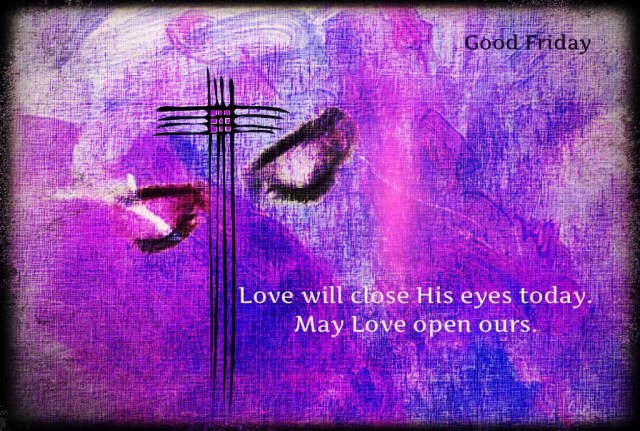
Good Friday
April 7, 2023

Today’s Readings:

https://bible.usccb.org/bible/readings/040723.cfm

Today, in God’s Lavish Mercy, we pray the most painful story of our faith. 

So they took Jesus, and, carrying the cross himself, 
he went out to what is called the Place of the Skull, 
in Hebrew, Golgotha.
There they crucified him, and with him two others, 
one on either side, with Jesus in the middle.
Pilate also had an inscription written and put on the cross.
It read,
“Jesus the Nazorean, the King of the Jews.”

John 19:16-18

As we watch Infinite Goodness broken on the altar of evil, our own sufferings and those of all the world pour out before us. Because it was for our suffering that Christ died, not only for that of his own time.

Yet it was our infirmities that he bore,
    our sufferings that he endured,
while we thought of him as stricken,
    as one smitten by God and afflicted.
But he was pierced for our offenses,
    crushed for our sins;
upon him was the chastisement that makes us whole,
    by his stripes we were healed.

Isaiah 53:4-5

Haven’t you asked yourself the question at least once, “Why did it have to be like this? Couldn’t our Redemption have been accomplished without this agony?

It is a question we carry with us throughout our lives as the profound contradiction of suffering challenges and often confounds us. Our faith is tested in pain’s relentless onslaught. Our souls struggle to understand what suffering is trying to tell us about God!


Jesus himself knew that struggle as we see so clearly in the Gethsemane story.

Good Friday is a day to sit quietly with that question, and to finally release it into the Mystery of God. We can never reach an answer or solution. We were not meant to.

We can only trust. That trust will allow suffering to transform us. And though we cannot find a solution, we can, like Jesus in the Garden, reach a place of sacred abandonment to God. From there, our true salvation can begin.

In the days when Christ was in the flesh, 
he offered prayers and supplications with loud cries and tears 
to the one who was able to save him from death, 
and he was heard because of his reverence.
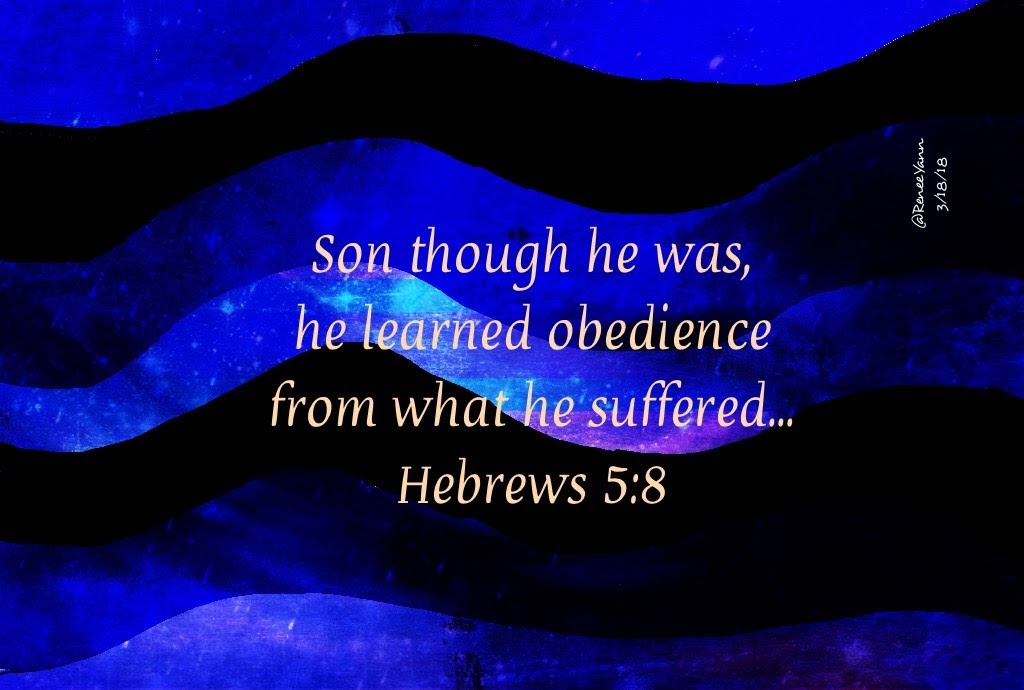
Son though he was, he learned obedience from what he suffered; 
and when he was made perfect,
he became the source of eternal salvation for all who obey him.

Hebrews 5:7-9

Poetry: What If I Fall? by Erin Hanson

There is freedom waiting for you,
On the breezes of the sky,
And you ask, "What if I fall?"
Oh, but my darling,
What if you fly?

Music: Take, Lord, Receive: the prayer of St. Ignatius of Loyola – John Foley, SJ

Take, Lord, receive.
all my liberty.
My memory, understanding, my entire will!
Give me only your LOVE, and your Grace,
that’s enough for me!
Your love and your grace, are enough for me!
Take Lord, receive,
All I have and posses.
You have given unto me,
Now I return it.
Give me only your love, and your grace,
that’s enough for me!
Your love and your grace,
are enough for me!
Take Lord receive,
all is yours now.
Dispose of it,
wholey according to your will.
Give me only your love, and your grace,
that’s enough for me!
Your love and your grace,
are enough for me!

My Body … for You

Holy Thursday
April 6, 2023

Today’s Readings:

https://bible.usccb.org/bible/readings/040623-Supper.cfm

Today, in God’s Lavish Mercy, the greatest act of love unfolds around a simple table, in the last rich hues of a Jerusalem sunset. No doubt the Twelve whom we are used to seeing in the paintings, and the many other who had sustained Christ’s journey by their service, sensed that this was an extraordinary Seder.

As you place yourself in the scene, you may wish to be one of the Apostles, or you may be the one who baked bread that would become His Body. You may be the one who decanted the precious wine to be His Blood.

Wherever you are in that ancient, yet living story – and wherever you are tonight, let the ancient awe fill your heart as you hear these astounding words:

Brothers and sisters:
I received from the Lord what I also handed on to you,
that the Lord Jesus, on the night he was handed over,
took bread, and, after he had given thanks,
broke it and said, “This is my body that is for you.
Do this in remembrance of me.”
In the same way also the cup, after supper, saying,
“This cup is the new covenant in my blood.
Do this, as often as you drink it, in remembrance of me.”
For as often as you eat this bread and drink the cup,
you proclaim the death of the Lord until he comes.

1 Corinthians 11: 23-26

After the supper, to help us comprehend his incomprehensible Gift, Jesus shows us what Eucharist looks like in everyday practice. It looks like the selfless service of a tender foot washing, the humble bending of our hearts to tend another’s need.

So, during supper,
fully aware that the Father had put everything into his power
and that he had come from God and was returning to God,
he rose from supper and took off his outer garments.
He took a towel and tied it around his waist.
Then he poured water into a basin
and began to wash the disciples’ feet
and dry them with the towel around his waist.

….

So when he had washed their feet
and put his garments back on and reclined at table again,
he said to them, “Do you realize what I have done for you?
You call me ‘teacher’ and ‘master,’  and rightly so, for indeed I am.
If I, therefore, the master and teacher, have washed your feet,
you ought to wash one another’s feet.
I have given you a model to follow,
so that as I have done for you, you should also do.”


Dearest Jesus, teach us the deep, deep lessons of these readings. Let them live in us in sacramental vigor poured over the world in Mercy.

As you walk now from the Upper Room toward the Agony of Gethsemane, let us walk beside you in trusting love.


Poetry: Loves – Scott Cairns is the author of eight books of poetry, including The Theology of Doubt (1985), The Translation of Babel (1990), Philokalia (2002), Idiot Psalms (2014), and Slow Pilgrim: The Collected Poems (2015). Spirituality plays an integral role in Cairns’ writing; in an interview, he said, “I’ve come to think of beauty as how God woos us to himself. One doesn’t so much create it or illuminate it as partake of it. Thereafter, one participates, collaborates, in its endless development.”

One of the more dramatic poems is “Loves.” In the voice of Mary Magdalen it offers a strong critique of the separation of flesh and spirit: “All loves are bodily, require / that the lips part, and press their trace / of secrecy upon the one / beloved . . .


Loves

Of Love’s discrete occasions, we
observe sufficient catalogue,
a likely-sounding lexicon

pronounced so as to implicate
a wealth of difference, where reclines
instead a common element,

itself quite like those elements
partaken at the table served
by Jesus on the night he was

betrayed—like those in that the bread
was breakable, the wine was red
and wet, and met the tongue with bright,

intoxicating sweetness, quite
like ... wine. None of what I write arrives
to compromise that sacrament,

the mystery of spirit graved
in what is commonplace and plain—
the broken, brittle crust, the cup.

Quite otherwise, I choose instead
to bear again the news that each,
each was still itself, substantial

in the simplest sense. By now, you
will have learned of Magdalen, a name
recalled for having won a touch

of favor from the one we call
the son of man, and what you’ve heard
is true enough. I met him first

as, mute, he scribbled in the dust
to shame some village hypocrites
toward leaving me unbloodied,

if ill-disposed to taking up
again a prior circumstance.
I met him in the house of one

who was a Pharisee and not
prepared to suffer quietly
my handling of the master’s feet.

Much later, in the garden when,
having died and risen, he spoke
as to a maid and asked me why

I wept. When, at any meeting
with the Christ, was I not weeping?
For what? I only speculate

—brief inability to speak,
a weak and giddy troubling near
the throat, a wash of gratitude.

And early on, I think, some slight
abiding sense of shame, a sop
I have inferred more recently

to do without. Lush poverty!
I think that this is what I’m called
to say, this mild exhortation

that one should still abide all love’s
embarrassments, and so resist
the new temptation—dangerous,

inexpedient mask—of shame.
And, well, perhaps one other thing:
I have received some little bit

about the glib divisions which
so lately have occurred to you
as right, as necessary, fit

That the body is something less
than honorable, say, in its
... appetites? That the spirit is

something pure, and—if all goes well—
potentially unencumbered
by the body’s bawdy tastes.

This disposition, then, has led
to a banal and pious lack
of charity, and, worse, has led

more than a few to attempt some
soul-preserving severance—harsh
mortifications, manglings, all

manner of ritual excision
lately undertaken to prevent
the body’s claim upon the heart,

or mind, or (blasphemy!) spirit—
whatever name you fix upon
the supposéd bodiless.

I fear that you presume—dissecting
the person unto something less
complex. I think that you forget

you are not Greek. I think that you
forget the very issue which
induced the Christ to take on flesh.

All loves are bodily, require
that the lips part, and press their trace
of secrecy upon the one

beloved—the one, or many, endless
array whose aspects turn to face
the one who calls, the one whose choice

it was one day to lift my own
bruised body from the dust, where, it seems
to me, I must have met my death,

thereafter, this subsequent life
and late disinclination toward
simple reductions in the name

of Jesus, whose image I work
daily to retain. I have kissed
his feet. I have looked long

into the trouble of his face,
and met, in that intersection,
the sacred place—where body

and spirit both abide, both yield,
in mutual obsession. Yes,
if you’ll recall your Hebrew word.

just long enough to glimpse in its
dense figure power to produce
you’ll see as well the damage Greek

has wrought upon your tongue, stolen
from your sense of what is holy,
wholly good, fully animal—
the body which he now prepares.

Music: Tenebrae Music for Holy Thursday –  Giovanni Pierluigi da Palestrina (1525-94)

This musical meditation is based on the Lamentations in the Book of Jeremiah. The word “tenebrae” means “shadows”.

The Pretender

Wednesday of Holy  Week
April 5, 2023

Today’s Readings:

https://bible.usccb.org/bible/readings/040523.cfm

Today, in God’s Lavish Mercy, we stand beside Jesus in a tangled world of insults, violence,  plots, and dirty money. How sickening and painful such an atmosphere must have been to him who is Love and Divine Innocence. The psalmist describes the pain like this:

Insult has broken my heart, and I am weak,
I looked for sympathy, but there was none;
for consolers, not one could I find.
Rather they put gall in my food,
and in my thirst they gave me vinegar to drink.

Psalm 69: 21-22

Despite such trauma, we see Christ’s trust and holy determination to embrace the Father’s Will however it is revealed to him.

The Lord GOD is my help,
therefore I am not disgraced;
I have set my face like flint,
knowing that I shall not be put to shame.

Isaiah 50:7

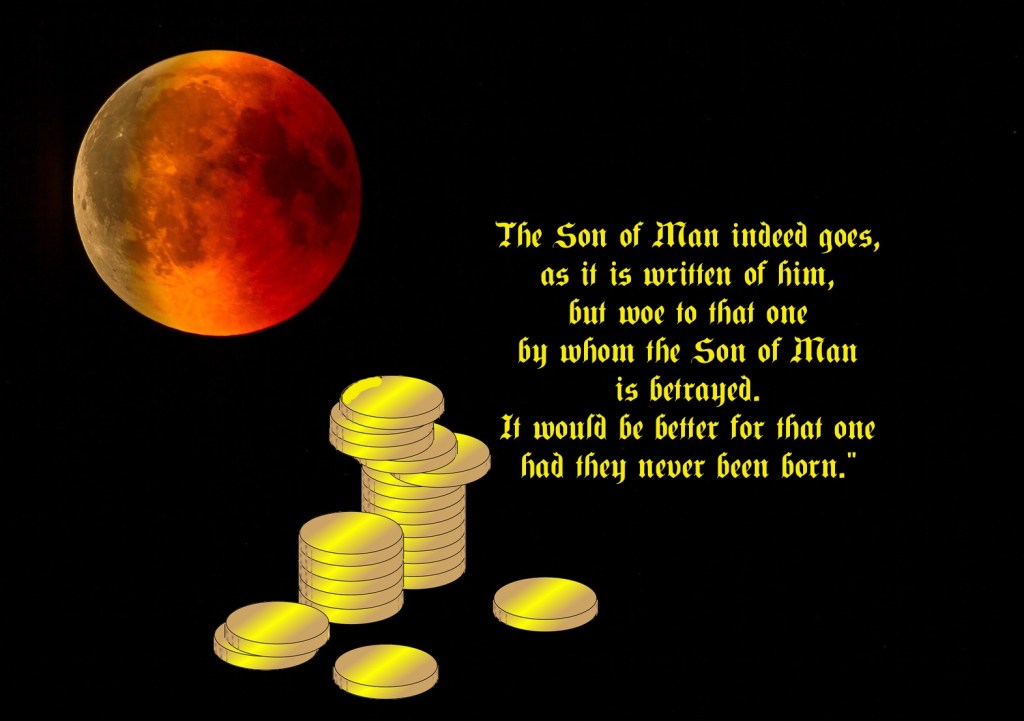
As we look to Jesus’s fidelity to find courage in our own challenges, we must also be starkly aware of what opposing infidelity looks like. We see it in the face of Judas – the Pretender who reclines at the Lord’s table, still eats the sacred food, dissembles his innocence while the blood-coins jingle in his pocket.

Once again, as the Passion story unfolds before us, we can find ourselves somewhere – perhaps many places – in its lines. Wherever that is, let us pray there with Jesus to be open in trust and fidelity to its transformative grace.


Poetry: Slow through the Dark – Paul Lawrence Dunbar

Slow moves the pageant of a climbing race;
   Their footsteps drag far, far below the height,
   And, unprevailing by their utmost might,
Seem faltering downward from each hard won place.
No strange, swift-sprung exception we; we trace
   A devious way thro’ dim, uncertain light,—
   Our hope, through the long vistaed years, a sight
Of that our Captain’s soul sees face to face.

   Who, faithless, faltering that the road is steep,
Now raiseth up his drear insistent cry?
   Who stoppeth here to spend a while in sleep
Or curseth that the storm obscures the sky?
   Heed not the darkness round you, dull and deep;
The clouds grow thickest when the summit’s nigh.


Music: The Betrayal of Judas – George Sviridov

The Twisted Kiss

Tuesday of Holy Week
April 4. 2023

Today’s Readings:

https://bible.usccb.org/bible/readings/040423.cfm

Today, in God’s Lavish Mercy, the clouds thicken around Jesus.

Reclining at table with his disciples, Jesus was deeply troubled and testified,
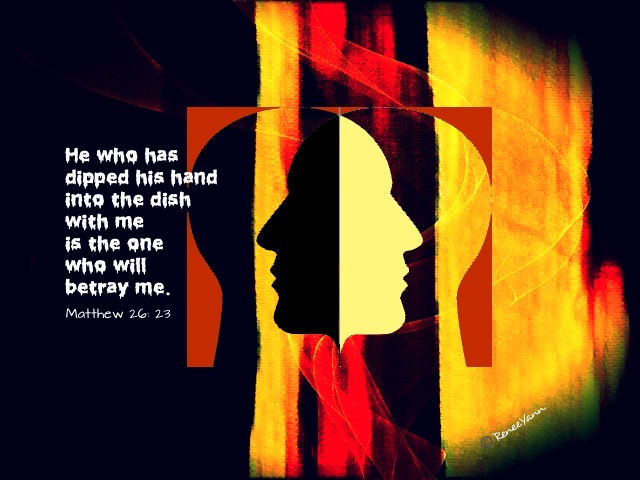
“Amen, amen, I say to you, one of you will betray me.”
The disciples looked at one another, at a loss as to whom he meant.

John 13:21

How painful for Jesus, and for these who have shared the glorious years of his ministry, to now sit with suspicion among yesterday’s friends. How lonely for each one as the dark force of doubt pushes them away from one another!

Only love can break through this kind of doubt, courageously exposing the truth in order that it might be reconciled and offered forgiveness:

One of his disciples, the one whom Jesus loved,
was reclining at Jesus’ side.
So Simon Peter nodded to him to find out whom he meant.
He leaned back against Jesus’ chest and said to him,
“Master, who is it?”

Jesus answered,
“It is the one to whom I hand the morsel after I have dipped it.”
So he dipped the morsel and took it and handed it to Judas,
son of Simon the Iscariot.

John 13: 21-26

As the rest of the Passion story unfolds, both Judas and Peter will need the kind of forgiveness these readings describe. Both prove false to Jesus’s trust. But one has the humble contrition to seek forgiveness. The other cannot forget himself enough to do so.


This “doubtful Tuesday” can teach us much about expectations, courage, truth, love, trust, humility, and forgiveness. Let us sit beside Jesus at the Gospel table and ask him, like the Disciples, how we measure up to his hope for us.


Poetry: Christ Washed the Feet of JudasGeorge Marion McClellan

Christ washed the feet of Judas!
The dark and evil passions of his soul,
His secret plot, and sordidness complete,
His hate, his purposing, Christ knew the whole.
And still in love he stooped and washed his feet.

Christ washed the feet of Judas!
Yet all his lurking sin was bare to him,
His bargain with the priest, and more than this,
In Olivet, beneath the moonlight dim,
Aforehand knew and felt his treacherous kiss.

Christ washed the feet of Judas!
And so ineffable his love ’twas meet,
That pity fill his great forgiving heart,
And tenderly to wash the traitor’s feet,
Who in his Lord had basely sold his part.

Christ washed the feet of Judas!
And thus a girded servant, self-abased,
Taught that no wrong this side the gate of heaven
Was ever too great to wholly be effaced,
And though unasked, in spirit be forgiven.

And so if we have ever felt the wrong
Of Trampled rights, of caste, it matters not,
What e’er the soul has felt or suffered long,
Oh, heart! this one thing should not be forgot:
Christ washed the feet of Judas


Music:  The Kiss – Joe Niemand 

Meet me in the garden
My love
Meet me there at midnight

At the place only we know
My love
A kiss awaits tonight

In the darkness between the flowers
My love
In the shadows of the moon

Your lips will tear the pretense like the curtain tomorrow afternoon

And so the glow of approaching torches
Makes the darkness dance like black flames
Ever faster to the music of every heart that refuses to be saved

I prayed this could be different
That my death could save you too
But your choices are your own
Now my friend, do what you came to do