Miserere

February 22, 2026
First Sunday of Lent


Supplication is a humble and earnest prayer
that asks God for specific spiritual or material aid. 


They stood quietly by a sunlit window. “I have forgotten how to have fun,” Anne said, gazing wistfully toward the wintering trees.

Her friend knew the statement to be true and did not argue. Recently retired, Anne had managed a heavy career by rigorously systematizing her life. She was dependable and predictable – like a trusted clock. But somehow, her joy had been caught in the gears.

Sometimes, change is as simple as confronting unexamined routines. At other times, it requires a profound turning. In this week’s readings, we hear the language of such radical transformation: “be reconciled, be holy, ask, repent, forgive” – words commanding a ruthless examination of our attitudes. They suggest that, in order to renew our hearts, we must let something in us die.

Paul begins the week reminding us that our sinful world is redeemable through the gracious gift of Jesus Christ. Believing this, we will have the courage for true transformation. Such faith frees us of our blindness to the unholy in our lives.

Throughout the week, Esther, Jonah, the God of Moses, and Jesus himself encourage us. We make this Lenten journey in the company Holy Ones who radicalized their lives in faith, awareness, action and joy.

Unless, like Anne, we discover some discomfort in our souls, we will not seek change. Such discovery requires that we pray at the windows of our souls. Have we forgotten the spring-like beauty of a life lived deeply in God? Have we never known it in the first place? This week, we are invited to seek God’s Mercy, to return to joy, or maybe to find it for the first time!


Music: Miserere Mei – Mozart


Suggested Reading:

Psalm 51, interpreted by Rev. Christine Robinson

Have mercy on me, O God,
For I’ve messed up again
Sinned against You in thought, word and deed,
and in what I have left undone.
Been–all too human.

Can you make me a new heart, O God?
and a right spirit? Can you break my willful plundering
of all that is Yours?
If I got it together again, others would follow—
I could teach, guide, help—and I would!

O Lord, open my lips,
that I may praise you.
I know you don’t want ritual sacrifice
were I to give a burnt offering you’d be exasperated.
What you want is that new heart and right spirit.
For this, I pray.


For Your Reflection:

  • What feelings or reactions do I have after reading this reflection?
  • Do my feelings or reactions remind me of any passage or event in scripture, especially in the life of Christ? 
  • What actions might I take today because of my response to these readings?

Joel’s Invitation

Ash Wednesday
February 18, 2026

Contrition is an act of the will, not just an emotion,
involving grief for past sins and a desire to regain God’s friendship.
There are two types:
perfect contrition, motivated by a love for God, and
imperfect contrition, motivated by a fear of punishment or hatred of sin.


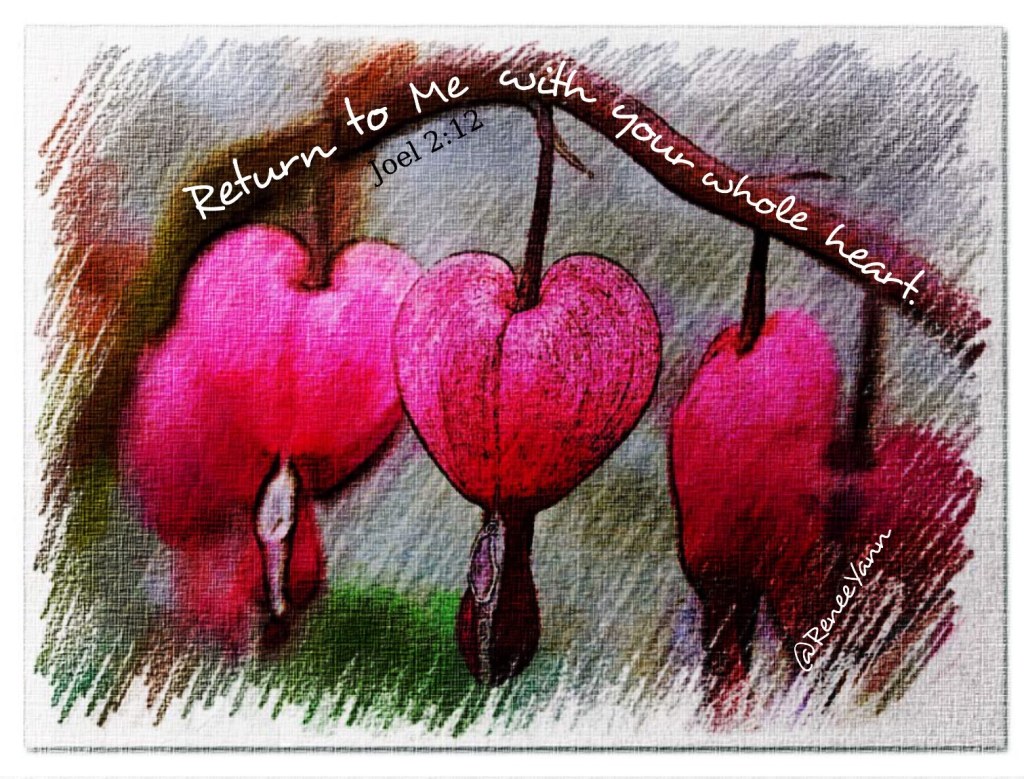
“Even now,” declares the LORD, “return to me with all your heart,
with fasting and weeping and mourning.”
Rend your heart and not your garments.
Return to the LORD your God Who is gracious and compassionate,
slow to anger and abounding in love, Who relents from overwhelming us.

Joel 2:12-13


“Even now…” – two of the most powerful words in scripture. Picture yourself saying them to a long-lost friend, or that friend to you. Even now – after all these years, after all you took for granted, after all your ingratitude, forgetfulness, pretense, indifference. Even now, I love and forgive you.

With the touch of sacred ashes, God reiterates that assurance to us … Even now, God waits and wants to restore us to wholeness, as in this story where you might even find yourself.


She had arranged to visit with an old college friend. They had been separated too long by the distancing choices that life often demands. She wanted to reconnect to that rare experience of shared transparency found just once or twice in a lifetime – the gift of a real friend.

They sat on a porch overlooking a gentle pond. The day was bright, the coffee hot, the chairs comfortable. But the magic was gone. Only half her friend had arrived for the cherished conversation. The other half – joy, adventure and the excess of youthful hope – had been lost. Somewhere in the intervening years, her friend had suffered a wound she did not share. This one afternoon would be too short a time to give that wound a name.

The ministry of healing requires time, whether it is to our own soul or to another’s that we bring the sweet ointment of restoration. It requires the quiet listening of a loving spirit. It requires the honest naming of wounds and the ardent desire to be made new.

As we begin our Lenten experience, God is waiting to receive us. God already knows the wounds we will bring to the conversation, already sees where our heart’s light has dimmed. God holds our half-heartedness next to his own heart and yearns to heal us.

Can we hear God’s unique invitation to us in this Lenten season? Can we confidently expose to the Divine gaze the depth of our need for grace and transformation? Can we journey with Christ, through his passion and death, to the wholeness we are called to?


Music: Parce Domine – 6th-century Latin antiphony sung here by A Capella Catholic Choir

Suggested Reading: Joel 2:12-17


For Your Reflection:

  • What feelings or reactions do I have after reading this reflection?
  • Do my feelings or reactions remind me of any passage or event in scripture, especially in the life of Christ? 
  • What actions might I take today because of my response to these readings?

The greatest among you …

February 16, 2026
Presidents Day

Humility is the virtue
that acknowledges our dependence on God,
involves a realistic self-knowledge
of both our strengths as gifts from God
and our weaknesses,
and restrains the desire to think
more highly of ourselves than we ought.
It opposes the deadly sin of pride.


Today, we honor the individuals who, in the office of President, have served the people of the United States with integrity. Some did it better than others, grounded, I think, in one indispensable virtue – humility.

Many Presidents seemed to have understood this critical virtue:

  • “Use power to help people. For we are given power not to advance our own purposes nor to make a great show in the world, nor a name. There is but one just use of power and it is to serve people.” ― George W. Bush
  • “No person was ever honored for what he received. Honor has been the reward for what he gave.” ― Calvin Coolidge
  • “Nobody cares how much you know, until they know how much you care.” ―Theodore Roosevelt
  • “It is amazing what you can accomplish if you do not care who gets the credit.” ― Harry S. Truman
  • “What are the things that you can’t see that are important? I would say justice, truth, humility, service, compassion, love. They’re the guiding lights of a life.” – Jimmy Carter

We may have varying political opinions about how each of these men delivered on their stated understanding. But they all executed their presidential service with honor, having accomplished something significant and generous for our country. They avoided pride and self-absorption, a deadly combination in any would-be leader—a combination that has been the downfall of several of their peers.


In a wonderful Gospel passage, Jesus confronts such budding pride in the Zebedee brothers, his apostles James and John. They lobby Jesus for premium seats in heaven. Jesus tells them that those seats come at a price they might not be willing to pay.

“You know that those who are regarded as rulers of the Gentiles lord it over them, and their high officials exercise authority over them. Not so with you. Instead, whoever wants to become great among you must be your servant, and whoever wants to be first must be subservient to all.”


Illustration by Eduardo Ramón Trejo.
Photos from Getty Images

Our Presidents have been called to live this kind of humble service to the nation. We thank God today for those who have answered the call well. We pray for brave women and men to answer this call in the future. May they model their service on the example of good presidents before them, and on the call of Jesus to serve God’s people in humility.


Music: Act Justly, Love Mercy, Walk Humbly – Pat Barrett

Suggested Scripture: Matthew 10:35-45

For Your Reflection:

  • What feelings or reactions do I have after reading this reflection?
  • Do my feelings or reactions remind me of any passage or event in scripture, especially in the life of Christ? 
  • What actions might I take today because of my response to these readings?
Valentine’s Lesson

February 14, 2026
St. Valentine’s Day


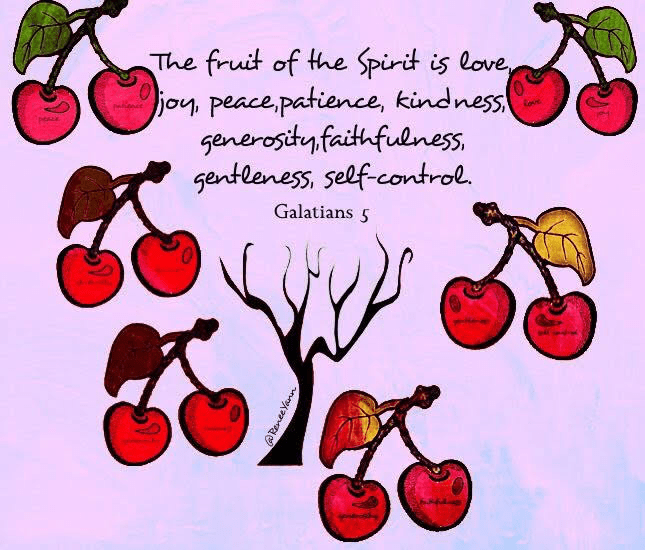
Benignity, a Fruit of the Holy Spirit, is defined as
compassionate and thoughtful action toward others.


Sister Gertrude was my beautiful 3rd-grade teacher. She was kindness itself in human form, the personification of “Benignity”.

About two weeks before Valentine’s Day, Sister said we could give one another “friendship cards” by posting them to the decorated box she had set in the classroom corner. On February 14th, the box would be opened and we would learn who our best friends were, and even if we might have some secret admirers! I was really excited because I was in love with Johnny Meyers, but I didn’t think he knew I was even alive. I thought this might help me find out!


It sounds like a delightful idea, doesn’t it, until you think about the couple of kids who don’t have any friends, or the ones whose families can’t afford the cost of cards.

I didn’t think about any of those things when I was eight years old, but I do remember one curious thing. On Valentine’s Day, every child in our classroom received several cards, even Henry Walsh whom we all shunned because he was mean and selfish. Besides, he wore his hair little bit like the monster kid from “The Blob”!


Then I realized that Sister’s conversation with me a week earlier might not have been an isolated incident. Maybe she had taken aside other kids besides me and given them three or four cards. Maybe she had encouraged them too to send a card to someone it was hard to like, or to someone who might not have friends. She had told me that we don’t always know what makes a person unlikable, but that usually it wasn’t their fault. Maybe a surprise card could help them out a little bit.

So, I sent a card to a few kids I didn’t like that much. And I learned the lesson Sister was trying to teach. It was the kind of lesson that kept on teaching for the next seventy years … and still going, each year with deeper understanding.


Yeah, and here’s the funny part that I have never fully unpacked. Henry Walsh, class mini-monster, sent ME a card! Apparently, he thought I didn’t have any friends, or maybe he wasn’t too thrilled with my hairdo either!


By the way, Johnny Meyers did send a card, and I don’t think it was one Sister gave him because it came with a friendship ring out of a Cracker Jack box. We all know what that means! Even I knew, and I was only in 3rd grade!

Nevertheless, I didn’t marry Johnny despite that Valentine’s Day proposal, but I learned a life-long lesson about love from Sister Gertrude.


Music: Try a Little Kindness – Glen Campbell’s song sung by Collin Raye

Suggested Reading: 1 Corinthians 13:1-13


For Your Reflection

  • What feelings or reactions do I have after reading this reflection?
  • Do my feelings or reactions remind me of any passage or event in scripture, especially in the life of Christ? 
  • What actions might I take today because of my response to these readings?

Fun=Joy in Action

February 7, 2026

Today’s news is full of impending competition – (even outside Washington 😂). Who will prevail, be the best, break the record, win the trophy?

But the opening of the Olympic Games and the start of Super Bowl weekend have me thinking about other kinds of games – the ones we play for fun, not to gain advantage.

Photo by Jim De Ramos on Pexels.com


Long ago, an older friend complained to me, “I have forgotten how to have fun!” The declaration startled me and left me speechless. If there was a formula, “young me” didn’t have it. However, over the decades of my own aging, I have pondered that remark, often examining my own life for signs of “fun diminishment”.

Those signs do seem to increase as responsibility grows or as energy wanes. What came naturally to us as children requires a little attention as we mature. As kids, we simply ran outside into the sunshine or rain, found somebody or something that absolutely entranced us, and magic happened.


I remember sitting on the front step with my friend Harry. We were both nine years old. I had just gotten a plastic camera in the mail with a quarter and a coupon from a cereal box. For an hour or so, we took pictures of pigeons perched on the telephone wires and garbage cans. We imagined ourselves expert artists creating a legacy for generations. It was easy then to forget that we were serious fourth-graders with unfinished homework, impending report cards, and a few chores before bedtime. It was also easy to forget that there was no film in the camera!


Later in life, that kind of beneficial forgetting is not so easy. We must unleash ourselves from a chain of “to dos” and “be carefuls”. We know better now. We don’t go out in the sun without screening, nor into the rain without an umbrella. We mostly try to avoid pigeons and garbage cans. Our potential “playgrounds” become much more constrained, sometimes inhibited by a false requirement of excessive money, planning, or chemical relaxation.


Examining my fun levels today, I realize how blessed I am.

My nieces, nephews, and grands live hundreds of miles away from me. Yet they provide me with invaluable links to pure fun. Every morning, a few of us play Wordl, Connections, or Crossplay together. I know they may be checking to see if I’m still alive, but the main purpose is fun – and the precious assurance of mutual care.

The younger kids delight me with photos of themselves doing modern imitations of Harry and me with the pigeons.
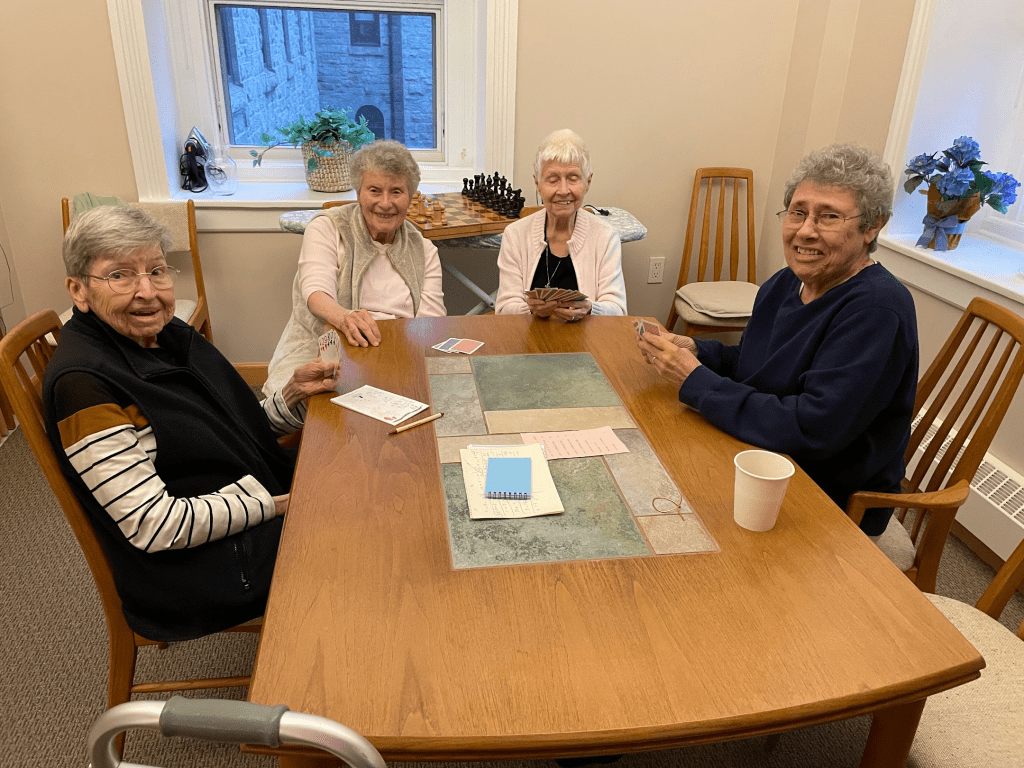
In our convent community rooms, I may find a game of pinochle, Hand and Foot, chess, bingo, or gin rummy. Even more precious, there always awaits a conversation with memories of good times, funny stories, and the generous abandon of enjoying one another.


So, if I came up with a fun formula today, it would include these essentials:

  • Fun is any “playground” where we find and give joy.
  • To have real fun, we don’t focus on the score.
  • We need time to have fun, just like we need time to eat, sleep, work, and pray.
  • We need to know what fun is – that it makes us laugh, appreciate the other, relax, and surrender self-importance
  • Fun is essentially spontaneous, but we can expose ourselves to its influence by not taking ourselves too seriously.
  • Fun always requires getting “outside” – even if it means only from our self-centeredness.
  • We can have fun alone with a game or movie, but it helps to have someone to have fun with, (and as Pope Leo said, someone not created by AI.)

Music: We All Stand Together – Paul McCartney

Let yourself be delighted by the thought of FUN!

Suggested Scripture: Ecclesiastes 3:9-13


For Your Reflection:

  • What feelings or reactions do I have after reading this reflection?
  • Do my feelings or reactions remind me of any passage or event in scripture, especially in the life of Christ? 
  • What actions might I take today because of my response to these readings?
Candlemas: A Seasonal Anchor

Feast of the Presentation
February 2, 2026

Candlemas,
also known as the Feast of the Presentation of Jesus Christ,
the Feast of the Purification of the Blessed Virgin Mary,
or the Feast of the Holy Encounter,
is a Christian feast day commemorating

the presentation of Jesus
at the Temple by Joseph and Mary.
It is based upon the account in
Luke 2:22–40.


How do the great trees die and come to life again? It’s a question we might ponder every winter as the bare, black branches fill with ice. Their stark emptiness seems a place from which there is no return. But we know otherwise. In the relentless cold of every February, our experience whispers the hope for April. Our liturgical year is filled with lynchpins to stabilize and orient us in this hope.


The Feast of Candlemas (February 2), an ancient celebration of hope, is one of the seasonal anchors Medieval people used to ground their faith through its various seasons. The Feast commemorates Mary’s Purification and the Presentation of Christ to the world – thus the candles!

Other ancient and seasonal feasts were:

May 3: Roodmas – celebrating the discovery and veneration of the True Cross (called “Rood” in Middle English)
Aug 1: Lammas – Originating from the Old English hlafmaesse (“loaf-mass”), it involved blessing loaves made from the new crop, signifying gratitude for the summer’s bounty and preparation for the coming winter.
Sept 29 Michealmas – Festival of St. Michael the Archangel, known as the protector against evil and leader of heaven’s armies
Nov 11 Martinmas – a festival celebrated on November 11th, marking the end of the harvest and the start of winter, honoring St. Martin of Tours, a soldier famous for sharing his cloak with a beggar, symbolizing light and charity as days grow shorter
Dec 25 Christmas – the ultimate celebration of hope in the Light of Jesus Christ


Like nature, each one of us has our seasons. Our lives contain the cycles of our youth and aging, birth and death. Our daily experiences turn in both the warm and the chilly intervals of our lives.

  • We have blossomed with the expectant life of spring: a new job, relationship, adventure.
  • We have cultivated love over warm summers of dedication and growth – our faith, families, friends, and ministries.
  • We have reaped the autumnal returns of our efforts, walking away from a red and golden field carrying a well-earned harvest – graduations, anniversaries, promotions, retirements.
  • Certainly, each of us has known our own winters, when cold has threatened and dark has isolated – and yet, like the trees – we have survived.

As we experience the depths of “Winter 2026”, Candlemas seems an opportune time to review the lessons of the season – especially the chapters on deep roots, inner quiet, and a hidden spiritual warmth that defies freezing.

In the winters of our lives, we learn what truly sustains us. We are called to delve into the power of endurance, resilience, forgiveness, honesty, loyalty, and faithfulness. These are the winter virtues that preserve life deep under the surface of any paralyzing storm. These are the salts that keep life’s highways passable, allowing us to stay connected to all that keeps us vibrant.

On any given day of the year, we can experience “winter”. Think of the times you have received (or given) the “cold shoulder. Remember when your explanations have been given an icy reception? Haven’t there been conversations where you were frozen out? Can’t you still see the frosty stare you got from someone who thought you were beneath them? We have all known some sub-zero responses when we were really looking for a warm word. We have all received some chilly greetings when we needed not to feel like an isolated stranger.


Hospitality is not listed as a Fruit of the Holy Spirit. Nevertheless, it is the melding of many of them. Hospitality is a radical welcome rooted in God’s love. It is the perfect antidote to all our methods of freezing one another out. It is the human anti-freeze that reminds us that we need one another’s warmth to survive the treacheries of life. It is a virtue to be deeply pondered in this societal age of frigid inhumanity to those we judge to be “alien”.

If there is someone in your life that you have exiled to the Arctic, consider reaching out in hospitality, care, forgiveness, or honesty. This winter, let go of the glacial grudges, silences, and harbored hurts that sometimes freeze our souls and kill our hope of returning life. Listen to the voice of the dark February nights. It is telling us how to move toward spring.


Music: We Are Called to Welcome Strangers – Jubilate

Suggested Scripture: 1 Peter 4:7-11

For Your Reflection:

  • What feelings or reactions do I have after reading this reflection?
  • Do my feelings or reactions remind me of any passage or event in scripture, especially in the life of Christ? 
  • What actions might I take today because of my response to these readings?