Sister Renee Yann, RSM, D.Min, is a writer and speaker on topics of spirituality, mission, and ethical business practice. After twenty years in teaching and social justice ministry, she served for over thirty years in various mission-related roles in Mercy Health System of Southeastern Pennsylvania.
Today, in God’s Lavish Mercy, we pray with Psalm 86, a very personal prayer. The kingdom, the nation, the people are not mentioned. It is a plea from one aching heart to its merciful God.
Each one of us has been that person on occasion. We may not have employed the exact words of Psalm 86, but we have prayed its sentiments in our own way.
HARKEN!
For me, that prayer is grounded in two powerful verbs, intimate requests made to a God Who might otherwise seem distant in our times of trouble.
Incline and Harken
Let’s just walk and talk with our listening God today. Feel God bend near to listen. Listen in return.
Poetry: Listen, can you hear it? by Rabindranath Tagore
Listen, can you hear it?God’s bamboo flute speaksthe pure language of love.The moon enlightens the trees,the path, the sinuous River.Oblivious of the jasmine's scentI stagger around,disheveled heart bereft of modesty,eyes wet with angst and delight.Tell me, dear friend, say it aloud:is God not my own Dark Lord?Is it not my name God’s flute poursinto the empty evening?For eons I longed for God,I yearned to know the Holy One.That's why God has come to me now,deep emerald Lord of my breath.O Lord, whenever your faraway flute thrillsthrough the dark, I say your name,only your name, and will my body to dissolvein your luminous River.
Hear me, Lord, in this moment.
What's stopping you?
The earth drowns in sleep.
Let's go. I'll walk with you, talk with you.
Today, in God’s Lavish Mercy, we pray with Psalm 51, that magnificent penitential psalm which is one of only seven among the 150. The psalm, set between two readings that do with fasting, suggests that what we should “fast” from is sin.
Some interpreters attribute the psalm to David, deeply repentant after his treacherous acts toward Uriah and Bathsheba. Others say that this was a subsequent assignation because the psalm so fit the incident.
Whatever the case, Psalm 51 gives of us a picture of someone profoundly aware of failure in faithfulness to God – not just a sin against another human being, but against God.
For I acknowledge my offense, and my sin is before me always: “Against you only have I sinned, and done what is evil in your sight.”
Psalm 51:5-6
Still, coupled with this aching repentance is the absolute conviction of God’s superseding Mercy.
Have mercy on me, O God, in your goodness; in the greatness of your compassion wipe out my offense. Thoroughly wash me from my guilt and of my sin cleanse me.
Psalm 51: 3-4
The psalmist has a large, lyrical notion in mind: that God should take the scattered, chaotic, failed self that he is, and out of it form a new, restored self. The movement from failed self to restored self is a gift asked of God in confidence.
Walter Brueggemann: From Whom No Secrets Are Hid
Praying with this psalm, the symbol of an arrow came to mind. You might have noticed the symbol recently on Valentines Day, used to describe the power of love to engage the heart.
But if the arrow is broken, how will it be made whole again?
Lord, you will open my lips; and my mouth will proclaim your praise. For you do not desire sacrifice or I would give it; a burnt offering you would not accept. My sacrifice, O God, is a contrite spirit; a contrite, humbled heart, O God, you will not scorn.
Psalm 51:17-19
On this Lenten journey, may we bring contrite hearts – our “broken arrows” – to God, asking to recognize our failures in love and to repent sincerely of them.
Poetry: Possible Answers to Prayer by Scott Cairns
Your petitions—though they continue to bear
just the one signature—have been duly recorded.
Your anxieties—despite their constant,
relatively narrow scope and inadvertent
entertainment value—nonetheless serve
to bring your person vividly to mind.
Your repentance—all but obscured beneath
a burgeoning, yellow fog of frankly more
conspicuous resentment—is sufficient.
Your intermittent concern for the sick,
the suffering, the needy poor is sometimes
recognizable to me, if not to them.
Your angers, your zeal, your lipsmackingly
righteous indignation toward the many
whose habits and sympathies offend you—
these must burn away before you’ll apprehend
how near I am, with what fervor I adore
precisely these, the several who rouse your passions.
Music: Broken Arrow – Let God turn your whole world around in this song by Rod Stewart
Who else is gonna bring you a broken arrow
Who else is gonna bring you a bottle of rain
There he goes moving across the water
There he goes turning my whole world around

Do you feel what I feel
Can we make it so that's part of the deal
I gotta hold you in these arms of steel
Lay your heart on the line this time

I want to breathe when you breathe
When you whisper like that hot summer breeze
Count the beads of sweat that cover me
Didn't you show me a sign this time

Who else is gonna bring you a broken arrow
Who else is gonna bring you a bottle of rain
There he goes moving across the water
There he goes turning my whole world around, around

Do you feel what I feel
Do you feel what I feel
Ah can you see what I see
Can you cut behind the mystery
I will meet you by the witness tree
Leave the whole world behind

I want to come when you call
I'll get to you if I have to crawl
They can't hold me with these iron walls
We got mountains to climb, to climb

Who else is gonna bring you a broken arrow
Who else is gonna bring you a bottle of rain
There he goes moving across the water
There he goes turning my whole world around
Turning my whole world around
Turning my whole world around
Today, in God’s Lavish Mercy, we pray with Psalm 1, a familiar reminder of what a working relationship with God looks like:
Blessed the one who follows not the counsel of the wicked Nor walks in the way of sinners, nor sits in the company of the insolent, But delights in the law of the LORD and meditates on God’s law day and night.
Psalm 1:1-2
The phrases in that little verse are so powerful!
We have seen all too clearly what happens when people “follow the counsel of the wicked”. We know how easily we can be infected by the negativity of “the insolent”. There is a spiritual distemper in us when these fractious humors fill the atmosphere.
Instead, we seek the peace and delight of being right with God. We embrace God’s law as a support and inspiration to guide us.
When we think of God’s Law, we might rightly think of the Commandments, the Beatitudes, the Torah, the Gospel – those places where we find the Law codified in words.
But we might also think of God’s Law as that silent omnipotent force that lifts the sun from darkness and sets it down again, that holds the seas in their global bowl, that lights the night with fiery stars.
Affinity with God’s Law is that loving practice which, by intrinsic prayer and reflection, gives over every moment of our lives to God’s order. That alignment, rooting us in God’s “due season”, allows goodness to blossom in us like a fruitful tree – an unfading, abundant harvest …
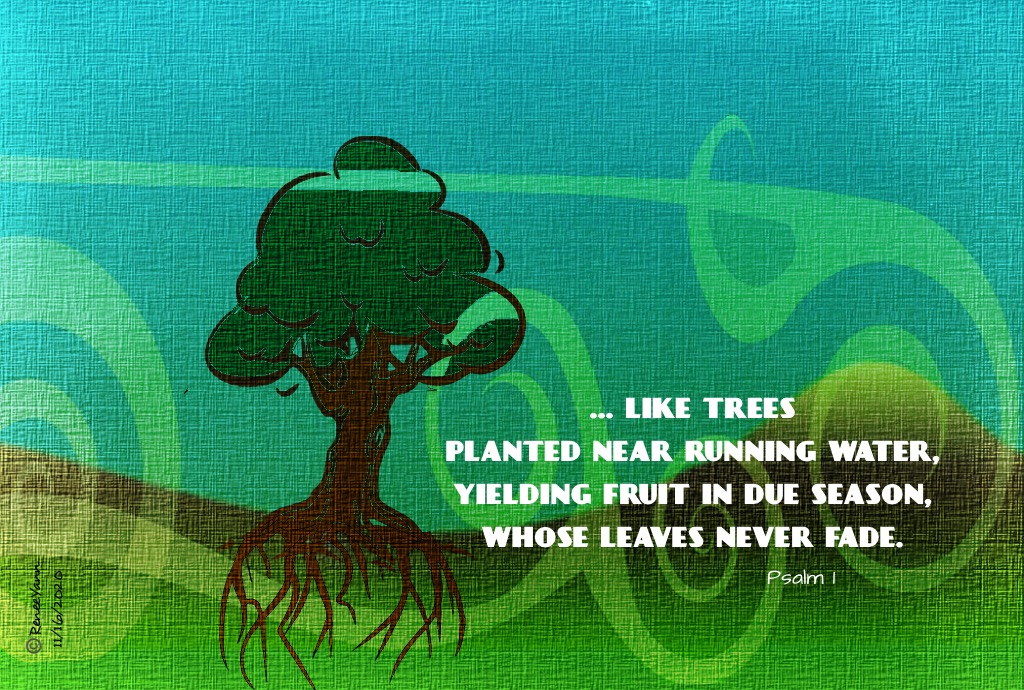
Like a tree planted near running water, That yields its fruit in due season, and whose leaves never fade, ever prospering.
Psalm 1:3
Poetry: Onto a Vast Plain – Rainer Maria Rilke
Listen.
You are not surprised at the force of the storm—
you have seen it growing.
The trees flee. Their flight
sets the boulevards streaming. And you know:
he whom they flee is the one
you move toward. All your senses
sing him, as you stand at the window.

The weeks stood still in summer.
The trees’ blood rose. Now you feel
it wants to sink back
into the source of everything. You thought
you could trust that power
when you plucked the fruit:
now it becomes a riddle again
and you again a stranger.

Summer was like your house: you know
where each thing stood.
Now you must go out into your heart
as onto a vast plain. Now
the immense loneliness begins.

The days go numb, the wind
sucks the world from your senses like withered leaves.

Through the empty branches the sky remains.
It is what you have.
Be earth now, and evensong.
Be the ground lying under that sky.
Be modest now, like a thing
ripened until it is real,
so that he who began it all
can feel you when he reaches for you.
Today, in God’s Lavish Mercy, as we begin the Holy Season of Lent, we pray with Psalm 51. It is an elegiac summons the Lord offers to those who hunger for restoration, for those on hope’s last shore.
Blow the trumpet in Zion! proclaim a fast, call an assembly; Gather the people, notify the congregation; Assemble the elders, gather the children and the infants at the breast; Let the bridegroom quit his room and the bride her chamber.
Perhaps there is something that dramatic in your life that you will want to bring to God’s Mercy. But for many of us, Lent is a time to stop ignoring the little things in our lives that cripple our full redemption.
Those:
unforgiven hurts
unresolved angers
petty jealousies
unloving criticisms
unkindnesses
petty cynicisms.
It is a time to face up to our failures to pray, listen, hope, encourage, witness, truth-tell, bless.
It is a time to:
become poor in spirit
mourn our suffering world
be meek before the power God’s Word
deepen in hunger and thirst for righteousness
be merciful
be pure of heart
be peacemaking
befriend persecuted
Lent reminds us that it’s not good enough to be good enough. Lent is about the “whole heart” thing. Is there anything keeping us from it?
Even now, says the LORD, return to me with your whole heart, with fasting, and weeping, and mourning; Rend your hearts, not your garments, and return to the LORD, your God.
Psalm 51 gives us a time-tested formula for a transformative Lent:
acknowledge sinfulness
ask forgiveness
act on God’s Grace
give thanks for God’s mercy
It’s a cycle we should repeat daily, but during Lent it’s time to take it up a notch.
Poetry: Marked by Ashes – Walter Brueggemann
Ruler of the Night, Guarantor of the day… This day — a gift from you. This day — like none other you have ever given, or we have ever received. This Wednesday dazzles us with gift and newness and possibility. This Wednesday burdens us with the tasks of the day, for we are already halfway home halfway back to committees and memos, halfway back to calls and appointments, halfway on to next Sunday, halfway back, half frazzled, half expectant, half turned toward you, half rather not.
This Wednesday is a long way from Ash Wednesday, but all our Wednesdays are marked by ashes — we begin this day with that taste of ash in our mouth: of failed hope and broken promises, of forgotten children and frightened women, we ourselves are ashes to ashes, dust to dust; we can taste our mortality as we roll the ash around on our tongues.
We are able to ponder our ashness with some confidence, only because our every Wednesday of ashes anticipates your Easter victory over that dry, flaky taste of death.
On this Wednesday, we submit our ashen way to you — you Easter parade of newness. Before the sun sets, take our Wednesday and Easter us, Easter us to joy and energy and courage and freedom; Easter us that we may be fearless for your truth. Come here and Easter our Wednesday with mercy and justice and peace and generosity.
We pray as we wait for the Risen One who comes soon.
Today, in God’s Lavish Mercy, we pray with Psalm 29 which describes the settling of peace over an ended storm.
The voice of the LORD is over the waters, the LORD, over vast waters. The voice of the LORD is mighty; the voice of the LORD is majestic.
Psalm 29:3
This gift of peace invites the psalmist to give glory to the Lord, and to do so in a celebratory manner:
Give to the LORD the glory due his name; adore the LORD in holy attire.
Psalm 29:4
Reading this little verse this morning, I was reminded of my novitiate days. What a profound joy and thrill it was for me to receive the habit of the Sisters of Mercy. I count myself fortunate to have entered just in time to wear the original habit – just for fourteen months before we adopted a modified style.
Each morning as we dressed, we said a specific prayer over each component of the habit. The prayers were beautiful and served to orient us to the duties and blessings of the day.
Psalm 29 reminds us to give thanks for our blessings – and our challenges – as we begin and end each day. But it specifically says that we should clothe ourselves in “holy attire” as we pray. In his letter to the Colossians, Paul describes such attire:
Therefore, as the elect of God, holy and beloved, clothe yourselves with heartfelt mercy, Kindness, humility, gentleness, and patience. Bear with one another and forgive any complaint you may have against another. Forgive as the Lord has forgiven you. And over all these virtues put on love, which is the bond of perfect unity. Let the peace of Christ rule in your hearts, for to this you were called as members of one body. And be thankful.
Colossians 3:12-15
Poem: She Walks in Beauty by Lord Byron
May we walk, attired in the beauty of God’s Grace and peace.
She walks in beauty, like the night
Of cloudless climes and starry skies;
And all that’s best of dark and bright
Meet in her aspect and her eyes;
Thus mellowed to that tender light
Which heaven to gaudy day denies.

One shade the more, one ray the less,
Had half impaired the nameless grace
Which waves in every raven tress,
Or softly lightens o’er her face;
Where thoughts serenely sweet express,
How pure, how dear their dwelling-place.

And on that cheek, and o’er that brow,
So soft, so calm, yet eloquent,
The smiles that win, the tints that glow,
But tell of days in goodness spent,
A mind at peace with all below,
A heart whose love is innocent!
Music: Because You Are Chosen – John Michael Talbot
Because you are chosen
Called to be holy
Because you are the Lord’s beloved
You must clothe yourself with kindness
With heartfelt mercy
In the meekness of humility
So bear you now with one another
And forgive as the Lord’s forgiven you
Over all these virtues
Bind them all together
In the Love of our Lord Jesus
Over all these virtues
Bind them all together
In the Love of our Lord Jesus
Over all these virtues
Bind them all together
In the Love of our Lord Jesus.
Today, in God’s Lavish Mercy, we pray with Psalm 50, set as a scene from a court proceeding. That seems rather appropriate after watching the impeachment proceedings, doesn’t it!
Psalm 50 is written to evoke the imagery of trial in which God calls all Creation as witnesses.
God the LORD has spoken and summoned the earth, from the rising of the sun to its setting.
Psalm 50: 1
God expresses displeasure to the people about two specific things.
The substance of their sacrifices:
Offer praise as your sacrifice to God; fulfill your vows to the Most High. Then call on me on the day of distress; I will rescue you, and you shall honor me.
Psalm 50: 15-16
2. Their blatant hypocrisy:
But to the wicked God says: “Why do you recite my commandments and profess my covenant with your mouth? You hate discipline; you cast my words behind you!
Psalm 50: 17-18
in judgement, God requires a conversion in the people:
Now understand this, you who forget God, lest I start ripping apart and there be no rescuer.
Psalm 50:23
The psalm’s imagery was no doubt effective for its first listeners because they, like us, had witnessed many a court proceeding that was all about “law” but very little about justice. They recognized hypocrisy clothed in pretense, even in themselves.
God, on the other hand speaks clearly about truth and justice:
Those who offer praise as a sacrifice honor me; I will let him whose way is steadfast look upon the salvation of God.
Psalm 50: 24
Praise is the prayer of a humble, aware, truthful, and obedient spirit. Our Gospel verse instructs us that we learn how to offer a sacrifice of praise by living in the pattern of Jesus:
I am the way and the truth and the life, says the Lord; no one comes to the Father except through me.
A Poem for Barack Obama’s Presidential Inauguration
Each day we go about our business,
walking past each other, catching each other’s
eyes or not, about to speak or speaking.

All about us is noise. All about us is
noise and bramble, thorn and din, each
one of our ancestors on our tongues.

Someone is stitching up a hem, darning
a hole in a uniform, patching a tire,
repairing the things in need of repair.

Someone is trying to make music somewhere,
with a pair of wooden spoons on an oil drum,
with cello, boom box, harmonica, voice.

A woman and her son wait for the bus.
A farmer considers the changing sky.
A teacher says, Take out your pencils. Begin.

We encounter each other in words, words
spiny or smooth, whispered or declaimed,
words to consider, reconsider.

We cross dirt roads and highways that mark
the will of some one and then others, who said
I need to see what’s on the other side.

I know there’s something better down the road.
We need to find a place where we are safe.
We walk into that which we cannot yet see.

Say it plain: that many have died for this day.
Sing the names of the dead who brought us here,
who laid the train tracks, raised the bridges,

picked the cotton and the lettuce, built
brick by brick the glittering edifices
hey would then keep clean and work inside of.

Praise song for struggle, praise song for the day.
Praise song for every hand-lettered sign,
the figuring-it-out at kitchen tables.

Some live by love thy neighbor as thyself,
others by first do no harm or take no more
than you need. What if the mightiest word is love?

Love beyond marital, filial, national,
love that casts a widening pool of light,
love with no need to pre-empt grievance.

In today’s sharp sparkle, this winter air,
any thing can be made, any sentence begun.
On the brink, on the brim, on the cusp,

praise song for walking forward in that light.
Music: Total Praise – Richard Smallwood
I just love this hymn and this choir!
Lord, I will lift my eyes to the hills
Knowing my help is coming from You
Your peace You give me in time of the storm
You are the source of my strength
You are the strength of my life
I lift my hands in total praise to You
You are the source of my strength
You are the strength of my life
I lift my hands in total praise to You
Amen, Amen, Amen, Amen
Amen, Amen, Amen, Amen
You are the source of my strength
You are the strength of my life
I lift my hands in total praise to You
Amen, Amen, Amen, Amen
Amen, Amen, Amen, Amen
Today, in God’s Lavish Mercy, we pray with Psalm 32 in which the psalmist expresses joy at being delivered from great suffering.
On this Valentines Day, our culture incentivizes us to think about “love”.
But our psalm might ask us to ponder that the greatest suffering is to believe, quite falsely, that we are unloved – or worse, unloveable. Still, Psalm 32 assures us that we are never unloveable to our God:
Then I acknowledged my sin to you my guilt I covered not. I said, “I confess my faults to the LORD,” and you took away the guilt of my sin.
Psalm 32
One of the reasons we are drawn to love is that the Beloved delivers us from “trouble”, brings us light, peace, comfort, hope, courage. The true Beloved allows us to see ourselves as beloved too. And we respond in love!
On this Valentines Day, you may have many dear human hearts to whom you wish to tell your love. But most important, in your prayer, tell the One Who is Love within you. And listen to Love telling you the same.
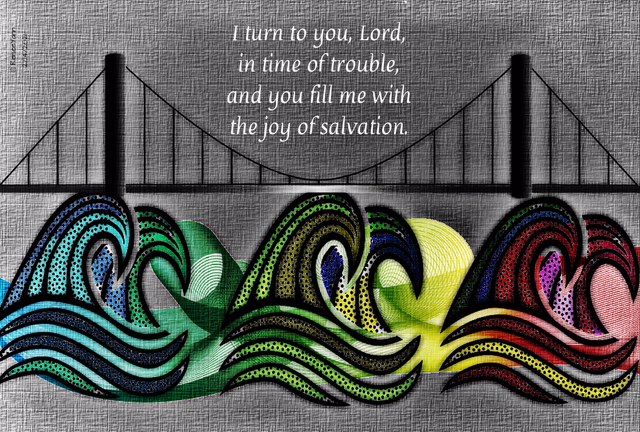
Poem: Bridges – Marion Strober
Music: Bridge Over Troubled Water – Simon and Garfunkel
Today, in God’s Lavish Mercy, we pray with Psalm 90, one of my favorites.
The psalm is so rich that it really needs no help to engage our prayer. But if you would like to pray with these, here are links to earlier reflections on Psalm 90.
Or, you might instead, wish to pray simply with the beautiful transliteration below and/or with one of these lovely pieces of music.
Poetry: Psalm 90 Life and Death - Christine Robinson
We have come out of the Earth
and to the Earth we return
Our lives are but a flash in the light of Eternity.
We are like beautiful flowers which live only a day.
We might live 70 years—more if our strength holds.
So much work and hardship!
How quickly the time passes.
Teach us then, to value our days
to treat each one as a sacred trust.
Fill our hearts with wisdom.
and a love for our lives.
In spite of all the grief and suffering
May we be always glad of this precious gift
And hallow the good in each day.
Music: Two selections today
In Every Age: Janèt Sullivan Whitaker
Long before the mountains came to be
And the land and sea and stars of the night,
Through the endless seasons of all time,
You have always been,
You will always be.
In ev'ry age, O God, you have been our refuge.
In ev'ry age, O God, you have been our hope.
Destiny is cast, and at your silent word
We return to dust and scatter to the wind.
A thousand years are like a single moment gone,
As the light that fades
At the end of day.
Teach us to make use of the time we have.
Teach us to be patient even as we wait.
Teach us to embrace our ev'ry joy and pain.
To sleep peacefully,
And to rise up strong.
You have been our refuge
You have been our hope.
Today, in God’s Lavish Mercy, we pray with Psalm 32, a classic penitential psalm.
It is an uncomplicated description of repentance and forgiveness which, nevertheless, discloses profound insights into the human spirit.
Blessed is the one whose fault is taken away, whose sin is covered. Blessed the one to whom the LORD imputes not guilt, in whose spirit there is no guile.
Psalm 32:1-2
This relational sequence of confession and forgiveness is probed in depth in Psalm 32 (where) the speaker describes his silence and his consequent bodily disability (vv. 3–4). One can observe in the psalm an inchoate theory of repression that became definitive for Sigmund Freud. Repression immobilizes, says the psalmist! The abrupt move in verse 5 concerns the process of making his sin known, saying it aloud, confessing it.
It is confession that makes forgiveness possible. It is denial that precludes assurance and that immobilizes the perpetrator.
Walter Brueggemann, From Whom No Secrets Are Hid
Praying with Psalm 32 this morning reminded me of a story I wrote a few years ago.
The Earring
Young Emma, skewered by indecision, had stared into her mother’s jewelry box. She had always loved those silver earrings, a gift to her mother from her grandmother—an heirloom now, a treasure beyond price. She wanted so to wear them on this special date, but they were “hands off” and she knew it. Still, her mother at work and unaware of her desire, Emma had succumbed to temptation.
The dance had been wonderful, a whirlwind of such delight that Emma had not noticed when her left earring had brushed against her partner’s shoulder, tumbling hopelessly under the dancers’ trampling feet. Only at evening’s end, approaching her front door exhausted and dreamy, had she reached up to unclip the precious gems.
Her mother sat waiting for her in the soft lamplight, having already noticed the earrings missing from her dresser. Awaiting retribution, Emma knelt beside her mother and confessed the further sacrilege of loss. But her mother simply cupped Emma’s tearful face in her hands, whispering, “You are my jewel. Of course I forgive you.” Though accustomed to her mother’s kindness, this act of compassion astonished Emma, filling her with an indescribable, transformative gratitude.
As we pray Psalm 32, there may be a great forgiveness we are thankful for, or just the small kindnesses that allow us to rise each morning with joy and hope. Perhaps there is a memory of compassion, like Emma’s, that we treasure—one that in turn has made us kinder and more honest.
But maybe, on the other hand, there is a “lost earring”, never acknowledged. With time, that unacknowledgement burrows deeper into the spirit restricting our capacity to love.
Psalm 32 reminds us that God is our Mother waiting in the lamplight to cup our face with love, to receive our joyful thanks for divine mercies.
For this shall every faithful soul pray to you in time of stress. Though deep waters overflow, they shall not reach us.
Psalm 32:6
Like Emma, we may be astonished at the graciousness that has been given to us. We may respond by pouring out our thanks to God in a silent act of prayer.
May we also have the courage to become like our merciful God, anticipating the other’s need for our forgiveness. May we seek the strength not to harbor injury, but too release it to make room for further grace in our hearts.
Poetry: FIRST FORGIVENESS - Irene Zimmerman
The usually mild evening breeze
became a wailing wind
when the gates clanged shut behind them.
They shivered despite their leathery clothes
as they searched for the fragrant blossoms
they’d grown accustomed to sleep on,
but found only serpentine coils
that bit and drew blood from their hands. It was Eve who discovered the cave.
When she emerged, she saw Adam
standing uncertainly at the entrance. A river of fire flooded her face
as she remembered his blaming words—
“The woman you gave me,
she gave me fruit from the tree,
and I ate.”

“Spend the night wherever you choose,”
she told him bitterly.
“You needn’t stay with me.” Long afterwards, when even the moon’s
cold light had left the entrance
and she’d made up a word
for the hot rain running from her eyes,
she sensed Adam near her in the dark. His breath shivered on her face.
“Eve,” he moaned,
“I’m sorry. Forgive me.” In the darkness between them
the unfamiliar words
waited, quivering.
She understood their meaning
when she touched his tears.
Music: Father, I Have Sinned – Eugene O’Reilly
Our story above was about a “prodigal daughter”. Our music is about a “prodigal son”.
Today, in God’s Lavish Mercy, we pray with Psalm 128 which some describe as a blueprint for a happy home.
Happy are they all who fear the Lord, and who follow in the ways of God! You shall eat the fruit of your labor; happiness and prosperity shall be yours. Your wife shall be like a fruitful vine within your house, your children like olive shoots round about your table.
Psalm 128, Canadian Inclusive Psalter
As lovely as it is, this interpretation may be overly simple.
Psalm 128, written in the post-exilic period, is the people’s song of gratitude for the chance to return to their homeland after the Babylonian captivity.
For Israel, the captivity was the result of their faithlessness to their covenant with God. The core sentiment of the psalm is awareness, repentance, and conviction to live life more intentionally – to live in fear of the Lord and thus preserve oneself from future calamity:
Blessed are you who fear the LORD, who walk in the Lord’s ways!
For us, that word “fear” is a tough one. It seems to contradict our desired relationship with the God who is Love, the God we have met in the person of Jesus Christ. How do we reconcile the contradiction?
Proverbs tells us this:
The fear of the LORD is the beginning of wisdom, and knowledge of the Holy One is understanding.
Proverbs 9:10
So this “fear” is significantly different from the emotion we might feel when, for example, we hear an unfamiliar noise in our darkened house.
Thus the ‘fear of the Lord’ is a relational term signifying the Israelites’ response to God’s grace displayed in salvation (especially the Exodus). As Walter Brueggemann has aptly written, it means: to take God with utmost seriousness as the premise and perspective from which life is to be discerned and lived. That ‘utmost seriousness’ requires attentiveness to some things rather than others, to spend one’s energies in response to this God who has initiated our life.
Mark J. Boda, Professor of Old Testament, McMaster Divinity College
This, in fact, is the rich sentiment underlying Psalm 128, and that will yield the security of an intimate relationship with God
May the LORD bless you from Zion; may you see Jerusalem’s prosperity all the days of your life, and live to see your children’s children. Peace upon Israel!
Psalm 128: 4-5
…as our life unfolds in God’s grace.
The psalmist’s “fear” might be more akin to awe, reverence, glad obedience to our God who loves us and wills our good. It is a virtue rooted in our search for a holy awe and wisdom as our life unfolds in God’s Grace:
Old Testament scholar, Walter Brueggemann, says we live in a technological society that has grossly confused knowledge and wisdom. He says wisdom is the mystery, held by God, about how and why life works…how creation holds together…and how human reason has its limits. Wisdom is God’s secret and even our bold Enlightenment expectations barely lay a finger on that secret. Wisdom involves recognizing limits before the mystery of God. Knowledge has to do with control, says Brueggemann. Wisdom has to do with awe.
William M. Klein, Pastor, Lexington Presbyterian Church
Poem: I Am Bending My Knee Originally from the Carmina Gadelica I, 3. Taken from Esther de Waal, editor, The Celtic Vision (Liguori, MO: Liguori/Triumph, 1988, 2001), p. 7.
I am bending my knee
In the eye of the Father who created me,
In the eye of the Son who purchased me,
In the eye of the Spirit who cleansed me,
In friendship and affection.
Through Thine own Anointed One, O God,
Bestow upon us fullness in our need,
Love towards God,
The affection of God,
The smile of God,
The wisdom of God,
The grace of God,
The fear of God,
And the will of God
To do on the world of the Three,
As angels and saints
Do in heaven;
Each shade and light,
Each day and night,
Each time in kindness,
Give Thou us Thy Spirit.
Music: The Fear of the Lord – First Baptist Dallas (Wow! How about this music ministry!)






























 Lavish Mercy