Fasting

Friday after Ash Wednesday
February 16, 2024

Today’s Readings:

https://bible.usccb.org/bible/readings/021624.cfm


This, rather, is the fasting that I wish:
releasing those bound unjustly,
untying the thongs of the yoke;
Setting free the oppressed,
breaking every yoke;
Sharing your bread with the hungry,
sheltering the oppressed and the homeless;
Clothing the naked when you see them,
and not turning your back on your own.
Then your light shall break forth like the dawn,
and your wound shall quickly be healed;
Your vindication shall go before you,
and the glory of the LORD shall be your rear guard.
Then you shall call, and the LORD will answer,
you shall cry for help, and he will say: Here I am!

Isaiah 58:6-9

In today’s passage from Isaiah, we are given clear instructions about fasting – some forms of this practice matter more than others.

Depriving oneself of physical comforts is an ancient practice of penance. It is intended to make us more prayerfully aware of the dynamic of sin and grace in our lives. But obviously, it is a self-centered spiritual practice.

Our reading tells us that God desires an other-centered fasting – the practice of mercy toward our sisters and brothers. And Isaiah is clear about who those needy brethren are.

Today, in God’s Lavish Mercy

In order to practice this mercy-centered fasting, there must be touch-points in our lives where we meet those in need. Today, we might examine our lives for our degree of insulation or isolation from society’s needy ones. We may isolate them by our attitudes, by our prejudices, by our physical distance, or perhaps just by our indifference.

Let’s ask ourselves today, “How might I reach out in prayer, service, and tenderness toward those who are in need of mercy?”


Poetry: Fasting – translated from Rumi

There's hidden sweetness in the stomach's emptiness.
We are lutes, no more, no less. If the soundbox
is stuffed full of anything, no music.
If the brain and belly are burning clean
with fasting, every moment a new song comes out of the fire.
The fog clears, and new energy makes you
run up the steps in front of you.

Be emptier and cry like reed instruments cry.
Emptier, write secrets with the reed pen.
When you're full of food and drink, Satan sits
where your spirit should, an ugly metal statue
in place of the Spirit. When you fast,
good habits gather like friends who want to help.

Fasting is Solomon's ring. Don't give it
to some illusion and lose your power,
but even if you have, if you've lost all will and control,
they come back when you fast, like soldiers appearing
out of the ground, pennants flying above them.
A table descends to your tents,
Jesus' table.

Expect to see it, when you fast, this table
spread with other food, better than the broth of cabbages.

Music: Forty Days and Forty Nights

Forty days and forty nights
You were fasting in the wild;
Forty days and forty nights
Tempted, and yet undefiled.

Shall not we your sorrow share
And from worldly joys abstain,
Fasting with unceasing prayer,
Strong with you to suffer pain?

Then if Satan on us press,
Flesh or spirit to assail,
Victor in the wilderness,
Grant we may not faint nor fail!


So shall we have peace divine;
Holier gladness ours shall be;
Round us, too, shall angels shine,
Such as served You faithfully.


Keep, O keep us, Savior dear,
Ever constant by your side,
That with you we may appear
At th’eternal Eastertide

Choose!

Thursday after Ash Wednesday
February 15, 2024

Today’s Readings:

https://bible.usccb.org/bible/readings/021524.cfm


Choose life, then,
that you and your descendants may live, by loving the LORD, your God,
heeding his voice, and holding fast to him.
For that will mean life for you,
a long life for you to live on the land that the LORD swore
he would give to your fathers Abraham, Isaac and Jacob.

Deuteronomy 30:19-20

The capacity to choose is a Divine gift that enables us to will our relationship with God. God desires the gift of our free choice to love Him.

What an act of divine courage for God to place hope in us! God does not demand our love. God waits for us to choose.

And God does not punish us if we choose otherwise. The choice is its own punishment because it is a rejection of the gift of divine life.


Today, in God’s Lavish Mercy:

As we give thanks for the gift to choose, and for God’s desire for our love, we do so in the light of today’s Gospel. It clarifies the character of a sincere choice for Jesus Christ:

Then Jesus said to all,
“If anyone wishes to come after me, they must deny themselves
and take up the cross daily and follow me.
For those who wish to save their lives will lose them,
but those who lose their lives for my sake will save them.
What profit is there for us to gain the whole world
yet lose or forfeit ourselves?”

Luke 9:23-25

Poetry: from Kahil Gibran

Do Not Love Half Lovers.
Do Not Entertain Half Friends.
Do Not Indulge in Works of the Half Talented.
Do Not Live Half a Life,
And Do Not Die a Half Death.

If You Choose Silence,
Then Be Silent.
When You Speak,
Do So Until You Are Finished.
Do Not Silence Yourself to Say Something,
And Do Not Speak To Be Silent.

If You Accept,
Then Express It Bluntly,
Do Not Mask It.
If You Refuse,
Then Be Clear About It,
For an Ambiguous Refusal
Is But a Weak Acceptance.

Do Not Accept Half a Solution.
Do Not Believe Half-Truths.
Do Not Dream Half a Dream.
Do Not Fantasize About Half Hopes.

Half a Drink Will Not Quench Your Thirst
Half a Meal Will Not Satiate Your Hunger
Half the Way Will Get You Nowhere
Half An Idea Will Bear You No Results.

Your Other Half Is Not
The One You Love,
It is You in Another Time
Yet In the Same Space
It is You when You Are Not.

Half A Life Is a Life You Didn’t live,
A Word You Have Not Said,
A smile You Postponed,
A Love You Have Not Had,
A Friendship You Did Not Know.

To Reach And Not Arrive,
Work And Not Work,
Attend Only To Be Absent.
What Makes You A Stranger
To Them Closest To You
And They Strangers To You.

The Half Is a Mere Moment Of Inability,
But You Are Able,
For You Are Not Half a Being
You Are A Whole That Exists
To Live a Life
Not Half a Life.

Music: I Choose God – Gospel Light Baptist Church

Ashes

Ash Wednesday
February 14, 2024

Today’s Readings:

https://bible.usccb.org/bible/readings/021424.cfm


But when you fast,
anoint your head and wash your face,
so that you may not appear to be fasting,
except to your Father who is hidden.
And your Father who sees what is hidden will repay you.

Matthew 6:17-18

Ashes are a sign to remind us that our bodily life is impermanent. Someday we will return to the earth, just as Jesus did. But the grace of our Baptism assures us that we will also rise again, just as Jesus did.

Today, in God’s Lavish Mercy:
As we bear the sign of ashes on our foreheads today, we also carry the joy of that Baptismal assurance. Therefore, in a joyful spirit, we offer our hidden prayer of thanksgiving to God for the times in our lives when “ashes” have been transformed to glory.


Poetry: Blessing the Dust – Jan Richardson

All those days
you felt like dust,
like dirt,
as if all you had to do
was turn your face
toward the wind
and be scattered
to the four corners
or swept away
by the smallest breath
as insubstantial—
Did you not know
what the Holy One
can do with dust?
This is the day
we freely say
we are scorched.
This is the hour
we are marked
by what has made it
through the burning.
This is the moment
we ask for the blessing
that lives within
the ancient ashes,
that makes its home
inside the soil of
this sacred earth.
So let us be marked
not for sorrow.
And let us be marked
not for shame.
Let us be marked
not for false humility
or for thinking
we are less
than we are
but for claiming
what God can do
within the dust,
within the dirt,
within the stuff
of which the world
is made,
and the stars that blaze
in our bones,
and the galaxies that spiral
inside the smudge
we bear.

Music: Ashes by Tom Conry


Lent 2024

Dear Friends,

The sacred season of Lent opens before us. Ash Wednesday is the first step in our journey with Jesus into the mystery of the Cross and the glory of the Resurrection.

Lent is an annual journey that most of us have taken for many years. We are familiar with the readings and rituals which lead us through these forty days. They are rich, complex, and profound – to the point that sometimes we may get lost in their complexity.

For the Lavish Mercy blog this year, I would like to simplify each day’s reflection by choosing only one word from the readings as the focus of each day’s prayer and meditation. My hope is that we receive that word in whatever manner it speaks to us in our particular circumstances.

You will notice that each day’s picture of the chosen word is overlaid on a repeated template:

The Word of God takes flesh in the person of Jesus and in our own lives. The purpose of our prayer is to become more and more one with that Word which comes to us in many forms each day – scripture, nature, relationships, events, the fruit of prayer, the gifts of silence….

I hope our Lenten reflections, and the single word they offer, will inspire us as we accompany Jesus through the dark and light journey to Easter morning.

Extra Pre-Lent #3

Tuesday before Lent
February 12, 2024


To help me more truly engage this Lenten time, I have considered some proven elements from our long Christian tradition.  I thought some of you might like to think about these as well. These three elements are: 

  • Practice
  • Time
  • Reflection

On Sunday, we thought about “Lenten Practice”. On Monday, “ Lenten Time”. Today, we consider “Lenten Reflection”

Lenten Reflection

How might I trace the effect of grace in my life as I make the Paschal journey with Jesus?

It is beneficial to commit to paper (or to voice recording) the effects of our prayer and spiritual practice. Journaling is a proven spiritual tradition to help focus our hearts on God and God’s goodness to us. Some easy ways to introduce this practice into our lives might be:

  • to choose a new book or tablet (or computer page) which might give us the sense of a fresh start
  • to record at least one phrase every morning and/or evening after our prayer
  • to draw, sketch, or doodle as we listen to spiritual or inspiring music
  • to re-read our entries weekly and consider how we have been blessed over those days.

What is essential is to focus our attention on God as we engage these practices, to make our actions a prayer.

I hope these simple suggestions have been helpful. Praying for a blessed Lent for all of you, and I hope that you will pray for me.

Constant Mercy

Tuesday of the Sixth Week in Ordinary Time
February 13, 2024

Today’s Readings:

https://bible.usccb.org/bible/readings/021324.cfm


Today, in God’s Lavish Mercy, James continues his spiritual encouragements.

For one thing, he makes it clear that God doesn’t tempt us. Some of us make the mistake of thinking that, saying things like, “God is testing me.”

James, outlining a perfect way to examine one’s conscience, says this:

No one experiencing temptation should say,
“I am being tempted by God”;
for God is not subject to temptation to evil,
and God himself tempts no one.
Rather, each person is tempted when lured and enticed by his own desire.
Then desire conceives and brings forth sin,
and when sin reaches maturity it gives birth to death.

James 1:13-15

Sin is an uncomfortable topic, and it’s an elusive one. Most of us aren’t outright blatant sinners. I think most of our sins are quiet indifferences, failures to love, unacknowledged greeds, self-imposed blindnesses to our responsibilities toward one another. These generate excuses that allow us to gossip, judge, blame, ignore, hurt and even use others both in our immediate world and in the larger global community.

In my experience, these desires are usually disguised, pretending to be beneficial for us at first sight. But underneath, they are rooted in selfishness and excess, diverting us from our center in God. 

So if we have some little labyrinths of temptation and sinful habits ensnaring us, we should listen to James. He encourages us to examine and check our own concupiscent desires as they are the seeds of our spiritual undoing.


In the second part of this passage, James takes the tone up a notch. He reminds us that, once centered on God, we realize that only good things come from God.

All good giving and every perfect gift is from above,
coming down from the Father of lights,
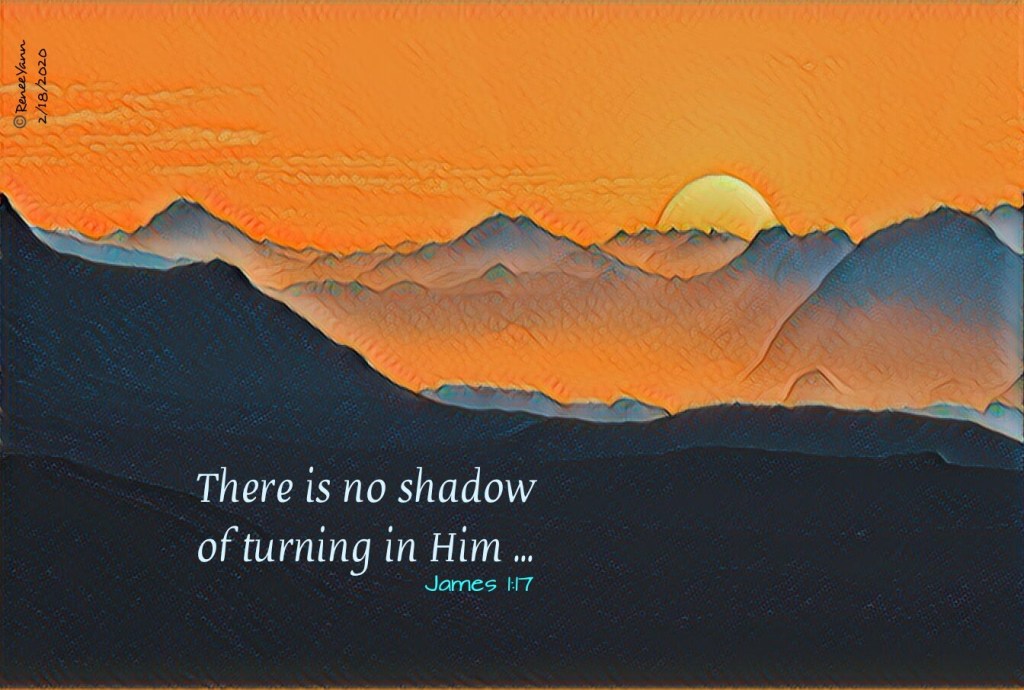
with whom there is no alteration or shadow of turning.

James 1:17

I particularly love that last phrase, rendered in our hymn today like this:

It’s beautiful to see how James, as a real spiritual leader, is so aware of his flock’s human struggles. No doubt, he shares them. What a blessing that his wise and loving guidance has come down through the ages to us!


Prose: from Carl Jung

The worst sin is unconsciousness, 
but it is indulged in with the greatest piety 
even by those who should serve humankind 
as teachers and examples.

Music: Great Is Thy Faithfulness – sung by Chris Rice

Extra Pre-Lent #2

Monday before Lent
February 12, 2024


Continuing from yesterday:

  • To help me more truly engage this Lenten time, I considered some proven elements from our long Christian tradition. I thought some of you might like to think about these as well. These three elements are:
  • Practice
  • Time
  • Reflection

On Sunday, we thought about “Lenten Practice”. Today, “Lenten Time”. Tomorrow, “Lenten Reflection”

Lenten Time
What time in my day might I reclaim for deepening my relationship with God in prayer and reflection?
Re-ordering our use of time is a great spiritual discipline. I can choose:

  • to dedicate a specific time slot to silence, prayer, and/or service. This dedicated time can be as short as a few minutes before we engage the ignition in our car, or as long as a dedicated Sunday to silence and prayer
  • to forego a daily TV show to instead do spiritual reading
  • to retire and rise earlier throughout Lent so that I have morning time to focus my day on God

What is essential is to focus our attention on God as we engage this simple practice, to make our actions a prayer.
A final thought tomorrow.

Golden Advice

Monday of the Sixth Week in Ordinary Time
February 12, 2024

Today’s Readings:

https://bible.usccb.org/bible/readings/021224.cfm


Today, in God’s Lavish Mercy, Lent is just a few days away. We will spend the intervening time in good company with insights from James, Peter and Mark. Today we begin the Epistle of James.

The Epistle of James- Chapter 1: Illustration provided to Wikimedia Commons by Distant Shores Media/Sweet Publishing as part of a cooperation project. Sweet Publishing released these images, which are taken from now-out-of-print Read’n Grow Picture Bible Illustrations (Biblical illustrations by Jim Padgett, courtesy of Sweet Publishing, Ft. Worth, TX, and Gospel Light, Ventura, CA. Copyright 1984.), under new license, CC-BY-SA 3.0

This letter is one of the very earliest of the New Testament. Scholars are mixed about exactly which “James” wrote it, but agree that it was one of several who were very close to Jesus – perhaps one of “the brothers of Jesus” mentioned in several New Testament passages:

  • Matthew 12:46-50
  • Mark 3:31
  • Luke 8:19
  • John 2:12
  • Acts 1:14
  • 1 Corinthians 9:5
  • and specifically “the Lord’s brother James” in Galatians 1:19

James writes in the style of Wisdom Literature, those Old Testament books that give advice, proverbs, and insights for living a holy life. His immediate audience was a community of dispersed Christian Jews whose world was filled with increasing upheaval and persecution.


When I read the following description I thought how germane James’s letter could be for our world today. His themes echo the teachings of Pope Francis for our chaotic time:

The epistle is renowned for exhortions on fighting poverty and caring for the poor in practical ways (1:26–27; 2:1-4; 2:14-19; 5:1-6), standing up for the oppressed (2:1-4; 5:1-6) and not being “like the world” in the way one responds to evil in the world (1:26-27; 2:11; 3:13-18; 4:1-10). Worldly wisdom is rejected and people are exhorted to embrace heavenly wisdom, which includes peacemaking and pursuing righteousness and justice (3:13-18).

JIM REIHER, “VIOLENT LANGUAGE – A CLUE TO THE HISTORICAL OCCASION OF JAMES.”EVANGELICAL QUARTERLY. VOL. LXXXV NO. 3. JULY 2013

Here is the golden advice James gives us today:

  • Be joyful in trials.
  • Let trials increase your perseverance not discourage you.
  • Doing this is a sign of wisdom.
  • When your wisdom is depleted, ask God for more with an open and trusting heart.
  • Honor all people, high or low in circumstances
  • Don’t be fooled by riches. They fade away.

In our Gospel, Jesus is frustrated with the Pharisees who insincerely demand a magical sign from him. They demonstrate none of the spiritual wisdom and openness to grace that James describes.

When we think about our own faith, where does it fall on the scale of sincerity, on the spectrum joy, justice, and faithful perseverance?


Poetry: On Joy and Sorrow – Kahlil Gibran

Then a woman said, Speak to us of Joy and Sorrow.
And he answered:
Your joy is your sorrow unmasked.
And the selfsame well from which your laughter rises 
was oftentimes filled with your tears.
And how else can it be?
The deeper that sorrow carves into your being, 
the more joy you can contain.
Is not the cup that holds your wine 
the very cup that was burned in the potter’s oven?
And is not the lute that soothes your spirit, 
the very wood that was hollowed with knives?
When you are joyous, look deep into your heart 
and you shall find it is only that which has given you sorrow 
that is giving you joy.
When you are sorrowful look again in your heart, 
and you shall see that in truth you are weeping for 
that which has been your delight.
Some of you say, “Joy is greater than sorrow,” 
and others say, “Nay, sorrow is the greater.”
But I say unto you, they are inseparable.
Together they come, 
and when one sits alone with you at your board, 
remember that the other is asleep upon your bed.
Verily you are suspended like scales 
between your sorrow and your joy.
Only when you are empty 
are you at standstill and balanced.
When the treasure-keeper lifts you 
to weigh his gold and his silver, 
needs must your joy or your sorrow rise or fall.

Music: Count It All Joy

Extra Pre-Lent #1

Sunday before Lent
February 11, 2024


Today we stand at the threshold of a sacred time. In a few days, we will begin our Lenten journey for the Year of our Lord, 2024. I reflected this morning on the purpose of Lent and on how I want to prepare in these three days leading up to Ash Wednesday.

Often Lent is interpreted only in the light of sacrifice and renunciation. We think about what we will give up, or what difficult practice we will assume. We might even introduce mixed purposes to our renunciations – thinking that fasting is a good way to lose weight, or that purging our excessive possessions is a path to feng shui in our environment. I know I have been guilty of these hidden agendas. Realizing this, I want to make the effort to live a more sincere Lent. I want to focus my spiritual awareness on Lent’s true purpose which is to align my life with the life of Christ.

To help me more truly engage this Lenten time, I have considered some proven elements from our long Christian tradition. I know that many of my readers already live a spiritual life deeply enriched by their own chosen practices. Still, I thought some of you might like to think about these few simple elements as well. These three elements are:
• Practice
• Time
• Reflection

Today, let’s think about “Lenten Practice”. Tomorrow, “ Lenten Time”. On Tuesday, “Lenten Reflection”

Lenten Practice
What practice might I introduce or deepen in my life that would turn my attention to God?
The choice of a Lenten practice can be very simple:
• to take a daily morning or evening walk in a spirit of prayer
• to read a spiritual rather than secular book throughout Lent
• to write a note or make a phone call to someone who would be blessed by your voice
• to not choose a new practice, but to choose a new attitude about some circumstance in my life, an attitude of hope or generosity

What is essential is to focus our attention on God as we engage this simple practice, to make our actions a prayer.
More tomorrow.

Leprosy

Sixth Sunday in Ordinary Time
February 11, 2024

Today’s Readings:

https://bible.usccb.org/bible/readings/021124.cfm


Today, in God’s Lavish Mercy, our readings are connected by the topic of leprosy.

The LORD said to Moses and Aaron,
“If someone has on his skin a scab or pustule or blotch
which appears to be the sore of leprosy,
he shall be brought to Aaron, the priest,
or to one of the priests among his descendants.
If the man is leprous and unclean,
the priest shall declare him unclean
by reason of the sore on his head.

Leviticus 13:2-3

“Leprosy” (Hebrew “tzaraat“) is first mentioned in chapters 13 and 14 of the Book of Leviticus. The term referred not only to many types of skin maladies but to ritual impurities and visually perceptible “punishments for sin”. In ancient times, someone suffering from an affliction as common as eczema might have been shunned as a leper.

Essentially, Levitical Law could base moral judgment of a person on their physical appearance. One might be seen to suffer physical deformity because of their own sins or the sins of their ancestors. The illness or deformity was then used as an excuse to condemn and isolate the suffering person.


Cleansing of the Leper by Harold Copping

Even though our scripture readings today are ostensibly about “leprosy”, they are about much more. Our readings challenge our ability or inability to see, love, and support our neighbor for who they are, not for how they appear. 

Jesus sees the person who comes to him, not the disease or disfigurement which inhibits him.

A leper came to Jesus and kneeling down begged him and said,
“If you wish, you can make me clean.”
Moved with pity, he stretched out his hand, 
touched him, and said to him, 
“I do will it. Be made clean.”

Mark 1: 40-41

Praying with today’s Gospel reminds me of the powerful movie “Philadelphia” starring Tom Hanks who won an Academy Award for his role as Andrew Beckett, a lawyer suffering from AIDS.

“Philadelphia” is notable for being one of the first mainstream Hollywood films not only to explicitly address HIV/AIDS and homophobia, but also to portray gay people in a positive light.
Andrew Beckett is a senior associate at the largest corporate law firm in Philadelphia. He conceals his homosexuality and his status as an AIDS patient from others in the office. A partner in the firm notices a lesion on Beckett’s forehead. Although Beckett attributes the lesion to a racquetball injury, it indicates Kaposi’s sarcoma, an AIDS-defining condition.

wikipedia

My own reflection today benefitted from revisiting this scene from the film. Like any parable, the story invites us to find ourselves somewhere in it.

People can be cut off from society for many conditions, be they leprosy, AIDS, or any other visible impediment. But the underlying reason they are shunned is fear — something about the person frightens us, or threatens to upset our religious, political, or economic securities.


If we want to be like Jesus, we must move beyond those fears and judgments – to see and love the person whom Mercy sees.


Music: “La Mamma Morta”, a 1950 Studio recording by Renata Tebaldi

Those who remember this movie will also remember this beautiful aria, played when Denzel Washington comes to consult with Tom Hanks in his home. The moment is a turning point for Washington who is fighting his own fears and prejudices as he takes on Hank’s case.

“La mamma morta” (They killed my mother) is a soprano aria from act 3 of the 1896 opera Andrea Chénier by Umberto Giordano. It is sung by Maddalena di Coigny to Gérard about how her mother died protecting her during the turmoils of the French Revolution.