Jubilee!

Saturday of the Seventeenth Week in Ordinary Time
Saturday, August 5, 2023

Today’s Readings:

https://bible.usccb.org/bible/readings/080523.cfm


One in a series of 60 paintings by Jacob Lawrence which captures
the journeys of millions of African-Americans
who left the Jim Crow South
in search of better lives elsewhere.


Today, in God’s Lavish Mercy, Leviticus offers us a reading critical to our moral clarity.

This fiftieth year you shall make sacred
by proclaiming liberty in the land for all its inhabitants.
It shall be a jubilee for you,
when every one of you shall return to his own property,
every one to his own family estate.

Leviticus 25:10

Leviticus 25 is the account of Jubilee which, for the Mosaic community, was the quintessential practice of justice.

When the Israelites came to the Promised Land, they came as an emancipated people to share in the abundance to which God had delivered them. There was initial equity in the sharing. But over time, power, influence and wealth were hoarded – endangerments that threaten all communities.

In the proclamation of Jubilee, God directs the people to return to an original justice in which all persons are freed from indebtedness of any kind in order to live in communal harmony.


Consider the hypothetical example of an Israelite family that lost their land twelve years before the Jubilee Year. On the tenth day of the seventh month, the entire community participates in the Day of Atonement and its ritual purging of sin. On this very same day, the trumpet is blown and the Jubilee year is announced; in this year, both sins and debts are forgiven, and the family that had been forced to live and work in another’s household for more than a decade regain possession of their land.

Imagine the joy of this moment! Imagine the dreams and desires! After having served as hired hands for a generation, now to be restored to a position of social and economic strength!

Michael J. Rhodes – Jubilee Formation: Cultivating Desire and Dependence in Leviticus 25

The concept of this type of justice is alien to our capitalist and consumerist orientations. We may have heard the attitude expressed, or we may hold it ourselves, that some people have and some people don’t. And the ones who “have” earned it and deserve it.

“Jubilee” instructs us that this is a false context for fulfilling God’s Will for the wholeness of Creation. In such a false context, reward ensues from avarice, dominance, possessiveness, and aggression, yielding a continually deeper gap between those who have and those who do not, between those who influence and those who cannot, between those who thrive and those who do not.


“Jubilee” resets the game board and in so doing resets attitudes about who owns what and how they must use it to enact the Reign of God.

I recently heard a story which speaks of forgetting to whom things belong. A very proper lady went to a tea shop. She sat at a table for two, ordered a pot of tea, and prepared to eat some cookies which she had in her purse. Because the tea shop was crowded, a man took the other chair and also ordered tea. As it happened, he was a Jamaican black, though that is not essential to the story. The woman was prepared for a leisurely time, so she began to read her paper. As she did so, she took a cookie from the package. As she read, she noticed that the man across also took a cookie from the package. This upset her greatly, but she ignored it and kept reading. After a while she took another cookie. And so did he. This unnerved her and she glared at the man. While she glared, he reached for the fifth and last cookie, smiled and offered her half of it. She was indignant. She paid her money and left in a great hurry, enraged at such a presumptuous man. She hurried to her bus stop just ouside. She opened her purse to get a coin for her bus ticket. And then she saw, much to her distress, that in her purse was her package of cookies unopened. The lady is not different from all of us. Sometimes we possess things so long that do not really belong to us that we come to think they are ours. Sometimes, by the mercy of God, we have occasion to see to whom these things in fact belong.

Walter Brueggemann, “Voices of the Night—Against Justice,” in To Act Justly, Love Tenderly, Walk Humbly: An Agenda for Ministers

The applications are abundant, obvious, and profound for our own lives in the various communites in which we live. But they are not easy applications to confront or practice. They pose the ultimate question to us: where do we place our security? The answer determines how fully we understand “Jubilee”.


You have two meaningful prose passages to consider today so let’s just add a little music for your prayer time.

Gabriel’s Oboe – Ennio Morricone played by Henrik Chaim Goldschmidt

Outside the Lines

Memorial of Saint John Vianney, Priest
Friday of the Seventeenth Week in Ordinary Time
August 4, 2023

Today’s Readings:

https://bible.usccb.org/bible/readings/080423.cfm


Today, in God’s Lavish Mercy, we dip our toes into the Book of Leviticus which is basically a set of instructions on how to live a good life.

Leviticus 23 establishes five holy times of prayer, reflection, and action for the people to grow in friendship with God.

  • the Sabbath (vv. 1–3)
  • the Feast of the Unleavened Bread, or Passover (vv. 4–14)
  • the Feast of Weeks, or Pentecost (vv. 15–23);
  • on the Day of Atonement (vv. 26-32)
  • the Feast of the Tabernacles (vv.33-44)

As Christians, we may be more familiar with Sabbath and Passover because their patterns are embodied in our Sunday and Easter celebrations. In the other less familiar feasts, we might recognize harvest sharing (Weeks), repentance (Atonement), reflection and recommitment (Tabernacles).


The Book of Leviticus is a formation manual for Israel’s spiritual life. Realizing that fact this morning, I thought about my Novitiate and early formation experiences in religious life. Readers who are religious sisters or brothers might share my experience, and those who are lay can probably think of their own comparisons. What were our earliest steps in our journey into God?

I wasn’t completely clueless when I came to the convent at 18 years of age. I did have a vigorous spiritual life and a deep desire to grow in relationship with God. What I needed was spiritual discipline and a quiet reverence in my whole being. And, in those early years, I received abundant amounts of both from multiple sources. It was my “Leviticus Time”.


But our “Leviticus Time” is only a launchpad. If we refuse to leave it, we will never fly. What we must move on to is a personal relationship with God, grounded in loving faith and Gospel commitment. While enhanced by exterior resources, the power of that relationship springs from an interior intimacy with God, as realized so clearly by our saint for today, John Vianney.


Today’s Gospel shows us a group of people unable to take that next step – beyond rules and practices into committed relationship. (“beyond” not “without” rules and practices – more on that in tomorrow’s reflection)

Jesus came to his native place and taught the people in their synagogue.
They were astonished and said,
“Where did this man get such wisdom and mighty deeds?
Is he not the carpenter’s son?
Is not his mother named Mary
and his brothers James, Joseph, Simon, and Judas?
Are not his sisters all with us?
Where did this man get all this?”
And they took offense at him.
But Jesus said to them,
“A prophet is not without honor except in his native place
and in his own house.”
And he did not work many mighty deeds there
because of their lack of faith.

Matthew 13:54-58

This is such a sad Gospel! Here God was right in the midst of these people! They could see him and hear him. He personally invited them to believe. But they refused to see God in Jesus. All they could see was their stagnated prejudgments and inert definitions.

These were probably good people. They more than likely kept all the Leviticus regulations. They colored within the lines, so to speak. Then Jesus came and asked them to step outside the lines. He asked them to believe that the poor are blessed and the persecuted happy. He asked them to cast their nets again into a sea that had denied them all night. He asked them to walk to him across the water. He asked them to sell everything they had and follow. He asked them to fall into the ground and die, as he would.

Only a courageous few set their safe scroll of Leviticus aside to give Jesus a wholehearted “Yes”.

What might we have done — what are we doing — when Jesus invites us outside the lines?


Poetry: Of Being – Denise Levertov

I know this happiness
is provisional:

the looming presences --
great suffering, great fear --

withdraw only
into peripheral vision:
but ineluctable this shimmering
of wind in the blue leaves:
this flood of stillness
widening the lake of sky:
this need to dance,
this need to kneel:
this mystery:

Music: Only You

Something a little different this morning – a picture to contemplate while you listen to a beautiful song. Just click the little white arrowhead in the grey bar below. Let the song take you where it will in your own spiritual landscape.

image by David Mark from Pixabay

Shekhinah – Indwelling Presence

Thursday of the Seventeenth Week in Ordinary Time
August 3, 2023

Today’s Readings:

https://bible.usccb.org/bible/readings/080323.cfm


Today, in God’s Lavish Mercy, our scripture passages focus on how God dwells with us and calls us to ever greater intimacy.

In Exodus, Moses meticulously performs God’s instructions to build a holy dwelling place – the Ark of the Covenant. When Moses’s work is finished, God settles in among the Israelites and begins the new work of leading them to the promised land. It is a “Finished. What’s Next” scenario.

The “next” is this: by manipulating a visible cloud, God signals when it is time to rest and when it is time to move forward on the journey.

Whenever the cloud rose from the Dwelling,
the children of Israel would set out on their journey.
But if the cloud did not lift, they would not go forward;
only when it lifted did they go forward.

Exodus 40:35-36

Verse 33, not included in today’s selection, says this:

Finally, Moses set up the court around the tabernacle and the altar and hung the curtain at the gate of the court.
Thus Moses finished all the work.

Exodus 40:33

The italicized phrase should ring a bell with us. It is reminiscent of this familiar phrase in Genesis:

By the seventh day God had finished the work he had been doing; so on the seventh day he rested from all his work.

Genesis 2:2

And it is predictive of this solemn phrase in John’s Gospel:

When he had received the sour wine, Jesus said, ‘It is finished,’ and he bowed his head and gave up his spirit.

John 19:30

Praying with Exodus today, we might consider how God continually finishes chapters in history and in our lives. With each completion, a new dynamic is initiated which reveals God’s deeper Presence to us. If our hearts are open, God always invites us deeper – that is the journey.


God enacts this ever-renewing revelation in the Scriptures as well as in our lives.

  • In Genesis, God comes to dwell in the Creation.
  • In Exodus, God comes to dwell in Presence.
  • In the Incarnation, God comes to dwell in our flesh.
  • In Pentecost, God comes to dwell in our spirits, giving us the capabilty of opening ourselves to the inexhaustible bounty of God’s Love.

God keeps coming to us anew, not with a new Face, but with a Face that, earlier, we may not have had the depth to recognize.


A word from the Hebrew, first encountered in ancient rabbinic literature, captures the concept of the eternal generative Presence dwelling among us: Shekhinah. The word means “dwelling” or “settling” and denotes the presence of God, as it were, in a particular place.


In today’s Gospel passage, Jesus finishes a significant chapter of his ministry. In five succinct parables, Jesus has painted a picture of our “next” – the Kingdom of Heaven.

  • the mustard seed
  • yeast
  • the hidden treasure
  • the merchant
  • the net

Image by chanwit whanset from Pixabay


Closing today’s lesson, Jesus charges the future teachers of the faith to remember the whole history of God’s indwelling as they guide the people to God’s penultimate revelation. As we move forward to a Parousia we can only imagine, we can be encouraged and consoled by the stories of God’s Presence in the past, and imaged for us in the parables.

“Then every scribe who has been instructed in the Kingdom of heaven
is like the head of a household who brings from his storeroom
both the new and the old.”

Matthew 13:52

Image by chanwit whanset from Pixabay


Before today, we may never have thought of ourselves as God’s “scribes”. But just as God used our first parents, and Moses, and the early disciples, God is using us to write the current and future story of God’s love for all Creation.

The chapter with your name will not be included in the Bible, but it will be written large in the Book of Life. It will be read by those who love you, depend on you, work with you, or need you. Each of our lives, in its own way, is a scipture for our times.


Poetry: Wellfleet Shabbat – Marge Piercy

The hawk eye of the sun slowly shuts.
The breast of the bay is softly feathered
dove grey. The sky is barred like the sand
when the tide trickles out.

The great doors of Shabbat are swinging
open over the ocean, loosing the moon
floating up slow distorted vast, a copper
balloon just sailing free.

The wind slides over the waves, patting
them with its giant hand, and the sea
stretches its muscles in the deep,
purrs and rolls over.

The sweet beeswax candles flicker
and sigh, standing between the phlox
and the roast chicken. The wine shines
its red lantern of joy.

Here on this piney sandspit, the Shekinah
comes on the short strong wings of the seaside
sparrow raising her song and bringing
down the fresh clean night.

Music: Dwelling Place – John Foley, SJ

Shine!

Wednesday of the Seventeenth Week in Ordinary Time
August 2, 2023

Today’s Readings:

https://bible.usccb.org/bible/readings/080223.cfm


Today, in God’s Lavish Mercy, Moses descends the mountain and returns to the people, his face shining with the glory of God.

As Moses came down from Mount Sinai
with the two tablets of the commandments in his hands,
he did not know that the skin of his face had become radiant
while he conversed with the LORD.

Exodus 34:29

Moses’s appearance frightened the Israelites. They weren’t accustomed to being this close to “The God Effect”. Moses had to veil his face until the people became a little more comfortable with his transformed self.


People who are close to God do have a certain “shine”. I know, because I live with a houseful of them! Most of these wonderful women are well into their years, and will moan occasionally about their ever-increasing wrinkles. Like most of us, they don’t see their own beauty, nor the fact that an inimitable loveliness radiates from their fundamental goodness.


Once again in today’s Gospel, as in this past Sunday’s, Jesus encourages his followers to live in that irradiating Presence. Finding that Presence is like finding a treasure or a pearl of great price. The Gospel searcher is filled with abundant “joy” upon the discovery. That joy, no doubt, lit up that finder the way Moses was fired by God’s Glory.


We all want to have that kind of joy. It is the true fulfillment of life. Jesus wants us to have it too as recorded in today’s Alleluia Verse:

I call you my friends, says the Lord,
for I have made known to you all that the Father has told me.

John 15:15

By studying, praying with, and imitating the life of Christ, we too – like the moon emblazoned by the Sun – will come to reflect an Immense Love.


Poetry: As Kingfishers Catch Fire – Gerard Manley Hopkins

As kingfishers catch fire, dragonflies draw flame;
As tumbled over rim in roundy wells
Stones ring; like each tucked string tells, each hung bell's
Bow swung finds tongue to fling out broad its name;
Each mortal thing does one thing and the same:
Deals out that being indoors each one dwells;
Selves — goes itself; myself it speaks and spells,
Crying Whát I dó is me: for that I came.
I say móre: the just man justices;
Keeps grace: thát keeps all his goings graces;
Acts in God's eye what in God's eye he is —
Chríst — for Christ plays in ten thousand places,
Lovely in limbs, and lovely in eyes not his
To the Father through the features of men's faces.

Music: Variations on a Theme From Pachelbel’s Canon in D Major – David Lanz

Come Away Awhile

Memorial of Saint Alphonsus Liguori, Bishop and Doctor of the Church
Tuesday of the Seventeenth Week in Ordinary Time
August 1, 2023

Today’s Readings:

https://bible.usccb.org/bible/readings/080123.cfm


Today, in God’s Lavish Mercy, Moses goes on a rigorous forty day retreat:

So Moses stayed there with the LORD for forty days and forty nights,
without eating any food or drinking any water,
and he wrote on the tablets the words of the covenant,
the ten commandments.

Exodus 33:28

The purpose of this intense retreat was for Moses to codify God’s law in his own heart. He is to be a witness and leader for God among the people. It was a law of relationship, written in stone for the people, but written in fire for Moses. If God’s intentions are not embedded in Moses’s own heart, his ministry will fail.

In our Gospel, the disciples go on a kind of retreat too. The crowds have been dismissed, and Jesus’s close friends sit down with him for an in-depth instruction in the meaning of his parables. They want to understand the mind and heart of Christ so that they can pattern their own on his Word.


A good retreat is like a spiritual spa experience. It can provide us with rest, clarity, nourishment, and stabilization. And good retreat direction, either through a spiritual guide or through the discipline of solitude, is invaluable to such a pursuit.

But while we can’t be on a formal retreat every day of our lives, we still need a daily “coming away” with God to center our spirits and to keep alive the holy fire within them.


Today might be a good day to evaluate those processes in our lives. Are they working for us? Or might our prayer and reflection time have become so routine as to lose its snap. Have we let life’s concerns slip into our solitude to the point of no longer hearing God’s whisperings? Or have we even truncated that time to meet those ever-expanding concerns?

We may feel so overwhelmed by life that we think we don’t have time for deep prayer. That’s like saying we don’t have time to breathe! If we don’t make the time for both of them, we will die. It’s that simple.


Sixty years ago, my Novice Director gave me a wonderful book. I return to it frequently to consider the spiritual discipline of my life. Here are two excerpts which seem to have bearing on today’s reflection and might inspire your considerations today:

When silence takes possession of you; when far from the racket of the human highway the sacred fire flames up in the stillness; when peace, which is the tranquillity of order, puts order in your thoughts, feelings, and investigations, you are in the supreme disposition for learning; you can bring your materials together; you can create; you are definitely at your working point; it is not the moment to dwell on wretched trifles, to half live while time runs by, and to sell heaven for nothings.


Retirement (retreat) is the laboratory of the spirit; interior solitude and silence are its two wings. All great works were prepared in the desert, including the redemption of the world

A.D. Sertillanges, The Intellectual Life: Its Spirit, Conditions, Methods

Poetry: The Stolen Child – William Butler Yeats
Using his love for Celtic lore and fantasy, Yeats imagines a return to innocence at the hands of magical creatures, the faeries. With imagery rich in natural wonder, the reader is invited to “come away” from a world impossible to understand, and to be restored in spiritual truth. Sounds like a retreat to me!

Where dips the rocky highland
Of Sleuth Wood in the lake,
There lies a leafy island
Where flapping herons wake
The drowsy water rats;
There we've hid our faery vats,
Full of berrys
And of reddest stolen cherries.
Come away, O human child!
To the waters and the wild
With a faery, hand in hand,
For the world's more full of weeping than you can understand.
Where the wave of moonlight glosses
The dim gray sands with light,
Far off by furthest Rosses
We foot it all the night,
Weaving olden dances
Mingling hands and mingling glances
Till the moon has taken flight;
To and fro we leap
And chase the frothy bubbles,
While the world is full of troubles
And anxious in its sleep.
Come away, O human child!
To the waters and the wild
With a faery, hand in hand,
For the world's more full of weeping than you can understand.
Where the wandering water gushes
From the hills above Glen-Car,
In pools among the rushes
That scarce could bathe a star,
We seek for slumbering trout
And whispering in their ears
Give them unquiet dreams;
Leaning softly out
From ferns that drop their tears
Over the young streams.
Come away, O human child!
To the waters and the wild
With a faery, hand in hand,
For the world's more full of weeping than you can understand.
Away with us he's going,
The solemn-eyed:
He'll hear no more the lowing
Of the calves on the warm hillside
Or the kettle on the hob
Sing peace into his breast,
Or see the brown mice bob
Round and round the oatmeal chest.
For he comes, the human child,
To the waters and the wild
With a faery, hand in hand,
For the world's more full of weeping 
than he can understand.

Music: Inner Peace – Hennie Bekker

Little Things Mean a Lot

Memorial of Saint Ignatius of Loyola, Priest
Monday of the Seventeenth Week in Ordinary Time
July 31, 2023

Today’s Readings:

https://bible.usccb.org/bible/readings/073123.cfm


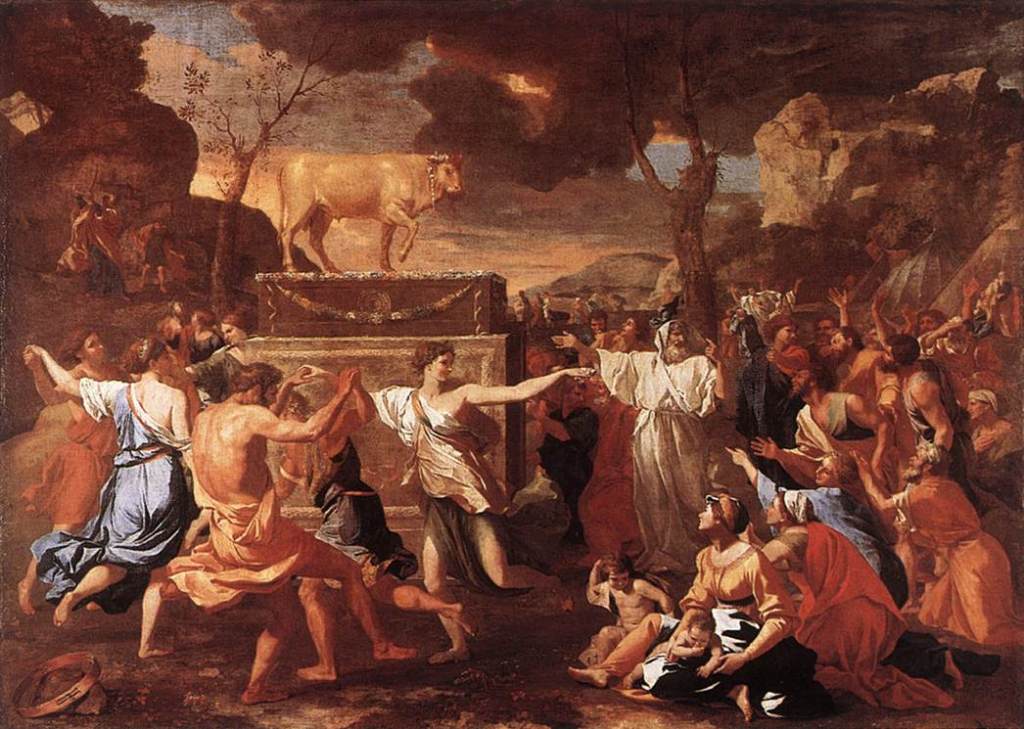
The Adoration of the Golden Calf – Nicholas Poussin

Today, in God’s Lavish Mercy, Aaron, brother of Moses, gets an “F” as a substitute teacher. While Moses is on the mountain negotiating with God for Israel’s future, Aaron caves to the people’s demands and assists them in creating an idol – the infamous “golden calf”.

As Walter Brueggemann says, “All it takes is a little gold to make a god”:

All you need in order to make a god is a measure of the substance that is most valuable in the community, in this case gold…and a mold that can shape the gold. The mold readily available to Aaron is a calf, well, better a “bull” – a symbol and embodiment of virility and fertility, the strength, power, and capacity to generate new life! All you need to make a god is a little gold and a pattern of vitality and fertility that bespeaks self-sufficiency,

Walter Brueggemann – from a Sunday sermon delivered in 2020

Moses was on the mountain for forty days. In his absence, and with God’s silence, the people became frightened. They felt powerless. In that powerlessness, they had a choice: to believe that God would be true to God’s word, or to construct an alternate god of their own design, one that made them feel powerful again. They made the wrong choice.


Praying with this passage today, we might ask ourselves what we do when circumstances render us powerless. What do we do when God seems silent and the supports we have trusted disappear or fail? What do we do when there seems to be no answer to our prayers?

And what is the substance, as Bruegemann notes, most valued in my various communities – the substance most likely to be turned to an idol: reputation, status, resources, influence, political power, physical strength or appearance?

Do we make the mistake of thinking things like this: My power rests in my money, or my looks, or my family name, or my business success, or my intelligence, or my intimidating reputation?

When it comes to the fundamental needs of our lives, none of these things can empower us. Every one of them can fail or disappear. Our only true power lies in God’s unfailing love for us and will for our good. That power is always with us but can be accessed only through faith.


Our Gospel tells us that all one needs is a little faith to ground oneself in the power of God’s love and fidelity..

Jesus proposed a parable to the crowds.
“The Kingdom of heaven is like a mustard seed
that a person took and sowed in a field.
It is the smallest of all the seeds,
yet when full-grown it is the largest of plants.
It becomes a large bush,
and the birds of the sky come and dwell in its branches.”

Matthew 13:31-32

I saw a great graphic on Facebook the other day. It pictured an open hand reaching out with a small speck on the index finger. The caption read:

I have a mustard seed,
and I’m not afraid to use it.


In the absence of a malleable, obeisant god, Israel mistakes their wealth for their god. They mold it into a figure that appears to restore their control over their lives. But they end up with only a clump of unresponsive metal.

God is not a divine butler waiting at the doorway for our next command. The ever-presnt Holy One is sometimes thickly veiled within the circumstances of our lives. It takes faith to stay in relationship with our often silent, but nonetheless abiding God.

Our Gospel tells us that if we have even the smallest seed of that faith, it will root in us and sustain us. And even the smallest measure of “holy yeast” will ferment to the point that others will find in us the inspiration to believe.


Poetry: The Golden Calf by John Newton, (1725 – 1807) who was an English evangelical Anglican cleric and slavery abolitionist. He had previously been a captain of slave ships and an investor in the slave trade. He served as a sailor in the Royal Navy (after forced recruitment) and was himself enslaved for a time in West Africa. He is noted for being author of the hymns Amazing Grace and Glorious Things of Thee Are Spoken.

When Israel heard the fiery law,
From Sinai's top proclaimed;
Their hearts seemed full of holy awe,
Their stubborn spirits tamed.
Yet, as forgetting all they knew,
Ere forty days were past;
With blazing Sinai still in view,
A molten calf they cast.
Yea, Aaron, God's anointed priest,
Who on the mount had been
He durst prepare the idol-beast,
And lead them on to sin.
Lord, what is man! and what are we,
To recompense thee thus!
In their offence our own we see,
Their story points at us.
From Sinai we have heard thee speak,
And from mount Calv'ry too;
And yet to idols oft we seek,
While thou art in our view.
Some golden calf, or golden dream,
Some fancied creature-good,
Presumes to share the heart with him,
Who bought the whole with blood.
Lord, save us from our golden calves,
Our sin with grief we own;
We would no more be thine by halves,
But live to thee alone.

Music: Amazing Grace


The Treasure

Seventeenth Sunday in Ordinary Time
July 30, 2023

Today’s Readings:

https://bible.usccb.org/bible/readings/073023.cfm


Today, in God’s Lavish Mercy, our readings pose an eternal question:

Are we wise enough to cherish
the treasure of God’s Kingdom?


The kind of life we live comes down to what we treasure. I won’t start a list here, but you might want to. For what do you sacrifice your time, attention, and effort? Where do you place the resources of your mind, body, and spirit?


In our first reading, Solomon has a dream in which he gets the amazing genie-like opportunity to actually name his treasure. He does so in an extremely clever prayer that woos God into acquiescence.

In the full version of this passage, Solomon has married the enemy Pharoah’s daughter, and has just finished sacrificing to false gods on the high mountain. He then falls asleep and has this dream in which he reminds God that, despite his marriage and worship practices, he is still like his ancestor David whom God loved completely for his faithfulness.


Solomon further shmoozes God by proclaiming himself an uniformed, youthful innocent who carries immense responsibilities on God’s behalf:

Now, LORD, my God, you have made me, your servant, king to succeed David my father; but I am a mere youth, not knowing at all how to act—

God falls for Solomon’s persuasions and ennobles him even beyond his request:

The LORD was pleased that Solomon made this request.
So God said to him:
“Because you have asked for this—
not for a long life for yourself,
nor for riches,
nor for the life of your enemies,
but for understanding so that you may know what is right—
I do as you requested.
I give you a heart so wise and understanding
that there has never been anyone like you up to now,
and after you there will come no one to equal you.”

1 Kings 3:10-13

In our second reading from Romans, Paul assures us that God already has in place for us the will and design for our good. We don’t have to make a wish in a dream the way Solomon did, nor proclaim ourselves patterned on the heritage of David.

Our salvation is accomplished in the person of Jesus Christ:

We know that all things work for good for those who love God,
who are called according to his purpose.
For those he foreknew he also predestined
to be conformed to the image of his Son,
so that he might be the firstborn
among many brothers and sisters.

Romans 8:28-29

In our Gospel, Jesus reminds us that, although God has predestined a plan for our salvation, we must choose to participate in it. Finding the “treasure” should give us incomparable joy. Finding the “pearl” should impel us to give everything for its possession.

The kingdom of heaven is like a treasure buried in a field,
which a person finds and hides again,
and out of joy goes and sells all that he has and buys that field.
Again, the kingdom of heaven is like a merchant
searching for fine pearls.
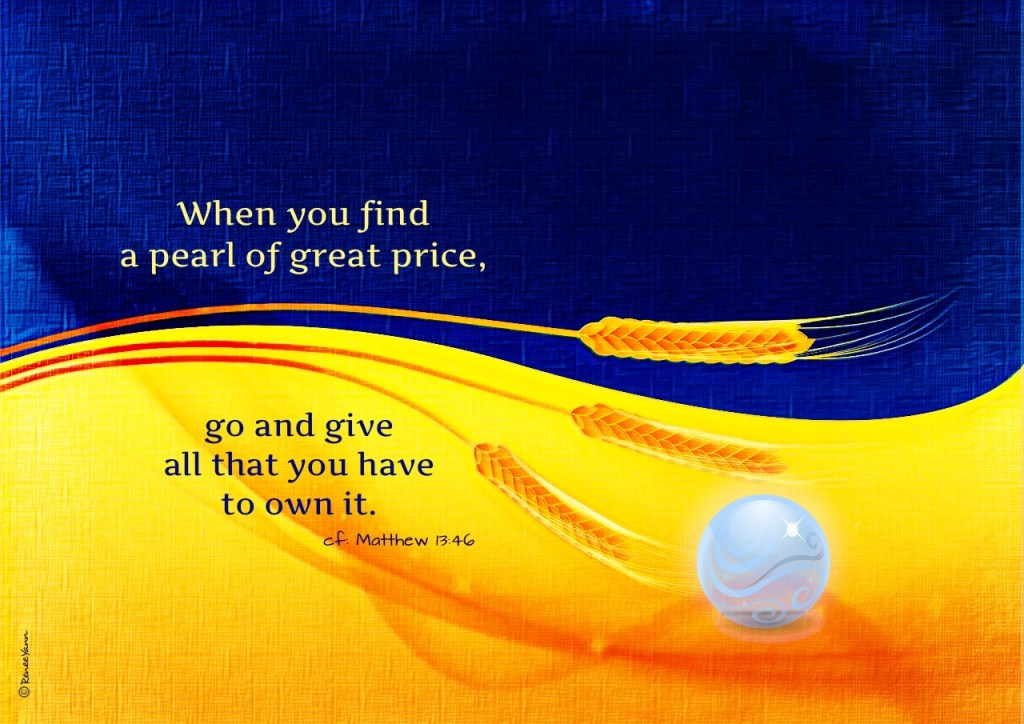
When he finds a pearl of great price,
he goes and sells all that he has and buys it.

Matthew 13:44

History tells us that Solomon had his challenges holding on to the treasures granted in his dream. Paul offers his advice in Romans 8 to encourage the early Christians suffering persecution for the sake of their spiritual treasures. Jesus emphasizes that everybody find or hold on to their pearls until the end of time.

We can infer from these three facts that finding the pearl isn’t enough. Preserving its integrity and beauty is the work of a faithful lifetime.


Poetry: The Bright Field – R.S. Thomas

I have seen the sun break through
to illuminate a small field
for a while, and gone my way
and forgotten it. But that was the
pearl of great price, the one field that had
treasure in it. I realise now
that I must give all that I have
to possess it. Life is not hurrying
on to a receding future, nor hankering after
an imagined past. It is the turning
aside like Moses to the miracle
of the lit bush, to a brightness
that seemed as transitory as your youth
once, but is the eternity that awaits you.

Music: Treasure in a Field – Dan Schutte, sung by Josephina Albuquerque, RJM

Friends of Jesus

Memorial of Saints Martha, Mary and Lazarus
Saturday of the Sixteenth Week in Ordinary Time
July 29, 2023

Today’s Readings:

https://bible.usccb.org/bible/readings/072923.cfm


Today, in God’s Lavish Mercy, we pray with three beloved friends of Jesus. And I mean real, down-to-earth buddies, heart-companions like the ones we seek out in the peaks and valleys of our lives. Jesus loved these three friends as John tells us in his Gospel:

Jesus loved Martha, and her sister Mary, and Lazarus.

John 11:5

Like many of the inspirational Bible figures, we know little about Martha, Mary and Lazarus. But the little we know goes deep when we consider it in prayerful reflection. For today’s prayer, I am focusing on Martha.


Martha is the doer – the wise, practical, and somewhat anxious member of the family. I think Martha had to have been the oldest, the big sister who watched over her younger siblings. She was the one who made sure the house was clean, the shopping done, the meal prepared. And, probably, she got a little annoyed when the others took these important responsibilities for granted. She obviously felt a bit unappreciated at times. Martha was confident in how she wanted things to be and worked to make them so.

Everyone needs a friend like Martha, even though they are sometimes a little annoying. They help keep us on the right track by their honest assessment of reality and their robust engagement of its demands. They prod us to recognize the call within our circumstances and the grace it will yield if attended to.


The Church offers us two readings to choose from today recounting incidents in the life of this family. In one of them, Martha even prods Jesus to do what needs to be done:

When Martha heard that Jesus was coming,
she went to meet him;
but Mary sat at home.
Martha said to Jesus,
“Lord, if you had been here,
my brother would not have died.
But even now I know that whatever you ask of God,
God will give you.

John 11:20-22

In the other reading choice, Martha (by tattling to Jesus) prods contemplative Mary to be a little more practical in their domestic situation.

Jesus entered a village
where a woman whose name was Martha welcomed him.
She had a sister named Mary
who sat beside the Lord at his feet listening to him speak.
Martha, burdened with much serving, came to him and said,
“Lord, do you not care
that my sister has left me by myself to do the serving?

Luke 10:38-40

Finally, in a monumental unwillingness to let unwanted things be as they are, Martha won’t even let Lazarus rest in peace. She wants him raised from the dead, and so she prods Jesus with the veiled request cited above.

The Raising of Lazarusby Duccio di Buoninsegna c.1513
(note the practical guy in the yellow cloak holding his nose!)

We can use our imagined insights into Martha’s nature to help us understand our own approach to the presence of God in our lives. What can guide us in such a meditation is the key component of this Gospel reading – the response of Jesus to Martha’s search for balance in her life:

Jesus said to her,
“Your brother will rise.”
Martha said to him,
“I know he will rise,
in the resurrection on the last day.”
Jesus told her,
“I am the resurrection and the life;
whoever believes in me, even if he dies, will live,
and anyone who lives and believes in me will never die.
Do you believe this?”
She said to him, “Yes, Lord.
I have come to believe that you are the Christ, the Son of God,
the one who is coming into the world.”

John 11:23-27

Jesus asks Martha to shift her perspective from practical knowledge to unquestioning faith. In a very real sense, Jesus is raising Martha to new life before he raises Lazarus. Ultimately, Jesus does what Martha asks, but not because she thinks it’s a good idea. The miracle is released from Christ’s heart by Martha’s unqualified faith.

And so it is with us when we pray. If our “prayer” is a dictation of how we would like God to behave, it will not engender the transformative grace of new life. That miracle is accomplished only if our prayer is an expression of absolute faith in God’s loving Will.


Poetry: The Raising of Lazarus – Rainer Maria Rilke, translated by Hanz Wright
This poem, unpublished in the poet’s lifetime, appears in a notebook that the Austro-German Rilke (1875–1926) kept while in Ronda, Spain, in 1913. The translation was begun by Wright decades ago (“I have been working on it, in a hundred versions, since I was in college,” he says). – source: Boston College Magazine


Evidently, this was needed. Because people need
to be screamed at with proof.
But Jesus knew his friends. Before they were,
he knew them; and they knew
that he would never leave them
desolate here. So he let his exhausted eyes close
at first glimpse of the village.
And immediately he seemed
to be standing in their midst.
Here was Martha, the dead boy’s sister.
He knew he would always find her
at his right hand, and beside her
Mary. They were all here.
Yet opening his eyes it was not so.
He was standing apart,
even the two women
slowly backing away,
as if from concern for their good name.
Then he began to hear voices
muttering under their breath
quite distinctly; or thinking,
Lord, if you had been hereour friend might not have died.
(At that, he seemed to reach out
to touch someone’s face
with infinite gentleness,
and silently wept.) He asked them the way
to the grave. And he followed
behind them, preparing
to do what is not done
to that green silent place
where life and death are one.
Merely to walk down this road
had started to feel like a test,
or a poorly prepared-for performance
with actors unsure of their lines,
or which play they were supposed to be in;
a feverish outrage rising inside him
at the glib ease with which words like “living”
and “being dead” rolled off their tongues.
And awe flooded his body
when he hoarsely cried,
“Move the stone!”
“By now he must stink,”
somebody helpfully shouted.
(And it was true, the body
had been lying in the tomb
four days.) But he was far away,
too far away inside himself
to hear it, beginning
to fill with that gesture
which rose through him:
no hand this heavy
had ever been raised, no human hand
had ever reached this height
shining an instant in air, then
all at once clenching into itself
at the thought all the dead might return
from that tomb where
the enormous cocoon
of the corpse was beginning to stir.
In the end, though, nobody stood
there at its entrance
but the young man
who had freed his right arm
and was pulling at his face,
at small strips of grave wrappings.
Peter looked across at Jesus
with an expression that seemed to say
You did it, or What have you done? And all
saw how their vague and inaccurate
life made room for him once more.

Music: Rise Up, Lazarus – CAIN

Life Guide

Friday of the Sixteenth Week in Ordinary Time
July 28, 2023

Today’s Readings:

https://bible.usccb.org/bible/readings/072823.cfm


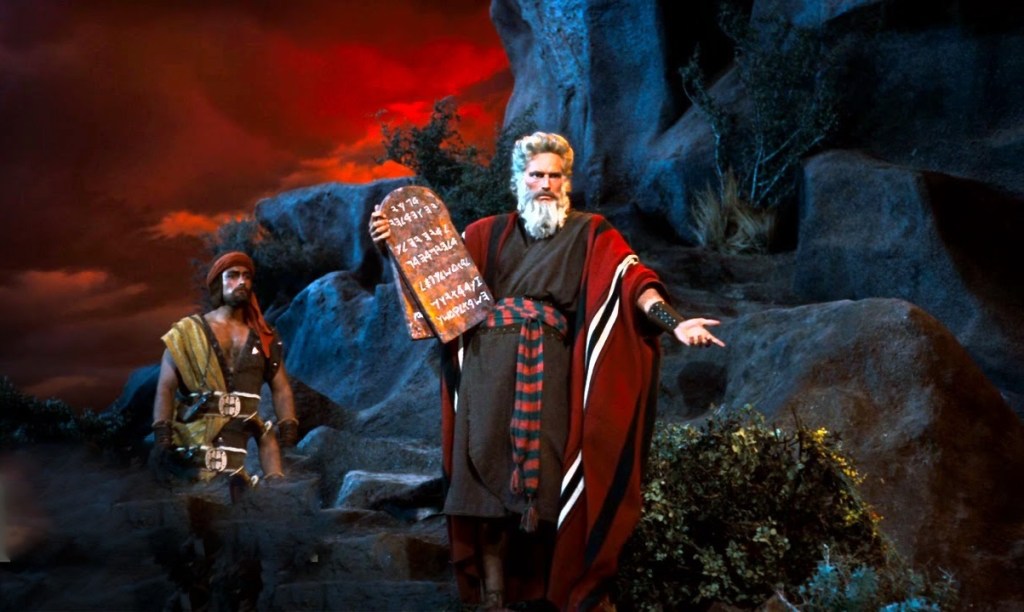
Moses with the Ten Commandments – Rembrandt


Today, in God’s Lavish Mercy, we are presented with a summary version the Ten Commandments.

But the daily readings have skipped over a dramatic passage. In between today’s reading and yesterday’s, Mount Sinai has exploded with the thunderous voice of God.

On the morning of the third day there were peals of thunder and lightning, and a heavy cloud over the mountain, and a very loud blast of the shofar,* so that all the people in the camp trembled.
But Moses led the people out of the camp to meet God, and they stationed themselves at the foot of the mountain.
Now Mount Sinai was completely enveloped in smoke, because the LORD had come down upon it in fire. The smoke rose from it as though from a kiln, and the whole mountain trembled violently.
The blast of the shofar grew louder and louder, while Moses was speaking and God was answering him with thunder.

Exodus 19:16-19

The writer of Exodus wants us to know that God was serious when delivering the Commandments:

With appropriate ritual preparation on the part of Israel (19:1–15), YHWH comes storming into the presence of Israel (19:16–25). This divine arrival, technically characterized as a theophany, a showing of God, is a disturbing upheaval of the mountain. This description of divine arrival is highly stylized and may reflect something of a repeatable liturgical performance. YHWH, shrouded in mystery, is accompanied by fire, smoke, the violent shaking of the mountain, a blast of trumpets, and thunder. The mountain, occupied by this assertive deity, is now saturated with dangerous holiness, so dangerous that YHWH might “break out against them” (19:22).

Walter Brueggemann – Delivered into Covenant (Pivotal Moments in the Old Testament)

These commandments, delivered clearly and deliberately in today’s passage, form the immutable groundwork for relationship with God. God makes it clear from the beginning that friends of God honor both God and neighbor, and in so doing honor themselves. While many of the Commandments are stated as prohibitions, they are really guides toward wholeness and balance in spiritual and communal life.


I remember, as a youngster, using the Commandments as a guide when preparing my list for weekly confession. It was hard to generate that list because, most of the time, I was a fairly good kid. I was pretty sure I hadn’t coveted my neighbor’s wife or anything like that.

I had not yet learned to capture the spirit of the Commandments which is just and humble relationship with God and God’s Creation. This relationship is rooted in awareness of and reverence for God’s Presence in all things.

In the Beatitudes, Jesus teaches us the perfection of the Ten Commandments. A magnificent book that helped me learn this is The Spirituality of the Beatitudes by Michael Crosby – another life-changing book.


But the seed sown on rich soil
is the one who hears the word and understands it,
who indeed bears fruit

and yields a hundred or sixty or thirtyfold.

Matthew 13:23

Like the seed variously scattered in today’s Gospel reading, our daily choices and actions may or may not fall short of the fertile ground. Of course, we have the spirit of the Commandments as a guide for that assessment. But the surer guide is the new Law of Love poured out for us on the still and silent Mount Calvary, and codified for us in the Gospel.


Poetry: The Garden of Love – William Blake, the famous mystical poet of late 18th and early 19th century England, was a deeply committed Christian. But he loathed organized religion because he felt that it destroyed the spirit of true faith. I chose this poem because it might reflect what happens when we see the Commandments only as spiritless rules.

I went to the Garden of Love,
And saw what I never had seen:
A Chapel was built in the midst,
Where I used to play on the green.
And the gates of this Chapel were shut,
And 'Thou shalt not' writ over the door;
So I turn'd to the Garden of Love,
That so many sweet flowers bore.
And I saw it was filled with graves,
And tomb-stones where flowers should be:
And Priests in black gowns, were walking their rounds,
And binding with briars, my joys & desires.

Music: The Ten Commandments – Johnny Cash – A delightful song that suggests we can find theologians anywhere if we just look for them! 😉

Clouds and Parables

Thursday of the Sixteenth Week in Ordinary Time
July 27, 2023

Today’s Readings:

https://bible.usccb.org/bible/readings/072723.cfm


Today, in God’s Lavish Mercy, our readings lead us to consider when, why, and how God speaks.

We all know that the big scene from Exodus is the delivery of the Ten Commandments. So as Sinai bubbles and churns in today’s reading, we may be waiting for that theophany.

But today’s passage from Exodus is not about the Commandments themselves. It is about getting oneself ready to hear what God is about to say.


God instructs Moses on how to prepare the people so that they have listening hearts able to respond with understanding and commitment.

While Israel was encamped here in front of the mountain,
the LORD told Moses,
“I am coming to you in a dense cloud,
so that when the people hear me speaking with you,
they may always have faith in you also.”
When Moses, then, had reported to the LORD the response of the people,
the LORD added, “Go to the people
and have them sanctify themselves today and tomorrow.
Make them wash their garments and be ready for the third day;
for on the third day the LORD will come down on Mount Sinai
before the eyes of all the people.”

Exodus 19:9-11

  • They are to expect a “cloud”
  • They are to see Moses as a conduit to God.
  • They are to prepare their hearts by symbolically preparing their garments.
  • They are to wait, in the mode of a vigil, for the Lord to speak.

In the late 1960s I, like the rest of the immediately post-Vatican II Church, was hungry to learn more enlightened theology. Around that time, I had the amazing opportunity of attending a lecture by the controversial priest and theologian Fr. Hans Küng. Some considered him a prophet, and some an iconoclast. But no one disagreed that he was a genius and an eminent voice for reform in the Catholic Church.

I was just beginning my theological education, and I knew — well actually — zip!

So I began to read everything I could find by or about Küng. I did serious prep work before the day came for the lecture. And it helped. I was ready to listen. My brain was spinning when I left the presentation (Küng is not easy!). Still, what little I understood inspired me to the next steps in my learning which has been life-long.


I think that’s what God is doing in today’s passage – readying hearts to listen to God’s life-long invitation to Covenant. That Covenant will be rooted in the community’s hearts by their faithfulness to the spirit of the Ten Commandments. And it will grow like any healthy relationship in love and mutual disclosure.


In our Gospel, Jesus talks about listening too. When asked why he spoke in parables to the crowd, Jesus replies:

Because knowledge of the mysteries of the Kingdom of heaven
has been granted to you, but to them it has not been granted.
To anyone who has, more will be given and he will grow rich;
from anyone who has not, even what he has will be taken away.
This is why I speak to them in parables, because
they look but do not see and hear but do not listen or understand.

Matthew 13:11-13

Parables can be a little bit like those Sinai clouds – their truth may not be immediately evident. But by faithfulness, the horizon clears and the light dawns. Although they might appear to be, parables are not descriptions of sowers and seed, and prodigal children or devoted fathers. Jesus’s parables are revelations about us and God, told in simple stories so that we won’t be quite as dazed by their powerful truth as I was by that long-ago lecture.


When I walked out of the Küng lecture, believe me, I was in a cloud. His presentation was so dense with meaning that I felt like I knew less coming out than going in! Sometimes when we hear the parables, we might have a similar feeling. But that’s why we pray, year after year, with the infinitely revealing scriptures. They meet us where we are in our particular circumstances, and will always take us deeper into God if we are prepared to let them.

And Jesus assures us that our efforts to follow him will be rewarded:

But blessed are your eyes, because they see,
and your ears, because they hear.
Amen, I say to you, many prophets and righteous people
longed to see what you see but did not see it,
and to hear what you hear but did not hear it.”

Matthew 13:16-17

Coming into deeper relationship with God takes time – dedicated time for silence, prayer, reflection, learning, and action born of contemplation. Let’s renew our deep desire for this kind of relationship.


Prose: excerpts from “The Cloud of Unknowing“, which is an anonymous work of Christian mysticism written in Middle English in the latter half of the 14th century. The text is a spiritual guide on contemplative prayer in the Late Middle Ages. The underlying message of this work suggests that the way to know God is to abandon consideration of God’s particular activities and attributes, and be courageous enough to surrender one’s mind and ego to the realm of “unknowing”, at which point one may begin to glimpse the nature of God. (Wikipedia)


  1. When you first begin, you find only darkness, and as it were a cloud of unknowing. You don’t know what this means except that in your will you feel a simple steadfast intention reaching out towards God. Do what you will, and this darkness and this cloud remain between you and God… Reconcile yourself to wait in this darkness as long as is necessary, but still go on longing after him whom you love.
  2. The nature of love is that it shares everything. Love Jesus, and everything he has is yours.…He may, perhaps, send out a shaft of spiritual light, which pierces this cloud of unknowing beteween you, and show you some of his secrets… then will you feel your affection flame with the fire of his love, far more than I can possibly say now…

Music: Transcending from “The Cloud of Unknowing” by Robert Kyr

Caritas patiens est benigna est
omnia suffert omnia credit
omnia sperat omnia sustinet
videmus enim nunc
per speculum in enigmate
tunc autem facie ad faciem
nunc cognosco ex parte
tunc autem cognoscam
sicut et cognitus sum
nunc autem manet
fides spes caritas
tria haec
maior autem his est caritas

Love is patient, Love is kind.
It bears all things, Believes all things,
Hopes all things, Endures all things.
For now we see
In a mirror, dimly,
But then we will see face to face.
Now I know only in part;
Then I will know fully,
Even as I have been fully known.
So now remain Faith, hope, love; These three,
But the greatest of these is love.