Sweet Light in His Eyes

Feast of Saint Andrew, Apostle

Saturday, November 30, 2019

Click here for readings

Today, in Mercy, we stand at the edge of a new Liturgical Year. Yes, in “Church-think”, it is New Year’s Eve.

And it’s fitting to stand here beside Andrew, on his feast, remembering how one day Jesus invited him to launch out into a whole new world.

Mt4_10Andrew

Today teases us with something we cannot yet imagine. Tomorrow, it will be December – the last month of 2019. It will be Advent, the time to wait in silence for unfathomed miracles. What graces will these days hold for us as we prepare for Christmas?

Jesus teased Andrew and Peter too with the promise to be “fishers of men”. Wading knee-deep in the Galilean Sea, do you think they had any hint of what Jesus was talking about? I don’t. I think they simply caught the faith, hope and love in his eyes the way a match catches flame when it’s struck.

Let’s stand with Andrew today at the brink of Advent, on the edge of the long nights or days of December (depending on our hemisphere 😉)

Let’s trust the fire we find in Christ’s eyes as we pray through this Holy Season. Let’s be very intentional not to miss the point of these sacred days by losing them to the muddle of a commercialized, secularized “holiday season”.

St Andrew PRayer


An old devotion that I still love is the St. Andrew Novena. The prayer, prayed from November 30 until December 24th, is meant to remind us of the true meaning of these days leading to Christmas. Because my mother said it with me when I was a little girl, it carries both spiritual and emotional riches for me.

It is traditionally suggested that we say it fifteen times a day. I will confess that I only say it once a day, but I do that slowly, focusing on the sacred mystery held within the words.


I also have created my personal version without specific petitions. I think God knows what we need and provides for us. That Lavish Mercy is enough and everything.

My St. Andrew’s Prayer:

Hail, and blessed be the hour and moment
at which the Son of God was born
of our dear Mother Mary
in a stable
at midnight
in Bethlehem
in the piercing cold.
At that hour, I ask you dear God,
to hear my prayer and grant my hope
that you fill our world again
with your Loving Presence.
Through Jesus Christ and His most Blessed Mother.
Amen
.

Music: We Shall Behold Him – Ron Kenoly (Lyrics below)

I love this hymn, especially the line “the sweet light in his eyes shall enhance those awaiting”. Maybe that’s the light Andrew saw. May we see it too!

The sky shall unfold
Preparing His entrance
The stars shall applaud Him
With thunders of praise
The sweet light in His eyes shall enhance those awaiting
And we shall behold Him, then face to face.

O we shall behold Him, we shall behold Him
Face to face in all of His glory
O we shall behold Him, yes we shall behold Him
Face to face, our Savior and Lord.

The angel will sound, the shout of His coming
And the sleeping shall rise, from there slumbering place
And those remaining, shall be changed in a moment
And we shall behold him, then face to face.

We shall behold Him, o yes we shall behold Him
Face to face in all of His glory
We shall behold Him, face to face
Our Savior and Lord
We shall behold Him, our Savior and Lord
Savior and Lord!

Don’t Sleepwalk Your Life!

Monday of the Thirty-fourth Week in Ordinary Time

November 25, 2019

Click here for readings

Today, in Mercy, we begin a series of readings from the Book of Daniel. It is the only time throughout the Liturgical Year that we get a good dose of Daniel. And it is well placed, coming in this final week before Advent.

Daniel is apocalyptic literature, a genre which conveys the author’s perception of the end times through dreams, visions and prophecies. Like many of our readings of the past weeks, Daniel focuses us on God’s Final Coming into time by interpreting current circumstances in a spiritual light.

Today’s Gospel does the same thing, but in a little different way. 

Jesus tells the story of the poor widow who gave everything she had for the sake of the poor. This widow, in a sense, already lives in the “end times”, a time when our only “possessions” will be the good we have done in our lives.

Both these readings set us up to reflect on our lives and times as we approach Advent. This sacred season is the annual reenactment of Christ’s First Coming in order to prepare us for:

  • Christ’s daily revelation in our lives
  • Christ’s Final Coming at the end of time

Mt24_awake

All of Daniel’s complex visions and prophecies can feel a little confusing, but we can focus on this:

  • God is continually revealing Godself in the ordinary circumstances of time.
  • We can open ourselves to this revelation by our humble prayer and good works.
  • Staying awake like this in our hearts and souls will allow us to pass seamlessly into God’s Presence when the end times come.

Music: Be Thou My Vision

Midnight Miracle

Saturday of the Thirty-second Week in Ordinary Time

November 16, 2019

Click here for readings

Today, in Mercy, we are blessed with some of the most gloriously imaginative images in Scripture:

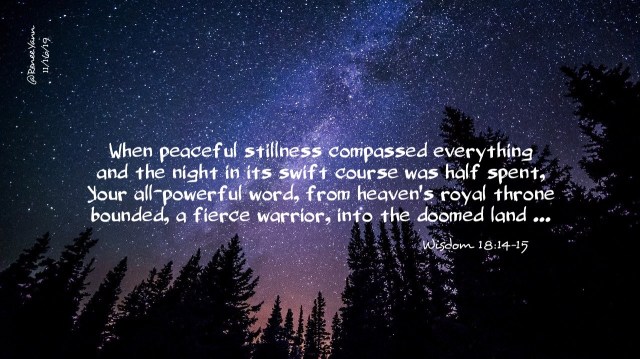
wis18_midnight

Although the passage is a poetic recounting of the Exodus experience, it always makes me think of Christmas. 

  • Midnight on a starry night
  • Peaceful stillness over the earth
  • The all-powerful Word transformed 
  • Appearing among us like a comet in our darkness
  • Hope renewed for an otherwise doomed land

Praying with the passage this morning, I realize that my “Christmas lens” on the reading is right on target.

The Christmas event begins our Exodus story, a story completed in the Passion, Death and Resurrection of Christ.

Just as the God of Moses reached into ancient Israel’s life to free them, transform them and make them God’s People, so God reaches into our lives. God does this not only on Christmas, but in every moment of our experience.

As our media and consumer culture bombards us, all too early, with all the secularized images of Christmas, let today’s verses bring us back to the true startling grace of our own Christ/Exodus stories:

We are not alone in the midnights of our lives.
Listen underneath all the distractions
to the, at first, softly emerging sound of Love
humming under all things.
Watch for the small lights of heaven
longing to break into our human darkness.
Give yourself to their Light.

No matter where we are in our lives right now,
no matter the joy or pain of our present circumstances,
God wants to use these realities to be with us
and to teach us Love.
Let us invite God
into our willingness
to learn that Love,

to become that Love.


Music: Winter Cold Night – John Foley, SJ

Lyrics below (yes, it is an Advent/ Christmas song. But it fits so perfectly. Please forgive me if I am rushing the season too.🤗)

Dark, dark, the winter cold night. Lu-lee-lay.
Hope is hard to come by. Lu-lee-lay.
Hard, hard, the journey tonight. Lu—lee-lay.
Star, guide, hope, hide our poor, winter cold night.

And on earth, peace, good will among men.

Lean, lean, the livin’ tonight. Lu-lee-lay.
Star seems darker sometimes. Lu-lee-lay.
Unto you is born this day a Savior.
Pain, yes, in the bornin’ tonight. Lu lee—lay.
Star, guide, hope, hide our poor, winter cold night.

Marking the Hours

Friday of the Seventeenth Week in Ordinary Time

August 2, 2019

Click here for readings

Today, in Mercy, we begin a few days of reading Leviticus. The reading today provides a long list of when and how the community should gather to worship. It is a lexicon on how to honor the sacred presence in their lives. Such honoring includes aspects of celebration, decoration, sharing, remembering and hoping together.

Lv23_37 hoursJPG

While the particular enjoinments detailed in Leviticus might not pertain to us, their spirit does. It is a spirit that encourages us to cherish the gift of time – moments, days, years – as precious opportunities to encounter God.

Down through the ages, people seeking holiness have used various, ritualized practices to remember and honor God’s omnipresence in their lives. They include morning and nighttime prayers, Grace before Meals, the Blessing of the Hour, the Angelus at noontime, the great liturgical practices of Advent and Lent, and the Divine Office. Each of these spiritual practices helps us to be more intentional about the true meaning and purpose of our daily life. 

Macrina Wiederkehr, a Benedictan monastic, has published a beautiful book to help people mark the hours of their day. She says this in Seven Sacred Pauses:


When I speak of “the hours” I am referring to those times of the day that the earth’s turning offers us: midnight, dawn, midmorning, noon, midafternoon, evening, and night. Although every hour is sacred, these special times have been hallowed by centuries of devotion and prayer…..

The daily and nightly dance of the hours is a universal way of honoring the earth’s turning as well as the sacred mysteries that flow out of our Christian heritage.


I think this is exactly what our Leviticus passage is doing as well. Our time is so precious and it flows so quickly! What a tragedy if we fail to stop and realize that it is the holy river on which we are meant to float to God!

robson-hatsukami-morgan-454S_xB0ReA-unsplash
Photo by Robson Hatsukami Morgan on Unsplash

Music: Teach Us to Number Our Days – Marty Goetz

Vigil

Saturday of the Fifteenth Week in Ordinary Time

July 20, 2019

Click here for readings

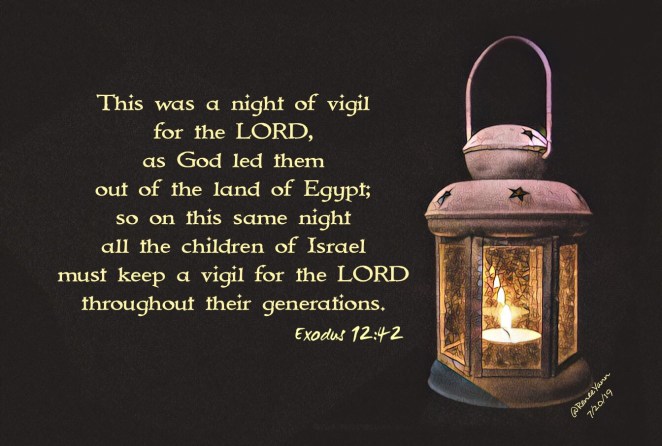
Today, in Mercy, we keep vigil with the “Children of Israel” as they begin the great Exodus.

Ex12_42 Vigil

Even the youngest of us understands what it means to “keep vigil”. Toddlers, on Christmas Eve, keep vigil for the sound of Santa’s footsteps on the roof.

Throughout our lives, the kinds of vigils we keep deepen in meaning. Any given night holds an array of vigil-keepers:

  • A nervous student pulls an all-nighter before a big exam.
  • An anxious parent watches over a feverish child.
  • A faith-filled soul sits in pre-dawn prayer.
  • A vigilant elder prays quietly at the death bed of a long-beloved.

As families and communities, we wait together for each other’s lives.

  • Together, we expect the births of each generation’s babies.
  • We wait and hope for college acceptances and new jobs.
  • We wait for test results of all kinds.
  • We wait to listen to one another’s stories of success or disappointment.
  • We wait and prepare for the dawning of great feasts like Christmas and Easter

When we keep vigil, we live in expectation of something or someone coming to us. But there is another important aspect to every vigil.

As we wait, something is also happening within us.
In the deep quiet of our waiting, we are transformed.

Thomas Merton, monk of Gethsemane, was assigned to keep a particular type of vigil at the abbey. It was called “fire watch”, a night-long lookout to ensure that no fire erupted in the old wooden buildings as the other monks slept.  Merton writes about that watch at the end of his book The Sign of Jonas:

The fire watch is an examination of conscience in which your task as watchman suddenly appears in its true light:  a pretext devised by God to isolate you, and to search your soul with lamps and questions, in the heart of darkness.
“Fire Watch, July 4, 1952”

Today, as we pray with Israel’s Passover vigil, let us consider our own vigils – current or past. Beyond their apparent meaning, to what secret transformation might God be inviting us? What is happening deep in our soul as we watch far out to the horizon of our hope?

Music: Firewatch – Chris Remo

Manger

Monday, December 24, 2018

Readings:  http://www.usccb.org/bible/readings/122418.cfm

manger 12_24

We can imagine the manger in any way we choose: perhaps a small rest in a cold, wooden barn, or a hard pallet for a soft newborn. I choose this year to imagine it as warm comfort and a circle of love.

Advent has been an unusual journey for me this year. Just two days after it began, I had my right knee replaced. It might not seem like a big deal. Thousands of people have it done every day. But it’s a big deal when it’s your knee.

I knew what to expect from my surgery and healing process. What I didn’t expect is that the time, coincidental with Advent, would take me to a new place in the heart of Jesus.

You see, what I had planned on was my surgeon’s expertise and my own determination. Like Mary and Joseph, I had set out wholeheartedly, knowing where I had to go and why.

But I had taken an inadequate measure of my vulnerability.

I had not considered my need for a compassionate stable owner; for the warm, living breath of other beings, for the wonder of shepherds, or the songs of angels to lift me up to my hopes for wholeness. Still these came to me in the most wonderful ways!

After an unexpected complication, I was welcomed at our nursing facility for a slightly longer stay than planned. It was my stable on a night that turned out chillier and longer than expected.

My sisters, family and friends – both near and far – breathed their comforting prayers over me, day after day. I saw that holy vapor rising even when I struggled through the first nights with pain or uncertainty. One even brought her prayers crocheted into a shawl under whose warmth I sought my healing.

People did all the things for me that I forgot I would be unable to do, all the time assuring me how well I was doing. Nurses, physicians and amazingly compassionate aides lifted me up – literally and figuratively – with hope and encouragement.

We may not think to find a shepherd’s smile or an angel’s song in such ordinary things as a cup of tea, a Payday candy bar, a soothing towelette, a warm pot pie, a vase of flowers, or a pan of kugel.

We may forget to recognize the heavenly host in a phone call, a card, a peek in the door to see what small service is needed.

But this is how God comes to us. This is the real Advent. It isn’t on a calendar.

Good people gave me many gifts through my Advent journey, the greatest of which was this: a crystal recognition of how much we need one another – even in the simplest of ways. No gesture of companionship or compassion is too small to foster the promise of healing and hope.

Nothing is truly born in isolation from love.

Our human fragility can be an uncomfortable companion, or it can be that just and relentless teacher whom we appreciate only after graduation.

I come to this Christmas Eve with a grateful desire to be more aware of the journeys of those beside me; to reach out my hand with prayer, compassion and help – to be a manger for the birth of everyday miracles. This was the enduring gift of this blessed Advent. 

As we close this holy season, we each may want to consider the “manger” within us. Warm? Circled in light? Open to Angel songs? What welcome will “Christ in Every Person” find in me? How has God brought me to the moment of Christmas?

“We are celebrating the feast of the Eternal Birth
which God the Father has borne
and never ceases to bear in all eternity….
But if it takes not place in me,
what avails it?
Everything lies in this,
that it should take place in me.”
~ Meister Eckhart 

Music:  Emanuel ~ Tim Manion (Lyrics below)

Baby born in a stall,
Long ago now and hard to recall
Cold wind, darkness and sin
Your welcoming from us all.

How can it be true
A world grown so cold now,
How can it be new
Sorrow’s end; God send,
Born now for me and you.

Emanuel, Emanuel,
What are we that you have loved us so well?
A song on high,
A Savior’s night,
Angel host rejoice thy glory to tell.

Lord, lead us to know,
You lay like a beggar so humble and low.
No place for your head, and straw for your bed
The glory of God to show.

Babe on mother’s knee,
Child so soon to be nailed to a tree,
All praise ‘til the end of our days.
O Lord, you have set us free.

Mary, Sacred Chamber

Sunday, December 23, 2018

 Click here for Readings

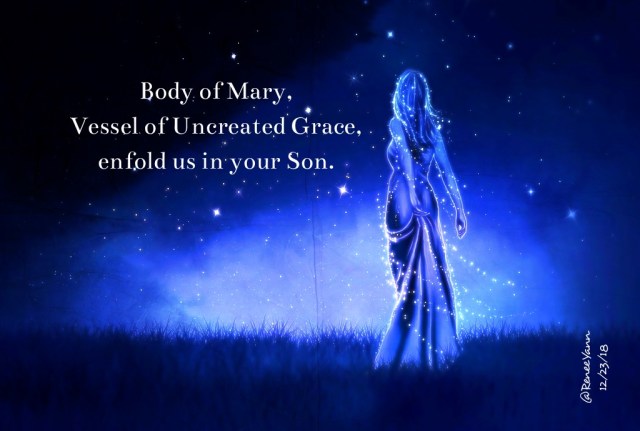
MAry 12_23

Today, in Mercy, our readings offer a harmonious exultation of Mary, beloved mother of Jesus.

The prophet Micah foretells the time “when she who is to give birth has borne.”

Even the ancient voices spoke of Mary, long before time knew her name. Their hope depended on her cosmic “Yes”, long before she spoke her first childish word.

Hebrews speaks of the Body of Christ, that physical place where the grandeur of God took flesh, that tabernacle woven of Mary’s own body and blood, that temple made possible by her “Fiat”.

The Gospel gives us two loving women, Elizabeth and Mary, rejoicing in God’s power manifested in their lives. They need no proclamations, executive orders, bills, or injunctions. Just a soft greeting, a leap within, a confirmed trust carried in each other’s eyes.

This poem by Mark Strand captures their moment for me. These two women had waited with all Creation for the redeeming Messiah. Now it was about to happen within their lives:

The Coming of Light
Even this late it happens:
the coming of love, the coming of light.
You wake and the candles are lit as if by themselves,
stars gather, dreams pour into your pillows,
sending up warm bouquets of air.
Even this late the bones of the body shine
and tomorrow’s dust flares into breath.

Music: Agni Parthene (Greek: Ἁγνὴ Παρθένε), rendered “O Virgin Pure”, is a Greek Marian Hymn composed by St. Nectarios in the late 19th century. The dulcet melody is sung here in both Greek and English. Lyrics are below.

O Virgin Pure
by St. Nectarios

Refrain: O Rejoice, Bride Unwedded.

O Virgin pure, immaculate/ O Lady Theotokos
O Virgin Mother, Queen of all/ and fleece which is all dewy
More radiant than the rays of sun/ and higher than the heavens
Delight of virgin choruses/ superior to Angels.
Much brighten than the firmament/ and pure than the sun’s light
More holy than the multitude/ of all the heav’nly armies.
O Rejoice, Bride Unwedded.

O Ever Virgin Mary/ of all the world, the Lady
O bride all pure, immaculate/ O Lady Panagia
O Mary bride and queen of all/ our cause of jubilation
Majestic maiden, Queen of all/ O our most holy Mother
More hon’rable than Cherubim/ beyond compare more glorious
than immaterial Seraphim/ and greater than angelic thrones.

O Rejoice, Bride Unwedded.

Rejoice, O son of Cherubim/ Rejoice, O hymn of angels
Rejoice, O ode of Seraphim/ the joy of the archangels
Rejoice, O peace and happiness/ the harbor of salvation
O sacred chamber of the Word/ flower of incorruption
Rejoice, delightful paradise/ of blessed life eternal
Rejoice, O wood and tree of life/ the fount of immortality

O Rejoice, Bride Unwedded.

I supplicate you, Lady/ now do I call upon you
And I beseech you, Queen of all/ I beg of you your favor
Majestic maiden, spotless one/ O Lady Panagia
I call upon you fervently/ O sacred, hallowed temple
Assist me and deliver me/ protect me from the enemy
And make me an inheritor/ of blessed life eternal.

O Rejoice, Bride Unwedded.

O King of Kings ( O Rex Gentium)

Saturday, December 22, 2018

Click here for readings

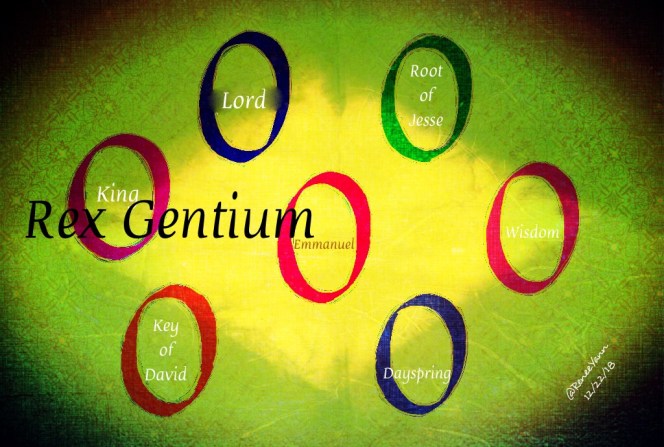
Rex Gentium

Today, in Mercy, our O Antiphon beseeches God, Who is King of All Nations, Who unites Gentile and Jew, to deliver us. 

But from what? 

The answer lies in the closing phrase of the antiphon: “we whom you formed from the dust of the earth”. 

Deliver us from the artificial barriers we have created to separate from and dominate over one another – by nationality, ethnicity, color, gender, social or economic class. We each began as dust and will end that way.  May we be humble, mutual and compassionate in the time between.

Consider the gracious humility of Hannah in our first reading today, and of Mary in our Gospel.  They are power figures in Salvation History.  But their power comes from their utter dependence on and honor to God, their only true King.

There was no fragmentation in the commitment of their entire lives to God. They understood all Creation to belong to the Divine.

King of Kings, deliver us from any such fragmentation. Make us all whole in You.

O King of all nations and keystone of the Church:
come and save us, whom you formed from the dust!
R. Alleluia, alleluia.

Music: O Rex Gentium – Gregorian Chant ( Latin rendering of the italicized prayer above.)

O God With Us (O Emmanuel)

Friday, December 21, 2018

Click here for Readings

Emmanuel

Today, is Mercy, we pray the O Antiphon:

“O Emmanuel, God with us, come to save us.” 

The prayer itself appears a contradiction. If God is with us, why need He come? 

If we are already saved, why need we pray for salvation? 

It is because we very human beings FORGET! 

Our pleading is not for God’s sake; it is for our own – to wake us and focus us on the amazing reality that God wants to be with every one of us every moment of our lives if we will just open those moments to God. 

Think about what you have missed of God’s Presence in your life? Even just yesterday … last week … last year …your lifetime! Wow! I know that, so often, I thought I was doing this all alone. O, God With Me, how blind I have been!

O Emmanuel, open my heart to your Presence in myself and in all Creation.

O Emmanuel, our King and Giver of Law:
come to save us, Lord our God!
R. Alleluia, alleluia.

Music: Michael Hegeman

O Key of David ( O Clavis David)

Thursday, December 20, 2018

Readings:  Click here for readings

Clavis David

Today, in Mercy, we pray the O Antiphon: “O Key of David, come and bring forth from his prison house the captive.”  

We probably don’t think of ourselves as captives. But simply by virtue of our humanity, we are probably inhibited in some way – by fear, pride, ignorance, prejudice, self-doubt… 

Paula D’Arcy puts it like this: “Who would I be, and what power would be expressed in my life, if I were not dominated by fear?
(Or maybe anger, some type of “ism’, greed, pride, and on and on.) 

Let us pray this prayer together, dear friends, for all held captive in both visible and invisible ways. May we pray especially for those captured by drugs, alcohol, or any other addiction.

May we pray especially for those held captive on our own border, that their human dignity may be honored; and for those causing their suffering, captured by their own indifference, greed, and political savagery.

O Key of David,
opening the gates of God’s eternal Kingdom:
come and free the prisoners of darkness!
R. Alleluia, alleluia.

Music;  Michael G. Hegeman