Today, in God’s Lavish Mercy, our Gospel offers us the luminous account of Gabriel’s Annunciation to young Mary. In my prayer, I think I would just like to sit beside Mary and wait for the graces God wishes to give me – to wait confidently as she did, and to do so with her guidance.
Annunciation – Edward Burns-Jones
I will use the powerful poem by Scott Cairns to focus my heart. You may want to use it as well.
Deep within the clay, and O my people
very deep within the wholly earthen
compound of our kind arrives of one clear,
star-illumined evening a spark igniting
once again the tinder of our lately
banked noetic fire. She burns but she
is not consumed. The dew lights gently,
suffusing the pure fleece. The wall comes down.
And—do you feel the pulse?—we all become
the kindled kindred of a King whose birth
thereafter bears to all a bright nativity.
Music: Monteverdi – Vespro della Beata Vergine led by John Eliot Gardiner
Claudio Giovanni Antonio Monteverdi (1567 – 1643) was an Italian composer, choirmaster and string player. A composer of both secular and sacred music, and a pioneer in the development of opera, he is considered a crucial transitional figure between the Renaissance and Baroque periods of music history.
The Vespro della Beata Vergine consists of 14 components: an introductory versicle and response, five psalms interspersed with five “sacred concertos”, a hymn, and two Magnificat settings. Collectively these pieces fulfil the requirements for a Vespers service on any feast day of the Virgin.
In March 1964, as a student at King’s College, Cambridge, John Eliot Gardiner led a performance of Monteverdi’s Vespers that not only launched his conducting career, but also his world-renowned Monteverdi Choir.
Today, in God’s Lavish Mercy, Isaiah describes the upside-down nature of God’s Reign:
Trust in the LORD forever! For the LORD is an eternal Rock, who humbles those in high places, and the lofty city he brings down; He tumbles it to the ground, levels it with the dust. It is trampled underfoot by the needy, by the footsteps of the poor.
Isaiah 26:4-6
God humbles the haughty, dwindles the lofty, tramples the elite with the “footsteps of the poor”. Wow! God turns our messy world on its head to right it!
This eloquent prophecy was intended to bolster the hopes of Isaiah’s careworn exiled community. It imagines the embodiment of the hope for which they have no evidence. Isaiah tells a geographically imprisoned people that they will be the ultimate conquerors. He assures a shackled community that their trust will earn them jubilant liberation. He enjoins them to believe!
It is really hard to have that kind of faith and trust when we have no evidence of delivery from whatever imprisons or assails us. Sometimes we wait a lifetime for a prayer to be answered but it seems that it never is. Are we fools to keep believing under such circumstances? Or are we wise enough to trust that the answers have come in ways we could not yet discern?
Our Gospel summons us to the same type of wildly hopeful trust. Jesus says that we cannot foresee nor control what kind of weather will assail us in life. Therefore, we must have a firm and sure foundation in faith so that we may survive any storm.
Jesus tells us to hear the sacred word with integrity and to measure ourselves according to it, because simply murmuring “Lord, Lord” doesn’t merit a pass to eternal life.
Everyone who listens to these words of mine and acts on them will be like a wise one who built the house on rock. The rain fell, the floods came, and the winds blew and buffeted the house. But it did not collapse; it had been set solidly on rock. And everyone who listens to these words of mine but does not act on them will be like a fool who built the house on sand. The rain fell, the floods came, and the winds blew and buffeted the house. And it collapsed and was completely ruined.
Matthew 7:24-27
In this Advent time, let’s pray for a simple, wise and strong faith for ourselves and for those we love.
Prose: from On Obstinacy in Belief by C.S. Lewis
… a little bit long from Lewis but so worth it! If you like the excerpt, here’s a link to the entire essay:
Christians seem to praise an adherence to the original belief which holds out against any evidence whatever. I must now try to show why such praise is in fact a logical conclusion from the original belief itself.

This can be done best by thinking for a moment of situations in which the thing is reversed. In Christianity such faith is demanded of us; but there are situations in which we demand it of others. There are times when we can do all that a fellow creature needs if only he will trust us.

In getting a dog out of a trap, in extracting a thorn from a child’s finger, in teaching a boy to swim or rescuing one who can’t, in getting a frightened beginner over a nasty place on a mountain, the one fatal obstacle may be their distrust.

We are asking them to trust us in the teeth of their senses, their imagination, and their intelligence. We ask them to believe that what is painful will relieve their pain and that what looks dangerous is their only safety. We ask them to accept apparent impossibilities: that moving the paw further back into the trap is the way to get it out; that hurting the finger very much more will stop the finger hurting; that water which is obviously permeable will resist and support the body; that holding onto the only support within reach is not the way to avoid sinking; that to go higher and onto a more exposed ledge is the way not to fall.

To support all these incredibilia we can rely only on the other party’s confidence in us—a confidence certainly not based on demonstration, admittedly shot through with emotion, and perhaps, if we are strangers, resting on nothing but such assurance as the look of our face and the tone of our voice can supply, or even, for the dog, on our smell. Sometimes, because of their unbelief, we can do no mighty works.

But if we succeed, we do so because they have maintained their faith in us against apparently contrary evidence. No one blames us for demanding such faith. No one blames them for giving it. No one says afterward what an unintelligent dog or child or boy that must have been to trust us. If the young mountaineer were a scientist it would not be held against him, when he came up for a fellowship, that he had once departed from Clifford’s rule of evidence by entertaining a belief with strength greater than the evidence logically obliged him to.

Now to accept the Christian propositions is ipso facto to believe that we are to God, always, as that dog or child or bather or mountain climber was to us, only very much more so.
Music: Sheep May Safely Graze – J. S. Bach from from Cantata No. 208, “Was mir behagt” (Hunt Cantata), BWV 208, arr. by Egon Petri, (Oliver Schnyder – Piano)
Today, in God’s Lavish Mercy, Isaiah tantalizes us with his vision of the sumptuous heavenly banquet:
On this mountain the LORD of hosts will provide for all peoples A feast of rich food and choice wines, juicy, rich food and pure, choice wines.
Isaiah 25:6-7
I can picture myself at that table munching on a savory turkey leg washed down by a bottomless pilsner. But if I stop there in my meditation I will have missed the whole point! The menu is not even the tip of the treasures to be had when we gather on Isaiah’s “Parousia Mountain”.
On that mountain, the veil will be lifted from our perception. The tangly web of our stresses and confusions will be wiped away. We will see ourselves and all Creation with God’s clear and loving eyes. Death – the lurking intruder threatening every earthly table – will have been eradicated, dissolved into Eternal Being.
On this mountain God will destroy the veil that veils all peoples, The web that is woven over all nations; God will destroy death forever.
Isaiah 25:7-8
In our first reading, Isaiah paints the picture of a mountain lifted from time and transformed with heaven. In our Gospel, Jesus too is on a mountain when he pulls heaven down to heal and feed the yearning crowd.
Jesus walked by the Sea of Galilee, went up on the mountain, and sat down there. Great crowds came to him, having with them the lame, the blind, the deformed, the mute, and many others. They placed them at his feet, and he cured them.
Matthew 15:29-30
No doubt the gathered people, cured of their nagging maladies, were stunned into an instant faith. But Jesus knows that they can not stay on this heaven-charged mountain forever. They have their life’s journey ahead of them, and the energy of nascent faith may wane on the long road. So he reinforces the healing miracles with the comfort and sustenance of common food:
My heart is moved with pity for the crowd, for they have been with me now for three days and have nothing to eat. I do not want to send them away hungry, for fear they may collapse on the way.
Matthew 15:32
In this incident, which is another version of the miracle in Matthew 14, the simple common folk have with them only the merest provisions. It is these that Jesus uses to fuel an enduring faith in these earth-bound believers:
Jesus said to them, “How many loaves do you have?” “Seven,” they replied, “and a few fish.” He ordered the crowd to sit down on the ground. Then he took the seven loaves and the fish, gave thanks, broke the loaves, and gave them to the disciples, who in turn gave them to the crowds. They all ate and were satisfied. They picked up the fragments left over–seven baskets full.
Matthew 15:34-37
God uses our merest provisions too to charge our daily life with faith’s energy. But we must take the holy time to let any misleading webs and obstructive veils fall from our perceptions. Our godless culture layers the world with so many distractions and fallacies that we are hard-pressed to see what’s really essential to true life.
Especially at Christmas time, God is nearly buried in tinsel, hype, and commercialism. A good Advent, spent in the awe-filled silence of scriptural reflection, is the antidote to this malady. Let’s be committed to it.
Poetry: Adult Advent Announcement – by David A. Redding, (from If I Could Pray Again – 1965)
O Lord,
Let Advent begin again
In us,
Not merely in commercials;
For that first Christmas was not
Simply for children,
But for the
Wise and the strong.
It was
Crowded around that cradle,
With kings kneeling.
Speak to us
Who seek an adult seat this year.
Help us to realize,
As we fill stockings,
Christmas is mainly
For the old folks —
Bent backs
And tired eyes
Need relief and light
A little more.
No wonder
It was grown-ups
Who were the first
To notice
Such a star.
Music: When I Can Read My Title Clear – arranged by Tim Sharpe This is an acapella version of the hymn text by Isaac Watts (1674 – 1748) interpreting Isaiah 25:8.It is set to the tune PISGAH, an American Folk Melody by the 19th-century composer Joseph C. Lowry
Today, in God’s Lavish Mercy, Isaiah challenges us with his outrageously hopeful poetry.
After describing, in lyrical magnificence, the Messianic Ruler, Isaiah tells us this:
Then the wolf shall be a guest of the lamb, and the leopard shall lie down with the kid; The calf and the young lion shall browse together, with a little child to guide them. The cow and the bear shall be neighbors, together their young shall rest; the lion shall eat hay like the ox. The baby shall play by the cobra’s den, and the child lay his hand on the adder’s lair. There shall be no harm or ruin on all my holy mountain; for the earth shall be filled with knowledge of the LORD, as water covers the sea.
Isaiah 11:6-10
We love this lilting Advent balladry, don’t we? Its movement is laced with hidden bells and waft of pine. It makes us remember Handel’s Messiah and resolve to find and play the CD we put away last January.
But as much as we might love the passage, do we believe it? Is the era of messianic peace possible, and will it be realized through the mystery of Divine Love incarnate in Jesus Christ?
Well, here are the facts:
Isaiah lived and prophesied a redeemed kingdom about 700 years before Christ. When Christ was born, the world was in pretty much the same sad shape as it was when Isaiah wrote.
Jesus lived 2000 years ago, speaking and modeling specific instructions for the world’s transformation. But the world is in pretty much the same sad shape today as it was when Jesus lived.
So where is all this “peaceable kingdom” stuff happening? Is it non-existent or just invisible? Is it just the rather lunatic imagining of ancient prophets?
Today’s Gospel offers us an understanding of God’s Reign too deep for the world’s logic. By the gift of faith and the grace of Baptism, we have been given a new set of eyes, charged with the same outrageous yet real hope evident in Isaiah and enfleshed in Christ.
I give you praise, Father, Lord of heaven and earth, for although you have hidden these things from the wise and the learned you have revealed them to the childlike…
… Turning to the disciples in private he said, “Blessed are the eyes that see what you see. For I say to you, many prophets and kings desired to see what you see, but did not see it, and to hear what you hear, but did not hear it.
Luke 10:21-24
If we can give ourselves to the vulnerable simplicity Jesus describes, faith can transform us. The “Kingdom” can live in us and because of us!
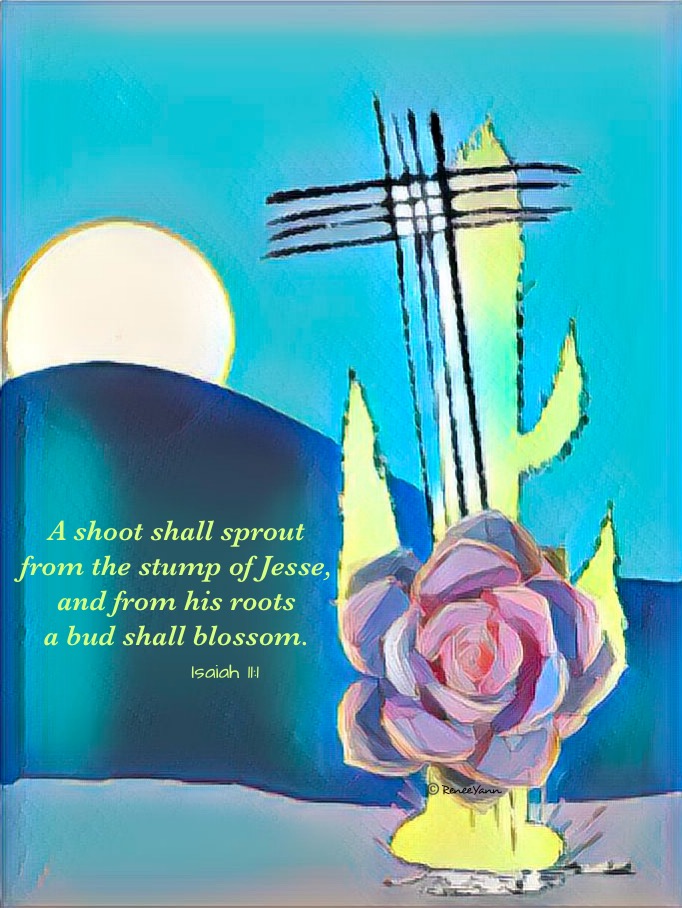
We too will see the bud beyond the stump. New life will arise from what appears lifeless. The worldly fears and inhospitalities that prey on us will be tamed by a holy confidence. In life’s sinuous circumstances, we will see the Holy Mystery unfolding.
The Kingdom, so indiscernible in our fractious world, will “advent” in us. This is what we long for in our Advent prayer.
Poetry: Advent Credo – Allan Boesak, a South African pastor in the Dutch Reformed Church, politician, anti-apartheid activist, and author of fifteen books. This poem is taken from his book Walking on Thorns (Eerdmans, 1984), and is often but wrongly attributed to Daniel Berrigan.
It is not true that creation and the human family are doomed to destruction and loss—
This is true: For God so loved the world that He gave his only begotten Son, that whoever believes in Him shall not perish but have everlasting life;
It is not true that we must accept inhumanity and discrimination, hunger and poverty, death and destruction—
This is true: I have come that they may have life, and that abundantly.
It is not true that violence and hatred should have the last word, and that war and destruction rule forever—
This is true: Unto us a child is born, unto us a Son is given, and the government shall be upon his shoulder, his name shall be called wonderful councilor, mighty God, the Everlasting, the Prince of peace.
It is not true that we are simply victims of the powers of evil who seek to rule the world—
This is true: To me is given authority in heaven and on earth, and lo I am with you, even until the end of the world.
It is not true that we have to wait for those who are specially gifted, who are the prophets of the Church before we can be peacemakers—
This is true: I will pour out my spirit on all flesh and your sons and daughters shall prophesy, your young men shall see visions and your old men shall have dreams.

It is not true that our hopes for liberation of humankind, of justice, of human dignity of peace are not meant for this earth and for this history—
This is true: The hour comes, and it is now, that the true worshipers shall worship God in spirit and in truth.

So let us enter Advent in hope, even hope against hope. Let us see visions of love and peace and justice. Let us affirm with humility, with joy, with faith, with courage: Jesus Christ—the life of the world.
Music: Lo, How a Rose E’er Blooming – pre-17th century anonymous hymn
From Wikipedia: The hymn was originally written with two verses that describe the fulfillment of the prophecy of Isaiah foretelling the birth of Jesus. It emphasizes the royal genealogy of Jesus and Christian messianic prophecies. The hymn describes a rose sprouting from the stem of the Tree of Jesse, a symbolic device that depicts the descent of Jesus from Jesse of Bethlehem, the father of King David. The image was especially popular in medieval times, and it features in many works of religious art from the period. It has its origin in the Book of Isaiah:
And there shall come forth a rod out of the stem of Jesse, and a Branch shall grow out of his roots.— Isaiah 11:1
Today, in God’s Lavish Mercy, we begin the Advent Watch, that annual time of acute spiritual awareness and hope-filled expectation.
We’ve all kept watch at various times in our lives, perhaps without even realizing it. It may have been as simple as waiting for a delayed but highly anticipated letter, or as worrisome as the anxious vigil over a feverish child. It may be as unnoticeable as waiting for an elevator, a green light, or a “transaction complete” at the ATM, or as marvelous as the nine-month expectancy of new life.
We should be good at waiting because we do it all the time, but maybe we’re not so good at it after all.
Good waiting requires our consciousness. We may idly consider the “waiting space” a neutral zone that we can fill with anything we choose – impatience, daydreaming, or distraction. But pivotal waiting can offer us an invaluable invitation – to meet God in a new way as we anticipate what we cannot yet see or comprehend. But sometimes we don’t pay enough attention to hear the invitation.
This kind of “keeping watch” can be a sacramental experience. It is a time when we are stilled before a reality or mystery we cannot control. We can only wait, hope, release any fear, and cleanse our demanding prayer of its useless stipulations. It is a time of confident abandonment into God’s loving will for our good. Advent is such a blessed time.
Praying with our Advent scriptures provides us with a curriculum for good waiting. Our teachers will be the divinely lyrical Isaiah, the Psalms, Matthew and Luke, and the glorious O Antiphons.
We begin today with this heartfelt entreaty to God:
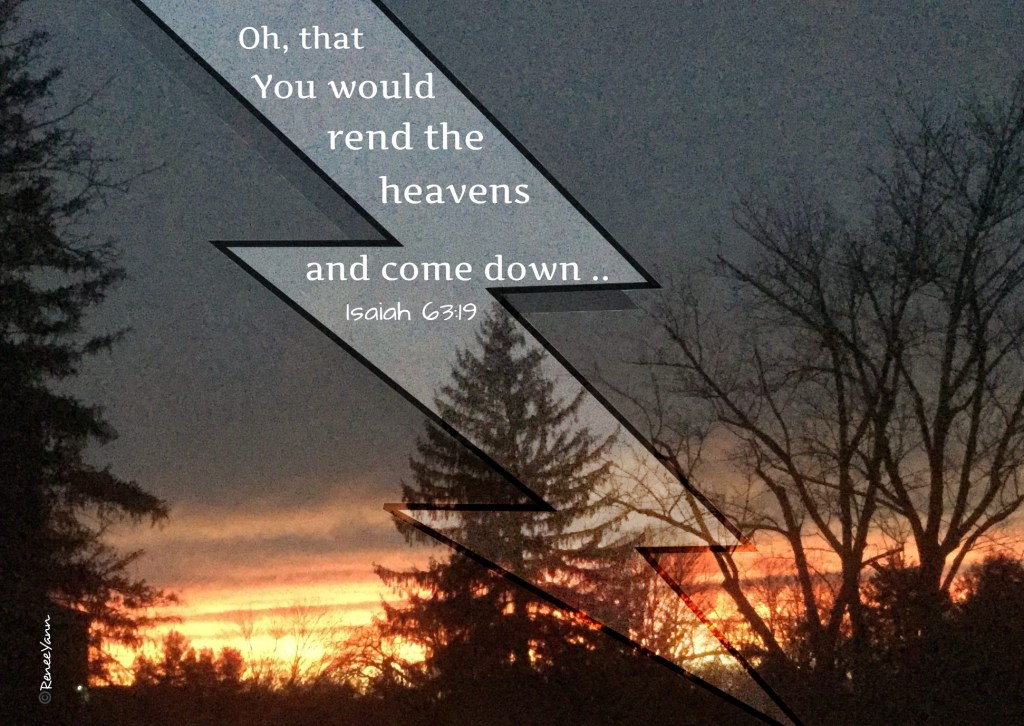
Oh, that you would rend the heavens and come down, with the mountains quaking before you, while you wrought awesome deeds we could not hope for, such as they had not heard of from of old. No ear has ever heard, no eye ever seen, any God but you doing such deeds for those who wait for him. Would that you might meet us doing right, that we were mindful of you in our ways!
Each one of us can look into our own hearts today, into our own perception of the world, to see where God is most sorely needed. As we pray Isaiah’s plea, we can do so assured by Paul’s blessing that God desires to answer us:
I give thanks to my God always on your account for the grace of God bestowed on you in Christ Jesus, that in him you were enriched in every way, with all discourse and all knowledge, as the testimony to Christ was confirmed among you, so that you are not lacking in any spiritual gift as you wait for the revelation of our Lord Jesus Christ. He will keep you firm to the end, irreproachable on the day of our Lord Jesus Christ. God is faithful, and by him you were called to fellowship with his Son, Jesus Christ our Lord.
Poetry: Advent (On a theme by Dietrich Bonhoeffer) – by Pamela Cranston
Look how long
the tired world waited,
locked in its lonely cell,
guilty as a prisoner.
As you can imagine,
it sang and whistled in the dark.
It hoped. It paced and puttered about,
tidying its little piles of inconsequence.
It wept from the weight of ennui
draped like shackles on its wrists.
It raged and wailed against the walls
of its own plight.
But there was nothing
the world could do
to find its freedom.
The door was shut tight.
It could only be opened
from the outside.
Who could believe the latch
would be turned by the flower
of a newborn hand?
Music: Wachet auf! ruft uns die Stimme – J.S. Bach
Wachet auf, ruft uns die Stimme Wake up, the voice calls us Der Wächter sehr hoch auf der Zinne, of the watchmen high up on the battlements, Wach auf, du Stadt Jerusalem! wake up, you city of Jerusalem! Mitternacht heißt diese Stunde; This hour is called midnight; Sie rufen uns mit hellem Munde: they call us with a clear voice: Wo seid ihr klugen Jungfrauen? where are you, wise virgins ? Wohl auf, der Bräutgam kömmt; Get up, the bridegroom comes; Steht auf, die Lampen nehmt! Alleluja! Stand up, take your lamps! Hallelujah! Macht euch bereit Make yourselves ready Zu der Hochzeit, for the wedding, Ihr müsset ihm entgegen gehn! you must go to meet him!
Light kisses Tennessee rooftops as, in the far distance, Radiant Dawn peeks brightly over the Great Smokey Mountains
Today, God’s Lavish Mercy, we pray a prayer full of beautiful, hopeful images. It is up to each one of us to ponder the presence of Light in our lives and the corners of shadow. It is up to us as we pray, to invite our God- Emmanuel to be with us in both portions of our experience. It is up to us to look toward the horizon with faith, hope and love in order to understand that God takes flesh in every moment of our lives.
May these images open our hearts to the immeasurable power and beauty of this Feast. Let us savor them slowly as we make our way to the waiting manger:
O Morning Star, splendor of Light Eternal and Sun of Righteousness: Come and enlighten those who dwell in darkness and the shadow of death.
O Radiant Dawn, it is Christmas Eve. We see the hint of your dawning along the dark horizon of our limitations.
How we long for You to fracture time, our fragile eggshell, Eternal Love flowing across our weary hearts.
O Dayspring, let us see beyond the darkness, beyond fear, and selfish calculations, beyond doubt, despair, hatred, even death… …to know that, in You, everything is Light for those who trust Your Rising.
We await your Christmas Morning in our world. Maranatha! Come, Lord, Jesus!
Today, in God’s Lavish Mercy, Malachi preaches the news of God’s Coming with dramatic authority! He tells us that the Lord is sending a messenger, somewhat in the mode of John the Baptist, to prepare the Lord’s way.
Thus says the Lord GOD: Lo, I am sending my messenger to prepare the way before me; And suddenly there will come to the temple the LORD whom you seek, And the messenger of the covenant whom you desire. Yes, he is coming, says the LORD of hosts. But who will endure the day of his coming? And who can stand when he appears?
Malachi 3:1-4
The passage is so dramatic that it inspired Handel to include it in his magnificent “Messiah”. Handel captures Malachi’s ominous tone, asking the key question: Who shall abide the day of his coming?
These are words of purification and judgement, with tiny tinges of fire and brimstone! Indeed the Lord’s coming is often stunningly fast and awesome. Just last week, our dear Sister Rosemary Herron passed away suddenly and unexpectedly while enjoying a holiday evening. Her death left all who knew her in a state of utter shock and heartbreak.
As we read Malachi today, we might wonder, “Was she ready?” Could she “withstand the Day of His Coming”? What was it like to have her world spun from earth to heaven in the matter of a few moments?
The second part of our reading gives us an answer.
Lo, I will send you Elijah, the prophet, Before the day of the LORD comes, the great and terrible day, To turn the hearts of the parents to their children, and the hearts of the children to their parents, Lest I come and strike the land with doom.
Malachi 3:23-24
If our hearts have been turned toward one another in this world, and if our time on earth has been spent in so turning others, then the Lord’s coming is not a “terrible day”. As Malachi alludes, our lives refine us like gold or silver. At the Lord’s coming, these precious elements will be tested.
Did we love inclusively?
Did we turn others toward love?
Did we try to turn the selfish worldly tide toward love?
All who knew Sister Rosemary know that she was pure gold, already refined by her lifelong choice to be Mercy in the world. That’s what makes her sudden passing so very difficult to cope with. But for Rosemary, that Divine Coming must have been a glorious surprise when she no doubt heard the words of Matthew’s Gospel:
Then the King will say to those on his right, ‘Come, you who are blessed by my Father; take your inheritance, the kingdom prepared for you since the creation of the world. For I was hungry and you gave me something to eat, I was thirsty and you gave me something to drink, I was a stranger and you invited me in, I needed clothes and you clothed me, I was sick and you looked after me, I was in prison and you came to visit me.
Matthew 25:34-36
Perhaps all of you kind readers would offer a prayer of consolation today for our Sister Rosemary’s family and friends, for her beloved school community at Mercy Career and Technical High School, for her religious community – the Sisters of Mercy, and for the many people she influenced throughout her very generous life.
R. Alleluia, alleluia. O King of all nations and keystone of the Church; come and save your beloved, whom you formed from the dust! R. Alleluia, alleluia.
Poetry:Good-bye Poem – Meg Bowman
Life is but weak if we waste it in weeping:
So, she has left you, she would soon or late.
Death from our lives takes all in her keeping,
Nothing we do can our sorrow abate.
Love, be it ever so deep and entire,
Asks that we strive for the end that she sought:
Catch the tossed torch! Take up the fire!
Light up our world, and teach as she taught.
Thursday of the Fourth Week of Advent December 22, 2022
Today, in God’s Lavish Mercy, our O Antiphon beseeches God, Who is King of All Nations, Who unites Gentile and Jew, to deliver us.
But from what?
The answer lies in the closing phrase of the antiphon: “we whom you formed from the dust of the earth”.
Deliver us from the artificial barriers we have created to separate from and dominate over one another – by nationality, ethnicity, color, gender, social or economic class. We each began as dust and will end that way. May we be humble, mutual and compassionate in the time between.
Consider the holy humility of Hannah in our first reading today, and of Mary in our Gospel. They are power figures in Salvation History. But their power comes from their utter dependence on and honor to God, their only true King.
I prayed for this child, and the LORD granted my request. Now I, in turn, give him to the LORD; as long as he lives, he shall be dedicated to the LORD.”
1 Samuel 1: 27-28
My soul proclaims the greatness of the Lord; my spirit rejoices in God my savior. for he has looked upon his lowly servant. From this day all generations will call me blessed: the Almighty has done great things for me, and holy is his Name.
Luke 1: 46-49
There was no fragmentation in the commitment of their entire lives to God. They understood all Creation to belong to the Divine.
King of Kings, deliver us from any such fragmentation. Make us all whole in You.
O King of all nations and keystone of the Church: come and save us, whom you formed from the dust! R. Alleluia, alleluia.
Poetry: A King Dressed as a Servant – Rumi
You may interpret Rumi, of course, as you wish. He is deeply mystical and his thoughts don’t always correspond to a logical path. But that’s the real beauty of his poetry. We can put ourselves in his poem and shape it to fit our experience of God. In this poem, Rumi says that we must wait, and be ready, for God’s Love to come to us. And when it does, it will be far beyond anything we expected.
A sweet voice calls out,"The caravan from Egypt is here!"A hundred camels with what amazing treasure!Midnight, a candle and someone quietlywaking me, "Your friend has come."I spring out of my body, put a ladderto the roof, and climb up to see ifit's true.Suddenly, there is a world within this world!An ocean inside the water jar!A king sitting with me wearingthe uniform of a servant!A garden in the chest of the gardener!I see how love has "thoughts,"and that these thoughts are circulatingin conversation with majesty.Let me keep opening this momentlike a dead body reviving.My teacher saw the Placeless Oneand from That, made a place.
Music: O Rex Gentium – Gregorian Chant ( this is a Latin rendering of the italicized prayer above.)
Today, in God’s Lavish Mercy, as the anticipation of Christmas builds to a crescendo, we have the tender and sublime images of the Song of Songs.
Hark! my lover–here he comes springing across the mountains, leaping across the hills. My lover is like a gazelle or a young stag. Here he stands behind our wall, gazing through the windows, peering through the lattices.
Song of Songs 2:8-9
This book of the Bible is unique in that “it shows no interest in Law or Covenant or the God of Israel, nor does it teach or explore wisdom like Proverbs or Ecclesiastes. Jewish tradition reads it as an allegory of the relationship between God and Israel; Christianity, as an allegory of Christ and his bride, the Church.” (Wikipedia)
Like all enduring poetry, the Song of Songs invites us to match its images with our own understanding of God. Of course, God is more than any image we can humanly create, but our relationship with God has the characteristics of a human relationship because WE are human.
As we read this passage, we might pray with thoughts like these:
God loves me – and all Creation – passionately.
God wants and waits for me to notice the loving Divine Presence in my life
God’s love is energetic and attentive. God is at the center and edge of all my existence.
Added to all that, God wants us to live in the world as people who already see the Spring of Eternal Life. Living with that kind of faith and hope allows us not only to find God, but to reflect God’s Presence to all around us.
For see, the winter is past, the rains are over and gone. The flowers appear on the earth, the time of pruning the vines has come, and the song of the dove is heard in our land. The fig tree puts forth its figs, and the vines, in bloom, give forth fragrance. Arise, my beloved, my beautiful one, and come!
Songs of Songs 8: 11-13
On this day of Winter Solstice, when – depending on our hemisphere – we are ultimately close or far from our Sunstar, this particular passage is so comforting. In our everyday life we will still experience a rollercoaster of seasons – sadness and joy and everything in between. But beyond all the seasons, the Verdant Eastertide has already redeemed our lives. With deep faith and hope, we can always live with the Spring’s abundance.
The Visitation by Raphael
In our Gospel, we are given a beautiful picture of Mary and Elizabeth, with in-vitro Jesus and John – dancing in the graces of this holy Springtime. Join them as we sing of O Antiphon for today:
R. Alleluia, alleluia. O Emmanuel, our King and Giver of Law: come to save us, Lord our God! R. Alleluia, alleluia.
Poetry: May is Mary’s Month – Gerard Manley Hopkins
May is Mary’s month, and I
Muse at that and wonder why:
    Her feasts follow reason,
    Dated due to season—

Candlemas, Lady Day;
But the Lady Month, May,
    Why fasten that upon her,
    With a feasting in her honour?

Is it only its being brighter
Than the most are must delight her?
    Is it opportunest
    And flowers finds soonest?

Ask of her, the mighty mother:
Her reply puts this other
    Question: What is Spring?—
    Growth in every thing—

Flesh and fleece, fur and feather,
Grass and greenworld all together;
    Star-eyed strawberry-breasted
    Throstle above her nested

Cluster of bugle* blue eggs thin
Forms and warms the life within;
    And bird and blossom swell
    In sod or sheath or shell.

All things rising, all things sizing
Mary sees, sympathising
    With that world of good,
    Nature’s motherhood.

Their magnifying of each its kind
With delight calls to mind
    How she did in her stored
    Magnify the Lord.

Well but there was more than this:
Spring’s universal bliss
    Much, had much to say
    To offering Mary May.

When drop-of-blood-and-foam-dapple
Bloom lights the orchard-apple
    And thicket and thorp† are merry
    With silver-surfèd cherry

And azuring-over greybell makes
Wood banks and brakes‡ wash wet like lakes
    And magic cuckoocall
    Caps, clears, and clinches all—

This ecstasy all through mothering earth
Tells Mary her mirth till Christ’s birth
    To remember and exultation
    In God who was her salvation.
Today, in God’s Lavish Mercy, we pray the O Antiphon:
“O Key of David, come and bring forth from his prison house the captive.”
We might not think of ourselves as captives. But simply by virtue of our humanity, we are probably inhibited in some way – by fear, pride, ignorance, prejudice, self-doubt…
Paula D’Arcy puts it like this: “Who would I be, and what power would be expressed in my life, if I were not dominated by fear?” (Or maybe anger, some type of “ism’, greed, pride, and on and on.)
Let us pray this prayer together, dear friends, for all held captive in both visible and invisible ways. May we pray especially for those captured by drugs, alcohol, or any other addiction. Pray also for those held in any kind of oppression through poverty, political manipulation, war and disregard for human rights.
O Key of David, opening the gates of God’s eternal Kingdom: come and free the prisoners of darkness! R. Alleluia, alleluia.
Our Gospel is the cherished passage of the Annunciation, a scripture we pray so often when we say the Hail Mary. Different lines and thoughts may strike our hearts as we pray these familiar verses. One stood out for me today:
Then the angel said to her, “Do not be afraid, Mary, for you have found favor with God.
It’s such a tender exchange! It reveals Mary’s honest humanity in that, of course, she was stunned and a little fearful when an angel jumped into her bedroom! And the message wasn’t too easy to comprehend either!
The words also reveal the great sensitivity of Gabriel, the fearless angel who noticed, understood, and comforted Mary’s uneasiness.
When we feel God speaking to us, particularly in challenging situations, it might ease us as well to think of these words. “Do not be afraid. You have found favor with God.” Indeed, every one of us has found favor with God through the Life, Death and Resurrection of Jesus.
Poetry: Annunciation – Denise Levertov
We know the scene: the room, variously furnished,
almost always a lectern, a book; always
the tall lily.
Arrived on solemn grandeur of great wings,
the angelic ambassador, standing or hovering,
whom she acknowledges, a guest.
But we are told of meek obedience. No one mentions
courage.
The engendering Spirit
did not enter her without consent.
God waited.
She was free
to accept or to refuse, choice
integral to humanness.
____________________________
Aren’t there annunciations
of one sort or another
in most lives?
Some unwillingly
undertake great destinies,
enact them in sullen pride,
uncomprehending.
More often
those moments
when roads of light and storm
open from darkness in a man or woman,
are turned away from
in dread, in a wave of weakness, in despair
and with relief.
Ordinary lives continue.
God does not smite them.
But the gates close, the pathway vanishes.
______________________________
She had been a child who played, ate, slept
like any other child – but unlike others,
wept only for pity, laughed
in joy not triumph.
Compassion and intelligence
fused in her, indivisible.
Called to a destiny more momentous
than any in all of Time,
she did not quail,
only asked
a simple, ‘How can this be?’
and gravely, courteously,
took to heart the angel’s reply,
perceiving instantly
the astounding ministry she was offered:
to bear in her womb
Infinite weight and lightness; to carry
in hidden, finite inwardness,
nine months of Eternity; to contain
in slender vase of being,
the sum of power –
in narrow flesh,
the sum of light.
Then bring to birth,
push out into air, a Man-child
needing, like any other,
milk and love –
but who was God.
This was the moment no one speaks of,
when she could still refuse.
A breath unbreathed,
                                Spirit,
                                          suspended,
                                                            waiting.
______________________________
She did not cry, ‘I cannot. I am not worthy,’
Nor, ‘I have not the strength.’
She did not submit with gritted teeth,
                                                       raging, coerced.
Bravest of all humans,
                                  consent illumined her.
The room filled with its light,
the lily glowed in it,
                               and the iridescent wings.
Consent,
              courage unparalleled,
opened her utterly.

















 Lavish Mercy