Today, in Mercy, Acts relates the story of Matthias and his inclusion as one of the Twelve. But besides Matthias, there was another man considered just as worthy of appointment, Justus. The lot did not fall on him and we never hear of him again.
So if there were two equally good men why didn’t they just widen the circle to thirteen Apostles?
This appointment of the twelfth apostle reflects the importance of the number twelve throughout Scripture. It is a number which signifies perfection, heritage, and strength.
Jacob Blessing His Twelve Sons – T. Daziel (c.1893)
The Book of Genesis states there were twelve sons of Jacob and those twelve sons formed the twelve tribes of Israel. The New Testament tells us that Jesus had twelve apostles. According to the Book of Revelation, the kingdom of God has twelve gates guarded by twelve angels.
So Matthias, the Twelfth, brought the circle of Apostles to wholeness.
In our Gospel, Jesus tells us that he chooses us all to be his friends. It is a friendship built on imitation of him, proven by keeping his commandments. His commandments are clear:
Love God.
Love others as I have loved you.
Every day, by prayer and reflective living, we deepen in our love for God and neighbor. We learn Love within the revelation of our own lives.
Jesus tells us that if we love like that our joy will be complete. May we be blessed by that holy joy.
Meditation: Instead of music today, a lovely meditation for those of us missing the celebration of Eucharist: No Longer Do I Call You Servants
Today, in Mercy, Acts reveals the tensions in the Church between Jewish and Gentile believers. For the Jews, the ritual of circumcision was a key expression of covenantal faith. Some felt it was necessary for Gentile converts to undergo the ritual in order to become Christians.
Like all start-ups, the Church had many friction points which required decisions about what was essential and what was only customary. Those customs being thousands of years old, the decisions become even harder. Readings later this week describe more conflict points.
Nevertheless, under the guidance of the Holy Spirit, and despite the venerability of custom, the nascent Church was able embrace a new reality rooted in Christ’s inclusive love.
These kinds of philosophical and theological tugs-of-war have accompanied the Church down through history. Some of them have helped reveal deeper insights into our faith. But, as in all human communities, some of the tugs have been motivated by fear, greed, power, and other selfish interests.
Watching how the early Church handles their particular situation may give us hints about how we should handle them today.
In our Gospel, Jesus makes clear what is essential and inviolable to the faith:
I am the vine, you are the branches.
Whoever remains in me and I in him will bear much fruit,
because without me you can do nothing.
I think “Remain” is a beautiful word. In the dictionary, it will be defined as ‘stay’. But it connotes much more to me. Re–main asks us not just to choose to stay with Jesus, but to choose it over and over – like reenlist, renew, recommit.
Remain means to endure with the Beloved Vine through every season – winter’s cold and summer’s heat, and all that’s in between.
Remain means “Love Me, stay beside me, even when others fall away.”
Today, in Mercy, our readings give us the powerful description of a growing Church built on the cornerstone of Jesus Christ.
Acts shows us how that young Church organizes itself on the pattern of Christ, its Foundation.
Our reading from Peter draws on Isaiah’s dynamic metaphor:
Jesus, too, describes a mansion, a sturdy dwelling place with God. It is not some ephemeral dream. That “mansion” is Christ himself who, by his death and Resurrection,brings us home to our Original Love.
Such images help us to imagine the unimaginable, that God:
made us in the Divine Likeness
sent the Beloved to redeem us
remains with us forever in the Holy Spirit
opens the doors of eternal life to us
This unimaginable grace is a trustworthy promise which we can rest on securely, as a magnificent building rests on its cornerstone.
When the exigencies of time and circumstance assail us, we need to go lean against that Rock. It will not move, even when everything else swirls around us.
Do not let your hearts be troubled. You have faith in God; have faith also in me. In my Father’s house there are many dwelling places… …I will come back again and take you to myself, so that where I am you also may be.
19th century photo of Mercy Motherhouse from Lower Merion Historical Society
The beautiful buildings on our Motherhouse grounds are constructed of sixteen inch thick stones, chiseled by a 19th century stonemason. On a clear, late afternoon, one western wall heats up like a vertical oven, capturing all the final sunbeams of the day. I like to lean against that wall, especially in winter, praying to the God Whose power it has absorbed. I ask that I too may absorb that power; that those for whom I pray may be wrapped in it.
Maybe today, you might find a stone like that to help you pray. Even hold a small one in your hand.
Such images can yield unexpected grace.
Music: Cornerstone – Hillsong ( Lyrics below)
My hope is built on nothing less
Than Jesus’ blood and righteousness
I dare not trust the sweetest frame
But wholly trust is Jesus’ name
My hope is built on nothing less
Than Jesus’ blood and righteousness
I dare not trust the sweetest frame
But wholly trust is Jesus’ name
Christ alone, Cornerstone
Weak made strong in the Savior’s love
Through the storm
He is Lord
Lord of all
When darkness seems to hide His face
I rest on His unchanging grace
In every high and stormy gale
My anchor holds within the veil
My anchor holds within the veil
Christ alone, Cornerstone
Weak made strong in the Savior’s love
Through the storm
He is Lord
Lord of all
He is Lord
Lord of all, Christ alone
Christ alone, Cornerstone
Weak made strong in the Savior’s love
Through the storm
He is Lord
Lord of all
Christ alone, Cornerstone
Weak made strong in the Savior’s love
Through the storm
He is Lord
Lord of all
When he shall come with trumpet sound
Oh, may I then in Him be found
Dressed in His righteousness alone
Faultless, stand before the throne
Cornerstone
Oh, yeah, in the Savior’s love
He is Lord
Lord of all
Christ alone, Cornerstone
Weak made strong in the Savior’s love
Through the storm
He is Lord
Lord of all
Today, in Mercy, Paul and Barnabas make a final grand effort to speak to the hearts of the Jews in Antioch. The outcome is both bad news and good news.
The Jewish community resists the Word. But the Gentiles receive it with an open heart and the Gospel ignites “through the whole region”. The catechesis was so successful that resisters mounted the persecution and expulsion of the disciples from the neighborhood.
Then reminiscent of Jesus’s advice in Matthew 10:14:
So they shook the dust from their feet in protest against them and went to Iconium.
The disciples were filled with joy and the Holy Spirit.
In our Gospel, Jesus instructs his disciples that He and the Father are one:
“If you know me, then you will also know my Father. From now on you do know him and have seen him.”
Philip, like Thomas in yesterday’s Gospel, says he needs a little more to go on than that simple statement:
“Master, show us the Father,
and that will be enough for us.”
Jesus once again patiently reminds Philip and the others that all that they have experienced in Him is a revelation of the Father. He further tells them that they themselves are to be that ongoing revelation for the world:
“Amen, amen, I say to you, whoever believes in me will do the works that I do, and will do greater ones than these, because I am going to the Father.
And whatever you ask in my name, I will do,
so that the Father may be glorified in the Son.
If you ask anything of me in my name, I will do it.”
As Christians, we believe that we too are commissioned in the Name of Christ to be his Presence in the world. Jesus tells us that whatever we ask in his Name will be accomplished.
That doesn’t mean that the name of Jesus is a magic formula to get what we want.
Instead, within the Holy Name, we come to trust the mercy, love, and abiding accompaniment of God. Such trust allows us to see the slow working of God’s loving Will in all things – just as Jesus did through his faithful life, heartbreaking death, and ultimately triumphant Resurrection.
Let us gently repeat that beloved Name in our prayer, asking that its sweet grace enlighten and transform us.
Music: In the Name of the Lord – Gloria Gaithersburg, Phil McHugh, and Sandi Patti
Barnabas, Paul and Mark window St. Patrick’s Church, Sussex, England
Today, in Mercy, and for much of this and next week, we travel with Paul on his first missionary journey. Acts 13 and 14 make for some interesting historical reading, revealing how the early Church took form, how leadership emerged, and how various congregations sparked the spread of the Gospel.
These passages also offer at least two important thoughts to enrich our faith and spiritual life:
They recount a compact synthesis of Salvation History, the story of God’s faithfulness to Israel and, through Jesus Christ, to us. It is a truly marvelous story. Praying with it can make us amazed and grateful that we are now a living part of its continuing grace.
They clearly establish the Christian life as a missionary life – one meant to receive but also to share the Good News of the Gospel.
In our Gospel, Jesus, by washing the feet of his companions, clearly demonstrates the key characteristic of a true missionary disciple — sacrificial love rendered in humble service.
Amen, amen, I say to you, no slave is greater than his master nor any messenger greater than the one who sent him. If you understand this, blessed are you if you do it.
Jesus commissions his disciples to imitate his love. He promises to be present with them as they minister in his name:
Amen, amen, I say to you, whoever receives the one I send receives me, and whoever receives me receives the one who sent me.
Jesus wasn’t just talking to a little dinner party gathered long ago. He was talking to us. For our time and place in history, we are the ones commissioned for Love.
Our service of the Gospel may take us on exciting journeys like Paul. Or we may be missionaries of prayer and charity, like Thérèse of Lisieux who, though she never left her cloister, was declared Patroness of the Missions by Pope Pius XI.
“O Jesus, my Love, my Life … I would like to travel over the whole earth to preach Your Name and to plant Your glorious Cross on infidel soil. But O my Beloved, one mission alone would not be sufficient for me. I would want to preach the Gospel on all five continents simultaneously and even to the most remote isles. I would be a missionary, not for a few years only but from the beginning of creation until the consummation of the ages.” (Thérèse of Lisieux – Story of a Soul)
In our prayer today, perhaps we might ask Paul, Barnabas, Thérèse or another of our favorite saints to help us see more clearly our own call to carry the mission in our lives.
Peter’s Vision of the Sheet – By Domenico Fetti – Kunsthistorisches Museum Wien, Bilddatenbank., Public Domain
Today, in Mercy, we have the long story and explanation by Peter of who can be welcomed into the Community. The earliest Christians were all Jews. Their beginning Christian rituals had deep roots in Jewish tradition. Their entire expectation of a Messiah was wrapped in the garment of the Old Testament. So it was hard for them to comprehend that Gentiles might also be saved by the Blood of Christ.
We might be tempted to consider these Jewish Christians very provincial, parochial, or even prejudiced. But maybe we should just look in the mirror!
It seems to be an enduring human inclination and, rather than – like Peter – to seek a road to inclusion, we claim privilege for ourselves and exclude others on all kinds of bases:
She’s a woman, so she can’t…. whatever…
He’s gay, so he can’t …
She’s divorced, so she can’t…
He’s pro-life, or pro-choice, so he can’t…
She’s a Muslim, an atheist, and (irony of ironies) a Jew, so she can’t…
Maybe in your own life, you have felt the pain of some of these suggested or blatant exclusions.
Jesus, in our Gospel, has a whole different approach to whom he loves. All creatures belong to him and will be brought to the Father in love.
I am the good shepherd, and I know mine and mine know me, just as the Father knows me and I know the Father;
and I will lay down my life for the sheep.
I have other sheep that do not belong to this fold.
These also I must lead, and they will hear my voice,
and there will be one flock, one shepherd.
Let us pray today to know and love our God ever more intensely. Let us ask to experience God’s infinite love and knowledge of us so that our unquenchable joy, humble gratitude, and limitless charity grow more evident.
Let us pray these gifts for all our sisters and brothers, no matter by what gate they come to the sheep fold.
Today, in Mercy, Peter is a headliner in both our readings.
I really love Peter. Can’t we relate to him on so many levels as he stumbles and shines through his growing relationship with Jesus?
Some of my best prayers with Peter have been:
when he tries to walk on water to meet Jesus in the sea
And Peter answered him, “Lord, if it is you, command me to come to you on the water.” He said, “Come.” So Peter got out of the boat and walked on the water and came to Jesus. But when he saw the wind, he was afraid, and beginning to sink he cried out, “Lord, save me.” Mk.14:28
when he gets slammed for trying to stop Jesus from talking about his death
Peter took Him aside and began to rebuke Him. “Far be it from You, Lord!” he said. “This shall never happen to You!” But Jesus turned and said to Peter, “Get behind me, Satan! You are a stumbling block to me!” Mt. 13:41
when his name is changed to Rock and he’s foretold his future
And I tell you that you are Peter, and on this rock I will build my church, and the gates of Hades will not overcome it. Mt. 16:18
when he cowers in denial outside Jesus’s trial
Immediately the rooster crowed the second time. Then Peter remembered the word Jesus had spoken to him: “Before the rooster crows twice you will disown me three times.” And he broke down and wept. Mk. 14:72
when he recognizes the Resurrected Jesus on the shore and swims to him
Then the disciple whom Jesus loved said to Peter, “It is the Lord!” As soon as Simon Peter heard him say, “It is the Lord,” he wrapped his outer garment around him (for he had taken it off) and jumped into the water. Jn.21:7
In today’s first reading, we see Peter in his full authority as the Vicar of Christ.
In our Gospel, we see Peter’s unequivocal confession of faith, voiced for the Church, voiced for all of us:
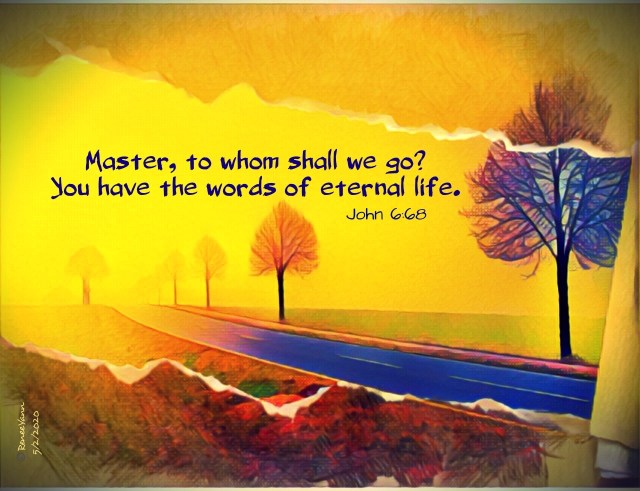
Jesus then said to the Twelve, “Do you also want to leave?” Simon Peter answered him, “Master, to whom shall we go? You have the words of eternal life. We have come to believe and are convinced that you are the Holy One of God.”
Let’s take whatever piece of Peter is in us today and lay it at the feet of Jesus in our own confession of faith.
(In a second post, I will share a wonderful poem about Peter written by John Poch. I think you’ll like it.)
Music:Lord, to Whom Shall We Go? – Michael Joncas (Lyrics below)
Lord, to whom shall we go?
You alone, you alone have the words of everlasting life.
Lord, to whom shall we go?
You alone, you alone have the words of everlasting life.
The law of the Lord is perfect
refreshing the soul.
How trustworthy the Lord’s decree,
making the simple wise.
Lord, to whom shall we go?
Lord, to whom shall we go?
Lord, to whom shall we go?
You alone, you alone have the words of everlasting life.
The precepts of the Lord are right,
rejoicing the heart.
How clear is the Lord’s command,
enlightening the eye.
The fear of the Lord is pure,
enduring forever.
How true the Lord’s ordinances,
all of them just.
They are more precious than gold,
than purest of Gold.
Sweeter than honey,
honey from the comb.
Today, in Mercy, our Gospel gives us the sense of Jesus claiming his inheritancefrom the Father. He makes it clear that the Father’s Will is the Redemption of all Creation. This is the divine charge given to Jesus. This is his mission.
Jesus continues to use the symbol of bread to teach the forming community.
Bread sustains life. God’s Word is eternal life.
Sharing bread is an act of community. In the Body of Christ, we are made One with God
and with one another.
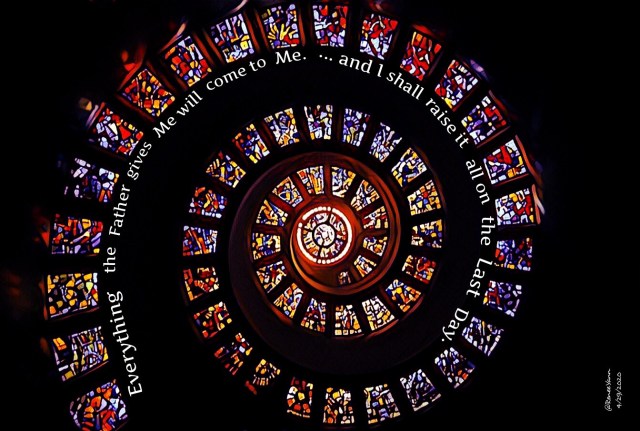
Bread can stale and disintegrate. Within the Body of Christ, we become eternal and will be raised up unto the Last Day.
These are such BIG thoughts, amazing teachings. I always wonder how simple shepherds, fishermen and housekeepers were supposed to understand! I wonder how we, in our human limitations, could begin to comprehend the infinitely loving design of God revealed in Jesus Christ!
Today, as we celebrate the feast of the great Saint Catherine of Siena, we can learn from her spiritual wisdom. Without formal education, she grew by grace into a Doctor of the Church.
She was born Catherine Benincasa on March 25, 1347, in Siena, Italy, and was a twin, the 24th child of 25. She only lived to the age of 33, dying of a stroke in Rome in 1380. Catherine of Siena, often referred to as “great Kate,” is well known for her expressive life of prayer shared in three major sources of writings: over 400 letters, 26 prayers, and The Dialogue of Divine Providence, which she referred to as “the book,” written in the format of a conversation between herself and God. She was noted for her style of learning, not acquired from formal education and degrees, but gained from an interior wisdom that came from lived experiences and a mystical life of prayer. ( https://www.hprweb.com/2020/02/the-trinitarian-theology-of-the-eucharist-according-to-st-catherine-of-siena/)
Here are two selections from Catherine’s extensive writings which reveal her ever-deepening relationship with God through the gift of the Bread of Life.
Eternal God, Eternal Trinity, You have made the Blood of Christ so precious through His sharing in your Divine Nature. You are a mystery as deep as the sea; the more I search, the more I find, and the more I find the more I search for You. But I can never be satisfied; what I receive will ever leave me desiring more. When You fill my soul I have an ever-greater hunger, and I grow more famished for Your Light. I desire above all to see You, the true Light, as you really are.
St. Catherine of Siena, Prayer 12, V 124–157
And by the light of most holy faith
I shall contemplate myself in you.
And I shall clothe myself in your eternal will,
And by this light I shall come to know
That you, eternal Trinity,
Are table
And food
And waiter for us.
You, eternal Father,
Are the table
That offers us as food
The Lamb, your only-begotten Son.
He is the most exquisite of foods for us,
Both in his teaching,
Which nourishes us in your will,
And in the sacrament
That we receive in Holy Communion,
Which feeds and strengthens us
While we are pilgrim travelers in this life.
And the Holy Spirit
Is indeed a waiter for us,
For he serves us this teaching
By enlightening our mind’s eye with it
And inspiring us to follow it.
And he serves us charity for our neighbors
And hunger to have as food
Souls
And the salvation of the whole world
For the Father’s honor
So we see that souls enlightened in you,
True light,
Never let a moment pass
Without eating this exquisite food
For your honor.
Music:Ave Verum Corpus – words attributed to 14th century Pope Innocent VI, melody to Mozart, sung by King’s College Choir
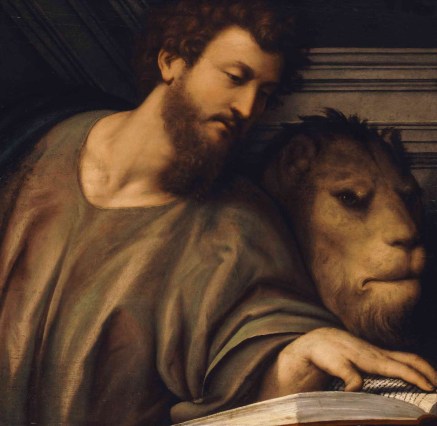
Today, in Mercy, we celebrate Saint Mark the Evangelist.
Mark the Evangelist by Il Pordenone (c. 1484-1539)
Who exactly that person was hides in the mists of early Church history. Several possible “Marks” are mentioned at various points in the New Testament. Whether they are the same or different persons and which, if any, is the author of Mark’s Gospel are questions scripture detectives have chased for centuries.
What the readings offer us today is a young man whom Peter loved and who absorbed the Good News under Peter’s own tutelage.
In today’s passage from Acts, Peter writes to Christians scattered throughout Asia Minor at the time of the persecutions. His teaching is clearly that of the universal leader of the Church helping the scattered flock to hold on to the faith.
Your opponent the Devil is prowling around like a roaring lion looking for someone to devour. Resist him, steadfast in faith, knowing that your brothers and sisters throughout the world undergo the same sufferings.
It isn’t hard to read these ancient words and imagine Pope Francis speaking them to all of us across the empty reaches of St. Peter’s Square. The suffering of the pandemic tests our faith and resolve. It too is a crucible which can either deepen or fracture our relationship with God.
Peter’s assurance can strengthen us: The God of all grace who called you to his eternal glory through Christ Jesus will himself restore, confirm, strengthen, and establish you after you have suffered a little. To him be dominion forever. Amen.
Mark, who sat at the feet of Peter’s strong and loving leadership, himself went on to become a devoted leader of Christ’s flock. How Mark must have cherished Peter’s brave and tender words to the young suffering Church and harkened back to them so often over the course of his life:
The chosen one (early Christian code for “the whole Church”) sends you greeting, as does Mark, my son. Greet one another with a loving kiss. Peace to all of you who are in Christ.
That gracious “kiss” from Peter carried the the love and power of every Christian, just as we carry it today in our constant prayer for and encouragement of one another.
Music: He Will Make You Strong – hymn based on 1 Peter
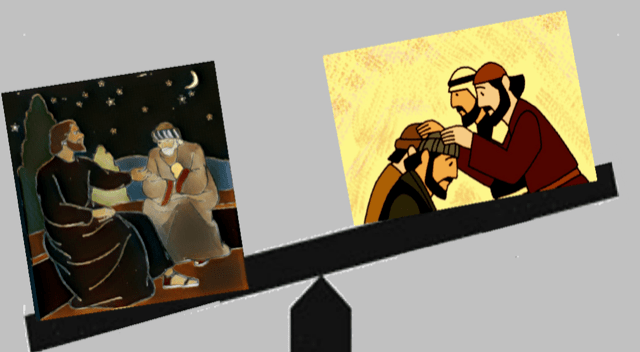
Today, in Mercy, we meet two towering figures of the early Christian story, Barnabas and Nicodemus.
In our first reading, Barnabas is cited as a devout member of the community of believers which …
… was of one heart and mind, and no one claimed that any of his possessions was his own, but they had everything in common.
Our Gospel brings us Nicodemus who “came to Jesus under cover of the night”.Nicodemus, obviously Ph.D. material, has a long exchange with Jesus in the attempt to come to intellectual comfort with Jesus’s message.
Nicodemus wants his faith to make logical sense before committing to it,to the point that Jesus sounds a little astounded at the effort:
You are the teacher of Israel and you do not understand what I am saying to you?
I think a little bit of both Barnabas and Nicodemus lives within each of us.
Like Nicodemus, we do believe, but we would like to understand more. We grapple with concepts of “God’s plan”, with the problem of evil, with what seems the random mercilessness of nature, and myriad other inexplicable realities.
Still, like Barnabas, we trust and are willing to lay our lives at the feet of Christ to be his agents in the world.
That balancing of trust with anxiety is the story of faith for most of us. And it’s OK.Both Nickie and Barnie turned out to be giants for Christ.And so will we with God’s help.
Music: Ye Must Be Born Again – sung by The Sensational Nightingales, a beloved Black Gospel Quartet that, with several membership changes, has been popular for over seven decades. (Lyrics below)
Ye Must Be Born Again written by William T. Sleeper in 1877
A ruler once came to Jesus by night,
To ask Him the way of salvation and light;
The Master made answer in words true and plain,
“Ye must be born again!”
“Ye must be born again!”
“Ye must be born again!”
“I verily, verily say unto thee,
Ye must be born again!”
Ye children of men, attend to the word
So solemnly uttered by Jesus, the Lord,
And let not this message to you be in vain,
“Ye must be born again.”
Oh, ye who would enter that glorious rest,
And sing with the ransomed the song of the blest;
The life everlasting if ye would obtain,
“Ye must be born again.”










 Lavish Mercy