Today, in Mercy, we celebrate the feast of the Apostles Simon and Jude. Not much is really known about either of these men. One tradition suggests that after the Ascension, they went together to carry the Gospel to Persia where they were eventually martyred.
Since we have so few facts, many legends and interpretations have grown up around these two men. Probably the strongest and most familiar of these is of St. Jude as the patron of hopeless cases.
There are probably very few of us who haven’t asked at least one favor from St. Jude in our lifetimes. This probability begs the question of why and how do we pray with the saints.
Our tradition holds that we exist in the Communion of Saints with all of God’s creatures, and that we inspire and support one another by the sharing of our lives. This sharing is not limited by time, nor is it constricted by death.
When we pray with the saints, we draw on their faithful witness to inspire, motivate and sustain us in our lives.
Today, we might pray within the spirit of these two great Christians whose witness, though historically muted, transcends time. May they inspire in us the passion and joy to speak Christ in our lives.
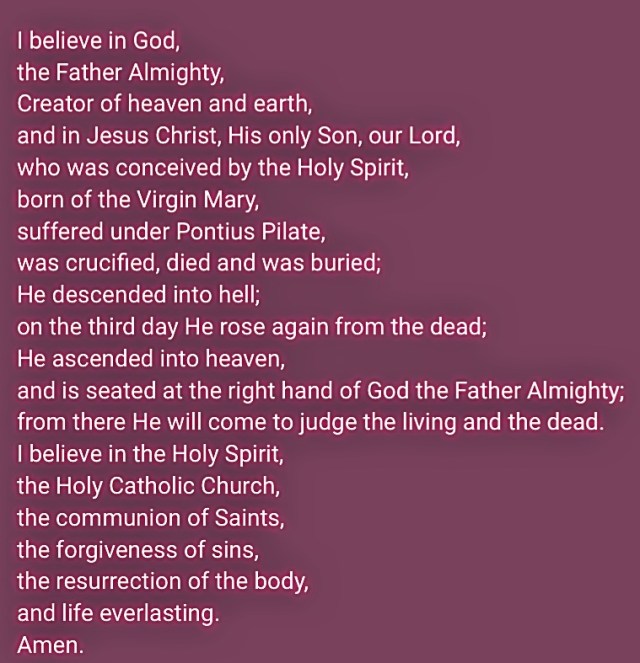
Music: Apostles’ Creed – sung here by Rebecca Gorzynska, a beautiful and talented artist (Latin and English text below.)
Today, in Mercy, we begin about a month of readings from Paul’s letter to the Romans. We will also continue with Luke’s Gospel all the way up to Advent.
To help me in praying with Romans, I am using a book by Scott W. Hahn, Father Michael Scanlan Chair of Biblical Theology at Steubenville University. In his introduction, Hahn says this:
Today’s reading offered me these elements to ponder and pray with:
Paul calls himself a “slave” of Jesus Christ
He invokes his call as an Apostle
He sets himself in the company of the prophets
He appeals to Jews who revere David
but proclaims Christ, through his Resurrection, as Messiah beyond human lineage
He proclaims his mission to the Gentiles
to bring about “the obedience of faith”
I’ll be honest with you. I’ve read or heard this passage maybe fifty times in my lifetime, and it has meant little or nothing to me. At best, it has sounded like a formal introduction such as those we hear from government “whereas” type decrees.
But I took Dr. Hahn’s advice, studying the passage, and reading it slowly and prayerfully. Here’s what I received:
Paul’s Apostolic call, to which he willingly enslaved his heart, was to preach the Good News of our redemption in Jesus Christ – to preach it to Jews, Romans, Gentiles, and all people.
It is an awesomely incredible message that can be received only through the gift of faith.
It is a message rooted in the scripture stories we love, and where we look to find a reflection of our own stories.
Learning from these realities will help us come to a faith which expresses itself in action and gives glory to God in our own time.
Luke gives us one such story today. Jesus reminds the crowd of two familiar passages – that of Jonah and the “Queen of the South” (the Queen of Sheba, 1 Kings 10). He indicates that the people in these stories believed without a sign.
Jesus tells the people gathered around him to learn from this. The crowd demands a sign, but Jesus says the sign is right in front of you – it is only your open heart that is lacking.
In his introduction, Paul prays for such open hearts in the Romans:
Grace to you and peace from God our Father and the Lord Jesus Christ.
By that same grace, may we receive faith’s blessing as well.
Today, in Mercy, Malachi (chronologically last of the Twelve minor prophets) lays it all out.He is writing for the Jewish community after the Restoration of the Second Temple. It is a community whose faith and practice have become “institutionalized”, having lost much of the raw vigor and intention of its first charismatic restorers.
I think we can all understand how that happens. It’s hard to maintain the passion of an early vision over the long years of its testing. This Jewish community has been visibly successful. They are home from captivity. The Temple has been rebuilt. Life is good. What’s the problem? So God tells them:
You have defied me in word, says the LORD, yet you ask, “What have we spoken against you?” You have said, “It is vain to serve God, and what do we profit by keeping his command, And going about in penitential dress in awe of the LORD of hosts?
The community has forgotten the heart of their life! In the imposing shadow of their Temple achievement, they have lost the memory of the God it honors.
Rabbi Gunther W. Plaut says this: Malachi describes a priesthood that is forgetful of its duties, a Temple that is underfunded because the people have lost interest in it, and a society in which Jewish men divorce their Jewish wives to marry out of the faith. The Prophet lived probably sometime after the year 500, perhaps as late as 450 (B.C.E.). It was an era of spiritual disillusionment, for the glorious age that earlier prophets had foreseen had not materialized.
It’s not a big leap to see ourselves foreshadowed in Malachi’s prophecy. We live on a devastated planet and a war-pocked world. We agonize over corrupted political, economic and justice systems. We worship in a scarred and struggling Church. We live in a culture that has forgotten. Indeed, in our materialistic world, it appears that:
… evildoers prosper, and even tempt God with impunity.
But Malachi tells the faithful people that the day of their reconciliation is coming. He tells them to remain steadfast, to keep their eyes on the prize.
… you shall be mine, says the LORD of hosts, my own special possession, on the day I arise. And I will have compassion on you, as a parent has compassion on a devoted child.
Our Gospel echoes this promise. If we but ask, God will give us the strength to remain merciful, faithful, and just – not to forget the heart of our life, not to be blind to it in our suffering brothers and sisters.
Music: Keep Your Eyes on the Prize– a folk song, a genre that carries a lot in common with prophetic poetry. This ballad became influential during the Civil Rights Movement of the 1950s and 1960s. It is based on the traditional song, “Gospel Plow” also known as “Hold On” or “Keep Your Hand on the Plow”.
This version is written by Pete Seeger sung by The Boss, Bruce Springsteen
Paul and Silas bound in jail
Had no money for to go their bail
Keep your eyes on the prize, hold on
Paul and Silas thought they was lost
Dungeon shook and the chains come off
Keep your eyes on the prize, hold on
Freedom’s name is mighty sweet
And soon we’re gonna meet
Keep your eyes on the prize, hold on
I got my hand on the gospel plow
Won’t take nothing for my journey now
Keep your eyes on the prize, hold on
Hold on, hold on
Keep your eyes on the prize, hold on
Only chain that a man can stand
Is that chain o’ hand on hand
Keep your eyes on the prize, hold on
I’m gonna board that big greyhound
Carry the love from town to town
Keep your eyes on the prize, hold on
Hold on, hold on
Keep your eyes on the prize, hold on
Now only thing I did was wrong
Stayin’ in the wilderness too long
Keep your eyes on the prize, hold on
The only thing we did was right
Was the day we started to fight
Keep your eyes on the prize, hold on
Hold on, hold on
(Jamming interlude)
Ain’t been to heaven but I been told
Streets up there are paved with gold
Keep your eyes on the prize, hold on
Today, in Mercy, our first reading brought to mind my “IKEA” days . We had just moved into our new convent, a real “fixer-upper”. Our meager furnishings consisted of some cast-offs from a closing convent and a few of IKEA’s befuddling “put-togethers”.
I wasn’t bad at put-togethers, but neither was I perfect. (Neither were any of you who ever tried it. Don’t lie to me!) Sometimes my imperfection rose to the level that I just unassembled whatever sorry mess I had and started all over again – from scratch.
That’s what Nehemiah does in our first reading. He lived in Judean-Persia and had a good job with the Persian King who favored him. When Nehemiah realized how bad things were back in Jerusalem, he felt terrible. He asked the king to sponsor him on a rebuilding trip, and the amiable king agreed.
So Nehemiah went to Jerusalem and reordered things. Greed, dissension, and selfishness had infected the People. The elite rich were feeding off the labors of the poor. Any attempts at restoring the heart of the community were languishing under these infections.
Nehemiah, a faith-filled man, was also a great administrator. He designed a spiritual government with a stringent communitarian financial system. This allowed the Israelites to return to their Abrahamic character as a People who cared for one another rather than profited off one another.
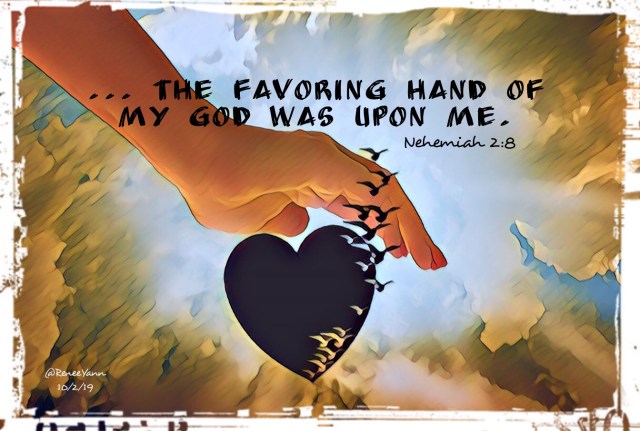
Nehemiah accomplished great things for God’s People because of his clarity, simplicity and faith. That faith moved him to acknowledge that his success occurred because…
Today, on this feast of the Holy Guardian Angels, perhaps we will feel God’s loving touch in our lives through their ever-present direction. Perhaps there are dissonant systems within or around us that we are being called to name and reorder in God’s good grace as well.
Music:By the Rivers of Babylon by Boney M. The song is based on today’s Responsorial Psalm 136. Even though the tone is jazzy, the song captures Israel’s longing for life as God intended it to be. “Babylon” = corrupted culture. We have our own longings for a return to a shared public life which honors God and nourishes the whole of Creation.
Boney M. is a Europe-Caribbean vocal group created by German record producer Frank Farian. Originally based in West Germany, the four original members of the group’s official line-up were Liz Mitchell and Marcia Barrett from Jamaica, Marie Williams, from Montserrat and Bobby Farrell, a performing-artist from Aruba.
Today, in Mercy, Paul and Jesus share a similar situation.
Paul is imprisoned in Rome. Visited by Epaphras, a citizen of Colossae, Paul seizes the chance to write to these Christians whom he has never seen in person. Paul tells the Colossians that his singular intention is to preach the truth of the Gospel so that they, and all the world, may be transformed in Christ.
to bring to completion for you the word of God, the mystery hidden from ages and from generations past.
That “mystery” is the nature of God as Love, only fleetingly accessible before its full revelation in the Person of Jesus Christ.
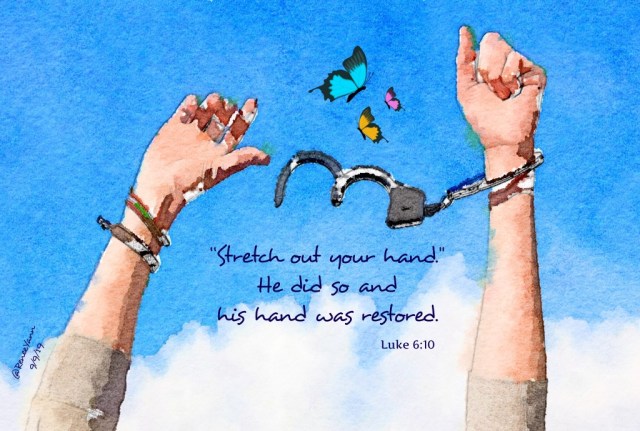
Jesus too, in today’s Gospel, is in a sort of prison. The prison consists of the entrenched resistance of people like the Pharisees. They are so entangled in the deceitful and self- serving interpretation of Law that they are blind to the revelation before them. They wait to pounce on Jesus if, contrary to the laws of the Sabbath, he heals a man’s withered hand.
Jesus tries logic in today’s account:
Then Jesus said to them, “I ask you, is it lawful to do good on the sabbath rather than to do evil, to save life rather than to destroy it?”
Unable to resist the logic, the Pharisees retreat to anger. They begin to plot the removal of this Truth they cannot counter. The saddest part of these resistances is that they estrange the resisters from their own good, from their own freedom, from their own salvation.
In our world, we see so many places closed off to the Mystery of Love.We see people imprisoning themselves in their own resistance and hate while they plot to build barriers against others. We see it in our geo-political world, in our Church, in our workplaces, in ourselves.
It takes courage to recognize and turn from such self-destructive fixations. We must be alert and brave to cooperate with our own transformation in grace.
This is why Paul writes of …
the great struggle I am having for you and for those in Laodicea and all who have not seen me face to face, that their hearts may be encouraged as they are brought together in love, to have all the richness of assured understanding, for the knowledge of the mystery of God, Christ, in whom are hidden all the treasures of wisdom and knowledge.
This is why God continues to offer grace in the gift of Jesus Christ, healing all that is “withered” in us when we lift it up in faith.
Today, in Mercy, Paul again affirms the faith and prudence of the Thessalonians:
Concerning times and seasons, brothers and sisters, you have no need for anything to be written to you. For you yourselves know very well that the day of the Lord will come like a thief at night.
He paints a dire picture of those “times and seasons”, likening them to the onset of labor pains. But like a mother’s labor, these pains ultimately yield life:
For God did not destine us for wrath, but to gain salvation through our Lord Jesus Christ.
So Christ, our Laboring Mother, delivers us – even through seasons of suffering and evil – to a new day. And we – we are the midwives to one another’s salvation:
Therefore, encourage one another and build one another up, as indeed you do.
This honest encouragement is so essential for us in our faith communities because, without it, the mystery of suffering and evil overwhelm us.
It is both awesome and fearsome to truly encounter Mystery. In its presence, we are rudderless: we cannot explain, control, or humanly rationalize it. Mystery can only be comprehended by greater Mystery. Suffering can only be plumbed by the greater Mystery of Love.
And we know Love’s Name: Jesus by Roc O’Connor (Lyrics below)
Refrain:
Jesus, Jesus
Let all creation bend the knee to the Lord.
1. In Him we live, we move and have our being;
In Him the Christ, In Him the King!
Jesus the Lord.
2. Though Son, He did not cling to Godliness,
But emptied Himself, became a slave!
Jesus the Lord.
3. He lived obediently His Father’s will
Accepting His death, death on a cross!
Jesus the Lord.
Today, in Mercy, our readings share the common theme of humility, instructing us that the virtue is essential to our salvation.
Humility, of course, gets a bad rap in our dominating, “me” culture. We tend to think of humiliation, servitude, inelegance rather than the actual root of the word: humus -“of the earth”.
I was fascinated last week by a small fracas arising from the unconsidered remarks of one of our Phillies baseball players. The team has been running hot and cold – with a little bit too much cold for some fans. The famous Philly “boos” have been flying. Frustrated with these, outfielder Sean Rodriguez referred to the disgruntled fans as “entitled”.
Uh oh! They didn’t like that. We prefer to think of ourselves as “deserving “, right?
Humility is that virtue which helps us realize that we are not “entitled” or “deserving” of anything over and above other human beings. It roots us in the respect for each other that refuses to rank the worth of other human beings.
The social leverage that comes from wealth, power, and influence can beguile us. We become lost in a maze of stereotypes, rankings and prejudices which are the foundation of social injustice.
We hear among ourselves justifying phrases for our entitlement like:
well, I earned what I have
at least I paid for it
“they” need to work if they want to have …(food, healthcare, housing…)
it’s their own fault for … (dropping out of school, taking drugs, ….)
that’s just the way it is in “those” countries. The people are …(lazy, stupid, violent …)
“they” don’t need what I need. “They” are used to being … (poor, disabled, sick …)
And probably the most dangerous of all the phrases:
it’s not my problem
I’m not the one exiling, bombing, blocking, trafficking, enslaving “them”
Today’s readings enjoin us: it is my problem. My attitude, choices, vote, conversation, and lifestyle matter at the banquet of life we are all meant to share.
My intention to humbly join and rejoice with all Creation, to take a seat beside and never above my sister and brother – this is my “entitlement” to the one banquet that matters.
When you hold a banquet, invite the poor, the crippled, the lame, the blind; blessed indeed will you be because of their inability to repay you. For you will be repaid at the resurrection of the righteous.
Music:A Place at the Table – Lori True and Shirley Elena Murray
Today, in Mercy, our first reading gives us the conclusion of the magnificent Book of Isaiah. Most biblical scholars today attribute this book to at least three different authors writing over the period of two centuries. The book is thus divided into three sections: First, Second, and Third Isaiah – each reflecting a particular time and circumstance in the history of the Jewish people.
Despite its multi-authorship, the Book holds an essential integrity throughout. As a whole, it is the story of the displacement and restoration of Israel. That dynamic is poetically articulated through the themes of loss, grief, hope, and responsiveness to hope. These themes are so fundamentally human and universal that Isaiah stands as one of the most influential scriptures, both spiritually and culturally.
Today’s passage from Isaiah, combined with the Lukan symbol of the narrow gate, strike a powerful message for us – as individuals, as Church, as global citizens.
There is one Kingdom in God and we ALL are invited to it.
I come to gather nations of every language; they shall come and see my glory.
But we will find our way to this Kingdom by the twists of suffering and compassion, living on one side or the other of that reciprocal throughout our lives.
How we support, include, love and minister with one another in our “displacement” determines our “restoration”:
And people will come from the east and the west and from the north and the south and will recline at table in the kingdom of God. For behold, some are last who will be first, and some are first who will be last
We know the works of mercy and our call to live them. Let’s pray for the strength to do so fully and joyfully.
Let’s pray for all nations, especially our own, to respond in mercy and hope to the displaced people of our time, knowing that it is only with them that we shall find the narrow gate.
Music: The People That Walked in Darkness (Is. 9:2) from Handel’s Messiah
Sung by James Milligan with Royal Liverpool Philharmonic Orchestra
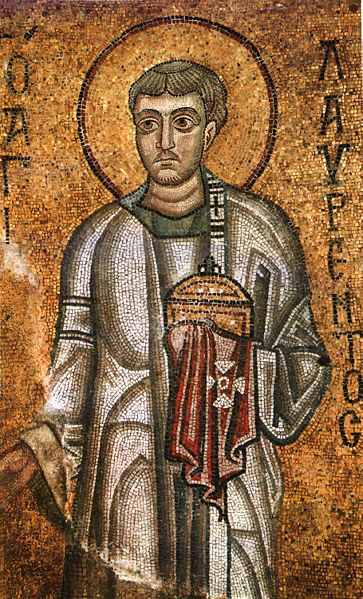
Saint Lawrence. Mosaic from the Saint Sophia Cathedral in Kiev.
Today, in Mercy, we celebrate the feast of St. Lawrence who is noted for his love for those who were poor. Legend has it that Lawrence was demanded, before his martyrdom, to turn over the Church’s riches to the emperor Valerian. Instead, he distributed all the resources among the poor. Lawrence then gathered all these people, presenting them before Valerian with these words:
Behold in these poor persons the treasures which I promised to show you – these are the true treasures of the Church.
Lawrence was likely inspired by readings like today’s. In Corinthians, Paul encourages us to be cheerful givers. He says this delights God, the Giver of Divine Abundance, whom we are imitating.
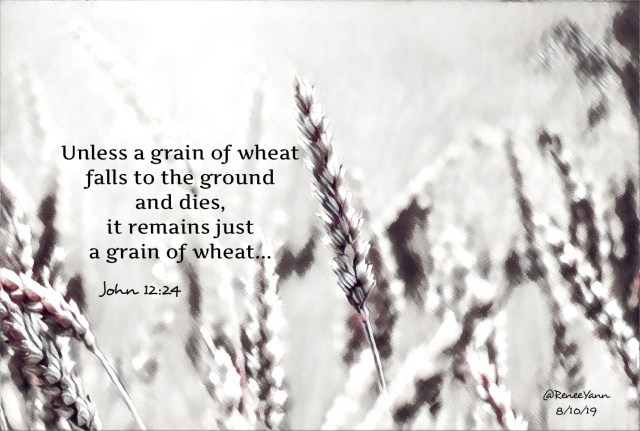
In our reading from John, Jesus says that only in dying to ourselves do we live – the ultimate generosity. He says that only by doing this can we truly follow him.
While these readings are clear and simple, they are so profound that we can hardly take in their message. What they ask of us is daunting! The encouragement Jesus gives us to respond to his challenge is this:
The Father will honor whoever serves me.
St. Lawrence believed and lived this promise. What about us?
Music: Before the Bread – Elizabeth Alexander
We all want our lives to be full and complete – to be “bread”. But there are many steps before the grain of wheat becomes bread, as captured in this elegantacapella canon.
Today, in Mercy, we have the first of a few readings from the Book of Numbers. Numbers is basically about two themes: journeying and maturing as a community of faith.
Numbers is the fourth book of the Bible, part of the five which comprise the Pentateuch, or Hebrew Torah. We can think of these books as a kind of Jewish “Roots”, for those who are familiar with the Alex Haley classic.
In the Pentateuch, both Jews and Christian find the foundational bedrock of their faith story. Today’s chapter focuses on two realities of faith and community: leadership and fidelity.
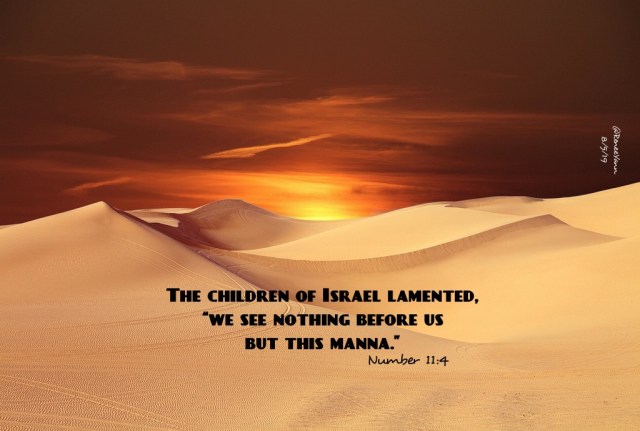
The People are having trouble staying committed to the journey. They are tired, hungry and walking around in circles. They are hungry for something besides manna, the way we become hungry for more than our dailyness.
Like most frustrated groups, they start busting on their leader – Moses. Moses, unwilling to carry their burdens alone, starts busting on God. Watch any TV drama for a similar plot/theme. As a matter of fact, let’s examine our lives for it.
Enduring commitment is hard, especially when it is tested. When our commitment seems meaningless, or ignored, or misinterpreted, or otherwise futile, what do we do? How do we re-examine and re-define the fundamental relationship of faith which informs that commitment.
This re-examination and deeper re-commitment is what the Israelites experience through their desert journey, until they are ready to pass into the Promised Land as God’s People.
It is what we experience as a person of faith and as a faith community. Commitment is never static. In life’s test chamber, it either grows or diminishes. Praying with these passages from the Sacred Scripture may help us to grow deeper in our faith and trust. They may help us find the center if we feel a little hungry and lost in the desert too.
Music: Guide Me, Thou, O Great Redeemer
This hymn is the English version of a melody written by the Welshman John Hughes in 1909. The text was composed in 1745 by William Williams, considered Wales’ most famous hymnist. As a writer of poetry and prose,he is also considered today as one of the great literary figures of Wales. For an interesting history of the hymn, click here.







 Lavish Mercy