Watch!

First Sunday of Advent
December 3, 2023

Today’s Readings:

https://bible.usccb.org/bible/readings/120323.cfm


Today, in God’s Lavish Mercy, we begin the Advent Watch, that annual time of acute spiritual awareness and hope-filled expectation.
We’ve all kept watch at various times in our lives, perhaps without even realizing it. It may have been as simple as waiting for a delayed but highly anticipated letter, or as worrisome as the anxious vigil over a feverish child. It may be as unnoticeable as waiting for an elevator, a green light, or a “transaction complete” at the ATM, or as marvelous as the nine-month expectancy of new life.

We should be good at waiting because we do it all the time, but maybe we’re not so good at it after all.


Good waiting requires our consciousness. We may idly consider the “waiting space” a neutral zone that we can fill with anything we choose – impatience, daydreaming, or distraction. But pivotal waiting can offer us an invaluable invitation – to meet God in a new way as we anticipate what we cannot yet see or comprehend. But sometimes we don’t pay enough attention to hear the invitation.

This kind of “keeping watch” can be a sacramental experience. It is a time when we are stilled before a reality or mystery we cannot control. We can only wait, hope, release any fear, and cleanse our demanding prayer of its useless stipulations. It is a time of confident abandonment into God’s loving will for our good. Advent is such a blessed time.


Praying with our Advent scriptures provides us with a curriculum for good waiting. Our teachers will be the divinely lyrical Isaiah, the Psalms, Matthew and Luke, and the glorious O Antiphons.

We begin today with this heartfelt entreaty to God:

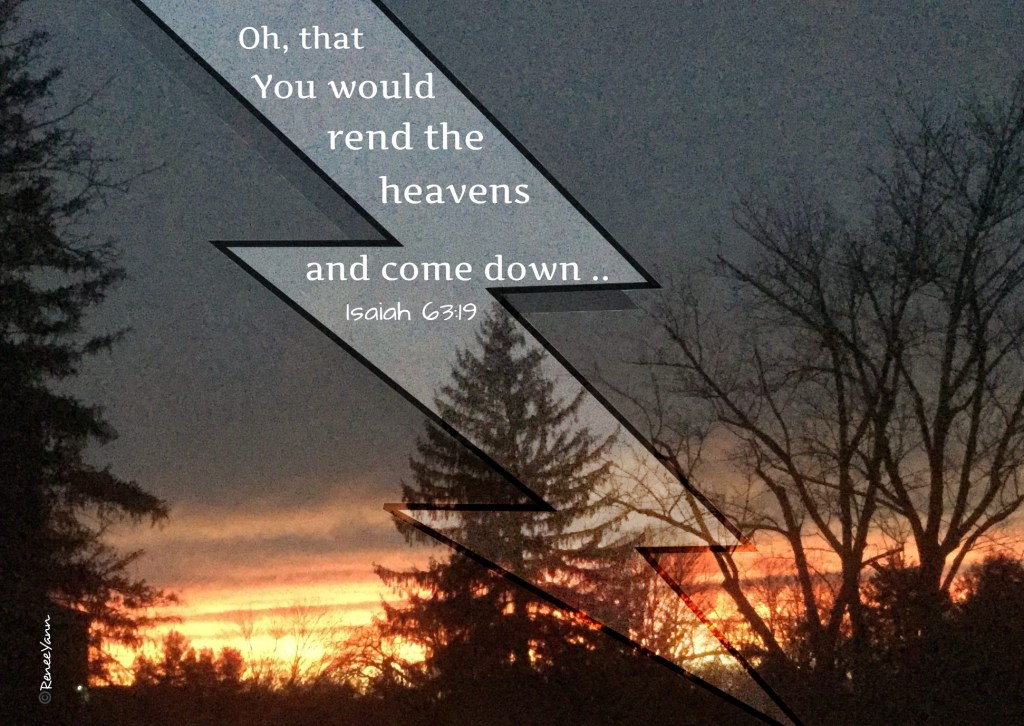
Oh, that you would rend the heavens and come down,
with the mountains quaking before you,
while you wrought awesome deeds we could not hope for,
such as they had not heard of from of old.
No ear has ever heard, no eye ever seen, any God but you
doing such deeds for those who wait for him.
Would that you might meet us doing right,
that we were mindful of you in our ways!


Each one of us can look into our own hearts today, into our own perception of the world, to see where God is most sorely needed. As we pray Isaiah’s plea, we can do so assured by Paul’s blessing that God desires to answer us:

I give thanks to my God always on your account
for the grace of God bestowed on you in Christ Jesus,
that in him you were enriched in every way,
with all discourse and all knowledge,
as the testimony to Christ was confirmed among you,
so that you are not lacking in any spiritual gift
as you wait for the revelation of our Lord Jesus Christ.
He will keep you firm to the end,
irreproachable on the day of our Lord Jesus Christ.
God is faithful,
and by him you were called to fellowship with his Son,
Jesus Christ our Lord.


Poetry: Advent (On a theme by Dietrich Bonhoeffer) – by Pamela Cranston

Look how long
the tired world waited,
locked in its lonely cell,
guilty as a prisoner.
As you can imagine,
it sang and whistled in the dark.
It hoped. It paced and puttered about,
tidying its little piles of inconsequence.
It wept from the weight of ennui
draped like shackles on its wrists.
It raged and wailed against the walls
of its own plight.
But there was nothing
the world could do
to find its freedom.
The door was shut tight.
It could only be opened
from the outside.
Who could believe the latch
would be turned by the flower
of a newborn hand?

Music: Wachet auf! ruft uns die Stimme – J.S. Bach

Wachet auf, ruft uns die Stimme
Wake up, the voice calls us
Der Wächter sehr hoch auf der Zinne,
of the watchmen high up on the battlements,
Wach auf, du Stadt Jerusalem!
wake up, you city of Jerusalem!
Mitternacht heißt diese Stunde;
This hour is called midnight;
Sie rufen uns mit hellem Munde:
they call us with a clear voice:
Wo seid ihr klugen Jungfrauen?
where are you, wise virgins ?
Wohl auf, der Bräutgam kömmt;
Get up, the bridegroom comes;
Steht auf, die Lampen nehmt! Alleluja!
Stand up, take your lamps! Hallelujah!
Macht euch bereit
Make yourselves ready
Zu der Hochzeit,
for the wedding,
Ihr müsset ihm entgegen gehn!
you must go to meet him!

A Syllabus of Faith

Feast of the Dedication of the Lateran Basilica in Rome
November 9, 2023

Today’s Readings:

https://bible.usccb.org/bible/readings/110923.cfm


Today, in God’s Lavish Mercy, we celebrate a rare type of feast day – one that marks the dedication of a church building.  For many, that seems a little odd. We are accustomed to celebrating Mary, Joseph, and other saints and feasts of Our Lord.

Here’s the thing: we are not actually celebrating a building.  We are celebrating what the building represents – the Body of Christ, the Church, made of living stones – us.

The Lateran Basilica, founded in 324, is the oldest public church in the city of Rome, and the oldest basilica in the Western world. Standing before it, one can sense the entire drama of our 2000-year-old Church whispering its secrets to us. We hear the echoes of human courage, hope, perseverance, and fidelity which, over centuries, have transmitted the faith to us. We can hear the now stilled voices of those who loved the faith enough to give it visible and glorious expression for all who would follow them.


Today’s feast reminds us that sometimes it helps to have visible symbols of the things we venerate and celebrate. That’s why we have medals, rosary beads, and candles – so that we can SEE something as we try to conceptualize a spiritual reality. Can you imagine the awe and joy of the early Christians when, after centuries of hiding from persecution, they were able to gather and worship in this magnificent edifice!

john lateran

St. John Lateran is the Pope’s parish church. Since he is the Bishop of the whole People of God, his physical church has come to symbolize the universal Body of Christ, the world Church.


Pope Benedict XVI in his Angelus Address, on November 9, 2008 said this:

Dear friends, today’s feast celebrates a mystery that is always relevant: God’s desire to build a spiritual temple in the world, a community that worships him in spirit and truth (cf. John 4:23-24).
But this observance also reminds us of the importance of the material buildings in which the community gathers to celebrate the praises of God.
Every community therefore has the duty to take special care of its own sacred buildings, which are a precious religious and historical patrimony. For this we call upon the intercession of Mary Most Holy, that she help us to become, like her, the “house of God,” living temple of his love.

st j lateran

As we pray today, we might want to consider the gift of faith on which our own lives are built – a faith whose cornerstone is Jesus Christ. In our second reading, Paul says this:

Brothers and sisters:
You are God’s building…..
Do you not know that you are the temple of God,
and that the Spirit of God dwells in you?


And in our Gospel, Jesus speaks of his own body as a temple which, though apparently destroyed by his enemies, will be raised up in three days.

By our Baptism, that same spiritual temple lives in us and in all the community of faith. That same power of Resurrection is alive in us! So in a very real sense, what we celebrate today is ourselves – the Living Church – raised up and visible as a sign of God’s Life in the world.

Happy Feast Day, Church (and I’m talking to YOU, dear reader!)


Research: For the Church History buffs among us, this Wikipedia article on St. John Lateran Basilica can serve as a syllabus on the annals of the Roman Catholic Church.

https://en.wikipedia.org/wiki/Archbasilica_of_Saint_John_Lateran


Music: Cornerstone – Hillsong

Let’s Meet in Heaven

The Commemoration of All the Faithful Departed
Thursday, November 2, 2023

Today’s Readings:

https://bible.usccb.org/bible/readings/110223.cfm


Today, in God’s Lavish Mercy, the whole Church joins in praying for the wholeness of the Communion of Saints. We all desire to be together again, with everyone we have loved, in eternal life.


This morning, as I prepare the reflection for All Souls Day, I consider how much religious practice can change in one’s lifetime. The Church and we are always growing in understanding and truth if we have open hearts. This graced understanding is exactly what the Church seeks in the current Synod on Synodality. Yet, as with all growth, we may tend to resist.


Today, I am taken (waaay) back to how All Souls Day was commemorated in my youth. My teachers impressed me with the idea that this special day was a time when repentant souls could be released from Purgatory if I prayed hard enough. I thought the process was similar to Amazon Prime Day where costs/penalties dropped and the early and persistent pray-er could snag a lot of souls for heaven.


(not us, but close enough)

We always had off from school on All Souls Day, so Janie McFadden and I would meet up about 5:45 AM to begin our marathon of Masses.  We had four parish priests so at three Masses a piece, Janie and I were set for the next few hours of liberating prayer. About 7:00 AM, Harry diNicolo finally showed up but he certainly didn’t get full credit like me and Janie!


The scene was somber.  The priests wore black vestments then, spoke mostly in Latin, and turned their backs to the participating congregation. There were a lot of candles and not very much real light that early in the morning. You guessed it – Janie and I took turns falling asleep. About every 10 minutes, one would punch the other in an effort to rev up purgatorial releases. Still not sure if any of that worked. Harry, by the way, went back home about 7:15 because he was hungry for breakfast.

One year, after the third Nicene Creed or so, Janie fainted. Sister Eucharistica told her not to do the All Souls Marathon again without drinking “a wee bit of milk before you come to Church”. Given our understanding of Divine Law at the time, requiring total fasting, we fourth graders were pretty sure Sr. Eucharistica would be the next soul we were praying out of Purgatory!


But as I think of her now, she was exactly the kind of person we need today for a “synodal Church”. She was a woman full of wisdom, courage, and common sense. She knew how to prioritize human needs long before the institutional Church figured it out. She knew Jesus desired communion with someone who wasn’t in a dead faint!

I think she probably knew too that we hadn’t come to Mass on that cold 1955 morning just to help “release” folks from purgatory.  We had come to remember people we loved who had gone ahead of us, to reflect on their lives, to miss them, love them, and to learn from both their lights and their shadows. 

We were young kids who, in our own small way, wanted to honor and face the meaning of death in human life. We wanted to know that God cared about our sadness over losing Grandmom or Uncle Joe. We wanted to know that God cared about us even though we too would face the same mysterious completion of our earthly lives.

Unfortunately, the Tridentine Mass didn’t provide much of that spiritual enrichment. But Sr. Eucharistica did. God bless her!


Today, in a language still very heavy with 16th-century concepts, the Catholic Encyclopedia defines purgatory as a place or condition of temporal punishment for those who, departing this life in God’s grace, are, not entirely free from venial faults, or have not fully paid the satisfaction due to their transgressions.

That language doesn’t do much for me either. I choose to think that most of us do the best we can with our lifetimes, but maybe there are a few who don’t. They don’t quite create the space in themselves to receive and eternally embrace God.  “Purgatory” is their second chance, a “time out” God gives them to get their heads together and realize how much they have been missing. Then, violà, they like all the saints are flooded with glory.


My dear friend Janie has long ago gone to the heavenly understanding.  I’m not sure what happened to Harry, even though we dated off and on well into high school.  I think he finally found somebody who liked to eat more than she liked to go to Mass. Meanwhile, my likes were going in a different direction.


Prose: from Pope Francis’s homily on November 2, 2022

Brother and sisters, let us feed our expectation for Heaven, let us exercise the desire for paradise. Today it does us good to ask ourselves if our desires have anything to do with Heaven. Because we risk continuously aspiring to passing things, of confusing desires with needs, of putting expectations of the world before expectation of God. But losing sight of what matters to follow the wind would be the greatest mistake in life.


Remembering Our Merion Mercy Family – lyrics below

We lovingly remember these dear Sisters and Associates who shared Mercy life with us and who have gone home to God in 2023.

One day in the love of Christ
we’ll meet once again
We’ll laugh as we celebrate a life with no end
Where death has been overcome by our Risen Lord

And there are no more goodbyes,
no more tears, no more loneliness,
and no more fear

Our pain turns to joy
darkness to light
in God’s heaven
there are no more goodbyes

No words tell the gratitude
we have for the gift
your life was to each of us
We’ll never forget

May angels now
lead you home
to our Risen Lord

And there are no more goodbyes,
no more tears, no more loneliness,
and no more fear

Our pain turns to joy
darkness to light, in God’s heaven
there are no more goodbyes

Though now with our heavy hearts
we go separate ways
we trust in the certain hope
there will come a day
we’ll join you in paradise
with our risen Lord

There will be no more goodbyes,
no more tears, no more loneliness,
and no more fear
Our pain turns to joy
darkness to light God’s heaven
there are no more goodbyes

Leaders of the Faith

Feast of Saints Simon and Jude, Apostles
October 28, 2023

Today’s Readings:

https://bible.usccb.org/bible/readings/102823.cfm


Brothers and sisters:
You are no longer strangers and sojourners,
but you are fellow citizens with the holy ones
and members of the household of God,
built upon the foundation of the Apostles and prophets,
with Christ Jesus himself as the capstone.

Ephesians 2:19-20

Today, in God’s Lavish Mercy, we celebrate the feast of the Apostles Simon and Jude. Not much is really known about either of these men. One tradition suggests that after the Ascension, they went together to carry the Gospel to Persia where they were eventually martyred.

simon_Jude

Since we have so few facts, many legends and interpretations have grown up around these saints. Probably the strongest and most familiar of these is of St. Jude as the patron of hopeless cases.

There are probably very few of us who haven’t asked at least one favor from St. Jude in our lifetimes. This probability begs the question of why and how do we pray with the saints.

Our tradition holds that we exist in the Communion of Saints with all of God’s creatures, and that we inspire and support one another by the sharing of our lives. This sharing is not limited by time, nor is it constricted by death.

When we pray with the saints, we draw on their faithful witness to inspire, motivate and sustain us in our lives.

Today, we might pray within the spirit of these two great Christians whose witness, though historically muted, transcends time. May they inspire in us the passion and joy to speak Christ in our lives.


Prose: Since we celebrate two Apostles today, we might want to slowly and carefully pray this prayer. The Apostles’ Creed is a statement of Christian belief that is used by Western churches, both Catholic and Protestant. While it is explicitly affirmed only in Western churches, it reflects traditions that were affirmed officially by the entire Church in the Nicene Creed. Although its roots are much earlier, in its present form it dates to about the eighth century.

apos creed

Music: Apostles’ Creed – sung here by Rebecca Gorzynska, a beautiful and talented artist (Latin and English text below.)

latin creed

The Right Thing

Friday of the Twenty-ninth Week in Ordinary Time
October 27, 2023

Today’s Readings:

https://bible.usccb.org/bible/readings/102723.cfm


Today, in God’s Mercy, Paul sounds a lot like someone approaching the microphone at “Sinners Anonymous“:

I know that good does not dwell in me, that is, in my flesh.
The willing is ready at hand, but doing the good is not.
For I do not do the good I want,
but I do the evil I do not want.

Romans 7:18-19

Paul basically attests to the fact that for human beings, even him, will and actions often don’t synch up. Sure, we want to be good people, but as Nike says, do we:

Do itJPG

Paul says no, we don’t. The only way we do the good we will to do is by the grace of Jesus Christ.

In our Gospel, Jesus affirms the slowness of the human spirit to act on the realities around us. In some translations, Jesus uses a phrase which caught on with the architects of Vatican II: the signs of the times.

You hypocrites!
You know how to interpret the appearance of the earth and the sky;
why do you not know how to interpret the present time?
“Why do you not judge for yourselves what is right?

Luke 12:56-57

Jesus is telling his listeners and us that we need to be alert to the circumstances of our world. It both weeps and rejoices. Where it weeps, we must be a source of mercy and healing. Where it rejoices, we must foster and celebrate the Presence of the Spirit.


In the Vatican II document Gaudium et Spes (The Church in the Modern World), we read:

In every age, the church carries the responsibility
of reading the signs of the times and of
interpreting them in the light of the Gospel,
if it is to carry out its task.
In language intelligible to every generation,
it should be able to answer the ever recurring questions
which people ask about the meaning
of this present life and of the life to come,
and how one is related to the other.
We must be aware of and understand the aspirations,
the yearnings, and the often dramatic features
of the world in which we live.


While we look forward hopefully to the communications that will come from the current Synod on Synodality, the Documents of Vatican II have everlasting meaning for the Church. Although written in the 1960s, these powerful words hold true today. We are the Church of which the document speaks. We are the ones whom Jesus calls to respond with authentic justice and mercy to the signs of the times. Read the newspaper in that light today. Watch the news in that light. Meet your brothers and sisters in that light today.


Poetry: The Right Thing – Theodore Roethke

Let others probe the mystery if they can.
Time-harried prisoners of Shall and Will —
The right thing happens to the happy man.

The bird flies out, the bird flies back again;
The hill becomes the valley, and is still;
Let others delve that mystery if they can.

God bless the roots! Body and soul are one!
The small become the great, the great the small;
The right thing happens to the happy man.

Child of the dark, he can outleap the sun,
His being single, and that being all:
The right thing happens to the happy man.

Or he sits still, a solid figure when
The self-destructive shake the common wall;
Takes to himself what mystery he can,

And, praising change as the slow night comes on,
Wills what he would surrendering his will
Till mystery is no more: No more he can.
The right thing happens to the happy man.


Music: The Times They Are A’changin’ – Bob Dylan whose songs in the 50s and 60sbecame anthems for the Civil Rights and anti-war movements. His lyrics during this period incorporated a wide range of political, social, philosophical, and literary influences, defied popular music conventions and appealed to the burgeoning counterculture. (Wikipedia) (Ah, it was a good time to be young!)

The Swedish Academy awarded Dylan the 2016 Nobel Prize inLiterature “for having created new poetic expressions within the great American song tradition.

Synod Retreat

Sessions 5 and 6

October 3, 2023

Thanks to all of you who let me know you were pleased to receive the links to the Synod Retreat. Below, you will see the official Synod Prayer, and Sessions 5 and 6 of the Retreat.

I have also included, at the end, Pope Francis’s response to a questioning letter sent to him by five retired conservative Cardinals, Walter Brandmüller and Raymond Leo Burke supported by three other Cardinals, Juan Sandoval Íñiguez, Robert Sarah, and Joseph Zen Ze-kiun. On the threshold of this momentous gathering, the men’s questions express their fears rather than their hopes for the Church, and attempt to limit the dynamism of the Synod solely to specific moral and doctrinal concerns. Their letter and questions may confuse and distract people from the real power and purpose of a synod. I found Pope Francis’s thoughtful, pastoral, and eloquent response most inspiring.

Session 5: Authority

https://www.vaticannews.va/en/church/news/2023-10/synod-retreat-meditation-authority.html


Session 6: The Spirit of Truth

https://www.vaticannews.va/en/church/news/2023-10/synod-retreat-meditation-the-spirit-of-truth-radcliffe.html


Response to the Dubia (Doubts)

https://www.vaticannews.va/en/pope/news/2023-10/pope-francis-responds-to-dubia-of-five-cardinals.html

God’s Firewall

Memorial of Saint Jerome, Priest and Doctor of the Church
September 30, 2023

Today’s Readings:

https://bible.usccb.org/bible/readings/093023.cfm


Today, in God’s Lavish Mercy, we begin the first of three passages from the prophet Zechariah to be read over the next few days. These are the only times we meet Zechariah in our cycle of readings, other than December 12th, the Feast of Our Lady of Guadalupe.

For that reason, we could easily overlook Zechariah, a minor prophet whose visions, so specifically directed to the post-exilic Israelite community, may seem alien and extraneous to our own spirituality.


But we should not overlook Zechariah. Here’s why.

These two prophets (Zechariah and Haggai) seek to rally the identity and vocation of Jews in a time when faith is hard and prospects are lean. Such a time, they assert, is a time for vigorous action. The rebuilding of the temple is thus an act of faith, confident in the reality of God, and an act of defiance against the established imperial order of the world, even the imperial order that funded the project. We might well read these prophets in our own time of “small things” when the church seems to lack energy, courage, and imagination. In just such a time it is urgent to enact visible faithful gestures (like the temple building) that defy business as usual. Thus the prophetic imagination given here outruns historical possibility. That is the quality and depth of faith held here to which we are invited.

Walter Brueggeman: From Judgement to Hope

Zechariah invites the people to imagine a world vastly beyond their present perceptions. It is a world where the Temple is rebuilt as a symbol of God’s Presence, central to their identity. That Divine Presence provides any protection needed, thus removing the need for “walls” of isolation, fear, oppression, defensiveness, and exclusion.

People will live in Jerusalem as though in open country,
because of the multitude of men and beasts in her midst.
But I will be for her an encircling wall of fire, says the LORD,
and I will be the glory in her midst.

Zechariah 2:8-9

Surely we could use such holy imagination in our times! And surely this is the sacred energy Pope Francis seeks as he leads the Church in synodality.

As our shared geopolitical world seems daily to become more fragmented and hostile, the power of our communal, Resurrection faith is crucial to its graceful restoration.


Zechariah calls the people to sing, even in the midst of their disheartening exile, and to dream of a world without vicious walls. We are called to the same hope even in a world that conspires to feed cynicism and indifference rather than justice and mercy.

Sing and rejoice, O daughter Zion!
See, I am coming to dwell among you, says the LORD.
Many nations shall join themselves to the LORD on that day,
and they shall be his people and he will dwell among you.

Zechariah 2:14

Prose: The Monk Manifesto – Christine Valtners Paintner

Monk Manifesto is a public expression of one’s commitment to live a compassionate, contemplative, and creative life. When I read it, I find encouragement to act for a more integrated world, one without dissociative walls.

  • I commit to finding moments each day for silence and solitude, to make space for another voice to be heard, and to resist a culture of noise and constant stimulation.
  • I commit to radical acts of hospitality by welcoming the stranger both without and within. I recognize that when I make space inside my heart for the unclaimed parts of myself, I cultivate compassion and the ability to accept those places in others.
  • I commit to cultivating community by finding kindred spirits along the path, soul friends with whom I can share my deepest longings, and mentors who can offer guidance and wisdom for the journey.
  • I commit to cultivating awareness of my kinship with creation and a healthy asceticism by discerning my use of energy and things, letting go of what does not help nature to flourish.
  • I commit to bringing myself fully present to the work I do, whether paid or unpaid, holding a heart of gratitude for the ability to express my gifts in the world in meaningful ways.
  • I commit to rhythms of rest and renewal through the regular practice of Sabbath and resist a culture of busyness that measures my worth by what I do.
  • I commit to a lifetime of ongoing conversion and transformation, recognizing that I am always on a journey with both gifts and limitations.

Music: One World – Toby Mac

I’m not a big fan of rap, but I think this song is pretty good for today’s reflection.

Radical Choices

Tuesday of the Twenty-fifth Week in Ordinary Time
September 26, 2023

Today’s Readings:

https://bible.usccb.org/bible/readings/092623.cfm


Today, in God’s Lavish Mercy, Luke gives us a jolt with this Gospel passage that has always disturbed me:

The mother of Jesus and his brothers came to him
but were unable to join him because of the crowd.
He was told, “Your mother and your brothers are standing outside
and they wish to see you.”
He said to them in reply, “My mother and my brothers
are those who hear the word of God and act on it.”

Luke 8:19-21

Honestly, I don’t want Jesus to sound officious like that with his family! I want him to wiggle through the crushing crowd and run into Mary’s loving arms. I want him to hug his mom to bits and pummel his little brothers on the back with callow delight.

And you know what – I think that might be exactly what Jesus did, on the way uttering the seemingly callous phrase which Luke has isolated and immortalized.


Like all scripture passages, we can read this one in the slant of our own light. At the same time, it is important to access the wisdom of scripture scholars in order to understand depths we might not otherwise discern. There is a scholarly consensus that this Lucan passage is intended to show us how radically dedicated Jesus was to his mission. The passage affirms that the mission is more important even than family ties … in other words, more important than anything. For thirty years Jesus had lived a quiet life somewhere within his mother’s circle of care. In this Gospel, that quiet time is over and he is on the path to his Passion, Death, and Resurrection.


I understand that radicality and the courage it takes to live it. I failed at it once (at least) but learned immensely from the failure.

When I was a young religious, there was a call for US nuns to minister in Nicaragua. I wanted to answer that call. When I told my mother about my emerging decision, she froze in time. My father had died just about a year and a half before. The thought of also “losing” me to a socio-politically volatile Central America traumatized my mom.

But my mom was so brave. She didn’t say, “Don’t go.” She simply said, “Take me with you. I can cook for all of you.”

Mom and I at the 41st Eucharistic Congress
Philadelphia (1976)


Needless to say, I wasn’t going to take my mom into a political boiler in order to satisfy my plans. But I also wasn’t going to leave her alone in the thinly-veiled desperation of her offer. I didn’t go to Nicaragua and, like Robert Frost’s split road, that has made a profound difference in my life.


That decision almost fifty years ago was a good one, and opened the way for me into other opportunities to serve God’s people. The Gospel did not suffer because of my hesitations or my mother’s. We both trusted our humanity that had, for all our lives, been directed toward God’s love.


But at this juncture in Jesus’s life, the Gospel demands that he open his heart beyond any familial or personal ties in order to embrace all people in the Gospel.

There are frequent times in each of our lives when we must choose for the largeness of the Gospel over limited self-interest. Enriching ourselves daily in scriptural wisdom will strengthen us to respond generously at those times.


Prose: Pope Francis on praying with the scriptures:

Through prayer a new incarnation of the Word takes place. And we are the “tabernacles” where the words of God want to be welcomed and preserved, so that they may visit the world. This is why we must approach the Bible without ulterior motives, without exploiting it. The believer does not turn to the Holy Scriptures to support his or her own philosophical and moral view, but because he or she hopes for an encounter; the believer knows that those words were written in the Holy Spirit, and that therefore in that same Spirit they must be welcomed and understood, so that the encounter can occur.


Music: O Word of God – Ricky Manolo – In this hymn, passages from the Psalms – snippets of God’s Word – are sung in a round within the plea for God’s Word to come into our hearts.

O Word of God, come into this space.
O Word of God, come send us your grace.
Open our minds; show us your truth.
Transform our lives anew.

O Word of God, come into this space.
O Word of God, come send us your grace.
Open our minds; show us your truth.
Transform our lives anew.

Here I am, O Lord my God
I come to do your Will.

Blessed are the poor in spirit,
the Kingdom of Heaven is theirs.

To the upright, I will show
the saving power of God.

Let all the nations
praise You, O God.
Let all the nations praise You.

The Lord is my shepherd,
there is nothing I shall want.

Keys to Wisdom

Twenty-first Sunday in Ordinary Time
August 27, 2023

Today’s Readings:

https://bible.usccb.org/bible/readings/082723.cfm


Today, in God’s Lavish Mercy, our readings revolve around the symbol of keys and the authority attached to them.

Chapter 22 of Isaiah tells the story of Eliakim whose name means “one whom God establishes”. Eliakim takes over as King Hezekiah’s prime minister. Shebna, his predecessor, has kind of wimped out as a fitting leader. Expecting an invasion by the Assyrian armies, Shebna has abandoned hope and instead built himself a nice tomb just in case. So, according to Isaiah, God is unhappy with Shebna and gives the authority and keys to Eliakim:

Thus says the LORD to Shebna, master of the palace:
“I will thrust you from your office
and pull you down from your station.
On that day I will summon my servant
Eliakim, son of Hilkiah;
I will clothe him with your robe,
and gird him with your sash,
and give over to him your authority.
He shall be a father to the inhabitants of Jerusalem,
and to the house of Judah.
I will place the key of the House of David on Eliakim’s shoulder;
when he opens, no one shall shut,
when he shuts, no one shall open.

Isaiah 22:19-22

The bestowal of “keys” is the key concept here (not to make a pun.) Keys, both in the passage from Isaiah and from Matthew, symbolize the commissioning of Eliakim and Peter as immediate subordinates to the “king”. They are to act in the king’s place as necessary and appropriate. They have “the keys to the kingdom”.


Our second reading leads us to understand that the symbolic keys given to Peter unlock mysteries far exceeding those described in Isaiah. The entire exchequer of the Faith is placed in Peter’s hands, a treasury for which Christ makes Peter and his successors forever responsible.

Oh, the depth of the riches and wisdom and knowledge of God! 
How inscrutable are his judgments and how unsearchable his ways!
For who has known the mind of the Lord
or who has been his counselor?
Or who has given the Lord anything
that he may be repaid?

For from him and through him and for him are all things. 
To him be glory forever. Amen.

Romans 11:33-36

While the Catholic Church interprets these passages as evidence for the primacy of Peter and the Popes, these scriptures also call all Christ’s disciples to plumb the depths of God’s infinite wisdom as it speaks within their own lives. In the community of learning and living we call “Church”, each of us has a role in illuminating the Gospel for our world.

Our daily prayer with the scriptures and our pursuit of reliable sources of sacred learning will deepen our ability to live the Gospel in our time. Peter did his job in his time. Now it’s our turn and Pope Francis’s turn. Let’s pray for him in a special way today.


Prayer for Pope Francis:

The ancient prayer for the Pope, sung regularly in the Vatican in Latin and found in prayer books and hymnals everywhere, is paraphrased from Psalm 41:3: 

May the Lord preserve him, give him a long life, 
make him blessed upon the earth,
and not hand him over to the power of his enemies.
O God, Shepherd and Ruler of all the faithful, 
look down in your mercy upon your servant, Francis,
whom you have appointed to preside over your Church,
and grant, we beseech you, that both by word and example,
he may edify all those under his charge so that,
with the flock entrusted to him,
he may arrive at length unto life everlasting.

Music: Who Has Known – John Foley, SJ

Oh, the depth of the riches of God
And the breadth of the wisdom and knowledge of God
For who has known the mind of God
To Him be glory forever

A virgin will carry a child and give birth
And His name shall be called Emmanuel
For who has known the mind of God
To Him be glory forever

The people in darkness have seen a great light
For a child has been born, His dominion is wide
For who has known the mind of God
To Him be glory forever

Honoring Mary

Memorial of the Queenship of the Blessed Virgin Mary
August 22, 2023
Tuesday of the Twentieth Week in Ordinary Time

Today’s Readings:

https://bible.usccb.org/bible/readings/0822-memorial-queenship-mary.cfm


Today, in God’s Lavish Mercy, we have an option in our readings. Therefore, I chose the readings for the Queenship of Mary for our reflection today.

The beautiful first reading from Isaiah will no doubt evoke sentiments of Advent as we hear its familiar dulcet tones. (Click the tiny white arrowhead in the grey bar below to hear a lovely interpretation.)

The people who walked in darkness
have seen a great light;
Upon those who dwelt in the land of gloom
a light has shone.


With today’s feast, we acknowledge that we were delivered from darkness by the brave and humble “Yes” of a young Nazarene woman, Mary, Mother of Jesus.

“Yes” is an infinitely powerful word when spoken in response to God’s Will. Mary’s “Yes” initiated the unfurling of God’s Dominion through the new law of Love:

For a child is born to us, a son is given us;
upon his shoulder dominion rests.
They name him Wonder-Counselor, God-Hero,
Father-Forever, Prince of Peace.
His dominion is vast
and forever peaceful,
From David’s throne, and over his kingdom,
which he confirms and sustains
By judgment and justice,
both now and forever.
The zeal of the LORD of hosts will do this!


As the “initiatrix” of that Reign, Mary has been designated by the Church as “Queen”. In this life, Mary’s role was that of a humble, faithful woman who gave all that she had to foster the ministry of Jesus. No doubt, she never felt herself to be a “queen”. And it is from the witness of that obedient fidelity that we draw the inspiration for our own ordinary lives.

Nevertheless, it is fitting to honor Mary under this regal title. Through it, we recognize and appeal to Mary’s unique and intimate partnership in the continuous unfolding of God’s Reign in our times.

For our own prayer, we might ask Mary to help us assess the vitality of our “Yes” to God as it unfolds for us in each day’s circumstances.


Annunciation by Henry Ossawa Tanner

Poetry: Fiat by Robert Morneau

On seeing Tanner’s Annunciation….

On her bed of doubt,
in wrinkled night garment,
she sat, glancing with fear
at a golden shaft of streaming light,
pondering perhaps, “Was this
but a sequel to a dream?”
The light too brief for disbelief,
yet its silence eased not her trembling.
Somehow she murmured a “yes”
and with that the light’s love and life
pierced her heart
and lodged in her womb.
The room remained the same
-rug still needed smoothing
-jug and paten awaiting using.
Now all was different
in a maiden’s soft but firm fiat.


Music: Hail Mary – Chris Rolinson