Today, in God’s Lavish Mercy, we read the magnificent Ephesians prayer, spoken by Paul over his beloved community — and over us. The phrases are like sacred honey, each one to be individually savored and consumed.
I never cease giving thanks for you
May God give you a spirit of wisdom and revelation
May the eyes of your hearts be enlightened
May you know what is the hope that belongs to God’s call
… what are the riches of glory in his inheritance among the holy ones
… and what is the surpassing greatness of his power for us who believe
Wow! What if we prayed for one another like that? What if we prayed for ourselves like that?
Sometimes we, and our companions on life’s journey, do require prayers for a specific need: recovery from illness, strength in a time of trial, courage in darkness.
But we should pray for one another every day – a prayer that transcends specific needs – a prayer for wisdom, faith, understanding, and wild confidence in God’s loving power in our lives.
Such a prayer, like Paul’s, helps create a web of spiritual resilience for our beloveds, around them and within them. This is the power of the Communion of Saints.
Let us pray like this for each other.
Poetry: some thoughts from today’s holy Wonder Woman, Teresa of Avila:
Each of us has a soul, but we forget to value it. We don’t remember that we are creatures made in the image of God. We don’t understand the great secrets hidden inside of us.
Today, in God’s Lavish Mercy, our readings continue the theme of sincere faith versus hypocritical practices.
Paul really lets the Galatian community have it. Apparently, their behavior had slipped pretty low! Paul’s list of things to be avoided contains some shocking stuff, like orgies, bursts of fury, and drinking bouts. Sounds bad! A lot worse, I hope, than any list he might make about us if he were writing now. I wonder?
In our Gospel, Jesus lets loose on some of the Pharisees too. He points out that they practice the tiniest, visible observances so that people see them as holy. But they ignore the more important requirements of love, justice and mercy. In other words, they look good but don’t do good.
As we pray with these readings, we could try to address the small hypocrisies in our own lives – a kind of “weed the garden” approach. Surely it would help our spiritual life to get rid of anything like orgies, fury and drunkenness. But I think most of us, dear readers, are pretty much beyond that.
I prefer to take my cues from Paul’s accompanying list of virtues to be pursued: love, joy, peace, patience, kindness, generosity, faithfulness, gentleness, self-control. How obvious are these things in my life? When I rest my head on the pillow at night, are these the things I remember about my day? Have I given these gifts to others? Have I received them with gratitude?
As we read about the tithes of mint, rue and other garden herbs, the cooks among us might like to imagine life as a great bouillabaisse, perfectly seasoned for God with all the spices on Paul’s menu. What little herb do you need to add right now?
Poetry: from “Lines Scribbled on an Envelope While Riding the 104 Broadway Bus” by Madeleine L’Engle
There is too much pain I cannot understand I cannot pray Here I am and the ugly man with beery breath beside me reminds me that it is not my prayers that waken your concern, my Lord; my prayers, my intercessions are not to ask for your love for all your lost and lonely ones, your sick and sinning souls, but mine, my love, my acceptance of your love. Your love for the woman sticking her umbrella and her expensive parcels into my ribs and snarling, “Why don’t you watch where you’re going?” Your love for me, too, too tired to look with love, too tired to look at Love, at you, in every person on the bus. Expand my love, Lord, so I can help to bear the pain…
Today, in God’s Lavish Mercy, our Gospel gives us the parable of the Good Samaritan. It is a story in which we can all find ourselves, maybe changing roles in the changing circumstances of our lives.
Have we ever been the robbers, the bullies, the outlaws who in some way used force or subterfuge to gain their own advantage? We don’t have to be a criminal to do this. We can do it by our prejudices, our preferential treatment, our gossip, our secrets and our cliques. We can do it by our uninformed or willful choices which deprive others of their needs and rights.
Have we ever been the Levite, the one who claims a special religious place by family heritage? Have we ever, like the Levite in the parable, bypassed someone because of her religion or ethnic origins – because she isn’t “like us”?
Have we ever been this pathetic priest who so completely misunderstands the role of minister – who ignores God’s suffering creature for fear of some imagined contamination?
Have we ever been the victim, the one set upon by the meanness of others, the one unable to heal himself from injury? Has the memory made us more like the Samaritan or like the robbers once we were healed?
And finally, have we ever been the Samaritan? Do we even want to be? Or do we think him foolish to have given his own time and treasure for a stranger?
This parable is a study in differences and how we respond to them. Some use differences to separate rather than enrich their world. They fail to understand that we all belong to each other and will live forever as one family in heaven. If we don’t learn to do it in this life, we won’t be part of it in the life to come.
Realizing this may change how we might have responded on that ancient road – or the road right now where we’re all just walking each other home.
Poetry: Vagrant – Mary Wickham, rsm
I am the mad one you will not shelter;
I am the beggar you will not own;
I am the ranter, the intemperate raver;
I am the self you hurl from home.
My passion frightens and dismays you,
I am garrulously obscene and wild.
My rage your own unleashes for view;
I am your willful, untameable child.
Reject, deny, revile, deride me-
until you embrace me I am bound;
my need will cry till I am free,
you are lost unless I am found.
Today, in God’s Lavish Mercy, our readings combine to offer us a powerful message: we are the translators of God’s Word for our time. Our choices and actions for justice and mercy make the vision “readable” – visible for our sisters and brothers.
Habakkuk starts our challenge. He is in a bit of a struggle with God, asking repeatedly how long God is going to allow the people to suffer. ( I have had similar conversations with God, especially during these charged political times).
In so many words, God tells Habakkuk to look to his faith – his vision through God’s eyes. God sees that “the just one, because of his faith, shall live.” God tells him to “write the vision down”, to make it apparent in his own choices and actions for justice and mercy. In other words, Habakkuk, I’ve done what I am going to do. The rest is up to you, Buddy!
In a similar way, Paul reminds Timothy to “stir up the flame” – the gift of God given at his profession of faith. Paul reminds Timothy that, by grace, he knows what is right and just. He must not be chicken about living and speaking that Truth – to write the vision down by his choices and actions for justice and mercy.
In our Gospel, the disciples seem to want their faith increased because the commitment to witness is scary. They think they might feel a little better about it all if their faith consoled them more. But “writing the vision with our lives” takes guts, and the disciples seem a little lacking in today’s reading.
Jesus tells them to buck up. They are blessed to serve the Word of God by the witness of their lives. It won’t always feel good, safe or successful. Still they, and we, must unfailingly write the vision down by our choices and actions for justice and mercy, because even …
When you have done all you have been commanded, say, ‘We are unprofitable servants; we have done what we were obliged to do.
Jesus calls it like it is today. We are blessed to be God’s translators. We have an undeniable call to live God’s just and merciful vision. No excuses. Get it together. Keep the pencil sharp. No asking God when He’s going to make things better. The legible (just and merciful) translation depends on us!
Poetry: Abou Ben Adhem – Leigh Hunt
Abou Ben Adhem (may his tribe increase!) And saw, within the moonlight in his room, Making it rich, and like a lily in bloom, An angel writing in a book of gold:— Exceeding peace had made Ben Adhem bold, And to the presence in the room he said, “What writest thou?”—The vision raised its head, And with a look made of all sweet accord, Answered, “The names of those who love the Lord.” “And is mine one?” said Abou. “Nay, not so,” Replied the angel. Abou spoke more low, But cheerly still; and said, “I pray thee, then, Write me as one that loves his fellow men.”
The angel wrote, and vanished. The next night It came again with a great wakening light, And showed the names whom love of God had blest, And lo! Ben Adhem’s name led all the rest.
Today, in God’s Lavish Mercy, we read how Job’s elder years were blessed with peace and prosperity — beautiful gifts!
We want this serenity and peace for all of our dear elders. They have traveled the road ahead of us, often showing us the way.
All of our beloved elders need and deserve appreciative love and respect from us. Tell your parents, grandparents and older friends what a blessing they are to you. Let them know they have shone a light on your path.
The writer imagines Job sitting with his children in the midst of his latter riches, having found a deep friendship with God through all the challenges of his life. His household has been blessed with the same friendship by learning from Job’s ardent faith.
Many times our elders need us to listen to their journey story. I remember a much older friend sadly telling me that no one was alive who shared her memories. Her words struck me as I realized the deep loneliness which accompanied them.
Our elders may need us to help them remember the worth and beauty of their long years. Even in advanced age, some may still be carrying regrets that we might help them forgive in themselves. Certainly all still bear losses that they may need to remember with us, and blessings that they need to re-celebrate in stories.
May we never take for granted what we have been given by the ones who go before us, on whose shoulders we stand. The simple act of listening may be the most perfect way to say “Thank You”.
Poetry: When You Are Old – William Butler Yeats in this tender poem, Yeats writes to a young beloved about what her old age should be like – remembering both her own youth and his preceding death.
When you are old and grey and full of sleep,
And nodding by the fire, take down this book,
And slowly read, and dream of the soft look
Your eyes had once, and of their shadows deep;

How many loved your moments of glad grace,
And loved your beauty with love false or true,
But one man loved the pilgrim soul in you,
And loved the sorrows of your changing face;

And bending down beside the glowing bars,
Murmur, a little sadly, how Love fled
And paced upon the mountains overhead
And hid his face amid a crowd of stars.
Today, in God’s Lavish Mercy, our readings will challenge us in ways we might rather not hear.
In our first reading, feisty Amos lambastes the Israelites for their sumptuous lifestyle which is indifferent to the plight of those who are poor. He calls them “complacent”, “at ease” in their prosperous, privileged existence, a condition that has numbed them to the harrowing inequities from which others suffer.
Woe to the complacent in Zion! Lying upon beds of ivory, stretched comfortably on their couches, they eat lambs taken from the flock, and calves from the stall!
Amos 6:4-5
In our second reading, Paul gives a final, impassioned charge to his dear protégé Timothy. He tells him not just to avoid, but to flee such complacency and the greedy materialism which feeds it. He outlines the elements of a Christian life, enjoining Timothy to “pursue righteousness, devotion, faith, love, patience, and gentleness”.
Paul gives Timothy the key to true Christian life:
Keep the commandment without stain or reproach …
…. “the commandment” being to love God above all, and love neighbor as self.
Dives and Lazarus by Bonifazio di Pitati The National Gallery – London
Our Gospel is, perhaps painfully, familiar to all of us – the story of Lazarus and Dives. It is a parable which puts the economic divide under the crystalline light of the Gospel, challenging us as to where we fit in it.
Most of us like comfort. We would rather be “haves” than “have nots”. But we struggle within our comfortable lives to discern our responsibility for others. We’re certainly not intentionally hard-hearted, “lying on ivory couches” and “drinking wine from bowls” while modern day Lazarus languishes right beside us.
We do try, in many ways, to respond to the call for charity and service. But don’t we still measure ourselves after hearing this Gospel? Don’t we still worry about any “Lazarus” unnoticed at our door?
Amos, Paul, and Jesus are charging us – just as they charged their immediate listeners – to live a life based in Biblical and Gospel justice. Justice seeks fullness of life for all the community. Jesus teaches us that “the community” is all Creation, and that how we treat the community is how we treat him.
Every day we might remind ourselves that, however hard we try, Christian love does not allow us to say, “It is enough”. We must keep on peeling away any indifference or blindness we have to the injustices of our culture and times, our economic and political systems. And we too must flee them, running toward justice, righteousness, and mercy.
We must ask ourselves this hard question:
Does my “wealth” – however large or small, material or immaterial- nourish the community or only consume it?
Poetry: Regret – Robert William Service
It's not for laws I've broken
That bitter tears I've wept,
But solemn vows I've spoken
And promises unkept;
It's not for sins committed
My heart is full of rue,
but gentle acts omitted,
Kind deeds I did not do.

I have outlived the blindness,
The selfishness of youth;
The canker of unkindness,
The cruelty of truth;
The searing hurt of rudeness .
By mercies great and small,
I've come to reckon goodness
The greatest gift of all.

Let us be helpful ever
to those who are in need,
And each new day endeavor
To do some gentle deed;
For faults beyond our grieving,
What kindliness atone;
On earth by love achieving
A Heaven of our own.
Music: Five Variants of Dives & Lazarus – Ralph Vaughn Williams’s beautiful interpretation of the folk song “Dives and Lazarus”.
Today, as the Mercy Family throughout the world celebrates Mercy Day, we praise and thank God for the call given to Venerable Catherine McAuley to respond to God’s grace by founding the Sisters of Mercy.
On September 24, 1827, Catherine used an unexpected inheritance to open a house for poor and homeless women in Dublin. It began with two, Catherine and Mary Ann Doyle – and that small, vibrant fire has lit the hearts of millions ever since.
Many of you, dear readers, carry that fire and will know Catherine’s story well. But some still unfamiliar with her life might want to explore this website:
For those of us who treasure a share in Catherine’s call, today’s readings may suggest several points for reflection. Ecclesiastes directs us to remember our “young call” that first turned us toward Mercy. It was full of fire and love which changed our lives. Today we pray in thanksgiving for that call and reiterate our desire to be transformed in Mercy
To gain courage and energy for that transformation, let us reach through time for Catherine’s hand, telling her how we share her dream for God’s Mercy for all Creation. Let us ask her to enliven us each morning with the same passion for justice, the same compassionate tenderness, the same welcoming heart by which she showed others the Lavish Mercy of God.
Are there not moments when we are overwhelmed by that Mercy welling up within us and around us, flowing from good hearts over the world’s needs? We see and bless this grace in each other, dear Family, as we thank God this day to be called “Mercy”.
May each of your lives be richly blessed and marked by that name!
Today, I thought you might enjoy this powerful poem by Denise Levertov. The music link is beneath it. Happy and blessed Mercy Day to all.
To Live in the Mercy of God
To lie back under the tallest oldest trees. How far the stems rise, rise before ribs of shelter open!
To live in the mercy of God. The complete sentence too adequate, has no give. Awe, not comfort. Stone, elbows of stony wood beneath lenient moss bed.
And awe suddenly passing beyond itself. Becomes a form of comfort. Becomes the steady air you glide on, arms stretched like the wings of flying foxes.
To hear the multiple silence of trees, the rainy forest depths of their listening.
To float, upheld, as salt water would hold you, once you dared.
To live in the mercy of God. To feel vibrate the enraptured waterfall flinging itself unabating down and down to clenched fists of rock.
Swiftness of plunge, hour after year after century, O or Ah uninterrupted, voice many-stranded.
To breathe spray. The smoke of it. Arcs of steelwhite foam, glissades of fugitive jade barely perceptible. Such passion— rage or joy?
Thus, not mild, not temperate, God’s love for the world. Vast flood of mercy flung on resistance. ———-
Today, in God’s Lavish Mercy, Paul reminds us and calls us to live as Christ’s Body.
As a body is one though it has many parts, and all the parts of the body, though many, are one body, so also Christ. For in one Spirit we were all baptized into one Body, whether Jews or Greeks, slaves or free persons, and we were all given to drink of one Spirit. Now the body is not a single part, but many. Now you are Christ’s Body, and individually parts of it.
1 Corinthians 12:12-14
Our prayer might lead us to ask ourselves, “How exactly have I been part of Christ’s Body in my life today?”.
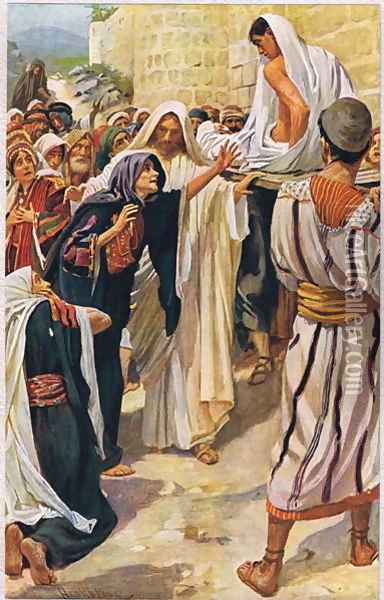
The Gospel story of the widow of Nain could help us answer. Reading it, I remember standing by a large walkway window at the Louisville Airport on a sweltering July day in 2005.
Down on the heat-softened tarmac, a small bevy of soldiers stood at attention. Slowly, a flag-draped casket was lowered into their waiting arms. Just to the side, a huddled family, waited as well. Two children clung to either side of their young mother. An older couple stood behind her, hands gentled on her shoulders.
At the window, several other travelers gathered in silence. A few teenage boys removed their inverted baseball caps when they noticed a distinguished older gentleman stand tall and hold a salute.
No one who witnessed that brief ceremony will ever forget it. The grief, reverence and astonishment at life’s fragility emblazoned the moment on every witnessing heart.
When Jesus passed the gates of Nain on that ancient morning, he had a like experience. He saw this “only son of a widowed mother”. Once again, shaken to his roots with compassion –splancha, he pulled heaven down to heal heart-breaking loss.
As Jesus drew near to the gate of the city a man who had died was being carried out, the only son of his widowed mother.
How I wished Jesus were flying out of Louisville that day in 2005! But then I realized He was there. The miracle was hidden, but still real. The Divine Compassion flowed through me, through the reverent gathering beside me, through the soldiers’ honoring arms, through the long prayerful memory we would all forever share.
That young man from Nain was raised from the dead… for a while. He, like all of us, eventually died. The miracle was not about him and his life. The miracle was the visible sign of God’s Lavish Mercy for us – God’s “feeling-with-us” in all our experiences. That compassion, whether miraculously visible or not, is always with us. It just took a different form that day in Louisville.
The baptismal commission to be Christ’s Body in the world calls each of us to the same type of compassion, of “being with” those who suffer, of honoring the God-given life of every person, and of believing in its ultimate resurrection.
Poetry: FIRSTBORN SONS AND THE WIDOW OF NAIN (LUKE 7:11–15) by Irene Zimmerman, OSF
Jesus halted on the road outside Nain
where a woman’s wailing drenched the air.
Out of the gates poured a somber procession
of dark-shawled women, hushed children,
young men bearing a litter that held
a body swathed in burial clothes,
and the woman, walking alone.
A widow then—another bundle of begging rags at the city gates. A bruised reed!
Her loud grief labored and churned in him till
“Halt!” he shouted.
The crowd, the woman, the dead man stopped.
Dust, raised by sandaled feet,
settled down again on the sandy road.
Insects waited in shocked silence.
He walked to the litter, grasped a dead hand.
“Young man,” he called
in a voice that shook the walls of Sheol,
“I command you, rise!” The linens stirred.
Two firstborn sons from Nazareth and Nain
met, eye to eye. He placed the pulsing hand into hers.
“Woman, behold your son,” he smiled.
Today, in God’s Lavish Mercy, Corinthians might leave us thinking, “Wow, maybe I’m a sinner but I’m sure not as bad as those guys!”
Their Names Have Been Changed to Protect the Innocent 🙂
Paul generates quite a list of reprobates, doesn’t he!
Do not be deceived; neither fornicators nor idolaters nor adulterers nor boy prostitutes nor sodomites nor thieves nor the greedy nor drunkards nor slanderers nor robbers will inherit the Kingdom of God.
The list is so compelling that we might be blinded by it and miss the message that the reading has for us. And I think the message is this – what do Paul’s miscreants have in common?
They have violated and scorned the sanctity of RELATIONSHIP which demands commitment, trust, reverence and integrity.
When, in our prayer, we examine our conscience and honestly place before God the best we have done with our day, how does it look in terms of right-relationship?
How committed, honest, respectful and caring have we been toward those God has given us in the circle of our lives?
Paul’s catalogue of sinners use others for their own selfish purposes. There is no mutuality, responsibility or investment in one another’s good. And while our wrongdoings may not make Paul’s Most Wanted List, they will be characterized by the same failings.
The question Paul offers us is this: how reverent, honest, respectful, merciful and loving am I in each of my relationships – with God, myself, Creation, my immediate and larger world? Or whom might I instead “write off” as fodder for my contempt, gossip, judgements, disregard, indifference or exclusion?
NAMASTE
Maybe we don’t mean to do these things, but I think we might be surprised if we really took a good look at ourselves — myself included.
In calling the Corinthians to get it together, Paul is also calling me.
Poetry: When I Am Among the Trees – Mary Oliver
When I am among the trees,
especially the willows and the honey locust,
equally the beech, the oaks and the pines,
they give off such hints of gladness.
I would almost say that they save me, and daily.
I am so distant from the hope of myself,
in which I have goodness, and discernment,
and never hurry through the world
but walk slowly, and bow often.
Around me the trees stir in their leaves
and call out, “Stay awhile.”
The light flows from their branches.
And they call again, “It's simple,” they say,
“and you too have come
into the world to do this, to go easy, to be filled
with light, and to shine.”
Today, in God’s Lavish Mercy, our readings share the common theme of humility, instructing us that the virtue is essential to our salvation.
Alleluia, alleluia. Take my yoke upon you, says the Lord, and learn from me, for I am meek and humble of heart.
Humility, of course, gets a bad rap in our dominating, “me” culture. We tend to think of humiliation, servitude, inelegance rather than the actual root of the word: humus -“of the earth”.
I was fascinated a few years ago by a small fracas arising from the unconsidered remarks of one of our Phillies baseball players. The team had been running hot and cold – with a little bit too much cold for some fans. The famous Philly “boos” had been flying. Frustrated with these, then outfielder Sean Rodriguez referred to the disgruntled fans as “entitled”.
Uh oh! They didn’t like that. We prefer to think of ourselves as “deserving “, right?
Humility is that virtue which helps us realize that we are not “entitled” or “deserving” of anything over and above other human beings. It roots us in the respect for each other that refuses to rank the worth of other human beings.
The social leverage that comes from wealth, power, and influence can beguile us. We become lost in a maze of stereotypes, rankings and prejudices which are the foundation of social injustice.
Do we ever hear among ourselves justifying phrases for our entitlement like these. Maybe the thoughts go unexpressed, but the attitude is unmistakably there:
well, I earned what I have
at least I paid for what I have
“they” need to work if they want to have …(food, healthcare, housing…)
it’s their own fault for … (dropping out of school, taking drugs, ….)
that’s just the way it is in “those” countries. The people are …(lazy, stupid, violent …)
“they” don’t need what I need. “They” are used to being … (poor, disabled, sick …)
And probably the most dangerous of all the phrases:
it’s not my problem
I’m not the one exiling, bombing, blocking, trafficking, enslaving “them”
Today’s readings enjoin us: it is my problem. My attitude, choices, vote, conversation, and lifestyle matter at the banquet of life we are all meant to share.
My intention to humbly join and rejoice with all Creation, to take a seat beside and never above my sister and brother – this is my only “entitlement” to the one banquet that matters.
When you hold a banquet, invite the poor, the crippled, the lame, the blind; blessed indeed will you be because of their inability to repay you. For you will be repaid at the resurrection of the righteous.
Prose – from Mary Oliver in Upstream (Penguin Press, 2016)
Understand from the first this certainty. Butterflies don’t write books, neither do lilies, or violets. Which doesn’t mean they don’t know, in their own way, what they are. That they don’t know they are alive – that they don’t feel, that action upon which all consciousness sits, lightly or heavily.
Humility is the prize of the leaf-world. Vainglory is the bane of us, the humans.
Sometimes the desire to be lost again, as long ago, comes over me like a vapor. With growth into adulthood, responsibilities claimed me, so many heavy coats. I didn’t choose them, I don’t fault them, but it took time to reject them. Now in the spring I kneel, I put my face into the packets of violets, the dampness, the freshness, the sense of ever-ness. Something is wrong, I know it, if I don’t keep my attention on eternity. May I be the tiniest nail in the house of the universe, tiny but useful. May I stay forever in the stream. May I look down upon the windflower and the bull thistle and the coreopsis with the greatest respect.
Music: A Place at the Table – Lori True and Shirley Elena Murray








 Lavish Mercy