Peter’s Vision of the Sheet – By Domenico Fetti – Kunsthistorisches Museum Wien, Bilddatenbank., Public Domain
Today, in God’s Lavish Mercy, we have the long story and explanation by Peter about who can be welcomed into the Community.
The earliest Christians were all Jews. Their beginning Christian rituals had deep roots in Jewish tradition. Their entire expectation of a Messiah was wrapped in the garment of the Old Testament. So it was hard for them to comprehend that Gentiles might also be saved by the Blood of Christ.
We might be tempted to consider these Jewish Christians very provincial, parochial, or even prejudiced in their closed attitudes. But maybe we should just look in the mirror!
It seems to be an enduring human inclination that, rather than – like Peter – seek a road to inclusion, we claim privilege for ourselves and exclude others on all kinds of bases:
She’s a woman, so she can’t…. whatever…
He’s gay, so he can’t …
She’s divorced, so she can’t…
He’s pro-life, or pro-choice, so he can’t…
She’s a Muslim, an atheist, and (irony of ironies) a Jew, so she can’t…
He’s too young – She’s too old – so they can’t …
Maybe in your own life, you have felt the pain of some of these suggested or blatant exclusions.
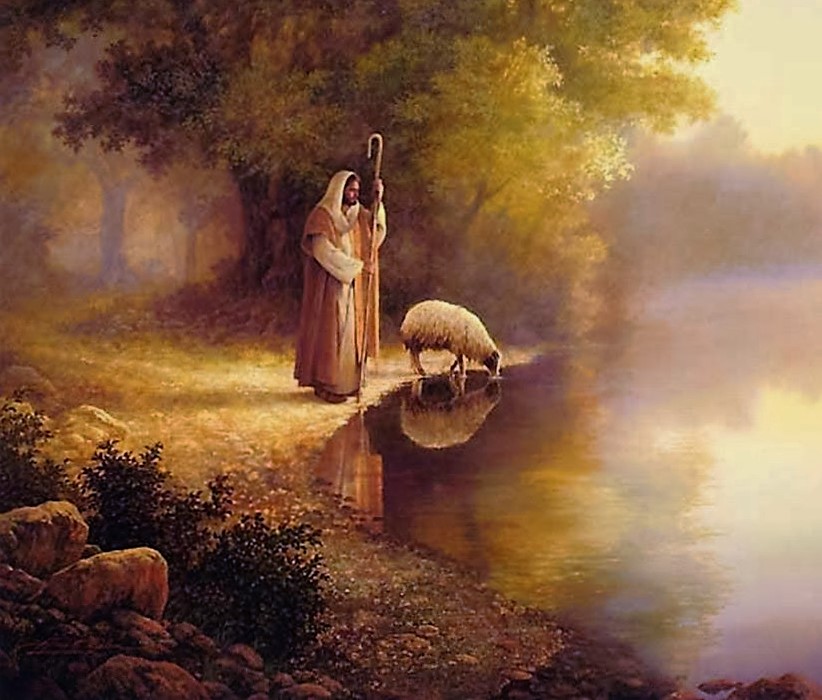
Jesus, in our Gospel, has a whole different approach to whom he loves. All creatures belong to him and will be brought to the Father in love.
I am the good shepherd, and I know mine and mine know me, just as the Father knows me and I know the Father; and I will lay down my life for the sheep. I have other sheep that do not belong to this fold. These also I must lead, and they will hear my voice, and there will be one flock, one shepherd.
Let us pray today to know and love our God ever more intensely. Let us ask to experience God’s infinite love and knowledge of us so that our unquenchable joy, humble gratitude, and limitless charity grow more evident.
Let us pray these gifts for all our sisters and brothers, no matter by what gate they come to the sheep fold.
Quote: I couldn’t find the original source, but it is a quote common in Eastern Spirituality:
We are all One. There is no Other.
Music: They’ll Know We Are Christians By Our Love
This is an interesting rendering of an old hymn. Kind of touched my heart.
Today, in God’s Lavish Mercy, our three readings make one thing very clear – we are ALL invited to membership in the Body of Christ. We are ALL welcome in the Beloved Community.
In our first reading, Paul and Barnabas preach to Jews, converts to Judaism and to Gentiles – to the effect that:
All who were destined for eternal life came to believe, and the word of the Lord continued to spread through the whole region.
Acts 13:48
In our second reading:
John, had a vision of a great multitude, which no one could count, from every nation, race, people, and tongue. They stood before the throne and before the Lamb.
Revelation 2:9
And in our Gospel, Jesus says:
My sheep hear my voice; I know them, and they follow me. I give them eternal life, and they shall never perish.
John 10:27
These readings describe the family of God to which every human being has been given entrance through the Death and Resurrection of Christ.
Think about that:
when you look into people’s eyes today
when you see their stories on the news
when you people-watch at the airport or the mall
when you drive by a cemetery where lives are remembered in stone
when you look at your children, your friends, your foes
when you take that last look in the mirror tonight before you fall asleep
This person has been invited, with me, to the family of God. How might that thought influence my choices and actions each day?
All of us – ALL OF US- are welcome; all of us, equally loved.
Poetry: O Shepherd of Souls – Hildegard of Bingen (1098–1179)
O Shepherd of souls
and o first voice
through whom all creation was summoned,
now to you,
to you may it give pleasure and dignity
to liberate us
from our miseries and languishing.
Music: Come Worship the Lord – John Michael Talbot
Come, worship the Lord For we are his people The flock that he shepherds Alleluia Come, worship the Lord For we are his people The flock that he shepherds Alleluia
And come, let us sing to the Lord And shout with joy to the rock who saves us Let us come with thanksgiving And sing joyful songs to the Lord
Come, worship the Lord For we are his people The flock that he shepherds Alleluia Come, worship the Lord For we are his people The flock that he shepherds Alleluia
The Lord is God, the mighty God The great King o’er all other gods He holds in his hands the depths of the earth And the highest mountains as well He made the sea, it belongs to him The dry land too, was formed by his hand
Come, worship the Lord For we are his people The flock that he shepherds Alleluia Come, worship the Lord For we are his people The flock that he shepherds Alleluia
Come, let us bow down and worship Bending the knee for the Lord our maker For we are his people We are the flock that he shepherds
Today, in God’s Lavish Mercy, I am offering a slightly edited edition of last year’s reflection for the Feast. Re-reading it, I thought it had some points worth repeating.
We pray today with Psalm 19 in which the psalmist draws on nature’s beauty to praise God.
The heavens declare the glory of God; and the firmament proclaims his handiwork. Day pours out the word to day; and night to night imparts knowledge.
Psalm 19: 2-3
Psalm 19 is used today to highlight the apostolic work of Philip and James who chose to declare the Gospel by their lives.
We note that these men are no longer called simply “disciples” or learnersof the Word. They are now “apostles”, charged with spreadingthe Word for the benefit of all.
In our Christian vocations, we each are called to live both these aspects of our call. We are continual learners of the faith through our prayer, reading, and listening. At the same time, we have an apostolic charge to spread the Gospel by the way we live.
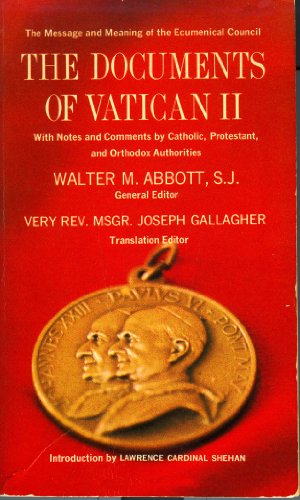
This double call was clearly proclaimed through Vatican II in the magnificent document Lumen Gentium, the Dogmatic Constitution on the Church.
I remember with great joy how this document, with its companions, released a surge of enthusiastic faith in the People of God when published in the 1960s. Many of us read and re-read our paperback copies of the Documents until they have long since fallen apart.
There is a Kindle edition available, but now when I want to be refreshed by their power, I access them for free on my iPad at the Vatican site:
Here is a favorite passage I used today to inform my prayer on this feast of two apostles
Lumen Gentium (The Dogmatic Constitution on the Church) promulgated by Pope Paul VI
The laity are gathered together in the People of God and make up the Body of Christ under one head. Whoever they are they are called upon, as living members, to expend all their energy for the growth of the Church and its continuous sanctification, since this very energy is a gift of the Creator and a blessing of the Redeemer.
The lay apostolate, however, is a participation in the salvific mission of the Church itself. Through their baptism and confirmation all are commissioned to that apostolate by the Lord. Moreover, by the sacraments, especially Holy Eucharist, that charity toward God and our brothers and sisters which is the soul of the apostolate is communicated and nourished. Now the laity are called in a special way to make the Church present and operative in those places and circumstances where only through them can it become the salt of the earth. Thus every lay person, in virtue of the very gifts bestowed upon them, is at the same time a witness and a living instrument of the mission of the Church itself “according to the measure of Christ’s bestowal”.
Besides this apostolate which certainly pertains to all Christians, the laity can also be called in various ways to a more direct form of cooperation in the apostolate of the Hierarchy. This was the way certain men and women assisted Paul the Apostle in the Gospel, laboring much in the Lord. Further, they have the capacity to assume from the Hierarchy certain ecclesiastical functions, which are to be performed for a spiritual purpose.
Upon all the laity, therefore, rests the noble duty of working to extend the divine plan of salvation to all persons of each epoch and in every land. Consequently, may every opportunity be given them so that, according to their abilities and the needs of the times, they may zealously participate in the saving work of the Church.
This morning’s question: how am I hearing and responding to my apostolic call?
Poetry: An Apostle’s Prayer – Edward Henry Bickersteth, Bishop of Exeter (1825-1906)
My God, my Father, let me rest
In the calm sun-glow of Thy face,
Until Thy love in me express’d
Draws others to Thy throne of grace.

O Jesu, Master, let me hold
Such secret fellowship with Thee,
That others, careless once and cold,
Won to my Lord and theirs may be.

Eternal Spirit, heavenly Dove,
The light of life to me impart,
Till fire descending from above
Burns on and on from heart to heart.

O Father, Son, and Holy Ghost,
Still, still may love to love respond;
And teach me, when I love Thee most,
Depths all unfathom’d lie beyond.
Music: The Call – from Five Mystical Songs – Vaughan Williams
Come, my Way, my Truth, my Life:
such a way as gives us breath;
such a truth as ends all strife;
such a life as killeth death.

Come, my Light, my Feast, my Strength:
such a light as shows a feast;
such a feast as mends in length;
such a strength as makes a guest.

Come, my Joy, my Love, my Heart:
such a joy as none can move:
such a love as none can part;
such a heart as joys in love.
Today, in God’s Lavish Mercy, Acts introduces us to Stephen, so filled with the Holy Spirit that “his face was like the face of an angel”.
Stephen is among the first group of Christians designated as deacons “to serve at table” – in other words, to do the administrative tasks that kept the community whole.
However, Stephen’s gifts went well beyond these services. Acts describes him like this:
Stephen, filled with grace and power, was working great wonders and signs among the people.
For today’s reflection, though, our focus will be John 6 which is the beginning of a week-long journey into the discourse on the Bread of Life (Jn 6:22-71). These passages, going from today until Friday, are like a “faith boot camp” for Jesus’s followers. They contain the core message of who Jesus is and how we are brought into communion with him.
John’s Gospel does not include an account of the Last Supper and institution of the Eucharist. The Bread of Life Discourse is where Jesus proclaims those teachings in John. It is a more detailed instruction and, as we pray with it over the course of the week, we may trace our own past and current awakening in faith.
Limbourg Brothers, Très Riches Heures du duc de Berry, Jesus Feeding the 5,000 Source Wikimedia Commons
Today’s verses offer very basic training. Jesus has just fed 5000 people in the miracle of the loaves and fishes. The crowds, not having a global view of the miracle like we do, are confused. They know they got plenty to eat, but did everybody? They heard many people ate, but they saw only their nearby neighbors. What really happened out on the green field?
Finding Jesus the next day, they are ready for another meal. They’re more interested in matzoh than miracles. Their basic hunger for physical sustenance consumes them. Jesus begins the task of opening their hearts to their deeper hungers and his desire to meet them:
Jesus said, “You are looking for me not because you saw signs but because you ate the loaves and were filled. Do not work for food that perishes but for the food that endures for eternal life.”
John 6: 26-27
Praying with today’s Gospel, we might ask ourselves some basic questions about our own faith.
When we go looking for God, as these hungry people did, what is it that we are looking for?
Do we talk to God only when we need something the way these folks needed another loaf or fish?
Jesus is inviting us to Eucharist, to Communion with him. To what degree have we opened our hearts to that invitation by our reflective prayer and acts of mercy?
Jesus’s basic message to his flock today is this:
Don’t be satisfied by a tasty roll, a fat fish, (or a fancy car, a good job, a comfortable life.) God made you for much more than these things. Come to Me and feed your deepest hunger.
Maybe, as we pray, we can ask the question posed at end of today’s Gospel and listen intently to Jesus’s answer:
So they said to him, “What can we do to accomplish the works of God?” Jesus answered and said to them, “This is the work of God, that you believe in the one he sent.”
Poetry: Bread of Life by Malcolm Guite
6: 35 Jesus said to them, ‘I am the bread of life.
Whoever comes to me will never be hungry,
and whoever believes in me will never be thirsty.
Where to get bread? An ever-pressing question
That trembles on the lips of anxious mothers,
Bread for their families, bread for all these others;
A whole world on the margin of exhaustion.
And where that hunger has been satisfied
Where to get bread? The question still returns
In our abundance something starves and yearns
We crave fulfillment, crave and are denied.
And then comes One who speaks into our needs
Who opens out the secret hopes we cherish
Whose presence calls our hidden hearts to flourish
Whose words unfold in us like living seeds
Come to me, broken, hungry, incomplete,
I Am the Bread of Life, break Me and eat.
Today, in God’s Lavish Mercy, our readings invite us to consider our capacity to trust. Who, what, why and when do we feel that we can trust?
In Acts, we see a beautiful example of the community trusting itself – presenting a concern, having it heard, and coming to a mutual resolution.
As the number of disciples continued to grow, the Hellenists complained against the Hebrews because their widows were being neglected in the daily distribution. So the Twelve called together the community of the disciples and said, “It is not right for us to neglect the word of God to serve at table. Brothers, select from among you seven reputable men, filled with the Spirit and wisdom, whom we shall appoint to this task, whereas we shall devote ourselves to prayer and to the ministry of the word.” The proposal was acceptable to the whole community,
Acts 6: 1-5
What a blessing such a process would be in any community from family, to work, social, and global communities!
But it’s not easy to come by that kind of trust, is it? It has to be proven – accumulated over small and consistent affirmations that such trust is safely given to the other, whoever that might be.
In our Gospel, the disciples’ ability to trust is tested.
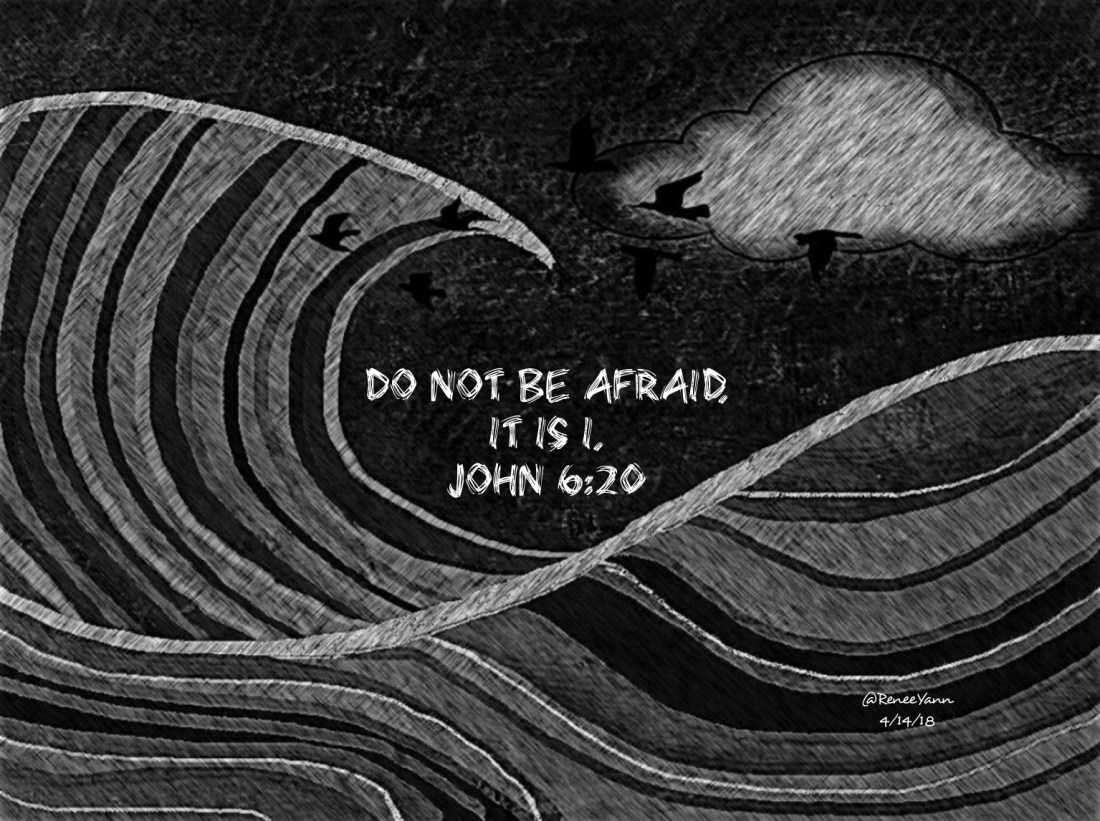
When it was evening, the disciples of Jesus went down to the sea, embarked in a boat, and went across the sea to Capernaum. It had already grown dark, and Jesus had not yet come to them. The sea was stirred up because a strong wind was blowing.
Jesus walks across the stormy water to meet his frightened disciples. They are afraid of the wind, the night and the wonder of Jesus.
One of my favorite quotes comes from the spiritually gifted Paula D’Arcy:
“Who would I be, and what power would be expressed in my life, if I were not dominated by fear.”
If you’re like me, your first inclination is to think, ” Well, I’m not dominated by fear!”
Just wait a minute. I encourage you to think about it. How has, or does, fear hold you back in your life?
As human beings, we harbor many fears even if we pretend to be very brave. We may be afraid of failure, loneliness, responsibility, insignificance, aging, dying or a thousand other things. Essentially, what we most fear is that we might be unloved or unlovable.
Just as he came to the disciples, Jesus comes to us through the night of any fear to prove that we are irrevocably safe in God’s Love. Even in darkness, we are the precious breath and heartbeat of God and cannot be extinguished by our fears.
Poetry: Trust by Lizette Woodworth Reese, (1856-1935), an American poet and teacher. Born in Maryland, she taught English for almost five decades in the schools of Baltimore. Though Reese was successful in prose as well as in poetry, the latter was her forté. She was named Poet Laureate of Maryland in 1931.
I am thy grass, O Lord! I grow up sweet and tall But for a day; beneath Thy sword To lie at evenfall.
Yet have I not enough In that brief day of mine? The wind, the bees, the wholesome stuff The sun pours out like wine.
Behold, this is my crown; Love will not let me be; Love holds me here; Love cuts me down; And it is well with me.
Lord, Love, keep it but so; Thy purpose is full plain; I die that after I may grow As tall, as sweet again.
Today, in God’s Lavish Mercy, we enter the Easter Season which will last until June 4th. The next day we will celebrate Pentecost.
Throughout these several weeks, we will have a thorough reading of the Acts of the Apostles.
Theologian Walter Brueggemann says this about Acts:
In the Book of Acts the church is a restless, transformative agent at work for emancipation and well-being in the world.
As Easter People, transformed by the Resurrection of Jesus, that’s what we’re all called to be:
transformative agents at work for emancipation and well-being in the world.
Our models and inspiration will be found in these early women and men we read about over the next few weeks. This was a community fully committed and learning to be disciples. This was a community that acted – within a culture of death – for an alternative, life-giving world.
“The whole book of Acts is about power from God that the world cannot shut down. In scene after scene, there is a hard meeting between the church and worldly authorities, because worldly authorities are regularly baffled by this new power and resentful of it.” At one point, in chapter 17, the followers of Jesus are accused of “turning the world upside down.” (Brueggemann)
Our world sorely needs such an active Church, speaking clearly to the issues that threaten and limit human life and wholeness in God. It’s not easy to be that witness, but it is critical. Our Gospel suggests the difficulty, but also defines the motivation:
Mary Magdalene and the other Mary went away quickly from the tomb, fearful yet overjoyed, and ran to announce the good news …
May we, though sometimes fearful, choose to be agents of the joyful Good News for our times. By our choices, attitudes and actions, may we be brave in witnessing Christ, even in trying circumstances!
Prose: from Deitrich Bonhoeffer
Discipleship never consists in this or that specific action: it is always a decision either for or against Jesus Christ.
Music: Mozart’s Exsultate Jubilate – sung by Regula Mühlemann
Be sure to wait after the applause for the Alleluia segment.
Exsultate, jubilate, o vos animae beatae! Dulcia cantica canendo, cantui vestro respondendo, psallant aethera cum me.
Fulget amica dies, iam fugere et nubila et procellae; exortus est justis inexspectata quies. Undique obscura regnabat nox; surgite tandem laeti, qui timuistis adhuc, et iucundi aurorae fortunatae frondes dextera plena et lilia date.
Tu, virginum corona, tu nobis pacem dona. Tu consolare affectus, unde suspirat cor. Alleluia.
Exult, rejoice, o blessed souls! Singing sweet songs, singing your song, the heavens sing praise with me.
A friendly day shines forth, clouds and thunderstorms recede; unforeseen peace has come to the righteous. Darkness was all over the world; arise joyfully at last you, who were hitherto in fear, and, leaning to the blissful morning light lavishly present wreaths of leaves and lilies.
You, the Virgin’s garland , grant us peace. Dull the grief, which makes our heart sigh. Halleluja.
Today, in God’s Lavish Mercy, as supper time falls slowly from east to west over the Earth, so will Christians worldwide seek communion with Christ and the believing community.
A great surge of intentional communion will join us in an irrepressible wave of faith. The evening skies will echo with the precious words that, despite whatever distances, gather us into one people in Christ:
Jesus took bread, and, after he had given thanks, broke it and said, “This is my body that is for you. Do this in remembrance of me.” In the same way also the cup, after supper, saying, “This cup is the new covenant in my blood. Do this, as often as you drink it, in remembrance of me.
Our Gospel reminds us that there are two equally significant dimensions to a full understanding of Eucharist:
the Body and Blood we share in Eucharist
the sacrificial service we live daily among the People of God who are the living Body of Christ for us.
In these times of worldly suffering and war, that second dimension sustains us.
Eucharist is offered when we wash the feet of our sisters and brothers:
by those who tend and comfort the sick, poor, war ravaged, and desolate.
by the suffering themselves who endure in faith and hope
by those who serve other’s needs for sustenance and safety
by those who pray for the healing, courage and restoration of all Creation
by each one of us as we turn from self toward the good of the Whole
As Jesus leans to wash the feet of his disciples, so may we lean in service over our suffering world. Jesus asks us:
Do you realize what I, your Lord and Master, have done for you?
We do not realize fully, Lord, what You have done for us.
But we are daily learning a new depth of understanding.
The realization rises like a slow dawn over the shadows of our selfishness. It is a sunrise which continues throughout our lives. Please help us to rise with You no matter how the darkness weighs on us.
Like the fragile bread and fluid wine which hide your Omnipotent Presence, may we become holy nourishment and joy for one another – a true and living memorial to your infinite act of love for us.
Prose Prayer: excerpts from Mass on the World – Pierre Teilhard De Chardin, SJ
Receive, O Lord, this all-embracing host which your whole creation, moved by your magnetism, offers you at this dawn of a new day.
This bread, our toil, is of itself, I know, but an immense fragmentation; this wine, our pain, is no more, I know, than a draught that dissolves. Yet in the very depths of this formless mass you have implanted — and this I am sure of, for I sense it — a desire, irresistible, hallowing, which makes us cry out, believer and unbeliever alike: ‘Lord, make us one.’
You have come down, Lord, into this day which is now beginning. But alas, how infinitely different in degree is your presence for one and another of us in the events which are now preparing and which all of us together will experience! In the very same circumstances which are soon to surround me and my fellow-men you may be present in small measure, in great measure, more and more or not at all. Therefore, Lord, that no poison may harm me this day, no death destroy me, no wine befuddle me, that in every creature I may discover and sense you, I beg you: give me faith.
Music: Pange Lingua – Chant of the Mystics Written by St. Thomas Aquinas in the 13th century English lyrics below
Sing, my tongue, the Saviour’s glory, Of His Flesh, the mystery sing; Of the Blood, all price exceeding, Shed by our Immortal King, Destined, for the world’s redemption, From a noble Womb to spring.
Of a pure and spotless Virgin Born for us on earth below, He, as Man, with man conversing, Stayed, the seeds of truth to sow; Then He closed in solemn order Wondrously His Life of woe.
On the night of that Last Supper, Seated with His chosen band, He, the Paschal Victim eating, First fulfils the Law’s command; Then as Food to all his brethren Gives Himself with His own Hand.
Word-made-Flesh, the bread of nature By His Word to Flesh He turns; Wine into His Blood He changes: What though sense no change discerns. Only be the heart in earnest, Faith her lesson quickly learns.
Down in adoration falling, Lo, the sacred Host we hail, Lo, o’er ancient forms departing Newer rites of grace prevail: Faith for all defects supplying, When the feeble senses fail.
To the Everlasting Father And the Son who comes on high With the Holy Ghost proceeding Forth from each eternally, Be salvation, honor, blessing, Might and endless majesty. Amen.
Today, in God’s Lavish Mercy, we receive a perfect encouragement from Isaiah:
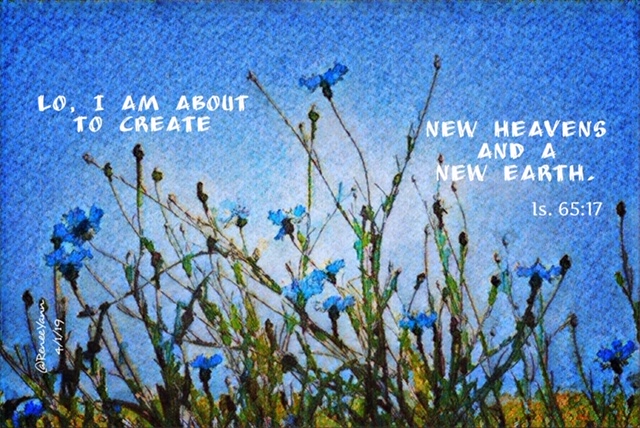
Walter Brueggemann calls Isaiah 65 “a glorious artistic achievement”. Indeed, these images confirm his statement:
a new heavens and a new earth;
constant rejoicing and happiness
people will be a delight
no weeping or crying;
long life for all
everyone with a home
enough for all to eat
As we pray with this passage today, we may experience a longing for a return to our beautiful, safe world – a world before pandemic, a world before the specter of WW III. In today’s violent and besieged environment, we all pray from a place of anxiety, loss, constraint, or some degree of suffering.
Isaiah’s community prayed from the same place. All the beautiful images were a promise not yet realized. The prophetic poetry of Isaiah is a call to courageous hope, not a description of current circumstances.
Faith invites us, even as we experience a bittersweet longing, to trust that God is with us, teaching us and leading us deeper into the Divine Understanding. Even as circumstances turn our world upside down, God will guide the falling pieces to a blessed place if we commit to find God in the tumbling.
I don’t think many of us would deny that the world has needed fixing for a long, long time. The systems we have built leave many in deficit throughout the world, and we have failed to address the wound.
War, pandemic, forced migration of the poor, climate catastrophe all have laid that failure bare.
As we pray for resolutions to these sufferings, may we be opened to an irrevocable awareness of our common humanity and responsibility for one another.
Only by such an outcome will we move closer to Isaiah’s peaceful Kingdom. Only by our courage to embrace it, can God fulfill the Promise in us.
Poetry: by Emily Dickinson
I many times thought Peace had come When Peace was far away — As Wrecked Men — deem they sight the Land — At Centre of the Sea —
And struggle slacker — but to prove As hopelessly as I — How many the fictitious Shores — Before the Harbor lie —
Today, in God’s Lavish Mercy, we are encouraged to pray. Hosea tells us:
Come, let us return to the LORD, it is he who has rent, but he will heal us; … the LORD will come to us like the rain, like spring rain that waters the earth.
Let the image of that truth sink into your parched spirit.
Our Gospel leads us to pray humbly:
But the tax collector stood off at a distance and would not even raise his eyes to heaven but beat his breast and prayed, ‘O God, be merciful to me a sinner.’
As we pray humbly today, let us ask for God’s refreshment for all our sisters and brothers across the earth. In good times and in trials, let us always praise God.
I would like to share one of my own poems with you today, as we kneel before God with all struggling Creation begging God for humanity to be washed in Mercy.
All Creation
All Creation kneels, a Single Being, to praise God.
From its immense heart, it sings myriad songs at once, Morning and Evensong, Praise and Dirge, Alas and Alleluia, intermingled
It sings even over its own scars, where the chasms cry out for balm. It sings both the remembrance and the hope of blessing. It sings the endurance of faith and the confidence of love.
In roar and silence, darkness and light, Creation kneels, a Single Being, to praise God.
Music: Total Praise sung by the Brooklyn Tabernacle Choir. Just watching these faith-filled people lifts my heart and gives me hope. I trust it will do the same for you, dear friends as we pray for one another.
Today, in God’s Lavish Mercy, our readings lead us to thank God for our heritage of faith. They remind us how precious that heritage is.
Moses, after reiterating the history of God’s goodness to Israel, enjoins the People:
Take care and be earnestly on your guard not to forget the things which your own eyes have seen, nor let them slip from your memory as long as you live, but teach them to your children and to your children’s children.
Deuteronomy 4:6
Jesus, too, acknowledges the importance of his religious heritage:
Do not think that I have come to abolish the law or the prophets. I have come not to abolish but to fulfill. Amen, I say to you, until heaven and earth pass away, not the smallest letter or the smallest part of a letter will pass from the law, until all things have taken place.
Matthew 5:17
Readings such as these move us to remember, consider and appreciate our own faith story – that personal unfolding of grace-filled circumstances which have led us to our present relationship with God.
For many of us, faith planted itself in us through the seeds of our family. We simply “inherited” the faith from our parents, grandparents and extended family. That community of blessings was extended through our parish and through our Christian education.
Take time to remember:
Who taught you your childhood prayers?
Who told you Bible stores?
Who prepared you for the sacraments?
Who served as a example to you of what a good Christian is like?
The answers will not be some big religious events. They will be simple memories that, at the time, you might not have even recognized as important to your faith life. I remember, for example, that every day in Lent my father walked with me to 6:30 AM Mass. Because many of the laborers had to be in work by 7:00 AM, the priest distributed communion for them before the Mass began. Just after the Gospel, Dad and all the other workmen would quietly exit to get to work on time. No fanfare. No preachy words. Just deep faith and devotion.
I can’t exactly put that lesson into words. All I know is that it deeply affected my faith and my profound appreciation for the Eucharist — and for my Dad.
And as you grew up and grew older:
Who has sincerely engaged with you on your questions of faith and morality?
Who has encouraged you to live a life of Christian service and social justice?
Who has modeled everyday holiness for you?
Who challenges and invites you to deeper spirituality and Christian witness?
The names and faces who have come into your prayer as you considered these questions — these people are the “fathers” and “mothers’ of your faith.
And of course, these questions may lead us to ask ourselves how we have done these things for the generations now depending on us for the transmission of faith?
Poetry: On Religion – Kahlil Gibran (1883-1931)
And an old priest said, Speak to us of Religion. And he said: Have I spoken this day of aught else? Is not religion all deeds and all reflection, And that which is neither deed nor reflection, but a wonder and a surprise ever springing in the soul, even while the hand hew the stone or tend the loom? Who can separate his faith from his actions, or his belief from his occupations? Who can spread his hours before him, saying, “This for God and this for myself’ This for my soul, and this other for my body?” All your hours are wings that beat through space from self to self. He who wears his morality but as his best garment were better naked. The wind and the sun will tear no holes in his skin. And he who defines his conduct by ethics imprisons his song-bird in a cage. The freest song comes not through bars and wires. And he to whom worshipping is a window, to open but also to shut, has not yet visited the house of his soul whose windows are from dawn to dawn.
Your daily life is your temple and your religion. Whenever you enter into it take with you your all. Take the plough and the forge and the mallet and the lute, The things you have fashioned in necessity or for delight. For in revery you cannot rise above your achievements nor fall lower than your failures. And take with you all men: For in adoration you cannot fly higher than their hopes nor humble yourself lower than their despair.
And if you would know God be not therefore a solver of riddles. Rather look about you and you shall see Him playing with your children. And look into space; you shall see Him walking in the cloud, outstretching His arms in the lightning and descending in rain. You shall see Him smiling in flowers, then rising and waving His hands in trees.













 Lavish Mercy