Today, in Mercy, we read the magnificent Ephesians prayer, spoken by Paul over his beloved community — and over us.The phrases are like sacred honey, each one to be individually savored and consumed.
I never cease giving thanks for you
May God give you a spirit of wisdom and revelation
May the eyes of your hearts be enlightened
May you know what is the hope that belongs to God’s call
… what are the riches of glory in his inheritance among the holy ones
… and what is the surpassing greatness of his power for us who believe
Wow! What if we prayed for one another like that? What if we prayed for ourselves like that?
Sometimes we, and our companions on life’s journey, do require prayers for a specific need: recovery from illness, strength in a time of trial, courage in darkness.
But we should pray for one another every day – a prayer that transcends specific needs – a prayer for wisdom, faith, understanding, and wild confidence in God’s lovingpower in our lives.
Such a prayer, like Paul’s, helps create a web of spiritual resilience for our beloveds, around them and within them. This is the power of the Communion of Saints.
Yesterday in Vatican City, St. Oscar Romero was canonized. This holy man was Archbishop of San Salvador from 1977 until his assassination while offering Mass on March 24, 1980. After Archbishop Romero’s death, a twelve-year civil war ensued in El Salvador, killing an estimated 75,000 people.
The Catholic Church in El Salvador, during these years, became deeply involved in protecting the lives and land rights of the poor who were severely oppressed by a militaristic government. This corrupt government engaged the assistance of the United States to suppress the people by interpreting their struggle as “communism”.
For years, the Salvadoran government received US supplied arms and military training at the School of the Americas in Ft. Benning, Georgia.It was someone trained with these arms who martyred St. Oscar Romero – and thousands of his poor, over many years.
Romero was not a politician. He averted confrontation wherever possible. But he could not stand by as thousands of his flock were slaughteredbecause their human rights threatened the status and greed of the powerful.
Sometimes we hear the empty adage that religion should never mix with politics.
St. Oscar Romero is one of hundreds of women and men who became saints because they believed the opposite.
Our faith is irrevocably entwined with the rest of our lives. Our Gospel demands that we embrace and honor the poor, the oppressed and the marginalized. We may not be called to the level of witness that Oscar Romero was. But we, each in our own way, are called to understand issues of justice, and to act as Jesus would.
We are called to challenge our government, as did many activists during these years, when it is blind to its own sins. The USA is still selling arms to oppressive governments, still supporting regimes and practices that ignore human rights. Our voices and our votes need to be informed, clear, and faith-filled. I find Network and excellent source of education for me on these issues:
Please read the lyrics below first, as they are a little difficult to understand. The images in the video are painful to view, but offer testament to the gross injustices the Salvadoran people endured.
There’s a sunny little country south of Mexico Where the winds are gentle and the waters flow But breezes aren’t the only things that blow In El Salvador
If you took the little lady for a moonlight drive Odds are still good you’d come back alive But everyone is innocent until they arrive In El Salvador
If the rebels take a bus on the grand highway The government destroys a village miles away The man on the radio says ‘now we’ll play South of the Border’
And in the morning the natives say, We’re happy you have lived another day Last night a thousand more passed away In El Salvador
There’s a television crew here from ABC Filming Rio Lempe and the refugees Calling murdered children the ‘tragedy’ Of El Salvador
Before the government cameras 20 feet away Another man is asking for continued aid Food and medicine and hand grenades For El Salvador
There’s a thump, a rumble, and the buildings sway A soldier fires the acid spray The public address system starts to play South of the Border
You run for cover and hide your eyes You hear the screams from paradise They’ve fallen further than you realize In El Salvador
Just like Poland is ‘protected’ by her Russian friends The junta is ‘assisted’ by Americans And if 60 million dollars seems too much to spend In El Salvador
They say for half a billion they could do it right Bomb all day, burn all night Until there’s not a living thing upright In El Salvador
They’ll continue training troops in the USA And watch the nuns that got away And teach the military bands to play South of the Border
And kill the people to set them free Who put this price on their liberty? Don’t you think it’s time to leave El Salvador? Songwriters: Jim Wallis / Noel Paul Stookey
Today, in Mercy, Paul and Peter have a big fight – two of the Greats take it to the mat over an issue of inclusivity in the early Church.
To put the episode in a nutshell, Peter had succumbed to political pressure from Jewish Christians to isolate non-Jewish Christians from full participation in the Church. The pressure was rooted in nationalism, religious prejudice and unexamined fear. Peter, in an attempt to manage these forces, made a huge misstep.
Paul, seeing that Peter’s actions would set a dangerous and divisive precedent in the emerging Church, confronted him before the whole community. For a moment in time, these two pillars of Christianity stood on separate shores.
Ultimately, through prayer, respect and discernment, Peter and Paul continued together to shepherd the embryonic Church toward a new reality – one built on, but beyond, the Judaism in which they both had been raised.
The Church, as a living reality, will always be challenged by issues of growth, identity, inclusion and other concerns. But as soon as we define ourselves as anything other than simply Christians, we run the risk of moving to our own “separate shores”.
We are not conservative or liberal Christians. We are not American, or European or Asian Christians. We are not gay or straight, Black or White, male or female, rich or poor Christians.
We are all sisters and brothers in the Gospel of Christ, standing on the same shore with Him, praying to our one Father. May this shared prayer help us to become who we are called to be.
Today, in Mercy, we meet Martha and Mary. These sisters are the personification of the Benedictine motto: Ora et labora: Pray and work – the two essentials that we all struggle to balance in our lives.
They, with their brother Lazarus, are dear friends of Jesus. The scriptures show us that Jesus felt comfortable at their home, and that they loved to have him stay with them.
As all of us do with our closest friends, Jesus understood the lights and shadows of their personalities – and they of his. He knew that Martha was the organizer, the one who planned and worried about the incidentals. Mary was deeply spiritual, but maybe had her head in the clouds a bit when it came to getting things done.
Perhaps these personality differences caused some tensions between the sisters, as they might between us and our family members or close friends. Sometimes these little, unnoticed frictions can suddenly become chasms between us and those we love.
How and why does it happen?
Jesus gives us the answer in this Gospel passage. He hears Martha’s simmering frustration. He calms her, as one might a child – “Martha, Martha…”. We can hear his gentle tone. Jesus tells her that worry and anxiety are signs that we are not spiritually free. He tells her that Mary has focused on the important thing.
This may sound repetitious, but just think about it a while:
It is so important to know what is important.
It is so freeing to agree on what matters with those closest to us. Talking with each other in openness, respect, and unconditional love is the only path to that freedom.
Martha and Mary slipped off that path a bit in this situation. But with Jesus’ help, they righted their relationship.
That’s the best way for us to do it too. Let Jesus show us what is most important through sharing our faith, and even our prayer, with those closest to us. Let him show us where our self-interests, need for control, fears and anxieties are blocking us from love and freedom.
It is the same way that we, like Mary, can strengthen our relationship with God. It is not sufficient for our prayer to consist of incidentals — pretty words and empty practices.
We must sit open-hearted at the feet of Jesus and let him love us, let him change us. Even in the midst of our responsibilities and duties, we must balance “the better part”.
Music: a charming little song by Peg Angell which leaves me with same practical question I always have when reading this passage: who actually did get the dinner ready?😂
Today, in Mercy, our Gospel gives us the parable of the Good Samaritan. It is a story in which we can all find ourselves, maybe changing roles in the changing circumstances of our lives.
Have we ever been the robbers, the bullies, the outlaws who in some way used force or subterfuge to gain their own advantage? We don’t have to be a criminal to do this. We can do it by our prejudices, our preferential treatment, our secrets and our cliques. We can do it by our uninformed or willful choices which deprive others of their needs and rights.
Have we ever been the Levite, the one who claims a special religious place by family heritage? Have we ever, like the Levite in the parable, bypassed someone because of her religion or ethnic origins – because she isn’t “like us”?
Have we ever been this pathetic priest who so completely misunderstands the role of minister – who ignores God’s suffering creature for fear of some imagined contamination?
Have we ever been the victim, the one set upon by the meanness of others, the one unable to heal himself from injury? Has the memory made us more like the Samaritan or like the robbers once we were healed?
And finally, have we ever been the Samaritan? Do we even want to be? Or do we think him foolish to have given his own time and treasure for a stranger?
This parable is a study in differences and how we respond to them. Some use differences to separate rather than enrich their world. They fail to understand that we all belong to each other and will live forever as one family in heaven. If we don’t learn to do it in this life, we won’t be part of it in the life to come.
Realizing this may change how we might have responded on that ancient road – or the road right now where we’re all just walking each other home.
Today, in Mercy, our reading from the Book of Numbers reveals a very human moment between Joshua and Moses.
Moses is getting older. He realizes that the time is approaching for him to hand over the leadership of his people. God seems to realize that too.
The LORD came down in the cloud and spoke to Moses. Taking some of the spirit that was on Moses, the LORD bestowed it on the seventy elders; and as the spirit came to rest on them, they prophesied.
Joshua, ever since his youth, has been aide to Moses. Moses is his hero – the one, who having spoken with God, led the People out of Egypt. Now Joshua sees other ordinary guys assuming some of Moses’s roles. Joshua feels his own security and comfort shifting beneath him, hints of a spiritual earthquake.
An outraged Joshua alerts Moses, begging him to stop these supposed imposters. But Moses assures Joshua with words no hero-worshipper ever wants to hear:
Are you jealous for my sake? Would that all the people of the LORD were prophets! Would that the LORD might bestow his spirit on them all!
What a powerful question Moses poses. It searches Joshua’s heart:
Are you jealous for my sake?
Are you fearful, biased, closed-hearted,
and self-protective because you fear
that you and I will lose position and power?
Surely Moses senses Joshua emerging as the next leader of Israel — even though Joshua might not share that awareness yet. Moses wants him to see that it is the Spirit of God Who leads the People through any human means She wishes.
When we presume to control the Spirit, or think to invest Her power only in our own particular “heroes”, we close ourselves to the amazing, surprising power of God. This Divine Power cannot be controlled and, like wildflowers through concrete, will bloom where She chooses.
We see the fruits of such presumption all over our histories: the falsely assumed superiority of men over women, whiteness over color, wealth over labor, age over youth, or any form of dominance over mutuality. These assumptions become concretized in our culture, hardening us to the movements of the Spirit.
If we have any hold on privilege in our lives, we might be inclined to profit by these assumptions. It is just such an inclination that Moses nips in Joshua in this powerful exchange between revered teacher and apprentice.
Music: An oldie, but goodie. Always brings me a deep peace.I hope it does the same for you, dear reader.
Today, as the Mercy Family throughout the world celebrates Mercy Day, we praise and thank God for the call given to Venerable Catherine McAuley to respond to God’s grace by founding the Sisters of Mercy.
On September 24, 1827, Catherine used an unexpected inheritance to open a house for poor and homeless women in Dublin. It began with two, Catherine and Mary Ann Doyle – and that small, vibrant fire has lit the hearts of millions ever since.
Many of you, dear readers, carry that fire and will know Catherine’s story well. But some still unfamiliar with her life might want to explore this website:
For those of us who treasure a share in Catherine’s call, today’s readings from Proverbs and Psalms offer a picture of what mercy in action looks like. Luke’s Gospel exhorts us that our Mercy light should be raised up to shine for all those seeking refuge from a darkness- whether it be poverty, sickness, ignorance or any kind of isolation or oppression.
To gain courage and energy for that shining, let us reach through time for Catherine’s hand, telling her how we share her dream for God’s Mercy for all Creation. Let us ask her to enliven us each morning with the same passion for justice, the same compassionate tenderness, the same welcoming heart by which she showed others the love of God.
Are there not moments when we are overwhelmed by the Mercy of God welling up within us and around us, flowing from good hearts over the world’s needs? We see and bless this grace in each other, dear Family, as we thank God this day to be called “Mercy”.
May each of your lives be richly blessed and marked by Mercy!
Today, I thought you might enjoy this powerful poem by Denise Levertov.
The music link is beneath it. ❤️ Happy and blessed Mercy Day to all.
To Live in the Mercy of God
To lie back under the tallest
oldest trees. How far the stems
rise, rise
before ribs of shelter
open!
To live in the mercy of God. The complete
sentence too adequate, has no give.
Awe, not comfort. Stone, elbows of
stony wood beneath lenient
moss bed.
And awe suddenly
passing beyond itself. Becomes
a form of comfort.
Becomes the steady
air you glide on, arms
stretched like the wings of flying foxes.
To hear the multiple silence
of trees, the rainy
forest depths of their listening.
To float, upheld,
as salt water
would hold you,
once you dared.
To live in the mercy of God.
To feel vibrate the enraptured
waterfall flinging itself
unabating down and down
to clenched fists of rock.
Swiftness of plunge,
hour after year after century,
O or Ah
uninterrupted, voice
many-stranded.
To breathe
spray. The smoke of it.
Arcs
of steelwhite foam, glissades
of fugitive jade barely perceptible. Such passion—
rage or joy?
Thus, not mild, not temperate,
God’s love for the world. Vast
flood of mercy
flung on resistance.
———-
Today, in Mercy, on this feast of St. Matthew, Apostle and Evangelist, we are blessed with an inspiring reading from Ephesians. We are reminded that each of us is called in God according to our particular gifts. Paul encourages us to live “in a manner worthy of the call we have received” in our Baptism.
For most of us, it has been quite a while since we were washed in the waters of our Baptism. A lot of other waters have passed under the bridge since then. We may, or may not, have recognized and responded to our call, continually carried to us on those life waters.
Each moment, each choice, each act and decision asks us once again to choose Christ – over sin, over self, over meaninglessness. Each life opportunity calls us closer to Jesus, to the pattern of his Cross, to the witness of his Resurrection.
Matthew heard such a call as he sat, perhaps dulled by the unconscious disengagement of his life, by the failure to live with intention and openness to grace. As He passed by Matthew, Jesus reached into that ennui, calling Matthew to evangelize all the future generations by his Gospel.
Jesus calls us to be evangelists too – every moment, every day. Our “Yes” to our particular call writes its own Gospel, telling the Good News through our faith, hope and love.
Pope Francis says this:
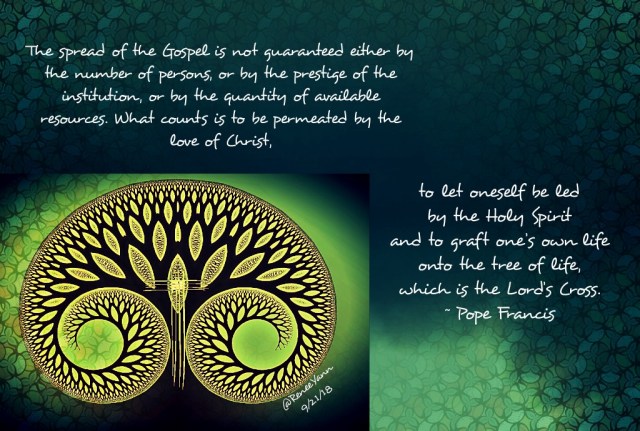
The spread of the Gospel is not guaranteed either by the number of persons, or by the prestige of the institution, or by the quantity of available resources. What counts is to be permeated by the love of Christ, to let oneself be led by the Holy Spirit and to graft one’s own life onto the tree of life, which is the Lord’s Cross.
Music: When You Call My Name ~ Brian Doerksen & Steve Mitchinson
Today, in Mercy, we encounter the often-read, less-practiced Corinthians passage on love. Could there be any word more massacred in our human language? Watch a few minutes of “Bachelorette”, or read a few Valentine’s cards, or listen to a commercial that tells you how much you’ll love some car! You’ll see what I mean.
Our souls so desperately need to learn and re-learn Paul’s definition of love.
To open, Paul tells us that nothing we do matters if it is done without love. Does this mean we have to enjoy executing all the duties required of us? I think not. Sometimes a duty feels like a drudgery.
But Paul is speaking here to our motivation. All that we do must be done because we care for and honor ourselves and others. This lightens any sense of burden and gives us a resilience and joy even in difficulty. This is what real love looks like.
Paul goes on to name the specific characteristics of love.If you’re like me, this section is like a checklist against which I measure myself:
Patient? – sometimes.
Jealous, pompous, boastful, rude? – uh oh!
Does not seek its own interests? – (alarms now going off)
Yes, the deeper we go into this passage, the more we realize how far we are from the kind of love Paul describes.
The whole point of the spiritual journey is to continually refine our understanding and practice of love until it fits more perfectly to the pattern of Jesus Who is Love.
Let’s all pray today to “clang” a little less, and love a lot more.
Today, in Mercy, Jesus tells us that we are his Body. How do we keep faith with this when the Body strains against its own parts? How do we look beyond human frailty to the vision of Christ?
No one can deny that the Church struggles with its peace and unity. The current reality of the Catholic Church is fraught with abuse, division and threatened schism. And these things are nothing new. Church history reads like a novel laced with intrigue, power plays, and gratuitous violence.
How are we to reconcile these realities with Jesus’ pronouncement in today’s Gospel?
I think we do so by acknowledging
that the Living Church has not yet sifted out the chaff from the wheat
that the Body of Christ is still being crucified
that our discipleship consists in sharing the continuing act of redemption with Jesus
We strengthen ourselves for this sacred participation by our faithfulness to the Gospel, by our quest for meaningful Eucharist, and by our reverence for Christ’s presence in all Creation.
Pierre de Chardin saw the Body of Christ in cosmic terms which open our understanding and challenge us to an evolution of grace. He says:
“ No, the Body of Christ must be understood boldly, as it was seen and loved by St. John, St. Paul, and the Fathers. It forms in nature a world which is new, an organism moving and alive in which we are all united physically, biologically….
It is first by the Incarnation and next by the Eucharist that Christ organizes us for Himself and imposes Himself upon us.Although He has come above all for souls, uniquely for souls, He could not join them together and bring them life without assuming and animating along with them all the rest of the world. By His Incarnation, He inserted Himself not just into humanity but into the universe which supports humanity, and He did so not simply as another connected element, but with the dignity and function of a directing principle, of a Center toward which everything converges in harmony and Love.”
(de Chardin: La Vie Cosmique)






 Lavish Mercy