Eyes Unveiled

Wednesday of the First Week of Advent
December 6, 2023

Today’s Readings:

https://bible.usccb.org/bible/readings/120623.cfm


Today, in God’s Lavish Mercy, Isaiah tantalizes us with his vision of the sumptuous heavenly banquet:

On this mountain the LORD of hosts
will provide for all peoples
A feast of rich food and choice wines,
juicy, rich food and pure, choice wines.

Isaiah 25:6-7

I can picture myself at that table munching on a savory turkey leg washed down by a bottomless pilsner. But if I stop there in my meditation I will have missed the whole point! The menu is not even the tip of the treasures to be had when we gather on Isaiah’s “Parousia Mountain”.

On that mountain, the veil will be lifted from our perception. The tangly web of our stresses and confusions will be wiped away. We will see ourselves and all Creation with God’s clear and loving eyes. Death – the lurking intruder threatening every earthly table – will have been eradicated, dissolved into Eternal Being.

On this mountain God will destroy
the veil that veils all peoples,
The web that is woven over all nations;
God will destroy death forever.

Isaiah 25:7-8

In our first reading, Isaiah paints the picture of a mountain lifted from time and transformed with heaven. In our Gospel, Jesus too is on a mountain when he pulls heaven down to heal and feed the yearning crowd.

Jesus walked by the Sea of Galilee,
went up on the mountain, and sat down there. 
Great crowds came to him,
having with them the lame, the blind, the deformed, the mute,
and many others. 
They placed them at his feet, and he cured them. 

Matthew 15:29-30

No doubt the gathered people, cured of their nagging maladies, were stunned into an instant faith. But Jesus knows that they can not stay on this heaven-charged mountain forever. They have their life’s journey ahead of them, and the energy of nascent faith may wane on the long road. So he reinforces the healing miracles with the comfort and sustenance of common food:

My heart is moved with pity for the crowd,
for they have been with me now for three days
and have nothing to eat. 
I do not want to send them away hungry,
for fear they may collapse on the way.

Matthew 15:32

In this incident, which is another version of the miracle in Matthew 14, the simple common folk have with them only the merest provisions. It is these that Jesus uses to fuel an enduring faith in these earth-bound believers:

Jesus said to them, “How many loaves do you have?” 
“Seven,” they replied, “and a few fish.” 
He ordered the crowd to sit down on the ground. 
Then he took the seven loaves and the fish,
gave thanks, broke the loaves,
and gave them to the disciples, who in turn gave them to the crowds. 
They all ate and were satisfied. 
They picked up the fragments left over–seven baskets full.

Matthew 15:34-37

God uses our merest provisions too to charge our daily life with faith’s energy. But we must take the holy time to let any misleading webs and obstructive veils fall from our perceptions. Our godless culture layers the world with so many distractions and fallacies that we are hard-pressed to see what’s really essential to true life.

Especially at Christmas time, God is nearly buried in tinsel, hype, and commercialism. A good Advent, spent in the awe-filled silence of scriptural reflection, is the antidote to this malady. Let’s be committed to it.


Poetry: Adult Advent Announcement – by David A. Redding, (from If I Could Pray Again – 1965)

O Lord,
Let Advent begin again
In us,
Not merely in commercials;
For that first Christmas was not
Simply for children,
But for the
Wise and the strong.
It was
Crowded around that cradle,
With kings kneeling.
Speak to us
Who seek an adult seat this year.
Help us to realize,
As we fill stockings,
Christmas is mainly
For the old folks —
Bent backs
And tired eyes
Need relief and light
A little more.
No wonder
It was grown-ups
Who were the first
To notice
Such a star.

Music: When I Can Read My Title Clear – arranged by Tim Sharpe
This is an acapella version of the hymn text by Isaac Watts (1674 – 1748) interpreting Isaiah 25:8.It is set to the tune PISGAH, an American Folk Melody by the 19th-century composer Joseph C. Lowry

All Nations …

Monday of the First Week of Advent
December 4, 2023

Today’s Readings:

https://bible.usccb.org/bible/readings/120423.cfm


Today, in God’s Lavish Mercy, Isaiah opens our prayer with this amazingly inclusive passage, both a vision and an invitation:

In days to come,
The mountain of the LORD’s house
shall be established as the highest mountain
and raised above the hills.
All nations shall stream toward it;
many peoples shall come and say:
“Come, let us climb the LORD’s mountain,
to the house of the God of Jacob,
That he may instruct us in his ways,
and we may walk in his paths.”

Isaiah 2:2-3

These first chapters of Isaiah were written about 8oo years before Christ, near the time of the Babylonian Captivity. The faith, vision, and hope of Israel were being sorely tested. Isaiah’s core message to these beleaguered people is that even when we do not see God, God abides. This abiding God will lead them to a new reality … to the “highest mountain” as opposed to their current valley of tears.

Isaiah is clear that this abiding promise is extended not only to Israel, but to all nations! What a surprising statement to find in the precious literature of Israel’s exceptionalism!


Jesus Heals a Centurion’s Servant – William Brassey Hole

To confirm this open invitation to “all nations”, our Gospel relates a complementary story. One of the first figures presented to us early in this Advent journey is the Gospel centurion, a Gentile with imperceptible religion but striking faith. His humble response to Jesus acknowledges that he, with all Creation, is subject to an infinitely loving Authority:

Lord, I am not worthy to have you enter under my roof;
only say the word and my servant will be healed.
For I too am a man subject to authority,
with soldiers subject to me.
And I say to one, ‘Go,’ and he goes;
and to another, ‘Come here,’ and he comes;
and to my slave, ‘Do this,’ and he does it.” 

Matthew 8:6-9

Our Advent lesson? Maybe this. To bring, as the centurion did, our beloved hopes and needs before God. To place them lovingly, confidently in the Divine Heart. To trust and receive God’s answers with all the faith we can gather. And to look, not past the moment, but through it to the holy mountain in the distance – a distance which is shortened by our faithful Advent prayer.


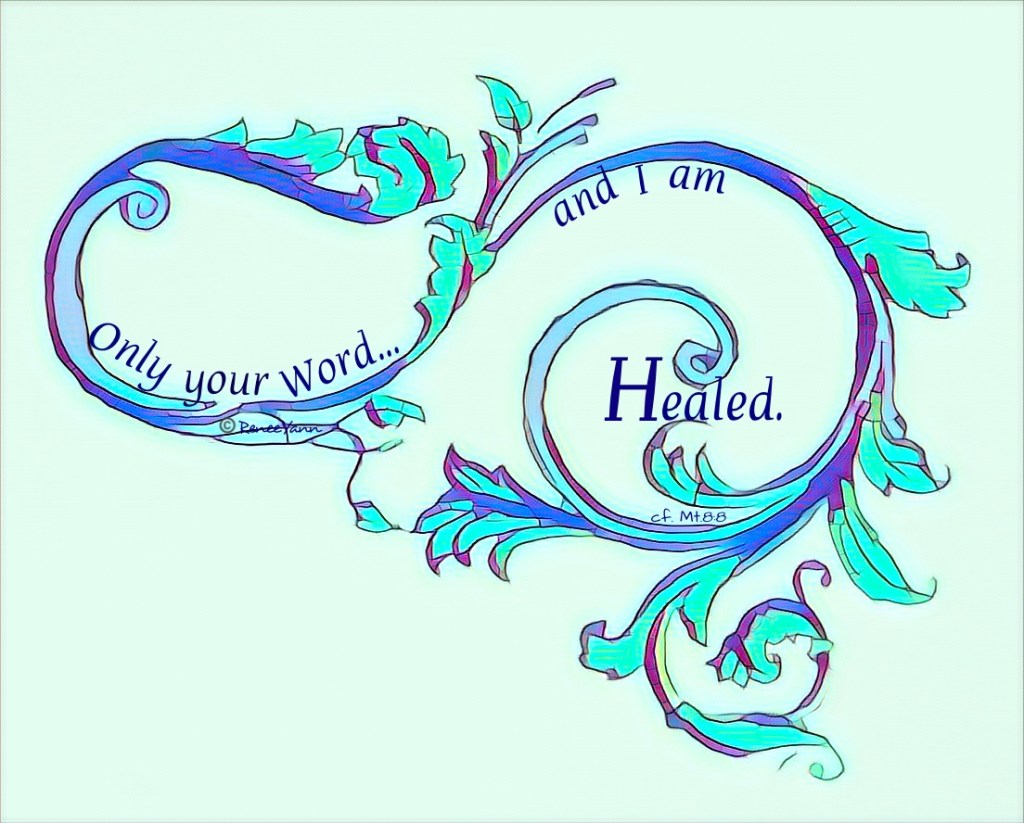
Poetry: I couldn’t come up with a written poem today, so I drew one:


Music: Healing – Peter Kater

On the Edge

Saturday of the Thirty-fourth Week in Ordinary Time
December 2, 2023

Today’s Readings:

https://bible.usccb.org/bible/readings/120223.cfm


Today, in God’s Lavish Mercy, we finally stand at the edge of the diving board before our plunge into the sublime days of Advent!


Daniel, at the end of a daunting passage, closes with this conviction that foreshadows the Messiah’s reign:

Then the kingship and dominion and majesty
of all the kingdoms under the heavens
shall be given to the holy people of the Most High,
Whose Kingdom shall be everlasting:
all dominions shall serve and obey him.

Daniel 7:27

In our Gospel, Jesus uses a tone similar to Daniel to encourage our vigilance:

Jesus said to his disciples:
“Beware that your hearts do not become drowsy
from carousing and drunkenness
and the anxieties of daily life,
and that day catch you by surprise like a trap.
For that day will assault everyone
who lives on the face of the earth.
Be vigilant at all times
and pray that you have the strength
to escape the tribulations that are imminent
and to stand before the Son of Man.”

Luke 21:34-36

I take these words as an imperative to engage the days of Advent for what they are supposed to be – a time of thoughtful, prayerful preparation to receive the gift and mystery of Christ in all its splendor.

The Gospel seems to suggest that we might become too tired for such prayer during all our frenetic Christmas preparations, or that we might break out the spiked egg nog a little too early. We are admonished to be alert, sober, and unanxious. We are advised to “Be vigilant” – that is, to light the heart’s candle and to wait patiently for God.


Poetry: Tug and Sigh – May Sarton, from “The Silence Now”

Like the datura’s yellow trumpets
I am waiting for the breath of angels
to perfume the twilight
of this ordinary day
and play the vigil hymn
reminding me
that heaven and earth
wed long ago.

I too am married
to the unseen
sigh and scent,
filling and returning,
thus never full –
always longing,
often failing,
yet ever blessed
with heaven’s pull.

Music: Silent Vigil – Tony O’Connor

Forgeries?

Wednesday of the Thirty-fourth Week in Ordinary Time
November 29. 2023

Today’s Readings:

https://bible.usccb.org/bible/readings/112923.cfm


Today, in God’s Lavish Mercy, we have a fascinating passage from the Book of Daniel, a masterpiece in apocalyptic literature. I enjoyed imagining the scene described by the author in which a magical hand appears to execute “the handwriting on the wall”.

As King Balshazzar and his thousand guests drank sacrilegiously from the sacred Temple chalices, this fabulous thing happened:

Suddenly, opposite the lampstand,
the fingers of a human hand appeared,
writing on the plaster of the wall in the king’s palace.
When the king saw the wrist and hand that wrote, his face blanched;
his thoughts terrified him, his hip joints shook,
and his knees knocked.

Daniel 5:5-6

The image is so wonderful that it has peppered our language and imagination for over two thousand years!

Belshazzar’s Feast – Rembrandt


Morris Bender, an American neuroscientist, offered this clever quip:

A skeptic is a person who, 
when he sees the handwriting on the wall, 
claims it is a forgery.

After a little chuckle, I realized how wise and accurate Bender is. How many times have I not only missed, but actively ignored, the handwriting on the wall! Our minds, hearts, and spirits continually give us signs to direct us in life. How well do we do at discerning these gifts.


The fruit of a deep spiritual life is to become more attentive to the suggestions of grace, and to respond to them with faith and courage. In our Gospel, Jesus makes it clear to his followers that this kind of faithful response will cost them much — possibly even their lives.

Jesus said to the crowd:
“They will seize and persecute you,
they will hand you over to the synagogues and to prisons,
and they will have you led before kings and governors
because of my name.

Luke 21:12

Still, Jesus tells them not to be afraid, that their lives are “secured” by their faith:

You will even be handed over by parents,
brothers, relatives, and friends,
and they will put some of you to death.
You will be hated by all because of my name,
but not a hair on your head will be destroyed.
By your perseverance you will secure your lives.

Luke 21:16-19

The Church uses the apocalyptic stories from Daniel and the dire warnings from Jesus to remind us that we do not live for this world alone. The fullness of eternal life awaits us after the completion of our earthly journey. We have to keep ourselves aware that our life is infinitely larger than it may appear to us in any given moment.

Faith, prayer, and the practice of interior silence can help us to live in that infinite largeness even though we have limited vision of it in this world. The coming days of Advent offer us a dedicated time to renew ourselves in these practices.


Poetry: from Rumi

O love,
O heart,
Find the way to heaven.
Set your sights on a place
Higher than your eyes can see.
For it was the higher aim
That brought you here
In the first place.
Now be silent.
Let the One who creates the words speak.
He made the door.
He made the lock.
He also made the key.
How many men have found tragic ends
Running after beauty?
Why don’t they look for you? -
The heart and spirit of all beauty.

Music: Secrets and Dreams – Fairborn Lachini

Breaking into Newness

Tuesday of the Thirty-fourth Week in Ordinary Time
November 28, 2023

Today’s Readings:

https://bible.usccb.org/bible/readings/112823.cfm


Today, in God’s Lavish Mercy, Daniel interprets a dream in which a statue spontaneously breaks apart, and Jesus warns that the beloved Temple will someday do the same thing. Our scriptures beg the question: how does one find strength to rebuild again?


We don’t like things to break apart that we hadn’t expected to break apart – even stupid things. I had a favorite old plastic mug that I loved to pack with ice and B.O.C. (beverage of choice) as I headed to the beach on a hot summer day. It was about a thousand years old but part of its famed origin was still visible on the faded side:

For some inexplicable reason, one morning I decided to pour my hot tea into that irreplaceable mug. It basically melted into itself like the wicked witch in the Wizard of Oz. It wasn’t a tragedy tantamount to Daniel’s dream or the Temple collapsing, but I’ll tell you, I have NEVER since had a matching drink on the beach!


My treasured mug disintegrated because I used it for the wrong purpose. And that is also the point of both our readings. Daniel describes how the ensuing generations, who misuse their power, will disappear one after the other until God establishes the permanent reign of justice:

… the kingdom shall be partly strong and partly fragile.
The iron mixed with clay tile
means that they shall seal their alliances by intermarriage,
but they shall not stay united, any more than iron mixes with clay.
In the lifetime of those kings
the God of heaven will set up a kingdom
that shall never be destroyed or delivered up to another people;
rather, it shall break in pieces all these kingdoms
and put an end to them, and it shall stand forever.

Daniel 2:42-44

Jesus describes the same dynamic in relationship to the Temple because its use has been diverted into material show and adornment rather than worship and the works of justice:

While some people were speaking about
how the temple was adorned with costly stones and votive offerings,
Jesus said, “All that you see here–
the days will come when there will not be left
a stone upon another stone that will not be thrown down.”

Luke 21:5

But, here’s the thing about God’s action to break up in our lives that which is no longer life-giving — the breakup will always yield new life if we can open our hearts to its grace.

As we look back over 2023, we may see a lot of disassembled pieces scattered across the landscape. Maybe some of the plans we had never flew, or maybe the string broke on some of the kites we’d been flying for years! There may have been small losses that seemed monumental at the time, or truly monumental losses whose significance has only deepened.

Wherever we stand amid our dreams and our temples, we can be sure of this as 2024 approaches: grace is always with us, renewing us in the ever clearer image of God.


This final week before Advent is a great time to take inventory of our spiritual lives. What needs to go and what needs to be strengthened? Most likely, we already know the answers. Now let’s gather the courage and focus to do what grace suggests.


Poem: Beginners – Denise Levertov

Levertov writes about hope, courage, justice, and mercy. The poem begins with a stanza from The Garden of Proserpine by Algernon Charles Swinburne, introduced by a dedication to activists Karen Silkwood and Eliot Gralia.

𝘋𝘦𝘥𝘪𝘤𝘢𝘵𝘦𝘥 𝘵𝘰 𝘵𝘩𝘦 𝘮𝘦𝘮𝘰𝘳𝘺 𝘰𝘧 𝘒𝘢𝘳𝘦𝘯 𝘚𝘪𝘭𝘬𝘸𝘰𝘰𝘥 𝘢𝘯𝘥 𝘌𝘭𝘪𝘰𝘵 𝘎𝘳𝘢𝘭𝘭𝘢

“From too much love of living,
Hope and desire set free,
Even the weariest river
Winds somewhere to the sea—“
– – – – – – –

But we have only begun
To love the earth.

We have only begun
To imagine the fullness of life.

How could we tire of hope?
— so much is in bud.

How can desire fail?
— we have only begun

to imagine justice and mercy,
only begun to envision

how it might be
to live as siblings with beast and flower,
not as oppressors.

Surely our river
cannot already be hastening
into the sea of nonbeing?

Surely it cannot
drag, in the silt,
all that is innocent?

Not yet, not yet—
there is too much broken
that must be mended,

too much hurt we have done to each other
that cannot yet be forgiven.

We have only begun to know
the power that is in us if we would join
our solitudes in the communion of struggle.

So much is unfolding that must
complete its gesture,

so much is in bud.

Music: Sacred River – Gandalf
As you experience this beautiful video, allow your spirit to remember the challenges and blessings of this past year that have brought you to this place with God, ready for a new beginning and a deeper love.

You are a Temple

Memorial of Saint Andrew Dung-Lac, Priest, and Companions, Martyrs
Friday of the Thirty-third Week in Ordinary Time
November 24, 2023

Today’s Readings:

https://bible.usccb.org/bible/readings/112423.cfm


Today, in God’s Lavish Mercy, both readings are set in the Temple. After the victory of Judas Maccabeus, the Jewish people restore their Temple with exuberant celebration, recognizing it as a symbol of God’s Presence among them. This is the origin of the celebration of Hanukkah, a word that means “dedication”.

For eight days they celebrated the dedication of the altar
and joyfully offered burnt offerings and sacrifices
of deliverance and praise.
They ornamented the facade of the temple with gold crowns and shields;
they repaired the gates and the priests’ chambers
and furnished them with doors.
There was great joy among the people
now that the disgrace of the Gentiles was removed.
Then Judas and his brothers and the entire congregation of Israel
decreed that the days of the dedication of the altar
should be observed with joy and gladness
on the anniversary every year for eight days,
from the twenty-fifth day of the month Chislev.

1 Maccabees 4: 56-59

In today’s Gospel. Jesus also “restores” the Temple by driving out the merchants who have diverted the Temple’s purpose as representative of God’s Presence.

Jesus entered the temple area and proceeded to drive out
those who were selling things, saying to them,
“It is written, My house shall be a house of prayer,
but you have made it a den of thieves.”

Luke 19:45-46

Our bodies too are temples of the Holy Spirit.
Paul, in his letter to the Corinthians tells us:

Do you not know
that your bodies are temples of the Holy Spirit,
who is in you, whom you have received from God?
You are not your own; you were bought at a price.

1 Corinthians 6:19-20

Through our Baptism into the Passion, Death and Resurrection of Christ, the Holy Spirit dwells in us. We are called to be transformed by this Indwelling. As in any relationship, this transformation is accomplished through transparency, communication, listening and acting on behalf of the Beloved.


Poetry: Heart Cave by Geoffrey Brown – a deeply spiritual poet, Brown offers us this imaginative image of waiting for, and welcoming, the transformative Presence of God in our lives:

I must remember to go down to the heart cave
And sweep it clean, make it warm, with fire on the hearth
And candles in their niches
The pictures on the walls glowing with quiet lights
I must remember to go down to the heart cave
And make the bed with the quilt from home
Strew rushes on the floor
And hang lavender and sage from the corners
I must remember to go down to the heart cave
And be there when you come.

Music:  J. S. Bach – Arioso from Cantata 156 – Susanne Beer on cello

If you have a little extra leisure on this Friday after Thanksgiving, you may enjoy the entire Cantata performed beautifully here by the Choir and Orchestra of the J. S. Bach Foundation

Stretching for God

Memorial of the Presentation of the Blessed Virgin Mary
Tuesday of the Thirty-third Week in Ordinary Time
November 21, 2023

Today’s Readings:

https://bible.usccb.org/bible/readings/112123.cfm


Today, in God’s Lavish Mercy, our readings are about living in the big picture of God’s vision for us.

Lk19_3 forest_trees

Once again, we meet Zacchaeus who, due to his short stature, was unable to get a glimpse of Jesus walking nearby. He wasn’t getting the whole picture but he wanted to!

Zacchaeus ran ahead and climbed a sycamore tree in order to see Jesus,
who was about to pass that way.
When he reached the place, Jesus looked up and said,
“Zacchaeus, come down quickly,
for today I must stay at your house.”
And he came down quickly and received him with joy.

Luke 19:4-5

Sometimes we miss Christ in our midst, don’t we? It may be because we’re “short” on time, patience, faith, attention, courage, peace, desire … you name it.

Zacchaeus may have been physically short, but he was tall in will and intention to see Jesus. The trees became his tools, not his obstacles.


In our first reading, Eleazar was a giant in the virtues necessary to “see beyond the trees” of his current circumstances. A more spiritually short-sighted person might have succumbed to the temptation to save himself at the cost of his faith and witness.

But Eleazar’s faith was long, both in years and in depth. He kept the eyes of his heart focused on that faith and was delivered beyond any short-sighted choices.

Eleazar made up his mind in a noble manner,
worthy of his years, the dignity of his advanced age,
the merited distinction of his gray hair,
and of the admirable life he had lived from childhood;
and so he declared that above all
he would be loyal to the holy laws given by God.

2 Maccabees 6:23

It’s hard sometimes to see the forest beyond the trees – to direct our choices, attitudes, and actions by a vision we glimpse only in the stretch of faith and prayer.

Perhaps these two God-seekers can inspire us today by their courage, steadfastness and faith to always live within God’s long eternal vision for us.


Zaccheus – by Richard Medrington

I hope you enjoy this clever poem as much as I did.

Here’s a man we all despise,
Damn his hide and damn his eyes.
Pray that God will some day free us,
From that loathsome leech Zacchaeus.
See him sitting at his table,
Takes as much tax as he’s able,
Stashes some away for later,
Dirty, double-dealing traitor.
Lord of liars, chief of crooks,
Look at how he cooks the books!
Renders what is ours to Caesar,
Cheating, money-grubbing geezer.
He’s the man we love to hate,
Vulgar, vapid reprobate,
Lounging in his lavish house,
Cringing toady, thieving louse.
Wonder how he got so rich?
Greedy, filching, little snitch.
We would lynch the poison gnome,
Were he not employed by Rome.
Then when Jesus comes to town,
See his smile turn to a frown!
Though he’s arrogant and proud,
He cannot see above the crowd.
How we laugh to see him squirm,
Nasty, creeping, crawling worm,
But here’s a thing not seen before:
A sell-out in a sycamore!
Now he’s shouting from the tree,
“Jesus, Jesus look at me!”
Hope he falls, the tiresome tyke,
Falls and lands upon a spike.
Careful Jesus. Don’t be conned,
Just ignore him, don’t respond.
Move on quickly, if you linger
He will twist you round his finger.
Then a voice rings loud and clear,
“Zack mate, get yourself down here!
I spy you in that sycamore,
And you’re the man I’m looking for.”
Now he’s off to have his dinner
With a man who is a sinner
And a traitor to our nation!
He’s gone down in our estimation.
Fraternising with our foe,
Of all the places he could go!
Who would think a man like that
Would take his meals with such a rat?
I beg your pardon, did you say
Zach’s giving half his wealth away?
Dispensing money to the poor?
This too has not been seen before.
And if he’s asked for too much tax
He’s giving fourfold rebates back?
Well, that’s amazing! If it’s true,
There’s going to be a massive queue.
I’m not that easy to deceive.
When I see it, I’ll believe.
He’ll fleece us when the Master’s gone,
It’s just another taxman’s con.
But Jesus says, “It is no scam,
He is a son of Abraham.
Salvation landed here today,
I seek for those who’ve gone astray,
And even though you think it strange,
Occasionally people change,
So do not look at him askance
But give the man a second chance.”
Of course at first this all seemed grand,
The thought of all that cash in hand!
But very soon we came to see
That nothing in this world is free.
In righteous wrath we had estranged him,
Then someone came along and changed him!
Thank you, Jesus. Smashing! Great!
Now there’s no one left to hate!
Since Zach is generous and kind
We’ve nothing left to hide behind.
He radiates with joy and thus
His kindly light exposes us.
His very presence seems to say,
“My life has changed from night to day.
Now tell me what is stopping you
From changing things in your life too?”
So here’s the source of our complaints:
Zacchaeus made us feel like saints,
But now we must admit it’s true
That we are rotten sinners too.
We pray that God will soon restore
Zacchaeus as he was before,
Or Jericho shall rue the day
That Jesus chose to pass this way.

Music: Zacchaeus – An oldie but goodie from Sister Miriam Therese Winter and the Medical Mission Sisters

Swooped into God!

Memorial of Saint Elizabeth of Hungary
Friday of the Thirty-second Week in Ordinary Time
November 17, 2023

Today’s Readings:

https://bible.usccb.org/bible/readings/111723.cfm


Today, in God’s Lavish Mercy, our two readings remind us that the journey into God is an ever-deepening passage to which we must continually open our hearts.

The Wisdom writer addresses those who sincerely seek God, but who cannot see beyond God’s handiwork. So they are satisfied to make gods of these created wonders:

All persons were by nature foolish who were in ignorance of God,
and who from the good things seen did not succeed in knowing him who is,
and from studying the works did not discern the artisan;
But either fire, or wind, or the swift air,
or the circuit of the stars, or the mighty water,
or the luminaries of heaven, the governors of the world, they considered gods.
Now if out of joy in their beauty they thought them gods,
let them know how far more excellent is the Lord than these;
for the original source of beauty fashioned them.

Wisdom 13:1-3

The writer seems astounded that these seekers get lost on their way to full knowledge of God:

For they search busily among his works,
but are distracted by what they see,
because the things seen are fair.
But again, not even these are pardonable.
For if they so far succeeded in knowledge
that they could speculate about the world,
how did they not more quickly find its Lord?

Wisdom 13: 7-9

I don’t find it so astounding. The invisible God we love and worship can be elusive, and the world through which we seek that God can be deeply distracting. I think it’s pretty easy to get stuck worshipping signs of God (which we can see) rather than God (Whom we cannot see). I think that’s what Jesus might have meant when he said, “Blessed are the pure of heart, for they shall see God.”


Our Gospel reading gives us a hint about truly seeking God. It’s a reading I have always found a little bit scary. As a child, I envisioned myself, or the dear person next to me, getting swooped up in some unexpected divine tornado. It wasn’t a comfortable image.

I tell you, on that night there will be two people in one bed;
one will be taken, the other left.
And there will be two women grinding meal together;
one will be taken, the other left.”
They said to him in reply, “Where, Lord?”
He said to them, “Where the body is,
there also the vultures will gather.”

Luke 17: 34-37

I mean, really, this is nobody’s favorite scripture passage! But what can it teach us? Maybe this: just like the unfulfilled worshippers in our Wisdom passage, the folks Jesus describes were distracted by the necessities and frivolities of life. In their spiritual journeys, they had not fully opened their hearts to the holy expectation of God. When God comes in a swoop of Infinite Grace, they’re just not ready for the swooping!


In our readings today, both the Wisdom writer and Jesus are encouraging us to meet every life experience as an opportunity to move deeper into the mystery of God.

The Wise One tells us to look beyond the beautiful distractions of our lives into the One Who ordains them:

Now if out of joy in their beauty they thought them gods,
let them know how far more excellent is the Lord than these;
for the original source of beauty fashioned them.

Wisdom 13:3

And Jesus very bluntly tells us that our visible experiences hold a deeper meaning that we will never know unless we yield our life fully to God’s transforming grace:

Whoever seeks to preserve their life will lose it,
but whoever loses it will save it.

Luke 17:33

Poetry: If only there were stillness, full, complete – Rainer Maria Rilke

If only there were stillness, full, complete.
If all the random and approximate
were muted, with neighbors’ laughter, for your sake,
and if the clamor that my senses make
did not confound the vigil I would keep —
Then in a thousandfold thought I could think
you out, even to your utmost brink,
and (while a smile endures) possess you, giving
you away, as though I were but giving thanks,
to all the living.

Music: Jessye Norman – Sanctus from Messe solennelle de Sainte Cécile in G major, by Charles Gounod

I never hear this piece without being awestruck by Ms. Norman’s magnificent voice. I had the great joy of meeting her and working with her briefly on a project over thirty years ago. She was majestic in every way. May she rest in Peace.

Grateful

Wednesday of the Thirty-second Week in Ordinary Time
November 15, 2023

Today’s Readings:

https://bible.usccb.org/bible/readings/111523.cfm


Today, in God’s Lavish Mercy, we pray with Psalm 82 considered, by at least one Biblical scholar, to be:

“.. the single most important text in the entire Christian Bible.”

John Dominic Crossan

Council of the Gods by Raphael

Psalm 82 best summarizes for me the character of (the early Biblical) God. 
It imagines a scene in which God sits among the gods and goddesses in divine council. 
Those pagan gods and goddesses are dethroned not just because they are pagan, 
nor because they are other, nor because they are competition. 
They are dethroned for injustice, for divine malpractice, for transcendental malfeasance. 
They are rejected because they do not demand and effect justice among the peoples of the earth. 
And that justice is spelled out as protecting the poor from the rich, 
protecting the systemically weak from the systemically powerful. 

Crossan: The Birth of Christianity

Rise up, O God, bring judgment to the earth.
Defend the lowly and the fatherless;
    render justice to the afflicted and the destitute.
Rescue the lowly and the poor;
    from the hand of the wicked deliver them.
Psalm 82: 3-4


Ten Lepers by James Christianson

To learn more about this enthralling painting, see:


In today’s Gospel, we encounter this just and supreme God in the person of Jesus when we witness the cure of the ten lepers.  

You know, it would be startling enough to run into one leper on your daily walk, right?  But TEN! That must have been an astounding situation. For Jesus’s followers, it must have been an overwhelming sight to meet those people – sad and disfigured by disease – and to watch them be restored to wholeness.

Can you imagine that the recipients of such a miracle wouldn’t have clung in gratitude to Jesus for the rest of their days??? But, wow, only one even bothered to say “Thank you”.

What might have kept the other nine away, locked in their blind ingratitude?


Perhaps it’s not such a mystery if we allow ourselves to examine our own often ungrateful hearts. We don’t necessarily mean to be boorish in the face of God’s kindness and the generosity of others, but we sometimes suffer from … (of course, I’m only speaking for myself here 🙂 )

  1. Distraction: our lives are filled with frenetic activity which causes our blessings to flit by us into dizzying forgetfulness
  2. Entitlement: we think we deserve or have earned those blessings
  3. Self-absorption: we are so wrapped up in ourselves that we don’t even notice that our whole life is a gift
  4. Laziness: we might say thanks if we get around to it. But we never get around to it.
  5. Unresolved anger: we’re mad that we even needed help
  6. Non-intentionality: we fail to live with intention and reflection, thus missing the opportunities for gratitude 
  7. Pride: we are too proud to acknowledge that we need anything
  8. Fear: we are afraid something will be required of us in return for the gift
  9. Spiritual blindness: we just don’t see the nurturing power of God and others in our life

It’s likely that our nine ungrateful lepers had these human frailties. But don’t be thinking about them, or your acquaintances who share their failings.  

Let’s think about ourselves and how we want to be more grateful. Let’s think about our omnipotent God who is always Justice and Mercy.

The story is a powerful wake-up call to do better than the poor lepers did by living this prayer:

May I live humbly and gratefully today.


Poetry: The Ten Lepers – by Rosanna Eleanor (Mullins) Leprohon who was both a poet and novelist. Born in Montreal in 1829, Rosanna Mullins was educated at the convent of the Congregation of Notre Dame.

’Neath the olives of Samaria, in far-famed Galilee,
Where dark green vines are mirrored in a placid silver sea,
’Mid scenes of tranquil beauty, glowing sun-sets, rosy dawn,
The Master and disciples to the city journeyed on.
And, as they neared a valley where a sheltered hamlet lay,
A strange, portentous wailing made them pause upon their way—
Voices fraught with anguish, telling of aching heart and brow,
Which kept moaning: “Jesus, Master, have mercy on us now!”
Softly raised the gentle Saviour His eyes like midnight star,
And His mournful gaze soon rested on ten lepers, who, afar,
Stood motionless and suppliant, in sackcloth rudely clothed,
Poor Pariahs! by their nearest, their dearest, shunned and loathed.
Not unto Him prayed vainly those sore afflicted ten,
No! He yearned too fondly over the erring sons of men,
Even sharing in their sorrows, though He joined not in their feasts,—
So He kindly told the Lepers: “Show yourselves unto the priests.”
When, miracle of mercy! as they turned them to obey,
And towards the Holy Temple quickly took their hopeful way,
Lo! the hideous scales fell off them, health’s fountains were unsealed,
Their skin grew soft as infant’s—their leprosy was healed.
O man! so oft an ingrate, to thy thankless nature true,
Thyself see in those Lepers, who did as thou dost do;
Nine went their way rejoicing, healed in body—glad in soul—
Nor once thought of returning thanks to Him who made them whole.
One only, a Samaritan, a stranger to God’s word,
Felt his joyous, panting bosom, with gratitude deep stirred,
And without delay he hastened, in the dust, at Jesus’ feet,
To cast himself in worship, in thanksgiving, warm and meet.
Slowly questioned him the Saviour, with majesty divine:—
“Ten were cleansed from their leprosy—where are the other nine?
Is there none but this one stranger—unlearned in Gods ways,
His name and mighty power, to give word of thanks or praise?”
The sunbeams’ quivering glories softly touched that God-like head,
The olives blooming round Him sweet shade and fragrance shed,
While o’er His sacred features a tender sadness stole:
“Rise, go thy way,” He murmured, “thy faith hath made thee whole!”

Music:  Hymn of Grateful Praise – Folliott S. Pierpoint

The Inscrutable Plan

Monday of the Thirty-first Week in Ordinary Time
November 6, 2023

Today’s Readings:

https://bible.usccb.org/bible/readings/110623.cfm


Today, in God’s Lavish Mercy, to understand our first reading from Romans, we have to put ourselves back in time to sit beside Paul as he writes.

Paul was a devout Jew. Remember how, before his conversion, he felt called to persecute Jews who had become Christians? Now here he is writing and preaching the Christian message himself. Still he believes in his deepest heart that God has a particular affection for the Jews and wills their salvation. So Paul tries to explain how this will happen.

The explanation can sort of leave your head spinning. But essentially, Paul believes that salvation will be accomplished when all people, Gentile and Jew, repent from whatever is their unfaithfulness and receive God’s Mercy – that from all eternity, God’s “inscrutable” plan was to redeem us all, not just Israel. Paul still seems a little amazed by this revelation and tries to pound it home to his listeners:

Just as you once disobeyed God 
but have now received mercy
because of their disobedience,
so they have now disobeyed in order that,
by virtue of the mercy shown to you,
they too may now receive mercy.
For God delivered all to disobedience,
that he might have mercy upon all.

Romans 11:30-32

Paul’s apologia meant more to the listeners of his time than it probably does to us. But it is in the final verses of the passage that Paul captures an eternal truth that rings as true today as it did in early Christian times:

Oh, the depth of the riches and wisdom and knowledge of God!
How inscrutable are his judgments and how unsearchable his ways!

For who has known the mind of the Lord
or who has been his counselor?
Or who has given him anything
that he may be repaid?

For from him and through him and for him are all things.
To God be glory forever. Amen.

Romans 11: 33-36

These magnificent lines remind all of us – Jew or Gentile, ancient or contemporary believer – that God is accomplishing the work of salvation in a depth of love beyond our understanding. Perhaps we spend moments of our lives wondering “why God lets things happen”, or “why God doesn’t intervene”.

Paul says we cannot answer those questions. God’s ways are infinitely beyond us, but nevertheless faithful and abiding. In our fidelity and hope, we see the unsearchable ways of God slowly unfold, moment by moment, in our lives and in our world.


The young, fiery Paul we first meet in Acts never expected his faith to be fulfilled outside the borders of Judaism. But our expectations and God’s inscrutable plan rarely align. That’s the wonder and mystery of the spiritual life! God will always surprise us, just as God surprised the deeply Judaic Paul into Christianity, even to the role of “Apostle to the Gentiles”!


I bet almost every one of us finds ourselves trying to “become holy” in a way we had not at first imagined. The challenges, opportunities, choices, responsibilities, and obstructions life presents take us down roads we did not envision. When Paul was thrown from his horse on the way to Damascus, his whole life plan was overthrown with him. And from that tailspin, the path to True Life opened up before him.

I’m going to spend some time in prayer thinking about my own life summersaults and how God has used them to lead me according to that “inscrutable plan”. Maybe you’d want to do the same.


Poetry: Light Shining Out of Darkness – William Cowper (1731-1800)

God moves in a mysterious way
His wonders to perform;
He plants His footsteps in the sea
And rides upon the storm.

Deep in unfathomable mines
Of never failing skill
He treasures up His bright designs
And works His sov’reign will.
Ye fearful saints, fresh courage take;
The clouds ye so much dread
Are big with mercy and shall break
In blessings on your head.
Judge not the Lord by feeble sense,
But trust Him for His grace;
Behind a frowning providence
He hides a smiling face.

His purposes will ripen fast,
Unfolding every hour;
The bud may have a bitter taste,
But sweet will be the flow’r.

Blind unbelief is sure to err
And scan His work in vain;
God is His own interpreter,
And He will make it plain.


Music: Who Has Known – John Foley, SJ

Oh, the depth of the riches of God
And the breadth of the wisdom and knowledge of God
For who has known the mind of God
To Him be glory forever

A virgin will carry a child and give birth
And His name shall be called Emmanuel
For who has known the mind of God
To Him be glory forever

The people in darkness have seen a great light
For a child has been born, His dominion is wide
For who has known the mind of God
To Him be glory forever