The Invitation

Memorial of Saint Elizabeth Ann Seton, Religious
January 4, 2023

Today’s Readings:

https://bible.usccb.org/bible/readings/010423.cfm

Today, in God’s Lavish Mercy, we celebrate the Feast of St. Elizabeth Anne Seton, the first American born saint.

Elizabeth Seton was born on August 28, 1774, of a wealthy and distinguished Episcopalian family. She was baptized in the Episcopal faith and was a faithful adherent of the Episcopal Church until her conversion to Catholicism.

She established her first Catholic school in Baltimore in 1808; in 1809, she established a religious community in Emmitsburg, Maryland. After seeing the expansion of her small community of teaching sisters to New York and as far as St. Loius, she died on January 4, 1821, and was declared a saint by Pope Paul VI on September 14, 1975. She is the first native born American to be canonized a saint.

(from CatholicCulture.org)


Jn 1_39

In our Gospel, we find the first disciples encountering Jesus. They are curious about him because the Baptist has just described him as “the Lamb of God”.

The two disciples heard what he said and followed Jesus.
Jesus turned and saw them following him and said to them,
“What are you looking for?”
They said to him, “Rabbi” (which translated means Teacher),
“where are you staying?”
He said to them, “Come, and you will see.”
So they went and saw where he was staying,
and they stayed with him that day.
It was about four in the afternoon.
Andrew, the brother of Simon Peter,
was one of the two who heard John and followed Jesus.

John 1: 37-40

We can picture Andrew and his unnamed buddy trailing behind Jesus, watching him, listening to him. Finally they hazard a question, “Rabbi, where do you live?”

It’s kind of a loaded question. What it might really mean are things like these:

  • Where did you come from all of sudden?
  • How could you possibly be the Messiah if you’re walking around looking just like us?
  • Do you go back to heaven at night or are you really one of us?
  • Can we just hang out and find out more about you?

Their faith is tentative, hopeful and maybe just a little bit suspicious. Does your faith ever feel like that? 


When we pray, are we convinced that God hears us? When we suffer, do we believe God abides with us? When we choose, act or respond, do we trust that God cares about our actions? Do we believe, in these and all circumstances, that the power of God is present in our lives?

To have that kind of faith, we have to “learn” Christ, to become as close and comfortable with him as with an intimate friend. In our Gospel, Jesus tells us how to do that: “Come and see.” 

In other words:

Spend time with me.
Talk with me about ordinary things.
Watch sunsets and sunrises with me.
Tell me your secrets.
Let me tell you mine.
Laugh with me.
Be silent with me.
Trust that you are never separate from me.

If we do these things, even slowly and steadily as the first disciples, we will eventually say with Andrew, “l have found the Messiah” – and he is living right within my life!


Poetry: the calling of the disciples – Lucille Clifton

some Jesus
has come on me

i throw down my nets
into the water he walks

i loose the fish
he feeds to cities

and everyone calls me
an old name

as i follow out
laughing like God’s fool
behind this Jesus

Music: Come and See – Bob Bennett
Life’s Curriculum of Faith

Memorial of Saints Basil the Great and Gregory Nazianzen,
Bishops and Doctors of the Church
January 2, 2023

Today’s Readings:

https://bible.usccb.org/bible/readings/memorial-saints-basil-great-and-gregory-nazianzen-bishops-and-doctors-church

1Jn2_24 beginning

Today, in God’s Lavish Mercy, we continue to relish John’s eloquent first letter in which he heartily instructs us in the life of Christian love and fidelity.

Let what you heard from the beginning remain in you. 
If what you heard from the beginning remains in you,
then you will remain in the Son and in the Father. 
And this is the promise that he made us: eternal life. 

1 John 2:24-26

John has written this letter out of concern about false teachings that are cropping up in the early Church. Misguided “prophets” are placing distorted interpretations on the pure, original message of the Gospel.

Human beings have never stopped doing that, have we? Down through the centuries, how many heresies and misinterpretations have tried to weave their confusion into the Gospel’s central, inviolable thread? How many charlatans, purposefully or ignorantly, have confused people with their bogus religious interpretations.

Has it happened to our own faith? Have we lost the crisp, clear power of our foundational belief? Have we been hijacked into a “faith” or religious practice that ultimately contradicts the Gospel?

It can happen easily in a society where truth is manipulated for purposes of politics, power, and economics. How can we work to avoid it?


John tells us to hold fast to the core teaching of the Gospel.

As for you,
the anointing that you received from him remains in you,
so that you do not need anyone to teach you. 
But his anointing teaches you about everything and is true and not false; 
just as it taught you, remain in him.

1 John 2: 27

This is the faith that many of us learned as children from devout parents and teachers. It is a faith that continues to evolve through scriptural prayer and meditation, through openness to theological wisdom, through the holy dialogue of the beloved community.

It is a living faith, stretched and tested by our daily choices for true Christian love for all people, especially the poor, sick and marginalized.

Ultimately, it is a faith rooted in the Cross and transformed by the Resurrection.

Over these next few weeks, let us listen carefully to John as he guides us to the depth of this faith.


Poetry: A Thanksgiving – St. John Henry Newman

The faith-journey of John Henry Newman has always inspired me. Born in 1801, he was an English theologian, academic, intellectual, philosopher, polymath, historian, writer, scholar and poet, first as an Anglican priest and later as a Catholic priest and cardinal. He was an important and controversial figure in the religious history of England in the 19th century. St. John Henry Newman was canonized as a saint in the Catholic Church in 2019.

As a young nun, when I thought faith was largely an intellectual pursuit, I was caught up in his Apologia Pro Vita Sua (Latin: A defense of one’s own life). The essay is a defense of his religious opinions, published in 1864 in response to Charles Kingsley of the Church of England after Newman quit his position as the Anglican vicar of St. Mary’s, Oxford.

Newman also wrote poetry. “A Thanksgiving” traces the unfolding gift and struggle of Newman’s faith journey.

Lord, in this dust Thy sovereign voice
First quicken’d love divine;
I am all Thine, Thy care and choice,
My very praise is Thine.

I praise Thee, while Thy providence
In childhood frail I trace,
For blessings given, ere dawning sense
Could seek or scan Thy grace;

Blessings in boyhood’s marvelling hour,
Bright dreams, and fancyings strange;
Blessings, when reason’s awful power
Gave thought a bolder range;

Blessings of friends, which to my door
Unask’d, unhoped, have come;
And, choicer still, a countless store
Of eager smiles at home.

Yet, Lord, in memory’s fondest place
I shrine those seasons sad,
When, looking up, I saw Thy face
In kind austereness clad.

I would not miss one sigh or tear,
Heart-pang, or throbbing brow;
Sweet was the chastisement severe,
And sweet its memory now.

Yes! let the fragrant scars abide,
Love-tokens in Thy stead,
Faint shadows of the spear-pierced side
And thorn-encompass’d head.

And such Thy tender force be still,
When self would swerve or stray,
Shaping to truth the froward will
Along Thy narrow way.

Deny me wealth; far, far remove
The lure of power or name;
Hope thrives in straits, in weakness love,
And faith in this world’s shame.

Music: some gentle meditation music for your prayer with John:

Herb Ernst – Song of the Inner Child

Sweet Child, forgive us …

Feast of the Holy Innocents, martyrs
December 28, 2022

Today’s Readings:

https://bible.usccb.org/bible/readings/122822.cfm

Jer 31_15 Ramah

Today, in God’s Lavish Mercy, we are lifted to Light by John’s sacred words in our first reading:

Beloved:
This is the message that we have heard from Jesus Christ
and proclaim to you:
God is light, and in God there is no darkness at all.

1 John 1:5

Simply hearing it, we long to abide in that whole and healing Light.


But then we read our Gospel, among the saddest accounts in all of Scripture – the slaughter of the Holy Innocents. Their needless deaths come at the hands of a power-crazed and fearful man.  So hungry for his own aggrandizement, he tries to assure it by killing a generation of children.

It sounds impossible, doesn’t it, that anyone could be so hardened by evil? It sounds impossible that good people would execute this order of a mad man! It sounds impossible that human beings could be so blind to the sanctity of another’s life!

When Herod realized that he had been deceived by the magi,
he became furious.
He ordered the massacre of all the boys in Bethlehem and its vicinity
two years old and under,
in accordance with the time he had ascertained from the magi.
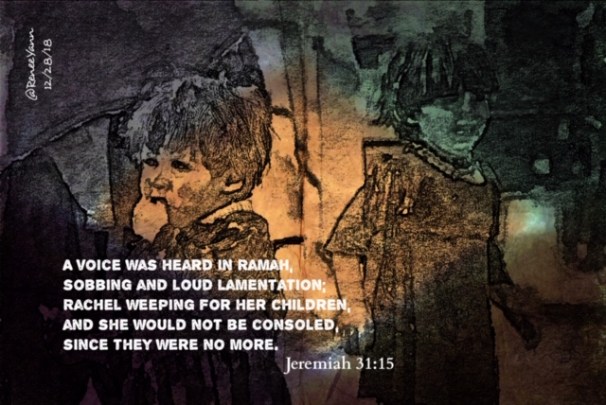
Then was fulfilled what had been said through Jeremiah the prophet:
A voice was heard in Ramah,
    sobbing and loud lamentation;
Rachel weeping for her children,
    and she would not be consoled,
    since they were no more.

Dear friends, we must confront our own blindness. We must look into the eyes of our 21st century children – the border children, the children of Ukraine, Russia, Sudan, Haiti, … the children of war, violence, drugs and poverty. We must hear the last cries of the children we fail to protect by adequate gun laws – the children of Columbine, Uvalde, Sandy Hook and on and on….

We must hear the cry of God, their Mother, and choose legislators and leaders who will honor life; who will shape global policies and relationships recognizing the common life we share in God – who will make true pro-life choices regarding gun control, arms sales, and an economy of endless war.

Our attitudes, our advocacy and our votes will either condemn or exonerate us when that Great Light ultimately reveals our hearts. When a society’s children become the victims of its indefensible corruption, we must say “Enough!”


Poetry: Holy Innocents – Christina Rossetti

Sleep, little Baby, sleep;
The holy Angels love thee,
And guard thy bed, and keep
A blessed watch above thee.
No spirit can come near
Nor evil beast to harm thee:
Sleep, Sweet, devoid of fear
Where nothing need alarm thee.

The Love which doth not sleep,
The eternal Arms surround thee:
The Shepherd of the sheep
In perfect love hath found thee.
Sleep through the holy night,
Christ-kept from snare and sorrow,
Until thou wake to light
And love and warmth to-morrow.

Music: A Coventry Carol – sung by Anúna

The “Coventry Carol” is an English Christmas carol dating from the 16th century. The carol was traditionally performed in Coventry in England as part of a mystery play called The Pageant of the Shearmen and Tailors. The play depicts the Christmas story from chapter two in the Gospel of Matthew: the carol itself refers to the Massacre of the Innocents, in which Herod ordered all male infants under the age of two in Bethlehem to be killed, and takes the form of a lullaby sung by mothers of the doomed children. (Lyrics below)

Lullay, thou little tiny child
Sleep well, lully, lullay
And smile in dreaming, little one
Sleep well, lully, lullay
Oh sisters two, what may we do
To preserve on this day
This poor youngling for whom we sing
Sleep well, lully, lullay
Farewell, lully, lullay
Herod the king in his raging
Set forth upon this day
By his decree, no life spare thee
All children young to slay
Then woe is me, poor child, for thee
And ever mourn and say
For thy parting, neither say nor sing
Farewell, lully, lullay
And when the stars fill darkened skies
In their far venture, stay
And smile as dreaming, little one
Farewell, lully, lullay
Dream now, lully, lullay

First and Lasting Faith

Feast of Saint John, Apostle and evangelist
December 27, 2022

Today’s Readings:

https://bible.usccb.org/bible/readings/122722.cfm

1Jun1_3 seenJPG

Today, in God’s Lavish Mercy, and for the next two weeks, our first readings take us into the beautiful mind and heart of John the Apostle, whose feast we celebrate today.

John, as I have met him in his Gospel and Letters, is a lover and a poet. He is, at the same time, a precise and exquisite engineer of thought and insight.

Often, a single word or phrase of John’s writing captures more than our minds can hold. Thus, praying with his writings should be a slow savoring, morsel by morsel, of Eternal Light captured for us in an elegant word.

Let these phrases rest with you in prayer today:
“What was from the beginning
Jesus, Uncreated, pre-existent Word of God

what we have heard, …
Whose voice John heard

what we have seen with our eyes, …
Whose acts of love John witnessed

what we looked upon …
Whose crucified body John held

and touched with our hands …
Whose wounds he wept over

concerns the Word of life
…this Jesus is John’s whole life.

And John proclaims this treasure to us today so that our joy may be complete — so that we, too, might find our whole and eternal life in this Beloved Word of God.


In our Gospel, John remembers the moment when he “saw and believed”. It was at the first Easter morning when he was very young. As he writes today’s epistle, John is very old. Thousands of acts of faith have spread across his long life like so many sunrises. But he still remembers that first amazed belief at an empty tomb.

Peter and the other disciple went out and came to the tomb.
They both ran, but the other disciple ran faster than Peter
and arrived at the tomb first;
he bent down and saw the burial cloths there, but did not go in.
When Simon Peter arrived after him,
he went into the tomb and saw the burial cloths there,
and the cloth that had covered his head,
not with the burial cloths but rolled up in a separate place.
Then the other disciple also went in,
the one who had arrived at the tomb first,
and he saw and believed.

John 20:3-8

Do you remember your first faith?
Do you cherish its many dawns over your life?
It might be good to pray with John about these things today.


Poetry: ” …That Passeth All Understanding” by Denise Levertov

An awe so quiet
I don’t know when it began.
A gratitude
has begun
to sing in me.
Was there
some moment
dividing
song from no song?
When does dewfall begin?
When does night
fold its arms over our hearts
to cherish them?
When is daybreak?

Music: When I First Believed ~ Mitch Langley

A Dozen Days

Memorial of Saint Lucy, Virgin and Martyr
Monday of the Third Week of Lent

Today’s Readings:

https://bible.usccb.org/bible/readings/121322.cfm

Today, in God’s Lavish Mercy, we feel the Church moving ever closer to the miracle of Christmas. The prophet Zephaniah, not quite as lyrically as Isaiah, paints a picture of who is ready for that miracle – because it is a fact: some will be able to receive it, and some will not.

Thus says the LORD:
Woe to the city, rebellious and polluted,
to the tyrannical city!
She hears no voice,
accepts no correction;
In the LORD she has not trusted,
to her God she has not drawn near.

Zephaniah 3:1-2

But the prophet also makes clear that there will be a “remnant people” in whose hearts the miracle will take life:

I will leave as a remnant in your midst
a people humble and lowly,
Who shall take refuge in the name of the LORD:
the remnant of Israel.
They shall do no wrong
and speak no lies;
Nor shall there be found in their mouths
a deceitful tongue;
They shall pasture and couch their flocks
with none to disturb them..

Zephaniah 3:12-13

As Jesus told the chief priests and elders in our Gospel:

“Amen, I say to you,
tax collectors and prostitutes
are entering the Kingdom of God before you. 
When John came to you in the way of righteousness,
you did not believe him;
but tax collectors and prostitutes did. 
Yet even when you saw that,
you did not later change your minds and believe him.”

Matthew 21: 31-32

Our readings today reiterate a truth that threads through all of scripture: the “Kingdom” is composed of the least likely in the world’s eyes. Wealth, power, influence, or appearances don’t cut it. Faith and dependence on God define the “remnant” who are God’s people.

I don’t think there are a lot of tax collectors among my readers, and probably not too many prostitutes either. 🙂 So who are we when we take a good look at ourselves? Are we our power, money or upper hand in the world? Or are we faithful souls who try to keep our hearts open to the Divine call to love God and our neighbor?

The more we try to be the latter, the more we will comprehend the Miracle we celebrate just twelve days from now.


Prose: Advent Credo – Allan Boesak (from Walking Among Thorns)

It is not true that creation and the human family are doomed to destruction and loss—
This is true: For God so loved the world that He gave his only begotten Son,
that whoever believes in Him shall not perish but have everlasting life;
It is not true that we must accept inhumanity and discrimination, 
hunger and poverty, death and destruction—
This is true: I have come that they may have life, and that abundantly.
It is not true that violence and hatred should have the last word, 
and that war and destruction rule forever—
This is true: Unto us a child is born, unto us a Son is given,
and the government shall be upon his shoulder,
his name shall be called wonderful councilor, mighty God,
the Everlasting, the Prince of peace.
It is not true that we are simply victims of the powers of evil 
who seek to rule the world—
This is true: To me is given authority in heaven and on earth,
and lo I am with you, even until the end of the world.
It is not true that we have to wait for those who are specially gifted, 
who are the prophets of the Church before we can be peacemakers—
This is true: I will pour out my spirit on all flesh
and your sons and daughters shall prophesy,
your young men shall see visions and your old men shall have dreams.
It is not true that our hopes for liberation of humankind, of justice, 
of human dignity of peace are not meant for this earth and for this history—
This is true: The hour comes, and it is now,
that the true worshipers shall worship God in spirit and in truth.
So let us enter Advent in hope, even hope against hope. 
Let us see visions of love and peace and justice.
 Let us affirm with humility, with joy, with faith, with courage: 
Jesus Christ—the life of the world.

Music: Just after today’s passage from Zephaniah, the prophet preaches in a more reassuring tone in verse 17. I thought you might like to pray with it.

Am I not here, I who am your mother?

(The above words were spoken to Juan Diego)
Feast of Our Lady of Guadalupe
December 12, 2022

Today’s Readings:

https://bible.usccb.org/bible/readings/121222.cfm

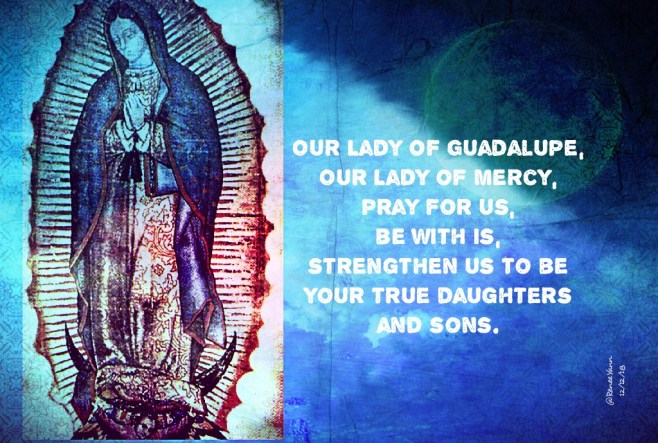
Today, in God’s Lavish Mercy, we celebrate the Feast of Our Lady of Guadalupe, commemorating the apparitions of Mary to the Mexican peasant Juan Diego in 1531. 

OLofGuadalupeJPG

It is also on this date, 300 years later, that Catherine McAuley founded the Sisters of Mercy in Dublin, Ireland. 

With a joyous faith like that expressed in our first reading, both Mary and Catherine found their joy in total commitment to God’s will and presence in their lives. May they inspire and help  to make God the center of our lives. May that discovery fill us with joy.

Sing and rejoice, O daughter Zion! 
See, I am coming to dwell among you, says the LORD.
Many nations shall join themselves to the LORD on that day,
and they shall be his people,
and he will dwell among you,
and you shall know that the LORD of hosts has sent me to you.

Zechariah 2:14

Perhaps  by increasing our spiritual simplicity, trust and humility like Juan Diego, we can grow closer to Mary and to her Son.

Today’s beautiful readings can lead us closer into Mary’s arms.  Zechariah, even without knowing her, named Mary the Holy Dwelling from whom Christ would come forth. Revelation captures multiple images from the Hebrew scriptures, fashioning a glorious picture of Mary’s significance in salvation history.

A great sign appeared in the sky, a woman clothed with the sun,
with the moon under her feet,
and on her head a crown of twelve stars.

Revelation 11:19

And our treasured passage from Luke — can we not read it like a beloved family story that gives us roots and wings?

The angel Gabriel was sent from God
to a town of Galilee called Nazareth,
to a virgin betrothed to a man named Joseph,
of the house of David,
and the virgin’s name was Mary.

Luke 1:26

Mary is not so far away from us.  She chose to enter Juan Diego’s life, looking like a queen he would recognize in his own culture. She has chosen to do the same thing in many other struggling cultures. 

How is Mary present to us today? How was she present to Catherine McAuley? Maybe as a homeless woman? An immigrant mother? An incarcerated young woman/? A sickly neighbor? An annoying, lonely grandmother?

What language is Mary speaking to us? Through what image is she reaching out to touch our hearts and lead us to her Son?


Poetry: The Messenger – Thomas Merton

There is some sentry at the rim of winter
Fed with the speech the wind makes
In the grand belfries of the sleepless timber.
He understands the lasting strife of tears,
And the way the world is strung;
He waits to warn all life with the tongue of March's
bugle,
Of the coming of the warrior sun.
When spring has garrisoned up her army of water,
A million grasses leave their tents, and stand in rows
To see their invincible brother.
Mending the winter's ruins with their laughter,
The flowers go out to their undestructive wars.
Walk in the woods and be witnesses,
You, the best of these poor children.
When Gabriel hit the bright shore of the world,
Yours were the eyes saw some
Star-sandalled stranger walk like lightning down the
air,
The morning the Mother of God
Loved and dreaded the message of an angel.

Music: Tota Pulchra Es Maria – Latin words and translation below. This lovely hymn reflects our responsorial psalm for today.

Tota pulchra es, Maria,
et macula originalis non est in te.
Vestimentum tuum candidum quasi nix, et facies tua sicut sol.
Tota pulchra es, Maria,
et macula originalis non est in te.
Tu gloria Jerusalem, tu laetitia Israel, tu honorificentia populi nostri.
Tota pulchra es, Maria.

You are all beautiful, Mary,
and the original stain [of sin] is not in you.
Your clothing is white as snow, and your face is like the sun.
You are all beautiful, Mary,
and the original stain [of sin] is not in you.
You are the glory of Jerusalem, you are the joy of Israel, you give honour to our people.
You are all beautiful, Mary.

The Holy Way

Monday of the Second Week of Advent
December 5, 2022

Today’s Readings:

https://bible.usccb.org/bible/readings/120522.cfm

Today, in God’s Lavish Mercy, Isaiah describes a beautiful hike through a desert turned verdant and lush. Usually that’s not the way we picture a desert, but the phenomenon is real.


A desert bloom is a climatic phenomenon that occurs in various deserts around the world. The phenomenon consists of the blossoming of a wide variety of flowers during early-mid spring in years when rainfall is unusually high. The blossoming occurs when the unusual level of rainfall reaches seeds and bulbs that have been in a latent or dormant state, and causes them to germinate and flower in early spring. It is accompanied by the proliferation of insects, birds and small species of lizards. (Wikipedia)

Bloom in Chilean Desert – photo by Javier Rubilar

Isaiah preached during tough times — real “desert” times for Israel. He uses the image of the luxuriant desert bloom to encourage his listeners that, despite their dire circumstances (the Assyrian occupation followed by the Babylonian captivity), there is hope.

But it is hard to hope and believe when you haven’t yet seen the flowers, right? Some of Isaiah’s audience may have seemed a little “weak kneed” about launching out on the journey when the horizon still looked pretty dry and lifeless.


    Strengthen the hands that are feeble,
        make firm the knees that are weak,
    Say to those whose hearts are frightened:
        Be strong, fear not!
    Here is your God,
        Who comes with vindication;
    With divine recompense
        God comes to save you.

Isaiah 35:3-4

I know I’ve felt weak-kneed at times, both literally and figuratively — those times when we are afraid to walk, to step forward or back, to move around or toward what we should. I’ll bet some of you have felt that way too.

At those times, we’re a little bit like the paralyzed man in today’s Gospel. We need courage, the help of good friends, and faith in God in order to stand up and walk on our own. Jesus wants to help us just like he helped this young man.

That you may know
that the Son of Man has authority on earth to forgive sins”–
Jesus said to the one who was paralyzed,
“I say to you, rise, pick up your stretcher, and go home.” 

He stood up immediately before them,
picked up what he had been lying on,
and went home, glorifying God. 

Luke 5:24-25

Advent invites us to journey
into deep faith and spiritual freedom,
to trust the desert for its flowers,
to believe that God lovingly wills
our vigor and wholeness.
 

The LORD himself will give his benefits;
    our land shall yield its increase.
Justice shall walk before him,
    and salvation, along the way of his steps.

Today’s Psalm 85: 13-14

Poetry: I Walked in a Desert – Stephen Crane

I walked in a desert.
And I cried,
“Ah, God, take me from this place!”
A voice said, “It is no desert.”
I cried, “Well, But —
The sand, the heat, the vacant horizon.”
A voice said, “It is no desert.”

Music: Desert Flower – Biljana Obradovic Bixy

Both Felt and Yet Awaited …

Second Sunday of Advent
December 4, 2022

Today’s Readings:

https://bible.usccb.org/bible/readings/120422.cfm

Today, in God’s Lavish Mercy, Isaiah paints the vision of Shalom.

“Shalom” is a Hebrew word commonly translated to English as “peace”.

In Hebrew, words are built on “roots”, generally of three consonants. When the root consonants appear with various vowels and additional letters, a variety of words, often with some relation in meaning, can be formed from a single root. Thus from the root sh-l-m come the words shalom (“peace, well-being”), hishtalem (“it was worth it”), shulam (“was paid for”), meshulam (“paid for in advance”), mushlam (“perfect”), and shalem (“whole”).


Our passage from Isaiah indicates an even deeper concept of shalom – one in which there is such right-balance among all creatures that:


When I first get up each morning, I glance through the news on my iPad while my tea is steeping. It’s a bad habit that I have trouble resisting because I want to make sure the world is all in one piece before I really start my day.

And, you know what? It never is. It’s a mess – with people shot, carjacked and bombed; with puppies abandoned, idiots in government, and tornadoes all over the place. There is little or no peace typed across the top of CNN.


The morning news is never going to blast the headline:
A shoot has sprung from the Jesse’s root! 
God’s spirit rests on him!

See, here’s the thing. This “Jesse news” is what we are meant to set our mornings by, to set our lives by – because we are people of faith, and we have been taught the true meaning of “shalom”. Shalom is something that will never be found in our “apparent” world. Shalom is only to be found within each of us who live the promise of Isaiah fulfilled in Jesus.


Advent is about pondering how to live “shalom” in an often corrupt world. It is a time to ask ourselves if we really believe the Promise to which Advent points:

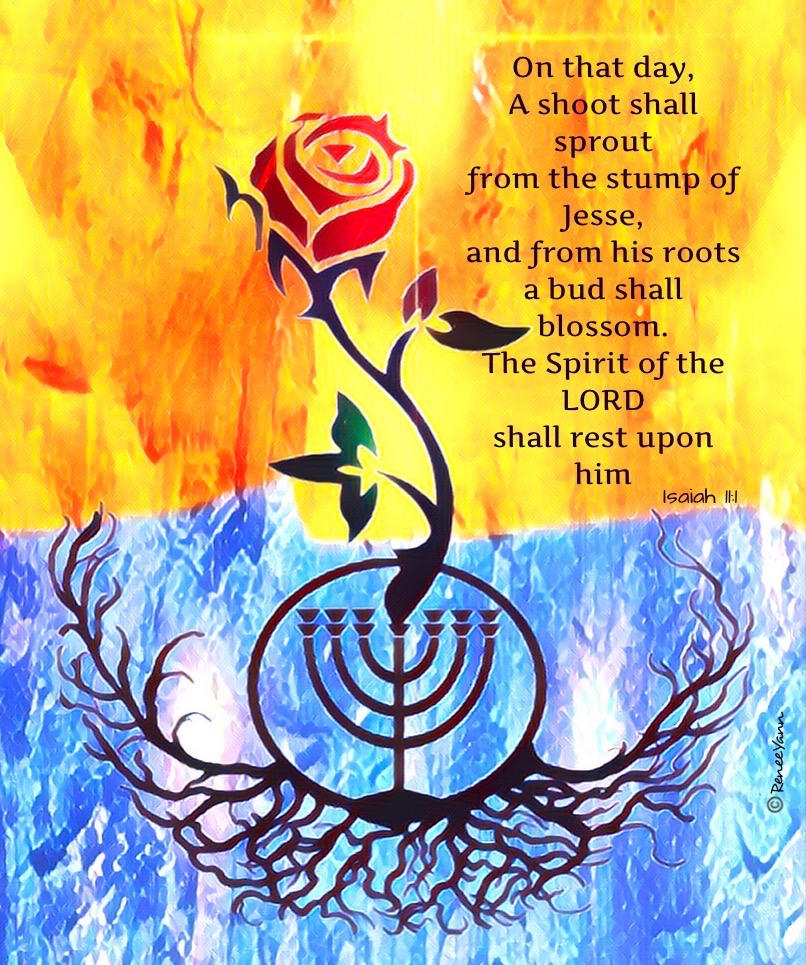
On that day, a shoot shall sprout from the stump of Jesse,
and from his roots a bud shall blossom.
The spirit of the LORD shall rest upon him:
a spirit of wisdom and of understanding,
a spirit of counsel and of strength,
a spirit of knowledge and of fear of the LORD,
and his delight shall be the fear of the LORD.
Not by appearance shall he judge,
nor by hearsay shall he decide,
but he shall judge the poor with justice,
and decide aright for the land’s afflicted.

Isaiah 11:1-4

While acknowledging the often leaden toxicity of our culture, our redeemed hearts will not be caught in it. We will live by and in the Promised Light because we understand that Isaiah’s “Day” started this morning when we decided to pray. We will live in the beautiful world that both has felt and yet awaits the touch of an Incarnate God.


Poetry: A World of Light – Elizabeth Jennings

Yes when the dark withdrew I suffered light
And saw the candles heave beneath the wax,
I watched the shadow of my old self dwindle
As softly on my recollection stole
A mood the senses could not touch or damage,
A sense of peace beyond the breathing word.
Day dawdled at my elbow. It was night
Within. I saw my hands, their soft dark backs
Keeping me from the noise outside. The candle
Seemed snuffed into a deep and silent pool:
It drew no shadow round my constant image
For in a dazzling dark my spirit stirred.
But still I questioned it. My inward sight
Still knew the senses and the senses' tracks,
I felt my flesh and clothes, a rubbing sandal,
And distant voices wishing to console.
My mind was keen to understand and rummage
To find assurance in the sounds I heard.
Then senses ceased and thoughts were driven quite
Away(no act of mine). I could relax
And feel a fire no earnest prayer can kindle;
Old parts of peace dissolved into a whole
And like a bright thing proud in its new plumage
My mind was keen as an attentive bird.
Yes fire, light, air, birds, wax, the sun's own height
I draw from now, but every image breaks.
Only a child's simplicity can handle
Such moments when the hottest fire feels cool,
And every breath is like a sudden homage
To peace that penetrates and is not feared.

Music: Beautiful World – Louis Armstrong

At Once, He Believed!

Feast of Saint Andrew, Apostle
November 29, 2022

Today’s Readings

https://bible.usccb.org/bible/readings/113022.cfm

Rom 10_17 Andrew

Today, in God’s Lavish Mercy, we celebrate the Feast of St. Andrew, the brother of Peter, also a fisherman, a beloved Apostle and friend of Jesus.

Our Gospel tells the story of Andrew’s call. The spontaneity of Andrew and Peter’s response to Jesus is stunning and deeply inspiring!

As Jesus was walking by the Sea of Galilee, he saw two brothers,
Simon who is called Peter, and his brother Andrew,
casting a net into the sea; they were fishermen.
He said to them,
“Come after me, and I will make you fishers of men.”
At once they left their nets and followed him.

Matthew 4:18-20

Another favorite passage about Andrew is when he points out to Jesus that, in the famished crowd, there is a young boy with five loaves and two fish.

When Jesus looked up and saw a great crowd coming toward him, he said to Philip,
 “Where shall we buy bread for these people to eat?” 
He asked this only to test him, for he already had in mind what he was going to do.

Philip answered him, “It would take more than half a year’s wages
to buy enough bread for each one to have a bite!”
Another of his disciples, Andrew, Simon Peter’s brother, spoke up, 
 “Here is a boy with five small barley loaves and two small fish,
but how far will they go among so many?”

Jesus said, “Have the people sit down.” 

John 6: 5-10

How simple and complete was Andrew’s faith! Those seven little items must have seemed so minute among 5000. Can you picture Andrew looking into Jesus’s eyes as if to say, “I know it’s not much but you can do anything!” Maybe it was that one devoted look which prompted Jesus to perform this amazing miracle!


We trust that our deep devotion and faith can move God’s heart too. On this feast of St. Andrew, many people begin a prayer which carries them through to Christmas. Praying it, we ask for particular favors from God.

I love this prayer because it was taught to me by my mother, a woman blessed with simple faith like Andrew’s. As I recite it, I ask to be gifted with the same kind of faith.

( Another reason I love it is this: how often in life do you get a chance to say a word like “vouchsafe“! )

St. Andrew Christmas Novena
Hail and blessed be the hour and moment
in which the Son of God was born

of the most pure Virgin Mary,
at midnight, in Bethlehem, in the piercing cold.
In that hour vouchsafe, I beseech Thee, O my God,
to hear my prayer and grant my desires
through the merits of Our Savior Jesus Christ,
and of His blessed Mother. Amen.


Like the hungry five thousand.
our hurting world needs sustenance and healing.
Let’s fold our Advent prayers around its many wounds,
asking God for miracles
with a simple faith like Andrew’s.

Poetry: St. Andrew’s Day – John Keble

In this thought-provoking poem, the poet uses Andrew’s and Peter’s relationship to reflect on the meaning of being true brothers (and of course SISTERS).

When brothers part for manhood's race,
What gift may most endearing prove
To keep fond memory its her place,
And certify a brother's love?
'Tis true, bright hours together told,
And blissful dreams in secret shared,
Serene or solemn, gay or bold,
Shall last in fancy unimpaired.
E'en round the death-bed of the good
Such dear remembrances will hover,
And haunt us with no vexing mood
When all the cares of earth are over.

But yet our craving spirits feel,
We shall live on, though Fancy die,
And seek a surer pledge-a seal
Of love to last eternally.
Who art thou, that wouldst grave thy name
Thus deeply in a brother's heart?
Look on this saint, and learn to frame
Thy love-charm with true Christian art.
First seek thy Saviour out, and dwell
Beneath this shadow of His roof,
Till thou have scanned His features well,
And known Him for the Christ by proof;
Such proof as they are sure to find
Who spend with Him their happy days,
Clean hands, and a self-ruling mind
Ever in tune for love and praise.
Then, potent with the spell of Heaven,
Go, and thine erring brother gain,
Entice him home to be forgiven,
Till he, too, see his Savior plain..
Or, if before thee in the race,
Urge him with thine advancing tread,
Till, like twin stars, with even pace,
Each lucid course be duly aped.
No fading frail memorial give
To soothe his soul when thou art gone,
But wreaths of hope for aye to live,
And thoughts of good together done.
That so, before the judgment-seat,
Though changed and glorified each face,
Not unremembered ye may meet
For endless ages to embrace.

Music:  Hear my prayer, O Lord is an eight-part choral anthem by the English composer Henry Purcell (1659–1695). The anthem is a setting of the first verse of Psalm 102 in the version of the Book of Common Prayer. Purcell composed it c. 1682 at the beginning of his tenure as Organist and Master of the Choristers for Westminster Abbey.

That Day Is Today!

Tuesday of the First Week of Advent
November 29, 2022

Today’s Readings:

https://bible.usccb.org/bible/readings/112922.cfm

Today, in God’s Lavish Mercy, Isaiah greets us once again with the inspiring phrase, “On that day …”

That day … the one whose dawning we are all awaiting, when all shall be complete and well in God:

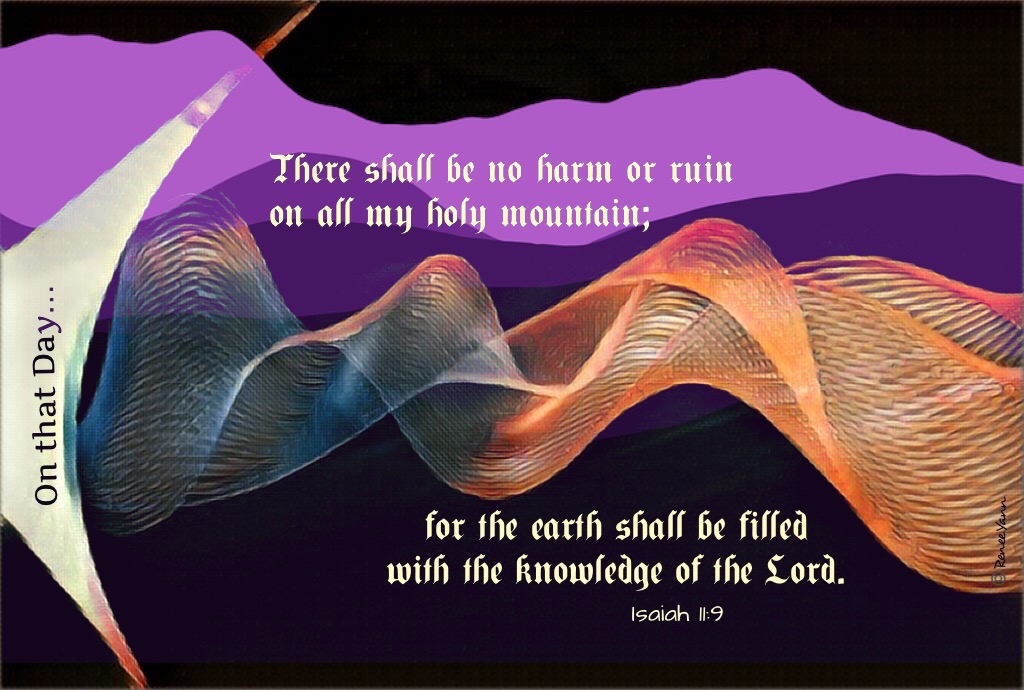
There shall be no harm or ruin on all my holy mountain;
for the earth shall be filled with knowledge of the LORD,
as water covers the sea.

Isaiah 11:9

How will we know when that day has come? Will it be dramatically different from today or yesterday? Will time have paused and the world be turned upside down? 

Or will it simply be that in my heart – right here and now – a “new day” has dawned?


Isaiah indicates that the “new day” is potentially present in the day we have, that when we see experience through God’s eyes, the stagnated stump of our lives blossoms in sacred possibility. 

On that day,
A shoot shall sprout from the stump of Jesse,
and from his roots a bud shall blossom.

Isaiah 11: 1

What a glorious description Isaiah offers us of the world transformed by the longed-for Messiah, that shoot which shall sprout from the stump of Jesse:


The Spirit of the LORD shall rest upon him:
a Spirit of wisdom and of understanding,
A Spirit of counsel and of strength,
a Spirit of knowledge and of fear of the LORD,
and his delight shall be the fear of the LORD.
Not by appearance shall he judge,
nor by hearsay shall he decide,
But he shall judge the poor with justice,
and decide aright for the land’s afflicted.
He shall strike the ruthless with the rod of his mouth,
and with the breath of his lips he shall slay the wicked.
Justice shall be the band around his waist,
and faithfulness a belt upon his hips.

Isaiah 11:2-5

As we pray these magnificent words this morning, we should let them thrill us with the truth that the “new day” has come! Indeed, since Christ has transformed us through his Incarnation, that “new day” dawns through us when we choose to live our lives impelled by its graces.


In our Gospel, Jesus says we can live in that divine possibility simply by trusting God the way a child trusts.

Jesus rejoiced in the Holy Spirit and said,
“I give you praise, Father, Lord of heaven and earth,
for although you have hidden these things
from the wise and the learned
you have revealed them to the childlike. 
Yes, Father, such has been your gracious will. 
All things have been handed over to me by my Father. 
No one knows who the Son is except the Father,
and who the Father is except the Son
and anyone to whom the Son wishes to reveal him.”

Luke 10:21-22

Let’s know and believe that Jesus turns to us as well as we pray today’s Gospel:

Turning to the disciples in private he said,
“Blessed are the eyes that see what you see. 
For I say to you,
many prophets and kings desired to see what you see,
but did not see it,
and to hear what you hear, but did not hear it.”

Luke 10:23-24

Poetry: Advent Good Wishes – David Grieve

I found this poem in a book by one of my favorite poets, Malcolm Guite. It’s a great book for Advent if you are interested.

Give you joy, wolf, 
when Messiah makes you meek 
and turns your roar into a cry that 
justice has been done for the poor. 
Give you joy, lamb, 
when Messiah saves you from jeopardy  
and all fear is overwhelmed 
by his converting grace. 
Give you joy, wolf and lamb together, 
as Messiah brings worldwide peace 
and, side by side, you shelter  
under Jesse’s spreading shoot.

Music: Memory – Trevor Nunn / Thomas Stearns Eliot / Andrew Lloyd-webber / Otto Eckelmann

In this beautiful song from Cats, the writers tap some of the same feelings Isaiah calls up – acknowledgement of the night, hope for the morning, and trust that “that new day” can begin.