A Circumcised Heart

Wednesday of the Fifth Week of Easter
May 10, 2023

Today’s Readings:

https://bible.usccb.org/bible/readings/051023.cfm

Today, in God’s Lavish Mercy, there’s a lot of clipping going on and being talked about.

In Acts, we read about the hubbub around circumcision of the Gentile Christians. Basically, early Christianity was an offshoot of Judaism. All the very earliest Christians were Jews. In many ways, they still thought with Jewish minds not new Christian ones.

The question of circumcision is one of their first wake-ups. Jews considered circumcision a sign of their covenant with God. Greeks on the other hand abhorred the practice. The Apostles were faced with the dilemma:

If our new faith is for all people, how will that change some of our practices?
Which pratices are essential to Christian life, and which are not?

As today’s reading ends, the Apostles are still sequestered on the issue. But the eventual resolution around circumcision proved to be a key factor in the cultural separation of Christianity from Judaism.


In our Gospel, Jesus talks about another kind of pruning, but the parallels are interesting.

A healthy and vigorous life in Christ is one that is “cultured” by God’s grace. That grace serves to cut away the unholy accretions that sometimes surface in our lives – sin, temptation, spiritual indifference, rampant self-interest, religious ennui……

Jesus said to his disciples:
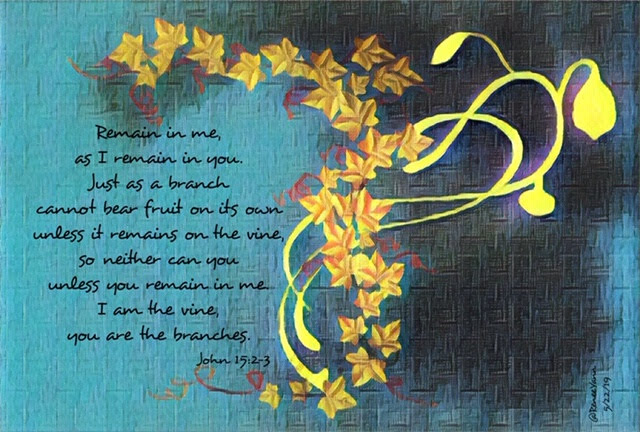
“I am the true vine, and my Father is the vine grower.
He takes away every branch in me that does not bear fruit,
and everyone that does he prunes so that it bears more fruit.
You are already pruned because of the word that I spoke to you.

John 15: 1-3

God’s Word touches us through scripture, through spiritual teaching, and through our reverent assimilation of our life experiences. We must listen to our lives to hear God’s Word. There is never a moment when God is not speaking to us in love – and often to a completely new understanding of what it means to be in covenant with God.


The Apostles finally come to the decision that one does not become a disciple by physical circumcision but rather by a grafting of one’s heart to God’s own heart. May we, the Church, learn from that openness for our own times. May we become more aware of those assumptions which cut off whole segments of humanity, relegating them to the ecclesiastical sidelines.

I am the vine, you are the branches.
Whoever remains in me and I in him will bear much fruit,
because without me you can do nothing…

If you remain in me and my words remain in you,
ask for whatever you want and it will be done for you.
By this is my Father glorified,
that you bear much fruit and become my disciples.”

John 15: 5;7-8

Poetry: I Am the Vine – Malcolm Guite

How might it feel to be part of the vine?
Not just to see the vineyard from afar
Or even pluck the clusters, press the wine,
But to be grafted in, to feel the stir
Of inward sap that rises from our root,
Himself deep planted in the ground of Love,
To feel a leaf unfold a tender shoot,
As tendrils curled unfurl, as branches give
A little to the swelling of the grape,
In gradual perfection, round and full,
To bear within oneself the joy and hope
Of God’s good vintage, till it’s ripe and whole.
What might it mean to bide and to abide
In such rich love as makes the poor heart glad?


Music: Landscapes of the Heart – Gary Schmidt

Find the Light Within the Question

Saturday of the Fourth Week of Easter
May 6, 2023

Today’s Readings:

https://bible.usccb.org/bible/readings/050623.cfm

Today, in God’s Lavish Mercy, our readings present us with two strikingly different forms of resistance to God’s Word.

In our first reading, we see that the community in Pisidian Antioch has responded positively to Paul’s inaugural preaching. He has returned, by invitation, for a second Sabbath to share the Good News. But the reaction is not so smooth this second time.

In a pattern very similar to what Jesus experienced when he preached in his home town synagogue, Paul meets initial approbation, cynicism, rejection and expulsion. And, like Jesus, he turns on his heel, leaving his rejectors tangled in their own faithless criticisms.

The resistance we see here is active. It is a choice not to believe.

On the following sabbath
almost the whole city
gathered to hear the word of the Lord. 
When the Jews saw the crowds, they were filled with jealousy
and with violent abuse contradicted what Paul said. 
Both Paul and Barnabas spoke out boldly and said,
“It was necessary that the word of God be spoken to you first,
but since you reject it
and condemn yourselves as unworthy of eternal life,
we now turn to the Gentiles. 

Acts 13:44-46

Today’s Gospel shows us another kind of resistance to the full embrace of faith.

Philip said to Jesus, 
“Master, show us the Father, and that will be enough for us.” 
Jesus said to him, “Have I been with you for so long a time
and you still do not know me, Philip? 
Whoever has seen me has seen the Father. 
How can you say, ‘Show us the Father’? 
Do you not believe that I am in the Father and the Father is in me? 

This is a passive resistance, one Philip didn’t even recognize in himself. What was it in him that made him impervious to the presence of God in Jesus? Was Philip dull, distracted, hyper-critical, unreflective?


I can’t speak for Philip, but I can tell you that when I miss a sacred point in my life, it is exectly for those reasons! When the moment of grace has passed me by, I do a swift re-take and realize that I had been caught in one or more of the following passive resistant behaviors:

  • too noisy
  • too opinionated
  • too sure of myself
  • too busy
  • too tired
  • too impatient
  • too scattered

If Philip was in the same boat, he did a good job getting out of it. He sailed on to be one of the great saints and teachers of the Church. Philip really heard Jesus’s answer to his oblivious question:

Jesus said:
The words that I speak to you I do not speak on my own. 
The Father who dwells in me is doing his works. 
Believe me that I am in the Father and the Father is in me,
or else, believe because of the works themselves. 
Amen, amen, I say to you,
whoever believes in me will do the works that I do,
and will do greater ones than these,
because I am going to the Father. 
And whatever you ask in my name, I will do,
so that the Father may be glorified in the Son. 
If you ask anything of me in my name, I will do it.”

John 14:10-14

May we not miss the point of Christ’s Presence in our lives. May we notice and lower our own resistances to hear the sacred answers right in front of us.


Poetry: After the Rain – Jared Carter

After the rain, it’s time to walk the field
again, near where the river bends. Each year
I come to look for what this place will yield—
lost things still rising here.
The farmer’s plow turns over, without fail,
a crop of arrowheads, but where or why
they fall is hard to say. They seem, like hail,
dropped from an empty sky,
Yet for an hour or two, after the rain
has washed away the dusty afterbirth
of their return, a few will show up plain
on the reopened earth.
Still, even these are hard to see—
at first they look like any other stone.
The trick to finding them is not to be
too sure about what’s known;
Conviction’s liable to say straight off
this one’s a leaf, or that one’s merely clay,
and miss the point: after the rain, soft
furrows show one way
Across the field, but what is hidden here
requires a different view—the glance of one
not looking straight ahead, who in the clear
light of the morning sun
Simply keeps wandering across the rows,
letting his own perspective change.
After the rain, perhaps, something will show,
glittering and strange.

Music: The Light Within – Peter Sterling

Believe and Abide in Me

Friday of the Third Week of Easter
April 28, 2023

Today’s Readings:

https://bible.usccb.org/bible/readings/042823.cfm

Today, in God’s Lavish Mercy, we have two powerful and life-changing readings.

The Conversion of St. Paul – Nicolas Bernard Lepicie


Paul’s conversion is high drama. And Jesus’ invitation to “consume” him is both pivotal and a bit confounding. Both accounts make clear that living our faith is not a walk in the park. It is a wholehearted, dynamic commitment to render the vital presence of Jesus in our lives.


We can probably find ourselves rather easily in Paul’s story, so let’s take on Jesus’ more complex challenge in our prayer today.

The setting is after the miracle of the loaves and fishes. The crowd presses Jesus for another miracle. They like miracles and they like to eat. Hey, I understand!

But Jesus realizes that they’re missing the point. The tsunami of bread and fish was just a sign not the essence of Jesus’ message. His message was, “Now you must BELIEVE!”

The Jews quarreled among themselves, saying,
“How can this man give us his Flesh to eat?”
Jesus said to them,
“Amen, amen, I say to you,
unless you eat the Flesh of the Son of Man and drink his Blood,
you do not have life within you.

John 6:52-53

So Jesus tells them that it was not enough to eat the miracle bread. He says that now they must consume him, make him their source of sustenance, live in such a way that they cannot live without him


Just as food feeds our emptiness and becomes one with us, so Jesus nourishes our spirit and unites with us. And this happens, not by physical consumption, but by our deep and transcendent believing in Jesus.

Whoever eats my Flesh and drinks my Blood
has eternal life,
and I will raise them on the last day.
For my Flesh is true food,
and my Blood is true drink.
Whoever eats my Flesh and drinks my Blood
remains in me and I in them.

John 6:53-54

Jesus’ words threw a powerful challenge to the hungry crowd as they do to us. We can’t just make ourselves believe. Faith is a gift, and sometimes the channels that allow it to pour into our hearts get a little clogged with worldly junk. How can we open those channels up a bit to release the power of faith in our lives?

Perhaps a prayer like this might help:

I exist because of You and within You.
I have nothing and am nothing without You.
You breathe Your life into every moment of my own.
May I see You, trust You, hear Your loving hints to me.
May I make room for You in my heart 
by my choices, prayer, and generosity.
May I abide in You as You so completely abide in me.

Poetry: If Only – Rainer Maria Rilke

If only there were stillness, full, complete.
If all the random and approximate
were muted, with neighbors’ laughter, for your sake,
and if the clamor that my senses make
did not confound the vigil I would keep —
Then in a thousandfold thought I could think
you out, even to your utmost brink,
and (while a smile endures) possess you, giving
you away, as though I were but giving thanks,
to all the living.

Music: Abide – Aaron Williams

Taught By God …

Thursday of the Third Week of Easter
April 27, 2023

Today’s Readings:

https://bible.usccb.org/bible/readings/042723.cfm

Today, in God’s Lavish Mercy, we read the fascinating account of the conversion of the Ethiopian eunuch. The story, filled with heavenly manifestations, may seem “other-worldly” to us and, in a way, that’s just what it is.

There is a new world – a New Covenant – sprung from Christ through the power of his Resurrection. The Acts of the Apostles is the proclamation of that New World given to us in a series of stories and miracles generated through the Holy Spirit.

And the story of the Ethiopian eunuch is a powerful one, offering a spectrum of interpretations and applications to our own spiritual life. However, using today’s Gospel as a lynchpin, let’s explore one particular concept.


In the passage from John, Jesus tells the crowds:


“No one can come to me
unless the Father who sent me draw him,
and I will raise him on the last day.
It is written in the prophets:
They shall all be taught by God.
Everyone who listens to my Father
and learns from him comes to me.

John 6:44-45

In other words, in order to truly understand our reality, we must allow the Spirit of God to enter our hearts and minds — because there is more to what is than meets the eye!

We cannot truly interpret our world with only our own intellectual resources. Our knowledge and understanding must be fed by God so that we may see the deep Spirit living under our otherwise thin perception of life.


The Baptism of the Eunich – Rembrandt

In our passage from Acts, the Ethiopian is a person of faith, a worshipper who seeks God. But he has hit a wall. He realizes that he cannot fully understand God’s revelation without a Spirit-inspired teacher. And lucky him – the Spirit decides to plunk Philip down in the middle of the desert to be that very teacher!

The context of the story tells us that God wants us all to be fully incorporated into God’s own life —

  • no matter how far out we are in our spiritual “deserts”
  • no matter what physical elements define or limit us
  • no matter what walls we hit when trying to live a faithful life

In our Gospel, Jesus tells us that he is the new and perfect source of nourishment for our yearning spirits. It is the Spirit of Jesus that Philip has brought to the Ethiopian.

Amen, amen, I say to you,
whoever believes has eternal life. 
I am the bread of life. 
Your ancestors ate the manna in the desert, but they died;
this is the bread that comes down from heaven
so that one may eat it and not die. 
I am the living bread that came down from heaven;
whoever eats this bread will live forever;
and the bread that I will give
is my Flesh for the life of the world.”

John 6:47-51

Now I doubt that we’re going to find Philip waiting by our “chariot” out in the driveway tomorrow morning. So how are we to be “taught by God“. Here are some ways that I think can help:

  • faithful prayer informed by good spiritual reading
  • devoted scripture study and prayer
  • spiritual retreat and reflection
  • spiritual companionship with others sincerely seeking God

Poetry: Soliloquy of the Ethiopian Eunuch – Robert Phillips

The miracle began with a miracle.
I was sitting in my gold-trimmed chariot
(well, not exactly my chariot—like all
my accoutrements, it belongs to her—
Candace, Queen of all the Ethiopians.
But since she put me in charge of her treasure,
I have the opportunity to live high.
Beauty has its privileges, and I don't mean
Candace. I'm here to tell you: That girl
Wasn't around when they passed out looks).
There I was, biding my time in the chariot,
near Jerusalem where I'd gone to worship.
I'd just passed Gaza, a real cultural desert.
I was studying Isaiah the Prophet
when suddenly this white man was translated—
there's absolutely no other word for it—
he literally was translated from wherever
to right next to me. It was the damndest thing!
He just stood there, ahuffing and apuffing.
Then he says with the greatest impertinence.
"Do you understand that book you're reading?"
His meaning was undeniable: the fact
that I'm black must have implied I'm illiterate,
or ignorant at best, despite my purple
silk robe and heavily gilded chariot.
I said, "This Isaiah is a heavy dude.
Perhaps you can shed some light on this passage?"
He was led as a sheep to the slaughter;
and like a lamb dumb before her shearer,
so opened he not his mouth . … "So who's the he?"
I asked. "Is this Isaiah talking
about himself, or is he palavering about
somebody else?" And Whitey (his real name was
Philip; it means Lover of Horses—ha!)
Whitey explained to me the "he" was Jesus,
and began to preach about the humiliation
of Jesus, and how his judgment was taken
away before his life on earth was taken,
and how he said not one word to save himself.
And now, in order to be saved, a body
must be baptized in the holy name of God.
I took it all in. Then he clambered inside
the chariot, and we commenced riding north,
which was where he came from before translated.
Presently we came upon a teensy pond.
"Here's some H20. So what's to keep you from
baptizing me on the spot?" That set him off
preaching some more: "If you believe with all
your heart that Jesus Christ is the Son of God,
blah blah blah, I'll do it." Seems this Jesus cat
charged him and a bunch of other honkies
to preach all nations about this Jesus stuff.
I told him with my dusky skin I qualified as
"all nations." So I stopped the chariot,
and we both sashayed down to the water hole.
And hallelujah, he baptized me! In the name
of the Father, and the Son, and the Holy Ghost.
Like to drowned me. The waters of salvation
ran down my dreadlocks. My gloomy skin took on
a peaceful hue. My black soul became dove white.
Then that lover of horses disappeared—poof!
It was enough to make my head spin, popping
in and out of the desert like that. Later
I heard Philip was preaching in this city
and that, creating real photo opportunities.
When I got back to the palace, I camped it up
about being saved, being washed in the blood
of the Lamb, and how this black soul now was white
as snow. (Though I confess I've never seen snow.
It's just one of those things you take on faith.)
Queen Candace had a hissy fit, stomped her foot
because she hadn't been baptized and her eunuch
had. I told her she'd just have to wait until
Philip or one of that gang of ten others
came her way. But she never did. I don't think
they thought hateful ugly queens much worth saving .
Now don't think being a eunuch is easy.
It was done so I could better serve my God
and my queen. I continued to lust in my heart.
But now I'm saved, I sleep the sleep of the just.

Music: Immortal, Invisible, God Only Wise – Walter C. Smith

Who? Me?

Third Sunday of Easter
April 23, 2023

Today’s Readings:

https://bible.usccb.org/bible/readings/042323.cfm

Today, in God’s Lavish Mercy, our readings invite us to consider any unrecognized blindness in our lives.

In the passage from Acts, Peter confronts the Israelites with an appalling truth to which they had been blind:

Jesus the Nazarene was a man commended to you by God
with mighty deeds, wonders, and signs,
which God worked through him in your midst, as you yourselves know.
This man, delivered up by the set plan and foreknowledge of God,
you killed, using lawless men to crucify him.

Acts 2:22-23

Peter Preaching in Jerusalem – Charles Poërson -c. 1642

Peter left his audience no outs, no excuses. He put the harsh fact before them and asked them to acknowledge it so that they might move forward in faith.


In our second reading, Peter counsels the early converts to recognize that they were rescued from a spiritually fatal blindness:

… conduct yourselves with reverence during the time of your sojourning,
realizing that you were ransomed from your futile conduct ..

1 Peter 1:17-18

Pilgrims on the Road to Emmaus – James Tissot

Luke’s Gospel gives us the warmly accessible Emmaus story. We have walked beside these beloved, crest-fallen disciples for years, haven’t we? But each year might reveal something different and deeper about the “blindness” that prevented them from recognizing Jesus who walked right beside them.

These progressive revelations can challenge us about how readily we recognize God’s Presence in our lives.

  • Were these otherwise faithful disciples just disappointed that their faith had not been rewarded with the results they expected?
  • Were they angry that they had wasted time trusting an apparent “failure”?
  • Were they only shallow believers anyway who had not really invested in Jesus?
  • Were they riddled with false expectations about the Messiah?
  • Were they so confined by old religious habits that they just couldn’t imagine an “Easter Jesus”?
  • Or were they just tired, hungry and caught on a dark road, thinking they could find an answer all by themselves?

Maybe we’ve been in a spot like theirs sometime in our lives. 


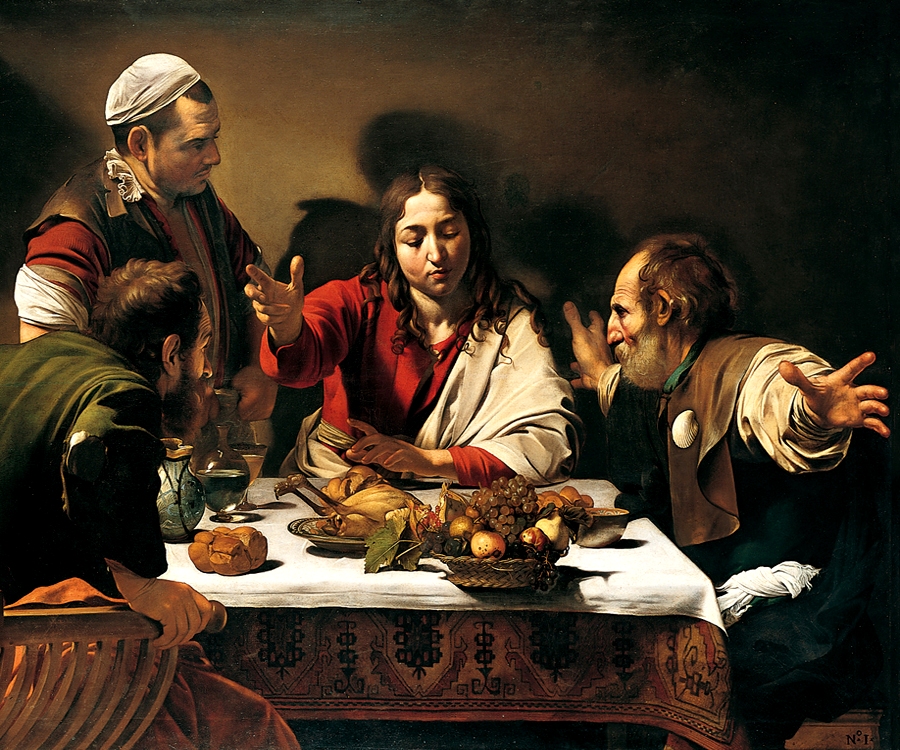
Dinner at Emmaus – Caravaggio


Let’s be with those disciples today and find ourselves in their story. Let’s attend to the “bread” of our dailyness as Jesus breaks it, and let our eyes be opened:

… while he was with them at table,
he took bread, said the blessing,
broke it, and gave it to them.
With that their eyes were opened and they recognized him…

Luke 24:30-31

Poetry: Witness – Denise Levertov

Sometimes the mountain
is hidden from me in veils
of cloud, sometimes
I am hidden from the mountain
in veils of inattention, apathy, fatigue,
when I forget or refuse to go
down to the shore or a few yards
up the road, on a clear day,
to reconfirm
that witnessing presence.


Music: Open My Eyes, Lord – Jesse Manibussan

Water and Pork Chops

Saturday of the Second Week of Easter
April 22, 2023

Today’s Readings:

https://bible.usccb.org/bible/readings/042223.cfm

Today, in God’s Lavish Mercy, little “disruptions” pop up in the center of both our readings.

In Acts, some of the Greek Christians think they are getting the short end of the stick when it comes to food distribution.

Believe me, I can picture the situation using personal experience. When I was an 18 year old postulant, I was a tall, skinny athlete — and I ate a lot of food. I wasn’t used to living in community, and I hadn’t noticed how my voracious appetite might be affecting those around me at the table.

In those “olden days”, the fifty-two of us freshly minted mini-nuns sat “in rank”, i.e according to age. The food was passed down the table from oldest to youngest. When I came to supper one night, the sister below me in rank had moved up a seat to be before me. I thought she just got mixed up about where her chair was so I asked her about it.

She told me she moved up in order to get a pork chop before I took them all!


Well, that’s what the Hellenists are doing in today’s reading which illustrates that living in community is a practical exercise as well as a spiritual one. That practicality calls upon us to make prudent arrangements for the community such as the disciples did in appointing more presbyters led by Stephen.

For us in our various communities today, the reading reminds us to think about the “pork chops” – who needs what and are they getting what they need. This principle holds for both spiritual and material needs and goods. Like the new presbyters, we each have a part to play in achieving that equity within our communities – including families, neighborhoods, churches, workplaces, and the world we share with all Creation.


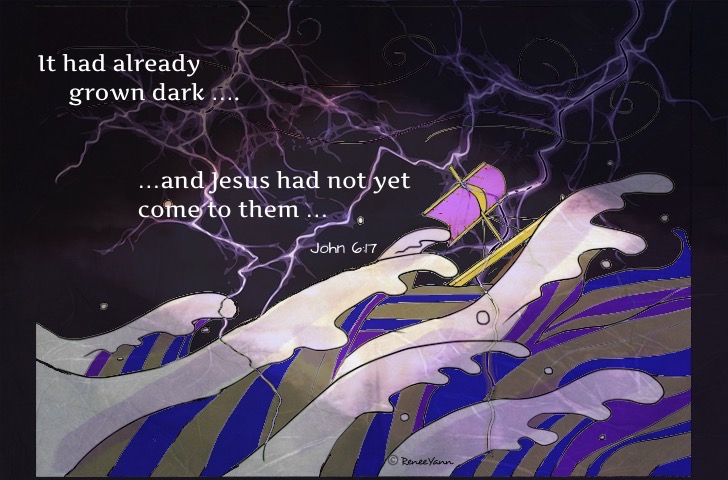
While our Gospel event is narrated in both Matthew and Mark, John gives us his own colorful version of the story of Jesus walking on the water. John highlights the conditions of the sea and atmosphere: darkness, the gusty wind, a turbulent ocean, and the absence of Jesus from the boat:

When it was evening, the disciples of Jesus went down to the sea,
embarked in a boat, and went across the sea to Capernaum.
It had already grown dark, and Jesus had not yet come to them.
The sea was stirred up because a strong wind was blowing.

John 6:16-18

So John makes it clear that it was the customary “dark and scary night“. But the disciples, tossed in the tumult, never express fear until they see Jesus walking across the water toward them. It seems they are less afraid of nature’s power than they are of the power of God!

Jesus sees their fear and tells them not to be afraid. In a phrase reminiscent of God’s self-revelation to Moses ( I am Who am), Jesus simply says, “It is I” — I am God. I am with you. Do not be afraid.


The disciples are still a little nervous and seem to prefer a less omnipotent Jesus . They ask him to get into the boat (in other words, “Be normal – not a Water-Walker”). But Jesus ignores the invitation and simply transports the boat to shore. One might picture the Twelve, tossed up on the shore, mouths agape and beginning to realize that their whole world was being turned upside-down in Christ!


Maybe we’re a little bit like the disciples sometimes. Sometimes we like God in small doses – not in a brilliant revelation or an irresistible call. Jesus snoozing beside us in the boat is comfortable. A radiant God coming to us in our life’s storms is a little harder to adjust to.

Our readings today remind us that God is present in every aspect of our lives – the daily practicalities and the topsy-turvy revelations. God may sit beside us in the boat, or might drag us stunned into another graced shore. But we should not be afraid in any case. Just prayerfully listen for the assurance, “It is I!”


Poetry: Walking on Water – Mark Jarmon

       Always the same message out of Matthew.
The water Jesus walks on is life’s turbulence.
        He calms our trouble and lifts us up again.

To walk on water? That’s what’s puzzling—
        that feat of antimatter, defeat of physics,
those beautiful unshod feet of cosmic truth

        for whom the whole performance is child’s play.
And unless one becomes as a little child
        the kingdom’s inaccessible by any route.

That water, then, its broken surface tension,
        collision of fracturing waves, apparent chaos,
its fractals turning infinite and weaving

        the netted skin between worlds, that web
of light and gravity which underpins our faith,
        water, a substance, stormy or pacific,

we know a myriad ways to get across it.
        But simply walking on it? Literally?
How far do you think you’d go before you fell

        through that convergence between time and space?
The water Jesus walked on wasn’t water
        only. It was the storm that made it rock.

Music: Walk on Water – Elevation Rhythm

A Good Heart, an “Easter-ed Heart”

Thursday of the Second Week of Easter
April 20, 2023

Today’s Readings:

https://bible.usccb.org/bible/readings/042023.cfm

Today, in God’s Lavish Mercy, the post-Resurrection Apostles continue their unstoppable testimony to Jesus Christ. Their persistence “infuriates” the Sanhedrin who fear the blood of Christ being called down upon them!

“We gave you strict orders did we not,
to stop teaching in that name.
Yet you have filled Jerusalem with your teaching
and want to bring this man’s blood upon us.”
But Peter and the Apostles said in reply,
“We must obey God rather than men. 
The God of our ancestors raised Jesus,
though you had him killed by hanging him on a tree.
God exalted him at his right hand as leader and savior
to grant Israel repentance and forgiveness of sins.
We are witnesses of these things,
as is the Holy Spirit whom God has given to those who obey him.”

Acts 5: 28-33

There is an interesting play in the words and concepts of this reading from Acts.

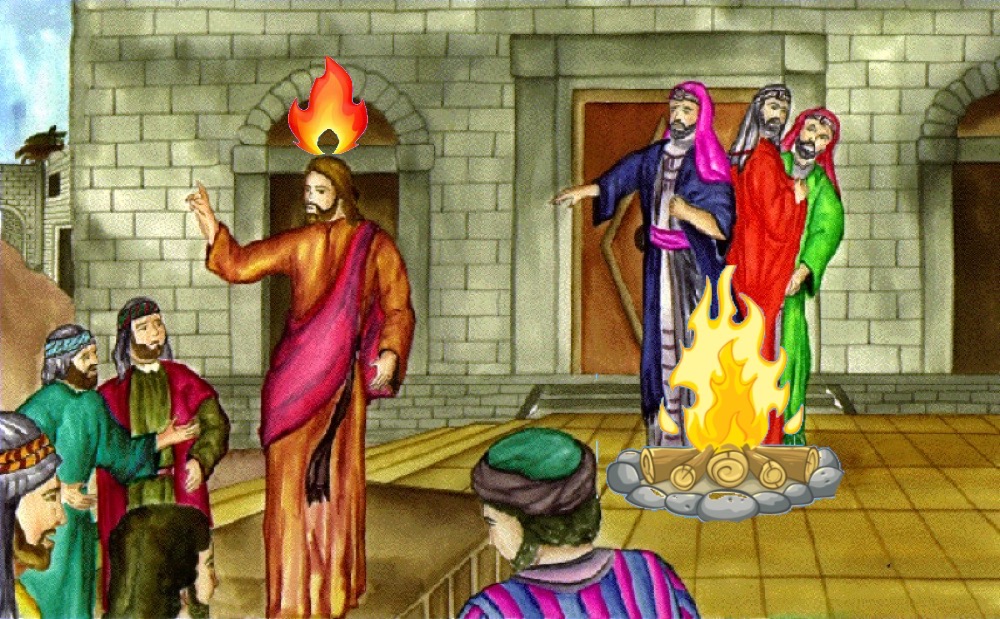
  • While the Sanhedrin are infuriated, or filled with the fire of denial and sin, the Apostles are inflamed with the unquenchable Fire of the Holy Spirit.
  • While the Sanhedrin fear the blood of Christ called down upon them, the disciples hearts are transformed by its power.

The contrast in their responses to God’s Word is stunning.


In our Gospel, John captures this contrast in a nutshell:

The one who comes from above is above all.
The one who is of the earth is earthly
and speaks of earthly things.

John 3:31

In other words, those transformed in the power of the Resurrection see the world with God’s eyes — “from above”. Those unconverted by that Power still see the world in godlessness.


Our Gospel calls us to be like the disciples not like the Sanhedrin.  It calls us to open our hearts:

  • to see the Truth Who is Jesus Christ
  • to believe that the Truth of his Resurrection lives in us
  • to become that Truth through the witness of our lives.

The Gospel calls us to live a whole-hearted faith which allows the Holy Spirit to be expressed in every aspect of our lives. Jesus does not ration the gift of the Spirit, nor should we:

Whoever does accept Christ’s testimony certifies that God is trustworthy.
For the one whom God sent speaks the words of God.
He does not ration his gift of the Spirit.

John 3:33-34

How do we live such a life of Christian witness? Do we have to shout the witness out loud with every action of our lives?  I don’t think so.

Brother David Steindl-Rast describes believers like this:

People who have faith in life are like swimmers who entrust themselves to a rushing river. They neither abandon themselves to its current nor try to resist it. Rather, they adjust their every movement to the watercourse, use it with purpose and skill, and enjoy the adventure.


And the great St. Teresa of Avila blesses believers with this prayer:

May today there be peace within.
May you trust God that you are exactly where you are meant to be.
May you not forget the infinite possibilities that are born of faith.
May you use those gifts that you have received,
and pass on the love that has been given to you.
May you be content knowing you are a child of God.
Let this presence settle into your bones,
and allow your soul the freedom to sing, dance, praise and love.
It is there for each and every one of us.


Poetry: Little Summer Poem Touching The Subject Of Faith by Mary Oliver

Every summer
I listen and look 
under the sun’s brass and even
into the moonlight, but I can’t hear

anything, I can’t see anything — 
not the pale roots digging down, nor the green 
stalks muscling up,
nor the leaves
deepening their damp pleats,

nor the tassels making,
nor the shucks, nor the cobs.
And still,
every day,

the leafy fields
grow taller and thicker — 
green gowns lofting up in the night,
showered with silk. 

And so, every summer,
I fail as a witness, seeing nothing — 
I am deaf too
to the tick of the leaves, 

the tapping of downwardness from the banyan feet — 
all of it
happening
beyond any seeable proof, or hearable hum. 

And, therefore, let the immeasurable come.
Let the unknowable touch the buckle of my spine.
Let the wind turn in the trees,
and the mystery hidden in the dirt

swing through the air.
How could I look at anything in this world
and tremble, and grip my hands over my heart?
What should I fear? 

One morning
in the leafy green ocean
the honeycomb of the corn’s beautiful body
is sure to be there.


Music: A Good Heart – Marc Enfroy

Not So Easy to Be Born Again!

Tuesday of the Second Week of Easter
April 18, 2023

Today’s Readings:

https://bible.usccb.org/bible/readings/041823.cfm

The words in today’s readings are little explosives camouflaged in familiarity.

We are used to reading how the earliest Christians formed a loving and mutual community. We might admire how they held everything in common. We might think how nice and comforting that must have been for everyone.

The community of believers was of one heart and mind,
and no one claimed that any of his possessions was his own,
but they had everything in common.
With great power the Apostles bore witness
to the resurrection of the Lord Jesus,
and great favor was accorded them all.

Acts 4:32

But, friends, I don’t think it was all that comforting! I think it was hard! People who had worked tirelessly to build secure lives had to rethink that security. Whether in material goods or established reputations, they had to give up houses, businesses, rabbi-ships, and political offices to truly be part of this radical new “community”.

They had to split the last two matzah balls with some dude who never worked a day in his life. It’s not easy!


Picture the heated conversations between someone choosing this “community” and a spouse who preferred to keep their big boat and villa by the seaside.

Imagine the rumbling synagogue crowd when the beloved old rabbi told them just to call him “brother”! Hear the distressed uproar when he announced that the Holy Law he had confidently taught them now must be rethought in Gospel light!

I’m pretty sure it wasn’t as smooth as Acts seems to imply. There is a small acknowledgment of that in the notoriety given to astoundingly generous Joseph. He stood out for buying in completely to this new community. ( We’ll hear more about him later under his new name “Barnabas”).

Thus Joseph, also named by the Apostles Barnabas
(which is translated “”son of encouragement””),
a Levite, a Cypriot by birth,
sold a piece of property that he owned,
then brought the money and put it at the feet of the Apostles.

Acts 4:36-37

By Henry Ossawa Tanner

The Gospel story of Nicodemus confirms the struggle to really become a Gospel person. It should be profoundly unsettling to those of us  -and I think that is ALL of us – who sometimes thrive on security, status, and control.

Nicodemus had “made it” in Jewish society. He was considered a good, learned, influential and wealthy man. But Jesus challenges him on every level of his success to test what he values and builds his life on.

  • Is Nicodemus really “good” in light of the Beatitudes?
  • Is he really “learned” in living the law of radical love?
  • Is he really “rich” in holy grace?

  • Or is his “goodness” tinged with judgement?
  • His “learning” mired in self-righteousness?
  • His “wealth” rooted in complacency with systemic injustice?

Jesus tells Nicodemus that the Spirit of God will not be tamed or controlled by these supposed “successes” of his life. Rather, Nicodemus must start all over again to be transformed in God:

Jesus said to Nicodemus:
“‘You must be born from above.’
The wind blows where it wills, and you can hear the sound it makes,
but you do not know where it comes from or where it goes;
so it is with everyone who is born of the Spirit.”

John 3:7-8

And here’s the really hard thing. We must make the “Nicodemus Choice” every day of our lives. Every circumstance invites us either to be “born again” or to choose the old securities we are so falsely comfortable with. Those securities can blind us with the complacency of one who has forgotten how to see.

Jesus answered and said to him,
“You are the teacher of Israel and you do not understand this?
Amen, amen, I say to you,
we speak of what we know and we testify to what we have seen,
but you people do not accept our testimony.
If I tell you about earthly things and you do not believe,
how will you believe if I tell you about heavenly things?

John 3:10-12

Poetry: Nicodemus – Mary Elizabeth Coleridge (1861-1907) 

With slow and stealthy steps he trod 
— The darkening and deserted streets; 
— And no one in the market greets 
The man upon his way to God. 

By night he left the splendid home 
— That sheltered many a sleeping guest. 
— One and another lay at rest — 
The master of the house would roam. 

Was there a single soul that knew? 
— No! For he feared the eye of scorn, 
— The crooked laugh of anger born. 
Only the bats about him flew. 

The broidered borders of his gown 
— He covered o’er, that none might see. 
— Shall good come out of Galilee? 
This were the mock of all the town. 

But in the City named for Peace 
— No peace his weary heart had known, 
— And ever in the crowd alone 
He waged a war that would not cease. 

He came by night — and yet he came. 
— And He that was Himself the Way 
— Shall own him in the Judgment Day, 
And to the world confess his name.


Music: Nicodemus – Graham Kendrick

Don’t Be Afraid

Monday in the Octave of Easter
April 10, 2023

Today’s Readings:

https://bible.usccb.org/bible/readings/041023.cfm

Today, in God’s Lavish Mercy, we begin to read and relish the post-Resurrection stories.

As I begin my prayer with these stories, I am reminded of a sweet cartoon I recently saw on Facebook. The illustration showed an elderly couple relaxing outside a simple home. The woman is shelling peas; the man whittling some wood. The comment below the picture reads, “If only I could visit my grandparents one more time!”. 

Haven’t we all felt that way about someone dear who has died.  If only we could be with them one more time!


Well, that’s exactly what happens in these post-Resurrection stories. The disciples, and we, get to be with Jesus one more time:

  • to re-hear his Truth more clearly in the light of the Resurrection 
  • to get right the Gospel imperatives we might have missed in our distractions 
  • to heal the doubts which his suffering, and ours, may have caused us
  • to have our faith irrevocably affirmed by his real and transformed Presence

The Three Marys at the Tomb – WILLIAM-ADOLPHE BOUGUEREAU


Mary Magdalene and the other Mary went away quickly from the tomb,
fearful yet overjoyed,
and ran to announce the news to his disciples.
And behold, Jesus met them on their way and greeted them.
They approached, embraced his feet, and did him homage.
Then Jesus said to them, “Do not be afraid.
Go tell my brothers to go to Galilee, 
and there they will see me.”

Mark 28:8-10

Like Mary Magdalen and the “other Mary”, we too might be “fearful but overjoyed” at moments in our faith life – those moments when we are confronted with our own small Calvaries. 

But Jesus, filled with the glory of Resurrection, greets us on our way. He tells us too, “Do not be afraid” —— you will see me, risen in your life. And you will understand.


Prose: from Paula D’Arcy

Who would I be,
and what power

would be expressed in my life,
if I were not dominated by fear.


Music: Don’t Be Afraid – Mac Lynch

God is Outside the Box!

Friday of the First Week in Ordinary Time
January 13, 2023

Today’s Readings:

https://bible.usccb.org/bible/readings/011323.cfm

Today, in God’s Lavish Mercy, our Gospel tells of a memorable event – so memorable that it is described in detail.

Jesus preaches from a neighborhood living room. Every access point to the house is blocked with excited listeners and miracle-seekers. Jesus has been corralled by the enthusiastic faithful.

roof

Then some latecomers arrive carrying their paralyzed friend. It is easy to imagine that these are young guys, because Jesus later calls the paralytic “Child”. Perhaps their friend was injured in a soccer game or diving accident in which they all had participated. Perhaps, as well as carrying him, they are carrying the burden of “survivor guilt”.

Whatever the situation, these friends are determined that the young man shall see Jesus. Confronted with the barricading crowd, they climb up on the roof, opening the turf plates to make an entry point. Jesus had to laugh as he saw to rooftop disappearing above him!


Would that we had such a wild desire to be in God’s Presence
– to know God face to face, and heart to heart!

Can we peel away the many barricades to such relationship? We have only our limited human images of God. While these can help us pray, they can also box God.

Faulty theology and exaggerated ritual can, believe or not, put a lid on God’s power!

It is important to read, listen, and grow within good theology. One measure of that value is the degree of limitation any “theology” puts on God. A theology that limits God to male, white, Catholic, Evangelical, Republican or Democrat (or whatever religion) – that kind of false theology limits us as well. 

A theology that is used as validation for political, economic, or moral domination distorts God, making God an idol of our own greed and selfishness. Such ”theologies” have, for centuries, made excuses for slavery, apartheid, pogroms, wars and holocausts. 

Let’s try to “take the roof off” our theology today. Let’s be sure our tightly held perceptions and beliefs are really leading us to the absolute freedom of a God Who cherishes all Beings, all Creation.


Poetry: God’s Grandeur – Gerard Manley Hopkins

The world is charged with the grandeur of God.
It will flame out, like shining from shook foil;
It gathers to a greatness, like the ooze of oil
Crushed. Why do men then now not reck his rod?
Generations have trod, have trod, have trod;
And all is seared with trade; bleared, smeared with toil;
And wears man's smudge and shares man's smell: the soil
Is bare now, nor can foot feel, being shod.
And for all this, nature is never spent;
There lives the dearest freshness deep down things;
And though the last lights off the black West went
Oh, morning, at the brown brink eastward, springs —
Because the Holy Ghost over the bent
World broods with warm breast and with ah! bright wings.

Music: God Beyond All Names ~ Bernadette Farrell