Today, in God’s Lavish Mercy, our readings offer us a theme of CONFIDENCE with a dash of JOY.
John begins with the reassuring verse:
From the Latin root meaning “to have full trust”, confidence is a rare and beautiful blessing in our lives. How many people or things are you able to trust that deeply? Are you blessed with a true confidant in your life?
John tells us that this is the kind of relationship we can and should have with God.
He says that when we pray with this confidence, we trust whatever answer we receive to bring us grace and life.
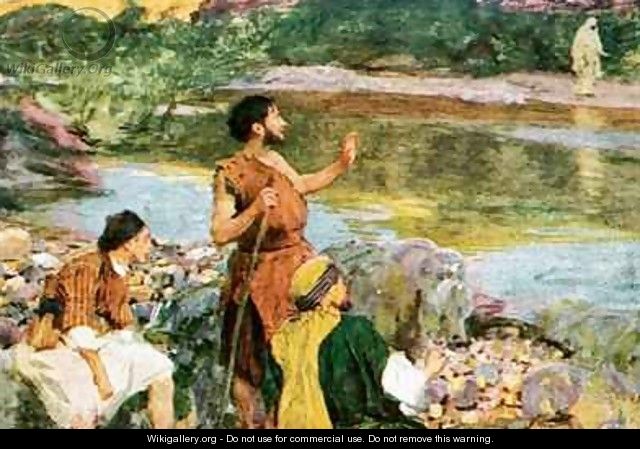
Behold the Lamb of God – William Hatherell, from wiki gallery
In our Gospel, John the Baptist’s followers are having a little trouble with their confidence. They are unsettled by the appearance and rising popularity of Jesus. John says to trust what is happening. He had already told them that a greater One would come after him.
John’s ultimate response is worth repeating in prayer, “So this joy of mine has been made complete. He must increase; I must decrease.”
When Christ shines through us without hindrance of our pride or fears, how complete our joy will be, how profoundly rooted our confidence!
Poetry: JOHN THE BAPTIST: THE PASSOVER (JOHN 1:35–39) by Irene Zimmerman, OSF
For years he’d preached the coming was at hand. Now John saw Jesus walking on the strand. “Behold the Lamb of God!” he called, and sent his own disciples hurrying. They went, filling Jesus’ footprints in the sand faster than the water could. John stayed and poured the river on the people and passed them over to his Lord.
I know: the title sounds like a new TV series, doesn’t it? But it’s not. It’s a story as old as time!
Today, in God’s Lavish Mercy, John talks about liars. He made me really think.
Liar! Liar! Pants on Fire!
When I was a kid going to weekly Saturday night confession (yes, remember a lot of us did that!) I really had to scrape to get a decent pile of sins. I mean, honestly, how much evil can one eight-year-old generate in a week?
But lying was always a good fallback to report on. You know the deal:
I told my teacher that I forgot my homework when I really hadn’t done it.
I told Petey Nicolo I could beat him up when I knew I couldn’t.
I told Chickie Schmidt I could ride a big bike like hers when I had actually just fallen on my face off a smaller one.
I told Sister I wasn’t smoking in the girls’ room when my very own cousin Joanie threw me under the bus!
As you can see, I was your normal childhood compulsive liar – pretending to be and do lots of things I only wished I could be or do. But that’s just part of growing up. Like most people, I got over it when I began to realize the power and necessity of growing confidently into one’s true self.
People depend on us to be who we really are, to be the real deal. The value of our work and contributions to the world hinges on this. The depth and endurance of our relationships rest on such transparency and authenticity. Even our ability to love ourselves is rooted in honest self-awareness.
So how do we deepen in that kind of truthfulness, especially in a modern culture that so often abuses it? John tells us that love is the way:
Beloved, we love God because God first loved us. If anyone says, “I love God,” but hates their brother or sister , they are liars; for whoever does not love the one they can see cannot love God whom they have not seen. This is the commandment we have from God: Whoever loves God must also love their sister and brother.
1 John 4:19-21
Friends, we live in a culture drowning in lies. Some have come to believe that unless one lies, one cannot compete. Businesses lie to sell untested or worthless commodities. Manufacturers veil the danger of their drugs, tobacco and vaping products. Politicians lie to condemn their opponents and excuse themselves. Leaders lie to justify war. And criminals lie to hide their crimes.
These liars may never even consider that their tangled lives are related to the scriptures. But every one of these deceptions is fueled by a failure in reverence and love for our sisters and brothers, by a failure in courage to be responsible for and love one another.
We lie because we think our truth is not enough. John tells us differently. Our awesome Truth is that we all are God’s children! And that is not only enough–it is EVERYTHING!
Our reading closes today with these words, so critical to the rebuilding of a truthful world:
In this way we know that we love the children of God when we love God and obey the commandments. For the love of God is this, that we keep the commandments. These are not burdensome, for whoever is begotten by God conquers the world. And the victory that conquers the world is our faith.
1 John 5:2-4
Let’s pray for one another’s courage, dear Friends, to be and demand the Truth that Love requires.
Prose: from “Man’s Universe” by Rabindranath Tagore
On the surface of our being
we have the ever-changing phases of the individual self,
but in the depth there dwells
the Eternal Spirit of human unity beyond our direct knowledge.
It very often contradicts the trivialities of our daily life
and upsets the arrangements made for securing our personal exclusiveness
behind the walls of individual habits and superficial conventions.
It inspires in us works that are the expressions of a Universal Spirit;
it invokes unexpectedly in the midst of a self-centered life a supreme sacrifice.
At its call, we hasten to dedicate our lives to the cause of truth and beauty,
to unrewarded service of others.
Music: True Heart – Oak Ridge Boys
Often, I use a popular song for prayer, allowing its words to speak to God for me. You might like to try it with this song. No doubt intended as a human love song, it can be a divine love song too – and it’s sure a good wake up prayer 🙂
Making money they can hide away. They never know what they’re working for. All they think about is making more. And every time the world spins round There’s a few more hearts that can’t be found ‘Cause they never had nothing to hold on to The way that I’m holding you. All ever need is your true heart Next to me when it’s cold and dark. All I need to keep from falling apart Is the beat of your true heart. Some people spend day and night Trying to love everybody in sight They never know what love is for All they think about is keeping the score. And every time the world spins round There’s a few more hearts that can’t be found ‘Cause they never had nothing to hold on to The way that I’m holding you. All ever need is your true heart Next to me when it’s cold and dark. All I need to keep from falling apart Is the beat of your true heart. Your true heart. No they never had nothing to hold on to The way that I’m holding you. All ever need is your true heart Next to me when it’s cold and dark. All I need to keep from falling apart Is the beat of your true heart. All ever need is your true heart Next to me when it’s cold and dark. All I need to keep from falling apart Is the beat of your true heart. All ever need is your true heart Next to me when it’s cold and dark. All I need to keep from falling apart Is the beat of your true heart.
Rise up in splendor, Jerusalem! Your light has come, the glory of the Lord shines upon you. See, darkness covers the earth, and thick clouds cover the peoples; but upon you the LORD shines, and over you appears his glory.
Isaiah 60:1-2
The journey to the Epiphany is repeated in each our lives – many times over. As we – like young Jesus – grow in age and grace, God continually calls us to new Lights, ever deeper into Love’s Divine Universe.
And we, like the determined Wise Ones, move closer – by whatever means we can – to the Promised Revelation. We have our own trusted “camels” which carry us toward Truth: meditation, spiritual reading, sacred song, prayerful journaling, holy silence, merciful service, Gospel love.
Faithful commitment to our soul’s journey leads us to God’s beautiful promise. It is a difficult and sometimes challenging journey, as our poem will attest. But it is not a hopeless, pointless, or endless one:
Then you shall be radiant at what you see, your heart shall throb and overflow, for the riches of the sea shall be emptied out before you, the wealth of nations shall be brought to you.
Isaiah 60
In our second reading, Paul describes that “wealth” in these words:
“that we are heirs and partners in God’s promise in Christ through the Gospel.”
Ephesians 3:6
Poetry: Nativity Poem – Joseph Brodsky
Imagine striking a match that night in the cave: Imagine crockery, try to make use of its glaze To feel cold cracks in the floor, the blankness of hunger. Imagine the desert – but the desert is everywhere.
Imagine striking a match in that midnight cave, The fire, the farm beasts in outline, the farm tools and stuff; And imagine, as you towel your face in the enveloping folds, Mary, Joseph, and the Infant in swaddling clothes.
Imagine the kings, the caravans’ stilted procession As they make for the cave, or, rather, three beams closing in And in on the star, the creaking of loads, the clink of a cowbell; (No thronging of Heaven as yet, no peal of the bell
That will ring in the end for the infant once he has earned it). Imagine the Lord, for the first time, from darkness, and stranded Immensely in distance, recognizing Himself in the Son Of Man: His homelessness plain to him now in a homeless one.
Music: Magi Veniunt – Sistine Choir
Magi veniunt ab oriente Ierosolimam quaerentes et dicentes: Ubi est qui natus est [Rex Judaeorum] cujus stellam vídimus? Vidimus stellam eius in oriente, et venimus [cum muneribus] adorare Dominum. Interrogabit magos Herodes quod signum vidissent super natum regem? Stellam magnam fulgentem cuius splendor illuminat mundum et nos cognovimus. Vidimus et venimus adorare Dominum
The wise men came from the East to Jerusalem asking questions and saying: Where is he that is born [King of the Jews], whose star we have seen? We have seen that star in the East, and we have come [with gifts] to worship the Lord. Herod questioned the magi what sign they had seen above the new-born king? We recognized that brightly shining star whose lustre lights the world and us. We have seen, and have come to worship the Lord
Today, in Mercy, we are lifted to Light by John’s sacred words in our first reading:
Beloved: This is the message that we have heard from Jesus Christ and proclaim to you: God is light, and in God there is no darkness at all.
1 John 1:5
Simply hearing it, we long to abide in that whole and healing Light.
But then we read our Gospel, among the saddest accounts in all of Scripture – the slaughter of the Holy Innocents. Their needless deaths come at the hands of a power-crazed and fearful man. So hungry for his own aggrandizement, he tries to assure it by killing a generation of children.
It sounds impossible, doesn’t it, that anyone could be so hardened by evil? It sounds impossible that good people would execute this order of a mad man! It sounds impossible that human beings could be so blind to the sanctity of another’s life!
Dear friends, we must confront our own blindness. We must look into the eyes of our 21st century children – the border children, the victims of school shootings, the children of Yemen, Syria, Afghanistan … the children of war, violence, drugs and poverty.
We must hear the cry of God, their Mother, and choose legislators and leaders who will honor life; who will shape global policies and relationships recognizing the common life we share in God – who will make true pro-life choices regarding gun control, arms sales, and an economy of endless war.
Our attitudes, our advocacy and our votes will either condemn or exonerate us when that Great Light ultimately reveals our hearts. When a society’s children become the victims of its indefensible corruption, we must say “Enough!” and act on our word.
Poetry: Holy Innocents by Christina Rossetti – 1830-1894 We might offer this wish and prayer for all the world’s children.
Sleep, little Baby, sleep;
The holy Angels love thee,
And guard thy bed, and keep
A blessed watch above thee.
No spirit can come near
Nor evil beast to harm thee:
Sleep, Sweet, devoid of fear
Where nothing need alarm thee.

The Love which doth not sleep,
The eternal Arms surround thee:
The Shepherd of the sheep
In perfect love hath found thee.
Sleep through the holy night,
Christ-kept from snare and sorrow,
Until thou wake to light
And love and warmth to-morrow.
Music: The Mediaeval Baebes – Coventry Carol
The “Coventry Carol” is an English Christmas Carol dating from the 16th century. The carol was traditionally performed in Coventry, England as part of a mystery play called “The Pageant of the Shearmen and Tailors”. The play depicts the Christmas story from chapter two in the Matthew’s Gospel. The carol itself refers to the massacre of the Holy Innocents in which Herod ordered all male infants under the age of two in Bethlehem to be killed, and takes the form of a lullaby sung by mothers of the doomed children. (Information from Wikipedia)
Lullay, Thou little tiny child
By, by, lully, lullay.
Lullay, Thou little tiny Child.
By, by, lully, lullay.
O sisters, too, how may we do,
For to preserve this day;
This poor Youngling for whom we sing,
By, by, lully, lullay.
Herod the King, in his raging,
Charged he hath this day;
His men of might, in his own sight,
All children young, to slay.
Then woe is me, poor Child, for Thee,
And ever mourn and say;
For Thy parting, nor say nor sing,
By, by, lully, lullay.
Today, in God’s Lavish Mercy, we pray with Psalm 80 which calls upon God to “rouse” – to wake up, to look toward us from heaven, and to take care of us. Perhaps the psalm calls us to wake too????
O shepherd of Israel, hearken, From your throne upon the cherubim, shine forth. Rouse your power. Once again, O LORD of hosts, look down from heaven, and see; Take care of this vine, and protect what your right hand has planted the we whom you yourself made strong.
Psalm 80: 2-3;15-16
Our Gospel places us with Jesus, as he descends the mountain after the Transfiguration.
He speaks about two great prophets – Elijah and John the Baptist:
Elijah – the fiery reformer who “turned back hearts” to the day of the Lord
John – who cried out in the desert, “Prepare the way of the Lord!”
These prophets open the door to our final approach to Christmas – our last few days to heed their advice and ready our hearts for the awesome, yet humble, coming of Christ.
Is there anything in my heart that needs to be turned back to God — any energy, dedication or insight that has shifted from God’s Way to my own selfish way?
Is there anything I must prepare so that my life is ready to receive Christ?
These are the questions Elijah and John offer us today.. Praying Psalm 80, we might ask that God care for us and show us the way to the Christmas Light.
Poetry: The God We Hardly Knew – Saint Oscar Romero
No one can celebrate a genuine Christmas without being truly poor.
The self-sufficient, the proud, those who, because they have everything, look down on others, those who have no need even of God – for them there will be no Christmas.
Only the poor, the hungry, those who need someone to come on their behalf, will have that someone. That someone is God. Emmanuel. God-with-us. Without poverty of spirit there can be no abundance of God.
Music: Prepare the Way, O Zion – Fernando Ortega (Lyrics below)
Prepare the way O Zion Your Christ is drawing near Let every hill and valley A level way appear Greet One who comes in glory Foretold in sacred story
Chorus: O blest is Christ that came In God’s most holy name Christ brings God’s rule O Zion He comes from heaven above His rule is peace and freedom And justice truth and love Lift high your praise resounding For grace and joy abounding
Fling wide your gates, O Zion Your Savior’s rule embrace And tidings of salvation Proclaim in every place All lands will bow rejoicing Their adoration voicing
Today, in God’s Lavish Mercy, we pray with Psalm 94 which assures us of God’s patient and enduring love.
Happy are they whom you instruct, O Lord! whom you teach out of your law; to give them rest in evil days… For you will not abandon your beloved, nor will you forsake your own.
Psalm 94: 12-14
How does God instruct us in this perfect Law? Our Alleluia Verse offers this insight:
Take my yoke upon you and learn from me, For I am meek and humble of heart.
Matthew 11:29
By imitating the humble love of Jesus, we learn to become more like God in whose image we are created.
Deepening in that imitative love is a lifelong journey. Sometimes, maybe often, our footing is unsure. Sometimes we even fall flat on our face!
The psalmist tells us we are not alone in the struggle, a verse we might repeat when we are a bit off spiritual balance:
Were not the LORD my help, my soul would soon dwell in the silent grave. When I say, “My foot is slipping,” your mercy, O LORD, sustains me.
Psalm 94: 17-18
Poetry: Prayer of the Tightrope Dancer – Sister Eleanor Fitzgibbons, IHM
Oh God of tenderness and watchful love, You are my balance beam, I shall not falter. With you, my surety, I will not fail.
Music: Two songs today
Blessed Assurance – written in 1883 by Fanny Crosby an amazing creative talent and activist. She was blind from infancy.
For my fellow tightrope walkers out there: Walk-in’ the Tightrope: Some of you might like this rockin’ song from Stevie Ray Vaughn to kick up your Saturday 😉
Today, in God’s Lavish Mercy, we pray with Psalm 13, a powerful lesson in prayer.
The psalm is one of my favorites because it feels so “real”. The one who prays, presumably David, needs an answer to his prayer- and is not perceiving one. (emphasis on “perceiving”)
So the psalmist sounds a bit like someone desperately calling customer service to see why a life-saving order has not arrived😉:
How long, LORD? Will you utterly forget me? How long will you hide your face from me? .. Look, answer me, O LORD, my God! Give light to my eyes that I may not sleep in death
Psalm 13: 2, 4
But as the psalmist continues to pray, an evolution of grace and understanding occurs. There is a realization that the kind of answer expected is one according to human measurement … one that will make the pray-er look triumphant in the eyes of his enemies:
Answer me, Lord my God … Lest my enemy say, “I have prevailed,” lest my foes rejoice at my downfall.
Psalm 13: 4-5
But the depth of our relationship with God is not determined by what our enemies think … or even our friends. That sacred relationship is rooted in our grateful recognition and trusting immersion in God’s ever-present mercy and love for us:
But I trust in your mercy. Grant my heart joy in your salvation, I will sing to the LORD, Who has dealt bountifully with me!
Psalm 13: 6-7
God always answers us. We may not have the capacity to perceive the answer because it is not the one we expected or wished for. But the truth is that through whatever “answer” unfolds to our prayer, God is leading us deeper into God’s heart.
Can we trust that? Can we yield to it? That is the “salvation” the psalmist ultimately prays for:
Sometimes we might hear a person say that they don’t know how to get started talking with God in prayer. They seem to feel it’s kind of like a blind date where you end up realizing you have nothing in common with each other.
Paul – in our reading from Romans says – no, wait a minute. God is already within you simply by the nature of your creaturehood. You are made of the very stuff of God. In fact, the Spirit of God deep within our souls is like the fiery magma from a volcano. It erupts from our love and prays for us to the Creator – if we will only let it.
Poetry: Praying by Mary Oliver
It doesn’t have to be
the blue iris, it could be
weeds in a vacant lot, or a few
small stones; just
pay attention, then patch
a few words together and don’t try
to make them elaborate, this isn’t
a contest but the doorway
into thanks, and a silence in which
another voice may speak.
Music: Spirit Seeking Light and Beauty – by Janet Erskine Stuart, interpreted here by the Daughters of St. Paul (Lyrics below)
Spirit seeking light and beauty, Heart still longing for your rest In your search for understanding, Only thus can you be blest,
Through the vastness of creation, Though your restless thought may roam, God is all that you can long for, God is all creation’s home.
Taste and see God, feel and hear God, Hope and grasp the unseen hand; Though the darkness seem to hide you, Faith and love can understand.
Loving Wisdom, guiding Spirit, All our hearts are made anew. Lead us through the land of shadows ‘Til we come to rest in you.
Today, in God’s Lavish Mercy, we pray with Psalm 24 in which the psalmist expresses the heart’s deep longing for God:
Who can ascend the mountain of the LORD? or who may stand in that holy place? The one whose hands are sinless, whose heart is clean, who desires not what is vain. Who shall receive a blessing from the LORD, a reward from God the savior. Such is the race that seeks for God, that seeks the face of the God of Jacob.
Psalm 24: 5-6
But achieving those sinless hands and clean heart is not always an easy task. It takes a life focused on faith and rooted in love.
Jesus talks about that focus in today’s Gospel.
Jesus gives us a parable which, at first, appears to say, “Get your act together fast, or God might zap you.” From Jesus’s words, we can assume that some public disasters have recently occurred. Those in the gathered crowd are unnerved by these events.
Jesus uses that nervousness to talk about repentance. He tells the people that tragedy can make us wake up to the fact that life is fragile and fleeting. That awareness should make us want to use our time on earth well, to give glory to God.
The repentance Jesus encourages is not just a contrition, or turning from sin. It is an opening of the soul’s eyes to see our lives and circumstances as God sees them.
Is God going to zap us if we don’t have that kind of repentance? No, I think not.
God is always Mercy … always, always Mercy.
With the parable of the fruitless fig tree, Jesus assures us that God is with us, giving us every grace and opportunity to bear spiritual fruit. God is patient and nurturing. But, in every human life, there is a limit to the time we have to respond.
Poetry: The Facts of Life – Pádraig Ó Tuama
That you were born and you will die.
That you will sometimes love enough and sometimes not.
That you will lie if only to yourself.
That you will get tired.
That you will learn most from the situations you did not choose.
That there will be some things that move you more than you can say.
That you will live that you must be loved.
That you will avoid questions most urgently in need of your attention.
That you began as the fusion of a sperm and an egg of two people who once were strangers and may well still be.
That life isn’t fair. That life is sometimes good and sometimes better than good.
That life is often not so good.
That life is real and if you can survive it, well, survive it well with love and art and meaning given where meaning’s scarce.
That you will learn to live with regret. That you will learn to live with respect.
That the structures that constrict you may not be permanently constricting.
That you will probably be okay.
That you must accept change before you die but you will die anyway.
So you might as well live and you might as well love. You might as well love. You might as well love.
Today, in God’s Lavish Mercy, we pray with Psalm 119, the longest and very familiar psalm which pleads for God to mercifully teach us:
Wisdom
Knowledge
Goodness
Generosity
Kindness
Compassion
In our readings, Paul asserts that without God’s Grace we can never attain these gifts. Jesus calls us to use these gifts and to practice a holy life by recognizing and responding justly to the challenges of our times.
Paul sounds a lot like someone approaching the microphone at “Sinners Anonymous”:
I know that good does not dwell in me, that is, in my flesh. The willing is ready at hand, but doing the good is not. For I do not do the good I want, but I do the evil I do not want.
Romans 7:18-20
Paul basically attests to the fact that for human beings, even him, will and actions often don’t synch up. Sure, we want to be good people, but as Nike says, do we …
Paul’s says no. The only way we do the good we will to do is by the grace of Jesus Christ.
In our Gospel, Jesus affirms the slowness of the human spirit to act on the realities around us. In some translations, Jesus uses a phrase which caught on with the architects of Vatican II: the signs of the times.
Jesus tells his listeners and us that we need to be alert to the circumstances of our world. It both weeps and rejoices. Where it weeps, we must be a source of mercy and healing. Where it rejoices, we must foster and celebrate the Presence of the Spirit.
In the Vatican II document Gaudium et Spes (The Church in the Modern World), we read:
In every age, the church carries the responsibility of reading the signs of the times and of interpreting them in the light of the Gospel, if it is to carry out its task. In language intelligible to every generation, it should be able to answer the ever recurring questions which people ask about the meaning of this present life and of the life to come, and how one is related to the other. We must be aware of and understand the aspirations, the yearnings, and the often dramatic features of the world in which we live.
Although written in the 1960s, these powerful words hold true today. We are the Church of which the document speaks. We are the ones whom Jesus calls to respond with authentic justice and mercy to the signs of the times.
Read the newspaper in that light today. Watch the news in that light. Meet your brothers and sisters in that light today.
Poetry: Ode to the West Wind by Percy Bysshe Shelley
Perhaps more than anything else, Shelley wanted his message of reform and revolution spread, and the wind becomes the symbol for spreading the word of change through the poet-prophet figure. Some also believe that the poem was written in response to the loss of his son William in 1819 (born to Mary Shelley – author of “Frankenstein”). The ensuing pain influenced Shelley. The poem allegorizes the role of the poet as the voice of change and revolution. (Wikipedia)
I
O wild West Wind, thou breath of Autumn’s being, Thou, from whose unseen presence the leaves dead Are driven, like ghosts from an enchanter fleeing, Yellow, and black, and pale, and hectic red, Pestilence-stricken multitudes: O thou, Who chariotest to their dark wintry bed The winged seeds, where they lie cold and low, Each like a corpse within its grave, until Thine azure sister of the Spring shall blow Her clarion o’er the dreaming earth, and fill (Driving sweet buds like flocks to feed in air) With living hues and odours plain and hill: Wild Spirit, which art moving everywhere; Destroyer and preserver; hear, oh hear!
II
Thou on whose stream, mid the steep sky’s commotion, Loose clouds like earth’s decaying leaves are shed, Shook from the tangled boughs of Heaven and Ocean, Angels of rain and lightning: there are spread On the blue surface of thine aëry surge, Like the bright hair uplifted from the head Of some fierce Maenad, even from the dim verge Of the horizon to the zenith’s height, The locks of the approaching storm. Thou dirge Of the dying year, to which this closing night Will be the dome of a vast sepulchre, Vaulted with all thy congregated might Of vapours, from whose solid atmosphere Black rain, and fire, and hail will burst: oh hear!
III
Thou who didst waken from his summer dreams The blue Mediterranean, where he lay, Lull’d by the coil of his crystalline streams, Beside a pumice isle in Baiae’s bay, And saw in sleep old palaces and towers Quivering within the wave’s intenser day, All overgrown with azure moss and flowers So sweet, the sense faints picturing them! Thou For whose path the Atlantic’s level powers Cleave themselves into chasms, while far below The sea-blooms and the oozy woods which wear The sapless foliage of the ocean, know Thy voice, and suddenly grow gray with fear, And tremble and despoil themselves: oh hear!
IV
If I were a dead leaf thou mightest bear; If I were a swift cloud to fly with thee; A wave to pant beneath thy power, and share The impulse of thy strength, only less free Than thou, O uncontrollable! If even I were as in my boyhood, and could be The comrade of thy wanderings over Heaven, As then, when to outstrip thy skiey speed Scarce seem’d a vision; I would ne’er have striven As thus with thee in prayer in my sore need. Oh, lift me as a wave, a leaf, a cloud! I fall upon the thorns of life! I bleed! A heavy weight of hours has chain’d and bow’d One too like thee: tameless, and swift, and proud.
V
Make me thy lyre, even as the forest is: What if my leaves are falling like its own! The tumult of thy mighty harmonies Will take from both a deep, autumnal tone, Sweet though in sadness. Be thou, Spirit fierce, My spirit! Be thou me, impetuous one! Drive my dead thoughts over the universe Like wither’d leaves to quicken a new birth! And, by the incantation of this verse, Scatter, as from an unextinguish’d hearth Ashes and sparks, my words among mankind! Be through my lips to unawaken’d earth The trumpet of a prophecy! O Wind, If Winter comes, can Spring be far behind?
Music: The Times They Are A’changin’ – Bob Dylan
Dylan’s songs in the 50s and 60s became anthems for the Civil Rights and anti-war movements. His lyrics during this period incorporated a wide range of political, social, philosophical, and literary influences, defied popular music conventions and appealed to the burgeoning counterculture. (Wikipedia)
Ah, it was a good time to be young! (me)
The Swedish Academy awarded Dylan the 2016 Nobel Prize in Literature “for having created new poetic expressions within the great American song tradition.”
Today, in God’s Lavish Mercy, we pray with Psalm 1 which promises that, if we walk in faith, we will prevail against any evil.
Blessed the one who follows not the counsel of the wicked Nor walks in the way of sinners, nor sits in the company of the insolent, But delights in the law of the LORD and meditates on the law day and night.
Psalm 1: 1-3
The passage from Romans and our Gospel preach, in no uncertain terms, that we must choose good over evil.
In our Gospel, Jesus says he has come to set fire on the earth! He says that, because of him, there will not be peace but division, setting households against one another.
It’s not a comforting Gospel.
And guess what, we don’t live in a comforting world do we? We see human beings set against each other in war, political corruption, economic despoiling, human trafficking, ecological crime and other deeply ingrained systemic abuses.
Pope John Paul II in his encyclical EVANGELIUM VITAE refers to these realities as a “culture of death”.
Some threats come from nature itself, but they are made worse by the culpable indifference and negligence of those who could in some cases remedy them. Others are the result of situations of violence, hatred and conflicting interests, which lead people to attack others through murder, war, slaughter and genocide.
And how can we fail to consider the violence against life done to millions of human beings, especially children, who are forced into poverty, malnutrition and hunger because of an unjust distribution of resources between peoples and between social classes? And what of the violence inherent not only in wars as such but in the scandalous arms trade, which spawns the many armed conflicts which stain our world with blood? What of the spreading of death caused by reckless tampering with the world’s ecological balance, by the criminal spread of drugs, or by the promotion of certain kinds of sexual activity which, besides being morally unacceptable, also involve grave risks to life? It is impossible to catalogue completely the vast array of threats to human life, so many are the forms, whether explicit or hidden, in which they appear today!
Paul says that, through our Baptism, we are called and strengthened to bear witness against such a culture:
But now that you have been freed from sin and have become slaves of God, the benefit that you have leads to sanctification, and its end is eternal life. For the wages of sin is death, but the gift of God is eternal life in Christ Jesus our Lord.
Every day, each one of us has the opportunity to stand up for mercy and justice by the choices we make, by the attitudes we affirm, by the values we stand for. But sometimes it’s hard, because it can set us against some of the people around and close to us. That’s when the rubber meets the road!
Poetry: The Onset by Robert Frost
In his poem, Frost is realistic about the onset of winter, at first comparing it to a death of someone who has failed to prevail against evil. But then he places winter in the whole cycle of the seasons and finds hope in the promise of spring.
Always the same, when on a fated night At last the gathered snow lets down as white As may be in dark woods, and with a song It shall not make again all winter long Of hissing on the yet uncovered ground, I almost stumble looking up and round, As one who overtaken by the end Gives up his errand, and lets death descend Upon him where he is, with nothing done To evil, no important triumph won, More than if life had never been begun.
Yet all the precedent is on my side: I know that winter death has never tried The earth but it has failed: the snow may heap In long storms an undrifted four feet deep As measured again maple, birch, and oak, It cannot check the peeper’s silver croak; And I shall see the snow all go down hill In water of a slender April rill That flashes tail through last year’s withered brake And dead weeds, like a disappearing snake. Nothing will be left white but here a birch, And there a clump of houses with a church.













 Lavish Mercy