Got Baggage?

Memorial of Saint Paul Miki and Companions, martyrs

February 6, 2020

Click here for readings

Today, in Mercy, “journey” is a central theme. David takes his final journey after commissioning his son Solomon as his successor. In our Gospel, Jesus commissions the disciples for their first missionary journey.

Each of these journeys has its own “baggage requirements”.


David’s situation is easy and can be stated in a phrase we are all familiar with:

“You can’t take it with you.”

The writer of Job expresses the same sentiment:

chick-154490_960_720And Job said,
“Naked I came from my mother’s womb,
and naked shall I return.
The LORD gave,
and the LORD has taken away;
blessed be the name of the LORD.”
Job 1:2


It’s a lesson we seem to have a hard time learning. Whenever I pack for a trip, the challenge resurfaces.

baggage
For anyone wondering, yes this is actually me at the airport, except for the heels! 🙂

Back in my early days of flying, when there were no baggage fees, some passengers took everything but the kitchen sink on their journeys. I have a clear picture of petite women hauling suitcases bigger than themselves over to the check-in counter.

Often in life we carry a lot of baggage we don’t need. Some of it is good stuff we just can’t part with, and some of it is junk we should have tossed long ago. The point is that it’s all weight we don’t need if we want to reach our desired destination easily.


Mk6_8journey
Jesus drives that point home to his disciples in today’s Gospel:

He instructed them to take nothing for the journey but a walking stick
– no food, no sack, no money in their belts.


Now that’s a pretty stringent packing list! So what might it mean for our spiritual journey?

Let’s ask ourselves this:

  • What weighs me down from being a loving, generous, just and merciful person?
  • Are there things I won’t let go of because I am fearful, insecure, or selfish?

When the disciples heeded Jesus’s advice, their ensuing freedom made them capable of miracles. Might such courage do the same thing for us?


Music: Have a little fun this morning with this great old country song. Apologies to all grammarians who will spot the blatant contradiction in the title!
I Wouldn’t Take Nothing for My Journey Now – Goodman Revival

Refrain:
Well, I wouldn’t take nothin’ for my journey now
Gotta make it to Heaven somehow
Though the devil tempt me and he tried to turn me around
He’s offered everything that’s got a name
All the wealth I want and worldly fame
If I could still I wouldn’t take nothin’ for my journey now

Well, I started out travellin’ for the Lord many years ago
I’ve had a lot of heartache and I met a lot of grief and woe
But when I would stumble then I would humble down
And there I’d say, I wouldn’t take nothin’ for my journey now

Oh, there’s nothin’ in this world that’ll ever take the place of God’s love
All the silver and gold wouldn’t buy a touch from above
When the soul needs healin’ and I begin to feelin’ His power
Then I can say, thank the Lord, I wouldn’t take nothing for my journey now

Oh, I wouldn’t take nothin’ for my journey now
Gotta make it to Heaven somehow
Though the devil tempts me and he tried to turn me around
He’s offered everything that’s got a name
All the wealth I want and worldly fame
If I could still I wouldn’t take nothin’ for my journey now.

Mercy Surrounds Us

Memorial of Saint Agatha, virgin and martyr

February 5, 2020

Click here for today’s readings

Today, in Mercy, David gets himself in trouble once again.

In the later years of his kingship, David is pretty impressed with himself. The kingdom has grown exponentially. There is peace and prosperity. David wants a census taken so that he can assess his capacity for new expansion.

So why does God get so mad about this census? The Book of Exodus sets out that a person has the right to number only his own belongings. The People belong to God, not to David. David’s pride and self-satisfaction has taken him over.

Ps32_deep waters

However, as usual, David repents. This is probably the best lesson we can learn from him. Then, in a greatly allegorized treatment, God gives David a choice of three punishments.


Passages like this can confuse us if we interpret them literally. Does God really interact and punish like this? 

It helps to remember the purpose of these writings — not to relay a factual history, but rather to tell a story that helps us grow in relationship with God.

What I believe happened here is that a pestilence did fall upon the country. At the same time, David realized that his heart had grown selfish and graceless. He took the natural event as a sign to turn back to God. And then the writers told the story in a way that the ancient peoples could relate to – with a God that forgives but gets even.


In our Gospel, Jesus preaches another vision of God – a vision of Complete Mercy, especially toward the vulnerable, weak, and sinful. That pretty much includes all of us.

Jesus releases the power of this Divine Mercy by his words and miracles. But his own family and neighbors reject him. They are more comfortable with a God who behaves like they do – meting out more judgement and punishment (preferably toward others!😉) than mercy and inclusive benediction.

In this Gospel, we begin to see Jesus as One who asks not only for repentance but for conversion – for a new way of being with God and neighbor, the way of Love.

How might we have responded had we been in that neighborhood synagogue? How are we responding today?

Music: Today’s Responsorial Psalm 32 – Marty Goetz ( Lyrics below)

Psalm 32 – Marty Goetz

These are periled times we live in, trouble everywhere
Weary hearts will often give in to this world’s despair
But high and over all, our Father knows our every care
And in His Book, if you will look, you’ll find His promise there

(Chorus)
He who trusts in the Lord
Mercy shall surround him
He who trusts in the Lord
Mercy shall surround him
Be glad in the Lord and rejoice
You upright in heart, lift up your voice
For great is His mercy toward all who trust in the Lord

Soon will be the time when we will see the Holy One
Oh how sweet to know that He’ll complete what He’s begun
And blessed is the man who stands forgiven in God’s son
And blessed are they who in that day will hear Him say, “Well done”

(Chorus)

Gracious is He and slow to anger
His loving kindness has no end
With love to embrace both friend and stranger
Reaching out to one and all, who upon His name will call

(Chorus)

Mercy is His reward
For all who trust, for the pure and just
Who put their trust in the Lord
For all who trust for the pure and just who put their trust in the Lord

Regret

Tuesday of the Fourth Week in Ordinary Time

February 4, 2020

Click here for readings

Today, in Mercy, we read one of the saddest lines in Scripture.

2Sam18_32

You have followed the story in these daily passages. Absalom rebels, designing to usurp his father’s throne. A massive battle rises between them. David, as commander-in-chief, remains behind, but gives instructions to his generals to spare Absalom’s life. Joab ignores the command, killing Absalom in a moment of vulnerability.

David is devastated.

david mourns
David Mourning Absalom’s Death – Jean Colombe

I think there is no more wrenching human emotion than regret. When I ministered for nearly a decade as hospice chaplain, and later in the emergency room, I saw so much regret.

People who had waited too long to say “I’m sorry”, “I forgive you”, “Let’s start over”, “Thank you for all you did for me”, “I love you”…..

Instead, these people stood at lifeless bedsides saying things like, “I should have”, “I wish…”, “If only…”


Life is complex and sometimes difficult. We get hurt, and we hurt others — sometimes so hurt that we walk away from relationship, or stay but wall ourselves off.

We might think that what is missing in such times is love. But I think it is more likely truth. In times of painful conflict, if we can hear and speak our truth to ourselves and one another, we open the path to healing.


If you want the truth, I’ll tell you the truth.
Listen to the secret sound,
the real sound, which is inside you.
~ Kabir


That healing may demand adjustments, agreements, even a willingness to step apart in mutual respect. But if the changes emerge from shared truth, restoration and wholeness are possible.

David and Absalom never found that path because they were so absorbed in their own self-interests. Theirs was the perfect formula for regret – that fruitless stump that perpetually sticks in the heart.

I remember a trauma surgeon leaving the hospital late one night after an unsuccessful effort to save a young boy who had been shot. The doctor carried the loss so heavily as he walked into the night saying to me, “I’m just going to go home and hug my kids.”

As we pray over David and Absalom today, let us examine our lives for the fractures that are still healable and act on them. Let us “hug” the life we have. Regret is a useless substitute.

When David Heard – Eric Whitaker ( The piece builds. Be patient. Lyrics below)

When David heard that Absalom was slain,
he went up into his chamber over the gate and wept,
and thus he said;

My son, my son,
O Absalom my son,
would God I had died for thee!

When David heard that Absalom was slain,
he went up into his chamber over the gate and wept,
and thus he said;

My son, my son.

Outrageous Grace

Monday of the Fourth Week in Ordinary Time

February 3, 2020

Click here for readings

Today, in Mercy, we have two highly dramatic passages. If there were an Oscar category for “Best Biblical Drama”, these stories would definitely be nominees!

In our ongoing “David Saga”, the troubled king flees Jerusalem because his own son Absalom is plotting to overthrow him. David, at this point in time, is humbled and not a little wearied by the theatrics of his life. His sins continue to haunt him and wreak a recompense. 


dirt thrower
Shimei curses David by Julius Schnorr von Karolsfeld

In today’s passage, we meet Shimei who has his own little miniseries going on in the Bible. Shimei is part of Saul’s family and holds David responsible for Saul’s demise. When meeting David in this passage, Shimei dangerously, and we might say stupidly, sets on him, throwing dirt and stones at the King. David prevents the troops from responding to the wildly outraged man. David even suggests that God may be trying to teach David something in the attack.


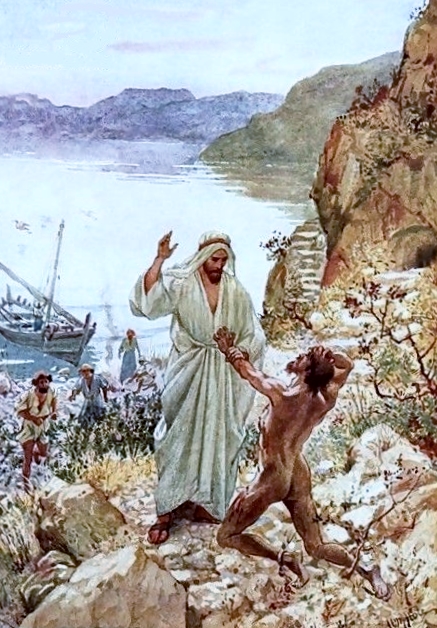
In our Gospel, we meet another wildly outraged man. This one is tormented by his inner demons, causing him also to put himself in dangerous situations. Jesus names this man’s tormentor and casts it out, giving the man control of himself again.


Have you ever been so offended, humiliated or injured that you felt outrage for yourself or another? Such fury chains us, making rationality and reconciliation close to impossible. Sometimes, it renders us impotent to name and address the deep source of our indignation. Instead, we lash out with stones of anger and hate – throwing the dirt of condemnation rather than seeking inner balance and healing.

dementor

Most of us have encountered large or small “dementors” in our life. (Thanks for the term AND the image, Harry Potter) 


But when I think of those who have endured unbelievable degrees of torment, I am amazed at their stories of faith and resolution: Anne Frank, Victor Frankel, Nelson Mandela, Harriet Tubman …. Jesus Christ. How did they come through it whole and blessed?


Mk5_1_20demoniac

Maybe the possessed man in Mark’s Gospel was just lucky that day to run into Jesus. Or maybe he sought out Christ, trying to find stability in the midst of his derangement.

When we face our own imbalances can we stay still long enough to ask, as David did, “What is God teaching me in this. How can this lead me closer to God?” If we could, might we not be surprised to see our demons named, cast into the greater sea of God’s eternal wisdom, peace and love?

Music: Amazing Grace – Sean Clive

It’s All About the Temple

Feast of the Presentation of the Lord

February 2, 2020

Click here for readings

Today, in Mercy, we begin with a reading from the prophet Malachi, a hurler of fire and brimstone in the 4th-5th century before Christ. It’s an interesting choice and begs the question of how it relates to this Feast when a little baby comes to be blessed in the Temple.

Presentation of Our Lord
Presentation of Our Lord – Ambrogio Lorenzetti (Wikipedia.org_ not for commercial use)

Ah, perhaps that’s the hinge – the Temple, both actual and symbolic.

Malachi writes at a time when the second Temple has been restored. In other words, God is about giving the people a second chance to behave according to the Covenant. But they’re not doing such a good job — especially those in charge, the priests:

A son honors his father,
and a servant fears his master;
If, then, I am a father,
where is the honor due to me?
And if I am a master,
where is the fear due to me?
So says the LORD of hosts to you, O priests,
who disdain my name.
Malachi 1:6

A Little Extra Music: Handel – But Who May Abide (You know you have time to listen just before the Super Bowl!)

Through a series of prophetic oracles, Malachi admonishes the people to repent before it is too late because no unrepentant soul will withstand the judgement.

Yes, he is coming, says the LORD of hosts.
But who will endure the day of his coming?
And who can stand when he appears?
For he is like the refiner’s fire,
or like the fuller’s lye.


In the passage from Hebrews, Paul presents the perfect priest, Jesus Christ. In taking flesh, Christ’s Body becomes the new Temple of our redemption. We stand before judgement already saved by his Passion, Death, and Resurrection.


In our Gospel, two aged and venerable prophets wait in the Temple for the Promised One. Their long years of prayer have already proven them faithful. Now, Simeon’s and Anna’s long and complete fidelity is rewarded by seeing their Savior. They know Him because they have already created a place for him in the Temple of their hearts. Now, they will meet their judgement in total peace. As Simeon’s prays:

“Now, Master, you may let your servant go
in peace, according to your word,
for my eyes have seen your salvation,
which you prepared in the sight of all the peoples:
a light for revelation to the Gentiles,
and glory for your people Israel.”

It’s a beautiful, total-hearted prayer!  Don’t we all hope to be able to offer it one day?

( I wrote an earlier reflection about dear Anna.  You might like to see it again here:

Music: Nunc Dimittis – Taizé (Latin and English text below)

Nunc dimittis servum tuum,
Now dismiss your servant
Domine, Domine,
Lord, Lord,
Secundum verbum tuum in pace.
according to your word in peace
Domine.
Lord.

Choices

Friday of the Third Week of Ordinary Time

January 31, 2020

Click here for readings

Today, in Mercy, if this first reading doesn’t smack you right between the eyes, check your political pulse, dear Friends!

David has become King, called to lead his people with a largeness of heart for their good…. but…

power


Power tends to corrupt, and the corruption is hard to resist even for the likes of David. With no checks and balances on him, David commandeers anything he desires – nations, goods, women, human lives! He is convinced that he can do anything he wants to do. His choices lurch him into a spinning culture of death, evil, and selfishness.

This passage from 2 Samuel is threaded with the very same lines woven into this morning’s newspapers: plotting, manipulation, lying, obstruction, projection, irresponsibility, crudeness, disrespect….

Aren’t we just so sick and tired of it all!?

Over the coming days, we will see how David’s corruption affects him – and it’s quite a drama! But for our prayer today, what can we learn?


Perhaps the Gospel offers us a key.

Mk4_30

Jesus talks about “the Kingdom of Heaven”. He uses the symbols of a healthy harvest and a tiny mustard seed. He teaches his listeners that when the things of God are planted deep in us, we too yield a life-giving harvest. We become large-hearted, God-hearted.

Through the gift of free will, God gives us power. We can choose between good and evil, self and others, life and death. In today’s passage, David makes some huge, selfish mistakes in his choices.

Throughout history and even today, people make the same good and bad choices. When leaders make such choices, the whole world feels the impact.

Today, I might want to check how I’m doing, not only in my personal choices, but in my advocacy for a moral and just world for all people.

Music:  A Pure Heart – Rusty Nelson

Who’s Boss?

Thursday of the Third Week in Ordinary Time

January 30, 2020

Click here for readings

Today, in Mercy, David has received a wake up call from God, delivered by the prophet Nathan:

Go and tell David my servant, Thus says the LORD:
Is it you who would build me a house to dwell in?
 
2 Samuel 7:5

As a follow up to David’s big idea of building a house for God, God says,”Wait a minute! I don’t think so!” Gently, but ever so clearly, God reminds David of a phrase very popular on social media today:

boss

It seems David has gotten a little full of himself. He likes being King. He decides to use his power and position to do something nice for God. But God uses the occasion to remind David that all that David has comes from God. David is not God’s King, he is God’s servant. David can’t do anything for God except to offer thanks, praise and worship.

Ps119 lamp

This huge spiritual insight turns David’s heart to see himself truly as God sees him. His subsequent prayer is full of humility and gratitude as David asks God for continued blessing on David’s House.

The lesson for me today is this: God is God. I am nothing without God. Everything I have and am comes from the Divine Goodness.

Meister Eckhart echoes here:

If the only prayer we say
in our entire lives is

“Thank You”,
it is enough.

Music: Thank You, God – mantra video composed by Michelle Sherliza

God Gets Tough

Feast of the Conversion of Saint Paul, Apostle

January 25, 2020

Click here for today’s readings

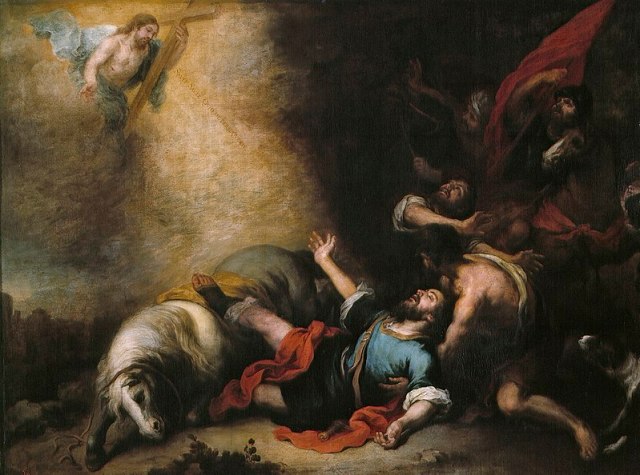
Today, in Mercy, we ride with Paul on the road to Damascus, there to be struck with him by a Godly Light.

800px-La_conversión_de_san_Pablo_(Murillo)
The Conversion of St. Paul — Bartolomé Esteban Murillo

Have you ever been knocked off your “high horse” by the sudden realization of something to which you had been totally blind? It’s shocking, isn’t it? 

We might react by castigating ourselves with remarks like:

  • How could I have missed that?
  • Wow, I was really stupid, or foolish, or naïve, or prejudiced, or misled, or … or what?

God, in a kind of ironic twist, strikes Paul blind in order to cure him of his real blindness: the right he claimed to persecute others for a faith he didn’t understand.

Sometimes God has to be pretty tough with us to wake us up to the truth of our souls. John Donne, the pre-eminent English metaphysical poet, prayed for that kind of Divine Toughness in his poem Batter my heart, three-personed God.

png-divider-lines--1400

Since I have blogged twice previously about this feast,


Links available here:

Click here for 1/24/2019 Reflection

Click here for 4/19/2018 Reflection


I thought my readers might like to pray with Donne’s poem, read by Tom O’Bedlam

Holy Sonnets: Batter my heart, three-person’d God
Batter my heart, three-person’d God, for you
As yet but knock, breathe, shine, and seek to mend;
That I may rise and stand, o’erthrow me, and bend
Your force to break, blow, burn, and make me new.
I, like an usurp’d town to another due,
Labor to admit you, but oh, to no end;
Reason, your viceroy in me, me should defend,
But is captiv’d, and proves weak or untrue.
Yet dearly I love you, and would be lov’d fain,
But am betroth’d unto your enemy;
Divorce me, untie or break that knot again,
Take me to you, imprison me, for I,
Except you enthrall me, never shall be free,
Nor ever chaste, except you ravish me.

Here also is a musical interpretation of the poem.
The University of South Florida Chamber Singers perform Richard Nance’s “Batter my heart” under the direction of Dr. James Bass 

Fill the World with Love

Memorial of Saint Francis de Sales, bishop and doctor of the Church

January 24, 2020

Click here for readings

Today, in Mercy, David spares Saul’s life even though Saul is in murderous pursuit of him. (Here is a video for kids featuring the moment. But I thought it was pretty cool. Maybe you will too.)

Is David noble or naïve? Is he magnanimous or stupid? As I pray this morning, I ask myself what it is that God might be saying to me through this passage.

Two things rise up:

  1. Above all else, David is motivated by a deep respect for God’s Will and Presence in his life.

David said to his men,
“The LORD forbid that I should do such a thing to my master,
the LORD’s anointed, as to lay a hand on him,
for he is the LORD’s anointed.”

    2.  David engages Saul directly and respectfully in the hope of reaching a resolution of    their issues.

When David finished saying these things to Saul, Saul answered,
“Is that your voice, my son David?”
And Saul wept aloud.

Reverence and honesty rooted in sincere love and respect for one another! What a world we would live in if each of us practiced these things unfailingly!


In our Gospel, Jesus calls his disciples to live in the world in just such a way – to bring healing and wholeness in the Name of Christ, for the sake of Love.

Our Alleluia Verse today captures the essence of Christ’s call to them —- and to us:

God was reconciling the world to himself in Christ,
and entrusting to us the message of that reconciliation.


Music: To Fill the World with Love sung by Richard Harris
(Lyrics below, but you will no doubt recall them from the fabulous film “Goodbye Mr. Chips”.)

In the morning of my life I shall look to the sunrise.
At a moment in my life when the world is new.
And the blessing I shall ask is that God will grant me,
To be brave and strong and true,
And to fill the world with love my whole life through.

And to fill the world with love
And to fill the world with love my whole life through

In the noontime of my life I shall look to the sunshine,
At a moment in my life when the sky is blue.
And the blessing I shall ask shall remain unchanging.
To be brave and strong and true,
And to fill the world with love my whole life through

In the evening of my life I shall look to the sunset,
At a moment in my life when the night is due.
And the question I shall ask only You can answer.
Was I brave and strong and true?
Did I fill the world with love my whole life through?

The Green-Eyed Monster

Thursday of the Second Week in Ordinary Time

January 23, 2020

Click here for readings

Today, in Mercy, both David and Jesus deal with the effects of immense popularity.

jealous

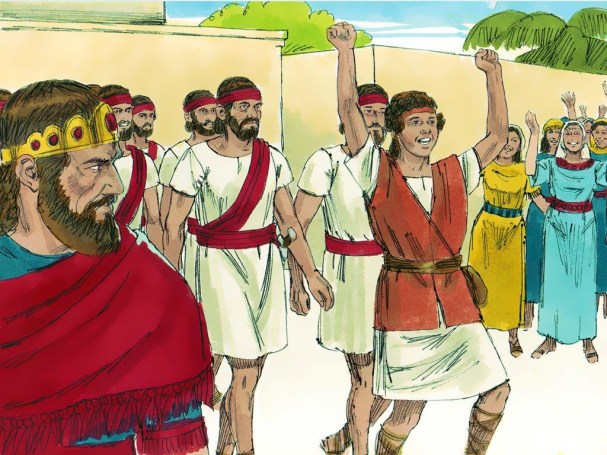
In David’s case, Saul is so jealous and threatened by David’s military success that he plots to murder him. Saul’s son Jonathan, David’s dear friend intervenes to turn his father’s evil intention. Ultimately though, Saul remains a man destroyed by jealousy.


green eye

Jealousy is aptly characterized as the “Green-Eyed Monster”:

The phrase ‘green-eyed jealousy’ was used by, and possibly coined by, Shakespeare to denote jealousy, in The Merchant of Venice, 1596.

In Othello, 1604, Shakespeare refers explicitly to the ‘green-eyed monster’ as jealousy when treacherous Iago counsels Othello:

O, beware, my lord, of jealousy;
It is the green-eyed monster which doth mock
The meat it feeds on; that cuckold lives in bliss
Who, certain of his fate, loves not his wronger;
But, O, what damned minutes tells he o’er
Who dotes, yet doubts, suspects, yet strongly loves!


These powerful words capture what it is like to feel, or to be the object of, jealousy – a feeling which grows out of one’s own insecurity. But since it is a feeling, it is not a sin. It is when we act on our jealousy, as Saul planned to do, that we sin.

I think, at sometime in our lives, most of us have experienced jealousy- either as donor or recipient. How we responded either fortified or eroded our character. Sincere reflection on those responses can continue to help us grow in charity.

Thinking about that, I benefitted from reading this passage from the Catholic Encyclopedia:

Jealousy is here taken to be synonymous with envy. It is defined to be a sorrow which one entertains at another’s well-being because of a view that one’s own excellence is in consequence lessened. Its distinctive malice comes from the opposition it implies to the supreme virtue of charity. The law of love constrains us to rejoice rather than to be distressed at the good fortune of our neighbor.

Our daily prayer and ever-deepening relationship with God can free us to face any “green-eyed monsters” we encounter, turning them into occasions of grace. Let’s pray for that!

Music:  Envy and Jealousy – Sweet Comfort Band (Lyrics below)