Who Do You See in the Mirror?

Eighteenth Sunday in Ordinary Time

August 4, 2019

Click here for reading

Today, in Mercy, our readings focus on “vanity” – its threats and remedies.

Often, we think of vanity as a physical emotion – that Narcissistic self-absorption that keeps us in front of a mirror for inordinate amounts of time. Our culture promotes this kind of vanity by working endlessly to convince us that without certain products we are “not enough” on our own. 

mirror statue

Historically, this kind of rhetoric was directed primarily toward women, spawning a nearly $500 billion global cosmetic market! But men are catching up! The men’s market is forecasted to reach nearly $30 billion by 2023.

Several years ago, while flying home from a business trip, I was seated across from two young women. As we approached home, the one nearest me, began to prepare for landing. She initiated an elaborate cosmetic ritual that involved no fewer than ten brushes plus an array of tubes and compacts. At first, it struck me really funny. Then I realized how very sad it was.

This maturing child was no more than eighteen. She was naturally beautiful with the vigor of youth. But she had obviously spent a lot of money and time not believing in her natural beauty.

Society considers vanity as a kind of pride and pomposity. I think just the opposite. I think vanity is really fear, self-dissatisfaction, anxiety and pain because something has convinced us that we are inadequate.

Vanity damages souls as well as bodies. It makes us behave in greedy, self-absorbed and careless ways toward our neighbors. It makes us pretend we are more than we think we are. It saps us of the strength to be generous, trusting and hopeful.

Paul, in his letter to the Colossians, tells us to get over this kind of vanity:

Put to death, then, the parts of you that are earthly:
immorality, impurity, passion, evil desire,
and the greed that is idolatry.
Stop lying to one another,

since you have taken off the old self with its practices
and have put on the new self,
which is being renewed, for knowledge,
in the image of its creator. 
Col3_10 new image

What if that sweet girl on Flight 419 had been able to look in her mirror and see the image of her Creator? What if we could all do that? How might we spend our time and money differently if we were convinced of how beautiful we are to God?

Music: How Could Anyone Ever Tell You – Shaina Nell

I have added two versions of this beautiful song. Let God sing it to you in your prayer today.


Unconditional Love

Tuesday of the Seventeenth Week in Ordinary Time

July 30, 2019

Click here for readings

Today, in Mercy, we consider God’s unconditional love.

God and Moses and the People have been through it. The trail of complaints, the golden calf, the shattered tablets – these are relational dramas to the extreme! Exodus is definitely soap opera material! Does it feel a little bit like your life, or your family’s, or the families you read about in the news?

Ex34_9 Life

Life is indeed a drama! And our relationship with God is highlighted and shadowed with its twists and turns. For that reason, today’s passage offers us so much comfort and confidence. Even after all that has happened, God reveals himself to Moses like this:

The LORD, the LORD, a merciful and gracious God,
slow to anger and rich in kindness and fidelity,
continuing his kindness for a thousand generations.

Moses is so moved by this new knowledge of God’s unconditional love, that he welcomes God as part of their community:

If I find favor with you, O LORD,
do come along in our company.
This is indeed a stiff-necked people;
yet pardon our wickedness and sins,

and receive us as your own.

We are invited by this reading to open ourselves to that same unconditional love, to thank God for journeying with us through life’s convolutions. Stiff-necked at times, repentant at others, we are always God’s beloved.

As we negotiate the intricacies of our life today, we might trustingly say like Moses:

Lord, do come along in my company.

Music: Outrageous Grace – Godfrey Birtill

Idols!

Memorial of Saint Martha

July 29, 2019

Click here for readings

Today, in Mercy, our readings offer us a central question for our faith and spirituality: What do we really worship?

Ex32_19 calf

As we continue the Exodus story, Moses has been on the mountain receiving the Law from God. Meanwhile, back at the ranch, delegated leader Aaron is blowing his assignment. The Israelites tire of waiting for Moses. They want another god to lead them onward. Aaron comes up with idea of fashioning such a idol from all their molten jewelry.

When Moses descends the mountain with the newly-minted tablets in hand, he burns in anger at the scene, smashing the holy stones at his feet. More than a flared temper, this act symbolizes a fractured relationship with God.

The story suggests this for our prayer: we are in ever-deepening relationship with God through our own covenants – our creation, our baptism, our further professions of faith and commitment, our sacramental encounters. These are all living relationships, inviting us to new and deeper life in God.

Still, there may be times in our lives when our hearts lose focus on these covenants 

  • when we try to move somewhere without God’s companionship
  • when we substitute old baubles for moral or spiritual truth
  • when we return to weakening comforts rather than grow into a challenging grace
  • when we just get really mixed up about what is most important in our lives

The calf-worshippers had a big fail in this regard. Exodus tells the story of a merciful God trying to deal with their disloyalty and refashion them as God’s chosen people.

Our Gospel shows us Martha, also a little off target in terms of her spiritual priorities. While she is no where near idol worship, she still allows needless distractions to keep her from fully enjoying relationship with God.

Martha

Gentle, merciful Jesus turns her eyes toward him and she understands. Maybe that beautiful grace is what we want to pray for today.

Music:  You Alone – Sarah Hart

Ask and Receive

Seventeenth Sunday in Ordinary Time

July 28, 2019

Click here for readings

Today, in Mercy, our readings are connected by two often oppositional themes: BARGAINING and TRUST.

The Genesis passage is a familiar story, mainly because “Mrs. Lot” later gets turned into a pillar of salt. But the beginning of the story, today’s reading, is all about Moses bargaining with God to spare the inhabitants of sinful Sodom and Gomorrah. 

The Divine conversation is painted in very human terms, a ping-pong match of “what if”s and “OK”s between Moses and God. Moses finally bargains God down to the hope of finding just ten good men in these depraved cities. And Moses trusts God to be merciful, a trust delivered in the salvation of Lot and his family.

In the second reading from Colossians, Paul reminds us of our own deliverance through baptism and sharing in the Resurrection of Christ. This is the infinite gift in which we put our hope and trust as believers.

Our Gospel reading from Luke opens with the Our Father, the ultimate prayer of trust. Jesus goes on to tell us that we can always trust God’s care for us.

Ask and you will receive;
seek and you will find;
knock and the door will be opened to you.
For everyone who asks, receives;

and the one who seeks, finds;
and to the one who knocks, the door will be opened.

Jesus isn’t talking about magic, where we just say the word and automatically get what we imagined, or where we bargain with God as if we had something to offer. 

Lk11_12 Ask_Egg

Jesus is talking about that fundamental trust which believes in God’s faithfulness to us in all circumstances. He will not “hand us a serpent when we ask for an egg”. But it may be a very different “egg” (outcome) from the one we expected. Trust allows us to crack it open to find the unimagined grace inside.

Music: I Will Trust in You – Lauren Daigle

The Bloody Lintel

Friday of the Fifteenth Week in Ordinary Time

July 19, 2019

Click here for readings

Today, in Mercy, we begin a series of texts about the Passover. These readings are so richly symbolic, not only for our personal prayer, but also for our sacramental understanding. Today’s passage addresses the acquisition and sacrifice of the Passover lamb.

plague
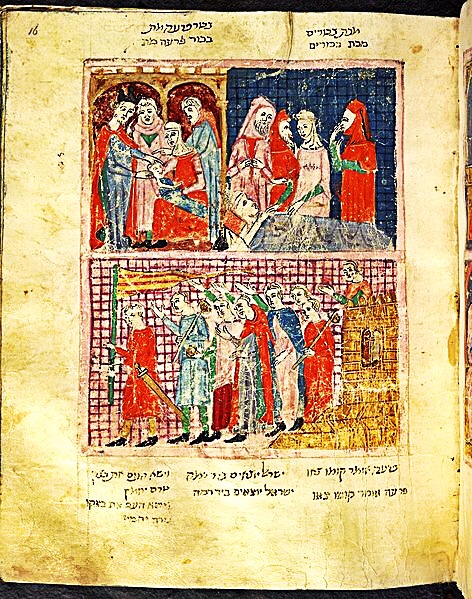
Scenes from Exodus. Full-page miniature, upper register: the tenth plague: the death of the first-born including Pharaoh’s son, lower register: the Israelites leaving Egypt. From the Haggadah for Passover (14thC.)

Maybe for you, as for me, this is one of first Bible stories you recall from childhood. I remember how the drama built as my teacher read this story – all these wide-eyed kindergarteners hanging on her every word.

God was done with Pharaoh who had already ignored nine – yes NINE – plagues! Now the Egyptians’ first-born would be taken from them in a heavenly massacre! It was terrible to imagine. But even worse to consider was how the innocent Israelites would be spared from the dreaded visitation!

Even as a little pre-schooler, I already knew that we sometimes get in situations that only God can get us out of.  What I have begun to learn in my maturity is that – rather than get us out of such circumstances –  God chooses to pass through these life experiences WITH us.

An image we might consider in our prayer today:  these lintels were marked in BLOOD. The visiting angel could have as easily read a charcoal mark on the door, or a colored slab of paint. But the deliverance was secured by blood.

lintel

When devastating loss, sorrow or confusion comes to our door, how does our faith deliver us to the Promise of joy and peace? 

It cannot be by some hastily obtained symbol or sign, or borrowed prayer. Our faith must already be rooted deep down in our veins, our arteries, our heart, our blood. That rooting shall not be moved, no matter the circumstance. That rooting ties us to the God of Life. That rooting allows us to discover God even in our chaos.

As we pray today, under the lintel post of our faith, let us be mindful that these magnificent passages prefigure the Holy Lamb of God, Jesus, who saves us from every kind of death. May we ask for the grace to deepen our Eucharistic and Paschal faith so that we may fully trust God in our own Passovers.

Music: Agnis Dei – Michael Hoppé

The Name

Thursday of the Fifteenth Week in Ordinary Time

July 18, 2010

Click here for readings

Today, in Mercy, God reveals God’s Name to Moses.

Ex3_14

Names are so important, aren’t they? Parents among you will remember how you labored over a name for each of your unborn children. Names carry roots to our history and hopes for our future. They suggest a shape for us to grow into and a way for us to be in the world.

In relationships, the giving of our name is a gift and an invitation. It is the first step in a mutual journey that may stop at the end of the encounter, or grow and blossom for years to come.

When God gives God’s name to Moses, it is all these things plus a Promise to abide forever in relationship. God hands Moses the key to call on God’s faithfulness forever. And God risks the hope that Moses will respond with fidelity and courage.

In prayer, and in our acts of mercy over a lifetime, God ever more deeply reveals the Holy Name to us. God promises to abide through our life with us and asks us to abide with Him. God risks that we will love, reverence, and respond to that amazing invitation with each successive moment and into eternity.

Today, in prayer, let us just rest in the Names we love to call God. Let us listen to the Love with which God names us.

Music:  Names of God – Laurell Hubick

The Burning Bush

Wednesday of the Fifteenth Week in Ordinary Time

July 17, 2019

Click here for readings

Today, in Mercy, we read about a “theophany” – a visible manifestation to humankind of God. Not your everyday occurrence, right? Well, let’s think about that.

Ex3_4 bush

In today’s passage from Exodus, Moses, self-exiled from Egypt because he murdered an abusive slave master, is shepherding his father-in-law’s flock through the desert. (Good practice for what will face him for the next forty years!) He’s basically out in the middle of nowhere, mindlessly daydreaming as the sheep dogs do most of the work.

All of a sudden, in the still, quiet spaciousness, a lonely bush combusts right in front of him! Theophany! God wants his attention.


For most of us, there are no burning bushes.
So what does God do when God wants our attention?


Just this morning, another Sister and I were praying in our quiet living room. In the stillness, I heard her very softly say, “Praise God”. She had noticed the clear, blue sky and gently swaying leaves outside our window. She had become instantly aware of how blessed she was by such beauty and life.

A theophany? I think so. And there are scores of them flowing past us daily if we can just open the inner heart to see them; if we can just pause to be grateful within their presence; if we can just acknowledge them by a simple prayer and wait to hear their message.

Some “theophanies” come gently like my friend’s this morning. Some come in an unexpected, and perhaps unwanted, explosion that disrupts our lives. But in each of their guises, they carry a God Who wants to speak with us. May we listen.

Music: jazzing it up today
Echoes from the Burning Bush – The Cathedral Singers

Moses stood on holy ground
Far from God descended down
Set the roadside bush on fire (bush on fire)

Then the Lord did there explain
Through His servant should remain
All the echoes from the bush on fire (the bush on fire)

Oh the echoes from the bush (I hear those lovely echoes from the burning bush)
How they thrill my soul (how they thrill my soul)
Oh the echoes from the bush (I hear those thrilling echoes from the burning bush)
Point me to the Lord (point me to the Lord)

I no more am doubting, but with joy I’m shouting
With no thought of shame to blush (no shame to blush)
This my song shall ever be, words that are so sweet to me
Echoes from the burning bush (the burning bush)

God sent down His only Son
Just to ransom everyone
By the echoes from the fire (from the fire)

God of every earthly land
Would not pick nor choose a man
For His blood will save us from the fire (eternal fire)

Wounded by Mercy

Tuesday of the Fourteenth Week in Ordinary Time

July 9, 2019

Click here for readings

Today, in Mercy, we continue to learn from the amazing saga of Jacob.

This passage tells a story we may have heard: 

Jacob, after years in isolation, is returning to seek reconciliation with his aggrieved brother Esau. Jacob is stressed, penitent, and maybe a good bit nervous about the first encounter.

He tries to get a decent night’s sleep before the highly anticipated meeting. But that was not to be.

Jacob and AngelJPG
Jacob Wrestling with the Angel by Eugène Delacroix

Jacob wrestles through night with an unnamed stranger. The stranger – perhaps an angel, perhaps God – wounds him, renames him, and ultimately blesses him.

The passage is so worth a reflective read! In that reflection, we may see glimpses of our own relationship with God. God comes to us too, unexpectedly, in both our lights and our darknesses. God wrestles us to look him in the face, in the heart – to turn our attention from all the luring distractions and shallowness that keep us from him.

At best we, like Jacob, might come to a sort of truce with God: we do not fully know God’s Name but we, nevertheless, receive God’s blessing. That blessing changes us, renames us. And, in a visible way, it marks us – just as Jacob was marked by a “limp”. We become vulnerable to the things of God, to God’s hope for the world, to the Mercy of God for all Creation. We become marked by a Love which, though it seems to weaken, is our ultimate and indefatigable strength.

Today’s final thought: Will we let ourselves be changed by the grace offered us in life’s struggles? Will we let ourselves be renamed and marked as God’s own?

Frederick Buechner, in his sermon The Magnificent Defeat talks about such surrender:

Power, success, happiness, as the world knows them, are his who will fight for them hard enough; but peace, love, joy, are only from God. And God is the enemy whom Jacob fought there by the river, of course, and whom in one way or another we all of us fight-God, the beloved enemy. Our enemy because, before giving us everything, he demands of us everything; before giving us life, he demands our lives – our selves, our wills, our treasure.

Will we give them, you and I? I do not know. Only remember the last glimpse that we have of Jacob, limping home against the great conflagration of the dawn. Remember Jesus of Nazareth, staggering on broken feet out of the tomb toward the Resurrection, bearing on his body the proud insignia of the defeat which is victory, the magnificent defeat of the human soul at the hands of God.

Music: Jacob Wrestles with the Angel – Leo Kraft

With You, All the Way!

Monday of the Fourteenth Week in Ordinary Time

July 8, 2019

Click here for readings

Today, in Mercy, we come to the heart of the Jacob story. Through prayer, it may reveal the heart of our story too.

Think of this. Is there anything better than a true friend who, even in your worst isolation, says:

  • I’ve got your back.
  • I’m right here at your side.
  • I’m with you through it all.

This is who God promises to be for Jacob in today’s wonderful first reading.

Gen28_12Ladder

Trickster Jacob, banished and fleeing from His enraged brother, falls asleep on the vast plain, with only a rock for his pillow. He is on a journey between two lives – the old one of extreme conflict, and a new one, as yet unrevealed. When he falls asleep on this desolate night, he thinks he journeys alone.

Ever feel like that? In life, we make many small and big journeys from the old to the new, the comfortable to the challenging, the past to the future, the known to the unknown. Sometimes we make choices to leave a “life” behind. Sometimes, life makes the choice in spite of us. In many of these chosen or unchosen transitions, we may feel very alone, even abandoned.

The good news of today’s reading is that God thinks otherwise.

Know that I am with you;
I will protect you wherever you go,
and bring you back to (wholeness).
I will never leave you
until I have done what I promised you.

In today’s Gospel, Jesus realizes this same ancient promise in the lives of two people on painful journeys. 

He heals the hemorrhaging woman through just her trusting fingertip along his garment’s hem. Such is the awesome power of faith and promise!

He raises new life in a dying child by the reach of her father’s faith into the heart of God’s mercy.

God is with each one of us too – unequivocally. God’s Mercy is everywhere and always.

Jacob responds to God’s promise with faith and hope. So do the Gospel’s centurion and suffering woman. Each of them, in their particular journey, shows us how to welcome God’s promise, “I am with you.” All we need do is to be with God too.

Music: You Are Mine – David Haas

Joy

Fourteenth Sunday in Ordinary Time

July 7, 2019

Click here for readings

Today, in Mercy, our readings are knit together by the theme of joy – a quality whose description and possession are elusive.

Lk10_20 joy

As I sought a way to write about joy, I thought immediately of the author C.S. Lewis. If you don’t know him, I suggest it would be worth your while to discover him.

C.S. Lewis was a British writer, academic and theologian. He is best known for his works of fiction, especially The Chronicles of Narnia, The Screwtape Letters, and The Space Trilogy. Among my favorite of his non-fiction works are Surprised by Joy and A Grief Observed.

Lewis clearly understood and lived a spirituality like the one offered in today’s readings. He came to understand the amazing difference between joy and happiness. He experienced joy as a longing for the Infinite which is suggested by life’s beauty, but never fully accessed by our human sensibility.

Isaiah, Paul, and Jesus preach this kind of joy in our readings. It is a joy that, even in the midst of trial, gives us peace and hope. It is rooted in our immutable trust in God’s abiding love for us. As today’s Psalm says:

Hear now, all you who fear God,
while I declare
what he has done for me.
Blessed be God who refused me not
my prayer or his kindness!

You might enjoy these quotes about joy from C.S.Lewis. Movie lovers among you might like the wonderful 1993 film about the relationship between Lewis and American poet Joy Davidman, her death from cancer, and how this challenged Lewis’s Christian faith.


All Joy reminds. It is never a possession, always a desire for something longer ago or further away or still ‘about to be’.”
C.S. Lewis, Surprised by Joy

“Joy—that sharp, wonderful Stab of Longing—has a lithe, muscular lightness to it. It’s deft. It produces longing that weighs heavy on the heart, but it does so with precision and coordination…It dashes in with the agility of a hummingbird claiming its nectar from the flower, and then zips away. It pricks, then vanishes, leaving a wake of mystery and longing behind it.”
(from Shadowlands and Song of Light by Kevin Ott – a journey into the thoughts of C.S.Lewis)

“If I find in myself a desire which no experience in this world can satisfy, the most probable explanation is that I was made for another world. If none of my earthly pleasures satisfy it, that does not prove that the universe is a fraud. Probably earthly pleasures were never meant to satisfy it, but only to arouse it, to suggest the real thing.”
C. S. Lewis, Mere Christianity

Music: Shadowlands – Rebecca St.James