Mountain

Second Sunday of Lent
February 25, 2024

Today’s Readings:

https://bible.usccb.org/bible/readings/022524.cfm


“Take your son Isaac, your only one, whom you love, 
and go to the land of Moriah.
There you shall offer him up as a holocaust 
on a mountain that I will point out to you.”


Jesus took Peter, James, and John 
and led them up a high mountain apart by themselves.
And he was transfigured before them, 
and his clothes became dazzling white, 
such as no fuller on earth could bleach them.


Often it is at the height of our joy, or the height of our sorrow that we feel closest to God. Intense experiences can bring us unequaled grace and opportunity for spiritual growth.

Today, in God’s Lavish Mercy:

In our prayer, we may gratefully remember the “mountains” of our lives, those times when joy, hope, pain, or anxiety built almost insurmountably in our hearts. How did God meet us in those moments? How did we meet God? How have our “mountains” transformed our lives?


Poetry: Unveiling the Heart’s Mirror – Rumi

All through eternity
Beauty unveils His exquisite form
in the solitude of nothingness;
He holds a mirror to His Face
and beholds His own beauty.
he is the knower and the known,
the seer and the seen;
No eye but His own
has ever looked upon this Universe.
His every quality finds an expression:
Eternity becomes the verdant field of Time and Space;
Love, the life-giving garden of this world.
Every branch and leaf and fruit
Reveals an aspect of His perfection.
The cypress gives hint of His majesty,
The rose gives tidings of His beauty.
Whenever Beauty looks,
Love is also there;
Whenever beauty shows a rosy cheek
Love lights Her fire from that flame.
When beauty dwells in the dark folds of night
Love comes and finds a heart
entangled in tresses.
Beauty and Love are as body and soul.
Beauty is the mine, Love is the diamond.
They have together
since the beginning of time-
Side by side, step by step.
I swear, since seeing Your face,
the whole world is fraud and fantasy
The garden is bewildered as to what is leaf
or blossom. The distracted birds
can’t distinguish the birdseed from the snare.
A house of love with no limits,
a presence more beautiful than venus or the moon,
a beauty whose image fills the mirror of the heart.

Music: God on the Mountain – Lynda Randle

Leprosy

Sixth Sunday in Ordinary Time
February 11, 2024

Today’s Readings:

https://bible.usccb.org/bible/readings/021124.cfm


Today, in God’s Lavish Mercy, our readings are connected by the topic of leprosy.

The LORD said to Moses and Aaron,
“If someone has on his skin a scab or pustule or blotch
which appears to be the sore of leprosy,
he shall be brought to Aaron, the priest,
or to one of the priests among his descendants.
If the man is leprous and unclean,
the priest shall declare him unclean
by reason of the sore on his head.

Leviticus 13:2-3

“Leprosy” (Hebrew “tzaraat“) is first mentioned in chapters 13 and 14 of the Book of Leviticus. The term referred not only to many types of skin maladies but to ritual impurities and visually perceptible “punishments for sin”. In ancient times, someone suffering from an affliction as common as eczema might have been shunned as a leper.

Essentially, Levitical Law could base moral judgment of a person on their physical appearance. One might be seen to suffer physical deformity because of their own sins or the sins of their ancestors. The illness or deformity was then used as an excuse to condemn and isolate the suffering person.


Cleansing of the Leper by Harold Copping

Even though our scripture readings today are ostensibly about “leprosy”, they are about much more. Our readings challenge our ability or inability to see, love, and support our neighbor for who they are, not for how they appear. 

Jesus sees the person who comes to him, not the disease or disfigurement which inhibits him.

A leper came to Jesus and kneeling down begged him and said,
“If you wish, you can make me clean.”
Moved with pity, he stretched out his hand, 
touched him, and said to him, 
“I do will it. Be made clean.”

Mark 1: 40-41

Praying with today’s Gospel reminds me of the powerful movie “Philadelphia” starring Tom Hanks who won an Academy Award for his role as Andrew Beckett, a lawyer suffering from AIDS.

“Philadelphia” is notable for being one of the first mainstream Hollywood films not only to explicitly address HIV/AIDS and homophobia, but also to portray gay people in a positive light.
Andrew Beckett is a senior associate at the largest corporate law firm in Philadelphia. He conceals his homosexuality and his status as an AIDS patient from others in the office. A partner in the firm notices a lesion on Beckett’s forehead. Although Beckett attributes the lesion to a racquetball injury, it indicates Kaposi’s sarcoma, an AIDS-defining condition.

wikipedia

My own reflection today benefitted from revisiting this scene from the film. Like any parable, the story invites us to find ourselves somewhere in it.

People can be cut off from society for many conditions, be they leprosy, AIDS, or any other visible impediment. But the underlying reason they are shunned is fear — something about the person frightens us, or threatens to upset our religious, political, or economic securities.


If we want to be like Jesus, we must move beyond those fears and judgments – to see and love the person whom Mercy sees.


Music: “La Mamma Morta”, a 1950 Studio recording by Renata Tebaldi

Those who remember this movie will also remember this beautiful aria, played when Denzel Washington comes to consult with Tom Hanks in his home. The moment is a turning point for Washington who is fighting his own fears and prejudices as he takes on Hank’s case.

“La mamma morta” (They killed my mother) is a soprano aria from act 3 of the 1896 opera Andrea Chénier by Umberto Giordano. It is sung by Maddalena di Coigny to Gérard about how her mother died protecting her during the turmoils of the French Revolution.

Selflessness

Saturday of the Fourth Week in Ordinary Time
February 3, 2024

Today’s Readings:

https://bible.usccb.org/bible/readings/020324.cfm


Today, in God’s Lavish Mercy, our readings offer us insights into the ministry of leadership. They are insights worth pondering for at least these two reasons:

  • We are all called to be leaders in some way in our lives, be it as parent, teacher, supervisor, team captain, committee lead, board chair … you name it.
  • We need to be able to recognize good leaders in order to follow wisely, otherwise we are following self-interested fools determined to re-create us in their likeness.

In both our readings, leadership is characterized by this key element: selflessness.

Solomon, when given the chance to ask for anything he wants, asks for a gift that will benefit the community.


Give your servant, therefore, an understanding heart
to judge your people and to distinguish right from wrong.

1 Kings 4:9

Jesus and the disciples, exhausted from the press of the crowd, still respond in mercy to their relentless needs

Jesus said to the disciples,
“Come away by yourselves to a deserted place and rest a while.”
People were coming and going in great numbers,
and they had no opportunity even to eat.
So they went off in the boat by themselves to a deserted place.
People saw them leaving and many came to know about it.
They hastened there on foot from all the towns
and arrived at the place before them.

When Jesus disembarked and saw the vast crowd,
his heart was moved with pity for them,
for they were like sheep without a shepherd;
and he began to teach them many things.

Mark 6: 30-34

As we daily focus our lives on becoming more like Christ, the practice of selflessness can be tricky – how to live selflessly without losing one’s self; how to foster common and individual good without depleting one’s own spiritual strength. To my mind, these things are important:

Honesty: I think the grounding virtue of a good leader is honesty – with others and with self. Once a leader starts to pretend, deceive, equivocate, feign ignorance, or outright lie, (even to themselves), they are no longer fit to lead.

Spiritual Discipline: When we look at Jesus’s life, we see that he practiced a cycle of ministry and prayer. Several times in the Gospel, Jesus withdraws to commune with the Father. Although Christ was in union with the Father at all times, he exercised his ministry around a personal discipline of solitude and prayer.

Discernment: Solomon understands the importance of this gift. What Solomon actually prays for is the sensitivity to practice the “cardinal virtues” that we learned long ago in catechism class. Remember? Prudence, Justice, Fortitude, and Temperance.


Prose: Remember the Baltimore Catechism? Well, maybe some of you are too young to remember, Here’s how wikipedia defines it:

A Catechism of Christian Doctrine, Prepared and Enjoined by Order of the Third Council of Baltimore, or simply the Baltimore Catechism, was the national Catholic catechism for children in the United States, based on St. Robert Bellarmine’s 1614 Small Catechism. The first such catechism written for Catholics in North America, it was the standard Catholic school text in the country from 1885 to the late 1960s. From its publication, however, there were calls to revise it, and many other catechisms were used during this period. It was officially replaced by the United States Catholic Catechism for Adults in 2004, based on the revised universal Catechism of the Catholic Church.


Throughout my adult life, I have retained an appreciation for what I learned from the now-defunct edition of the Baltimore Catechism. While it conveyed the impression that a recipe for holiness could be compacted into a small manual, its inimitable Thomistic logic left valuable lessons with me to which I often return. Here are a few that informed my prayer today as I reflected on “selflessness”:

Besides the theological virtues of faith, hope, and charity there are other virtues, called moral virtues.

These virtues are called moral virtues because they dispose us to lead moral, or good lives, by aiding us to treat persons and things in the right way, that is, according to the will of God.

The chief moral virtues are: prudence, justice, fortitude, and temperance; these are called cardinal virtues.

These virtues are called cardinal virtues because they are like hinges on which hang all the other moral virtues and our whole moral life. The word “cardinal” is derived from the Latin word “cardo” meaning hinge.

  • Prudence disposes us in all circumstances to form right judgments about what we must do or not do.
  • Justice disposes us to give everyone what belongs to them.
  • Fortitude disposes us to do what is good despite any difficulty.
  • Temperance disposes us to control our desires and to use rightly the things which please ourselves.

Music: Song of Solomon – Martin Smith

Crippling Regret

Tuesday of the Fourth Week in Ordinary Time
January 30, 2024

Today’s Readings:

https://bible.usccb.org/bible/readings/013024.cfm


Today, in God’s Lavish Mercy, we read one of the saddest lines in Scripture.

2Sam18_32

You have followed the story in these daily passages. Absalom rebels, designing to usurp his father’s throne. A massive battle rises between them. David, as commander-in-chief, remains behind, but gives instructions to his generals to spare Absalom’s life. Joab ignores the command, killing Absalom in a moment of vulnerability.

David is devastated.

david mourns
David Mourning Absalom’s Death –
Jean Colombe

I think there is no more wrenching human emotion than regret. When I ministered for nearly a decade as hospice chaplain, and later in the hospital emergency room, I saw so much regret.

People who had waited too long to say “I’m sorry”, “I forgive you”, “Let’s start over”, ” It was my fault too..”, “Thank you for all you did for me”, “I love you”…..

Instead, these people stood at lifeless bedsides saying things like, “I should have”, “I wish…”, “If only…”


Life is complex and sometimes difficult. We get hurt, and we hurt others — sometimes so hurt that we walk away from relationship, or stay but wall ourselves off.

We might think that what is missing in such times is love. But I think it is more likely truth. In times of painful conflict, if we can hear and speak our truth to ourselves and one another, we open the path to healing.


If you want the truth, I’ll tell you the truth.
Listen to the secret sound,
the real sound, which is inside you.
~ Kabir


That healing may demand adjustments, agreements, even a willingness to step apart in mutual respect. But if the changes emerge from shared truth, restoration and wholeness are possible.

David and Absalom never found that path because they were so absorbed in their own self-interests. Theirs was the perfect formula for regret – that fruitless stump that perpetually sticks in the heart.


I remember a trauma surgeon leaving the hospital late one night after an unsuccessful effort to save a young boy who had been shot. The doctor carried the loss so heavily as he walked into the night saying to me, “I’m just going to go home and hug my kids.”

As we pray over David and Absalom today, let us examine our lives for the still healable fractures and act on them. Let us “hug” the life we have. Regret is a useless substitute.


Poetry: The Eyes of My Regret – Angelina Weld Grimké

Angelina Weld Grimké was born in Boston on February 27, 1880. She was the daughter of Archibald Grimké, who had been born a slave in Charleston, South Carolina, and Sarah Stanley Grimké, a white woman and the daughter of an abolitionist. Named after her great-aunt, the abolitionist and suffragist, Angelina Grimké Weld, Grimké grew up in liberal, aristocratic Boston society. She attended the best preparatory schools in Massachusetts, including Cushing Academy and the now defunct Carleton School.

My readers might be interested in Sue Monk Kidd’s excellent historical novel “The Invention of Wings” which tells the story of the poet’s abolitionist great-aunts, the Grimké sisters.


The Eyes of My Regret

Always at dusk, the same tearless experience,
The same dragging of feet up the same well-worn path
To the same well-worn rock;
The same crimson or gold dropping away of the sun
The same tints—rose, saffron, violet, lavender, grey
Meeting, mingling, mixing mistily;
Before me the same blue black cedar rising jaggedly to a point;
Over it, the same slow unlidding of twin stars,
Two eyes, unfathomable, soul-searing,
Watching, watching—watching me;
The same two eyes that draw me forth, against my will dusk after dusk;
The same two eyes that keep me sitting late into the night, chin on knees
Keep me there lonely, rigid, tearless, numbly miserable,
—The eyes of my Regret.

Music: When David Heard – Eric Whitaker (The piece builds. Be patient. Lyrics below)

When David heard that Absalom was slain,
he went up into his chamber over the gate and wept,
and thus he said;

My son, my son,
O Absalom my son,
would God I had died for thee!

When David heard that Absalom was slain,
he went up into his chamber over the gate and wept,
and thus he said;

My son, my son.

Mercy in the Darkness

Monday of the Fourth Week in Ordinary Time
January 29, 2024

Today’s Readings:

https://bible.usccb.org/bible/readings/012924.cfm


Today, in God’s Lavish Mercy, our readings are peppered with angst, curses, demons, and rampaging pigs. Not the perfect way to start your day, right? So after quietly reading all the passages, I asked myself if they had anything to offer me this morning, or should I just play Spider Solitaire on my iPad?

As I considered that question, last night’s evening news flashed before my mind – gun violence, assaults, war, hit-and-run accidents! Suddenly I realized that my world is not that different from the mayhem around David or Jesus. My world just wears different clothes and can create chaos faster because of technological power.


The cause of David’s dire situation is clearly defined by Shimei, the curser:

Shimei Curses David – by Julius Schnorr von Carolsfeld

As David was approaching Bahurim,
a man named Shimei, the son of Gera
of the same clan as Saul’s family,
was coming out of the place, cursing as he came.
He threw stones at David and at all the king’s officers,
even though all the soldiers, including the royal guard,
were on David’s right and on his left.
Shimei was saying as he cursed:
“Away, away, you murderous and wicked man!
The LORD has requited you for all the bloodshed in the family of Saul,
in whose stead you became king,
and the LORD has given over the kingdom to your son Absalom.
And now you suffer ruin because you are a murderer.”

2 Samuel 16:5-7

In other words, David is completely out of alignment with the “self” God created him to be. God’s beautiful hope in David has been nearly swallowed up by most of the seven deadly sins. And good for Shimei, who slings every one of them back in David’s face! What a wake-up call!


In our Gospel, the Evil One has taken up residence in the skewed and troubled soul of a tomb-dweller:

… a man from the tombs who had an unclean spirit met Jesus.
The man had been dwelling among the tombs,
and no one could restrain him any longer, even with a chain.
In fact, he had frequently been bound with shackles and chains,
but the chains had been pulled apart by him and the shackles smashed,
and no one was strong enough to subdue him.

Mark 5:3-4

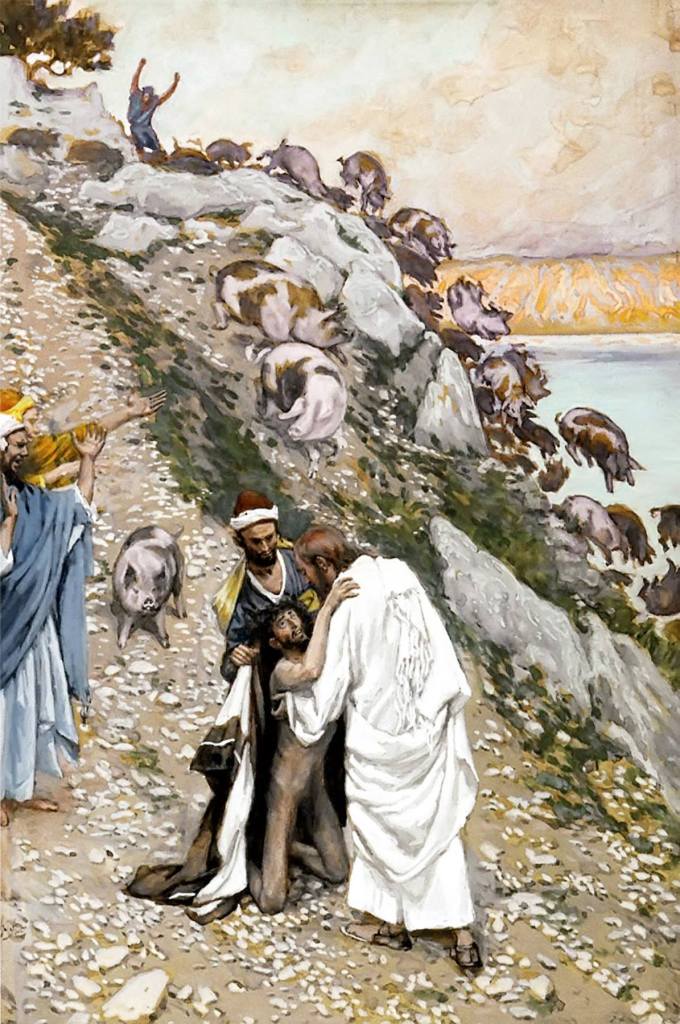
Swine Driven into the Sea by James Tissot

For reasons the Gospel does not reveal, demons rage inside this pathetic man. Jesus confronts them with an intensity even beyond Shimei’s, casting them into the subsequently nose-diving swine:

Catching sight of Jesus from a distance,
he ran up and prostrated himself before him,
crying out in a loud voice,
“What have you to do with me, Jesus, Son of the Most High God?
I adjure you by God, do not torment me!”
(Jesus had been saying to him, “Unclean spirit, come out of the man!”)
Jesus asked him, “What is your name?”
He replied, “Legion is my name. There are many of us.”
And he pleaded earnestly with Jesus
not to drive them away from that territory.

Now a large herd of swine was feeding there on the hillside.
And they pleaded with him,
“Send us into the swine. Let us enter them.”
And he let them, and the unclean spirits came out and entered the swine.
The herd of about two thousand rushed down a steep bank into the sea,
where they were drowned.

Mark 5:6-13

Wow! I mean, really, these two readings are Cecil B. DeMille stuff! Certainly there is a lesson for each of us somewhere in all this drama.

  • Might David’s plight remind us to keep our lives in alignment with God’s hope and will for us?
  • Might Shimei’s rage and brutal honesty help us to consider any retained hurts and vengeances we harbor?
  • Might the poor, chained tomb-dweller help us to place our own small demons squarely in the merciful light of God’s healing power before they get too powerful for us to face?
  • Might the devastated pigs caution us that innocent people can get hurt when our sinful inclinations derail us?

Even though many aspects of today’s readings are harsh, they hold a central message of God’s enduring mercy toward us even in times of desperation and apparent hopelessness. May we hold on to this truth if we ever come to a place of darkness in our lives. And may we offer that Light to those we encounter who are bearing such suffering.


Poetry: Excerpt from “Love Song to the Demon-Possessed Pigs of Gadara” – William Fargason

William Fargason is the author of Love Song to the Demon-Possessed Pigs of Gadara (University of Iowa Press, 2020), winner of the 2019 Iowa Poetry Prize and the 2020 Florida Book Award in Poetry (Gold Medal). In this collection, Fargason inspects the pain of memory alongside the pain of the physical body. Fargason takes language to its limits to demonstrate how grief is given a voice. His speaker confronts illness, grapples with grief, and heals after loss in its most crushing forms. (from Iowa University Press).


The silence just before and just after,
and the black eyes as you leapt— “
no protest, no acceptance either.

You ran almost in unison,
a dance without music,
a curtain call,
and the crowd standing knowing this is what happens
once we find beauty:

                                      we must watch it leave.


Music: Healing Time on Earth – John Denver

… the seed would sprout…

Memorial of Saints Timothy and Titus, bishops
January 26, 2024

Today”s Readings:

https://bible.usccb.org/bible/readings/012624.cfm


Today, in God’s Lavish Mercy, we have two beautiful readings to enrich our prayer.

In our first reading, Paul blesses and encourages his young disciple Timothy. Reminding Timothy of his faith heritage, received from his mother and grandmother, Paul inspires Timothy to live a spiritually courageous life:

I remind you to stir into flame
the gift of God that you have through the imposition of my hands.
For God did not give us a spirit of cowardice
but rather of power and love and self-control.
So do not be ashamed of your testimony to our Lord,
nor of me, a prisoner for his sake;
but bear your share of hardship for the Gospel
with the strength that comes from God.

2 Timothy 1: 6-8

Praying with this passage, we can look both back and forward – to those who have encouraged our faith, and to those who depend on us for edification.


Image by Rosy / Bad Homburg / Germany from Pixabay

In our Gospel, Jesus paints a picture for his disciples of what the Kingdom of Heaven is like. This is a realm in which we already live – the eternal universe of the Creator’s love and grace. But our time-bound eyes can’t see that world clearly. It is more real than our physical world, but perceptible only to the awakened spirit.

Jesus tries to explain this “kingdom” to his followers. He says that like the growth of a seed, this world is a sacred mystery whose energy is generated by God, not by us:

This is how it is with the Kingdom of God;
it is as if someone were to scatter seed on the land
and would sleep and rise night and day
and the seed would sprout and grow,
they know not how.
Of its own accord the land yields fruit,
first the blade, then the ear, then the full grain in the ear.
And when the grain is ripe, they wield the sickle at once,
for the harvest has come.

Mark 4: 26-29

Paul and Jesus encouraged their followers to live in joyous alignment with this Divine Order – the “Kingdom of God”, as scripture calls it. In our prayer today, let’s listen to their counsel, for it is meant for us as well.


Poetry: Let This Darkness Be a Bell Tower – Rainer Maria Rilke, Sonnets to Orpheus II, 29

“Quiet friend who has come so far,
feel how your breathing makes more space around you.
Let this darkness be a bell tower
and you the bell. As you ring,
what batters you becomes your strength.
Move back and forth into the change.
What is it like, such intensity of pain?
If the drink is bitter, turn yourself to wine.
In this uncontainable night,
be the mystery at the crossroads of your senses,
the meaning discovered there.
And if the world has ceased to hear you,
say to the silent earth: I flow.
To the rushing water, speak: I am.”

Music: Lamb of God – from the Mass of St. Timothy – Matt Maher

Noble Soul

Friday of the Second Week in Ordinary Time
January 19, 2024

Today’s Readings:

https://bible.usccb.org/bible/readings/011924.cfm


Today, in God’s Lavish Mercy, David spares Saul’s life even though Saul is in murderous pursuit of him. (Here is a video for kids featuring the moment. But I thought it was pretty cool. Maybe you will too.)

Is David noble or naïve? Is he magnanimous or stupid? As I pray this morning, I ask myself what it is that God might be saying to me through this passage.

Two things rise up:

  1. Above all else, David is motivated by a deep respect for God’s Will and Presence in his life.

David said to his men,
“The LORD forbid that I should do such a thing to my master,
the LORD’s anointed, as to lay a hand on him,
for he is the LORD’s anointed.”

1 Samuel 24:7

    2.  David engages Saul directly and respectfully in the hope of reaching a resolution of    their issues.

When David finished saying these things to Saul, Saul answered,
“Is that your voice, my son David?”
And Saul wept aloud.

1 Samuel 24:17

Reverence and honesty rooted in sincere love and respect for one another! What a world we would live in if each of us practiced these things unfailingly!


In our Gospel, Jesus calls his disciples to live in the world in just such a way – to bring healing and wholeness in the Name of Christ, for the sake of Love.

Our Alleluia Verse today captures the essence of Christ’s call to them —- and to us:

God was reconciling the world to himself in Christ,
and entrusting to us the message of that reconciliation.

2 Corinthians 5:19

Poetry: Noble Deeds – Henry Wadsworth Longfellow

Whene'er a noble deed is wrought,
Whene'er is spoken a noble thought,
Our hearts in glad surprise,
To higher levels rise.

The tidal wave of deeper souls
Into our inmost being rolls,
And lifts us unawares
Out of all meaner cares.

Honor to those whose words or deeds
Thus help us in our daily needs,
And by their overflow
Raise us from what is low!

Music: To Fill the World with Love sung by Richard Harris
(Lyrics below, but you will no doubt recall them from the fabulous film “Goodbye Mr. Chips”.)

In the morning of my life I shall look to the sunrise.
At a moment in my life when the world is new.
And the blessing I shall ask is that God will grant me,
To be brave and strong and true,
And to fill the world with love my whole life through.

And to fill the world with love
And to fill the world with love my whole life through

In the noontime of my life I shall look to the sunshine,
At a moment in my life when the sky is blue.
And the blessing I shall ask shall remain unchanging.
To be brave and strong and true,
And to fill the world with love my whole life through

In the evening of my life I shall look to the sunset,
At a moment in my life when the night is due.
And the question I shall ask only You can answer.
Was I brave and strong and true?
Did I fill the world with love my whole life through?

Can God Do It?

Memorial of Saint Anthony, Abbot
Wednesday of the Second week in Ordinary Time
January 17, 2024

Today’s Readings:

https://bible.usccb.org/bible/readings/011724.cfm


Today, in God’s Lavish Mercy, both our readings are electric with emotion.

In our first reading, Israel is mortally threatened by the Philistines. We see Saul, their King, fearful and drained of courage. And we see David, their hope, filled with confidence in God’s presence and power.

David spoke to Saul:
“Let your majesty not lose courage.
I am at your service to go and fight this Philistine.”
But Saul answered David,
“You cannot go up against this Philistine and fight with him,
for you are only a youth, while he has been a warrior from his youth.”

David continued:
“The LORD, who delivered me from the claws of the lion and the bear,
will also keep me safe from the clutches of this Philistine.”
Saul answered David, “Go! the LORD will be with you.”

1 Samuel 17: 32-33;37

Young David engages God’s power with the confidence generated by innocence and goodness. This is the same confidence that Jesus has as he lives out his call. He knows what the Divine desire for us – our healing and wholeness. He is one with that desire.


In today’s Gospel, Jesus sees a man suffering from a withered hand. He knows he has the power to heal this man and that the Father desires such healing. But the Pharisees, who are afraid of Jesus’s power, invoke the Law in an attempt to control him.

The Pharisees watched Jesus closely
to see if Jesus would cure the man on the sabbath
so that they might accuse him.
He said to the man with the withered hand,
“Come up here before us.”
Then he said to the Pharisees,
“Is it lawful to do good on the sabbath rather than to do evil,
to save life rather than to destroy it?”

Mark 3:2-4

But the Pharisees didn’t even have the guts to answer Jesus. This angered him. He was disgusted with their small-hearted selfishness. Rather than be filled with wonder at this man restored to wholeness, “… they went out and plotted against Jesus.”


We often encounter this kind of fearful smallness in our lives … sometimes even in ourselves. What can we learn from David and Jesus about confidently living a larger life, held within the power of God?


Prose Poem: West Wind 2 – Mary Oliver

You are young. So you know everything. You leap
into the boat and begin rowing. But, listen to me.
Without fanfare, without embarrassment, without
any doubt, I talk directly to your soul. Listen to me.

Lift the oars from the water, let your arms rest, and
your heart, and your heart’s little intelligence, and listen to 
me.

There is life without love. It is not worth a bent
penny, or a scuffed shoe. It is not worth the body of a 
dead dog nine days unburied.

When you hear, a mile
away and still out of sight, the churn of the water
as it begins to swirl and roil, fretting around the
sharp rocks — when you feel the mist on your mouth
and sense ahead the embattlement, the long falls
plunging and steaming—then row, row for your life
toward it.


Music: Confidence – by Sanctus Real

Praying with Anna

The Sixth Day in the Octave of Christmas
December 30, 2023

Today’s Readings:

https://bible.usccb.org/bible/readings/123023.cfm


rembrant anna
Presentation in the Temple – Rembrandt van Rijn

There was a prophetess, Anna,
the daughter of Phanuel, of the tribe of Asher.
She was advanced in years,
having lived seven years with her husband after her marriage,
and then as a widow until she was eighty-four.
She never left the temple,
but worshiped night and day with fasting and prayer.
And coming forward at that very time,
she gave thanks to God and spoke about the child
to all who were awaiting the redemption of Jerusalem.

Luke 2:36-38

Today, in God’s Lavish Mercy, we meet the venerable prophetess Anna. Oh, what she has to teach us!

  • Perseverance: she had waited eight decades for the revelation
  • Unconditional Faith: throughout those decades, she prayed always believing
  • Pure Spirit: she believed that, like the pure in spirit, she would see God
  • Unquestioning Receptivity to the Holy: when the Savior appeared, not in glory nor a fiery chariot, she received his vulnerability without hesitation
  • Adoration: “She never left the temple,but worshiped night and day with fasting and prayer.”
  • Sacred Satisfaction: “And coming forward at that very time, she gave thanks to God” because her faith and hope had been affirmed.
psalm_light

There is so much in this reading for each one of us. Find yourself somewhere within it today as you pray. Perhaps:

  • Am I expecting God in every moment of my life?
  • If I have received the gift of “old age”, how has the long wait blessed and/or challenged me to keep hold of God’s hand?
  • If I am still “young”, how do I invite God into my unfolding journey?
  • Am I asking God to continually reveal Divinity in my daily life?
  • Am I purifying my heart of self-interest so that I can better perceive God’s Presence?
  • Can I welcome God no matter how the Divine Presence clothes itself?
  • Do I stay with my prayer, creating a deep temple in my spirit?
  • Can I find contentment and peace with how God chooses to be with me – even in suffering?

(In a second post, I will share a powerful reflective poem by Leddy Hammock & Sue Kelly – Prayer of Imagination for Anna, the Prophetess. I hope you love this piece as much as do.)


Music: While I Wait – Lincoln Brewster

Graceful Pivot

Fourth Sunday of Advent
Christmas Eve
December 24, 2023

Today’s Readings:

https://bible.usccb.org/bible/readings/122423.cfm


Today, in God’s Lavish Mercy, on this Christmas Eve and Fourth Sunday of Advent, we are blessed with the iconic reading from Luke:

The moment of Annunciation ….
where history pivots on a woman’s willingness for God

The angel Gabriel was sent from God
to a town of Galilee called Nazareth,
to a virgin betrothed to a man named Joseph,
of the house of David,
and the virgin’s name was Mary.
And coming to her, he said,
“Hail, full of grace! The Lord is with you.”
But she was greatly troubled at what was said
and pondered what sort of greeting this might be.
Then the angel said to her,
“Do not be afraid, Mary,
for you have found favor with God.

“Behold, you will conceive in your womb and bear a son,
and you shall name him Jesus.
He will be great and will be called Son of the Most High,
and the Lord God will give him the throne of David his father,
and he will rule over the house of Jacob forever,
and of his kingdom there will be no end.”
But Mary said to the angel,
“How can this be,
since I have no relations with a man?”
And the angel said to her in reply,
“The Holy Spirit will come upon you,
and the power of the Most High will overshadow you.
Therefore the child to be born
will be called holy, the Son of God.
And behold, Elizabeth, your relative,
has also conceived a son in her old age,
and this is the sixth month for her who was called barren;
for nothing will be impossible for God.”
Mary said, “Behold, I am the handmaid of the Lord.
May it be done to me according to your word.”
Then the angel departed from her.

Luke 1:26-38

Poetry: The Blessed Virgin Compared to the Air We Breathe – Gerard Manley Hopkins  

Wild air, world-mothering air,
Nestling me everywhere,…
Minds me in many ways
Of her who not only
Gave God’s infinity
Dwindled to infancy
Welcome in womb and breast,
Birth, milk, and all the rest
But mothers each new grace
That does now reach our race…
And makes, O marvellous!
New Nazareth in us,
Where she shall yet conceive
Him, morning, noon, and eve;
New Bethlems, and he born
There, evening, noon, and morn…
Be thou then, O thou dear
Mother, my atmosphere;
My happier world, wherein
To wend and meet no sin…
Stir in my ears, speak there
Of God’s love, O live air,
Of patience, penance, prayer:
World-mothering air, air wild,
Wound with thee, in thee isled,
Fold home, fast fold thy child.

Music: Ave Maria (in German) – Franz Schubert