Good Ground for Hope

Sixteenth Sunday in Ordinary Time
July 23, 2023

Today’s Readings:

https://bible.usccb.org/bible/readings/072323.cfm


Today, in God’s Lavish Mercy, our readings revolve around the dynamic of hope – God’s hope planted in our spirits and our hope entrusted to God’s Mercy.

As we pray with these passages, it helps to remind ourselves of the true definition of “hope”. It is a word that many of us use carelessly to the point that we may have lost the power of its meaning – as in when we say things like, “I hope it doesn’t rain”. What we really mean is that we wish it wouldn’t rain.

Hope is not the same as wishing. Wishing is a mental activity that has no power to make its object come true. Hope, on the other hand, is a resident condition of our spirits that frees us to live with enthusiasm and gratitude despite whatever outcome may arise.

Wishing dissapates when conclusions pass. Hope is eternal because it draws its energy from faith in God’s Infinite Mercy and the promise of eternal life.


The Book of Wisdom’s author understood the Source from which hope springs:

Though you are master of might, you judge with clemency,
and with much lenience you govern us;
for power, whenever you will, attends you.
And you taught your people, by your deeds,
that those who are just must be kind;
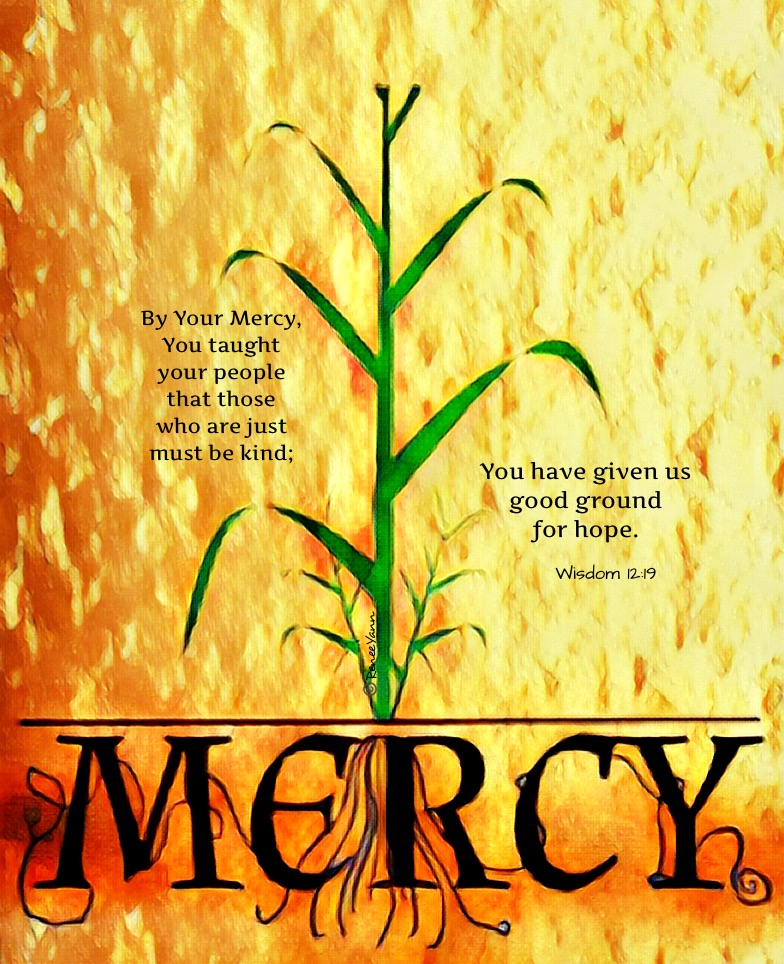
and you gave your children good ground for hope
that you would permit repentance for their sins.

Wisdom 12:18-19

Paul, in another passage from magnificent Romans 8, acknowledges that we can sustain hopeful hearts only by the power of the Holy Spirit who lifts us up and prays within us when we are too overwhelmed to do so ourselves.

The Spirit comes to the aid of our weakness;
for we do not know how to pray as we ought,
but the Spirit intercedes with inexpressible groanings. 
And the one who searches hearts
knows what is the intention of the Spirit,
because Spirit intercedes for the holy ones
according to God’s will.

Romans 8:26-27

Jesus gives us a great parable for understanding hope. How discouraged might that farmer have been when the enemy tried to ruin his crop! But instead, the farmer realized that his field, like life, can sustain both the wheat and the weeds. If we live hopefully and faithfully, the wheat can be gathered from the harvest, and the weeds ultimately cast aside.


How many times in our own lives have we nearly been overwhelmed by the weeds! There is no life which passes without its hurts, disappointments, confusions, and dashed wishes! Some experience a sparse scattering of these weeds, and some lives are thick with difficulty. How surprising that it is often in the latter circumstance that hope rises up and sustains hearts.


As our Responsorial Psalm reminds us, those who live simply and sincerely are most able to tap deeply into the mysterious power of hope.

Blessed are you, Father, Lord of heaven and earth;
you have revealed to little ones the mysteries of the kingdom.


Poetry: From “Odes” – George Santayana was a Spanish-American philosopher known more for his aphorisms than his poetry. He came up with lines like, ‘Those who cannot remember the past are doomed to repeat it”, and “Fanaticism consists in redoubling your effort when you have forgotten your aim.”

IV

Slowly the black earth gains upon the yellow,
And the caked hill-side is ribbed soft with furrows.
Turn now again, with voice and staff, my ploughman,
Guiding thy oxen.
Lift the great ploughshare, clear the stones and brambles,
Plant it the deeper, with thy foot upon it,
Uprooting all the flowering weeds that bring not
Food to thy children.
Patience is good for man and beast, and labour
Hardens to sorrow and the frost of winter.
Turn then again, in the brave hope of harvest,
Singing to heaven.

Music: Weed and Wheat – Silayio Kirisua is a Maasi woman who represented Kenya in the Voice of Holland singing competition. After winning the competition, she has become an international sensation.

Two Kinds of Silence

Tuesday of the Fifteenth Week in Ordinary Time
July 18, 2023

Today’s Readings:

https://bible.usccb.org/bible/readings/071823.cfm

Today, in God’s Lavish Mercy, silence plays a role in both our readings, but they are silences that differ profoundly from each other.

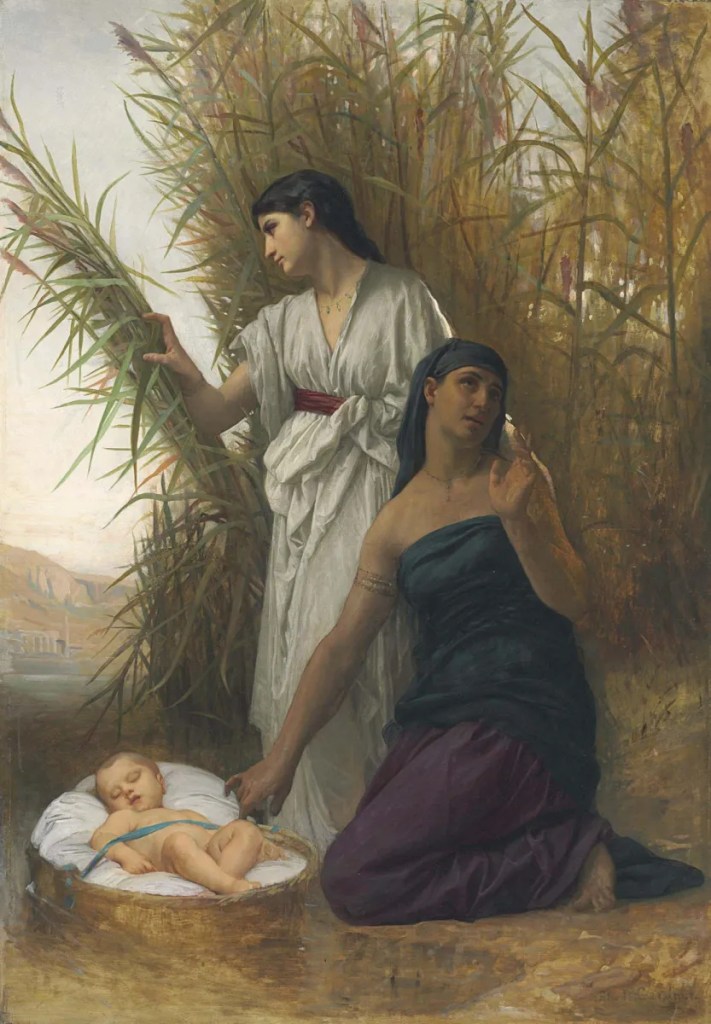
Moses in the Bulrushes – by Elizabeth Jane Gardner


In Exodus, we see the power of silent resistance to turn the tide of history. It is the resistance of righteousness.

Pharaoh, out of fear, has ordered all Hebrew boy babies drowned at birth. But Moses’s mother (Jochebed), aided by his sister (Miriam), silently resists.

A certain man of the house of Levi married a Levite woman,
who conceived and bore a son.
Seeing that he was a goodly child, she hid him for three months.
When she could hide him no longer, she took a papyrus basket,
daubed it with bitumen and pitch,
and putting the child in it,
placed it among the reeds on the river bank.
His sister stationed herself at a distance
to find out what would happen to him.

Her resistance, though silent, was nonetheless active. Look at all the intricate steps she took to assure the success of her plot.


The resistance cited in Matthew is of a different nature entirely. It reflects a hard heart not a determined heart. It is the resistance of indifference.

Christ Preaching at Capernaum – by Maurycy Gottlieb


Capernaum had become Jesus’s own home town. He had moved there as a young adult in order to begin his ministry after his own neighborhood had rejected him. But despite Jesus’s miracles and witness, Capernaum resisted the call of the Gospel:

Jesus began to reproach the towns
where most of his mighty deeds had been done,
since they had not repented.

And as for you, Capernaum:

Will you be exalted to heaven?
You will go down to the netherworld.

For if the mighty deeds done in your midst had been done in Sodom,
it would have remained until this day.
But I tell you, it will be more tolerable
for the land of Sodom on the day of judgment than for you.


We might find ourselves anywhere in these stories. We all experience resistances within, around, and toward us – sometimes for good reasons, sometimes not. We just have to fill in the blank to imagine all the resistances we are capable of:

I tend to resist ______________________________.

What did you come up with? Maybe some of these?

  • change
  • work
  • quiet
  • commitment
  • injustice
  • direction
  • strangers
  • programming
  • affection
  • cronyism, and on and on and on……

Jesus wanted to break through the negative resistance of his dearest communities.

Jocebed and her courageous women companions used positive resistance to break through abusive domination.

In our spiritual lives, we must, by prayer and informed reflection, lower our resistance to God’s transforming Word.

We must, at the same time, assume our role in resisting the injustice and violence of our times. Like Jocebed, we might consider our precious world and its peoples as if they were our own children, threatened by fear-blinded tyranny. In that case, what determined steps would we be willing to take to preserve its sacred life?


Poetry: Rosa Parks by Nikki Giovanni

This is for the Pullman Porters who organized when people said
they couldn’t. And carried the Pittsburgh Courier and the Chicago
Defender to the Black Americans in the South so they would
know they were not alone. This is for the Pullman Porters who
helped Thurgood Marshall go south and come back north to fight
the fight that resulted in Brown v. Board of Education because
even though Kansas is west and even though Topeka is the birth-
place of Gwendolyn Brooks, who wrote the powerful “The
Chicago Defender Sends a Man to Little Rock,” it was the
Pullman Porters who whispered to the traveling men both
the Blues Men and the “Race” Men so that they both would
know what was going on. This is for the Pullman Porters who
smiled as if they were happy and laughed like they were tickled
when some folks were around and who silently rejoiced in 1954
when the Supreme Court announced its 9—0 decision that “sepa-
rate is inherently unequal.” This is for the Pullman Porters who
smiled and welcomed a fourteen-year-old boy onto their train in
1955. They noticed his slight limp that he tried to disguise with a
doo-wop walk; they noticed his stutter and probably understood
why his mother wanted him out of Chicago during the summer
when school was out. Fourteen-year-old Black boys with limps
and stutters are apt to try to prove themselves in dangerous ways
when mothers aren’t around to look after them. So this is for the
Pullman Porters who looked over that fourteen-year-old while
the train rolled the reverse of the Blues Highway from Chicago to
St. Louis to Memphis to Mississippi. This is for the men who kept
him safe; and if Emmett Till had been able to stay on a train all
summer he would have maybe grown a bit of a paunch, certainly
lost his hair, probably have worn bifocals and bounced his grand-
children on his knee telling them about his summer riding the
rails. But he had to get off the train. And ended up in Money,
Mississippi. And was horribly, brutally, inexcusably, and unac-
ceptably murdered. This is for the Pullman Porters who, when the
sheriff was trying to get the body secretly buried, got Emmett’s
body on the northbound train, got his body home to Chicago,
where his mother said: I want the world to see what they did
to my boy. And this is for all the mothers who cried. And this is
for all the people who said Never Again. And this is about Rosa
Parks whose feet were not so tired, it had been, after all, an ordi-
nary day, until the bus driver gave her the opportunity to make
history. This is about Mrs. Rosa Parks from Tuskegee, Alabama,
who was also the field secretary of the NAACP. This is about the
moment Rosa Parks shouldered her cross, put her worldly goods
aside, was willing to sacrifice her life, so that that young man in
Money, Mississippi, who had been so well protected by the
Pullman Porters, would not have died in vain. When Mrs. Parks
said “NO” a passionate movement was begun. No longer would
there be a reliance on the law; there was a higher law. When Mrs.
Parks brought that light of hers to expose the evil of the system,
the sun came and rested on her shoulders bringing the heat and
the light of truth. Others would follow Mrs. Parks. Four young
men in Greensboro, North Carolina, would also say No. Great
voices would be raised singing the praises of God and exhorting
us “to forgive those who trespass against us.” But it was the
Pullman Porters who safely got Emmett to his granduncle and it
was Mrs. Rosa Parks who could not stand that death. And in not
being able to stand it. She sat back down.


Music: Soften My Heart, Lord – Maranatha Singers

Leaving Fear Behind

Monday of the Fifteenth Week in Ordinary Time
July 17, 2023

Today’s Readings:

https://bible.usccb.org/bible/readings/071723.cfm


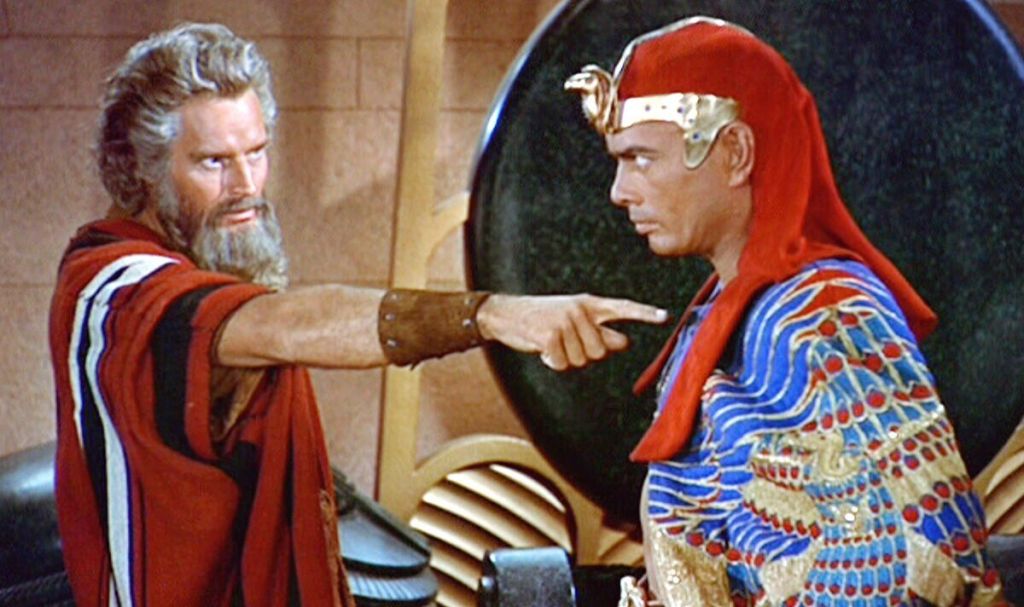
Today, in God’s Lavish Mercy, as we continue with Matthew, we begin a nearly three-week engagement with the Book of Exodus. Our companion along the way will be Moses (and, on occasion, Charlton Heston).

The Book of Exodus, a literary masterpiece, has profoundly influenced religion and culture for over 3000 years. Finally written down about 300 years before Christ, it is a gathering of the rich oral traditions and salvation history of the Judea-Christian faith. A total of forty chapters, the Book can be divided into two key parts: the liberation from Egyptian enslavement and the formation of a new, life-giving Covenant with God.

The Book’s enduring influence can be ascribed to these two themes. They reflect the universal life cycles in all of nature and in each one of our lives. The totality of human culture as well as our individual biographies are stories of breaking forth from whatever binds us into the call and promise of fuller life.


Today’s chapter is an introduction or bridge from the time of Joseph, (when Israel thrived in Egypt), to just before the emergence of Moses, (when Israel suffered in Egypt).

A new king, who knew nothing of Joseph, came to power in Egypt.
He said to his subjects, “Look how numerous and powerful
the people of the children of Israel are growing, more so than we ourselves!
Come, let us deal shrewdly with them to stop their increase;
otherwise, in time of war they too may join our enemies
to fight against us, and so leave our country.”

Accordingly, taskmasters were set over the children of Israel
to oppress them with forced labor.

Exodus 1:8-11

The theme of suffering also anchors our passage from Matthew:

Jesus said to his Apostles:
“Do not think that I have come to bring peace upon the earth.
I have come to bring not peace but the sword.

Matthew 10:34

The suffering imposed upon both “the children of Israel” and true disciples of Jesus generates from the same source – fear:

  • Pharaoh is afraid of what he will lose should the growing Israelite community turn on him.
  • The fear of losing one’s life in Christ inhibits the heart from true discipleship.

As we pray and study these next few weeks with the Book of Exodus, we may be moved to consider the fears both within and around us that prevent us from growing to fuller life.

Our world is full of the fears that induce violence and retribution. Our own spirits may be restrained with the fear of what we might lose by falling deeper into a Gospel life.


Our journey through Exodus offers us a time to consider and examine the fears we perceive. These fears may not necessarily be big spiritual impediments. They may be as simple as the fear of not being right, first, liked, included, or successful. But those very simple fears, left moldering in our hearts, are the seeds of the isolation, domination, and dissolution we see so rampant in our current culture.

Praying with Exodus, may we ask for courage to name and expose our personal and societal fears to God’s healing grace. We might begin with this thought from Paula D’Arcy:

Who would I be,
and what power would be expressed in my life,
if I were not dominated by fear?

Israel finally answered that question by coming into Covenant with God and Community with one another. The path is much the same for us in our lives.


Poetry: Immortality by Lisel Mueller

In Sleeping Beauty’s castle
the clock strikes one hundred years
and the girl in the tower returns to the world.
So do the servants in the kitchen,
who don’t even rub their eyes.
The cook’s right hand, lifted
an exact century ago,
completes its downward arc
to the kitchen boy’s left ear;
the boy’s tensed vocal cords
finally let go
the trapped, enduring whimper,
and the fly, arrested mid-plunge
above the strawberry pie
fulfills its abiding mission
and dives into the sweet, red glaze.
As a child I had a book
with a picture of that scene.
I was too young to notice
how fear persists, and how
the anger that causes fear persists,
that its trajectory can’t be changed
or broken, only interrupted.
My attention was on the fly:
that this slight body
with its transparent wings
and life-span of one human day
still craved its particular share
of sweetness, a century later.


Music: Fear is a Liar by Zach Williams – in this song, Williams images God as Fire, a Fire upon Whom we can cast our fears for a return of Love.

“Ifs” and “In-Betweens”

Monday of the Fourteenth Week in Ordinary Time
July 10, 2023

Today’s Readings:

https://bible.usccb.org/bible/readings/071023.cfm


Today, in God’s Lavish Mercy, Genesis takes us deeper into the story of Jacob, and Matthew tells of a faith-filled centurion and a hope-filled woman. These are a wonderful narratives painted in images so intense that they have infused the prayers of generations.


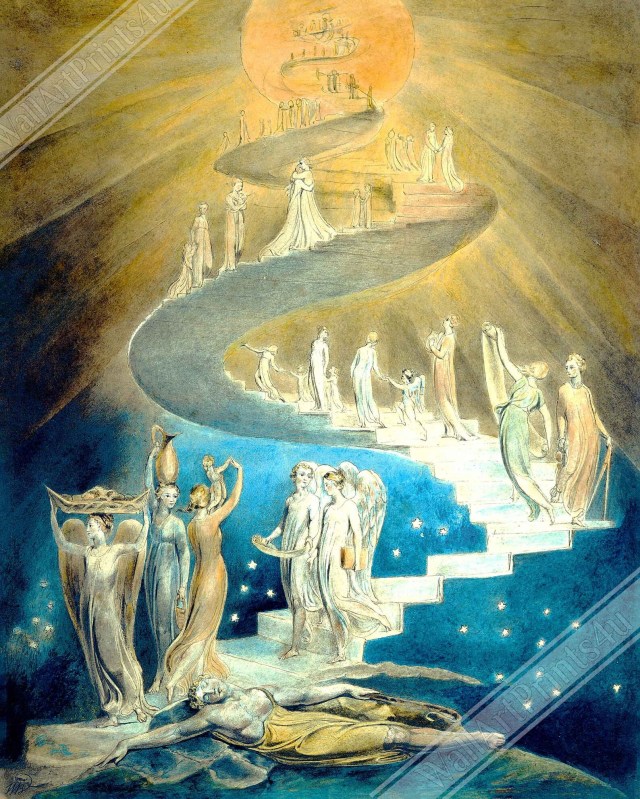
Jacob’s Ladder by William Blake

Jacob and his mother have successfully stolen the birthright from Esau. But now Jacob, threatened with muder by his wronged brother, is an exile seeking a place to live out his life.

Jacob is on a journey in between his past and his future, between his choices and his regrets, between his security and his hope. He is in a place of momentous “ifs” because he has no “for sures” in hand.

Pausing at a shrine, Jacob sleeps and dreams of angels, of a laddered freeway to heaven. God appears and speaks to him, reiterating the essence of the Abrahamic promises.


By Divine Graciousness, God has intruded on Jacob’s “in-betweeness”

In you and your descendants
all the nations of the earth shall find blessing.
Know that I am with you;
I will protect you wherever you go,
and bring you back to this land.
I will never leave you until I have done what I promised you.”

Genesis 28:14-15

The experience moves Jacob to make a vow, hinged on a particular word of hope : IF

If God remains with me,
to protect me on this journey I am making
and to give me enough bread to eat and clothing to wear,
and I come back safe to my father’s house, the LORD shall be my God.
This stone that I have set up as a memorial stone shall be God’s abode.”

Genesis 28:20-22

If I But Touch the Hem by James Tissot

In our Gospel, the suffering woman pivots her hope on the same word: IF

A woman suffering hemorrhages for twelve years came up behind him
and touched the tassel on his cloak.
She said to herself, “If only I can touch his cloak, I shall be cured.”
Jesus turned around and saw her, and said,
“”Courage, daughter! Your faith has saved you.””
And from that hour the woman was cured.

Matthew 9:20-22

It is clear from God’s spontaneous generosity in both these passages that Divine Mercy does not swing on an “IF“. God waits for us to open our hearts. God’s Promise is constant, and God’s Will for our wholeness in immutable. The “IFs” are our constructions, not God’s. God is with us no matter what, not if.


Most of our life is spent atwix one thing and another – between youth and old age, sickness and healing, security and contentment, courage and fear, indifference and awareness … beginnings and endings in a thousand forms. It is at these in-between places that God waits for us, as God did for Jacob, as Jesus did for the suffering woman.

“In-between” is usually an uncomfortable place because we are stretched between growth and passivity. But in the stretch, we may find a holy place, as Jacob did. In the reach of our heart for the hem of God’s garment we, like the extravasating woman, may find new life.


Poetry: That Passeth All Understanding – Denise Levertov

An awe so quiet 
I don’t know when it began. 

A gratitude 
had begun 
to sing in me. 

Was there 
some moment 
dividing 
song from no song? 

When does dewfall begin? 

When does night 
fold its arms over our hearts 
to cherish them? 

When is daybreak?

Music: In Between – J.J. Pfeifer (lyrics below)

In between the day and the night
In between the dark and the light
In between what′s wrong and what’s right
I′ll find you

I’m not really sure just why I care
My heart is broken and I’m scared
Walls are coming down
My defense is on the ground
I′m falling

In between the day and the night
In between the dark and the light
In between what′s wrong and what’s right
I′ll find you

I don’t want to lose you
Can′t stand the pain
I wanna feel the sun
Not always feel the rain
Walls are coming down
My defense is on the ground
I’m falling

In between the day and the night
In between the dark and the light
In between what′s wrong and what’s right
I’ll find you (find you)

I′ll find you
Forever beside you (beside you)
I′ll find you
Breathing inside you
I’ll find you

I′ll find you
I’ll find you

Don’t Be Afraid

Wednesday of the Thirteenth Week in Ordinary Time
July 5, 2023

Today’s Readings:

https://bible.usccb.org/bible/readings/070523.cfm

Today, in God’s Lavish Mercy, our readings encourage us not to be afraid.

“Do not be afraid”, or one of its many forms (e.g. “take courage”, “be at peace”), is a phrase that appears frequently in scripture. It is often uttered by God. And it usually occurs at a point of human desperation but spiritual opportunity for the one who actually is afraid.


Today, Genesis offers us the story of Hagar, the enslaved concubine of Abraham and mother of his eldest son Ishmael. Hagar draws the fearful scorn of Sarah after Sarah bears Isaac. Sarah is afraid that the older boy, Ismael, will inherit what she wants only for her own son. Sarah forces Abraham to send Hagar away as our passage today describes:

Sarah noticed the son whom Hagar the Egyptian
had borne to Abraham
playing with her son Isaac;
so she demanded of Abraham:
“Drive out that slave and her son!
No son of that slave is going to share the inheritance
with my son Isaac!”

Genesis 21:9-10

Sarah is worried about Abraham’s material legacy, but God knows there is an infinitely greater endowment to be left to the children of Abraham. God does not limit that promise to Isaac alone:

God said to Abraham: “Do not be distressed about the boy
or about your slave woman.
Heed the demands of Sarah, no matter what she is asking of you;
for it is through Isaac that descendants shall bear your name.
As for the son of the slave woman,
I will make a great nation of him also,
since he too is your offspring.”

Gemesis 21:12-13

Poor Hagar trods off into the desert with baby Ismael where, finally bereft of water, food, and energy she sits down near some bushes to die.

As she sat opposite Ishmael, he began to cry.
God heard the boy’s cry,
and God’s messenger called to Hagar from heaven:
“What is the matter, Hagar?
Don’t be afraid; God has heard the boy’s cry in this plight of his.
Arise, lift up the boy and hold him by the hand;
for I will make of him a great nation.”
Then God opened her eyes, and she saw a well of water.
She went and filled the skin with water, and then let the boy drink.

Genesis 21:14-19

God opened Hagar’s eyes and she could see the means of her survival – a fresh well in the desert.

“Seeing” is a key reflection point of this passage. When no one else cared to see Hagar as a person, God saw her. When Hagar was at the very edge of existence, her spiritual eyes were cleared and she saw God.

This passage from Genesis invites us to reflect on:

  • times we have felt “invisible” or afraid in our lives, and how that circumstance may have offered us a new understanding of God
  • times when we have been blind to the fear or desperation of others who needed us to notice their marginalization

Hagar, (like Adam, Abraham, Jonah, David, Ruth), is an archetype of the Hebrew Scriptures. Yet her powerful story often takes second place to those of the great ancestors, just as she herself took second place to Sarah in the Abrahamic canon. I found an excellent article about Hagar as I prepared this reflection. If you would like to read it, the link is below.


Poetry: I Return to the Church – Carolyn Marie Rogers

I like this poem because it speaks to me of the appreciation which grows in us as we mature in faith and experience. The poet seems to have passed through a “desert”, from youth to a later age. It is only then that she recognizes all the grace she did not “see” in her earlier life.


Spoons of love and
grace, mushy with mercy,
like oatmeal in a bowl
hushes my mouth into
sugary sweet solemnity.
A neophyte’s reverence.
Holiness. Me. God’s witness
recipient.
A finger to make a cross
across my lips.
And is this love?
Oh yes, this is love
when I come, returned from
the world from walking through
hells, my hungry years.
Hunger that is called youth
looking for rainbows, promised
lands, edens, and paradises.
Only to find it all
that I left behind, that
I could not see like Hagar.
And I did not
even know the word,
desert.

Music: Hagar’s Song – Sue Hahn, writer; Amanda Hopper, vocalist (lyrics below)


A life of injustice is all I have known.
Shamed and mistreated I’ve never been loved.
My dignity’s taken. I finally fled
alone and forsaken in this wilderness

You speak my name like you really know me.
You ask where I’ve come from 
and where I am going
You tell me return, there is no need to run.
You give me your blessing, a name for my son.

You are the God who sees me.
You are the God who hears me.
You keep all your promises.
You know all my fears.
You met me in my wilderness
wandering in despair.
I will choose to trust and obey.
You are the God who cares.

Now we are abandoned, 
a wasteland to roam.
My son won’t survive here,
nowhere to call home.
Life seems so hopeless.
We’ve cried all we can.
I thought you’d protect us .
Did I misunderstand?

You speak my name,
“Hagar, Don’t Be Afraid”.
You’ve seen all our tears 
and your plan hasn’t changed.
They’ve reawakened, 
you open my eyes.
A well in the desert proves
You will provide.

You are the God who sees me.
You are the God who hears me
You keep promises.
You know all my fears.
You met me in my wilderness
wandering in despair.
I will choose to trust and obey.
You are the God who cares
This is not the path I would have chosen
but it’s the one that led me straight to You.
Just when I was sure my life was over
You retold my story with your truth.
You see me; You know me.
Hallelujah, Hallelujah
you see me and you know me
Hallelujah, Hallelujah

Me? A Prophet?

Thirteenth Sunday in Ordinary Time
July 2, 2023

Today’s Readings:

https://bible.usccb.org/bible/readings/070223.cfm

Today, in God’s Lavish Mercy, our readings instruct us on the nature of prophecy.


Walter Bruggemann, in his transformational book “The Prophetic Imagination” writes about prophets. He indicates that prophets emerge in the context of “totalism” – those paralyzing systems which attempt to control and dominate all freedom and possibility.

Totalism kills ideas, hope, freedom, choice, self-determination, and creativity for the sake of controlling reality for its own advantage. Totalism is the ultimate “abusive relationship“. Examples in our society include cults, hate groups, mob rule, or any relationship that subjugates another’s free will.

Brueggemann defines the prophet as one engaged in these three tasks to restore hope and freedom:

  • the prophet is clear on the force and illegitimacy of the totalism.
  • the prophet pronounces the truth about the force of the totalism that contradicts the purpose of God.
  • the prophet articulates the alternative world that God has promised, and that God is actually creating within the chaos around us.

Our first reading comes from the Second Book of Kings which was written about 600 years before Christ. The Jewish people experienced the totalism of the Babylonian Captivity.. First and Second Kings was written to help the people understand their situation, to remain faithful to God, and to move toward freedom.


These two books are full of powerful figures pulling the people both toward and away from God – biblical Baddies and Goodies who carried profound messages about faith or its abandonment.


One of the Goodies is Elisha the Prophet whom we meet in today’s verses. Elisha confronts barrenness and death with the transformative power of faith. The Summanite woman is able to benefit from this power because she believes.


In our second reading, Paul doesn’t use the word “prophet” but he talks about the Resurrection Power we receive through our Baptism. This power calls us and confirms us as bearers of God’s transformative Word in a hostile and unfree world.


In our Gospel, Jesus is direct with his disciples about the rewards which fall to those who have prophetic faith:

“Whoever receives you receives me,
and whoever receives me receives the one who sent me.
Whoever receives a prophet because he is a prophet
will receive a prophet’s reward,
and whoever receives a righteous man
because he is a righteous man
will receive a righteous man’s reward.
And whoever gives only a cup of cold water
to one of these little ones to drink
because the little one is a disciple—
amen, I say to you, he will surely not lose his reward.”

Matthew 10:40-42

So, are we actually called to be prophets? The answer is YES. We are called by the Gospel and through our Baptism to do what Walter Brueggemann describes above:

  • to name the structures of unfreedom in our lives and in our world
  • to speak truth and stand against those things which contradict God’s Mercy and Love
  • to witness hope and courage by the joyous, generous service of our lives

Photo by Ashley Batz on Unsplash


Poetry: Onto a Vast Plane – Rainer Maria Rilke

You are not surprised at the force of the storm—
you have seen it growing.
The trees flee. Their flight
sets the boulevards streaming. And you know:
he whom they flee is the one
you move toward. All your senses
sing him, as you stand at the window.

The weeks stood still in summer.
The trees’ blood rose. Now you feel
it wants to sink back
into the source of everything. You thought
you could trust that power
when you plucked the fruit:
now it becomes a riddle again
and you again a stranger.

Summer was like your house: you know
where each thing stood.
Now you must go out into your heart
as onto a vast plain. Now
the immense loneliness begins.

The days go numb, the wind
sucks the world from your senses like withered leaves.

Through the empty branches the sky remains.
It is what you have.
Be earth now, and evensong.
Be the ground lying under that sky.
Be modest now, like a thing
ripened until it is real,
so that he who began it all
can feel you when he reaches for you.


Music: When the Prophet Speaks – Van Morrison (lyrics below)

When the prophet speaks, mostly no one listens
When the prophet speaks and no one hears
Only those who have ears to listen
Only those that are trained to hear

Come closer now, I'll tell you what they whisper
Closer now, we'll whisper it in your ear
What big ears you've got when you get the details
Do you understand, do I make it clear?

When the prophet speaks, yeah, no one listens
When the prophet speaks, mostly no one hears
Only those that are trained to listen
Only those who have ears to hear

When the prophet speaks, yeah, no one listens
Baby, baby, baby, baby, baby
Don't you have no fear
You gotta get the truth on what is happening

When the prophet speaks, have to make it clear
Come closer now and I will whisper
Whisper the secret in your ear
What thick ears you've got when you get all the details

Do you understand, do I make myself clear?
When the prophet speaks, you've got to listen
When the prophet speaks, you've got to get the truth
When the prophet speaks, don't need no explanation

When the prophet speaks, have to make it move
Prophet speaks, no one listens
When the prophet speaks, mainly nobody hears
Only those that are trained to listen

Only those who have ears to hear

Paul’s Insanity

Friday of the Eleventh Week in Ordinary Time
June 23, 2023

Today’s readings:

https://bible.usccb.org/bible/readings/062323.cfm


Today in God’s Lavish Mercy, our dear Apostle Paul is pretty much around the twist with the Corinthians. As the Church grows and the faith spreads, many “Christian” teachers arise. Some are truly called to the mission and ministry. They engage it and discharge it with humility and grace.

But some get their motives all mixed up with their own agenda for aggrandizement. They are flashy eloqutionists who can mesmerize an audience with their practiced charms. But they have missed the point of the Gospel of Jesus Christ. Instead they make the mission all about themselves – their wealth, success, prosperity and power. . These are the ones who are driving Paul “nuts” – to the point of speaking “insanely” in verse 23:

Are they ministers of Christ? (I am talking like an insane person.) 
I am still more,
with far greater labors, far more imprisonments,
far worse beatings, and numerous brushes with death.

2 Corinthians 11:23

Living the Gospel is not easy, and preaching it with integrity may be even harder. The Gospel contradicts everything our unredeemed human nature craves. To demonstrate this, Paul says that he too will boast like the errant preachers boast. But Paul contradicts them by boasting not of his personal gifts and powers, but of his sufferings, weaknesses, anxieties and catastrophes. He shows that he loves the Gospel and the Church so much that he will suffer for it to keep it aligned with the Truth of Jesus Christ.


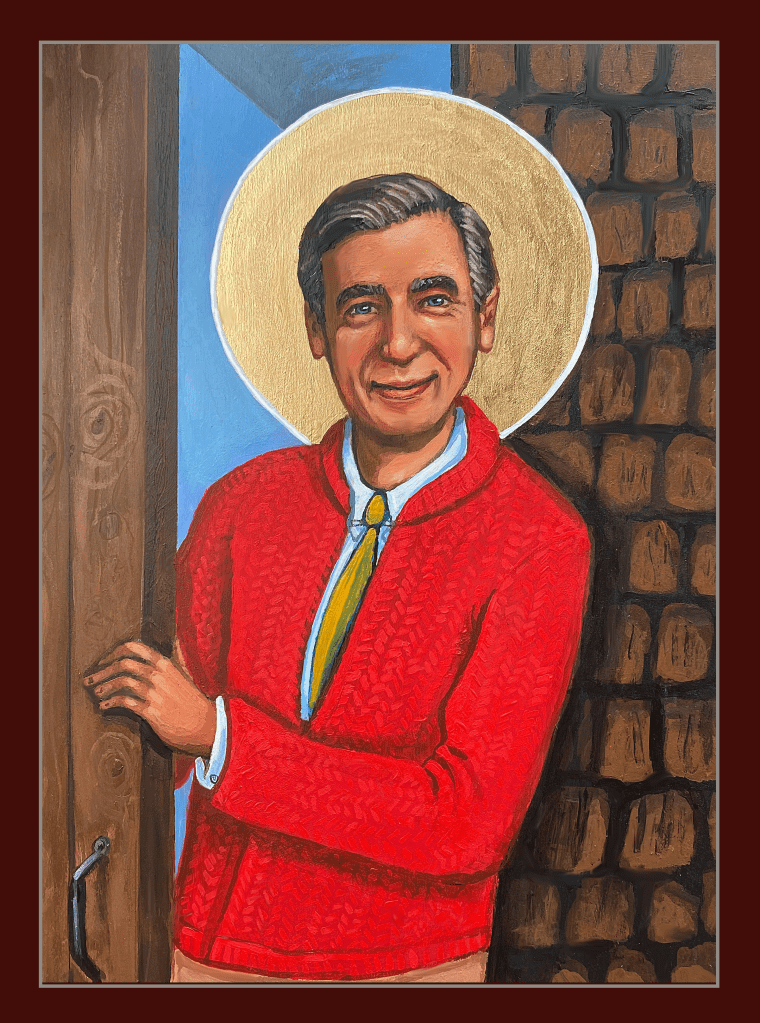
Kelly Latimore IconsMr. Rogers ( a truthful preacher himself)

When I read 2 Corinthians, I realize that Paul was no Mr. Rogers humming soft philosophy to his followers. Paul could be a fiery hot head unafraid to show his anxious love and indignant frustration for a dense yet beloved community. When they were “stupid” enough to be infatuated with a worldly teacher, Paul suffered intensely for their loss of the Gospel:

And apart from these things, there is the daily pressure upon me
of my anxiety for all the churches.
Who is weak, and I am not weak?
Who is led to sin, and I am not indignant?

2 Corinthians 11:28-29

In our Gospel, Jesus paints an ominous metaphor for those who distort truth for their own purposes. If we allow ourselves, as individuals or as a culture, to normalize dishonesty, we are doomed to an incomprehensible darkness. When we practice such normalization, we eventually forget how to even discern the truth and we become convinced of the lie we have become.

“The lamp of the body is the eye.
If your eye is sound, your whole body will be filled with light;
but if your eye is bad, your whole body will be in darkness.
And if the light in you is darkness, how great will the darkness be.”


These are powerful readings and have much to say to us and to our socio-political institutions. If we truly are people of faith, we will listen.


Poetry: We Grow Accustomed to the Dark – Emily Dickinson

We grow accustomed to the Dark –
When Light is put away –
As when the Neighbor holds the Lamp
To witness her Good bye –
A Moment – We Uncertain step
For newness of the night –
Then – fit our Vision to the Dark –
And meet the Road – erect …

Music: The Sound of Silence – Simon and Garfunkel

The Other Cheek

Monday of the Eleventh Week in Ordinary Time
June 19, 2023

Today’s Readings:

https://bible.usccb.org/bible/readings/061923.cfm


Today, in God’s Lavish Mercy, Matthew hits us right between the eyes with one of the most difficult Gospel passages to defend, to explain, and – most certainly – to practice.

Jesus said to his disciples:
“You have heard that it was said,
An eye for an eye and a tooth for a tooth.
But I say to you, offer no resistance to one who is evil.


“Oh, wow’, we might think. “Did Jesus have any idea what kind of a world I’d be living in someday?!”


Violence is so rampant in our society that some of us have stopped looking at the news because we can’t stand it! Here in the U.S., we are traumatized by statistics around the number and kind of artillery in our neighborhoods and who dies as a result – children, worshippers, movie-goers, picnickers. Are these the “enemy” for whom we have designed our lethal weapons?

We see gunpoint carjackings, drive-by shootings, and unlicensed militia defending their political prejudices. We see children afraid to go to school. Mothers afraid to go shopping. Believers afraid to go to their place of worship. We have even seen an assault on the American government stoked by a nationalistic rhetoric of hostility, hatred, and aberrant machismo.

There are so many guns now on American streets that we may think the best response is to carry our own. The “law” allows that. We may consider ourselves valiant if we “stand our ground”, legally shooting some innocent bystander who happened to wander onto our property or drive into our traffic lane!

So what, in God’s Name, does this Gospel have to say to us who have descended almost beyond recue into the chasm of violence?


Remember, Jesus has just finished talking about the Law. He has assured his followers that he has come to fulfill the Law rather than to abolish it. Jesus honors and recognizes the Law as the framework that has held in place Israel’s centuries-long relationship with God.

But Jesus indicates that following the letter of the Law while not fulfilling its spirit is contradictory to the Reign of God. We can use the “law” as an excuse for our complacency – keeping in place those unexamined tenets that make us comfortable, rich, and more powerful to the detriment of others. This is what the Pharisees and Saducees had done.


In each of the five situations listed in today’s Gospel, Jesus isn’t telling us to lie down like a doormat and let ourselves be walked on. What he’s saying is that with God’s help, there is a better way, a deeper response that we can give to the conflicts in our lives.

Jesus encourages his followers not to meet the other with resistance. So often, resistance is our first defense rather than patience, negotiation, honesty, listening, or forgiveness. Jesus is asking us to stand still for a moment before lashing back – and in that moment move toward a more graced and courageous resolution. He is counseling us to listen, to imagine mutuality, and to work together for an equilibium of justice with mercy.

It must be admitted that sometimes this just doesn’t seem to work. Those with the power to make positive change can block the way, just as they did for Jesus. We can end up looking like “losers” – or even die – like Jesus did. But even though he had the power – the Omnipotence to do so – Jesus did not resist. If we really understand the Paschal Mystery and believe in the Resurrection, we will know why, and we will try to imitate him.


So where do we start? I think it starts with:

  • the level of reverence in our everyday interactions,
  • our attitudes toward “the other” – someone different from me in race, ethnicity, religion, sexuality, nationality, economic status, or opinion.
  • with our efforts toward reasonable gun legislation, educational equity for all children, universally available mental health services, and the eradication of abysmal poverty in our cities.

Can I do something to advance these changes? Not all by myself. But as a community of faith, Christians can bring amazing influence to these issues. Today’s Gospel is telling me to act on that belief.


Poem: Some – Daniel Berrigan, SJ

Some stood up once and sat down.
Some walked a mile and walked away.
Some stood up twice and sat down
I’ve had it, they said.
Some walked two miles and walked away
It’s too much, they cried.
Some stood and stood and stood.
They were taken for dummies
They were taken for fools
They were taken for being taken in.
Some walked and walked and walked.
They walked the earth
They walked the waters
They walked the air.
Why do you stand?
they were asked, and
Why do you walk?
Because of the children, they said, and
Because of the heart, and
Because of the bread.
Because
the cause
is the heart’s beat
and the children born
and the risen bread.

Music: Where Have All the Flowers Gone – written by Pete Seeger, sung by Joan Baez

Fidelity in Exile

Memorial of Saint Boniface, Bishop and Martyr
June 5, 2023

Today’s Readings:

https://bible.usccb.org/bible/readings/060523.cfm

Today, in God’s Lavish Mercy, we begin a series of readings from the Book of Tobit. This fascinating scripture is actually a biblical novel written by an unknown author about 200 years before Jesus was born. It tells the story of a character who lived 800 years before that. It is not an autobiography or history. It is a combination of fiction, poetry, allegory and wisdom. Probably a “best seller” in its own time, it is actually really fun to read – and it gives us a good dose of spiritual wisdom!


In a nutshell, the book of Tobit relates how two suicidal characters, one blind
(Tobit) and one haunted by a husband-killing demon (Sarah) are healed with
medicinal fish organs by Tobit’s son Tobiah with the guidance of the angel
Raphael. Tobiah marries Sarah and acquires wealth and property into the
bargain. In addition to being entertaining, the book of Tobit
maintains that one can withstand temporary misfortune
and ultimately enjoy a happy life if one performs righteous deeds.

Delicious Prose: Reading the Tale of Tobit with Food and Drink, by Naomi S.S. Jacobs

In today’s passage, Tobit introduces himself as a good man who wants to share his blessings with someone less fortunate. He sends his son Tobiah on the noble errand to find such a person. On his way, Tobiah discovers a murdered kinsman left unburied where he died. Upon hearing of it, Tobit “springs” into action, doing the right thing for this unfortunate victim. As a result of his righteous response, Tobit incurs the wrath not only of the Assyrian overlords, but also of his wimpy Israelite neighbors who are too afraid (or lazy) to keep the Mosaic Law while in exile.

Tobit Burying the Dead – Andrea DiLeone


Big lessons from this reading? Remember, the author of Tobit was writing for a community that had been ripped from their spiritual and material home. They knew the waning hope of one in exile. They needed to be reminded of and supported by stories of covenantal fidelity – both God’s and humanity’s.

By the rivers of Babylon we sat and wept when we remembered Zion.(Ps.137)


But even if our lives are not quite so dramatic as theirs, the reading holds quite a few lessons for us as well.

  • Circumstances may cause one to feel “exiled” from the comfort of their faith, but it is essential to retain a stabilizing religious devotion and practice.
  • It is important to invite and include others, especially the young, in the faithful practice of charity and justice.
  • It is normal and healthy to grieve the spiritual losses or emptiness we may experience. Such recognition is a first step to healing, and can give us the release to move on to what we need to do:

Returning to my own quarters, I washed myself
and ate my food in sorrow.
I was reminded of the oracle
pronounced by the prophet Amos against Bethel:
All your festivals shall be turned into mourning,
and all your songs into lamentation.

And I wept.
Then at sunset I went out, dug a grave, and buried him.

Tobit 2:5-7

Prose: How to Be Hopeful by Barbara Kingsolver, from her commencement address at Duke University, May 11, 2008

HOPE: AN OWNER’S MANUAL
Look, you might as well know, this thing
is going to take endless repair: rubber bands, crazy glue, tapioca, the square of the hypotenuse. Nineteenth century novels. Heartstrings, sunrise: all of these are useful. Also, feathers.

To keep it humming, sometimes you have to stand on an incline, where everything looks possible;
on the line you drew yourself. Or in
the grocery line, making faces at a toddler secretly, over his mother's shoulder.

You might have to pop the clutch and run
past all the evidence. Past everyone who is laughing or praying for you. Definitely you don't want to go directly to jail, but still, here you go, passing time, passing strange. Don't pass this up.

In the worst of times, you will have to pass it off.
Park it and fly by the seat of your pants. With nothing in the bank, you'll still want to take the express.
Tiptoe past the dogs of the apocalypse that are sleeping in the shade of your future. Pay at the window.
Pass your hope like a bad check.
You might still have just enough time. To make a deposit. 

Music: Take Courage – Kristine DiMarco

A Grape Soon Ripe

Saint Charles Lwanga and Companions, Martyrs
June 3, 2023

Today’s Readings:

https://bible.usccb.org/bible/readings/060323.cfm

Today, in God’s Lavish Mercy, we pray with our final passage from the Book of Sirach. We will read Sirach only five or six times again scattered throughout the liturgical year.

In today’s reading, Sirach offers a grateful reflection on the early blessing of wisdom and pursuit of holiness in his life.

I thank the LORD and I praise him;
I bless the name of the LORD.
When I was young and innocent,
I sought wisdom openly in my prayer
I prayed for her before the temple…

Sirach 51:13-14

Sirach’s prayer will resonate with many of us whose earliest days were blessed with faithful parents and grandparents. These wisdom figures taught us to love and seek God in our lives. As we pray today, we think of them with gratitude, as well as of the many teachers who guided our young spirits into God’s Light.

Even if we have moved far from the parish church of our youth, we may recall the graces we received within her walls. We might prayerfully recollect our beloved grade school and high school where we were guided in the pursuit of a meaningful and reverent life.


Hopefully, our prayer brings us to realize how blessed we have been from the beginning of our lives. This is the kind of prayer Sirach prays in today’s reading. He is filled with gratitude and praise because he understands that it is all a gratuitous and undeserved blessing:

My heart delighted in Wisdom,
My feet kept to the level path
because from earliest youth I was familiar with her.
In the short time I paid heed,
I met with great instruction.
Since in this way I have profited,
I will give my teacher grateful praise.

Sirach 51:15-17

Sirach’s prayer brings him to that still and holy place deep in his heart — that place where he touches the Wisdom of God. He describes it like this:

I sought Wisdom openly in my prayer
I prayed for her before the temple,
and I will seek her until the end,
and she flourished as a grape soon ripe.

Sirach 51:13-15

Many of us are so busy and intent on living our lives forward – trying to make it through this day to the next. We may not take the time to consider and appreciate the “ripe grape” our life has already become.

I look around me in our convent chapel and realize that I am living with holy people. Of course, like me, they have their personal twists and trademarks. Still each one of them has walked through their roundabout years into the heart of God. Every day they live into a deeper goodness – aging like fine wine, unaware that the grape has already ripened and is blessing the world around them.

The Great Vintner accomplishes this holy transformation in us by a slow accumulation of blessings which saturate our hearts in God. Pausing, like Sirach, to recognize and give thanks fills us with generous gratitude and a confident courage for the days to come.


Take time to look at the holy people in your own life today, the ones through whom God’s Wisdom has poured into your life. They are the ones who love you into a better person by their goodness, honesty, humility, and generosity. You meet them in your family, friends and workplace. Or you may have met them only in a book, poem, song or story.

I met with great instruction.
Since in this way I have profited,
I will give my teacher grateful praise.

Sirach 51:16-17

Poetry: Our Responsorial Psalm 19 today beautifully complements Sirach’s prayer and can serve as a perfect poetic refletion for us.


The law of the LORD is perfect,
refreshing the soul.
The decree of the LORD is trustworthy,
giving wisdom to the simple.

The precepts of the LORD are right,
rejoicing the heart.
The command of the LORD is clear,
enlightening the eye.

Awe of the LORD is pure,
enduring forever;
The ordinances of the LORD are true,
all of them just.

They are more precious than gold,
than a heap of purest gold;
Sweeter also than syrup
or honey from the comb.


Music: Psalm 19 – Jess Ray