Radical Choices

Tuesday of the Twenty-fifth Week in Ordinary Time
September 26, 2023

Today’s Readings:

https://bible.usccb.org/bible/readings/092623.cfm


Today, in God’s Lavish Mercy, Luke gives us a jolt with this Gospel passage that has always disturbed me:

The mother of Jesus and his brothers came to him
but were unable to join him because of the crowd.
He was told, “Your mother and your brothers are standing outside
and they wish to see you.”
He said to them in reply, “My mother and my brothers
are those who hear the word of God and act on it.”

Luke 8:19-21

Honestly, I don’t want Jesus to sound officious like that with his family! I want him to wiggle through the crushing crowd and run into Mary’s loving arms. I want him to hug his mom to bits and pummel his little brothers on the back with callow delight.

And you know what – I think that might be exactly what Jesus did, on the way uttering the seemingly callous phrase which Luke has isolated and immortalized.


Like all scripture passages, we can read this one in the slant of our own light. At the same time, it is important to access the wisdom of scripture scholars in order to understand depths we might not otherwise discern. There is a scholarly consensus that this Lucan passage is intended to show us how radically dedicated Jesus was to his mission. The passage affirms that the mission is more important even than family ties … in other words, more important than anything. For thirty years Jesus had lived a quiet life somewhere within his mother’s circle of care. In this Gospel, that quiet time is over and he is on the path to his Passion, Death, and Resurrection.


I understand that radicality and the courage it takes to live it. I failed at it once (at least) but learned immensely from the failure.

When I was a young religious, there was a call for US nuns to minister in Nicaragua. I wanted to answer that call. When I told my mother about my emerging decision, she froze in time. My father had died just about a year and a half before. The thought of also “losing” me to a socio-politically volatile Central America traumatized my mom.

But my mom was so brave. She didn’t say, “Don’t go.” She simply said, “Take me with you. I can cook for all of you.”

Mom and I at the 41st Eucharistic Congress
Philadelphia (1976)


Needless to say, I wasn’t going to take my mom into a political boiler in order to satisfy my plans. But I also wasn’t going to leave her alone in the thinly-veiled desperation of her offer. I didn’t go to Nicaragua and, like Robert Frost’s split road, that has made a profound difference in my life.


That decision almost fifty years ago was a good one, and opened the way for me into other opportunities to serve God’s people. The Gospel did not suffer because of my hesitations or my mother’s. We both trusted our humanity that had, for all our lives, been directed toward God’s love.


But at this juncture in Jesus’s life, the Gospel demands that he open his heart beyond any familial or personal ties in order to embrace all people in the Gospel.

There are frequent times in each of our lives when we must choose for the largeness of the Gospel over limited self-interest. Enriching ourselves daily in scriptural wisdom will strengthen us to respond generously at those times.


Prose: Pope Francis on praying with the scriptures:

Through prayer a new incarnation of the Word takes place. And we are the “tabernacles” where the words of God want to be welcomed and preserved, so that they may visit the world. This is why we must approach the Bible without ulterior motives, without exploiting it. The believer does not turn to the Holy Scriptures to support his or her own philosophical and moral view, but because he or she hopes for an encounter; the believer knows that those words were written in the Holy Spirit, and that therefore in that same Spirit they must be welcomed and understood, so that the encounter can occur.


Music: O Word of God – Ricky Manolo – In this hymn, passages from the Psalms – snippets of God’s Word – are sung in a round within the plea for God’s Word to come into our hearts.

O Word of God, come into this space.
O Word of God, come send us your grace.
Open our minds; show us your truth.
Transform our lives anew.

O Word of God, come into this space.
O Word of God, come send us your grace.
Open our minds; show us your truth.
Transform our lives anew.

Here I am, O Lord my God
I come to do your Will.

Blessed are the poor in spirit,
the Kingdom of Heaven is theirs.

To the upright, I will show
the saving power of God.

Let all the nations
praise You, O God.
Let all the nations praise You.

The Lord is my shepherd,
there is nothing I shall want.

Breathers of Hope

Monday of the Twenty-fifth Week in Ordinary Time
September 25, 2023

Today’s Readings:

https://bible.usccb.org/bible/readings/092523.cfm


Today, in God’s Lavish Mercy, we begin three weeks of readings from some of the lesser known prophets and reformers in ancient Israel:


  • Ezra: instrumental in restoring the Jewish scriptures and religion to the people after the return from the Babylonian Captivity and is a highly respected figure in Judaism.
  • Nehemiah: his book describes his work in rebuilding Jerusalem during the Second Temple period.
  • Haggai: a Hebrew prophet during the building of the Second Temple in Jerusalem, and one of the twelve minor prophets in the Hebrew Bible. He is known for his prophecy in 520 BCE, commanding the Jews to rebuild the Temple
  • Zechariah: His greatest concern was with the building of the Second Temple
  • Baruch: the prophet Jeremiah’s scribe who is mentioned at Baruch 1:1. The book is a reflection of a late Jewish writer on the circumstances of Jewish exiles from Babylon
  • Malachi: Malachi describes a priesthood that is forgetful of its duties, a Temple that is underfunded because the people have lost interest in it, and a society in which Jewish men divorce their Jewish wives to marry out of the faith. (W. Gunther Plaut)
  • Joel: delivers a message of warning and repentance to the southern kingdom of Judah after the nation was divided.
  • Jonah: prophesied the destruction of Nineveh, but attempts to escape his divine mission.

Now some of my readers who are scripture geeks like me may have been interested in the above list. The rest of you skipped down to this paragraph to see if I had anything at all interesting to say about today’s readings. 😉

How about this? While Israel’s prophets and reformers speak to a certain time in history, their themes speak powerfully to our own times and culture as well:

Walter Brueggemann describes the prophets’ two primary themes:

  • First, they are very sure that political economic arrangements that contradict the purpose of God cannot be sustained.
  • Second, the prophets are voices of hope that affirm that God is a future-creating agent who keeps promises and who, against all odds, creates a new world reality that is distinct from present power arrangements.

Walter Brueggemann: From Judgment to Hope


The prophets remind us that, beyond any purely temporal interpretation of life, God is real and intimately involved in the unfolding of both our personal and global histories. When we pray with the prophets, we are strengthened in courage to engage our world, and to act in hope for the redemption of our culture.


In today’s reading, the reformer Ezra speaks a word of liberating alternative hope to a people who had been decimated by the Babylonian Captivity. Many of them thought they had lost their soul in Babylon. Ezra, by the power of God, breathes it back into them.

Therefore, whoever among you belongs to any part of his people,
let him go up, and may his God be with them!
Let everyone who has survived, in whatever place they may have dwelt,
be assisted by the people of that place
with silver, gold, goods, and cattle,
together with free-will offerings
for the house of God in Jerusalem

Ezra 1:3-4

As we consider our own times, our “breathers of hope” may come to mind: Pope Francis working to rebuild the Church, and Martin Luther King inspiring a vision of equity, respect and inclusion. We may think of voices like St. Oscar Romero, Venerable Catherine McAuley, Simone Weil, St. Edith Stein, Greta Thunberg, Servant of God Dorothy Day, or Pierre Teilhard de Chardin. Each one has spoken selflessly for peace, mercy, justice, and wholeness in a fragmented, sinfully distracted society.


In today’s Gospel, Jesus, Divine Daystar of every prophet’s hope, calls each one of us to the work of hope-filled prophecy, and faith-filled listening:

Jesus said to the crowd:
“No one who lights a lamp conceals it with a vessel
or sets it under a bed;
rather, he places it on a lampstand
so that those who enter may see the light.
For there is nothing hidden that will not become visible,
and nothing secret that will not be known and come to light.
Take care, then, how you hear.
To anyone who has, more will be given,
and from the one who has not,
even what he seems to have will be taken away.”

Matthew 5:1-6

Poetry: Advice to a Prophet – Richard Wilbur

When you come, as you soon must, to the streets of our city,
Mad-eyed from stating the obvious,
Not proclaiming our fall but begging us
In God’s name to have self-pity,
Spare us all word of the weapons, their force and range,
The long numbers that rocket the mind;
Our slow, unreckoning hearts will be left behind,
Unable to fear what is too strange.
Nor shall you scare us with talk of the death of the race.
How should we dream of this place without us?—
The sun mere fire, the leaves untroubled about us,
A stone look on the stone’s face?
Speak of the world’s own change. Though we cannot conceive
Of an undreamt thing, we know to our cost
How the dreamt cloud crumbles, the vines are blackened by frost,
How the view alters. We could believe,
If you told us so, that the white-tailed deer will slip
Into perfect shade, grown perfectly shy,
The lark avoid the reaches of our eye,
The jack-pine lose its knuckled grip
On the cold ledge, and every torrent burn
As Xanthus once, its gliding trout
Stunned in a twinkling. What should we be without
The dolphin’s arc, the dove’s return,
These things in which we have seen ourselves and spoken?
Ask us, prophet, how we shall call
Our natures forth when that live tongue is all
Dispelled, that glass obscured or broken
In which we have said the rose of our love and the clean
Horse of our courage, in which beheld
The singing locust of the soul unshelled,
And all we mean or wish to mean.
Ask us, ask us whether with the worldless rose
Our hearts shall fail us; come demanding
Whether there shall be lofty or long-standing
When the bronze annals of the oak tree close.

Music: Daystar – Brooklyn Tabernacle Choir (Lyrics below)

Lily of the Valley, let your sweet aroma fill my life
Rose of Sharon show me how to grow in beauty in God's sight
Fairest of ten thousand make me a reflection of your light
Daystar shine down on me let your love shine through me in the night

Lead me Lord, I'll follow. Anywhere you open up the door
Let your word speak to me, show me what I've never seen before
Lord I want to be your witness, you can take what's wrong and make it right
Daystar shine down on me, let your love shine through me in the night

Lord I've seen a world that's dying wounded by the master of deceit
Groping in the darkness, haunted by the years of past defeat
But when I see you standing near me shining with compassion in your eyes
I pray Jesus shine down on me let your love shine through me in the night

Lead me Lord, I'll follow anywhere you open up the door
Let your word speak to me, show me what I've never seen before
Lord I want to be your witness, you can take what's wrong and make it right
Daystar shine down on me, let your love shine through me in the night

Invisible

Memorial of Saint Pius of Pietrelcina, Priest
Saturday of the Twenty-fourth Week in Ordinary Time
September 23, 2023

Today’s Readings:

https://bible.usccb.org/bible/readings/092323.cfm


Today, in God’s Lavish Mercy, we have our final reading from 1 Timothy. In the closing words of this letter, Paul pleads with Timothy, and with the community Timothy shepherds, to stay faithful. Paul encourages them to do this even though the Power they believe in is invisible.

… keep the commandment without stain or reproach
until the appearance of our Lord Jesus Christ
that the blessed and only ruler
will make manifest at the proper time,
the King of kings and Lord of lords,
who alone has immortality, who dwells in unapproachable light,
and whom no human being has seen or can see.
To him be honor and eternal power. Amen.

1 Timothy 6:14-16

In our Gospel today, Jesus describes the Word of God aa a seed that falls upon the human heart with varying results. It is a parable we are familiar with and we get it. If we don’t have a ready heart, plowed and furrowed with faith and charity, that lonely seed is going to die.

The problem is that even when that seed falls into our very faithful hearts, we don’t always SEE the results. The work of faith is a work with invisible powers. It is a work with hope, with trust, with perseverance, with courage – much like the work in any garden.


I hear really good people, whose lives are beautiful witnesses to faith, still question themselves and their goodness. Because their lives are threaded with challenges and disappointments, they think their lack of faith might be the cause. Because the world at large may appear to be a mess, they wonder if the God they believe in is really there!

Indeed, even though the seed of God’s Word is alive, still it is buried in the realities of our lives. And we wait in sometimes doubtful anticipation for its flowering.


Paul knew that Timothy would encounter these roadblocks just as we all do. That is why his letters to Timothy are a powerful source of encouragement to us all as we strive to live a holy life. As we close these letters today, don’t put them on a shelf forever. I go back to Timothy often just to grab a few verses for light in a shadowy time. I encourage you to do the same.

The final verses of 1 Timothy struck me with a smile as I read them today. They follow just after today’s reading:

O Timothy, guard what has been entrusted to you.
Avoid profane babbling
and the absurdities of so-called knowledge.
By professing it,
some people have deviated from the faith.


Poetic Prose: Rainer Maria Rilke

When I think of the Paul’s letters to young Timothy, I am reminded of Rilke’s Letters to a Young Poet. Here is a favorite passage:

You are so young; you stand before beginnings… 
have patience with everything that
remains unsolved in your heart.
Try to love the questions themselves,
like locked rooms and like
books written in a foreign language.
Do not now look for the answers.
They cannot now be given to you
because you could not live them.
It is a question of experiencing everything.
At present you need to live the question.
Perhaps you will gradually,
without even noticing it,
find yourself experiencing the answer,
some distant day.

Music: Invisible Spirit – by Anandra

Uncompromising Faith

Memorial of the Passion of Saint John the Baptist
August 29, 2023

Today’s Readings:

https://bible.usccb.org/bible/readings/082923.cfm


John the Baptist – Titian (1540)

Today, in God’s Lavish Mercy, we honor John the Baptist under the title of his “Passion”. The memorial used to be called “the Beheading of John the Baptist”, a title that more referenced the act of the criminal rather than the perseverance of the martyr.

The Gospel narrative is gripping, as is much of the history of John the Baptist. He was no smoldering wick. Rather, John was on fire with the Truth of the Messiah and he never compromised.

Herod was the one who had John the Baptist arrested and bound in prison
on account of Herodias,
the wife of his brother Philip, whom he had married.
John had said to Herod,
“It is not lawful for you to have your brother’s wife.”
Herodias harbored a grudge against him
and wanted to kill him but was unable to do so.

Mark 6: 17-19

In a commentary on this Gospel, Pope Francis described the central players like this: There are four characters:

  • King Herod “corrupt and indecisive”
  • Herodias, the wife of the king’s brother who “knew only how to hate”
  • Salome, “the vain ballerina”,
  • the “prophet, decapitated and alone in his cell”.

Pope Francis continued:

John had pointed Jesus out to His first disciples, indicating that He was the Light of the world. He, instead, gave his life little by little, to the point of being extinguished in the darkness of a prison cell.
Life has value only when we give it; when it is given in love, in truth; when we give it to others, in daily life, in our families. It should always be given. If someone grasps his or her life in order to keep it, like the king by his corruption, or the woman with her hatred, or the child, the young girl with her vanity that was that of an adolescent, naive, life dies, life ends up withered, it is useless”

Homily of Pope Francis, Santa Marta, 8 February 2019

Pope Benedict XVI also offered some compelling thoughts on the Passion of John the Baptist:
 “Celebrating the martyrdom of St. John the Baptist also reminds us – Christians in our own times – that we cannot give into compromise when it comes to our love for Christ, for his Word, for his Truth. The Truth is the Truth; there is no compromise. The Christian life requires, as it were, the ‘martyrdom’ of daily fidelity to the Gospel; the courage, that is, to allow Christ to increase in us and to direct our thoughts and actions.”


Francis and Benedict give us plenty to think about as we celebrate this solemn feast. Let us pray for the courage to live our faith wholeheartedly, inspired by the unswerving fidelity of St. John the Baptist.


Poetry: from “Saint John the Baptist” by Thomas Merton

St. John, strong Baptist,
Angel before the face of the Messiah
Desert-dweller, knowing the solitudes that lie
Beyond anxiety and doubt,
Eagle whose flight is higher than our atmosphere
Of hesitation and surmise,
You are the first Cistercian and the greatest Trappist:
Never abandon us, your few but faithful children,
For we remember your amazing life,
Where you laid down for us the form and pattern of
Our love for Christ,
Being so close to Him you were His twin.
Oh buy us, by your intercession, in your mighty heaven,
Not your great name, St. John, or ministry,
But oh, your solitude and death:
And most of all, gain us your great command of graces,
Making our poor hands also fountains full of life and wonder
Spending, in endless rivers, to the universe,
Christ, in secret, and His Father, and His sanctifying Spirit.

Music: Jesu, Joy of Man’s Desiring – J.S. Bach – This beautiful hymn befits John’s great love and devotion to Jesus.

Hope and Resilience

Friday of the Twentieth Week in Ordinary Time
August 25, 2023

Today’s Readings:

https://bible.usccb.org/bible/readings/082523.cfm


Today, in God’s Lavish Mercy, we read the tender and beloved story of Ruth and Naomi. We have come to love the beautiful exchange between these two women, filled with devotion and selfless love:

But Ruth said to Naomi, “Do not ask me to abandon or forsake you!
For wherever you go, I will go, wherever you lodge I will lodge,
your people shall be my people, and your God my God.
Where you die I will die,
and there be buried.
May the LORD do thus to me, and more,
if even death separates me from you!”

Ruth 1: 16-17

Who doesn’t long to be devoutly loved the way Ruth loved Naomi?
Who, especially in elder years or lonely times, isn’t filled with gratitude for the faithful companionship of dear ones?
Who isn’t moved at a wedding ceremony when young couples make brave promises like Ruth’s, having no idea what their vow will require down the years?


Reading the story of Ruth from these perspectives can carry us to deep reflection, but it can also leave us with an insubstantial or idealized perception of the infinite Love mirrored in this Scripture.

The Book of Ruth is so much more than an admirable devotion.

In the Book of Ruth, significant theological formation occurs, presenting a beautifully written story placed distinctively between the chaos of the Book of Judges and the epic struggle between the prophet Samuel and the intractable King Saul in the first book of Samuel. Nestled in between this chaotic downward spiral and the recalcitrance of Saul, Ruth exhibits resilience amidst vulnerability, an outsider grafted into the Davidic lineage and its climactic conclusion in Christ. A theology of hope for those found outside the normative structures of patriarchal, religious, and cultural normative spheres.

Bradford Parker: Ruth: A Theology of Resilience Amidst Vulnerability

Various authors suggest a host of underlying theological themes in Ruth:

  • the community is responsible for those who are hungry;
  • the experience of despair cannot be ignored;
  • people young and old are to be cared for; and
  • the marginalized are to push to the center, and those at the center are to move toward the marginalized. (Katherine Doob Sakenfeld: Ruth, Interpretation)

Another writer sees “Ruth is herself the “mirror of God” by reflecting Yahweh through her actions of devotion throughout the narrative.” (John C. Holbert: Preaching the Old Testament)

Andre LaCocque argues that “Ruth belongs to the extraordinary. She is characterized by hesed (Mercy).” (Ruth: Continental Commentary)


The Book of Ruth, on surface appearance, is a simple yet compelling story. But reading under its words, we will find astounding depth:

  • a faithful elder who now feels abandoned by God (Naomi),
  • a vulnerable young woman who chooses to act for mercy and justice (Ruth)
  • a man who, by aligning himself unselfishly to the Law, allows the continuation of the familial line which will lead through Obed to David and ultimately to Jesus.(Boaz)

Naomi teaches us how to respond from the depths of loss, sadness, diminishment, or fear. Ruth shows us how courage, fidelity, and mercy act in the everyday world.
Boaz models faithfulness, responsibility, and justice given without question when needed.


It is not a stretch to say that Ruth is a Christ figure, foreshadowing the Merciful Jesus who accompanies us in our vulnerabilities and who, by loving us, teaches us how to love:

“Teacher, which commandment in the law is the greatest?”
He said to him,
“You shall love the Lord, your God, with all your heart,
with all your soul, and with all your mind.
This is the greatest and the first commandment.
The second is like it:
You shall love your neighbor as yourself.
The whole law and the prophets depend on these two commandments.”

Matthew 22:36-40

Poetry: Rather than choose a single poem for you, here is the link to a series of thoughtful, poetic reflections on the characters in the Book of Ruth.

Poems from the Velveteen Rabbit blog

Music: Ruth’s Song – Misha and Marty Goetz

God’s Faithfulness

Thursday of the Nineteenth Week in Ordinary Time
August 17, 2023

Today’s Readings:

https://bible.usccb.org/bible/readings/081723.cfm


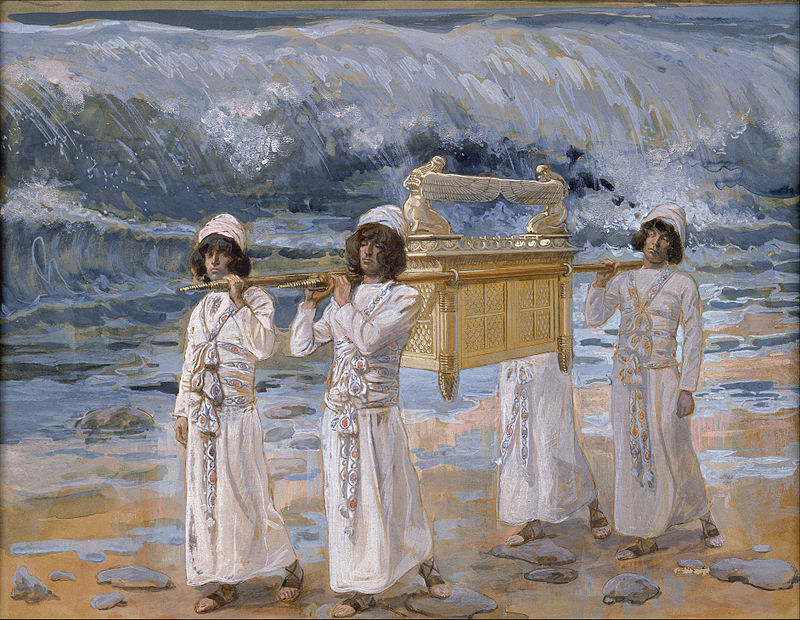
Today, in God’s Lavish Mercy, we pray with Psalm 114, eight short but extremely powerful verses. They summarize the entire faith journey of Israel, a People born in the Exodus and coming to full promise as they pass over the Jordan.

Crossing the Jordan by James Tissot

Our first reading describes the Jordan passage which mirrors the miraculous passage through the Red Sea. Joshua becomes the new Moses leading the people, finally, into the Promised Land.

As early as the 6th century, Psalm 114 was included in funeral and burial liturgies in order to emphasize the triumphant and joyful character of our final passage into heaven.


It’s hard for us to think of death that way. On a purely human level, death feels sad – like an end or a loss. But our faith says differently. 

Even throughout life, in all our smaller losses, frustrations and failures, our faith encourages us to see things differently. Faith calls us to see each “exodus” , each “crossing”, as the beginning of a journey to a new promise. It calls us to remember that the seas and rivers will part – that God always makes a way.

Faith calls us to receive 
life’s contradictions and impasses 
as opportunities to learn a different way.

In Psalm 114, the poet-psalmist uses natural metaphors to remind us of God’s transformative presence in our lives. The Red Sea disappears. The Jordan River opens a path. Mountains skip and hills leap out of our way.

Why was it, sea, that you fled?
Jordan, that you turned back?
Mountains, that you skipped like rams?
You hills, like lambs?

Psalm 114:5-6

When we face turbulent seas, overwhelming passages, exoduses from the comfortable places, may we find courage in remembering God’s faithfulness as Psalm 114 encourages us to do.


Poetry: The Valley of Vision – Taken from The Valley of Vision: A Collection of Puritan Prayers & Devotions, edited by Arthur Bennett.

Lord, high and holy, meek and lowly,
Thou hast brought me to the valley of vision,
where I live in the depths but see Thee in the heights;
hemmed in by mountains of sin I behold Thy glory. 
Let me learn by paradox that the way down is the way up,
that to be low is to be high,
that the broken heart is the healed heart,
that the contrite spirit is the rejoicing spirit,
that the repenting soul is the victorious soul, 
that to have nothing is to possess all,
that to bear the cross is to wear the crown,
that to give is to receive,
that the valley is the place of vision.
Lord, in the daytime stars can be seen from deepest wells, 
and the deeper the wells the brighter Thy stars shine;
let me find Thy light in my darkness,
Thy life in my death,
Thy joy in my sorrow,
Thy grace in my sin,
Thy riches in my poverty,
Thy glory in my valley.

Music: God Will Make a Way – Don Moen

Remember and Love Generously

Memorial of Saint Clare, Virgin
August 11, 2023
Friday of the Eighteenth Week in Ordinary Time

Today’s Readings:

https://bible.usccb.org/bible/readings/081123.cfm


Today, in God’s Lavish Mercy, our readings continue to take us through Deuteronomy, and for the next two weeks, through Joshua, Judges, and Ruth.

The word “Deuteronomy” means “second law” because the book is a reiteration and refinement of the Law given in Exodus. The Book of Deuteronomy is basically three big speeches by Moses, the commissioning of Joshua as Israel’s next leader, and a recounting of the death of Moses.


Today’s speech is powerful and beautiful. Moses calls on the people to remember and give thanks for the immense blessings they have received at the hand of God.

Ask now of the days of old, before your time,
ever since God created man upon the earth;
ask from one end of the sky to the other:
Did anything so great ever happen before?
Was it ever heard of? 
Did a people ever hear the voice of God
speaking from the midst of fire, as you did, and live?

Deuteronomy 4:32-33

At length, Moses recounts the sacred history of the people and tells them that, because of it, they are called to respond in covenanted fidelity.

This is why you must now know, and fix in your heart,
that the LORD is God in the heavens above and on earth below,
and that there is no other.
You must keep his statutes and commandments which I enjoin on you today,
that you and your children after you may prosper,
and that you may have long life on the land
which the LORD, your God, is giving you forever.”

Deuteronomy 4: 39-40

Moses offered these encouraging and directive speeches because he sensed he was near the end of his life and that Israel was moving into a new phase of its life.

In our Gospel, Jesus feels the same way. In the section immediately preceding today’s reading, Matthew says this:

From that time on, Jesus began to show his disciples that he must go to Jerusalem and suffer greatly from the elders, the chief priests, and the scribes, and be killed and on the third day be raised


In today’s passage, Jesus calls his disciples to live in covenanted fidelity by imitating his life.

Whoever wishes to come after me must deny himself,
take up his cross, and follow me.
For whoever wishes to save his life will lose it,
but whoever loses his life for my sake will find it.
What profit would there be for one to gain the whole world
and forfeit his life?
Or what can one give in exchange for his life?

Matthew 16: 25-26

I’ve read this Gospel passage a thousand times in the past sixty or seventy years. And I ask myself each time, “Do you really take this seriously? Do you really understand that your life is not for yourself but for God and all of God’s beloved creatures?”

It takes radical courage to live that kind of understanding. But continually remembering God’s Presence and Promises throughout our own lives strengthens us. That’s what Moses was trying to tell his people. That’s what Jesus is encouraging his disciples to recognize.

Jesus promises that, at the end of time, each will be repaid according to the level of their generosity. But the repayment doesn’t wait for the end times. Remembering our lives in grateful prayer will convince us of this: there is no true happiness, no deep joy, unless we learn to live beyond our own self-interests.


Poetry: Unless a Grain of Wheat Falls into the Ground and Dies – Malcolm Guite

Oh let me fall as grain to the good earth
And die away from all dry separation,
Die to my sole self, and find new birth
Within that very death, a dark fruition,
Deep in this crowded underground, to learn
The earthy otherness of every other,
To know that nothing is achieved alone
But only where these other fallen gather.

If I bear fruit and break through to bright air,
Then fall upon me with your freeing flail
To shuck this husk and leave me sheer and clear
As heaven-handled Hopkins, that my fall
May be more fruitful and my autumn still
A golden evening where your barns are full.

Music: Unless a Grain of Wheat – Bernadette Farrell


Unless a grain of wheat shall fall upon the ground and die,
it remains but a single grain with no life.

If we have died with him then we shall live with him;
if we hold firm, we shall reign with him.
Unless a grain of wheat shall fall upon the ground and die,
it remains but a single grain with no life.

If anyone serves me then they must follow me;
wherever I am my servants will be.
Unless a grain of wheat shall fall upon the ground and die,
it remains but a single grain with no life.

Make your home in me as I make mine in you;
those who remain in me bear much fruit.
Unless a grain of wheat shall fall upon the ground and die,
it remains but a single grain with no life.

If you remain in me and my word lives in you,
then you will be my disciples.
Unless a grain of wheat shall fall upon the ground and die,
it remains but a single grain with no life.

Those who love me are loved by my Father;
we shall be with them and dwell in them.
Unless a grain of wheat shall fall upon the ground and die,
it remains but a single grain with no life.

Peace I leave with you, my peace I give to you;
peace which the world cannot give is my gift.
Unless a grain of wheat shall fall upon the ground and die,
it remains but a single grain with no life.

It’s All About Trust

Wednesday of the Eighteenth Week in Ordinary Time
August 9, 2023

Today’s Readings:

https://bible.usccb.org/bible/readings/080923.cfm


Today, in God’s Lavish Mercy, our reading from Numbers is about trust versus fear.  The Israelites have finally made it to the front door of the Promised Land. But they hesitate to go in. They get Moses to bargain with God to allow scouts to go ahead of them, checking out the lay of the land. These scouts return with a mixed report: arable land, but ferocious current residents! The community freezes in fear, refusing to go farther.

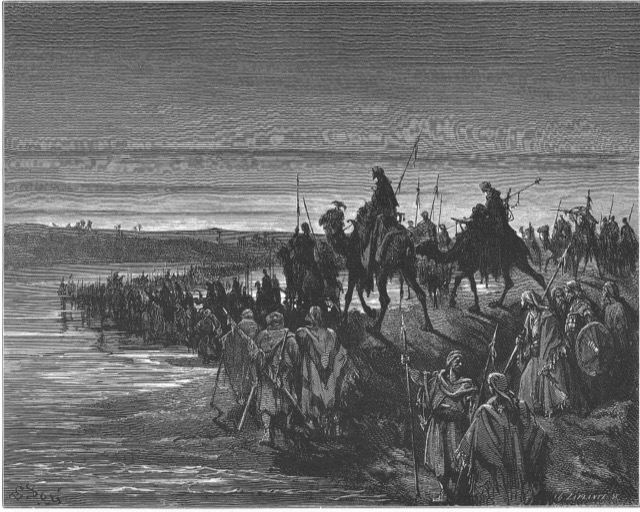
Israelites into Canaan
The Israelites Cross the Jordan River by Gustave Doré 1832-1883

So what’s this all about for us? Is it wrong for us to be deliberate about our decisions, reversing them when the situation becomes threatening? No, of course not. So what’s the difference here in our Numbers community?

At this moment in Israel’s history, God has made clear what is expected of them. They are in covenant with God – “all in” to follow God’s plan for their lives. God has demonstrated an irrevocable commitment to them in numerous ways, and forgiven earlier disloyalties. 

The question before them now is have they given God their whole hearts.

Or will this be a sham covenant in which they pick and choose when they will be for God and when they will be just for themselves?


The life of deep spiritual commitment to God is not always smooth. We get really mixed up sometimes in our self-concerns and fears. Many years ago, one of my eighth grade students asked me this: what if there really is no God and you’ve wasted your life believing there was?

It was quite a question, and I’ll bet you want to know my answer.

I said that I wouldn’t change a thing about how I have chosen to live my life. Trusting God and giving my life to God has given me a freedom beyond the limits of this world. Even if, at the end, her doubt proved true, I would have had a blessed and joyous life.

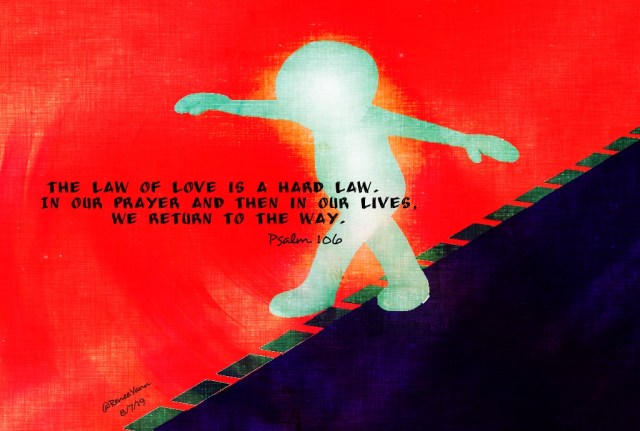
Psalm 106

The fact is that we, just like those Israelites standing on the edge of Canaan, don’t know what will happen to us if we trust God. Life and the future is an intimidating open border that challenges our faith and resolve.

But if we constantly hedge our self-gift to God, we will never be capable of receiving the fullness of God’s gift in return.

Today, let’s pray for the trust to step over into God’s country by our acts of faith, hope, love, mercy, generosity, truthfulness, hospitality and courage.


This beautiful reinterpretation of today’s Responsorial Psalm may inspire you as it did me. It is from the website of Christine Robinson, a Unitarian Universalist minister: Click here for Psalm renderings

Psalm 106: Returning
“Give thanks to God, who is good
whose mercy endures forever.”

We stand in awe of an infinity
which we cannot begin to comprehend
We set ourselves to live in tune with the universe—
that we may be glad with the gladness of people of faith.
Yes, time and time again we have gone astray,
We have despoiled this beautiful, wonderful world
dealt unjustly with our compadres
The law of love is a hard law.
In our prayer and then in our lives,
we return to the Way.

Music: Trust God – Rick Muchow 

Thunderous Son!

Feast of Saint James, Apostle
July 25, 2023

Today’s Readings:

https://bible.usccb.org/bible/readings/072523.cfm


Today, in God’s Lavish Mercy, we celebrate St. James the Greater. As you know, there were two Aposltes named James. It can get confusing. I know because about half the men in my family are named James. It’s hard to call out to one of them at a family reunion because four or five people will answer when you yell, “Hey, Jim!”

So tradition has solved the St. James name problem by designating one as “the Greater” and one as “the Less”, descriptors based on age not importance. Today we celebrate James the Greater.


Mary Salome and Zebedee with Sons James and John
according to Hans Seuss Kolmback – c.1511
(Love the hat, or what? And, baby John is already holding the “cup”!)


James and his brother John were sons of Zebedee. In Mark 17, Jesus nicknames the two of them “Sons of Thunder”, so he must have had some early insight into their fiery nature. That nature was clearly displayed after the Transfiguration when Jesus began his final journey to Jerusalem. He had sent the disciples ahead to prepare an overnight stay in a Samaritan village, but the villagers rejected Jesus. This made the Zebedee boys mad so they asked Jesus:

… the people there did not welcome him, because he was heading for Jerusalem. 
When the disciples James and John saw this, they asked,
“Lord, do you want us to call fire down from heaven to destroy them?” 
But Jesus turned and rebuked them.
Then he and his disciples went to another village.

Luke 9:53-56

You know what, I really like these guys! James and his brother John were all-in to Jesus and the Gospel. Their thundery enthusiasm got convoluted at times but, by word and example, Jesus continued to redirect their immense energy toward God’s Will.

I like their mother too. She had her own kind of fire and wanted the best for her boys as today’s Gospel indicates:

The mother of the sons of Zebedee approached Jesus with her sons
and did him homage, wishing to ask him for something.
He said to her,
“What do you wish?”
She answered him,
“Command that these two sons of mine sit,
one at your right and the other at your left, in your Kingdom.”

Matthew 20:20-21

With a surface reading of this passage, we might consider Mrs. Zebedee a little dense or arrogant. But Jesus simply responded by reminding her that her sons too, like him, would experience suffering before any heavenly reward.

The Gospel does not record Mrs. Zebedee’s response, whether she was miffed, chastened, frightened, or apologetic. What later chapters do record is that she got the message and embraced it. Of all the disciples she, with only a few other brave women and her boy John, showed up at the foot of the cross.

Where our man James the Greater was on that Good Friday we do not know. But he certainly stuck with Jesus in the long run.


The Zebedee Family, with its many Gospel appearances, can teach us so much about relationship with Jesus, about maturing slowly – sometimes haltingly – in Gospel faith, and about long-term fidelity to God’s Will. Let us pray with them today.


Poetry: from The Parables of Our Lord and Savior Jesus Christ, c.1763

PARABLE LXIII.

The two Sons of Zebedee.
The spouse of Zebedee, that bare
The sons of Thunder, made a pray'r,
As she to Christ adoring came;
And Jesus said, What would the dame?
‘Grant me, O Lord, that either son
‘Be with thee in thy kingdom; one
‘Upon thy right hand to appear,
‘The other on the left as near.’
But Jesus answer'd their desire,
‘Ye know not what ye would require.
‘Do ye yourselves of strength believe.
‘The cup I drink of to receive?
‘And in that baptism be baptiz'd,
‘Which is for Christ himself devis'd?’
O Lord, we do, they answer make.
‘Ye shall indeed my cup partake,
‘Be baptiz'd in my baptism too;
‘But 'tis not of my gifts to you,
‘On right or left to place, but theirs
‘For whom my heav'nly Sire prepares’
But when this thing was told the ten,
They were enrag'd at both the men:
But Jesus call'd them all, and said,
‘Ye know the Gentiles chuse a HEAD,
‘And that great prince that holds the reins,
‘Will plead a merit for his pains:
‘But with you it shall not be so;
‘Who would be great, he shall be low,
‘And he th'aspiring chief of all
‘A lord at ev'ry servant's call.
‘'Tis with the Son of Man the same,
‘To serve, and not be serv'd, he came;
‘A minister of no esteem,
‘Which dies the myriads to redeem.’
When Christ the multitudes had fed
With God's good fishes and his bread,
At once so great was his renown,
The people proffer'd him a crown,
From which in haste the Lord withdrew
To better points he had in view.
Christians must honour and obey
Such men as bear the sov'reign sway.
But, in respect of each to each,
The Lord and his apostles teach,
That we should neither load nor bind,
But be distributive and kind

Music: Congaudeant Catholici from the Codex Calixtinus – Music for the Feast of St. James the Apostle

The Codex Calixtinus (or Codex Compostellus) is a manuscript that is the main element of the 12th-century Liber Sancti Jacobi (‘Book of Saint James’), a pseudepigraph whose likely author is the French scholar Aymeric Picaud. The codex was intended as an anthology of background detail and advice for pilgrims following the Way of Saint James to the shrine of the apostle Saint James the Great, located in the cathedral of Santiago de Compostela, Galicia. The collection includes sermons, reports of miracles and liturgical texts associated with Saint James, and a set of polyphonic musical pieces. In it are also found descriptions of the route, works of art to be seen along the way, and the customs of the local people.

Three parts of the Codex Calixtinus include music: Book I, Appendix I, and Appendix II. These passages are of great interest to musicologists as they include early examples of polyphony. (Wikipedia)

Today’s selection is the Congaudeant Catholici. I could not find an English translation of the lyrics but, for the Latin scholars reading here, go to it with the text below! For the rest of us, it’s just a beautiful ancient melody to pray with.

Latin text

Congaudeant catholici,
letentur cives celici

Refrain: die ista

Clerus pulcris carminibus
studeat atque cantibus.

Hec est dies laudabilis,
divina luce nobilis.

Vincens herodis gladium,
accepit vite bravium.

Qua iacobus palatia,
ascendit ad celestia.

Ergo carenti termino
benedicamus domino.

Magno patri familias
solvamus laudis gratias.

No Sign Will Be Given Except…..

Monday of the Sixteenth Week in Ordinary Time
July 24, 2023

Today’s Reading:

https://bible.usccb.org/bible/readings/072423.cfm


Today, in God’s Lavish Mercy, Jesus is pestered by scribes and Pharisees who want him to prove himself by a sign.

Jesus answers their jibing in a kind of spiritual code.

Some of the scribes and Pharisees said to Jesus,
“Teacher, we wish to see a sign from you.”
He said to them in reply,
“An evil and unfaithful generation seeks a sign,
but no sign will be given it
except the sign of Jonah the prophet.
Just as Jonah was in the belly of the whale three days and three nights,
so will the Son of Man be in the heart of the earth
three days and three nights.

Matthew 12:38-40

So what exactly is “The Sign of Jonah”? Sounds like the title of a Dan Brown novel, doesn’t it?

Well, it is the title of a wonderful book, but not one by Dan Brown.


When I was in high school, I was obsessed with the writings of Thomas Merton. The fire was ignited by my freshman homeroom teacher who gave me a copy of his “Seeds of Contemplation” — another book that changed my life. Inspired by that first read, I slowly made my way through Seven Storey Mountain, No Man is an Island, Thoughts in Solitude … finally coming, in a veil of limited understanding, to “The Sign of Jonas”.

I didn’t understand the title. What I did begin to understand, as Merton journaled his daily life in the Abbey of Gethsemane, was that we discover God not by any external revelation or intellectual acquisition, but by our choices for love in the pattern of Jesus.

In today’s Gospel, the scribes and Pharisees seek an external demonstration that Jesus is all powerful. But their seeking is an insincere attempt at self-satisfaction, not a choice for Gospel love.


So what does Jonah have to do with the Pharisees’ insincerity? Jonah, given a mission by God, could not initially align himself with God’s call. At God’s irresistable invitation, Jonah spent three days of solitude in a whale’s belly contemplating his circumstances. By the graces gained in his solitude, Jonah emerged as a prophet for God.


As recounted in his book, the whale’s belly for Merton was his life in Gethsemane Abbey where he found the profound meaning and deep awareness of his vocation.

Let me rest in Your will and be silent.
Then the light of Your joy will warm my life.
Its fire will burn in my heart
and shine for Your glory.
This is what I live for. Amen, amen.


It may not sound all that inviting, but every one of us is called to the “whale’s belly”. Our transformation there is accomplished by our congruity with Christ’s sojourn in the tomb. Like Jesus, we must die to self for the sake of others. Like Jonah, we must abandon our fears and conveniences to become signs of God’s love in the world.


The Pharisees didn’t get it. And, God help them, I understand. It’s hard to get it! Life seems so much easier if we run away from this deep call like Jonah did at first. But the call remains: to be God’s Word in the world – to “shine for God’s glory“.


The editorial staff of the National Catholic Reporter wrote this about Merton’s Sign of Jonas:

Thomas Merton wrote in his early journals that the “sign of Jonas” — the mystery of Christ’s death and resurrection — is “burned into the roots of our being.” Sooner or later, everyone faces the universal truth that only through death to self do we find life. Merton embraced this sign and described himself as one like Jonah, because “I find myself traveling toward my destiny in the belly of a paradox.”


We may need to choose a little “whale-belly” time to get our hearts straight with this astounding yet universal call to be “for God” in our paradoxical world.


Poetry: two poems from “You! Jonah!” by Thomas John Carlisle

THE GREAT INTRUDER
It is exasperating
to be called
so persistently
when the last thing
we want to do
is get up and go
but God
elects
to keep on
haunting
like some
holy ghost.

———————–

COMING AROUND
And Jonah stalked
to his shaded seat
and waited for God
to come around
to his way of thinking.
And God is still waiting
for a host of Jonahs
in their comfortable houses
to come around
to His way of loving.

Music: Jonah and the Whale – Louis Armstrong – lyrics below

Jonah was a man who got a word from the Lord
Go and preach the Gospel to the sinful land‿
But he got on a ship and he tried to get away
And he ran into a storm in the middle of the sea

Now the Lord, He made the waves just roll so high
The ship begin to sink and they all begin to cry
So they pulled ole Jonah out of the hole
And they jumped him in the water just to lighten up the load

Now the Lord made a whale, long and wide Lord, Lord waddnat a fish
And he swallowed up Jonah, hair and hide Lord, Lord waddnat a fish,
Mmm, Lord, mmm, Lord

Now Jonah started to pray in the belly of the whale
Lord, Lord waddnat a fish
He repented of his sins like a man in jail
Lord, Lord waddnat a fish
Mmm, Lord, mmm, Lord

Now Jonah must o’ been a bad man, he must o’ been a sinner
Lord, Lord waddnat a fish
Cos when the whale got him down, he didn’t like his dinner
Lord, Lord waddnat a fish
Mmm, Lord, mmm, Lord

Well he swum around the ocean, sick as he could be
Lord, Lord waddnat a fish
And after three days, whoops! he had to set him free
Lord, Lord waddnat a fish, mmm

So the whale spit Jonah out onto dry land
Lord, Lord waddnat a fish
And went on to preaching like a righteous man
Lord, Lord waddnat a fish

Then the people quit their sins when they heard him the town
Lord, Lord waddnat a fish
So when you hear the call, don’t you turn the Gospel down
Lord, Lord waddnat a fish, mmm?