Power in Fragility

Memorial of Saints John de Brébeuf and Isaac Jogues, Priests, and Companions, Martyrs
October 19, 2022

Today’s Readings:

https://bible.usccb.org/bible/readings/101922.cfm

Today, in God’s Lavish Mercy,  Paul proclaims his mission to the Gentiles, announcing that through the Gospel, salvation is offered to all people. He says that, by grace, he became a minister of this Gospel – called to preach “the inscrutable riches of Christ”.

Lk12_48 much given

And Paul certainly did an extraordinary job. He had been given much by God, and he gave it back wholeheartedly.

In the Gospel, Jesus talks about that same kind of investment. In answer to Peter’s confusion about the call to be ready for God, Jesus tells the story of wily steward.

This servant had been given much: trust, responsibility, power and probably higher pay. But when the master is away, the trusted servant fails him, acting cruelly and greedily in his own interest.

Jesus ends the story with a pronouncement that has always shaken me a little: 

For unto whomever much is given,
much will be required. 

I know I’ve been given a stunning abundance by God: faith, family, friends and a thousand other graces.  But my will and ability to give back sometimes feels as fragile as a decaying leaf. Ever feel like that?

It turns out that even Paul, great Apostle to the Gentiles, felt that way too. He says so in his letter to the Corinthians. Paul asks God to remove his fragility.

But He said to me,
“My grace is sufficient for you, 
for my power is made perfect in weakness.” 

Let’s pray today to be good stewards of the amazing riches God has given us – in Creation, Faith, Grace and Community. Let us invite God’s power to perfect our weakness, all for the sake of God’s glory.

Even a lacy leaf can be beautiful when it is filled with Light.


Poetry: To Autumn – John Keats

Season of mists and mellow fruitfulness,
  Close bosom-friend of the maturing sun;
Conspiring with him how to load and bless
  With fruit the vines that round the thatch-eves run;
To bend with apples the moss'd cottage-trees,
  And fill all fruit with ripeness to the core;
    To swell the gourd, and plump the hazel shells
  With a sweet kernel; to set budding more,
And still more, later flowers for the bees,
Until they think warm days will never cease,
    For summer has o'er-brimm'd their clammy cells.
Who hath not seen thee oft amid thy store?
  Sometimes whoever seeks abroad may find
Thee sitting careless on a granary floor,
  Thy hair soft-lifted by the winnowing wind;
Or on a half-reap'd furrow sound asleep,
  Drowsed with the fume of poppies, while thy hook
    Spares the next swath and all its twined flowers:
And sometimes like a gleaner thou dost keep 
  Steady thy laden head across a brook;
  Or by a cider-press, with patient look,
    Thou watchest the last oozings, hours by hours.
Where are the songs of Spring? Ay, where are they?
  Think not of them, thou hast thy music too,--
While barred clouds bloom the soft-dying day,
  And touch the stubble-plains with rosy hue;
Then in a wailful choir the small gnats mourn
  Among the river sallows, borne aloft
    Or sinking as the light wind lives or dies;
And full-grown lambs loud bleat from hilly bourn;
  Hedge-crickets sing; and now with treble soft
  The redbreast whistles from a garden-croft,
    And gathering swallows twitter in the skies.

Music: My Grace is Sufficient for You – Keith and Amy Amano 

Hypocrisy! Oh, no!

Tuesday of the Twenty-eighth Week in Ordinary Time
October 11, 2022

Today’s Readings:

https://bible.usccb.org/bible/readings/101122.cfm

Today, in God’s Lavish Mercy, our readings challenge religious and moral hypocrisy.

Lk.11_39 dirty cup

Paul, in his continuing letter to the Galatians, counsels them about the practice of circumcision. But his counseling is really about freedom in Christ. 

In Paul’s time, circumcision had religious significance as a sign of inclusion in the Jewish nation. Some Jewish Christians mistakenly taught that a Gentile must first become a Jew, through the law of circumcision, in order to become a Christian.

Paul condemns this error, reminding the Galatians that the grace given to us in Christ is beyond the Law.

For in Christ Jesus,
neither circumcision nor uncircumcision counts for anything,
but only faith working through love.

In the Gospel, Jesus condemns any religious practice that is empty and just for show.  He compares such rituals to cups, whose clean exterior hides a corrupt interior. Jesus says that the remedy to this hidden nastiness is to give alms, to be merciful.

We are all aware of pharisaical behavior within our religious institutions. We have seen disgusting evidence of it in sexual predation among clergy. We see it when exaggerated religious rituals are substituted for sincere, communal worship. We see it when the small, visible mistakes of others are used to hide the gaping faithlessness of the condemner. Sometimes, we are even caught in the judgmental nets these pretenses spin.

When we are confused by such situations, look to the words of Jesus and Paul today:

Look for faith working through love.
Look for a generous heart that sees and comforts the poor.

If our “religious” observance results in any form of exclusion, prejudice, condemnation or unforgiveness, we can be sure it is not of God.

Poetry: by Omar Khayyam

If you will listen to me, 
I will give you some advice:
[Here it is] 
For the love of God 
put not on the mantle
of hypocrisy. 
Eternity is for all time, 
and this world
is but an instant. 
Then sell not for an instant 
the empire
of eternity.

Music: Purify My Heart ~ Brian Doerksen

Your Life Spells It Out!

Twenty-seventh Sunday in Ordinary Time
October 2, 2022

Today’s Readings:

https://bible.usccb.org/bible/readings/100222.cfm

Today, in God’s Lavish Mercy,  our readings combine to offer us a powerful message: we are the translators of God’s Word for our time. Our choices and actions for justice and mercy make the vision “readable” – visible for our sisters and brothers.

Hab2_2 vision

Habakkuk starts our challenge. He is in a bit of a struggle with God, asking repeatedly how long God is going to allow the people to suffer. ( I have had similar conversations with God, especially during these charged political times).

In so many words, God tells Habakkuk to look to his faith – his vision through God’s eyes. God sees that “the just one, because of his faith, shall live.” God tells him to “write the vision down”, to make it apparent in his own choices and actions for justice and mercy. In other words, Habakkuk, I’ve done what I am going to do. The rest is up to you, Buddy!


In a similar way, Paul reminds Timothy to “stir up the flame” – the gift of God given at his profession of faith. Paul reminds Timothy that, by grace, he knows what is right and just. He must not be chicken about living and speaking that Truth – to write the vision down by his choices and actions for justice and mercy.


In our Gospel, the disciples seem to want their faith increased because the commitment to witness is scary. They think they might feel a little better about it all if their faith consoled them more. But “writing the vision with our lives” takes guts, and the disciples seem a little lacking in today’s reading.

Jesus tells them to buck up. They are blessed to serve the Word of God by the witness of their lives. It won’t always feel good, safe or successful. Still they, and we, must unfailingly write the vision down by our choices and actions for justice and mercy, because even …

When you have done all you have been commanded,
say, ‘We are unprofitable servants;
we have done what we were obliged to do.

Jesus calls it like it is today. We are blessed to be God’s translators. We have an undeniable call to live God’s just and merciful vision. No excuses. Get it together. Keep the pencil sharp. No asking God when He’s going to make things better. The legible (just and merciful) translation depends on us!

Poetry: Abou Ben Adhem – Leigh Hunt

Abou Ben Adhem (may his tribe increase!) 
And saw, within the moonlight in his room, 
Making it rich, and like a lily in bloom, 
An angel writing in a book of gold:— 
Exceeding peace had made Ben Adhem bold, 
And to the presence in the room he said, 
“What writest thou?”—The vision raised its head, 
And with a look made of all sweet accord, 
Answered, “The names of those who love the Lord.” 
“And is mine one?” said Abou. “Nay, not so,” 
Replied the angel. Abou spoke more low, 
But cheerly still; and said, “I pray thee, then, 
Write me as one that loves his fellow men.” 

The angel wrote, and vanished. The next night 
It came again with a great wakening light, 
And showed the names whom love of God had blest, 
And lo! Ben Adhem’s name led all the rest.

Music: The Vision – Patrick Love

Job’s Storms

Monday of the Twenty-sixth Week in Ordinary Time
September 26, 2022

Today’s Readings:

https://bible.usccb.org/bible/readings/092622.cfm

Job on the Dunghill – Gonzalo Carrasco

Today, in God’s Lavish Mercy, we have the first of six readings from the wonderful Book of Job, that magnificent ancient poem which explores the human relationship with God.

“The book of Job in its three parts of narrative-poetry-narrative is a daring, majestic fugue that renders theological trouble and submissiveness in all of its immense complexity. The whole of the drama is to be fully appreciated in its inexhaustible artistry, and not interpreted so that it is made to conform to any of our ready-made theological packages.” 

Walter Brueggemann, An Introduction to the Old Testament: The Canon and Christian Imagination, 2003

The story opens with Satan annoying God with a plot against Job by suggesting that Job loves God only because God blesses Job:

And the LORD said to Satan, “Have you noticed my servant Job,
and that there is no one on earth like him,
blameless and upright, fearing God and avoiding evil?”
But Satan answered the LORD and said,
“Is it for nothing that Job is God-fearing?
Have you not surrounded him and his family
and all that he has with your protection?

To test out his thesis, Satan strikes a deal with God to go vex the heck out of poor Job:

And the LORD said to Satan,
“Behold, all that he has is in your power;
only do not lay a hand upon his person.”
So Satan went forth from the presence of the LORD.


Hopefully, we will learn something about ourselves and our relationship with God as we pray with Job over the next six readings. It is a simple book to read but a challenging one to understand. The poem seems to center on humankind’s recurring question to God: Why do good people have to suffer? But it is really about much more than that.

Job is a soul of unshakeable faith. Never once does he deny or abandon God. But he stands up to a God he doesn’t yet understand. He rails, he argues, he quiets, he listens. The book is really about that growing understanding and faith. Job’s questions are our questions. Job’s storms are our storms. Job’s journey into grace is our journey:

  • How do we relate to the inscrutable mystery of God’s Love when the circumstances of our life seem bereft of it?
  • How do we remain faithful when God seems to be silent to our pleading?
  • How do we continue to choose good when the choice seems foolish and unrewarding?

Like Job, is my faith strong enough to choose God even in the midst of all these “how’s”? Will I allow my heart to remain open to the intense truth of that Love as my life reveals it to me?


Poetry: Reversed Thunder – Malcolm Guite

This light is muffled, muted, murky, dense.
Thick with a threat of thunder unreleased.
The clouds are darkening, the air grows tense,
The coming storm is lowering in the east
Something within me trembles too, and pales,
Though no one sees the brooding darkness there,
Or feels the tension building between poles
Of faith and doubt, of vision and despair.
Everything deepens, gathers to a head:
Anguish and anger at my absent God
Until the charge of all that’s left unsaid
Leaps out at last to find its lightening rod.

But even as the skies are rent and riven
I find that lightening rod is earthed in heaven.

Music: Across the View – Richard Burmer

Trust Your Life

Thursday of the Twenty-fifth Week in Ordinary Time
September 22, 2022

Today’s Readings:

https://bible.usccb.org/bible/readings/092222.cfm

Today, in God’s Lavish Mercy, we meet the first of a few readings from Ecclesiastes, written by an author who calls himself Qoheleth – Teacher. The book contains many loved and oft-repeated phrases that we might recognize:

  • There is a time for everything, and a season for every activity under heaven
  • He has made everything beautiful in its time.

And today’s kick-off thought:

  • Vanity of vanities ….  All is vanity.

Reading Ecclesiastes places us in the presence of a writer who is a realist at best, and a cynic at worst. Parts of the book can be downright depressing; other parts, elegant in their spare beauty.


We can finish a passage like today’s and hear echoes around us of Star Trek’s Borg mantra: 

Resistance is futile. 

Qoheleth says as much:

What has been will be again,
what has been done will be done again;
there is nothing new under the sun.

The phrase carries at least a little tinge of hopelessness. But I think a lot depends on the way we read it.


Realizing that “things are the way they are” can give us a sense of stability and trust. It can release us from struggling needlessly against realities that will not be moved. It can encourage us to find within these “immovables” the hidden path to a new grace. It can remind us that others have endured; so can we.

What is is

One of our Wisdom Sisters taught us that by naming and accepting our reality, we can move from fighting it into growing from it. She always said, “What is, is” – implying “now deal with it”.

It sounds spartan, but it actually can be very freeing. We can’t change so many things – the weather, the tides, the hearts of others. The years will pass, friendships blossom and fade. We will get old, if we are blessed with that gift. We’ll lose our jump shot and probably some of our hair – maybe a few others things too.

But God will always love us, abide with us and cherish us for eternity. We’re gonna’ make it, one way or the other – because ‘God Who is, is!”


Poetry: Prayer – Galway Kinnell

Whatever happens. Whatever
what is is is what
I want. Only that. But that.

Music: In Every Age – Janét Sullivan Whitaker

Mary, Holy Name

Monday of the Twenty-fourth Week in Ordinary Time
Memorial of the Most Holy Name of Mary 
September 12, 2022

Alleluia, alleluia.
Blessed are you, O Virgin Mary, who believed 
that what was spoken to you by the Lord would be fulfilled.

Today’s Readings

https://bible.usccb.org/bible/readings/0912-memorial-most-holy-name-mary.cfm

Today, in God’s Lavish Mercy, we have a choice in readings between the 24th Monday or the Holy Name of Mary. I’m going with Mary, especially since the passage from Corinthians is about people overeating and drinking (and stealing parking spots?) at their church meetings. Can you imagine! Well, yes, maybe we’ll save that for another day. 😉

When the fullness of time had come,

God sent his Son,
born of a woman..

Galatians 4:4

It’s such a brief and simple phrase from Galatians, isn’t it? But it carries the whole possibility of our redemption, and the infinite hope of our eternal life.

We owe it all, of course to God’s Mercy, but in a very real way, we owe it to this “woman” who is not even named in Galatians!

Today, let’s simply say her holy name in prayer, asking to be strengthened in faith, courage, hope, fidelity, and love – the hallmarks of her life.

Praying her name slowly – Mary……… Mary…… Mary …. let each breath deepen our love for her. Let each quiet thought ask for the grace to learn from her.

Music:

Run the Race

Memorial of Saint Peter Claver, Priest
September 9, 2022

May we begin today with a prayer of gratitude and respect
for the remarkable life of service of

Queen Elizabeth II

sketch for the Queen’s Jubilee by Eleanor Tomlinson

Today’s Readings:

https://bible.usccb.org/bible/readings/090922.cfm

Today, in God’s Lavish Mercy, there is a powerful urgency in Paul’s preaching.

Do you not know that the runners in the stadium all run in the race,
but only one wins the prize?
Run so as to win.
Every athlete exercises discipline in every way.
They do it to win a perishable crown,
but we an imperishable one.
Thus I do not run aimlessly;
I do not fight as if I were shadowboxing.
No, I drive my body and train it,
for fear that, after having preached to others,
I myself should be disqualified.

1 Corinthians 9:24-27

Let’s face it: Paul must have been a seriously intense guy. I mean look at his life! Early on, he took it on himself to personally go around “murderously” persecuting Christians. He got knocked off his high horse in a bolt from heaven, was struck blind, cured, and converted. This man did not live a laid-back life!

Conversion of Paul – Caravaggio

In today’s scripture, Paul tells the Corinthians to have an equal passion in living out their Christian faith. He describes his own complete dedication and chosen sacrifices to live and preach Christ’s message, saying:

All this I do for the sake of the Gospel,
so that I too may have a share in it.

In our Gospel, Jesus says that to live the faith sincerely, we must be rid of anything that blinds us. Paul got his corrected vision in a lightning induced horse-fall. Maybe we need similar drama to achieve ours. Or maybe we just need to consistently place our judgements, beliefs, passions, and convictions before God humbly asking for the grace of discernment.

Why do you notice the splinter in your brother’s eye,
but do not perceive the wooden beam in your own?
How can you say to your brother,
“Brother, let me remove that splinter in your eye,’”
when you do not even notice the wooden beam in your own eye?
You hypocrite!  Remove the wooden beam from your eye first;
then you will see clearly
to remove the splinter in your brother’s eye.”


Poetry: The Racer – John Masefield

And as he landed I beheld his soul
Kindle, because, in front, he saw the Straight
With all its thousands roaring at the goal,
He laughed, he took the moment for his mate.
I saw the racer coming to the jump,
Staring with fiery eyeballs as he rusht,
I heard the blood within his body thump,
I saw him launch, I heard the toppings crusht.
Would that the passionate moods on which we ride
Might kindle thus to oneness with the will;
Would we might see the end to which we stride,
And feel, not strain, in struggle, only thrill.
And laugh like him and know in all our nerves
Beauty, the spirit, scattering dust and turves.

Music: Chariots of Fire – Vangelis

God bless Queen Elizabeth II
who has faithfully run the race.
May she rest in peace.

Mary, Singer of Joy

Feast of the Nativity of the Blessed Virgin Mary
September 8, 2022

Today’s Readings:

https://bible.usccb.org/bible/readings/090822.cfm

Today, in God’s Lavish Mercy, on our Blessed Mother’s birthday, we pray with the beautiful final verses of Psalm 13.

These verses embody an immense shift in form from the psalm’s early lines. Early on, the psalmist cries out four times, “How long, O Lord?”.

How long: 

  • Will you forget me?
  • Will you hide your face from me?
  • Must I carry sorrow in my soul?
  • Will my enemy triumph over me?

Referring to these early verses reminds us that Mary’s life was full of sorrow as well as joy. On a feast like today, we think of Mary in her heavenly glory. But in her lifetime, Mary suffered many sorrows. She was an unwed mother, a refugee, and a widow. She was the mother of an executed “criminal” and a leader of his persecuted band.

The Julian of Norwich, “Her Showing of Love”

What was it that allowed Mary to transcend sorrow and claim joy? Our psalm verses today help us to understand. They show the psalmist turning to heartfelt prayer., trusting God’s abiding protection.

Look upon me, answer me, LORD, my God!
Give light to my eyes lest I sleep in death,
Lest my enemy say, “I have prevailed,”
lest my foes rejoice at my downfall.


That deep trust ultimately yields
not only peace, but joy. 
Mary, singer of the Magnificat, 
is the quintessence of that holy joy.


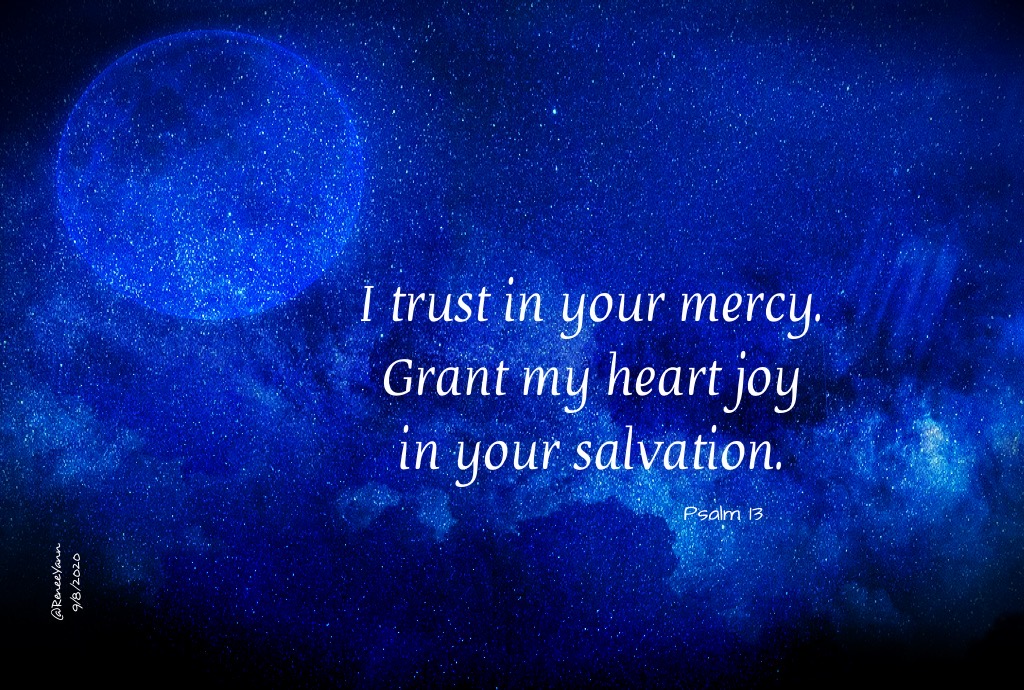
But I trust in your mercy.
Grant my heart joy in your salvation,
I will sing to the LORD,
Who has dealt bountifully with me!

Today, in our prayer, we ask Mary to love and guide us through the challenges of our lives.


Poetry: Three Days – Madeleine L’Engle

Friday:
When you agree to be the mother of God
you make no conditions, no stipulations.
You flinch before neither cruel thorn nor rod.
You accept the tears; you endure the tribulations.
But, my God, I didn't know it would be like this.
I didn't ask for a child so different from others.
I wanted only the ordinary bliss,
to be the most mundane of mothers.

Saturday:
When I first saw the mystery of the Word
made flesh I never thought that in his side
I'd see the callous wound of Roman sword
piercing my heart on the hill where he died.
How can the Word be silenced? Where has it gone?
Where are the angel voices that sang at his birth?
My frail heart falters. I need the light of the Son.
What is this darkness over the face of the earth?
Sunday:
Dear God, He has come, the Word has come again.
There is no terror left in silence, in clouds, in gloom.
He has conquered the hate; he has overcome the pain.
Where, days ago, was death lies only an empty tomb.
The secret should have come to me with his birth,
when glory shone through darkness, peace through strife.
For every birth follows a kind of death, and only after pain comes life.

Music Video: Magnificat –

Between a Rock and …

Monday of the Twenty-third Week in Ordinary Time
September 5, 2022

Today’s Readings:

https://bible.usccb.org/bible/readings/090522.cfm

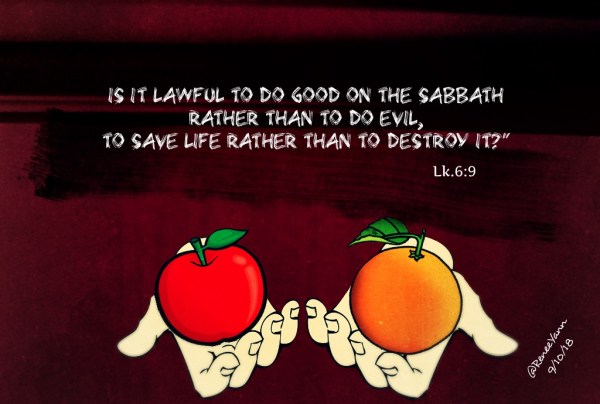
Today, in God’s Lavish Mercy, our Gospel finds the Pharisees once again confronting Jesus with a dilemma.  It is the Sabbath, a day when any kind of “work” is prohibited. Yet, a man with a withered hand approaches Jesus needing to be cured. Should Jesus do this work?

Lk6_9 law or mercy

It is the classic, Pharisaical confrontation: appearing to weigh two equal responses which in reality are incomparable – like apples and oranges. They are similar only on the surface. Their essences are quite distinct.

Jesus’ continuing debate with the Pharisees always swirls around the balance between law and spirit. The Pharisees have idolized the Law, allowing it to swallow the Spirit. Under their intransigent interpretation, the poor crippled man in today’s Gospel would have lost the chance for healing.


We call quandaries like this being “between a rock and a hard place”. The ancient Greeks called  it “between Scylla and Charybdis” – an adjacent huge rock and whirlpool which threatened to swallow their ships passing through. The image powerfully captures the angst accompanying  these dilemmas.

We navigate such hazards throughout our lives, facing choices which are often unclear and confusing. Our alternatives sail the wide range between “law” and “spirit”, between what seems advantageous and what seems right, between what is comfortable and what is spiritually challenging, between what is “legal” and what is just and merciful.


How do we choose according to the pattern of Christ? How do we choose forgiveness, mercy, inclusive love, peace and charity in a world that screams “Choose selfishly. You deserve it!”

Through prayer, scriptural reflection, and merciful service, our spirits absorb that Sacred Pattern of Christ. It is in the shape of the Cross. It will guide us between our Scylla and Charybdis.


Poetry: Scylla and Charybdis – from The Aeneid by Virgil

                    BUT when near the coasts
Of Sicily, Pelorus’ narrow straits
Open to view, then take the land to the left,
And the left sea, with a wide circuit round,
And shun the shore and sea upon the right.         5

Those lands, ’t is said, by vast convulsions once
Were torn asunder (such the changes wrought
By time), when both united stood as one.
Between them rushed the sea, and with its waves
Cut off the Italian side from Sicily,         10

And now between their fields and cities flows
With narrow tide. There Scylla guards the right,
Charybdis the implacable the left;
And thrice its whirlpool sucks the vast waves down
Into the lowest depths of its abyss,         15

And spouts them forth into the air again,
Lashing the stars with waves. But Scylla lurks
Within the blind recesses of a cave,
Stretching her open jaws, and dragging down
The ships upon the rocks. Foremost, a face,         20

Human, with comely virgin’s breast, she seems,
E’en to the middle; but her lower parts
A hideous monster of the sea, the tails
Of dolphins mingling with the womb of wolves.
Better to voyage, though delaying long,         25

Around Pachyna’s cape, with circuit wide,
Than once the shapeless Scylla to behold
Under her caverns vast, and hear those rocks
Resounding with her dark blue ocean hounds.

Today’s song is simple, almost childlike – but that simplicity is often just what we need in the face of a dilemma.
Music: I Choose You – Libby Allen Songs

Alleluia: Call to Discipleship

Thursday of the Twenty-second Week in Ordinary Time
September 1, 2022

Today, in God’s Lavish Mercy, our readings lead us to consider our call.

Lk5_11 leftJPG

The call to discipleship comes to us within the other calls of our life: the call to be a good parent, spouse, sibling, child. It comes in the call to be a moral, values-driven employer; an honest, hard-working employee; a supportive, engaged co-worker. Christ asks us to mirror him as neighbor, friend, colleague, and citizen.

In whatever skill or profession we practice, Christ asks us to exercise it as he would – to choose, judge and behave as he would.


In our Gospel, the first disciples are astonished at the miracle of the fishes. Like a lightening bolt, that astonishment transforms their world view. They now see Christ as the Center of their lives. They drop their nets on the seashore. They leave everything to follow him.


What is it that we must leave to make Christ the center of our lives? What nets are we caught in that keep us from freeing the call within us?

We are challenged by a world filled with the entanglements of greed, destructive power, aggression, bigotry, lies, and political & social pretense. How much have these infected the purity of our desire to follow Jesus?


Poetry: On St. Peter Casting Away His Nets at Our Saviour’s Call – Richard Crashaw

Thou hast the art on't Peter; and canst tell 
To cast thy Nets on all occasions well. 
When Christ calls, and thy Nets would have thee stay: 
To cast them well's to cast them quite away.

Music: Lord, You Have Come to the Seashore- Caesareo Gabarain

Lord, You have come to the seashore
Neither searching for…the rich nor the wise,…
desiring only…that I should follow
Refrain:
O Lord, with your eyes set upon me,
gently smiling, you have spoken my name;
all I longed for I have found by the water.
At your side, I will seek other shores.

Lord, see my goods, my possessions;
in my boat you find…no power, no wealth…
Will you accept then…my nets and labor?

Lord,…take my hands and direct them
Help me spend myself in seeking the lost,…
returning love for…the love you gave me.

Lord,…as I drift on the waters…
be the resting place…of my restless heart,…
my life’s companion,…my friend and refuge.