Lent: Through Fire and Storm

April 6, 2022
Wednesday of he Fifth Week of Lent

Today, in God’s Lavish Mercy, we see faith tested by fire.

7SRCYZFA2A

In our first reading, three young men stand convinced of God. Even the threat of a fiery death cannot shake them from that conviction.

And their faith is not a quid pro quo – a case where they say to God, “I’ll believe if you do ‘X’ for me.” No, their commitment is unqualified and complete:

If our God, whom we serve,
can save us from the white-hot furnace
and from your hands, O king, may he save us!
But even if he will not, know, O king,
that we will not serve your god
or worship the golden statue.

Daniel 3: 17-18

When Shadrach, Meshach, and Abednego are cast into the furnace, a fourth figure appears with them, an angel of God who delivers them safely through their trial.

fire

In our Gospel, even “the Jews who believed” in Jesus begin to quibble with him. They stand with him at the threshold of his Passion and Death, the great fire that will test them all. Like the three young men at the furnace, they face the ultimate choice:

Who do you really believe in?
What God will you give your life to?

Jesus challenges them to follow him into the fire that faces him:

Jesus answered them, “Amen, amen, I say to you …
… if the Son frees you, then you will truly be free.
I know that you are descendants of Abraham.
But you are trying to kill me,
because my word has no room among you.
I tell you what I have seen in the Father’s presence;
then do what you have heard from the Father.

John 8: 34-36

Throughout our lives, our faith will be tested many times. That’s why it’s called “faith” and not “certainty ”. Our life circumstances will ask us, again and again, if our faith is strong enough to stand in the fire, to walk the Calvary road with Jesus.

Let the testimony of the ages inspire us with courage. From our scriptural heritage, we know the fire hid an angel. We know the road continued past the bloody hill and on to the Resurrection. We know that every storm will pass and leave us washed anew in grace if we make that ultimate choice to be faithful.


Poetry: Touched by an Angel – Maya Angelou

We, unaccustomed to courage 
exiles from delight 
live coiled in shells of loneliness 
until love leaves its high holy temple 
and comes into our sight 
to liberate us into life. 

Love arrives 
and in its train come ecstasies 
old memories of pleasure 
ancient histories of pain. 
Yet if we are bold, 
love strikes away the chains of fear 
from our souls. 

We are weaned from our timidity 
In the flush of love’s light 
we dare be brave 
And suddenly we see 
that love costs all we are 
and will ever be. 
Yet it is only love 
which sets us free.


Music: Praise You in This Storm – Casting Crowns

Lent: Trust the Light

April 4, 2022
Monday of the Fifth Week of Lent

Today, in God’s Lavish Mercy, our first reading offers us one of the most captivating, and perhaps infuriating, stories of the Bible – the story of Susanna. This is a tale that can offer us many points of reflection. Rather than offer you my own, I would like to refer you to this excellent article by Dr. Malka Zeiger Simkovich is a the Crown-Ryan Chair of Jewish Studies at Catholic Theological Union in Chicago, and the director of their Catholic-Jewish Studies program.


Our Gospel for today picks of the themes of knowledge, truth and judgement we have found in Daniel.

Jesus in facing mounting harassment and criticism from those threatened by his message. In today’s passage, a group of Pharisees engages in a verbal duel with Jesus:

The Pharisees said to him,
“You testify on your own behalf,
so your testimony cannot be verified.”
Jesus answered and said to them,
“Even if I do testify on my own behalf, my testimony can be verified,
because I know where I came from and where I am going.
But you do not know where I come from or where I am going.
You judge by appearances, but I do not judge anyone.

Jesus makes it clear that such mental gymnastics, devoid of heart and spirit, are nothing but a journey in darkness:

Jesus spoke to them again, saying,
“I am the light of the world.
Whoever follows me will not walk in darkness,
but will have the light of life.”


We’ve all met people who want to make faith into a mental Rubik’s cube. But deep faith will never fit into blocks and clever twists. Deep faith releases us from the need to have everything fit – from the futile imagination that we are in control of anything but our power to love.

As we pray with the little pieces of Susanna, Pharisees, and wicked elders we might discover in our own lives, let’s ask for the courage and grace to relax into the Light that Jesus offers us today.


Poetry: Peter Quince at the Clavier – Wallace Stevens

  I 

Just as my fingers on these keys 

Make music, so the selfsame sounds 

On my spirit make a music, too. 

Music is feeling, then, not sound; 

And thus it is that what I feel, 

Here in this room, desiring you, 

Thinking of your blue-shadowed silk, 

Is music. It is like the strain 

Waked in the elders by Susanna: 

Of a green evening, clear and warm, 

She bathed in her still garden, while 

The red-eyed elders, watching, felt 

The basses of their beings throb 

In witching chords, and their thin blood 

Pulse pizzicati of Hosanna. 

                                              II 

In the green water, clear and warm, 

Susanna lay. 

She searched 

The touch of springs, 

And found 

Concealed imaginings. 

She sighed, 

For so much melody. 

Upon the bank, she stood 

In the cool 

Of spent emotions. 

She felt, among the leaves, 

The dew 

Of old devotions. 

She walked upon the grass, 

Still quavering. 

The winds were like her maids, 

On timid feet, 

Fetching her woven scarves, 

Yet wavering. 

A breath upon her hand 

Muted the night. 

She turned— 

A cymbal crashed, 

And roaring horns. 

                                           III 

Soon, with a noise like tambourines, 

Came her attendant Byzantines. 

They wondered why Susanna cried 

Against the elders by her side; 

And as they whispered, the refrain 

Was like a willow swept by rain. 

Anon, their lamps’ uplifted flame 

Revealed Susanna and her shame. 

And then, the simpering Byzantines 

Fled, with a noise like tambourines. 

                                             IV 

Beauty is momentary in the mind— 

The fitful tracing of a portal; 

But in the flesh it is immortal. 

The body dies; the body’s beauty lives. 

So evenings die, in their green going, 

A wave, interminably flowing. 

So gardens die, their meek breath scenting 

The cowl of winter, done repenting. 

So maidens die, to the auroral 

Celebration of a maiden’s choral. 

Susanna’s music touched the bawdy strings 

Of those white elders; but, escaping, 

Left only Death’s ironic scraping. 

Now, in its immortality, it plays 

On the clear viol of her memory, 

And makes a constant sacrament of praise.


Music: Bach: Prelude in C Major, BWV 846, The Well-Tempered Clavier

Lent: Stop Pretending

April 2, 2022
Saturday of the Fourth Week of Lent

Today, in God’s Lavish Mercy, danger continues to escalate for Jesus.

Our first reading from Jeremiah foreshadows Jesus’s situation. Some powerful people didn’t want to hear what Jeremiah preached. And we can understand why: Jeremiah prophesied the destruction of Jerusalem because of Israel’s unfaithfulness. It’s a message that was hard to swallow.

jeremiah

The core of Jeremiah’s teaching was this:
You people have to change. This is not the way God created the world to be.

But the people couldn’t listen. They had let the skewed reality of their lives become normal and needed. They couldn’t accept the world of mutual love and justice that God imagined for them.


Jesus meets the same kind of stonewalling.

In today’s passage, the hard-hearted rationalize their resistance:

“The Christ will not come from Galilee, will he?
Does not Scripture say that the Christ will be of David’s family
and come from Bethlehem, the village where David lived?”

But their antagonism isn’t really about geography and lineage. It’s about blind comfort in a world balanced toward their advantage. It’s about the fear of grace-inspired change.

Lk8_generous heart


Isn’t it the truth that we’ll use almost any argument to resist what demands our conversion? I understand why these guys “each went to his own house”, as the Gospel says in closing. They took refuge from grace in the little roofed pretense of their own control.

They didn’t have the courage to open their hearts to Jesus. Do we?


Poetry: LOVE IS THE MASTER – RUMI

Love is the One who masters all things;
I am mastered totally by Love.
By my passion of love for Love
I have ground sweet as sugar.
O furious Wind, I am only a straw before you;
How could I know where I will be blown next?
Whoever claims to have made a pact with Destiny
Reveals himself a liar and a fool;
What is any of us but a straw in a storm?
How could anyone make a pact with a hurricane?
God is working everywhere his massive Resurrection;
How can we pretend to act on our own?
In the hand of Love I am like a cat in a sack;
Sometimes Love hoists me into the air,
Sometimes Love flings me into the air,
Love swings me round and round His head;
I have no peace, in this world or any other.
The lovers of God have fallen in a furious river;
They have surrendered themselves to Love’s commands.
Like mill wheels they turn, day and night, day and night,
Constantly turning and turning, and crying out.

Music:  Spirit, Open My Heart –  Alfred V. Fedak

Lent: Embracing the Brokenhearted

April 1, 2022
Friday of the Fourth Week of Lent

Today, in God’s Lavish Mercy, our reading from the Book of Wisdom clearly describes the machinations and motivations of an evil heart. We see fear, jealousy, control, and greed all strangling the described plotters.

Wisdom also shows us the characteristics of the good heart: justice, holy knowledge, purity, gentleness, patience, strength and perseverance.

The struggle between these two dimensions has defined human interactions ever since Eden.

Ps34 brokenhearted

Our Gospel tells us that these forces met their ultimate contest in the Passion and Death of Jesus Christ. And the Victor has been revealed in the triumph of the Resurrection.

These beliefs are the foundation of our faith, bedrocks we can live by when life’s circumstances test our resolve and courage.


The presence of evil and suffering in human life causes us an ongoing struggle. When we see good people suffer and evildoers seem to triumph our faith may be tested. Some people ask if God is punishing us, or has God abandoned us. Some even wonder if there really is a God at all!


Today’s readings might help us rebalance our faith and dig deeper into its mysteries – because faith is a relationship, not a handbook. No matter how hard we search, pat answers don’t exist … just the daily learning to which the Gospel invites us.

In the life of Jesus, the Father neither caused evil nor removed it. The Father simply remained one with Jesus – living, loving, rejoicing and suffering with him. God does that with us too.

So when we pray, do we pray for miracles? Sure we do! Some miracles would be really great right now. Even Jesus prayed for that kind of intervention in Gethsemane:

Father, if you will, take this cup from me.

But when that didn’t happen, Jesus stayed the faithful course, trusting that he was already safe in his Father, no matter what swirled around him.

We may want to pray our poignant Responsorial Psalm today, asking God to help us faithfully abide in its promise. Here is a beautiful translation by Steven Mitchell from his book, A Book of Psalms:Reflections Adapted from the Hebrew (Available on Amazon – Click here for Amazon

I will bless the Lord at all times;
my lips will sing out his praise.
I will thank him for the love he has shown me
and the clarity that gladdens my heart. 

Sing out with me and thank him;
be grateful for all his gifts.
Turn to him; let your soul feel his presence;
oh taste and see that the Lord is good;
happy are those who trust him. 

You who desire true life
and wish to walk on God’s path:
Depart from evil; do good;
seek peace with all your soul. 

The Lord cares for the righteous
and watches over the merciful.
He is near when their hearts are broken;
when their spirits are crushed, he is with them.
And though they may undergo hardships,
he fills them with blessings in the end.

Music:  The Poor Man Cries – Marty Goetz (Lyrics below)

Lyrics

The Lord On High is very near
To all who call on Him
This poor man cries and He hears
And delivers him from all his fears

For the Lord is nigh to them that fear Him
The contrite will have light never dim
The righteous cry and He hears
And delivers them from all their fears
From all their fears

“Gad-lu l’Adonai ee’ti,
Oon’ ram’ma sh’mo yach-dau”
I will bless Him all my days
His praise shall continually be in my mouth
To the King I sing with pride

And the humble hear
And the sad, are glad in Him
His angels fly ’round those near
If you ever listen close you might hear
You just might hear
“Gad-lu l’Adonai ee’ti,
Oon’ ram’ma sh’mo yach-dau”
I will bless Him all my days

His praise shall continually be in my mouth
He brings good things so I know
He’s always here
Never denied I’m supplied by Him
For He has his eyes on those He holds dear
And He delivers them from all their fears
From all their fears
This Poor Man Cries, and He hears
And delivers him from all his fears, from all his fears

Lent: God Remembers

March 30, 2022
Wednesday of the Fourth Week of Lent

Today, in God’s Lavish Mercy, our readings offer us the deeply comforting image of God as a mother, vigilant and caring for us even in our unawareness.

In our reading from Isaiah, the Israelites recently have been freed from their long sojourn in Babylon and have returned to Jerusalem. It is a time of great joy, but also of reorientation and reflection. God, Who may have seemed to abandon them to captivity, is assuring them that is not so:

Thus says the LORD:
In a time of favor I answer you,
on the day of salvation I help you;
and I have kept you and given you as a covenant to the people,
To restore the land
and allot the desolate heritages,
Saying to the prisoners: Come out!

Isaiah 49: 8-9

We too may have times when we think God isn’t paying attention to us, or to the world that seems to be falling apart around us. We may be tempted to think that Divine attention is turned to us only when we demand it by intense prayer of supplication.

In Isaiah 49, God – through a outlay of abundant promises, – tells us otherwise:

But Zion said, “The LORD has forsaken me;
my Lord has forgotten me.”
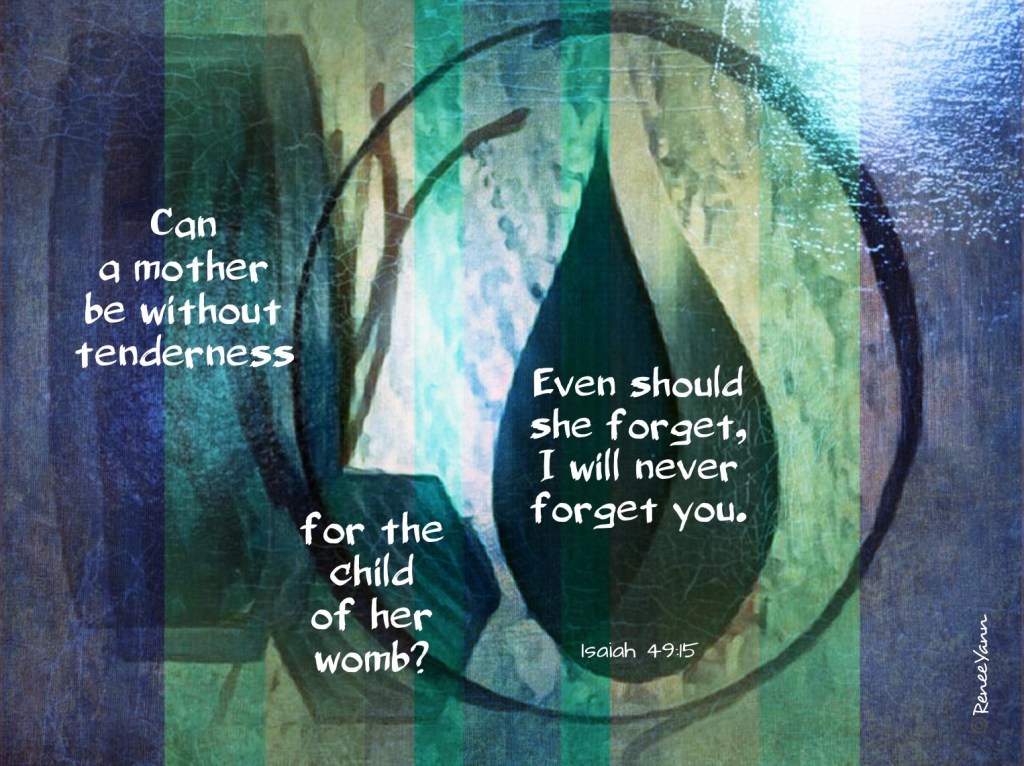
Can a mother forget her infant,
be without tenderness for the child of her womb?
Even should she forget,
I will never forget you.

Isaiah 49:14-15

In our Gospel, Jesus tells us the same things in a little bit of a different way.

My Father is at work until now, so I am at work.

John 5: 17

When he says this, Jesus is in the midst of the recalcitrant, vengeful Pharisees who have placed their faith only in their own arrogance – who have come to depend only on their own wealth and power rather than on the mercy and love of God.

Jesus offers his own outlay of Divine promises, showing how he and God the Creator are One in their constant desire for each of us to share fully in the Divine Life, even to the point of taking flesh to redeem us:

For just as the Father has life in himself,
so also he gave to the Son the possession of life in himself.
And he gave him power to exercise judgment,
because he is the Son of Man.
Do not be amazed at this,
because the hour is coming in which all who are in the tombs
will hear his voice and will come out,
those who have done good deeds
to the resurrection of life …

John 5: 26-29

We might ask in our prayer today to be deepened in our awareness of God’s constant, loving Presence in our lives. There is no moment or circumstance that doesn’t offer us an invitation to greater grace and holiness. But, unlike the Pharisees, we must open our hearts to trust God’s Presence in all things and to find that path to God’s heart.


In these final weeks of Lent, and in this particular passage from John, we see Jesus doing exactly what we must do. As Calvary began to loom unrelentingly on the horizon, Jesus could not have found it easy to accept the path unfolding before him. But he trusted. He knew the Father was with him. He believed that he walked toward Resurrection even though all he could see was a dark lonely hill.

May our Lenten prayer let us learn from Jesus.


Poetry: Forgetting by Joy Ladin

Zion says, “The LORD has forsaken me, my Lord has forgotten me.” Can a woman forget her baby, or disown the child of her womb? Though she might forget, I never could forget you.
—Isaiah 49:14–15

You never remember anything, do you?
How I formed you in your mother’s womb;
nursed you; bathed you; taught you to talk;

led you to springs of water?
I sang your name before you were born.
I’m singing your name now.

You’re clueless as an infant.
When I tell you to shout for joy,
you hear a bicycle, or a cat.

Sometimes, memories of me come back
like children you forgot you had:
a garden; a bride; an image of  your mother,

your best friend, your brother, or a cop, or snow, or afternoon.
The heavens shout; mountain becomes road;
gardenias burst into song.

Whose are these? you wonder.
Then you forget, and feel forgotten,
like an infant who falls asleep

at a mother’s breast
and wakes up hungry again.
Your mother might forget you, child,

but I never forget.
I’ve engraved your name
on the palms of my hands.

I show you trees, I lay you down in the grass,
I shower you with examples of my love—
sex and birds, librarians and life skills, emotions, sunlight, compassion.

Nothing connects.
Every dawn, every generation,
I have to teach you again:

this is water; this is darkness;
this is a body
fitting your description;

that’s a crush;
these are bodily functions;
this is an allergic reaction.

This is your anger.
This is mine.
This is me

reminding you to eat.
Turn off the stove.
Take your medication.

This is the realization
that I am yours and you are mine. This is you
forgetting.

Music: Will Never Forget You – Carey Landry

Lent: The Deep Dive

March 29, 2022
Tuesday of the Fourth Week of Lent

Today, in God’s Mercy, our readings describe a deep and hidden stream revealed by God –

first to Ezechiel …

Raffael-vision-ezechiel
The Vision of Ezechiel by Rafael

then to a long-paralyzed man …

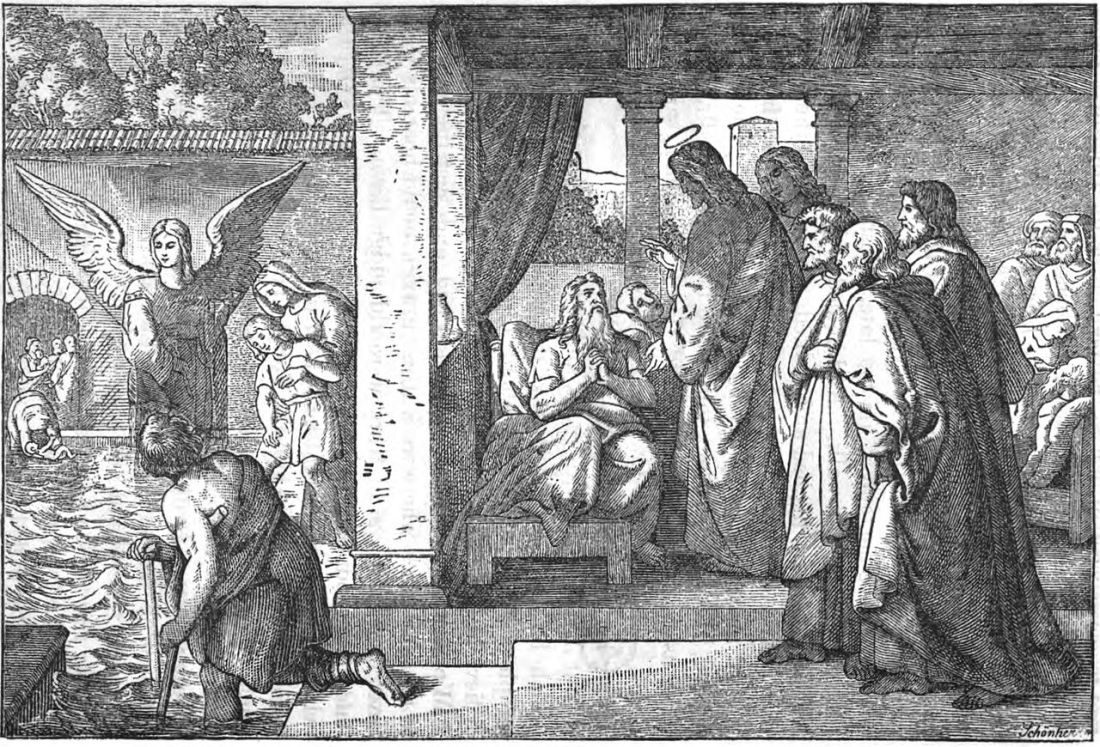
Schönherr_The_pool_of_Bethesda
The pool of Bethesda, by Schönherr.

So many stories in Scripture are laced with the same theme: there is a infinite mystery hidden under the surface of life:

  • Keep searching. Keep searching. 
  • The precious pearl that awaits discovery. 
  • The lost coin that must be found. 
  • The mustard seed buried in circumstance. 
  • The stream running deep under appearances.

We might be tempted to dismiss our first reading from Ezechiel as over-described allegory. But its rendition of the slow, steady deepening, through which God leads the prophet, offers us an apt image to reflect on our own graced journey. 

Ez47_9 stream

Hasn’t God led us gently to the faith we have today? Like young children learning to ride the ocean breakers, we have been taught by a patient God Who returns in every tide to take us deeper into our next capacity for grace.


For thirty-eight years, the man in today’s Gospel has been paralyzed by the water’s edge. Maybe we know how he feels.

duck

He believes that his life is beyond transformation. He cannot dive under the surface of his circumstances to find the quickening waters.


Jesus gives him the key to unlock his paralysis. In a short phrase, Jesus offers the man a multilayered question:

  • What do you really want in your deepest heart?
  • When you find the answer, break through all that has kept you from that deepest desire. 
  • Step with Me through the next wave, and the next until, finally, we swim together in the great ocean of covenanted trust.

As our Responsorial Psalm-poem promises:

God is our refuge and our strength,
an ever-present help in distress.
Therefore we fear not, though the earth be shaken
and mountains plunge into the depths of the sea.

There is a stream whose runlets gladden the city of God,
the holy dwelling of the Most High.
God is in its midst; it shall not be disturbed;
God will help it at the break of dawn.

Music: I Am – Marty Goetz (Lyrics below)

Come, behold the works of the Lord
How He has wrought the desolation
How He has brought His early help
The Lord of Hosts is with us
The God of Jacob is our refuge
When the nations rage and all the kingdoms fall
He says I Am, I Am, I Am all

And there’s a river whose streams make glad the city of God
They flow to His Holy habitation
They flow to the home of the Most High
The Lord of Hosts is with us
The God of Jacob is our refuge
He breaks the bow, he shatters the spear
And says I Am, I Am, I Am here!

So we will not fear
Though the worlds should change
Though the waters roar
Though the mountains shake and tremble
For He’s a present help in trouble, in trouble

Be still and know that I am God
I Am exalted in the nations
I Am exalted in the earth
The Lord of Hosts is with us
The God of Jacob is our refuge
To the ends of the earth He causes wars to cease and says
I Am, I Am, I Am peace
He says I Am, I Am, I Am peace

Lent: The Miracle of Transformation

March 21, 2022
Monday of the Third Week of Lent

Today, in God’s Lavish Mercy, our readings are about prophets and miracles, brought to us by Elisha and Jesus.

The core of the readings is this: some of us want the prophets’ miracles, but we don’t want their challenge to live in God’s freedom. We want their cures, only to return to lifestyles that make us spiritually sick or imprisoned.

Wanting to write about these themes, I decided to check with my favorite Old Testament scholar, Walter Brueggemann to see if he had any wisdom on the story of Naaman.

Naaman
Naaman brings his retinue and gifts… from The Pictorial History of Palestine and the Holy Land (1844) by John Kitto

Well, Walter certainly did…. something so good and wise that I won’t water it down with my own words. The link is below. It’s a little long, but so worth your reading and meditation. I hope you’ll take the time.

Click here for Walter Brueggemann’s article


Music: some instrumental music to listen to while you’re reading

Beloved St. Joseph

Saturday, March 19, 2022
Solemnity of Saint Joseph

Today, in Mercy, we celebrate our beloved Saint Joseph.

saint-joseph-with-the-christ-child-ca-1650-oil-on-canvas-sebastian-martinez
St. Joseph and the Christ Child by Sebastian Martinez

Our first reading describes the line of descent from David down through the ages to Joseph of the House of David.

God promises David:

I will raise up your heir after you, sprung from your loins,
and I will make his kingdom firm.
It is he who shall build a house for my name.
And I will make his royal throne firm forever.

Joseph is the realization of that House.  He was the one who ultimately gave shelter, both literally and physically, to the Promised One.


Beloved Joseph, provider of safe and sacred shelter, opens his arms to our fearful and pleading prayers. Often in my life when I had a particularly difficult need, I have prayed the Litany of St. Joseph. Just a few of its beautiful phrases may bring you confidence and peace.

Praying with today’s Gospel, let’s imagine ourselves being invited by Joseph, Mary and Jesus to go down with them  to our own “Nazareth” — to find the voice of God in the sacred protection of our homes and hearts.

Jesus went down with Mary and Joseph
and came to Nazareth,

and he obediently listened to them.


Poetry: The Temptation Of St. Joseph by W. H. Auden

From For the Time Being

I

JOSEPH
My shoes were shined, my pants were cleaned and pressed,
And I was hurrying to meet
My own true Love:
But a great crowd grew and grew
Till I could not push my way through,
Because
A star had fallen down the street;
When they saw who I was,
The police tried to do their best.

CHORUS [off]
Joseph, you have heard
What Mary says occurred;
Yes, it may be so.
Is it likely? No.

JOSEPH
The bar was gay, the lighting well-designed,
And I was sitting down to wait
My own true Love:
A voice I’d heard before, I think,
Cried: “This is on the House. I drink
To him
Who does not know it is too late;”
When I asked for the time,
Everyone was very kind.

CHORUS [off]
Mary may be pure,
But, Joseph, are you sure?
How is one to tell?
Suppose, for instance. . . Well. . .

JOSEPH
Through cracks, up ladders, into waters deep,
I squeezed, I climbed, I swam to save
My own true Love:
Under a dead apple tree
I saw an ass; when it saw me
It brayed;
A hermit sat in the mouth of a cave:
When I asked him the way,
He pretended to be asleep.

CHORUS [off]
Maybe, maybe not.
But, Joseph, you know what
Your world, of course, will say
About you anyway.

JOSEPH
Where are you, Father, where?
Caught in the jealous trap
Of an empty house I hear
As I sit alone in the dark
Everything, everything,
The drip of the bathroom tap,
The creak of the sofa spring,
The wind in the air-shaft, all
Making the same remark
Stupidly, stupidly,
Over and over again.
Father, what have I done?
Answer me. Father, how
Can I answer the tactless wall
Or the pompous furniture now?
Answer them. . .

GABRIEL
No, you must.

JOSEPH
How then am I to know,
Father, that you are just?
Give me one reason.

GABRIEL
No.

JOSEPH
All I ask is one
Important and elegant proof
That what my Love had done
Was really at your will
And that your will is Love.

GABRIEL
No, you must believe;
Be silent, and sit still.


Music:  I absolutely love this video of these dear Sisters of St. Joseph in Rochester singing “Hail Holy Joseph, Hail”. Having been taught by the sisters of St. Joseph for twelve years, I know the hymn very well. Looking at these Sisters, we can just imagine the long legacy of their generous ministries under the guidance of Joseph, their beloved patron. May God bless all our Sisters of St. Joseph on their Feastday!
(Lyrics below as well as the Litany of St. Joseph in a second post)

Hail, holy Joseph, Hail
by Father Frederick Faber

Hail, holy Joseph, hail!
⁠Chaste spouse of Mary, hall!
Pure as the lily flower
⁠In Eden’s peaceful vale.

Hail, holy Joseph, hail!
⁠Prince of the house of God!
May His best graces be
⁠By thy sweet hands bestow’d.

Hail, holy Joseph, hail!
⁠Belov’d of angels, hail!
Cheer thou the hearts that faint,
⁠And guide the steps that fail.

Hail, holy Joseph, hail!
⁠God’s choice wert thou alone;
To thee the Word made flesh
⁠Was subject as a Son.
O Christ’s dear Mother, bless;
⁠And bless, ye Saints on high,
All meek and simple souls
⁠That to Saint Joseph cry.

Lent: Untie the Knots

March 15, 2022
Tuesday of the Second week of Lent

Today, in God’s Lavish Mercy, in Isaiah’s prophecy, God addresses some of the most famous sinners in the Bible — the residents of Sodom and Gomorrah. And the Divine manner of that address is both gentle and direct…

Come now … let us set things right!

Come now, let us set things right,
says the LORD:
Though your sins be like scarlet,
they may become white as snow;
Though they be crimson red,
they may become white as wool.
If you are willing, and obey,
you shall eat the good things of the land;
But if you refuse and resist,
the sword shall consume you:
for the mouth of the LORD has spoken!

Isaiah 1:18-20

Setting things right! Aren’t there times in our lives when we long for that? Not in the sense of vengeance or some vigilante justice, but rather in the sense of balance, equity, peace, and understanding in our lives.


Some things go wrong in our lives – that’s just the way it is. And sometimes we struggle endlessly and futilely to realign them.

Even in the most tranquil and “together” lives, there are places of irresolution – little knots in our life story of “why” and “why not”; of “if” and “if only”.

These may be places where we can’t really “forget” and so have not really forgiven. They may be nagging questions left unanswered because we hadn’t the courage to ask. They may be reasons we wanted to explain but no one wanted to listen. They may be excuses or pretenses we have made for so long that we have begun to believe them ourselves.

In almost all such instances, a scarlet concupiscence is at the root of our suffering or pain – sin, not only in the other, but in ourselves that longs to be made white as snow.


In many such cases, the time passes when we might reach out to the other for mutual healing. Death, distance, stubborn resistance and other walls may block us from worldly reconciliation.

But in God’s realm, healing is still possible, as is the power of our desire for the other to be healed with us.

in Isaiah’s beautiful passage, God invites us to full and eternal wholeness. That wholeness is achieved through our willingness to be open before God and to practice obedient listening in our prayer.

If you are willing, and obey,
you shall eat the good things of the land.

Isaiah 1:19

Let’s listen to and trust the awesome invitation in Isaiah:
“Come now, let us set things right”
… come to Me where I will allow you to forgive yourself as I forgive you.
Let us begin to untie any grace-resistant knot in your heart.
Untied, it also frees the other to seek their own healing.


Poetry: Forgiveness – George MacDonald

God gives his child upon his slate a sum –
To find eternity in hours and years;
With both sides covered, back the child doth come,
His dim eyes swollen with shed and unshed tears;
God smiles, wipes clean the upper side and nether,
And says, ‘Now, dear, we’ll do the sum together!’

Music: White As Snow – Maranatha Singers

Live in Truth

February 25, 2022
Friday of the Seventh Week in Ordinary Time

Today, in God’s Lavish Mercy, our readings instruct us on one of life’s most important realities: truthful relationship – with God, nature, other people, and ourselves.

James reminds us that the prophets spoke the truth at great personal cost.

Take as an example of hardship and patience, brothers and sisters,
the prophets who spoke in the name of the Lord.
Indeed we call blessed those who have persevered.

James 5:10

Culture sometimes characterizes a “prophet” as one who can foresee the future, one who has a greater capacity than the normal person. And indeed there are great leaders who fit that understanding. They see things rightly and help us to realign our vision.


But, in an everyday sense, a prophet is simply someone who sees the truth and is unafraid to speak it. A prophet doesn’t pretend, deflect, lie, ignore, hide, distort or abuse Truth. The call to this kind of prophecy is one that we all share.

Such a call requires that we are honest, first and foremost, with God and with ourselves. It asks that we live a discerning and courageous life, reverently telling our truth as best we understand before God:

… let your “Yes” mean “Yes” and your “No” mean “No,”
that you may not incur condemnation.

James 5:12

In our Gospel, we find the Pharisees trying trip up Jesus with their pretend concern for the Law. Instead, what they are really concerned about is that they could lose their hold on power if the people turn to Jesus and his teaching.


Jesus calls them “hard of heart” because they are not open to the Spirit. They hide in a labyrinth of minutiae rather than the clarity of Love and Truth.

Living in the Truth of God’s grace and mercy, we grow in our ability to be prophetic. It means that people know they will get the truth from us — not opinion or advice; not bluntness or unnecessary critique — but a discernment offered in love, reverence, and mutual hope.

Like the biblical prophets, and like Jesus himself, we will meet people who don’t want that kind of truth. They haven’t been able to espouse it in themselves, so they don’t want to hear it from us. We see this played out daily in a sham political world that continually creates its own version of reality to suit its selfish ends.

In such situations, James would offer us this encouragement:

You have heard of the perseverance of Job,
and you have seen the purpose of the Lord,
because the Lord is compassionate and merciful.

And our Alleluia Verse offers us a prayer for such times:

Your word, O Lord, is truth;
consecrate us in the truth.


So persevere.
Seek your truth in prayer.
Give it to the world generously
with compassion and mercy.

Poetry: A Legend of Truth – Rudyard Kipling
“A Friend of the Family”
From “Debits and Credits” (1919-1923)

Once on a time, the ancient legends tell,
Truth, rising from the bottom of her well,
Looked on the world, but, hearing how it lied,
Returned to her seclusion horrified.
There she abode, so conscious of her worth,
Not even Pilate’s Question called her forth,
Nor Galileo, kneeling to deny
The Laws that hold our Planet ‘neath the sky.
Meantime, her kindlier sister, whom men call
Fiction, did all her work and more than all,
With so much zeal, devotion, tact, and care,
That no one noticed Truth was otherwhere.

Then came a War when, bombed and gassed and mined,
Truth rose once more, perforce, to meet mankind,
And through the dust and glare and wreck of things,
Beheld a phantom on unbalanced wings,
Reeling and groping, dazed, dishevelled, dumb,
But semaphoring direr deeds to come.

Truth hailed and bade her stand; the quavering shade
Clung to her knees and babbled, “Sister, aid!
I am–I was–thy Deputy, and men
Besought me for my useful tongue or pen
To gloss their gentle deeds, and I complied,
And they, and thy demands, were satisfied.
But this–” she pointed o’er the blistered plain,
Where men as Gods and devils wrought amain–
“This is beyond me! Take thy work again.”

Tablets and pen transferred, she fled afar,
And Truth assumed the record of the War…
She saw, she heard, she read, she tried to tell
Facts beyond precedent and parallel–
Unfit to hint or breathe, much less to write,
But happening every minute, day and night.
She called for proof. It came. The dossiers grew.
She marked them, first, “Return. This can’t be true.”
Then, underneath the cold official word:
“This is not really half of what occurred.”

She faced herself at last, the story runs,
And telegraphed her sister: “Come at once.
Facts out of hand. Unable overtake
Without your aid. Come back for Truth’s own sake!
Co-equal rank and powers if you agree.
They need us both, but you far more than me


Music: Beautiful Truth – Angela Predhomme