Alleluia: A Lamp to My Feet

Memorial of Saint Anthony of Padua, Priest and Doctor of the Church
June 13, 2022

https://bible.usccb.org/bible/readings/061322.cfm

Today, in God’s Lavish Mercy. we thank God for lighting our path.

Alleluia, alleluia.
A lamp to my feet is your word,
a light to my path.


I know each one of us has come home late at night, maybe in a heavy rain. The way home is dark and we are unsure of ourselves in the gloom. Depending on how far we’re coming from, the journey can be harrowing. We can’t wait to see that light in our very familiar and cozy front window.

This feeling is so universal that one hotel chain has capitalized upon it:


Our Alleluia Verse today recognizes that God has, and always will “leave the light on for us”. Grace awaits us in every circumstance if we turn our hearts to God.

The tough part is doing that when we feel a little bit panicky in the dark. It takes courage to be still and let God’s Light find us. We can become better and stronger by gratefully remembering all the times God has already brought us home to wholeness.

God has not failed us in the past and will not fail us now, or in the future.


Poetry: At a Window – Carl Sandburg

Give me hunger,
O you gods that sit and give
The world its orders.
Give me hunger, pain and want,
Shut me out with shame and failure
From your doors of gold and fame,
Give me your shabbiest, weariest hunger!
But leave me a little love,
A voice to speak to me in the day end,
A hand to touch me in the dark room
Breaking the long loneliness.
In the dusk of day-shapes
Blurring the sunset,
One little wandering, western star
Thrust out from the changing shores of shadow.
Let me go to the window,
Watch there the day-shapes of dusk
And wait and know the coming
Of a little love.

Music: Guiding Light – Alan Scott

Alleluia: Lean into God!

Memorial of Saint Barnabas, Apostle
Saturday of the Tenth Week in Ordinary Time
June 11, 2022

Today, in God’s Lavish Mercy, we ask God to help us set our hearts in the right direction — toward God in all things.

And we express the blessed insight that to live within God’s Law is to be favored.

Alleluia, alleluia.
Incline my heart, O God, to your decrees;
and favor me with your law.


Here’s the way I picture this prayer.

Life is like a rip tide. It can capture us and pull us under its breakers when we least expect it. But as any good ocean swimmer knows, when we are caught in a rip tide, we must relax, lean into it, and swim perpendicular to its force.


Our Alleluia Verse today is kind of a “rip-tide prayer”. We ask for the courage to lean into God’s power in our lives, to trust it, and to swim with it even though it contradicts a godless culture.


God promises that there is always a current of grace to carry us to the Divine Heart, but our efforts alone cannot sustain us. As in Psalm 86, we can ask God to do a little leaning toward us to help us out in a tough sea! 🙂

May we ever incline our hearts to God’s Love already leaning over us in Mercy.


Poetry: You are so weak – Rumi

You are so weak.
Give up to grace.
The ocean takes care of each wave ’til it gets to shore.
You need more help than you know.

Music: Oceans – Hillsong

Alleluia: Walk with God

June 8, 2022
Wednesday of the Tenth Week in Ordinary Time

Today, in God’s Lavish Mercy, our Alleluia Verse is, in a sense, a dangerous prayer. Think about it: do we really want to learn God’s ways?

Alleluia, alleluia.
Teach me your paths, my God,
and guide me in your truth. (Mt. 5:17-19)

I remember, as a young person, thinking that “the path of life” would be pretty straight. You know like school, job, relationships, achievements over the years, and eventually maybe I would even die, but .. you know, probably not. 🙂

In my young head, life looked something like this:


Well, now that my “golden years” are actually turning a little bit burnt orange, I look back and see that my life has been more like this:


How can we possibly find God along such swirly paths?

Our verse today from Psalm 25 offers us the answer.

We ask God to teach us how
and to guide us.


It sounds pretty simple, doesn’t it? And it is simple. It’s not easy, but it’s simple. Within each of life’s twists and turns, God has a wisdom to teach us. That gift opens to us as we immerse ourselves in the Truth of the Gospel, just as Jesus encourages his listeners to do in today’s reading from Matthew.

May we open our hearts
and say “Yes!”
to the
“Alleluia Walk”
to which God invites us over the course
of our switchback, zigzag lives!

Poetry: “Yes” is a world – e.e. cummings

love is a place
& through this place of
love move
(with brightness of peace)
all places

yes is a world
& in this world of
yes live
(skilfully curled)
all worlds


Music: Marty Goetz – Jeremiah 29:11 which seems to fit so well with today’s Alleluia!

Friday of the Seventh Week of Easter

Memorial of Saint Charles Lwanga and Companions, Martyrs

June 3, 2022

festus
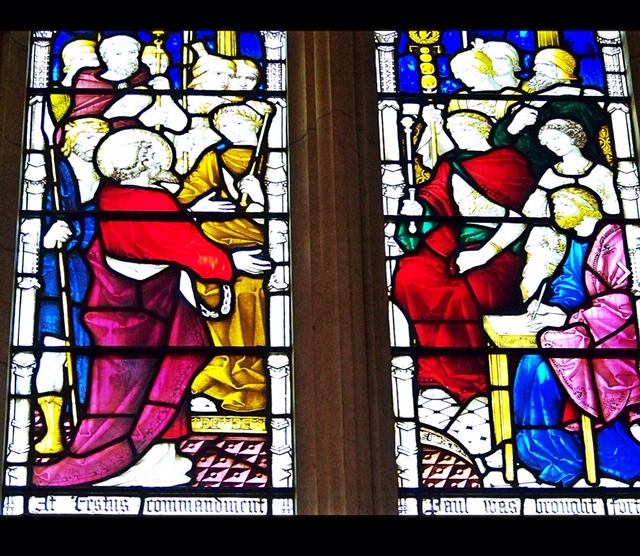
Window in St. Paul’s Cathedral, Melbourne – Paul Pleads His Case (Festus in yellow)

Today, in God’s Lavish Mercy, Paul’s case goes before Festus and King Herod Agrippa. Just in case you are confused, like I was, about just who this particular Herod is, this family tree from Wikipedia helped:

chart

This King Agrippa was Marcus Julius Agrippa II (A.D. 27-100), son of Agrippa I (Acts 12:1-25) and great-grandson of Herod the Great (Mt 2:1-23). 

I offer these facts for no real spiritual reason, but they remind me that these biblical characters were real people, like us, engaging (or not) a real life of faith. (Also, I thought it was fun to see how uncreative they were in naming their babies )


In our Gospel, Jesus once again prepares Peter for his tremendous responsibility in the building of that faith. Jesus asks Peter three times, “Do you love Me?”. By the third interrogation, Peter’s answer sounds a little intense:

“Lord, you know everything; you know that I love you.”

Hearing this response, Jesus lays the full burden of Peter’s life upon his shoulders. Not only must Peter “feed” the faith of Jesus’s followers, he must do so by giving over all control to God:

“Amen, amen, I say to you, when you were younger,
you used to dress yourself and go where you wanted;
but when you grow old, you will stretch out your hands,
and someone else will dress you
and lead you where you do not want to go.”

hand

Like Peter,
we too are given the gift and responsibility
of living a faithful life.
Like Peter, we all learn through the years,
that life comes to us in unexpected ways.
In reality, life often chooses us
rather than the other way around.


As we pray with these passages, we might want to look back over our lives for those points where life challenged or unbalanced us. What unexpected blessings came from those surprises/shocks? When God’s plan contradicted our own, how were we eventually blessed with courage, hope, gratitude, and insight?

We are the person we are today because of how we responded to God’s mysterious plan for our lives. Did we reach out our hand and let God lead us? Do we still need to do some letting go in order to enjoy that kind of freedom?


Rather than a poem today, I will be offering second post. It is a reflection I wrote many years ago for healthcare ministers and other chaplains. I think you might enjoy it. Watch for it later today – “Holding Hands with God”


Music:  Precious Lord, Take My Hand – written by Thomas A. Dorsey, sung here by the Great Mahalia Jackson

When my way groweth drear

Precious Lord, linger near-ear

When my li-ight is almost gone

Hear my cry, hear my call

Hold my ha-and lest I fa-all

Take my hand, precious Lor-ord

Lead me on

Precious Lord, take my hand

Lead me on, let me sta-and

I am tired, I’m weak, I am worn

Through the storm, through the night

Lead me on to the li-ight

Take my ha-and, precious Lor-ord

Lead me home

When my work is all done

And my race here is are you-un

Let me see-ee by the light

Thou hast shown

That fair city so bright

Where the lantern is the li-ight

Take my ha-and, precious Lor-ord

Lead me on

Precious Lord, take my hand

Lead me on, let me sta-and

I am tired, I’m weak, I am worn

Through the storm, through the night

Lead me on to the li-ight

Take my ha-and, precious Lor-ord

Lead me home

Wednesday of the Seventh Week of Easter

Memorial of St. Justin, Martyr
June 1, 2022

Today, in God’s Lavish Mercy, Jesus and Paul continue their heart-wrenching farewell addresses.

We’ve become accustomed to the passages and may read them without much emotional investment, but honestly they are real “weepers” – like movies where you have to bite the edge of your popcorn cup to keep from sobbing out loud.


paul-s-farewell-to-ephesian-elders-sacred-biblical-history-old-new-testament-two-hundred-forty-images-ed-st-69560609
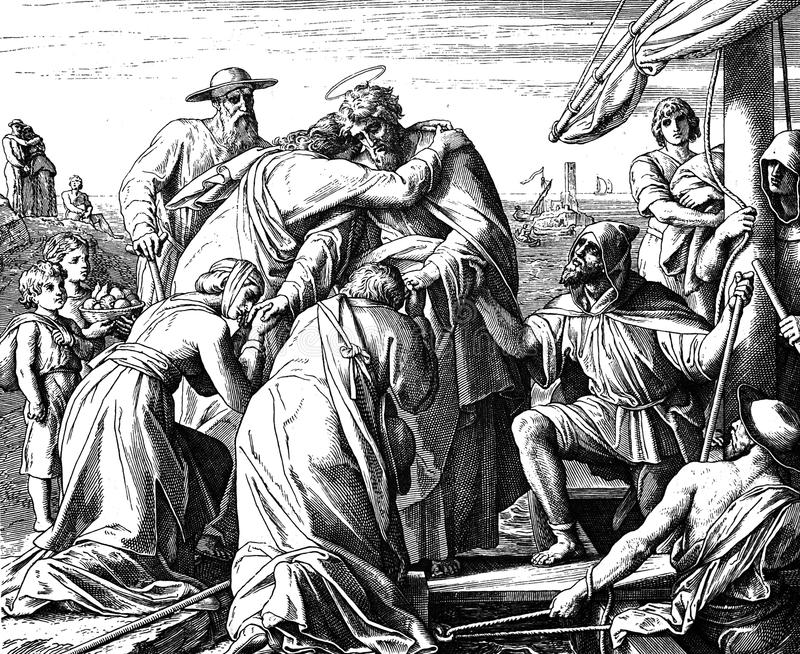
St. Paul Bids Farewell to the Ephesians

Look at Acts, for example, and put yourself in the scene:

When Paul had finished speaking
he knelt down and prayed with them all.
They were all weeping loudly
as they threw their arms around Paul and kissed him,
for they were deeply distressed that he had said
that they would never see his face again.
Then they escorted him to the ship.

Acts 20: 36-38

blessing

The verses from John are not quite so emotional, but picture yourself being prayed over like this. You sense that this is really a final blessing. You know these may be some of Christ’s last words you will ever hear.

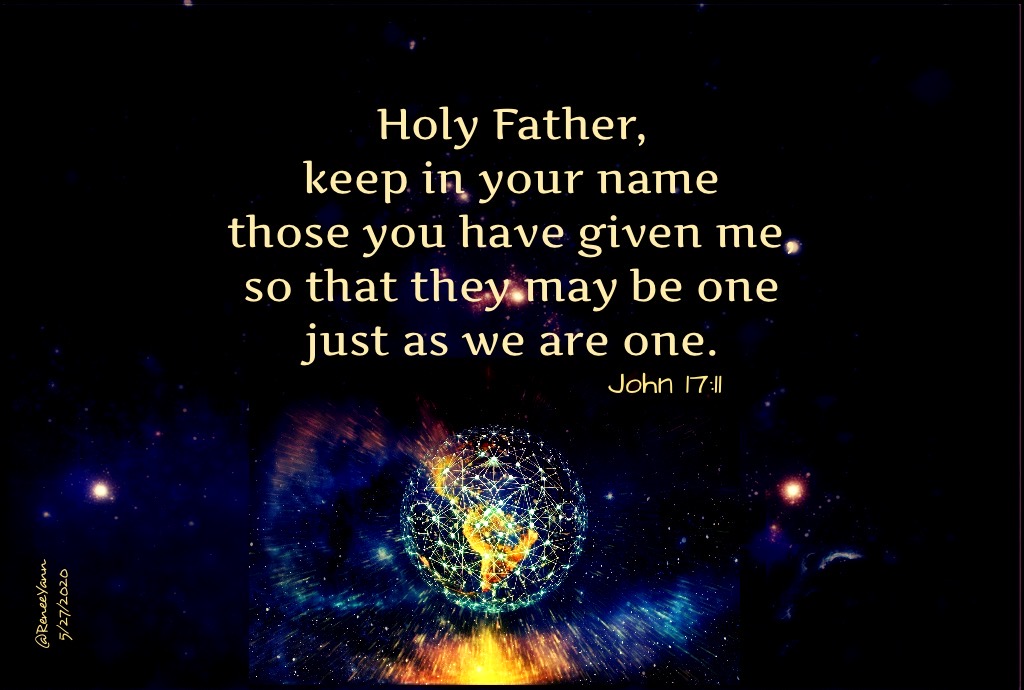
Holy Father, keep them in your name
that you have given me,
so that they may be one just as we are one.

John 17: 11

As we pray with today’s scriptures,
we are reminded that
goodbyes are awfully hard.
We need to mourn them
within a community of faith
lest our hearts break
from their weight. 


So many of us, in these sorrowful times, feel the deep pain of those suffering senseless violence and unprovoked war. We can only imagine the loss of bereaved families in Buffalo, NY and devastated parents and children in Uvalde, TX. We feel anger and horror at the suffering of the Ukrainian people.

In the throes of such pain, we need to tell one another the stories of our loved ones, to sing together our belief in eternal life, to prove that we can still find joy in kept memories, to cry at the sight of one another’s tears, and to act for justice in the name of one another’s suffering. This is what Jesus did.

Jn17_11 keep

Let us find courage and sustaining hope in the core of Jesus’s message today:

Father, now I am coming to you.
I speak this in the world

so that those you have given me
may share my joy completely.

All that we love, and may seem to have lost, is preserved and transformed – complete and joyful – in the infinite love of God. 

We too can be there in our prayer. We may be shaken by loss, but we are confident in faith. We know and believe that we are all kept in God’s Name. That faith gives us the power to transform our wounded world.


Poetry: Hymn for the Hurting – By Amanda Gorman
Ms. Gorman is a poet and the author of “The Hill We Climb,” “Call Us What We Carry” and “Change Sings.”


Everything hurts,
Our hearts shadowed and strange,
Minds made muddied and mute.
We carry tragedy, terrifying and true.
And yet none of it is new;
We knew it as home,
As horror,
As heritage.
Even our children
Cannot be children,
Cannot be.

Everything hurts.
It’s a hard time to be alive,
And even harder to stay that way.
We’re burdened to live out these days,
While at the same time, blessed to outlive them.

This alarm is how we know
We must be altered —
That we must differ or die,
That we must triumph or try.
Thus while hate cannot be terminated,
It can be transformed
Into a love that lets us live.

May we not just grieve, but give:
May we not just ache, but act;
May our signed right to bear arms
Never blind our sight from shared harm;
May we choose our children over chaos.
May another innocent never be lost.

Maybe everything hurts,
Our hearts shadowed & strange.
But only when everything hurts
May everything change.


Music: Aaronic Benediction – Misha and Marty Goetz

Friday of the Sixth Week of Easter

May 27, 2022

Today, in God’s Lavish Mercy, Jesus acknowledges the difficulty of living a Christian life in a hostile world, especially without his physical presence to lead the disciples.

John16_22 separation

He knows that his friends are anguished at the thought of being separated from him. He compares their heartbreak to the pain of a mother in labor. The comparison is a perfect one because labor pains yield a gift that washes away the memory of suffering:

… when she has given birth to a child,
she no longer remembers the pain because of her joy
that a child has been born into the world.

John 16:21

Jesus tries to comfort his followers with this analogy, but he doesn’t deny the sorrow they are experiencing. Jesus knows that separation from what we dearly love can be a crushing experience. He knows that change often carries unwanted loss.

joys and sorrows

Our lives are braided into this cycle of labor, birth, love, loss, sorrow and joy. Jesus assures us that if we live this cycle in faith and hope, all things return to him in glory:

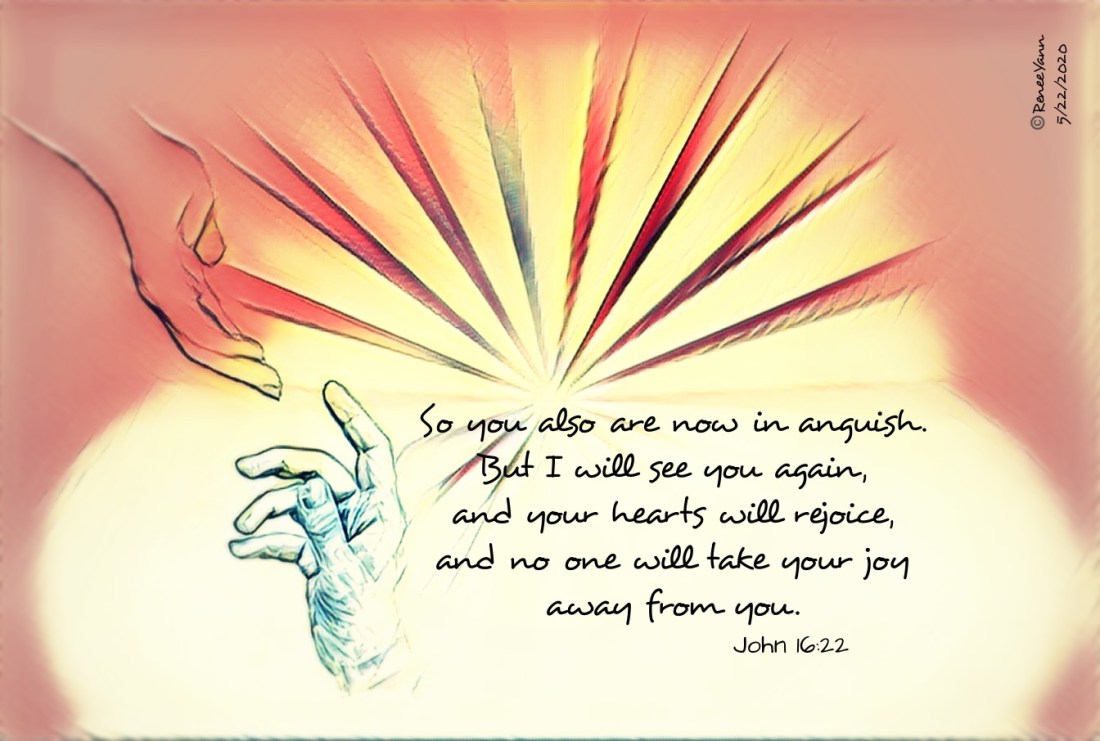
But I will see you again, and your hearts will rejoice,
and no one will take your joy away from you.

John 16:22

Poetry: Braid Your Hair With His – Mark Heathcote

God - has many names, 
but ‘Love' is the one that counts 
most aptly ‘Love' … ‘Love' 

‘Just Love' only, one word 
one name like ‘God' isn't it? 

God - has so many names 
each acts as a veil 
but ‘Love' is, ‘Love' only. 
So braid your hair with His 
embrace, lock fingers with His. 

His is a tree twining roots 
His is the first branch you perch on 
His is trees-bough at your centre 
your hearts bead is a locket of amber 
the tree's name is Love. 

At those times in our lives when we more feel the absence of God than the presence, remembering the endurance and bravery of others may help us. Although it’s not a religious song, this melody kept playing itself in my heart as I read today’s Gospel. It opened my spirit to a very comforting prayer time.

Music: We’ll Meet Again – Dame Vera Lynn

Dame Vera Margaret Lynn Welch, CH,DBD, OStJ, was a British singer of traditional popular music, songwriter and actress, whose musical recordings and performances were enormously popular during World War II. She died in 2020 at the age of 103.

She is widely known as “the Forces Sweetheart” and gave outdoor concerts for the troops in Egypt, India and Burma during the warThe songs most associated with her are “We’ll Meet Again”, “The White Cliffs of Dover”, “A Nightingale Sang in Berkeley Square”, and “There’ll Always Be an England”. 

Sixth Sunday of Easter

May 22, 2022

Today, in God’s Lavish Mercy, our readings definitely convey the sense of a young Church growing in its self-understanding.

The early Church leaders, most of whom are Jews, grapple with the question of whether new Gentile followers must first be circumcised in order to be baptized.

Over twenty centuries later, the answer seems obvious. But the question nagging the disciples shows us how they experienced their Christianity as emerging from Judaism. They had no concept of the call to Christianity coming in any other way.

It seems it was a huge shift for some of them to realize that God is not Jewish, that God is the God of all peoples – just as some of us today have trouble understanding that God is not Catholic, Protestant, Muslim, male, white, born again or any other human limitation we attach to the Divine.

Rev21_2 Jerusalem

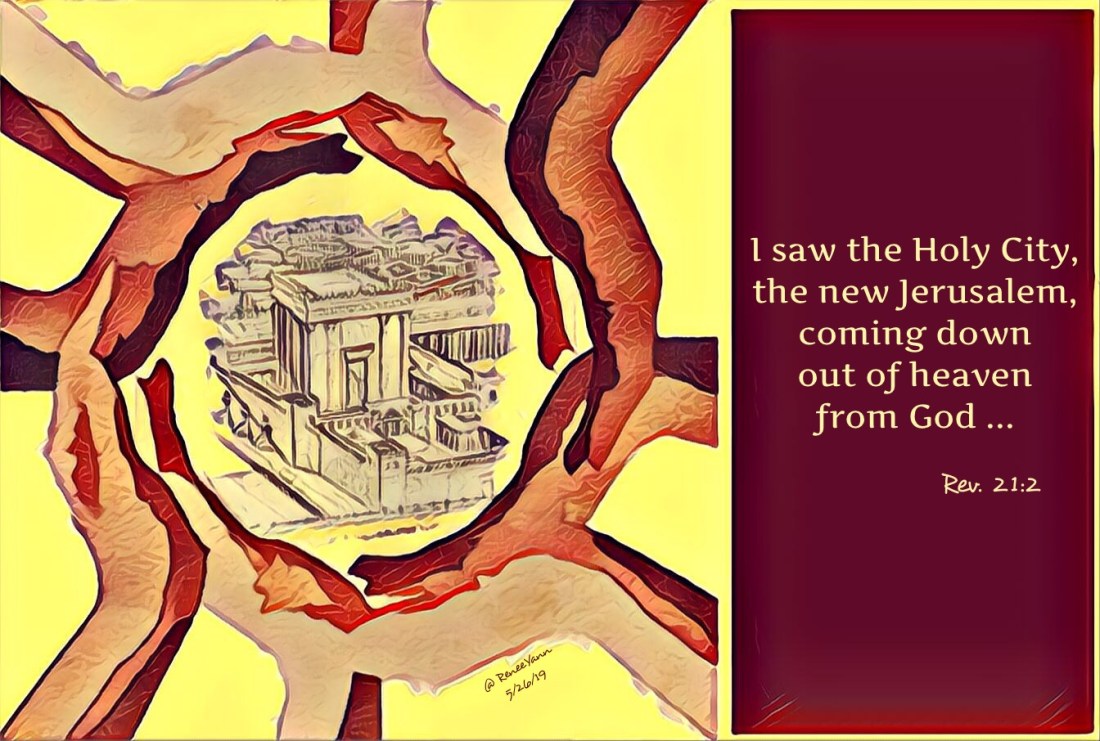
Our second reading reveals how John dealt with navigating this shift. Still cemented in his Jewish symbols, he sees “Jerusalem” coming down out of heaven from God. But it was a new Jerusalem – one without the central symbol of Judaism, the Temple:

I saw no temple in the city
for its temple is the Lord God almighty and the Lamb.
The city had no need of sun or moon to shine on it,
for the glory of God gave it light,
and its lamp was the Lamb.

For John, the New Creation in Christ included, but exceeded the Jewish narrative.

In our Gospel, Jesus prepares his disciples for life without his physical presence. They, too, need to learn to let go. He encourages them to open their hearts to even greater graces:

The Advocate, the Holy Spirit,
whom the Father will send in my name,
will teach you everything
and remind you of all that I told you.

Jesus is reminding his disciples, and us, that the graces and learnings of the New Creation are infinite. If we can learn when to let go of our old practices, our material symbols, our impregnable sureties, the Holy Spirit will astound us, and re-shape our understanding of God, just as She did for Mary, Peter, Paul, John and all the many enlightened saints through the ages.

As Pentecost approaches, let us pray for such Enlightenment in ourselves and especially in our Church. For the world seems to grow ever more resistant to the Holy Spirit Whose Gifts are wisdom, understanding, counsel, fortitude, knowledge, piety, and awe of God.

Let us pray for a New Jerusalem where all are one in God.


Poetry: The Props Assist the House – Emily Dickinson

Dickinson’s poem can be interpreted in many ways, but for me it speaks about spiritual openness. While the symbol of Jerusalem was central in Old Testament faith, the early Christian community is called to open itself to a “New Jerusalem” with all the amazing inspirations of the Holy Spirit. We are called to the same openness in our spiritual life.

The Props assist the House
Until the House is built
And then the Props withdraw
And adequate, erect,
The House support itself
And cease to recollect
The Auger and the Carpenter —
Just such a retrospect
Hath the perfected Life —
A past of Plank and Nail
And slowness — then the Scaffolds drop
Affirming it a Soul


Music: If you do nothing else with this reflection, please allow yourselves the thrill of listening to the celestial voice of Miss Jessye Norman. (Always gives me goosebumps!)

Saturday of the Second Week of Easter: God’s Breath and Heartbeat

April 30, 2022

Today, in God’s Lavish Mercy, our readings invite us to consider our capacity to trust. Who, what, why and when do we feel that we can trust?


In Acts, we see a beautiful example of the community trusting itself – presenting a concern, having it heard, and coming to a mutual resolution.

As the number of disciples continued to grow,
the Hellenists complained against the Hebrews
because their widows
were being neglected in the daily distribution.
So the Twelve called together the community of the disciples and said,
“It is not right for us to neglect the word of God to serve at table.
Brothers, select from among you seven reputable men,
filled with the Spirit and wisdom,
whom we shall appoint to this task,
whereas we shall devote ourselves to prayer
and to the ministry of the word.”
The proposal was acceptable to the whole community,

Acts 6: 1-5

What a blessing such a process would be in any community from family, to work, social, and global communities!

But it’s not easy to come by that kind of trust, is it? It has to be proven – accumulated over small and consistent affirmations that such trust is safely given to the other, whoever that might be.


In our Gospel, the disciples’ ability to trust is tested.

When it was evening, the disciples of Jesus went down to the sea,
embarked in a boat, and went across the sea to Capernaum.
It had already grown dark, and Jesus had not yet come to them.
The sea was stirred up because a strong wind was blowing.

John 6: 16-17

Jesus walks across the stormy water to meet his frightened disciples. They are afraid of the wind, the night and the wonder of Jesus.


One of my favorite quotes comes from the spiritually gifted Paula D’Arcy:

“Who would I be,
and what power would be expressed in my life,
if I were not dominated by fear.”

If you’re like me, your first inclination is to think, ” Well, I’m not dominated by fear!”

Just wait a minute. I encourage you to think about it. How has, or does, fear hold you back in your life?

As human beings, we harbor many fears even if we pretend to be very brave. We may be afraid of failure, loneliness, responsibility, insignificance, aging, dying or a thousand other things. Essentially, what we most fear is that we might be unloved or unlovable.


Just as he came to the disciples, Jesus comes to us through the night of any fear to prove that we are irrevocably safe in God’s Love. Even in darkness, we are the precious breath and heartbeat of God and cannot be extinguished by our fears.

IMG_5060

Poetry: Trust by Lizette Woodworth Reese, (1856-1935), an American poet and teacher. Born in Maryland, she taught English for almost five decades in the schools of Baltimore. Though Reese was successful in prose as well as in poetry, the latter was her forté. She was named Poet Laureate of Maryland in 1931.


I am thy grass, O Lord!
I grow up sweet and tall
But for a day; beneath Thy sword
To lie at evenfall.

Yet have I not enough
In that brief day of mine?
The wind, the bees, the wholesome stuff
The sun pours out like wine.

Behold, this is my crown;
Love will not let me be;
Love holds me here; Love cuts me down;
And it is well with me.

Lord, Love, keep it but so;
Thy purpose is full plain;
I die that after I may grow
As tall, as sweet again.


Tuesday of the Second Week of Easter: 2022

April 26, 2022

Nicodemus

Today, in God’s Lavish Mercy, we meet two towering figures of the early Christian story, Barnabas and Nicodemus.

In our first reading, Barnabas is cited as a devout member of the community of believers which …

… was of one heart and mind,
and no one claimed that any of his possessions was his own,
but they had everything in common.

Acts 4:32

Our Gospel brings us Nicodemus who “came to Jesus under cover of the night”.  Nicodemus, obviously Ph.D. material, has a long exchange with Jesus in the attempt to come to intellectual comfort with Jesus’s message.

Nicodemus wants his faith to make logical sense before committing to it, to the point that Jesus sounds a little astounded at the effort:

You are the teacher of Israel 
and you do not understand 
what I am saying to you?

John 3:10

I think a little bit of both Barnabas and Nicodemus lives within each of us.

barnabas seesaw

Like Nicodemus, we do believe, but we would like to understand more. We grapple with concepts of “God’s plan”, with the problem of evil, with what seems the random mercilessness of nature, and myriad other inexplicable realities.

Still, like Barnabas, we trust and are willing to lay our lives at the feet of Christ to be his agents in the world.

That balancing of trust with anxiety is the story of faith for most of us. And it’s OK.  Both Nickie and Barnie turned out to be giants for Christ.  And so will we with God’s help.


Poetry: The Night – BY HENRY VAUGHAN
John 3.2

Through that pure virgin shrine,
That sacred veil drawn o’er Thy glorious noon,
That men might look and live, as glowworms shine,
And face the moon,
Wise Nicodemus saw such light
As made him know his God by night.

Most blest believer he!
Who in that land of darkness and blind eyes
Thy long-expected healing wings could see,
When Thou didst rise!
And, what can never more be done,
Did at midnight speak with the Sun!

O who will tell me where
He found Thee at that dead and silent hour?
What hallowed solitary ground did bear
So rare a flower,
Within whose sacred leaves did lie
The fulness of the Deity?

No mercy-seat of gold,
No dead and dusty cherub, nor carved stone,
But His own living works did my Lord hold
And lodge alone;
Where trees and herbs did watch and peep
And wonder, while the Jews did sleep.

Dear night! this world’s defeat
The stop to busy fools; care’s check and curb;
The day of spirits; my soul’s calm retreat
Which none disturb!
Christ’s progress, and His prayer time;
The hours to which high heaven doth chime;

God’s silent, searching flight;
When my Lord’s head is filled with dew, and all
His locks are wet with the clear drops of night;
His still, soft call;
His knocking time; the soul’s dumb watch,
When spirits their fair kindred catch.

Were all my loud, evil days
Calm and unhaunted as is thy dark tent,
Whose peace but by some angel’s wing or voice
Is seldom rent,
Then I in heaven all the long year
Would keep, and never wander here.

But living where the sun
Doth all things wake, and where all mix and tire
Themselves and others, I consent and run
To every mire,
And by this world’s ill-guiding light,
Err more than I can do by night.

There is in God, som say,
A deep but dazzling darkness, as men here
Say it is late and dusky, because they
See not all clear.
O for that night! where I in Him
Might live invisible and dim!


Music: Ye Must Be Born Again – sung by The Sensational Nightingales, a beloved Black Gospel Quartet that, with several membership changes, has been popular for over seven decades.  (Lyrics below)

Ye Must Be Born Again
written by William T. Sleeper in 1877

A ruler once came to Jesus by night,
To ask Him the way of salvation and light;
The Master made answer in words true and plain,
“Ye must be born again!”
“I verily, verily say unto thee,
Ye must be born again!”

Ye children of men, attend to the word
So solemnly uttered by Jesus, the Lord,
And let not this message to you be in vain,
“Ye must be born again.”

Oh, ye who would enter that glorious rest,
And sing with the ransomed the song of the blest;
The life everlasting if ye would obtain,
“Ye must be born again.”

Easter Tuesday: Yet We Believe

April 19, 2022

Today, in God’s Lavish Mercy, our readings present us with a picture of the nascent Church as it works toward understanding itself in the physical absence of Jesus.

Throughout the Gospels, we see a Christian community forming around a Leader they can see, hear and touch. Acts reveals how that community awakens to itself when Jesus is no longer materially present.

Acts shows us a Church like us. We have never seen Christ, nor heard him, nor touched him. And yet we believe, or want to believe.


In our reading today, Peter preaches with brutal honesty:

Let the whole house of Israel know for certain
that God has made him both Lord and Christ,
this Jesus whom you crucified.

Acts 2:26
acts2_38_heartstruck

Peter’s message gets through to the assembly, to the point that, when they hear it, they are “cut to the heart”. This phrase indicates a profound conversion in the way they believed. Peter tells them that their faith, like Jesus’ life, must now become a sign of contradiction to a “corrupt generation “.


What might this powerful passage say to us?

For one thing, the reading calls us to be honest about the sincerity of our faith.

  • Is it the core of our lives?
  • Or is it, at best, a Sunday hobby?
  • Does it pervade our relationships and choices, giving witness to Christ’s commission to love?
  • Or is it a tool to judge and vilify those who differ from us?

The reading doesn’t demand that we “preach our faith out loud”. It calls us to a much deeper and more courageous witness:

  • to be Truth in a world of lies
  • to be Peace in violence
  • to be Justice in the face of abuse and domination
  • to be Servant rather than be served
  • to be Love for those deemed unlovable
  • in other words, to be like Jesus

And to do it all because we have been “cut to the heart” by the witness of the Cross and Resurrection.


Poetry: attributed to St. Teresa of Ávila

Christ has no body but yours,
No hands, no feet on earth but yours,
Yours are the eyes with which He looks
Compassion on this world,
Yours are the feet with which He walks to do good,
Yours are the hands, with which He blesses all the world.
Yours are the hands, yours are the feet,
Yours are the eyes, you are His body.
Christ has no body now but yours,
No hands, no feet on earth but yours,
Yours are the eyes with which he looks
compassion on this world.
Christ has no body now on earth but yours.


Music: By Faith-Keith & Kristyn Getty