The Root of Your Self

Twelfth Sunday in Ordinary Time
June 25, 2023

Today’s Readings:

https://bible.usccb.org/bible/readings/062523.cfm


Today, in God’s Lavish Mercy, our readings are studies in darkness and light.

Jeremiah – from the Sistine Chapel ceiling painted by Michelangelo c. 1512


Our first reading comes from Jeremiah, sometimes referred to as “the weeping prophet”. Jeremiah was pretty much a sad sack, as today’s selection demonstrates. He wrote for the Jews during the darkness of the Babylonian exile, helping them to mourn their situation which had been brought upon themselves by their unfaithfulness and sin. Jeremiah calls the people to repent and to find a healing grace by trusting God.

Sing to the LORD,
praise the LORD,
who has rescued the life of the poor
from the power of the wicked!

Jeremiah 22:13

Paul, addressing the Romans, uses the same light/dark, sin/redemption theme. He says that all of us display an inclination to darkness by any choice to break relationship with God, neighbor and Creation.


In the Genesis allegory of Adam and Eve, they choose to supersede God’s terms of relationship, eschewing the pure abundance of Creation for the sake of a self-satisfying “apple”.


The magnificent encyclical “Laudato Si” leads us through an enlightened understanding of of this Genesis story:

The creation accounts in the book of Genesis contain, in their own symbolic and narrative language, profound teachings about human existence and its historical reality. They suggest that human life is grounded in three fundamental and closely intertwined relationships: with God, with our neighbor and with the earth itself. According to the Bible, these three vital relationships have been broken, both outwardly and within us. This rupture is sin. The harmony between the Creator, humanity and creation as a whole was disrupted by our presuming to take the place of God and refusing to acknowledge our creaturely limitations. This in turn distorted our mandate to “have dominion” over the earth (cf. Gen 1:28), to “till it and keep it” (Gen 2:15). As a result, the originally harmonious relationship between human beings and nature became conflictual (cf. Gen 3:17-19). It is significant that the harmony which Saint Francis of Assisi experienced with all creatures was seen as a healing of that rupture. Saint Bonaventure held that, through universal reconciliation with every creature, Saint Francis in some way returned to the state of original innocence. This is a far cry from our situation today, where sin is manifest in all its destructive power in wars, the various forms of violence and abuse, the abandonment of the most vulnerable, and attacks on nature.

Laudato Sì, paragraph 66

Our Gospel so beautifully complements this enlightened understanding. Jesus encourages his disciples not to be afraid because the Creator embraces them in love and care. They, as we, need not make parsimonious choices that fracture essential relationships with God, neighbor, self, or Creation. We are already safe and whole in God.

Jesus said to the Twelve:
“Fear no one.
Nothing is concealed that will not be revealed,
nor secret that will not be known.
What I say to you in the darkness, speak in the light;
what you hear whispered, proclaim on the housetops…

… Are not two sparrows sold for a small coin?
Yet not one of them falls to the ground without your Father’s knowledge.
Even all the hairs of your head are counted.
So do not be afraid; you are worth more than many sparrows…

Matthew 10:26-33

Poetry: The Root of the Root of Yourself – Rumi

(Reading this poem, we might imagine that the Trinity is inviting us to recover the pristine goodness of our creation.)

Don’t go away, come near.
Don’t be faithless, be faithful.
Find the antidote in the venom.
Come to the root of the root of yourself.
Molded of clay, yet kneaded
from the substance of certainty,
a guard at the Treasury of Holy Light —
come, return to the root of the root of your Self.
Once you get hold of selflessness,
You’ll be dragged from your ego
and freed from many traps.
Come, return to the root of the root of your Self.
You are born from the children of God’s creation,
but you have fixed your sight too low.
How can you be happy?
Come, return to the root of the root of your Self.
You were born from a ray of God’s majesty
and have the blessings of a good star.
Why suffer at the hands of things that don’t exist?
Come, return to the root of the root of your Self.
You are a ruby embedded in granite.
How long will you pretend it’s not true?
We can see it in your eyes.
Come to the root of the root of your Self.
You came here from the presence of that fine Friend,
a little dazed, but gentle, stealing our hearts
with that look so full of fire; so,
come, return to the root of the root of your Self.

Music: Rainlight – David Lanz

Don’t Miss Sirach!

Memorial of St. Justin, Martyr
June 1, 2023

Today’s Readings:

https://bible.usccb.org/bible/readings/060123.cfm

Today, in God’s Lavish Mercy, we pray with one of our last few readings from the Book of Sirach. On Saturday, we will finish this book and, on Monday, move on to the Book of Tobit.

Both Sirach and Tobit are considered deuterocanonical (or “second list”) books of the Bible. That’s a really big word that makes you sound smart but its meaning is simple. The term refers to a group of writings composed sometime in the 300 years before the birth of Christ. The Catholic Church considers them part of the Old Testament. Most Protestant denominations do not.

Therefore, my readers who are not Catholic may be unfamiliar with these books. The Protestant Bible is composed of the protocanonical (or “first list”) of books, the earlier texts which comprised the Hebrew scriptures. Catholic translations of the Bible include both proto and deutero books.


So who cares, you might be saying. Well, I think it’s helpful to realize that the formulation of what comprises the Bible was a fluid process. Jews, Catholics and Protestants mean different things when they say “my Bible”. We share many of the same readings, but may never have heard some others. Sirach and Tobit are good examples of those sometimes missed readings.


And what a shame it would be to miss the wise and lyrical Sirach who was a real poet writing around 200 years before Jesus was born. His work was preserved, popular and shared. Many references in the New Testament indicate that Jesus and the disciples were familiar with Sirach’s work. That’s cool, don’t you think? I like to think of Jesus listening to sacred stories or reading books like Sirach before he went to bed at night.


And maybe Jesus, as we might this morning, walked along the beach or sat by a dawn-lit window praying with these beautiful words:

Now will I recall God’s works;
what I have seen, I will describe.
At God’s word were his works brought into being;
they do his will as he has ordained for them.
As the rising sun is clear to all,
so the glory of the LORD fills all his works;
Yet even God’s holy ones must fail
in recounting the wonders of the LORD,
Though God has given these, his hosts, the strength
to stand firm before his glory.

Sirach 2:15-17

Our Gospel may lead us to pray with Bartimeus, begging for the kind of sight Sirach describes – an inner sight that comes from allowing God to plumb our hearts:

He plumbs the depths and penetrates the heart;
their innermost being he understands.
The Most High possesses all knowledge,
and sees from of old the things that are to come:
He makes known the past and the future,
and reveals the deepest secrets.

Sirach 42:18-19

Poetry: how about if we just enjoy more of Sirach’s elegant poetry

How beautiful are all God's works!
even to the spark and fleeting vision!
The universe lives and abides forever;
to meet each need, each creature is preserved.
All of them differ, one from another,
yet none of them has God made in vain,
For each in turn, as it comes, is good;
can one ever see enough of their splendor?

Music: Across the Universe – John Lennon and the Beatles

This song reminds me that God’s Universe is everlasting. Nothing will change God’s Presence to us. The phrase “Jai Guru Deva” is a Sanskrit phrase which can be translated “Glory to the Shining Remover of Darkness”, reminding us of Bartimeus’s experience of being healed from his blindness.

Upside-Down, Inside-Out

Thursday of the Fourth Week of Easter
May 4, 2023

Today’s Readings:

https://bible.usccb.org/bible/readings/050423.cfm

Today, in God’s Lavish Mercy, our two readings take us on a journey. We sail through Israel’s long and spectacular salvation history from Moses through David and forward to Jesus. And in the sailing, we get turned head over heels.


In our first reading, Paul encapsulates twelve hundred years in a few elegant verses. (Nice job, Paul!)

The touchpoints of his homily are these:

  • the sojourn in the land of Egypt. 
  • forty years in the desert.
  • destruction of Canaan,
  • judges up to Samuel the prophet.
  • King Saul, for forty years. 
  • King David whose descendants gave Israel …
  • JESUS
  • then a little mention of John the Baptist

Paul’s succinct preaching allows us to see God’s powerful arm reaching through the long sleeve of Isreal’s history, finally handing the Chosen People the ultimate gift — Jesus Christ the Messiah.


Ah, but then we have our Gospel – which does today what it always does so well. It turns everything upside down and inside-out.

Through the twelve hundred years of Israel’s pre-Christian history, we see an agonizingly slow rise to power and glory culminating in David’s reign. How deeply later Israelites longed for a future Savior who would shine like the royal David had – who would restore the glory of Israel. That was their cherished expectation.


But Jesus turns that long sleeve of salvation history inside out. He preaches an inverse power fueled by service, a glory dressed in humble acts of mercy and forgiveness.

His longing is not for a worldly restoration, but for a whole New Creation born of sacrificial love. His hope is not for a secular kingdom but for a transformational community enlivened in the Triune God.

When Jesus had washed the disciples’ feet, he said to them:
“Amen, amen, I say to you, no slave is greater than his master
nor any messenger greater than the one who sent him.
If you understand this, blessed are you if you do it.

John 12:16-20

As we read and pray the scriptures, we get better at seeing the sacred understory of grace sustaining us. Upside-down, inside-out, our daily life is filled with divine mystery and revelation. We just have to look at the flip side to catch hold of the sail.

I was a teenager during the golden age of the 33 and 45 rpm records. I had a slew of Elvis, Fats Domino, Roy Orbison, The Everley Brothers, Ray Charles, The Supremes and many others. Each record had a hit on one side, and I rarely bothered to look at the other side. One day I flipped one of my “Top 10s” (The Wildcat Blues) to take a look at the other side, only to find what would become one of my favorite songs of all time: Petite Fleur. After the 1950s, it faded from the top ten list, but it has stayed on my list for 60 years.

When I hear that song, it sinks into my spirit creating a feeling that resists words. Like much good music, it reorders something in my spirit so that I see the world a little differently. And I would never have found it if I hadn’t turned things upside down to listen to the understory.


If we allow ourselves to dive deep under the scriptures – to go to the “flip side” – as Jesus invites us to do in today’s Gospel, we will find our own “petite fleurs” of insight and grace.

If you understand this,
blessed are you if you do it.

John 13:17

Prose: from Seeing by Annie Dillard

The secret of seeing is, then, the pearl of great price. 
If I thought he could teach me to find it and keep it forever 
I would stagger barefoot across a hundred deserts 
after any lunatic at all. 

But although the pearl may be found,
it may not be sought. 
The literature of illumination reveals this above all: 
although it comes to those who wait for it, 
it is always, even to the most practiced and adept, 
a gift and a total surprise… 

I cannot cause light; 
the most I can do is try to put myself 
in the path of its beam. 
It is possible, in deep space, to sail on solar wind. 
Light, be it particle or wave, has force: 
you rig a giant sail and go. 

The secret of seeing is to sail on solar wind.
Hone and spread your spirit till you yourself are a sail, 
whetted, translucent, broadside to the merest puff.

Music: Petite Fleur – Chris Barber

Mystery!

Feast of Saints Philip and James, Apostles
May 3, 2023

Today’s Readings:

https://bible.usccb.org/bible/readings/050323.cfm

Today, in God’s Lavish Mercy, our Gospel invites us to pray with the Apostle Philip on this his and James’ feast day.

St. James and St. Philip by Peter Paul Rubens


Philip is mentioned several times in John’s Gospel

  • In John 6:6, Jesus engages Philip regarding the feeding of the 5,000.
  • In John 12:21, Philip appears speaks for the Greek community, informing Andrew that they want to be introduced to Jesus.
  • In today’s Gospel, Philip asks Jesus to be shown the Father. Jesus responds with a simple and perfect instruction on one of the most profound mysteries of our faith – the nature of the Trinity.

“Master, show us the Father, and that will be enough for us.”
Jesus said to him, “Have I been with you for so long a time
and you still do not know me, Philip?
Whoever has seen me has seen the Father.
How can you say, ‘Show us the Father’?
Do you not believe that I am in the Father and the Father is in me?
The words that I speak to you I do not speak on my own.
The Father who dwells in me is doing his works. 

John 14:9-10

Jesus seems surprised at Philip’s question. Maybe he didn’t think it was that hard to understand the Blessed Trinity! But writers ever since have found it pretty complex. Most notably, St. Augustine took over 15 years to write his masterpiece De Trinitate (On the Trinity). An excellent current English translation by Edmund Hill, OP contains fifteen books in over five hundred pages!


But Jesus makes it pretty simple for Philip. Here’s my interpretation:

Philip, You see me, you see the Creator.
We are perfectly One.
Perfect Love does that.
My words are the Creator’s Words.
My works are completing the Creator’s works Who dwells in me.
It’s not a problem, Philip. You don’t need an answer.
It’s a beautiful Mystery. Just believe and be with it.


The noted 20th century Christian existentialist Gabriel Marcel wrote about the difference between a mystery and a problem.

Marcel worried that a technical ethos was reshaping how we see the world and ourselves. He especially worried about a tendency to reduce mysteries to problems. A problem, for Marcel, is something external to us that can be determinatively understood and solved with a generalizable technique. A mystery, on the other hand, is something in which we are inextricably involved. It has roots deep within us, but it also reaches beyond us. While a problem can be definitively solved, a mystery can only be navigated in light of the concrete situation and the people involved.

Gabriel Marcel: Mystery in an Age of Problems – Steven Knepper

True faith requires that we trust the Mystery of God. Like Philip, we may want answers to the great challenges of life and religion. But these things are not like math problems or scientific equations which can reach human resolution.

Life and faith are more like poetry or music – both of which enter into us and change something deep inside of us. It is a change that cannot be put into words but is nevertheless real. It is mystery.


Knowing and loving our Triune God is the same kind of mystery. We are made of God and God dwells within us. Each of our life experiences offers a small revelation of this overarching Mystery which is far too infinite to ever be packaged in a “solution” such as Philip requests in our Gospel.


Sometimes we may hear ourselves trying to turn the mystery of God into a solvable problem. Do you ever think or voice questions like these:

  • Why does God allow good people to suffer?
  • Why didn’t God just create everybody to be good, to erase evil from the world?
  • Why is God letting THIS (whatever it is) happen to me!

At different times in our spiritual lives, we all suffer from the Big WHY. Some people never get over it, turning atheist or agnostic in their approach to life when they can’t reach an answer. Some, by the grace of God, abide in the questions and come to a place of undefinable peace in the Mystery of God.

Let’s pray to St. Philip today to be granted a measure of the grace he obviously received as he went on to carry the Gospel to Greece, Syria, and Phrygia.

And, although we have concentrated on Philip today, here’s a word about St. James who was obviously very special to Jesus. James, along with his brother John and Peter, formed an informal triumvirate among the Twelve Apostles. Jesus allowed them to be the only apostles present at three quintessential events:

  • Mark 5:37: the Raising of Jairus’ daughter
  • Matthew 17:1: the Transfiguration of Jesus
  • Matthew 26:37: the Agony in the Garden of Gethsemane

Poetry: If Only – Rainer Maria Rilke from The Book of Hours

If only there were stillness, full, complete.
If all the random and approximate
were muted, with neighbors’ laughter, for your sake,
and if the clamor that my senses make
did not confound the vigil I would keep —
Then in a thousandfold thought I could think
you out, even to your utmost brink,
and (while a smile endures) possess you, giving
you away, as though I were but giving thanks,
to all the living.

Music: Lux Beata Trinitas – the hymn, ascribed to St. Ambrose in the 4th century, is sung here by Harry Christophers and the Sixteen whose mission is “… a performing arts charity which exists to take beautiful and inspiring choral music, from the Renaissance to today, to as wide and diverse an audience as possible.” (English translation of hymn below)

O TRINITY of blessed Light,
O Unity of sovereign might,
as now the fiery sun departs,
shed Thou Thy beams within our hearts.
To Thee our morning song of praise,
to Thee our evening prayer we raise;
Thee may our glory evermore
in lowly reverence adore.
All laud to God the Father be;
all praise, Eternal Son, to Thee;
all glory, as is ever meet,
to God the Holy Paraclete.

Athanasius in Spring

Memorial of Saint Athanasius, Bishop and Doctor of the Church
May 2, 2023

Today’s Readings:

https://bible.usccb.org/bible/readings/050223.cfm

Today, in God’s Lavish Mercy, we celebrate the feast of St. Athanasius, and since our readings repeat themes we have prayed with for a few days, I thought we might focus our prayer today on Athanasius.

Living in 4th century Egypt, Athanasius was a Church Father – one of the ancient and influential Christian theologians and writers who established the intellectual and doctrinal foundations of Christianity. (For insight into the often uncelebrated Church Mothers, see this excellent article: https://www.ncronline.org/news/opinion/simply-spirit/honor-mothers-early-christianity-during-womens-history-month )


During his lifetime, the Church struggled with the heresy of Arianism which questioned whether Jesus was really God. Athanasius was named a Doctor of the Church for his steadfast defense of the doctrine of the divinity of Christ. Some of Athanasius’s writings are suggestive of the theology of our great modern theologians, and so necessary for our spirituality today.

The Self-revealing of the Word
is in every dimension –
above, in creation;
below, in the Incarnation;
in the depth, in Hades;
in the breadth, throughout the world.
All things have been filled
with the knowledge of God.

St. Athanasius

Pierre Teilhard de Chardin, the revered Jesuit theologian of the early 20th century, writes in a tone suggestive of Athanasius:

If we live at a distance from God, the universe remains neutral or hostile to us. But if believe in God, immediately all around us the elements, even the irksome, organize themselves into a friendly whole, ordered to the ultimate success of life.

Pierre de Chardin, SJ in Christianity and Evolution

More recently, beloved Pope Francis teaches with the same sacred appreciation of the “mystical” depths of Creation:

The universe unfolds in God, who fills it completely. Hence, there is a mystical meaning to be found in a leaf, in a mountain trail, in a dewdrop, in a poor person’s face. The ideal is not only to pass from the exterior to the interior to discover the action of God in the soul, but also to discover God in all things.

Pope Francis in Laudato Sí, 84)

As we pray in these early days of May, still drenched in the glory of Easter, may we hear God speaking to us in the infinitely new and ever-evolving power and beauty of all Creation.

The occurrence of chance in the world in its own finite way reflects the infinite creativity of the living God, endless source of fresh possibilities. The indwelling Creator Spirit grounds not only life’s regularities but also the novel occurrences that open up the status quo, igniting what is unexpected, interruptive, genuinely uncontrolled, and unimaginably possible. As boundless love at work in the universe, the Spirit embraces the chanciness of random mutations, being the source not only of order but also of the unexpected breaks in order that ensure freshness. Divine creativity is much more closely allied to the outbreak of novelty than our older order-oriented theology ever imagined

Elizabeth Johnson, CSJ – Distinguished Professor of Theology at Fordham University in her book, Ask the Beasts: Darwin and the God of Love

Poetry: Spring – Mary Oliver

Somewhere
a black bear
has just risen from sleep
and is staring
down the mountain.
All night
in the brisk and shallow restlessness
of early spring
I think of her,
her four black fists
flicking the gravel,
her tongue
like a red fire
touching the grass,
the cold water.
There is only one question:
how to love this world.
I think of her
rising
like a black and leafy ledge
to sharpen her claws against
the silence
of the trees.
Whatever else
my life is
with its poems
and its music
and its glass cities,
it is also this dazzling darkness
coming
down the mountain,
breathing and tasting;
all day I think of her -—
her white teeth,
her wordlessness,
her perfect love.

Music: Spring from The Four Seasons – Antonio Vivaldi

Water and Pork Chops

Saturday of the Second Week of Easter
April 22, 2023

Today’s Readings:

https://bible.usccb.org/bible/readings/042223.cfm

Today, in God’s Lavish Mercy, little “disruptions” pop up in the center of both our readings.

In Acts, some of the Greek Christians think they are getting the short end of the stick when it comes to food distribution.

Believe me, I can picture the situation using personal experience. When I was an 18 year old postulant, I was a tall, skinny athlete — and I ate a lot of food. I wasn’t used to living in community, and I hadn’t noticed how my voracious appetite might be affecting those around me at the table.

In those “olden days”, the fifty-two of us freshly minted mini-nuns sat “in rank”, i.e according to age. The food was passed down the table from oldest to youngest. When I came to supper one night, the sister below me in rank had moved up a seat to be before me. I thought she just got mixed up about where her chair was so I asked her about it.

She told me she moved up in order to get a pork chop before I took them all!


Well, that’s what the Hellenists are doing in today’s reading which illustrates that living in community is a practical exercise as well as a spiritual one. That practicality calls upon us to make prudent arrangements for the community such as the disciples did in appointing more presbyters led by Stephen.

For us in our various communities today, the reading reminds us to think about the “pork chops” – who needs what and are they getting what they need. This principle holds for both spiritual and material needs and goods. Like the new presbyters, we each have a part to play in achieving that equity within our communities – including families, neighborhoods, churches, workplaces, and the world we share with all Creation.


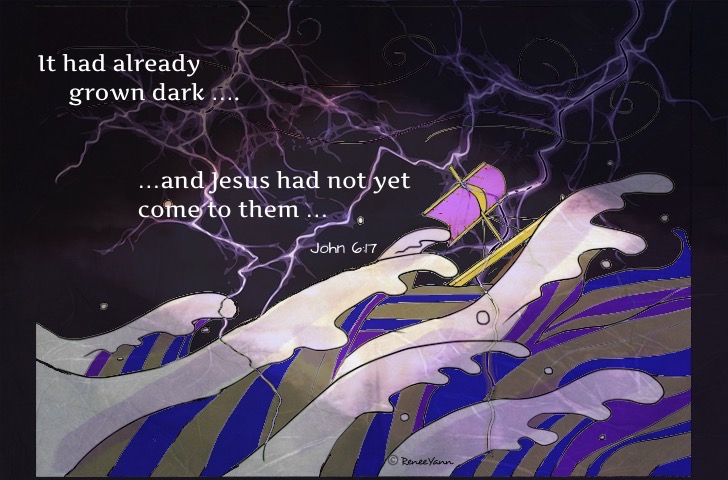
While our Gospel event is narrated in both Matthew and Mark, John gives us his own colorful version of the story of Jesus walking on the water. John highlights the conditions of the sea and atmosphere: darkness, the gusty wind, a turbulent ocean, and the absence of Jesus from the boat:

When it was evening, the disciples of Jesus went down to the sea,
embarked in a boat, and went across the sea to Capernaum.
It had already grown dark, and Jesus had not yet come to them.
The sea was stirred up because a strong wind was blowing.

John 6:16-18

So John makes it clear that it was the customary “dark and scary night“. But the disciples, tossed in the tumult, never express fear until they see Jesus walking across the water toward them. It seems they are less afraid of nature’s power than they are of the power of God!

Jesus sees their fear and tells them not to be afraid. In a phrase reminiscent of God’s self-revelation to Moses ( I am Who am), Jesus simply says, “It is I” — I am God. I am with you. Do not be afraid.


The disciples are still a little nervous and seem to prefer a less omnipotent Jesus . They ask him to get into the boat (in other words, “Be normal – not a Water-Walker”). But Jesus ignores the invitation and simply transports the boat to shore. One might picture the Twelve, tossed up on the shore, mouths agape and beginning to realize that their whole world was being turned upside-down in Christ!


Maybe we’re a little bit like the disciples sometimes. Sometimes we like God in small doses – not in a brilliant revelation or an irresistible call. Jesus snoozing beside us in the boat is comfortable. A radiant God coming to us in our life’s storms is a little harder to adjust to.

Our readings today remind us that God is present in every aspect of our lives – the daily practicalities and the topsy-turvy revelations. God may sit beside us in the boat, or might drag us stunned into another graced shore. But we should not be afraid in any case. Just prayerfully listen for the assurance, “It is I!”


Poetry: Walking on Water – Mark Jarmon

       Always the same message out of Matthew.
The water Jesus walks on is life’s turbulence.
        He calms our trouble and lifts us up again.

To walk on water? That’s what’s puzzling—
        that feat of antimatter, defeat of physics,
those beautiful unshod feet of cosmic truth

        for whom the whole performance is child’s play.
And unless one becomes as a little child
        the kingdom’s inaccessible by any route.

That water, then, its broken surface tension,
        collision of fracturing waves, apparent chaos,
its fractals turning infinite and weaving

        the netted skin between worlds, that web
of light and gravity which underpins our faith,
        water, a substance, stormy or pacific,

we know a myriad ways to get across it.
        But simply walking on it? Literally?
How far do you think you’d go before you fell

        through that convergence between time and space?
The water Jesus walked on wasn’t water
        only. It was the storm that made it rock.

Music: Walk on Water – Elevation Rhythm

The Image of God

Christmas Weekday
January 3, 2023

Today’s Readings

https://bible.usccb.org/bible/readings/010323.cfm

Today, in God’s Lavish Mercy, we pray with John’s soul-stirring words:

1 jn 3_ 2

Beloved, we are God’s children …

When I pray these words I think of my mother. As a little child, I already bore a clear physical likeness to her. But as I grew into a young woman, and later an older woman, people remarked that we looked like twins. There were even occasions when we were confused with each other.

This visible resemblance gave me great pride. My mother was strong, courageous, funny, wise, and fiercely loving. I loved to hear the phrase, “Oh my, you are the image of your mother!” I wanted to be like her – made of the same stuff as she was.


In our reading today, John tells us that we are made of the very stuff of God – the essence of the Sacred. He suggests that when people look at us they should see God’s features written all over us.

See what love the Creator has bestowed on us
that we may be called the children of God.
Yet so we are.

1 John 2:30

John says that we should see this Divine familial likeness in one another – that we are each imprinted with our Creator’s image.

The reason the world does not know us is that it did not know him.
Beloved, we are God’s children now;
what we shall be has not yet been revealed.

1 John 2:31

If we believe John’s words, what tenderness we would bear toward ourselves and others! How could we ever belittle, hate or kill one another? How could we ever do these things to ourselves?


In our Gospel, the great prophet John the Baptist sees the imminent transformation of the world coming toward him in the person of Jesus Christ. May we see this too as, by our sincere prayer and study of the scriptures, the Light of Christmas waxes in our hearts throughout 2023. In that Loving Light, we recognize one another clearly as beloved children of God.

John the Baptist saw Jesus coming toward him and said,
“Behold, the Lamb of God, who takes away the sin of the world.
…..
John testified further, saying,
“I saw the Spirit come down like a dove from the sky
and remain upon him.
I did not know him,
but the one who sent me to baptize with water told me,
‘On whomever you see the Spirit come down and remain,
he is the one who will baptize with the Holy Spirit.’
Now I have seen and testified that he is the Son of God.”

John 1:29-34

Poetry: I Am the Light – Malcolm Guite

I see your world in light that shines behind me,
Lit by a sun whose rays I cannot see,
The smallest gleam of light still seems to find me
Or find the child who’s hiding deep inside me.
I see your light reflected in the water,
Or kindled suddenly in someone’s eyes,
It shimmers through the living leaves of summer,
Or spills from silver veins in leaden skies,
It gathers in the candles at our vespers
It concentrates in tiny drops of dew
At times it sings for joy, at times it whispers,
But all the time it calls me back to you.
I follow you upstream through this dark night
My savior, source, and spring, my life and light.

Music: How Can Anyone Ever Tell You – Shaina Knoll

Often, when I think of Christ on the Cross, I can hear God the Mother singing this song to Jesus, reaching from heaven to console Him in His pain.

This morning, we might ask God to sing this song over our wounded world which has so obscured God’s likeness – perhaps to sing it over us if we are in particular pain.

In our heart’s deep forgiveness, we might sing this song over anyone who has hurt us – the meanness coming from their failure to recognize their own beauty – the fact that they and we are the very image of our loving God.

An Eternal Moment

The Seventh Day in the Octave of Christmas
New Year’s Eve – 2022

Today’s Readings:

https://bible.usccb.org/bible/readings/123122.cfm

new sunset

Today, in God’s Lavish Mercy, we stand on the far western shore of the Year of Our Lord, 2022.

It is well near evening.  Our memories are silhouetted against the deep purple sky as they sail beyond the shimmering horizon.  In 2022, we have lived, laughed, lost and loved in ways never to be repeated, yet never to be forgotten.  The great turning of time goes relentlessly on, but we have written our story in its indelible trail. It’s an awesome realization.

John, when writing the first reading, seems to have felt some of tonight’s emotions:

Children, it is the last hour; 
and just as you heard that the evil one is among us,

But you have the anointing that comes from the Holy One,
and you all have knowledge. 

Slightly later on in the epistle, John finishes the thought:

Let what you heard from the beginning remain in you.
If what you heard from the beginning remains in you,
then you will remain in the Son and in the Father.
And this is the promise that he made us: eternal life.


With fireworks and reveling, popular culture will invite us to the brash celebration of our presence within this point in history.  But, at the altar of our hearts, we recognize this long evening of reminiscence as a time of quiet thanksgiving and petition.  It is a time of awe and trust. It is an evening when we balance “time” against the promise of “eternity”.


IMG_1991

Like flint struck against the almighty soul of God, we have been given life.  We are God’s fire at this moment in time’s long unwinding.  Tonight, we turn our spirits to those beside us, behind us, before us and we pray in thanksgiving and hope for them.


IMG_1994

Together, we sink into the Dark Infinity of our Creator who sustains all life beyond our worries, fears and limitations.  With innumerable universes, God balances us in the Palm of Mercy.  As the midnight shadows fall, God closes the fingertips of grace and protection over us.

In the split moment between two years, we too become infinite – fire in God’s darkness, spark redeemed beyond time.


IMG_1989

In 2023, we will forget this transcendent moment.  The bright light of daily living will blind us to that piece of divinity shining in our souls.  But tonight, let us remember.  As midnight passes by, may our spirits kneel within us to the Awesome Mystery who holds us, as one, eternally within Itself.

A truly blessed New Year to you and your beloveds, my friends.


Music: Be Still My Soul – Kari Jobe

O Constant Creator!

Memorial of Saint Ambrose, Bishop and Doctor of the Church
December 7, 2022

Today’s Readings

https://bible.usccb.org/bible/readings/120722.cfm

Today, in God’s Lavish Mercy, we pray with Psalm 103 which bursts with music even as we silently read it!

Bless the LORD, O my soul;
and all my being, bless God’s holy name.
Bless the LORD, O my soul,
and forget not all God’s benefits.

Psalm 103:1–2

Our psalm rests today between two Advent readings that pick up its melody of grace and mercy.

In our first reading, Isaiah has just finished praising the Creator in the magnificence of nature. Today’s verses continue that praise and awed wonderment. As we read, we can picture God, robed in glory, marching out the sun, moon, stars …

Lift up your eyes on high
and see who has created these things:
He leads out their army and numbers them,
calling them all by name.
By his great might and the strength of his power
not one of them is missing!

Isaiah 40:26

When we take the time to appreciate a sunrise or sunset, or to trace the constellations across the dark December sky, we are doing what Isaiah encourages his listeners to do – trusting our all-powerful God. If our Creator can hold the heaven’s together in eternal beauty, we can expect the same to be done for us who are the most cherished of God’s creatures.

Do you not know
or have you not heard?
The LORD is the eternal God,
creator of the ends of the earth.
He does not faint nor grow weary,
and his knowledge is beyond scrutiny.
He gives strength to the fainting;
for the weak he makes vigor abound.

Isaiah 40:28-29

In our Gospel, Jesus puts God’s abiding promise into a comforting invitation:

Jesus said to the crowds:
“Come to me, all you who labor and are burdened,
and I will give you rest.
Take my yoke upon you and learn from me,
for I am meek and humble of heart;
and you will find rest for yourselves.
For my yoke is easy, and my burden light.

Matthew 11:28-30

As we continue our Advent journey with Isaiah and Jesus, maybe we might like to catch a sunset or sunrise … or go out and look up at the winter stars. Doing so, let’s give ourselves fully in faith to our Creator’s promise to be with us in every rising and setting of our lives. Let us act as people who fully hope and believe:

They that hope in the LORD will renew their strength,
they will soar as with eagles’ wings;
They will run and not grow weary,
walk and not grow faint.

Isaiah 40:31

Poetry: Come – Christina Rossetti 

‘Come,’ Thou dost say to Angels,
To blessed Spirits, ‘Come’:
‘Come,’ to the lambs of Thine own flock,
Thy little ones, ‘Come home.’

‘Come,’ from the many-mansioned house
The gracious word is sent;
‘Come,’ from the ivory palaces
Unto the Penitent.

O Lord, restore us deaf and blind,
Unclose our lips though dumb:
Then say to us, ‘I will come with speed,’
And we will answer, ‘Come.’


Music: On Eagle’s Wings – Michael Joncas

The Holy Way

Monday of the Second Week of Advent
December 5, 2022

Today’s Readings:

https://bible.usccb.org/bible/readings/120522.cfm

Today, in God’s Lavish Mercy, Isaiah describes a beautiful hike through a desert turned verdant and lush. Usually that’s not the way we picture a desert, but the phenomenon is real.


A desert bloom is a climatic phenomenon that occurs in various deserts around the world. The phenomenon consists of the blossoming of a wide variety of flowers during early-mid spring in years when rainfall is unusually high. The blossoming occurs when the unusual level of rainfall reaches seeds and bulbs that have been in a latent or dormant state, and causes them to germinate and flower in early spring. It is accompanied by the proliferation of insects, birds and small species of lizards. (Wikipedia)

Bloom in Chilean Desert – photo by Javier Rubilar

Isaiah preached during tough times — real “desert” times for Israel. He uses the image of the luxuriant desert bloom to encourage his listeners that, despite their dire circumstances (the Assyrian occupation followed by the Babylonian captivity), there is hope.

But it is hard to hope and believe when you haven’t yet seen the flowers, right? Some of Isaiah’s audience may have seemed a little “weak kneed” about launching out on the journey when the horizon still looked pretty dry and lifeless.


    Strengthen the hands that are feeble,
        make firm the knees that are weak,
    Say to those whose hearts are frightened:
        Be strong, fear not!
    Here is your God,
        Who comes with vindication;
    With divine recompense
        God comes to save you.

Isaiah 35:3-4

I know I’ve felt weak-kneed at times, both literally and figuratively — those times when we are afraid to walk, to step forward or back, to move around or toward what we should. I’ll bet some of you have felt that way too.

At those times, we’re a little bit like the paralyzed man in today’s Gospel. We need courage, the help of good friends, and faith in God in order to stand up and walk on our own. Jesus wants to help us just like he helped this young man.

That you may know
that the Son of Man has authority on earth to forgive sins”–
Jesus said to the one who was paralyzed,
“I say to you, rise, pick up your stretcher, and go home.” 

He stood up immediately before them,
picked up what he had been lying on,
and went home, glorifying God. 

Luke 5:24-25

Advent invites us to journey
into deep faith and spiritual freedom,
to trust the desert for its flowers,
to believe that God lovingly wills
our vigor and wholeness.
 

The LORD himself will give his benefits;
    our land shall yield its increase.
Justice shall walk before him,
    and salvation, along the way of his steps.

Today’s Psalm 85: 13-14

Poetry: I Walked in a Desert – Stephen Crane

I walked in a desert.
And I cried,
“Ah, God, take me from this place!”
A voice said, “It is no desert.”
I cried, “Well, But —
The sand, the heat, the vacant horizon.”
A voice said, “It is no desert.”

Music: Desert Flower – Biljana Obradovic Bixy