Lent: Redemptive Suffering

April 8, 2022
Friday of the Fifth Week of Lent

Today, in God’s Lavish Mercy, as we inch closer to Holy Week, we meet both a very troubled Jeremiah and Jesus.

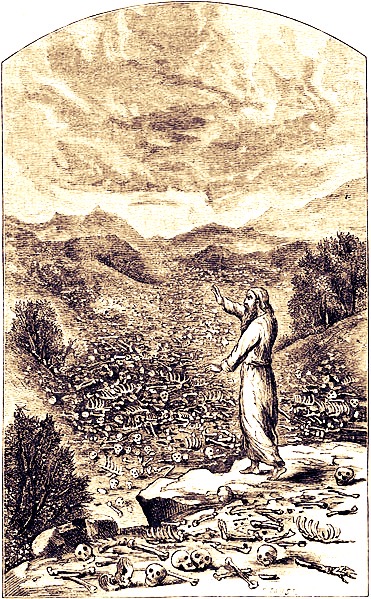
V0034343 The prophet Jeremiah wailing alone on a hill. Engraving.
The Prophet Jeremiah Weeping Alone on a Hill (from the Wellcome Trust)

Jeremiah, the Old Testament mirror of Jesus’s sufferings, bewails the treachery even of his friends:

I hear the whisperings of many:
“Terror on every side!
Denounce! let us denounce him!”
All those who were my friends
are on the watch for any misstep of mine.

Jeremiah 20:10

That’s really raw, because you can get through almost anything in the company of true friends.


Jesus weeps
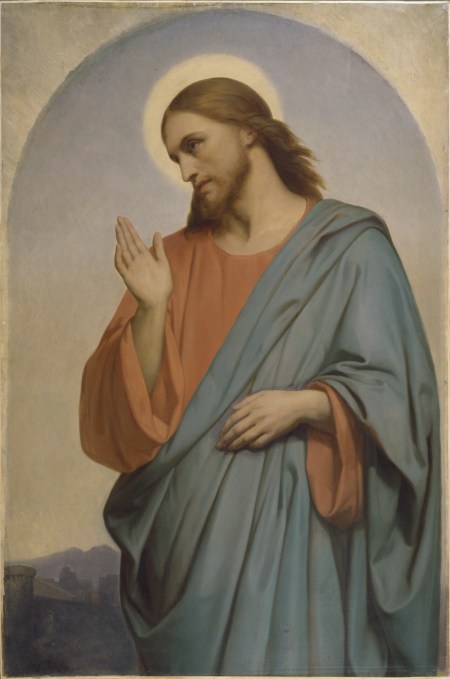
Jesus Weeping Over Jerusalem by Ary Scheffer (1795-1858)

Jesus came as a Friend and hoped to find Friends of God by his ministry. And he did find many. But not all.

It takes some work to be a true friend of Jesus. Some didn’t have the courage, or generosity, or passion, or hopeful imagination to reach past their self-protective boundaries – to step into eternal life even as they walked the time-bound earth.


In today’s Gospel this band of resisters project their fears and doubts to the crowds around them. The evil sparks inflame the ready tinder of human selfishness. The mob turns on Jesus, spiritual misers scoffing at the generous challenge to believe.

Jesus pleads with them to realize what they are doing:

If I do not perform my Father’s works, do not believe me;
but if I perform them, even if you do not believe me,
believe the works, so that you may realize and understand
that the Father is in me and I am in the Father.

John 10:37-38

But Jesus and Jeremiah, though troubled, are grounded in God. Our Responsorial Psalm captures what might have been their silent prayer:

Psalm18 distress

Poetry: The following transliteration of Psalm 18, composed by Christine Robinson, might help us to be with Jesus in his moment, and in our own moments of fear, anxiety, or doubt.

I open my heart to you, O God
for you are my strength, my fortress,
the rock on whom I build my life.

I have been lost in my fears and my angers
caught up in falseness, fearful, and furious
I cried to you in my anguish.
You have brought me to an open space.
You saved me because you took delight in me.
I try to be good, to be just, to be generous
to walk in your ways.
I fail, but you are my lamp.
You make my darkness bright
With your help, I continue to scale the walls
and break down the barriers that fragment me.
I would be whole, and happy, and wise
and know your love
Always.


Music: Overcome – Psalm 18 by James Block

Lent: Will We Be Able to See?

April 5, 2022
Tuesday of the Fifth Week of Lent

Today, in God’s Lavish Mercy, there are some common threads running through our readings.

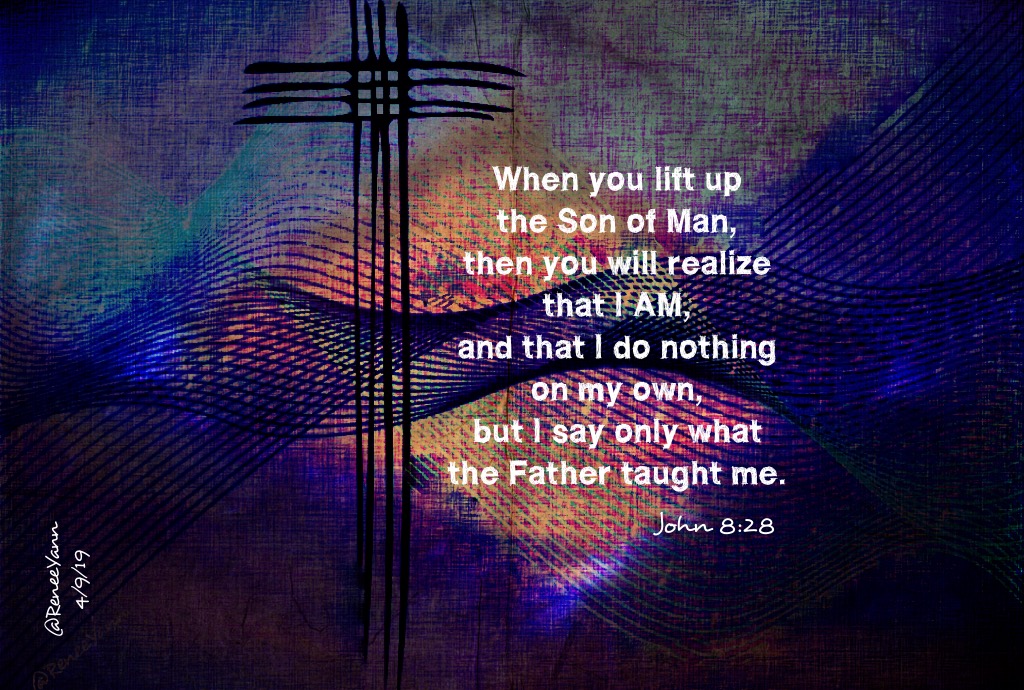
Jn8_28 sign

In the passage from Numbers, we have a restless crowd, confused and hungry, feeling directionless in a vast wilderness. They demand an answer from Moses:

Why have you brought us up from Egypt to die in this desert,
where there is no food or water?
We are disgusted with this wretched food!”

To make things worse, God, annoyed at their complaints, sends a bunch of snakes to hassle them.


In John’s Gospel, a disgruntled gathering of Pharisees pesters Jesus for a resolution to their questions. Even after all Jesus’ signs and preaching, they ask Him, “Who are you?”

  • In both instances, it is impossible for the questioners to receive the answer they seek because they lack faith.
  • In both instances, they are told that a sign will be lifted up before them and that then they will understand.

We’re on a life’s journey, at times confused and disgruntled, just like those ancient Hebrews.

We may be locked in faithless expectations of God, just like those debating Pharisees.

In our difficulties and challenges,
will we be able to see
the sign that God offers us?
Not the one we design or demand –
but the unexpected one rising up
out of the depths of our faith?

Poetry: The Crosse – George Herbert

What is this strange and uncouth thing?

To make me sigh, and seek, and faint, and die,

Untill I had some place, where I might sing,

          And serve thee; and not onely I,

But all my wealth and familie might combine

To set thy honour up, as our designe.

          And then when after much delay,

Much wrastling, many a combate, this deare end,

So much desir’d, is giv’n, to take away

          My power to serve thee; to unbend

All my abilities, my designes confound,

And lay my threatnings bleeding on the ground.

          One ague dwelleth in my bones,

Another in my soul (the memorie

What I would do for thee, if once my grones

          Could be allow’d for harmonie):

I am in all a weak disabled thing,

Save in the sight thereof, where strength doth sting.

          Besides, things sort not to my will,

Ev’n when my will doth studie thy renown:

Thou turnest th’ edge of all things on me still,

          Taking me up to throw me down:

So that, ev’n when my hopes seem to be sped,

I am to grief alive, to them as dead.

          To have my aim, and yet to be

Further from it then when I bent my bow;

To make my hopes my torture, and the fee

          Of all my woes another wo,

Is in the midst of delicates to need,

And ev’n in Paradise to be a weed.

          Ah my deare Father, ease my smart!

These contrarieties crush me: these crosse actions

Doe winde a rope about, and cut my heart:

          And yet since these thy contradictions

Are properly a crosse felt by the Sonne,

With but foure words, my words, Thy will be done.
 

( George Herbert (3 April 1593 – 1 March 1633) was a Welsh poet, orator, and priest of the Church of England. His poetry is associated with the writings of the metaphysical poets, and he is recognized as “one of the foremost British devotional lyricists.” He was born into an artistic and wealthy family and largely raised in England. He received a good education that led to his admission to Trinity College, Cambridge, in 1609. He went there with the intention of becoming a priest, but he became the University’s Public Orator and attracted the attention of King James I. He served in the Parliament of England in 1624 and briefly in 1625.

After the death of King James, Herbert renewed his interest in ordination. He gave up his secular ambitions in his mid-thirties and took holy orders in the Church of England, spending the rest of his life as the rector of the rural parish of Fugglestone St Peter, just outside Salisbury. He was noted for unfailing care for his parishioners, bringing the sacraments to them when they were ill and providing food and clothing for those in need. Henry Vaughan called him “a most glorious saint and seer”.[4] He was never a healthy man and died of consumption at age 39. ~ from Wikipedia)


Music: By Grace Alone – David Ward

Lent: God Remembers

March 30, 2022
Wednesday of the Fourth Week of Lent

Today, in God’s Lavish Mercy, our readings offer us the deeply comforting image of God as a mother, vigilant and caring for us even in our unawareness.

In our reading from Isaiah, the Israelites recently have been freed from their long sojourn in Babylon and have returned to Jerusalem. It is a time of great joy, but also of reorientation and reflection. God, Who may have seemed to abandon them to captivity, is assuring them that is not so:

Thus says the LORD:
In a time of favor I answer you,
on the day of salvation I help you;
and I have kept you and given you as a covenant to the people,
To restore the land
and allot the desolate heritages,
Saying to the prisoners: Come out!

Isaiah 49: 8-9

We too may have times when we think God isn’t paying attention to us, or to the world that seems to be falling apart around us. We may be tempted to think that Divine attention is turned to us only when we demand it by intense prayer of supplication.

In Isaiah 49, God – through a outlay of abundant promises, – tells us otherwise:

But Zion said, “The LORD has forsaken me;
my Lord has forgotten me.”
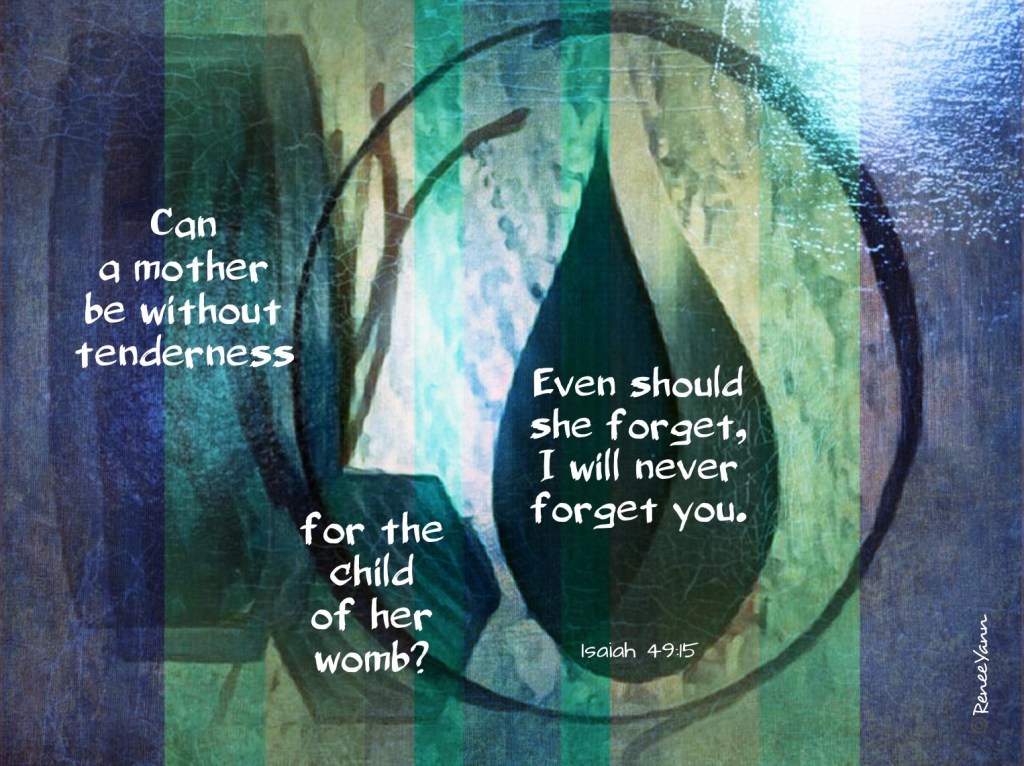
Can a mother forget her infant,
be without tenderness for the child of her womb?
Even should she forget,
I will never forget you.

Isaiah 49:14-15

In our Gospel, Jesus tells us the same things in a little bit of a different way.

My Father is at work until now, so I am at work.

John 5: 17

When he says this, Jesus is in the midst of the recalcitrant, vengeful Pharisees who have placed their faith only in their own arrogance – who have come to depend only on their own wealth and power rather than on the mercy and love of God.

Jesus offers his own outlay of Divine promises, showing how he and God the Creator are One in their constant desire for each of us to share fully in the Divine Life, even to the point of taking flesh to redeem us:

For just as the Father has life in himself,
so also he gave to the Son the possession of life in himself.
And he gave him power to exercise judgment,
because he is the Son of Man.
Do not be amazed at this,
because the hour is coming in which all who are in the tombs
will hear his voice and will come out,
those who have done good deeds
to the resurrection of life …

John 5: 26-29

We might ask in our prayer today to be deepened in our awareness of God’s constant, loving Presence in our lives. There is no moment or circumstance that doesn’t offer us an invitation to greater grace and holiness. But, unlike the Pharisees, we must open our hearts to trust God’s Presence in all things and to find that path to God’s heart.


In these final weeks of Lent, and in this particular passage from John, we see Jesus doing exactly what we must do. As Calvary began to loom unrelentingly on the horizon, Jesus could not have found it easy to accept the path unfolding before him. But he trusted. He knew the Father was with him. He believed that he walked toward Resurrection even though all he could see was a dark lonely hill.

May our Lenten prayer let us learn from Jesus.


Poetry: Forgetting by Joy Ladin

Zion says, “The LORD has forsaken me, my Lord has forgotten me.” Can a woman forget her baby, or disown the child of her womb? Though she might forget, I never could forget you.
—Isaiah 49:14–15

You never remember anything, do you?
How I formed you in your mother’s womb;
nursed you; bathed you; taught you to talk;

led you to springs of water?
I sang your name before you were born.
I’m singing your name now.

You’re clueless as an infant.
When I tell you to shout for joy,
you hear a bicycle, or a cat.

Sometimes, memories of me come back
like children you forgot you had:
a garden; a bride; an image of  your mother,

your best friend, your brother, or a cop, or snow, or afternoon.
The heavens shout; mountain becomes road;
gardenias burst into song.

Whose are these? you wonder.
Then you forget, and feel forgotten,
like an infant who falls asleep

at a mother’s breast
and wakes up hungry again.
Your mother might forget you, child,

but I never forget.
I’ve engraved your name
on the palms of my hands.

I show you trees, I lay you down in the grass,
I shower you with examples of my love—
sex and birds, librarians and life skills, emotions, sunlight, compassion.

Nothing connects.
Every dawn, every generation,
I have to teach you again:

this is water; this is darkness;
this is a body
fitting your description;

that’s a crush;
these are bodily functions;
this is an allergic reaction.

This is your anger.
This is mine.
This is me

reminding you to eat.
Turn off the stove.
Take your medication.

This is the realization
that I am yours and you are mine. This is you
forgetting.

Music: Will Never Forget You – Carey Landry

Lent: A Man of Sorrows

March 18, 2022
Friday of the Second Week of Lent

Today, in God’s Lavish Mercy, there is a great sadness in our readings.

The poignant opening line from Genesis immediately strikes us:

Israel loved Joseph best of all his sons,
for he was the child of his old age.
Genesis 37:3

Joseph

We picture young Joseph in his beautiful rainbow coat and, under an olive tree’s shade, old Jacob(Israel) proudly, tenderly, watching him play.

As the story ensues to reveal the later betrayal of Joseph’s jealous brothers, we are left astounded. Such treachery, especially among brothers, sickens the heart.


Our Gospel picks up the sad theme because Joseph and his brothers are archetypes of Christ’s story with humankind.

800px-The_Wicked_Husbandman_(The_Parables_of_Our_Lord_and_Saviour_Jesus_Christ)_MET_DP835802
The Wicked Husbandman by John Everett Millais shows the owner’s murdered son

Jesus tells a parable in which he is actually the unnamed main character. He is the Son sent by a loving Father. He is the one rejected, beaten and killed by the treacherous tenants of his Father’s garden.


We know from our familiarity with Scripture that both these stories ultimately come to glorious conclusions. But today’s readings do not take us there. They leave us standing, mouths dropped open, at the dense meanness of the human heart, at the soul’s imperviousness to grace, at the profound sadness Jesus felt at this point in his ministry.


In our prayer today, let’s just be with Jesus, sharing his sadness for the meanness still poisoning our world. We might pray today for Jesus suffering in the Ukrainian people and throughout the many war-infested parts of our world.

May our prayers comfort Jesus with our desire to be open to God’s Grace and Mercy. May they lead us to actions of peace and justice on behalf of our suffering sisters and brother.


Poetry: Despised and Rejected – Christina Rossetti

My sun has set, I dwell
In darkness as a dead man out of sight;
And none remains, not one, that I should tell
To him mine evil plight
This bitter night.
I will make fast my door
That hollow friends may trouble me no more.

“Friend, open to Me.”–Who is this that calls?
Nay, I am deaf as are my walls:
Cease crying, for I will not hear
Thy cry of hope or fear.
Others were dear,
Others forsook me: what art thou indeed
That I should heed
Thy lamentable need?
Hungry should feed,
Or stranger lodge thee here?

“Friend, My Feet bleed.
Open thy door to Me and comfort Me.”
I will not open, trouble me no more.
Go on thy way footsore,
I will not rise and open unto thee.

“Then is it nothing to thee? Open, see
Who stands to plead with thee.
Open, lest I should pass thee by, and thou
One day entreat My Face
And howl for grace,
And I be deaf as thou art now.
Open to Me.”

Then I cried out upon him: Cease,
Leave me in peace:
Fear not that I should crave
Aught thou mayst have.
Leave me in peace, yea trouble me no more,
Lest I arise and chase thee from my door.
What, shall I not be let
Alone, that thou dost vex me yet?

But all night long that voice spake urgently:
“Open to Me.”
Still harping in mine ears:
“Rise, let Me in.”
Pleading with tears:
“Open to Me that I may come to thee.”
While the dew dropped, while the dark hours were cold:
“My Feet bleed, see My Face,
See My Hands bleed that bring thee grace,
My Heart doth bleed for thee,
Open to Me.”

So till the break of day:
Then died away
That voice, in silence as of sorrow;
Then footsteps echoing like a sigh
Passed me by,
Lingering footsteps slow to pass.
On the morrow
I saw upon the grass
Each footprint marked in blood, and on my door
The mark of blood forevermore.

Music:  Handel: Messiah – He was despised and rejected – sung by Jakub Józef Orliński

“He was despised and rejected of men; a man of sorrows, and acquainted with grief.
(Isaiah 53, v.3)
“He gave his back to the smiters, and his cheeks to them that plucked off the hair: he hid not his face from shame and spitting.” (Isaiah 50, v.6)

Lent: The Choice

March 3, 2022
Thursday after Ash Wednesday

Today, in God’s Lavish Mercy, our readings confirm that a life patterned on Christ contradicts worldly definitions.

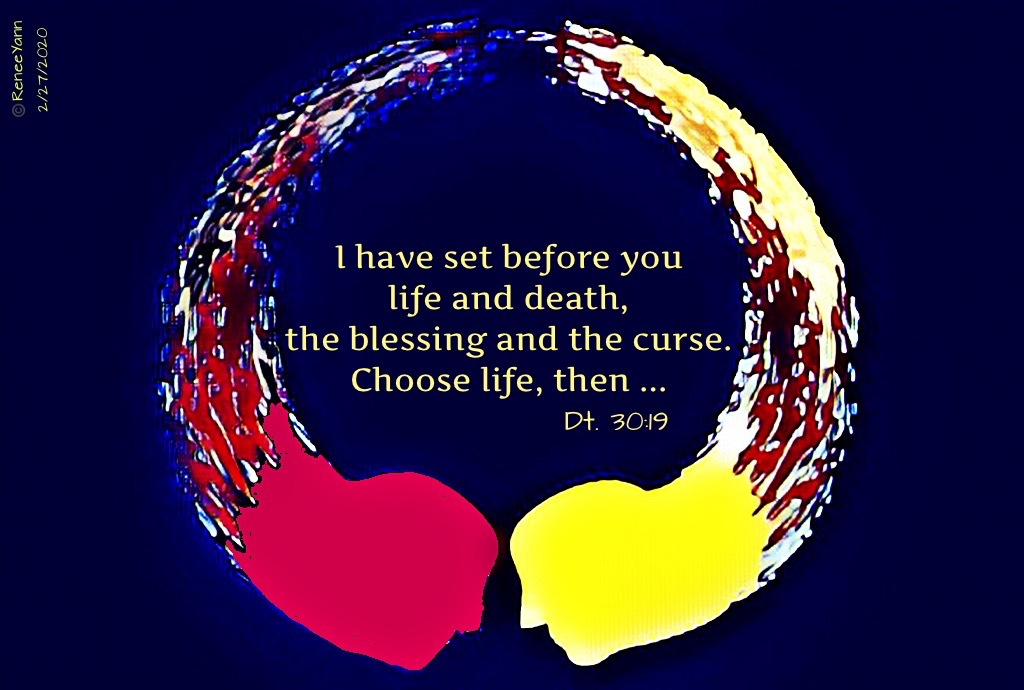
Deuteronomy gives us stark, either-or, advice:

I have set before you life and death,
the blessing and the curse.
Choose life, then,
that you and your descendants may live,
by loving the LORD, your God,
heeding his voice,
and holding fast to him.

Deuteronomy 30: 15-16

It’s definitive advice, but we could probably do these things, right?

  • Choose life
  • Love God
  • Heed God’s voice
  • Hold fast to God

Sounds OK, doesn’t it?


It’s when Jesus comes along that it begins to sound difficult.
Jesus tells us, “Here’s how you choose life:

“Whoever wishes to save his life will lose it,
but whoever loses his life for my sake will save it.”


Jesus tells us, “Here’s the God you must love, one who:

“suffers greatly, is rejected, and is killed.”


Jesus tells us, “Here’s what my voice says to you :

“What profit is there for you to gain the whole world
yet lose or forfeit yourself?”


Jesus tells us, “Here’s how you hold fast to me:

‘Take up your cross daily and follow me.”

The deep love of the Holy Cross was the sacred gift of Catherine McAuley to her Mercy Family.
Let us listen to her counsel.

Some have huge crosses to carry in their lives – war, famine, enslavement, untended illness, homelessness, persecution, poverty. Those who carry such crosses are singularly loved by God who dwells with them.

But if we don’t have big, obvious crosses in our lives – if we are among those the world deems fortunate – how do we follow the crucified Jesus to find our way to eternal life?

How do we really CHOOSE LIFE?

We need to get close to the ones God singularly loves. We need to walk beside them and lift some of their heavy crosses. We need to help their voices be heard, their needs be met, their rights be honored.

Not all of us can do this by direct service. But we can do it by our advocacy, our material contributions, and our articulated support for justice.

We need to make these choices for LIFE all the time. But Lent is a great time to examine the vigor and commitment of our choices, a time to take a closer walk with our suffering Christ and ask him to inspire our courage.


Poetry: Simon the Cyrenian Speaks – Countée Cullen, an American poet, novelist, children’s writer, and playwright, particularly well known during the Harlem Renaissance. I picked his poem today because Simon of Cyrene is someone who chose to carry the cross just as we are asked to do.

He never spoke a word to me,
And yet He called my name;
He never gave a sign to me,
And yet I knew and came.

At first I said, “I will not bear
His cross upon my back;
He only seeks to place it there
Because my skin is black.”

But He was dying for a dream,
And He was very meek,
And in His eyes there shone a gleam
Men journey far to seek.

It was Himself my pity bought;
I did for Christ alone
What all of Rome could not have wrought
With bruise of lash or stone.


Music: Just a Closer Walk with Thee – Patsy Cline and Willie Nelson

Living the Cross

February 17, 2022
Thursday of the Sixth Week in Ordinary Time

Today, in God’s Lavish Mercy, two disciples of Jesus are our teachers. James advises us on what to do. Beloved Peter, as so often is the case, shows us what not to do.

James tells us to show no partiality. He makes clear that he is talking about impartiality toward those who are materially poor. It’s a maxim that Jesus gave us time and again in the Gospel.

James reminds us that Jesus is not just impartial toward those who are poor, he actually has a preferential love for them. So Jesus was partial to the poor, right? Hmm!

Yes, I think that’s right. In order to balance our human inclination to the richest, best, strongest, etc., Jesus teaches us to go all out in the other direction.

It’s like this great cartoon that popped up on Facebook a while ago:


Our Gospel picks up the theme.

Because of his great love for the poor and his passion for mercy, Jesus tells his followers that suffering is coming. Peter doesn’t like hearing that. Can you see Peter take Jesus aside and say, “Listen, Jesus, negative talk is going to hurt your campaign. You’re God! You can just zap suffering out of your life!”


Jesus responds to Peter definitively: “Get thee behind me, Satan!”

James Tissot: Get Thee Behind me, Satan

Wow! That must have stung! But that’s how important it was to Jesus that his followers understood his mission: to preach Mercy to the poor, sick, and broken by sharing and transforming their experience.

Jesus wants us to understand that too.


Prose: from St. Oscar Romero

It is no honor for the Church 
to be on good terms with the powerful.
The honor of the Church consists in this,
that the poor feel at home in her,
that she fulfils her mission on earth,
that she challenges everyone,
the rich as well,
to repent and work out their salvation,
but starting from the world of the poor,
for they, they alone are the ones who are blessed.

Music: Beauty for Brokenness – Graham Kendrick

Our Tender God

October 25, 2021
Monday of the Thirtieth Week in Ordinary Time

Today, in God’s Lavish Mercy, we pray with Psalm 68 which pictures a triumphant God, rising like the sun over the darkness of evil.

Arise, O God, and let your enemies be scattered;
let those who hate you flee.
Let them vanish like smoke when the wind drives it away; 
as the wax melts at the fire,
so let the wicked perish at your presence.

Psalm 68: 1-3

This psalm comforts us with a tender picture of God:

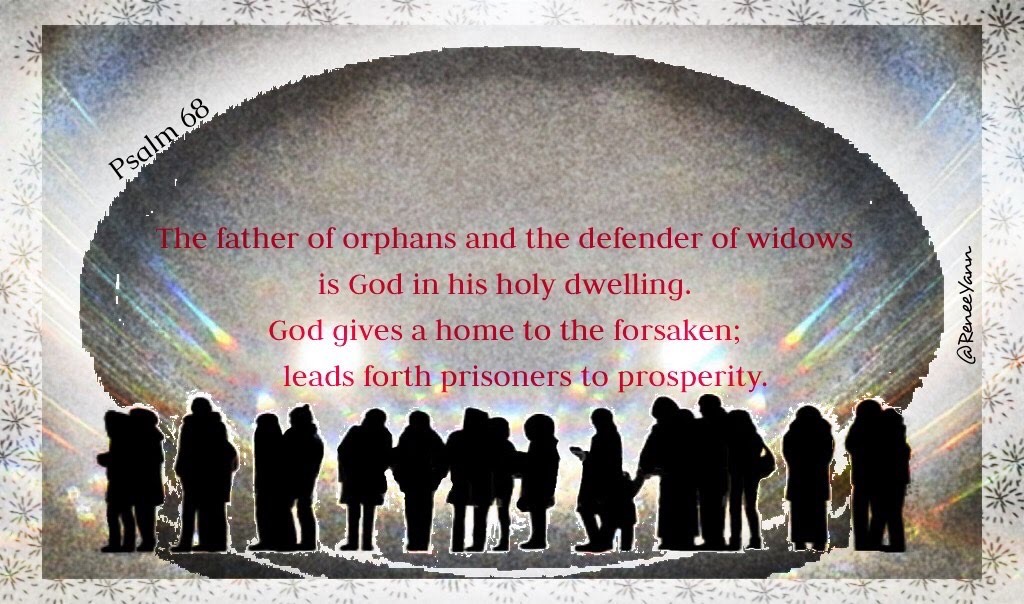
Protector of orphans, defender of widows,
the One who dwells in holiness,
who gives the solitary a home
and brings forth prisoners into freedom;
but the rebels shall live in dry places.

Psalm 68: 5-6

It is the same tenderness Paul presents in our first reading:

For those who are led by the Spirit of God are children of God.
For you did not receive a spirit of slavery to fall back into fear,
but you received a spirit of adoption,
through which we cry, “Abba, Father!”
The Spirit bears witness with our spirit
that we are children of God,
and if children, then heirs,
heirs of God and joint heirs with Christ…

if only we suffer with him
so that we may also be glorified with him.

And there we have the key line:
we are to live a life aligned with
the Passion, Death, and Resurrection of Christ.

And what will that kind of life look like? It will look like our merciful Jesus of today’s Gospel – who stepped out to see, comfort, and heal the suffering around him.

Jesus recognized the crippled woman as “an heir of God, and joint heir with him” to the fullness of life in God. We are called recognize ourselves and all of our sisters and brothers in the same way.


Poetry: WOMAN UN-BENT (LUKE 13:10–17) – by Irene Zimmerman, OSF

That Sabbath day as always
she went to the synagogue
and took the place assigned her
right behind the grill where,
the elders had concurred,
she would block no one’s view,
she could lean her heavy head,
and (though this was not said)
she’d give a good example to
the ones who stood behind her. 

That day, intent as always
on the Word (for eighteen years
she’d listened thus), she heard
Authority when Jesus spoke. 

Though long stripped
of forwardness,
she came forward, nonetheless,
when Jesus summoned her.
“Woman, you are free
of your infirmity,” he said. 

The leader of the synagogue
worked himself into a sweat
as he tried to bend the Sabbath
and the woman back in place. 

But she stood up straight and let
God’s glory touch her face.

Video: Jesus Heals the Bent-over Woman

If you’d still like a little music, this one seems to fit: Spirit Touch by Joseph Akins

This Cup Is Your Life

October 17, 2021
Twenty-ninth Sunday in Ordinary Time

Today, in God’s Lavish Mercy, we pray with Psalm 33 which

“proclaims the LORD as the one

in whom the righteous may place their trust and hope.”

James L. Mays: Psalms (Interpretation: A Bible Commentary for Teaching and Preaching)

Upright is the word of the LORD,
    and all his works are trustworthy.
God loves justice and right;
    of the kindness of the LORD the earth is full.

See, the eyes of the LORD are upon those in awe,
    upon those who hope for God’s kindness,
To deliver them from death
    and preserve them in spite of famine.

Psalm 33: 4-5; 18-19

This is a good psalm to be reminded of as we encounter readings from Isaiah and Mark which sound almost Lenten in tone. Our psalm reminds us that, despite adverse appearances, God abides with us and fosters our well-being.


Isaiah gives us the image of a broken Jesus, crushed by a “suffering that justifies many”.

Christ as the Man of Sorrows – Albert Durer

Mark recounts the story of the two rather oblivious disciples asking to sit in glory beside Jesus. They do not realize that the path to this glory is through Gethsemane and Calvary.

Jesus asks these disciples the same question he asks us throughout our lives:

“Can you drink the cup that I will drink?”

Each of our sufferings and sacrifices may be small or large in life. But when they are united with Christ in faith and hope, they all are redemptive.

We will be asked, as Jesus was, to lay down our life in love. 

  • It may be in the unselfish raising of a family, or the humble pastoring of a church community. 
  • It may be in the long-term care of an elderly parent or neighbor. 
  • It may be in a ministry of healing, teaching, or encouragement where another requires our labor, patience and mercy. 
  • It may be as a public servant who actually serves, or as a private nurse who tenderly nurses. 
  • It may be as a community member who builds life by respect, responsibility, and mutuality.

We will come to realize, as did the ambitious sons of Zebedee, that true discipleship is not flash and glam. It is the daily choice to quietly lift the cup we have been given, and raise it to the honor of God – in openness, trust, joy and delight that we are called to share in the life of Christ.


Poetry: Can you Drink the Cup – Scott Surrency, OFM.Cap

Can you drink the cup?
Drink, not survey or analyze,
ponder or scrutinize –
from a distance.
But drink – imbibe, ingest,
take into you so that it becomes a piece of your inmost self.
And not with cautious sips
that barely moisten your lips,
but with audacious drafts
that spill down your chin and onto your chest.
(Forget decorum – reserve would give offense.)

Can you drink the cup?
The cup of rejection and opposition,
betrayal and regret.
Like vinegar and gall,
pungent and tart,
making you wince and recoil.
But not only that – for the cup is deceptively deep –
there are hopes and joys in there, too,
like thrilling champagne with bubbles
that tickle your nose on New Year’s Eve,
and fleeting moments of almost – almost – sheer ecstasy
that last as long as an eye-blink, or a champagne bubble,
but mysteriously satisfy and sustain.

Can you drink the cup?
Yes, you — with your insecurities,
visible and invisible.
You with the doubts that nibble around the edges
and the ones that devour in one great big gulp.
You with your impetuous starts and youth-like bursts of love and devotion.
You with your giving up too soon – or too late – and being tyrannically hard on yourself.
You with your Yes, but’s and I’m sorry’s – again.
Yes, you – but with my grace.

Can you drink the cup?

Can I drink the cup?

Yes.


Music: The Cup of Salvation ~Shane & Shane (Lyrics below.)

I love the Lord for He heard my voice
And answered my cry for mercy
Because He listened to me
I will call upon Him as long as I live

CHORUS

What shall I render to the Giver of life and who all things are made
What shall I render to the One who paints the oceans blue
Jesus Christ

I will lift up a cup of salvation
Call on the Name of the Lord
How do I repay the life that You gave
I’ll call on the Name of the Lord
Lift up a cup, You have already poured

What kind of rendering is found in this taking
Found in this drinking of love
Love so abundant He meets me in depravity
With one thing to give

CHORUS

You have delivered my soul from death
My eyes from tears
My feet from stumbling
And I will walk before the Lord
In the land of the living

CHORUS

Feast of the Exaltation of the Holy Cross

Tuesday, September 14, 2021

Today, in God’s Lavish Mercy, we pray with Psalm 78 which commands us:

Do not forget the works of the Lord!


The psalm, in its entirety, is a recital of God’s faithfulness to Israel over time, culminating in the triumph of David/Jerusalem/Temple.

God chose David his servant,
took him from the sheepfolds.
From tending ewes God brought him,
to shepherd Jacob, the people,
Israel, God’s heritage.
He shepherded them with a pure heart;
with skilled hands he guided them.

Psalm 78: 70-73

David foreshadows Jesus, the Good Shepherd who not only tends the sheep but becomes the Lamb of God. Jesus completes our salvation by his death on the Cross. In him, the long journey of Psalm 78 is ultimately fulfilled.


Philippians’ exquisite hymn captures the profound nature of that fulfillment:

Christ Jesus, though he was in the form of God,
    did not regard equality with God something to be grasped.
    Rather, he emptied himself,
    taking the form of a slave,
    coming in human likeness;
    and found human in appearance,
    he humbled himself,
    becoming obedient to death,
    even death on a cross.

Philippians 2:5-8

Each of our lives reflects, in its own way, the salvation journey we find in scripture. We experience the same kind of twists and turns, highs and lows as those described in Psalm 78.

In each of these moments, we are held in the mystery of the Cross wherein Christ transforms all suffering to grace:

Because of this, God greatly exalted him
    and bestowed on him the name
    that is above every name,
    that at the name of Jesus
    every knee should bend,
    of those in heaven and on earth and under the earth,
    and every tongue confess that
    Jesus Christ is Lord,
    to the glory of God the Father.

Philippians 2: 9-11

Poetry: Good Friday – Christina Rossetti (1830-1894)

Am I a stone and not a sheep 
That I can stand, O Christ, beneath thy cross, 
To number drop by drop Thy blood’s slow loss, 
And yet not weep?
Not so those women loved 
Who with exceeding grief lamented thee; 
Not so fallen Peter weeping bitterly; 
Not so the thief was moved;
Not so the sun and moon 
Which hid their faces in a starless sky, 
A horror of great darkness at broad noon— 
I, only I.
Yet give not o’er, 
But seek thy sheep, true Shepherd of the flock; 
Greater than Moses, turn and look once more 
And smite a rock.

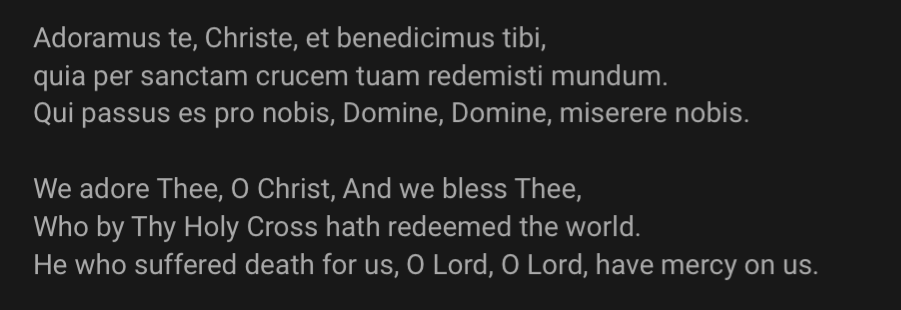
Music: Adoramus Te, Christe

Twenty-fourth Sunday in Ordinary Time

Sunday, September 12, 2021

Today, in God’s Lavish Mercy, our Sunday readings increase in dramatic tone.  The passage from Isaiah describes a Savior bent on his mission despite mounting resistance and expressed hatred.

The Lord GOD opens my ear that I may hear;
and I have not rebelled,
    have not turned back.
I gave my back to those who beat me,
    my cheeks to those who plucked my beard;
my face I did not shield
    from buffets and spitting.

Isaiah 50:5-6

Psalm 116 paints a person set upon by suffering and death threats, still trusting in the Lord’s saving grace.

The cords of death encompassed me;
    the snares of the netherworld seized upon me;
    I fell into distress and sorrow,
And I called upon the name of the LORD,
    “O LORD, save my life!”

Psalm 116: 3-4

In the Epistle, James says we must demonstrate our faith by our works — by putting our money where our mouth is.

What good is it, my brothers and sisters,
if someone says he has faith but does not have works? 

James 2:14

And in our Gospel, Jesus says we demonstrate our faith by following him, renouncing ourselves and taking up our cross.

This is heavy stuff. Jesus wants us to be like him — and it would be so much easier not to be!  It would be so much easier to think that our life is all about ourselves, and that we have no responsibility for Beloved Creation.

It would be so much easier not to give our lives to Christ to allow Him to bless the world through our love.

But if we wish to “save” our lives like this, we will — in the end — lose them for eternity.

Let us pray today for the grace to take our life and lay it down over the Cross of Christ.

In that laying down, to conform ourselves to the pattern of his love, to place the weight of our burdens and hopes on the crossbeam of his strength.

Let us ask for the strength to live 

  • for God
  • for others
  • for good in the world
  • and never for self when it injures or lessens others or our Sacred Home.

This is the way we will keep our lives in Christ.

Music: Renouncement – Michael Hoppé