The Glory Yet to Come

Tuesday of the Thirtieth Week in Ordinary Time
October 31, 2023

Today’s Readings:

https://bible.usccb.org/bible/readings/103123.cfm


Today, in God’s Lavish Mercy, we pray with Psalm 126, a song of hope fulfilled:

When the LORD brought back the captives of Zion,
    we were like men dreaming.
Then our mouth was filled with laughter,
    and our tongue with rejoicing.

Then they said among the nations,
    “The LORD has done great things for them.”
The LORD has done great things for us;
    we are glad indeed.

Psalm 126: 1-3

In our readings, we are called to be people of hope – to live in gratitude for hopes fulfilled, and to live in confidence of future blessing.


Paul blesses us with some of his most powerful words:

I consider that the sufferings of this present time are as nothing
compared with the glory to be revealed for us.

Romans 8:18

How often, over the ensuing centuries, have these words uplifted and bravened a struggling heart! Paul reminds us of what he so passionately believed – that we are not here for this world alone; that we, with all Creation, are being transformed for eternal life in God.


Jesus too reminds us that our life in faith is so much bigger than we perceive. We see a tiny mustard seed, but God sees the whole tree of eternal life blossoming in us.  We see a fingertip of yeast, but God sees the whole Bread of Life rising in us.

Paul tells us to be People of Hope who do not yet expect to see the object of their hope but who, nonetheless, believe and love with all their hearts.

May we pray this today for ourselves, and for anyone burdened by suffering or hopelessness at this time in their lives.


Poetry: Hope – Czeslaw Milosz – poet, prose writer, translator, and diplomat. He primarily wrote his poetry in Polish. Regarded as one of the great poets of the 20th century, he won the 1980 Nobel Prize in Literature. In its citation, the Swedish Academy called Miłosz a writer who “voices our exposed condition in a world of severe conflicts”.

Hope is with you when you believe
The earth is not a dream but living flesh,
that sight, touch, and hearing do not lie,
That all thing you have ever seen here
Are like a garden looked at from a gate.
You cannot enter. But you're sure it's there.
Could we but look more clearly and wisely
We might discover somewhere in the garden
A strange new flower and an unnamed star.
Some people say that we should not trust our eyes,
That there is nothing, just a seeming,
There are the ones who have no hope.
They think the moment we turn away,
The world, behind our backs, ceases to exist,
As if snatched up by the hand of thieves.

Music:  Living Hope – Phil Wickham
Raised Up!

Monday of the Thirtieth Week in Ordinary Time
October 30, 2023

Today’s Readings:

https://bible.usccb.org/bible/readings/103023.cfm


Today, in God’s Lavish Mercy, we pray with Psalm 68 which pictures a triumphant God, rising like the sun over the darkness of evil.

Arise, O God, and let your enemies be scattered;
let those who hate you flee.
Let them vanish like smoke when the wind drives it away; 
as the wax melts at the fire,
so let the wicked perish at your presence.

Psalm 68:1-3

This psalm comforts us with a tender picture of God:

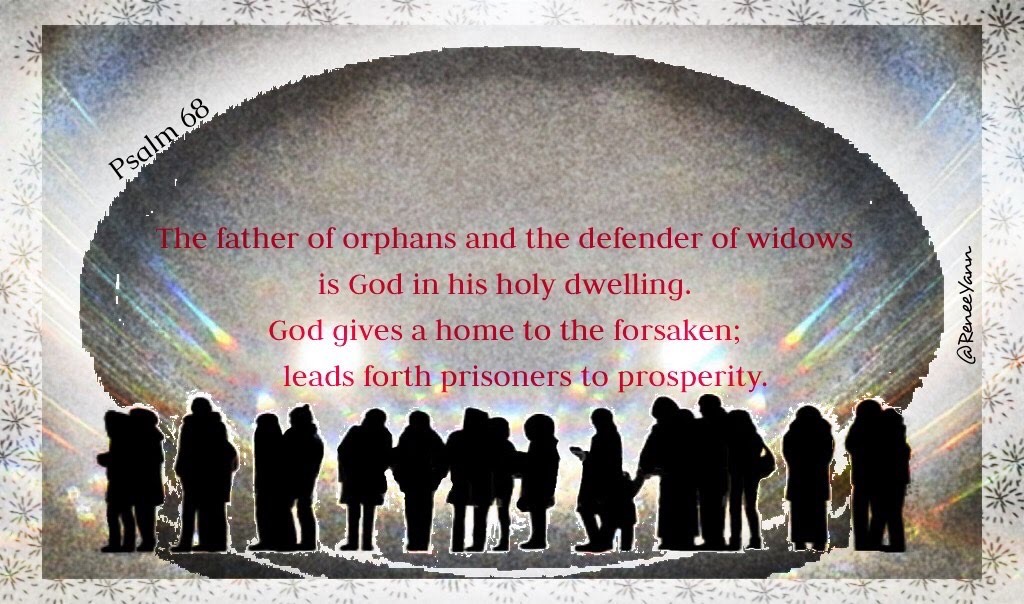
Protector of orphans, defender of widows,
the One who dwells in holiness,
who gives the solitary a home
and brings forth prisoners into freedom;
but the rebels shall live in dry places.

Psalm 68: 5-6

It is the same tenderness Paul presents in our first reading:

For those who are led by the Spirit of God are children of God.
For you did not receive a spirit of slavery to fall back into fear,
but you received a spirit of adoption,
through which we cry, “Abba, Father!”
The Spirit bears witness with our spirit
that we are children of God,
and if children, then heirs,
heirs of God and joint heirs with Christ…
if only we suffer with him
so that we may also be glorified with him.

Romans 8:8-9

And there we have the key line: 
we are to live a life aligned with 
the Passion, Death, and Resurrection of Christ.


And what will that kind of life look like? It will look like our merciful Jesus of today’s Gospel – who stepped out to see, comfort, and heal the suffering around him.

Jesus recognized the crippled woman as “an heir of God, and joint heir with him” to the fullness of life in God. We are called to recognize ourselves and all of our sisters and brothers in the same way.


Poetry: WOMAN UN-BENT (LUKE 13:10–17) – by Irene Zimmerman, OSF

That Sabbath day as always 
she went to the synagogue 
and took the place assigned her 
right behind the grill where, 
the elders had concurred, 
she would block no one’s view, 
she could lean her heavy head, 
and (though this was not said) 
she’d give a good example to 
the ones who stood behind her. 
 
That day, intent as always 
on the Word (for eighteen years 
she’d listened thus), she heard 
Authority when Jesus spoke. 
 
Though long stripped 
of forwardness, she came forward, nonetheless, 
when Jesus summoned her. 
“Woman, you are free of your infirmity,” he said. 

The leader of the synagogue 
worked himself into a sweat 
as he tried to bend the Sabbath 
and the woman back in place. 

But she stood up straight and let 
God’s glory touch her face.

Video: Jesus Heals the Bent-over Woman

If you’d still like a little music, this one seems to fit: Spirit Touch by Joseph Akins

It’s That Simple

Thirtieth Sunday in Ordinary Time
October 29, 2023

Today’s Readings:

https://bible.usccb.org/bible/readings/102923.cfm


Today, in God’s Lavish Mercy, our readings instruct us on how to love God. Now maybe you think you don’t need any help on that topic, and maybe you’re right. But — just maybeeeeee – you and I are a little bit like the folks in our passage from Exodus who sometimes forgot that the way to love God is to love neighbor.

“You shall not molest or oppress an alien,
for you were once aliens yourselves in the land of Egypt. 
You shall not wrong any widow or orphan. 
If ever you wrong them and they cry out to me,
I will surely hear their cry. 

Exodus 22;21-22

It seems that these Exodus folks suffer from spiritual obtusity. They are a little forgetful of who they really are. They forget their roots – that they were once aliens themselves. They forget that widows and orphans matter as much as they do. They forget that their neighbor needs a cloak (or a home) to be able to sleep at night.

So God tells them, “Hey, I love these people you have conveniently “forgotten”. So don’t pretend you love me if you don’t love them.” It’s that simple.


In our Gospel, Jesus basically says the same thing. When the brilliant Pharisee tries to trap Jesus in an obtuse intellectual argument, Jesus disarms him with a clear and simple response:

Jesus said to him,
“You shall love the Lord, your God,
with all your heart,
with all your soul,
and with all your mind.
This is the greatest and the first commandment.
The second is like it:
You shall love your neighbor as yourself.
The whole law and the prophets depend on these two commandments.”

Matthew 22:37-40

The whole enterprise of the spiritual life is to actualize Jesus’s response in one’s life. In the process of doing that by our response to God’s grace, we might sometimes get caught in spiritual forgetfulness, intellectual excuses, or the blare of a dissonant culture.


In our second reading, Paul commends the Thessalonians for having done well in this spiritual endeavor. They did it by replacing what was idolatrous in their lives with the living and true God:

You turned to God from idols
to serve the living and true God
and to await his Son from heaven,
whom he raised from the dead,
Jesus, who delivers us from the coming wrath.

1 Thessalonians 1:9-10

I don’t like to think of myself as particularly idolatrous, but I do have little false gods pop up in my life at times. They tend to wear the deceptive costumes of the seven deadly sins convincing me that I have a right, or at least an excuse, to ignore my neighbor for the sake of my egotism, possessiveness, or spiritual laziness.


May today’s readings wake us up to anything we need to hear within them so that we may freely sing with today’s psalmist:

I love you, my true God, my strength,
my neighbor God, present in my life,
my balance, safety, comforter.
My God, my dear steady God,
my protection, well of my salvation,
my trustworthy Friend!
I praise You because, with You,
I am safe from any false god
and anointed by your grace
for the journey.

Psalm 18: my prayerful adaptation

Poetry: You, Neighbor God – Rainer Maria Rilkë

You, neighbor god, if sometimes in the night
I rouse you with loud knocking, I do so
only because I seldom hear you breathe
and know: you are alone.
And should you need a drink, no one is there
to reach it to you, groping in the dark.
Always I hearken. Give but a small sign.
I am quite near.
Between us there is but a narrow wall,
and by sheer chance; for it would take
merely a call from your lips or from mine
to break it down,
and that without a sound.
The wall is builded of your images.
They stand before you hiding you like names.
And when the light within me blazes high
that in my inmost soul I know you by,
the radiance is squandered on their frames.
And then my senses, which too soon grow lame,
exiled from you, must go their homeless ways.

Music: Overcome – Psalm 18 – James Block

This song renders the Psalm in a beautiful melody. The Psalm, however, retains the militant images so prevalent in the culture of ancient Israel (and sadly in our own). Our task, as we listen and pray these Psalms, is to hear those images as metaphors for our own spiritual challenges and blessings, rather than as an approbation of war and domination.

Leaders of the Faith

Feast of Saints Simon and Jude, Apostles
October 28, 2023

Today’s Readings:

https://bible.usccb.org/bible/readings/102823.cfm


Brothers and sisters:
You are no longer strangers and sojourners,
but you are fellow citizens with the holy ones
and members of the household of God,
built upon the foundation of the Apostles and prophets,
with Christ Jesus himself as the capstone.

Ephesians 2:19-20

Today, in God’s Lavish Mercy, we celebrate the feast of the Apostles Simon and Jude. Not much is really known about either of these men. One tradition suggests that after the Ascension, they went together to carry the Gospel to Persia where they were eventually martyred.

simon_Jude

Since we have so few facts, many legends and interpretations have grown up around these saints. Probably the strongest and most familiar of these is of St. Jude as the patron of hopeless cases.

There are probably very few of us who haven’t asked at least one favor from St. Jude in our lifetimes. This probability begs the question of why and how do we pray with the saints.

Our tradition holds that we exist in the Communion of Saints with all of God’s creatures, and that we inspire and support one another by the sharing of our lives. This sharing is not limited by time, nor is it constricted by death.

When we pray with the saints, we draw on their faithful witness to inspire, motivate and sustain us in our lives.

Today, we might pray within the spirit of these two great Christians whose witness, though historically muted, transcends time. May they inspire in us the passion and joy to speak Christ in our lives.


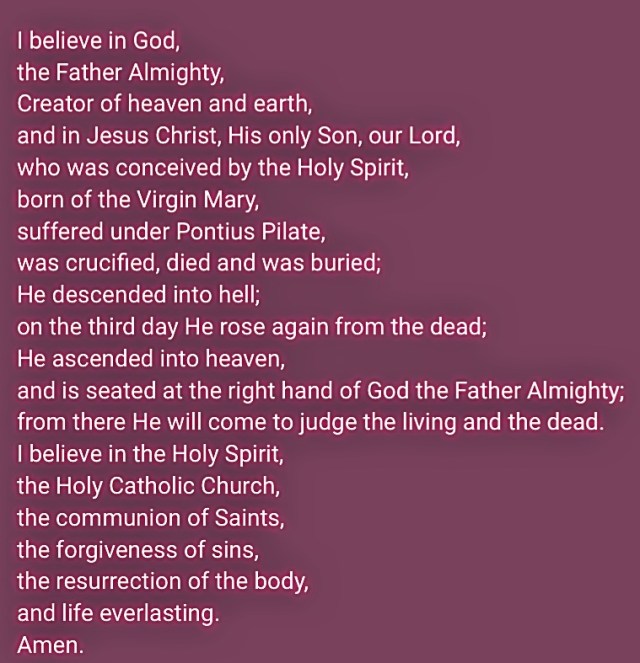
Prose: Since we celebrate two Apostles today, we might want to slowly and carefully pray this prayer. The Apostles’ Creed is a statement of Christian belief that is used by Western churches, both Catholic and Protestant. While it is explicitly affirmed only in Western churches, it reflects traditions that were affirmed officially by the entire Church in the Nicene Creed. Although its roots are much earlier, in its present form it dates to about the eighth century.

apos creed

Music: Apostles’ Creed – sung here by Rebecca Gorzynska, a beautiful and talented artist (Latin and English text below.)

latin creed

The Key of Knowledge

Memorial of Saints John de Brébeuf and Isaac Jogues
Thursday of the Twenty-eighth Week in Ordinary Time
October 19, 2023

Today’s Readings:

https://bible.usccb.org/bible/readings/101923.cfm


Today, in God’s Lavish Mercy, “the Law” plays a central role in our readings.

At their best, laws are those commonly agreed-upon markers that guide the human community on its shared journey. Ideally conceived in the context of justice, every law will lead to a balance of well-being for all concerned.


It is in the human administration of law that we meet challenges. Such administration rests in the hands of “superiors” who are, like all of us, subject to prejudice, ignorance, domination, and arrogance. These individuals can regress to an interpretation of law that benefits only themselves and those they favor.

In our Gospel, Jesus vociferously condemns this corruption of the Law by the very people who have been entrusted with its integrity:

Woe to you, scholars of the law!
You have taken away the key of knowledge.
You yourselves did not enter and you stopped those trying to enter.

Luke 11:52

What is that “key of knowledge” Jesus refers to? I think it is this: that the Law is only peripheral. While it must be respected, it must also be transcended so that we live beyond it and into the Spirit Who generates it.


In our first reading, Paul makes an astounding statement that surely knocked the pharisaical legalists on their pins! Paul says that God’s righteousness is not found in the Law but solely in faith in Jesus Christ.

Now the righteousness of God has been manifested apart from the law,
though testified to by the law and the prophets,
the righteousness of God through faith in Jesus Christ
for all who believe.

Romans 3:21-22

This passage in Romans is critical to the Christian understanding of “righteousness”. No one can achieve righteousness apart from the grace of God which is given to us solely as gift and not reward for our actions. But it is also essential that a person create an inner receptivity to grace, a receptivity achieved through the personal exercise of faith, hope, and love – that is, by the works of mercy.


Since the early 16th century, various Christian denominations have been trying to split the hair of this argument which is dubbed “Sola Fide (faith alone)”. The argument asks, “Are we made right with God by faith alone, or by faith demonstrated in good works?”.

Paul and Jesus addressed the question fifteen hundred years before anybody even thought up the Sola Fide conundrum. They did so in direct and simple language so that their listeners could learn and feel confident in their faith life.


The debate around “sola fide” can devolve into theological hair-splitting, an exercise that seems almost like an intellectual game. Contrary to hair-splitting, our faith life is fostered by a theology deeply rooted in spirituality and evidenced in reverent, grateful, and charitable living. Laws can help us with that pursuit but they can’t accomplish it. Only an active, loving faith, responsive to God’s grace, can unlock that door.


Prose: Excerpt from Lumen Fidei (The Light of Faith), the first encyclical of Pope Francis (June 29, 2013)

(This passage and the encyclical as a whole are so beautiful that I hope you will take time to savor the words, even in small doses. I broke it up into small sections because that’s the way I best prayed with it.)

Since faith is a light, it draws us into itself, 
inviting us to explore ever more fully 
the horizon which it illumines, 
all the better to know the object of our love. 

Christian theology is born of this desire. 
Clearly, theology is impossible without faith; 
it is part of the very process of faith, 
which seeks an ever deeper understanding 
of God’s self-disclosure culminating in Christ. 

It follows that theology is more 
than simply an effort of human reason 
to analyze and understand, 
along the lines of the experimental sciences. 
God cannot be reduced to an object. 
He is a subject who makes himself known 
and perceived in an interpersonal relationship. 

Right faith orients reason to open itself 
to the light which comes from God, 
so that reason, guided by love of the truth, 
can come to a deeper knowledge of God. 

The great medieval theologians and teachers 
rightly held that theology, as a science of faith, 
is a participation in God’s own knowledge of himself. 
It is not just our discourse about God, 
but first and foremost the acceptance and the pursuit 
of a deeper understanding 
of the word which God speaks to us, 
the word which God speaks about himself, 
for he is an eternal dialogue of communion, 
and he allows us to enter into this dialogue. 

Theology thus demands the humility 
to be "touched" by God, 
admitting its own limitations before the mystery, 
while striving to investigate, 
with the discipline proper to reason, 
the inexhaustible riches of this mystery.

Music: Spirit Seeking Light and Beauty – Janet Erskine Stuart, RSCJ

Be Like Luke!

Feast of Saint Luke, evangelist
October 18, 2023

Today’s Readings:

https://bible.usccb.org/bible/readings/101823.cfm


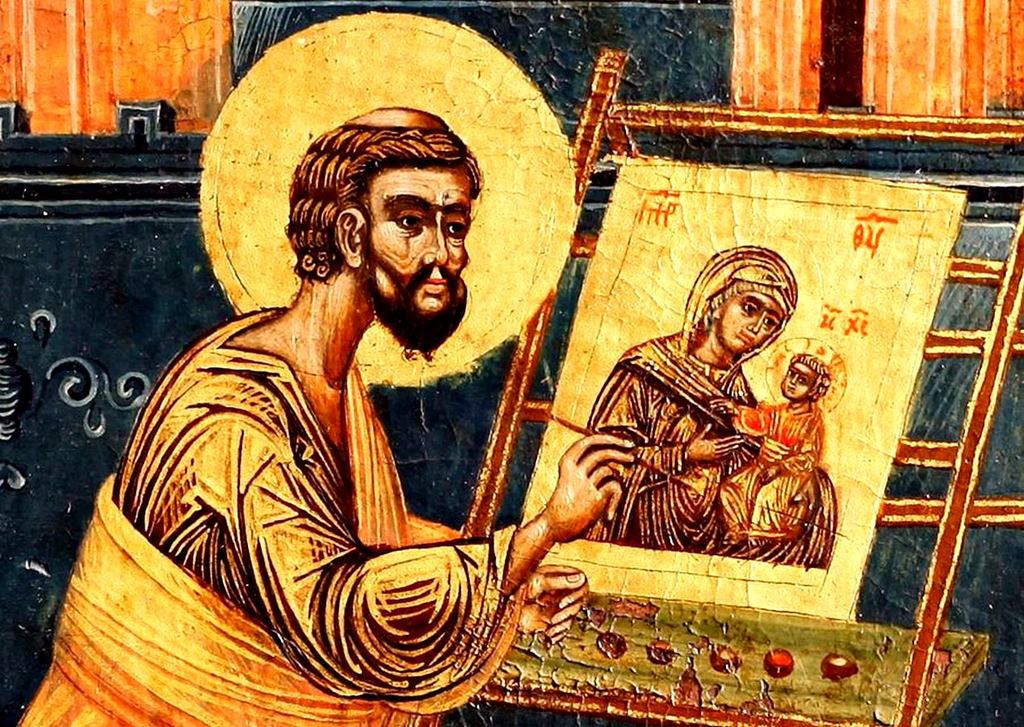
The Tradition of the Orthodox Church says that
Luke was a painter who created icons of Mary.
Historian Theodorus Lector mentions St Luke drawing the Virgin;
Saint Andrew of Crete wrote about St Luke depicting both Mary and Christ;
Saint Simeon the Metaphrast, historian and the author of many biographies of saints,
mentioned one icon of the Virgin Mary holding Christ.
He said that it was painted by St Luke and is “honored even to this day.”
(from the Convent of St. Elizabeth website: https://obitel-minsk.org/history)


Today, in God’s Lavish Mercy, we pray with St. Luke, the elegant author who has painted a tender picture of God on human hearts. That picture has the beautiful face of Jesus Christ, Incarnate Mercy for all people.

God is portrayed throughout the Old and New Testaments as a warrior or a stern judge, but Luke, through his parables, presents God as a loving, anxious father who forgives his erring son before the boy can ask to be forgiven and lavishes love on him.

Joseph Blenkinsopp: Luke’s Jesus

Today’s first reading gives us some insight into Luke’s character and personal committment to the spread of the Gospel:

Beloved:
Demas, enamored of the present world,
deserted me and went to Thessalonica,
Crescens to Galatia, and Titus to Dalmatia.
Luke is the only one with me.

2 Timothy 4:10

Apparently Luke, unlike Demas, was not “enamored of the present world”. Wow! What a packed description that is! Paul is obviously disappointed. It would appear that Demas, Crescens, and Titus decided to opt out of their contracts. Only Luke hung on with a rather gloomy-sounding Paul who is pining for his cloak and papyrus rolls.

I would imagine Paul was not an easy boss to work for. He was a firebrand – both when he fought against the Gospel and when he fought for it. No doubt he demanded the same intensity from those who directly assisted him. And the work itself was daunting. Luke recounts in the Acts of the Apostles the many trials that had to be met before any small success.

Some of the apostolic candidates just didn’t vibe with all of that. But Luke could work with Paul’s fire. And he could uncover the glorious story within the many challenging folds they navigated. What a blessing he must have been to the wildly dynamic and sometimes mercurial Paul!


Luke had incorporated into his own life Jesus’s ministerial call so clearly described in today’s Gospel:

Go on your way;
behold, I am sending you like lambs among wolves.
Carry no money bag, no sack, no sandals;
and greet no one along the way.
Into whatever house you enter,
first say, ‘Peace to this household.’
If a peaceful person lives there,
your peace will rest on him;
but if not, it will return to you.

Luke 10:3-6

Like Paul, Luke never met Jesus in person. Both were born shortly after Jesus’s time on earth. But the two of them knew Christ intimately and carried that inspirited knowledge to their own world and to the ages.

Our picture of Jesus would be a lot blurrier without Luke. Nearly half of Luke’s content is not found in the other three Gospels.

Many stories, sayings, and images found only in Luke have become an indispensable part of Christian consciousness. The Prodigal Son, the Good Samaritan, the Rich Man and Lazarus, the Pharisee and the Publican, the encounter with the Risen One on the Road to Emmaus, the Magnificat, the angel’s song Peace on Earth are only in Luke, but it is difficult to imagine the Christian tradition without them.

Eugene Boring: Introduction to the New Testament: History, Literature, Theology

Perhaps you have a favorite among the exclusive stories cited above. This feast of St. Luke may be a good day to remember why that story is important to you and to thank Luke for its gift.


Poetry: Luke – Malcolm Guite

His gospel is itself a living creature
A ground and glory round the throne of God,
Where earth and heaven breathe through human nature
And One upon the throne sees it is good.
Luke is the living pillar of our healing,
A lowly ox, the servant of the four,
We turn his page to find his face revealing
The wonder, and the welcome of the poor.
He breathes good news to all who bear a burden
Good news to all who turn and try again,
The meek rejoice and prodigals find pardon,
A lost thief reaches paradise through pain
The voiceless find their voice in every word
And, with Our Lady, magnify Our Lord.

Music: Luke’s Gospel contains four special canticles connected to the Birth of Jesus:

  • The Magnificat (Luke 1:46-56)
  • The Benedictus (Luke 1: 67-79)
  • The Gloria in Excelsis (Luke 2:13-14)
  • The Nunc Dimittis ( Luke 2:29-32)

The Obedience of Faith

Monday of the Twenty-eighth Week in Ordinary Time
October 16, 2023

Today’s Readings:

https://bible.usccb.org/bible/readings/101623.cfm


Today, in God’s Lavish Mercy, we begin about a month of readings from Paul’s letter to the Romans. We will also continue with Luke’s Gospel all the way up to Advent.

In my 2019 reflections on these passages, to help me understand Romans, I used a book by Scott W. Hahn, Father Michael Scanlan Chair of Biblical Theology at Steubenville University. I decided to return to that opening reflection as we meet Romans again today.

In his introduction, Hahn says this:

Hahn_Romans

Today’s reading offered me these elements to ponder and pray with:

  • Paul calls himself a “slave” of Jesus Christ
  • He invokes his call as an Apostle
  • He sets himself in the company of the prophets
  • He appeals to Jews who revere David
  • but proclaims Christ, through his Resurrection, as Messiah beyond human lineage
  • He proclaims his mission to the Gentiles
  • to bring about “the obedience of faith”

I’ll be honest with you. I’ve read or heard this passage maybe fifty times in my lifetime, and it has meant little or nothing to me. At best, it has sounded like a formal introduction such as those we hear from government “whereas” type decrees.

But I took Dr. Hahn’s advice, studying the passage, and reading it slowly and prayerfully. Here’s what I received:

  • Paul’s Apostolic call, to which he willingly enslaved his heart, was to preach the Good News of our redemption in Jesus Christ – to preach it to Jews, Romans, Gentiles, and all people.
  • It is an awesome and incredible message that can be received only through the gift of faith.
  • It is a message rooted in the scripture stories we love, and where we look to find a reflection of our own stories.
  • Learning from these realities will help us come to a faith which expresses itself in action and gives glory to God in our own time.

Luke gives us one such story today. Jesus reminds the crowd of two familiar passages – that of Jonah and the “Queen of the South” (the Queen of Sheba, 1 Kings 10). He indicates that the people in these stories believed without a sign.

Jesus tells the people gathered around him  to learn from this. The crowd demands a sign, but Jesus says the sign is right in front of you – it is only your open heart that is lacking.


In his introduction, Paul prays for such open hearts in the Romans:

Rm1_grace_peace

Grace to you and peace from God our Father
and the Lord Jesus Christ.

By that same grace, may we receive faith’s blessing as well.


Poetry: Love Constraining to Obedience – William Cowper (1731-1800)
Cowper’s poem captures the interior transformation that occurs when our obedience is motivated by love rather than simply by duty.

No strength of nature can suffice 
To serve the Lord aright:
And what she has she misapplies,
For want of clearer light.

How long beneath the Law I lay
In bondage and distress;
I toiled the precept to obey,
But toiled without success.

Then, to abstain from outward sin
Was more than I could do;
Now, if I feel its power within,
I feel I hate it too.

Then all my servile works were done
A righteousness to raise;
Now, freely chosen in the Son,
I freely choose His ways.

‘What shall I do,’ was then the word,
‘That I may worthier grow?’
‘What shall I render to the Lord?’
Is my inquiry now.

To see the law by Christ fulfilled
And hear His pardoning voice,
Changes a slave into a child,
And duty into choice.

Music: Grace and Peace – Fernando Ortega

Valley of Decision

Saturday of the Twenty-seventh Week in Ordinary Time
October 14, 2023

Today’s Readings:

https://bible.usccb.org/bible/readings/101423.cfm


Today, in God’s Lavish Mercy, Joel launches into a cautionary poem replete with metaphors. His images are so effective that, even 3000 years later, many will be very familiar to us from the liturgy and even from modern culture.


Some of my readers may be of an age to remember the wonderful film “The Valley of Decision” starring two of the all-time greats, Greer Garson and Gregory Peck. The film’s title is plucked right out of Joel.


Apply the sickle,
for the harvest is ripe;
Come and tread,
for the wine press is full;
The vats overflow,
for great is their malice.
Crowd upon crowd
in the valley of decision;
For near is the day of the LORD
in the valley of decision.
Sun and moon are darkened,
and the stars withhold their brightness.
The LORD roars from Zion,
and from Jerusalem raises his voice;
The heavens and the earth quake,
but the LORD is a refuge to his people,
a stronghold to the children of Israel.


By using metaphors, the poet-prophet accomplishes an extensive lesson that, delivered in prose, would have exhausted his beleaguered audience.

Metaphors have a way
of holding the most truth
in the least space.

Orson Scott Card

Like all prophets, Joel employs current events to point to a deeper understanding. Many of the metaphors he uses throughout his prophecy have been employed in the liturgy, particularly during Lent. Joel’s message is a universal call to repentance germane to every generation, but particularly to that liturgical season.

Yet even now,’ declares the Lord,
‘return to me with all your heart,
with fasting, with weeping, and with mourning;
and rend your hearts and not your garments.

Joel 2: 12-13

In our Gospel. the core of Joel’s message is given direct and fuller voice in Jesus’ statement:

Blessed are those
who hear the Word of God
and observe it.

Luke 11:28

In our own lives – our own “valleys of decision”, this is the foolproof way we prepare for the Day of the Lord – hearing and observing the Word of God.


Music: Valley of Decision – Christafari

(When I read about Christafari, I am reminded that we can never underestimate or judge the many ways that people come to Christ.)

Christafari was founded in 1989 by Pastor Mark Mohr. Raised in a Christian family, during his teens Mohr strayed from his spiritual upbringing and turned to drugs and alcohol, going as far as growing and even dealing marijuana. After running away from home, living on the streets, and hitting rock-bottom, he had an undeniable encounter with God that drastically transformed his world. At 17, Mark re-committed his life to Christ and took what he now calls his “Freedom Step” out of addiction.

Christafari is comprised of men and women from various continents, countries, and cultures who are true missionaries at heart and share a love for reggae music and passion for following Jesus to the ends of the earth.

Run come and fall
People take heed to His call
Valley of decision
(Valley of decision)
This is no game
People have to die in His name
Valley of decision
(Valley of decision)
Darkness, it looms all around us
I find it hard to see
But I don’t know, I don’t know, I don’t know, I don’t know, I don’t know
Whether I should stay or whether I should flee
People all around me seem, they seem to be so sad
I hear them cry, I hear them ball
I see them back against the wall
I wish I could wipe away their tears
There’s a Holy
A Holy hill
Holy mount Zion
Holy, Holy mount Zion
Just know that He’s the Lord, Your God, yeah
In this valley of decision
Valley of decision
Even though I run through enough hills and valleys
I fear no evil, ’cause God is with me
Even though I run through enough hills and valleys
Thy rod and staff, they will comfort me
Even though I run through enough hills and valleys
I fear no evil, ’cause God is with me
Even though I run through enough hills and valleys
Thy rod and staff, they will comfort me
Run come and fall
People take heed to His call
Valley of decision
(Valley of decision)
This is no game
People have to die in His name
Valley of decision
(Valley of decision)
There’s a Holy
A Holy hill
Holy mount Zion
Holy, Holy mount Zion
Just know that He’s the Lord, Your God, yeah
In this valley of decision
Valley of decision
Even though I run through enough hills and valleys
I fear no evil, ’cause God is with me
Even though I run through enough hills and valleys
Thy rod and staff, they will comfort me
Even though I run through enough hills and valleys
I fear no evil, ’cause God is with me
Even though I run through enough hills and valleys
Thy rod and staff, they will comfort me
Jah great and dreadful day will soon come
Jah will pour out His mighty, mighty, mighty Spirit to all mankind
Through Him all creation, all creation was made
Those who call upon His name
(Call on His name and You will be saved)
There’s a Holy
A Holy hill
Holy mount Zion
Holy, Holy mount Zion
Just know that He’s the Lord, Your God, yeah
In this valley of decision
Valley of decision
Run come and fall
People take heed to His call
Valley of decision
(Valley of decision)
This is no game
People have to die in His name
Valley of decision
(Valley of decision)
Even though I run through enough hills and valleys
I fear no evil, ’cause God is with me
Even though I run through enough hills and valleys
Thy rod and staff, they will comfort me
Even though I run through enough hills and valleys
I fear no evil, ’cause God is with me
Even though I run through enough hills and valleys
Thy rod and staff, they will comfort me
Even though I run through enough hills and valleys
I fear no evil, ’cause God is with me
Even though I run through enough hills and valleys
Thy rod and staff, they will comfort me

Prayer

Wednesday of the Twenty-seventh Week in Ordinary Time
October 11, 2023

Today’s Readings:

https://bible.usccb.org/bible/readings/101123.cfm


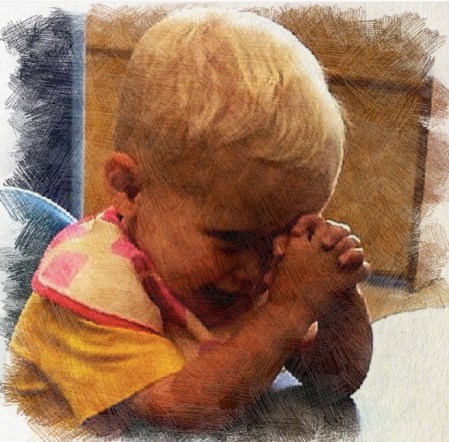
Ollie praying

Today, in God’s Lavish Mercy, Jesus teaches his disciples how to pray. His prayer is simple and direct, like talking to your best friend over a morning cup of coffee.

What about us? How do we pray?

Most of our first learned prayers are a lot like Jesus’s simple Our Father. We praise God, giving thanks, and asking for what we need.

Then we grow up and get sophisticated. We may begin to “say” or read prayers rather than use our own words. While such a practice can deepen our understanding of prayer, it places a layer between us and our conversation with God.

Sometimes others lead our prayer in the community of faith. This too can enrich us as we are inspired by a shared faith. But, sorry to say, at other times such prayer, indifferently led, can leave us empty and even frustrated. The whole process can be a little like trying to have a private conversation in an elevator full of noisy people.


Just as Jesus often went off in solitude to pray, this kind of prayer is our most intimate time with God – a time when God allows us to know God and ourselves in a deeper way. This sacred time alone with God may be spent in words, song, or the silence that speaks beyond words.

It is a time to be with the Beloved as we would be with our dearest, most faithful companion. We rest in the field of our experiences, letting them flow over God’s heart in tenderness. We listen with the ear of absolute trust to the secrets God tells us in the quiet.


When we become deeply accustomed to this type of intimate prayer, it transforms our self-understanding. Our every thought, word, and action is in the Presence of God. It is God Who hears our joys, sorrows, fears, and inspirations rising up in our hearts even before we hear them ourselves. It is God Who holds us at the center of our lives in communion with all Creation. It is God Who breathes grace into our human moments in acts of mercy, joy, charity, and justice.

Father, hallowed be your name,
your Kingdom come.
Give us each day our daily bread
and forgive us our sins
for we ourselves forgive everyone in debt to us,
and do not subject us to the final test.

Luke 11:2-4

Poetry: Praying – Mary Oliver

It doesn’t have to be
the blue iris, it could be
weeds in a vacant lot, or a few
small stones; just
pay attention, then patch

a few words together and don’t try
to make them elaborate, this isn’t
a contest but the doorway

into thanks, and a silence in which
another voice may speak.

Our Father – Leontyne Price

Sibling Dilemma

Tuesday of the Twenty-seventh Week in Ordinary Time
October 10, 2023

Today’s Readings:

https://bible.usccb.org/bible/readings/101023.cfm

Today, in God’s Lavish Mercy, we pray with Martha and Mary. These sisters are the personification of the Benedictine motto: Ora et labora: Pray and work – the two essentials that we all struggle to balance in our lives.

They, with their brother Lazarus, are dear friends of Jesus. The scriptures show us that Jesus felt comfortable at their home, and that they loved to have him stay with them.

As all of us do with our closest friends, Jesus understood the lights and shadows of their personalities – and they of his. He knew that Martha was the organizer, the one who planned and worried about the incidentals. Mary was deeply spiritual, but maybe had her head in the clouds a bit when it came to getting things done. 

Perhaps these personality differences caused some tensions between the sisters, as they might between us and our family members or close friends. Sometimes these little, unnoticed frictions can suddenly become chasms between us and those we love. 

How and why does it happen?

Jesus gives us the answer in this Gospel passage. He hears Martha’s simmering frustration. He calms her, as one might a child – “Martha, Martha…”. We can hear his gentle tone. Jesus tells her that worry and anxiety are signs that we are not spiritually free. He tells her that Mary has focused on the important thing.

This may sound repetitious, but just think about it a while:

It is so important to know what is important. 

It is so freeing to agree on what matters with those closest to us. Talking with each other in openness, respect, and unconditional love is the only path to that freedom.

Maybe Martha and Mary slipped off that path a bit in this situation. But with Jesus’ help, they righted their relationship. 

That’s the best way for us to do it too. Let Jesus show us what is most important through sharing our faith, and even our prayer, with those closest to us. Let him show us where our self-interests, need for control, fears and anxieties are blocking us from love and freedom.

It is the same way that we, like Mary, can strengthen our relationship with God. It is not sufficient for our prayer to consist of incidentals — pretty words and empty practices. 

We must sit open-hearted at the feet of Jesus and let him love us, let him change us. Even in the midst of our responsibilities and duties, we must balance “the better part”.


Poetry: Bethany Decisions – Irene Zimmerman, OSF 

As Jesus taught the gathered brothers
and Martha boiled and baked their dinner,
Mary eavesdropped in the anteroom
between the great hall and the kitchen.
Her dying mother’s warning words
clanged clearly in her memory—
“Obey your sister. She has learned
the ways and duties of a woman.”

She’d learned her sister’s lessons well
and knew a woman’s place was not
to sit and listen and be taught.
But when she heard the voice of Jesus
call to her above the din
of Martha’s boiling pots and pans,
she made her choice decisively—
took off her apron and traditions,
and walked in.


Music: a charming little song by Peg Angell which leaves me with same practical question I always have when reading this passage: who actually did get the dinner ready?