Mystery!

Feast of Saints Philip and James, Apostles
May 3, 2023

Today’s Readings:

https://bible.usccb.org/bible/readings/050323.cfm

Today, in God’s Lavish Mercy, our Gospel invites us to pray with the Apostle Philip on this his and James’ feast day.

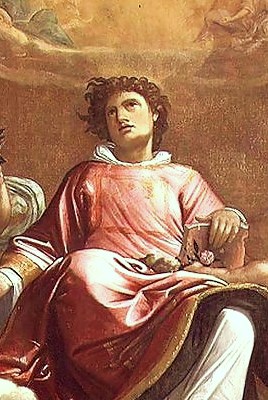
St. James and St. Philip by Peter Paul Rubens


Philip is mentioned several times in John’s Gospel

  • In John 6:6, Jesus engages Philip regarding the feeding of the 5,000.
  • In John 12:21, Philip appears speaks for the Greek community, informing Andrew that they want to be introduced to Jesus.
  • In today’s Gospel, Philip asks Jesus to be shown the Father. Jesus responds with a simple and perfect instruction on one of the most profound mysteries of our faith – the nature of the Trinity.

“Master, show us the Father, and that will be enough for us.”
Jesus said to him, “Have I been with you for so long a time
and you still do not know me, Philip?
Whoever has seen me has seen the Father.
How can you say, ‘Show us the Father’?
Do you not believe that I am in the Father and the Father is in me?
The words that I speak to you I do not speak on my own.
The Father who dwells in me is doing his works. 

John 14:9-10

Jesus seems surprised at Philip’s question. Maybe he didn’t think it was that hard to understand the Blessed Trinity! But writers ever since have found it pretty complex. Most notably, St. Augustine took over 15 years to write his masterpiece De Trinitate (On the Trinity). An excellent current English translation by Edmund Hill, OP contains fifteen books in over five hundred pages!


But Jesus makes it pretty simple for Philip. Here’s my interpretation:

Philip, You see me, you see the Creator.
We are perfectly One.
Perfect Love does that.
My words are the Creator’s Words.
My works are completing the Creator’s works Who dwells in me.
It’s not a problem, Philip. You don’t need an answer.
It’s a beautiful Mystery. Just believe and be with it.


The noted 20th century Christian existentialist Gabriel Marcel wrote about the difference between a mystery and a problem.

Marcel worried that a technical ethos was reshaping how we see the world and ourselves. He especially worried about a tendency to reduce mysteries to problems. A problem, for Marcel, is something external to us that can be determinatively understood and solved with a generalizable technique. A mystery, on the other hand, is something in which we are inextricably involved. It has roots deep within us, but it also reaches beyond us. While a problem can be definitively solved, a mystery can only be navigated in light of the concrete situation and the people involved.

Gabriel Marcel: Mystery in an Age of Problems – Steven Knepper

True faith requires that we trust the Mystery of God. Like Philip, we may want answers to the great challenges of life and religion. But these things are not like math problems or scientific equations which can reach human resolution.

Life and faith are more like poetry or music – both of which enter into us and change something deep inside of us. It is a change that cannot be put into words but is nevertheless real. It is mystery.


Knowing and loving our Triune God is the same kind of mystery. We are made of God and God dwells within us. Each of our life experiences offers a small revelation of this overarching Mystery which is far too infinite to ever be packaged in a “solution” such as Philip requests in our Gospel.


Sometimes we may hear ourselves trying to turn the mystery of God into a solvable problem. Do you ever think or voice questions like these:

  • Why does God allow good people to suffer?
  • Why didn’t God just create everybody to be good, to erase evil from the world?
  • Why is God letting THIS (whatever it is) happen to me!

At different times in our spiritual lives, we all suffer from the Big WHY. Some people never get over it, turning atheist or agnostic in their approach to life when they can’t reach an answer. Some, by the grace of God, abide in the questions and come to a place of undefinable peace in the Mystery of God.

Let’s pray to St. Philip today to be granted a measure of the grace he obviously received as he went on to carry the Gospel to Greece, Syria, and Phrygia.

And, although we have concentrated on Philip today, here’s a word about St. James who was obviously very special to Jesus. James, along with his brother John and Peter, formed an informal triumvirate among the Twelve Apostles. Jesus allowed them to be the only apostles present at three quintessential events:

  • Mark 5:37: the Raising of Jairus’ daughter
  • Matthew 17:1: the Transfiguration of Jesus
  • Matthew 26:37: the Agony in the Garden of Gethsemane

Poetry: If Only – Rainer Maria Rilke from The Book of Hours

If only there were stillness, full, complete.
If all the random and approximate
were muted, with neighbors’ laughter, for your sake,
and if the clamor that my senses make
did not confound the vigil I would keep —
Then in a thousandfold thought I could think
you out, even to your utmost brink,
and (while a smile endures) possess you, giving
you away, as though I were but giving thanks,
to all the living.

Music: Lux Beata Trinitas – the hymn, ascribed to St. Ambrose in the 4th century, is sung here by Harry Christophers and the Sixteen whose mission is “… a performing arts charity which exists to take beautiful and inspiring choral music, from the Renaissance to today, to as wide and diverse an audience as possible.” (English translation of hymn below)

O TRINITY of blessed Light,
O Unity of sovereign might,
as now the fiery sun departs,
shed Thou Thy beams within our hearts.
To Thee our morning song of praise,
to Thee our evening prayer we raise;
Thee may our glory evermore
in lowly reverence adore.
All laud to God the Father be;
all praise, Eternal Son, to Thee;
all glory, as is ever meet,
to God the Holy Paraclete.

The Noble Shepherd

Monday of the Fourth Week of Easter
May 1, 2023

Today’s Readings:

https://bible.usccb.org/bible/readings/050123.cfm

Today, in God’s Lavish Mercy, our Gospel invites us, once again, to pray in the company of the Good Shepherd. (The Greek phrase could better be translated as “The Noble Shepherd“)


Just a bit earlier in his sermon, Jesus delivered this blockbuster to the gathered crowd:

I came so that you might have life
and have it more abundantly.

John 10:10

I don’t know how those on the ancient hillside received this stunning announcement, but I know that I have heard and read it a thousand times with a dull and stupid heart.


We let ourselves get used to the scriptures. We hear the priest humdrumming the words while we entertain a tumble of distractions in our foggy heads. We pray the words in our quiet rooms while sleep nibbles away at their astounding meaning.

But here’s what our Gospel shouts to us this morning:

I am here to give you abundant life!
For heaven’s sake, let your heart and soul stand up,
open your arms, and embrace the gift I offer you.


Several deep lessons reside within today’s reading, but we might choose to focus on this:

I am the good shepherd,
and I know mine and mine know me,
just as the Father knows me and I know the Father;
and I will lay down my life for the sheep.

John 10: 11-12

Jesus is telling us
that he is our “good shepherd” for this reason:
because he knows and loves us with the same intensity
that he and the Father know and love each other.

In other words, Jesus loves us with a love that absorbs us into the heart of God. There, we are fed with that love and given an infinitely abundant life – a life that demands to be given and shared.


Jesus tells us that he will lay down his life for his sheep, because this is the nature of Divine Love — it is fully self-giving. The Creator gave everything for us in the gift of Jesus. Jesus gave everything for us in the Paschal Gift. We, recipients of these infinite gifts, are called to give everything for the sake of God’s love in the world.

Does this mean we all have to run out and try to be martyrs? Certainly not. It might be even harder to respond to this call with consistent dailyness than it would be to do so with martyrish abandon.


Our reading from Acts helps us understand what this divine love looks like in an ordinary life. It looks like openness to the Holy Spirit, willingness to change for the sake of others’ good, inclusion of all people in the loving community, actions that build unity and reverence for one another.


The Good Shepherd is a Giving Shepherd who teaches us that we have such an abundance of life in him that we are safe giving our small portion of life for others. We do not need to bury, fortify, protect, and squirrel away our life like misers and hoarders – because, in God, all that we give is continually replaced with even greater plentitude.

We do not have to be first, smartest, prettiest, richest, most powerful, always right or all the other perfectionisms we sometimes are deluded by.

What we have to be is kind, merciful, open, forgiving, honest, generous and humble. These are the true currencies of abundant life in Christ. With the amazing gift we have been given, we are called to allow God to “shepherd” through us in our own particular “sheepfold”.


In his transcendent love, Jesus laid his life down willingly for our sake, and that utter willingness allowed him to take it up again in glory. We might be invited to do a little “life-laying down” ourselves today. Can we find Christ’s invitation, promise, and power within that ordinariness?


The Good Shepherd by James Tissot


Poetry: On Generosity – Walter Brueggemann

On our own, we conclude:
there is not enough to go around
we are going to run short
of money
of love
of grades
of publications
of sex
of beer
of members
of years
of life
we should seize the day
seize our goods
seize our neighbours goods
because there is not enough to go around
and in the midst of our perceived deficit
you come
you come giving bread in the wilderness
you come giving children at the 11th hour
you come giving homes to exiles
you come giving futures to the shut down
you come giving easter joy to the dead
you come – fleshed in Jesus.
and we watch while
the blind receive their sight
the lame walk
the lepers are cleansed
the deaf hear
the dead are raised
the poor dance and sing
we watch
and we take food we did not grow and
life we did not invent and
future that is gift and gift and gift and
families and neighbours who sustain us
when we did not deserve it.
It dawns on us – late rather than soon-
that you “give food in due season
you open your hand
and satisfy the desire of every living thing.”
By your giving, break our cycles of imagined scarcity
override our presumed deficits
quiet our anxieties of lack
transform our perceptual field to see
the abundance………mercy upon mercy
blessing upon blessing.
Sink your generosity deep into our lives
that your muchness may expose our false lack
that endlessly receiving we may endlessly give
so that the world may be made Easter new,
without greedy lack, but only wonder,
without coercive need but only love,
without destructive greed but only praise
without aggression and invasiveness….
all things Easter new…..
all around us, toward us and
by us
all things Easter new.
Finish your creation, in wonder, love and praise. Amen.

Music: The Lonely Shepherd – written by James Last and played here by Louis Grosari

Completely occupied with good deeds …

Memorial of Saint Catherine of Siena, Virgin and Doctor of the Church
April 29, 2023

Today’s Readings

https://bible.usccb.org/bible/readings/042923.cfm

Today, in God’s Lavish Mercy, we prayerfully remember one of the great women of the Church, Catherine of Siena.

Catherine of Siena, TOSD (1347 – 1380) was a member of the Third Order of Saint Dominic. She was a mystic, activist, and author who had a great influence on Italian literature and on the Catholic Church. Canonized in 1461, she is also a Doctor of the Church.

Three genres of work by Catherine survive:
– Her major treatise is The Dialogue of Divine Providence. It is a dialogue between God and a soul who “rises up” to God.
– Catherine’s letters are considered one of the great works of early Tuscan literature.
– Twenty-six prayers of Catherine of Siena also survive, mostly composed in the last eighteen months of her life.

Wikipedia

The beauty of Catherine’s life and spirituality has blessed the world for nearly seven centuries. Still, it has never grown old because it was fully rooted in an eternal God.

Catherine’s sanctity was born of:
transcendent FAITH,
uncompromising TRUTH,
and overarching LOVE
for God
and God’s Creation.


Our first reading today introduces another, much earlier, woman pillar of the Church – Tabitha, sometimes called Dorcas. She was so important to the Christian community in Joppa that they sent for Peter upon her death. They needed his intervention in order to hold the community together in the face of this profound loss.

Now in Joppa there was a disciple named Tabitha
(which translated is Dorcas). 
She was completely occupied with good deeds and almsgiving. 
Now during those days she fell sick and died,
so after washing her, they laid her out in a room upstairs. 

Acts 9: 36-38

St. Cyprian, writing in the 3rd century, implies that Dorcas merited Peter’s miraculous intervention because of her Christian generosity, her being “completely occupied with good deeds and almsgiving“.

Dorcas, Raised from the Dead by Peter – Jacob Jordaens (c. 1655)


Though little is given to describe Tabitha’s position in the community, one might imagine that she was a woman of some means. Many widows achieved a certain status living on the accumulated wealth of their deceased husbands and the dividends of their recovered dowries. This generous women seems to have gathered around her a community of less fortunate neighbors who came to depend on her for their livelihood.

In Tabitha/Dorcas, we find a model of women’s discipleship repeated through the centuries and into our own times.

  • She is aware of the needs around her and of her own capacity to meet those needs.
  • Inspired by the Gospel, she builds a community to embrace both the needs and the strengths she recognizes.
  • She acts FOR others, especially those who are in need, in imitation of Christ.

In the 14th century, Catherine of Siena manifested a similar pattern of discipleship.

Catherine of Siena – from Eleanor Fortescue Brickdale’s
Golden Book of Famous Women (1919)


Catherine saw the whole Church as her community and recognized its need for reconciliation and unity. She confronted fracturing political allegiances and destructive ecclesiastical egos to advocate for the Roman Pope’s sovereignty over the global Church, thus influencing the entire flow of European history.

My sweet Lord, look with mercy upon your people
and especially upon the mystical body of your Church.
Greater glory is given to your name for pardoning a multitude of your creatures
than if I alone were pardoned for my great sins against your majesty.
It would be no consolation for me to enjoy your life
if your holy people stood in death.
For I see that sin darkens the life of your bride the Church
– my sin and the sins of others.

from A Dialogue on Divine Providence

Catherine, whose profound spirituality was laced with miracles and mysticism, nevertheless taught an attainable spiritual discipline in her writings – a practical spirituality demonstrated, as was Tabitha’s, in generous acts of love:

The love which the soul sees that God has for her,
she, in turn, extends to all other creatures. . .
she immediately feels compelled to love her neighbor as herself,
for she sees how supremely she herself is loved by God,
beholding herself in the wellspring of the sea of the Divine Essence.

Letter to Raymond of Capua, dated February 17, 1376

In our Gospel, Jesus has just finished telling the people:

“Amen, amen, I say to you,
unless you eat the flesh of the Son of Man
and drink his blood, you do not have life within you.”

They respond to this “hard saying” with hesitancy and “shock”. Jesus tells them that he knows that this level of faith is impossible to reach on one’s own and so…

“For this reason I have told you that no one can come to me
unless it is granted him by my Father.”

John 6: 64-65

Tabitha and Catherine of Siena, by the power of the Holy Spirit granted through our Creator, attained a beautiful faith expressed in generous works for their communities. As we pray with them today, let us ask God for the grace of such faith for ourselves and for our whole Church.


Poetry: Consumed in Grace (Catherine of Siena) – from Daniel Ladinsky’s “Love Poems from God”

I first saw God when I was a child, six years of age.
The cheeks of the sun were pale before Him,
and the earth acted as a shy
girl, like me.

Divine light entered my heart from His love
that did never fully wane,

though indeed, dear, I can understand
how a person’s faith
can at times flicker,

for what is the mind to do
with something that becomes the mind’s ruin:
a God that consumes us
in His grace.

I have seen what you want;
it is there, a Beloved of infinite
tenderness.


Music: The Mystical Ecstasy of Catherine of Siena – from the opera Santa Caterina da Siena by Marco Enrico Bossi

Taught By God …

Thursday of the Third Week of Easter
April 27, 2023

Today’s Readings:

https://bible.usccb.org/bible/readings/042723.cfm

Today, in God’s Lavish Mercy, we read the fascinating account of the conversion of the Ethiopian eunuch. The story, filled with heavenly manifestations, may seem “other-worldly” to us and, in a way, that’s just what it is.

There is a new world – a New Covenant – sprung from Christ through the power of his Resurrection. The Acts of the Apostles is the proclamation of that New World given to us in a series of stories and miracles generated through the Holy Spirit.

And the story of the Ethiopian eunuch is a powerful one, offering a spectrum of interpretations and applications to our own spiritual life. However, using today’s Gospel as a lynchpin, let’s explore one particular concept.


In the passage from John, Jesus tells the crowds:


“No one can come to me
unless the Father who sent me draw him,
and I will raise him on the last day.
It is written in the prophets:
They shall all be taught by God.
Everyone who listens to my Father
and learns from him comes to me.

John 6:44-45

In other words, in order to truly understand our reality, we must allow the Spirit of God to enter our hearts and minds — because there is more to what is than meets the eye!

We cannot truly interpret our world with only our own intellectual resources. Our knowledge and understanding must be fed by God so that we may see the deep Spirit living under our otherwise thin perception of life.


The Baptism of the Eunich – Rembrandt

In our passage from Acts, the Ethiopian is a person of faith, a worshipper who seeks God. But he has hit a wall. He realizes that he cannot fully understand God’s revelation without a Spirit-inspired teacher. And lucky him – the Spirit decides to plunk Philip down in the middle of the desert to be that very teacher!

The context of the story tells us that God wants us all to be fully incorporated into God’s own life —

  • no matter how far out we are in our spiritual “deserts”
  • no matter what physical elements define or limit us
  • no matter what walls we hit when trying to live a faithful life

In our Gospel, Jesus tells us that he is the new and perfect source of nourishment for our yearning spirits. It is the Spirit of Jesus that Philip has brought to the Ethiopian.

Amen, amen, I say to you,
whoever believes has eternal life. 
I am the bread of life. 
Your ancestors ate the manna in the desert, but they died;
this is the bread that comes down from heaven
so that one may eat it and not die. 
I am the living bread that came down from heaven;
whoever eats this bread will live forever;
and the bread that I will give
is my Flesh for the life of the world.”

John 6:47-51

Now I doubt that we’re going to find Philip waiting by our “chariot” out in the driveway tomorrow morning. So how are we to be “taught by God“. Here are some ways that I think can help:

  • faithful prayer informed by good spiritual reading
  • devoted scripture study and prayer
  • spiritual retreat and reflection
  • spiritual companionship with others sincerely seeking God

Poetry: Soliloquy of the Ethiopian Eunuch – Robert Phillips

The miracle began with a miracle.
I was sitting in my gold-trimmed chariot
(well, not exactly my chariot—like all
my accoutrements, it belongs to her—
Candace, Queen of all the Ethiopians.
But since she put me in charge of her treasure,
I have the opportunity to live high.
Beauty has its privileges, and I don't mean
Candace. I'm here to tell you: That girl
Wasn't around when they passed out looks).
There I was, biding my time in the chariot,
near Jerusalem where I'd gone to worship.
I'd just passed Gaza, a real cultural desert.
I was studying Isaiah the Prophet
when suddenly this white man was translated—
there's absolutely no other word for it—
he literally was translated from wherever
to right next to me. It was the damndest thing!
He just stood there, ahuffing and apuffing.
Then he says with the greatest impertinence.
"Do you understand that book you're reading?"
His meaning was undeniable: the fact
that I'm black must have implied I'm illiterate,
or ignorant at best, despite my purple
silk robe and heavily gilded chariot.
I said, "This Isaiah is a heavy dude.
Perhaps you can shed some light on this passage?"
He was led as a sheep to the slaughter;
and like a lamb dumb before her shearer,
so opened he not his mouth . … "So who's the he?"
I asked. "Is this Isaiah talking
about himself, or is he palavering about
somebody else?" And Whitey (his real name was
Philip; it means Lover of Horses—ha!)
Whitey explained to me the "he" was Jesus,
and began to preach about the humiliation
of Jesus, and how his judgment was taken
away before his life on earth was taken,
and how he said not one word to save himself.
And now, in order to be saved, a body
must be baptized in the holy name of God.
I took it all in. Then he clambered inside
the chariot, and we commenced riding north,
which was where he came from before translated.
Presently we came upon a teensy pond.
"Here's some H20. So what's to keep you from
baptizing me on the spot?" That set him off
preaching some more: "If you believe with all
your heart that Jesus Christ is the Son of God,
blah blah blah, I'll do it." Seems this Jesus cat
charged him and a bunch of other honkies
to preach all nations about this Jesus stuff.
I told him with my dusky skin I qualified as
"all nations." So I stopped the chariot,
and we both sashayed down to the water hole.
And hallelujah, he baptized me! In the name
of the Father, and the Son, and the Holy Ghost.
Like to drowned me. The waters of salvation
ran down my dreadlocks. My gloomy skin took on
a peaceful hue. My black soul became dove white.
Then that lover of horses disappeared—poof!
It was enough to make my head spin, popping
in and out of the desert like that. Later
I heard Philip was preaching in this city
and that, creating real photo opportunities.
When I got back to the palace, I camped it up
about being saved, being washed in the blood
of the Lamb, and how this black soul now was white
as snow. (Though I confess I've never seen snow.
It's just one of those things you take on faith.)
Queen Candace had a hissy fit, stomped her foot
because she hadn't been baptized and her eunuch
had. I told her she'd just have to wait until
Philip or one of that gang of ten others
came her way. But she never did. I don't think
they thought hateful ugly queens much worth saving .
Now don't think being a eunuch is easy.
It was done so I could better serve my God
and my queen. I continued to lust in my heart.
But now I'm saved, I sleep the sleep of the just.

Music: Immortal, Invisible, God Only Wise – Walter C. Smith

A Dynamic Faith

Wednesday of the Third Week of Easter
April 26, 2023

Today’s Readings:

https://bible.usccb.org/bible/readings/042623.cfm

Today, in God’s Lavish Mercy, our readings allow us to experience the dynamic nature of faith, as it was experienced in the early Church.And it wasn’t always pretty!

The Stoning of St. Stephen – Rembrandt

Acts tells us of a rising violence toward the Christians, especially those considered “Hellenistic Jews”. There was prejudice against them among the Pharisees even before these Jews converted to Christianity. They were “outsiders “:

The Hellenistic Jews are those who speak mainly Greek, and formerly lived outside of Judea and Galilee. But they had settled in Jerusalem — retired, as it were, to the homeland. Nevertheless, they still have affinities with lands of the Jewish dispersion from which they came. The Hebraic Jews are those who speak mainly Aramaic, and were born in Jerusalem or Judea.

Michael Morrison, PhD, professor of Biblical Studies at Grace Communion Seminary


Stephen, the first Christian martyr, was a Hellenist, as was Philip mentioned today as the first Christian missionary. He is a different Philip from the Apostle who remained in Jerusalem according to the passage.


As I picture the forces at work in the early Church, I am reminded of the ocean, ever-changing in its flow from peace to storm, yet ever-constant in its tides.

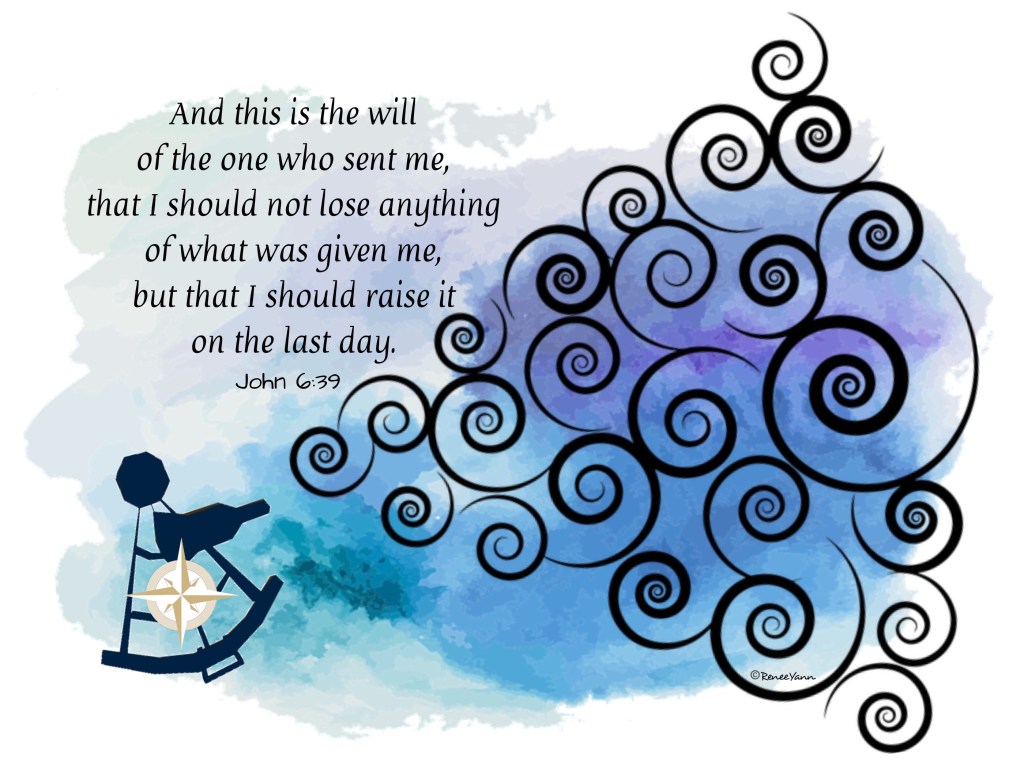
Faith is the anchor holding us steady in the waves, the sextant pointing us toward Christ’s Promise. As our Gospel says:

And this is the will of the one who sent me,
that I should not lose anything of what he gave me,
but that I should raise it on the last day.
For this is the will of my Father,
that everyone who sees the Son and believes in him
may have eternal life,
and I shall raise him on the last day.

John 6: 39-40

Stephen had this vital and tenacious faith, and died for it. Philip had it and shared it. The Apostles had it and held it steady for the rest of us.

How is the vital and dynamic faith living in me? How deeply do I believe and live the Promise? Let’s ask God today to strengthen our faith and to keep our focus on the Promise of eternal life.


Poetry: In Whom We Live and Move and Have Our Being – Denise Levertov 

Birds afloat in air's current,
sacred breath?  No, not breath of God,
it seems, but God
the air enveloping the whole
globe of being.
It's we who breathe, in, out, in, in the sacred,
leaves astir, our wings
rising, ruffled -- but only the saints
take flight.  We cower
in cliff-crevice or edge out gingerly
on branches close to the nest.  The wind
marks the passage of holy ones riding
that ocean of air.  Slowly their wake
reaches us, rocks us.
But storms or still,
numb or poised in attention,
we inhale, exhale, inhale,
encompassed, encompassed.

Music: The Promise – Marc Enfroy

Living the Gospel

Feast of Saint Mark, evangelist
April 25, 2023

Today’s Readings:

https://bible.usccb.org/bible/readings/042523.cfm

Today, in God’s Lavish Mercy, on the feast of St. Mark, our readings instruct and nourish us on how to live the Gospel.

As devout lovers of the Gospel, we have heard this phrase a thousand times: “the Gospel according to Mark…”.

But who was this “Mark”, and how was he motivated to become one of the four Evangelists who have given the Gospel to the ages?

According to Eusebius of Caesarea (260-339 A.D.), Herod Agrippa I, in his first year of reign over the whole of Judea (AD 41), killed James, son of Zebedee and arrested Peter, planning to kill him after the Passover. Peter was saved miraculously by angels, and escaped out of the realm of Herod (Acts 12:1–19). Peter went to Antioch, then through Asia Minor (visiting the churches in Pontus, Galatia, Cappadocia, Asia, and Bithynia, as mentioned in 1 Peter 1:1), and arrived in Rome in the second year of Emperor Claudius (AD 42). Somewhere on the way, Peter encountered Mark and took him as travel companion and interpreter. Mark the Evangelist wrote down the sermons of Peter, thus composing the Gospel according to Mark, before he left for Alexandria in the third year of Claudius (AD 43).

Wikipedia on the Historia Ecclesiastica of Eusebius

Peter dictating the Gospel to Mark
This finely-carved ivory from the 7th century
is in the Victoria and Albert Museum in London.

Our first reading from Peter’s letters gives us an intimate insight into the conversations between Peter and Mark as they traveled those roads in Asia Minor. These were real people reflecting on their call to preach the Gospel to all the world:

Clothe yourselves with humility
in your dealings with one another, for:

God opposes the proud
but bestows favor on the humble.


So humble yourselves under the mighty hand of God,
that he may exalt you in due time.
Cast all your worries upon him because he cares for you.

1 Peter :5-7

While Peter offers these words for the sake of the churches in Asia Minor, picture him sitting only with Mark as Mark diligently scribes Peter’s words. Mark is a young man, maybe still a teenager. His heart is fired with the story of Jesus to the point that he has left his home to travel and learn from this one man who was closest to Jesus himself.

Peter’s stories burn into Mark’s soul and inspire him. Eventually, his own preaching and discipleship will carry the Gospel to the church of Alexandria years after Peter has died, and to us through the written word he inspired.

Our devout and consistent prayer and study of the scriptures allows us to be transformed by that same Sacred Fire – the power of the Holy Spirit given at Pentecost. We, too, can sit beside Peter and Mark and learn from their ardent spirituality.


Dr. Mary Healy is professor of Scripture at Sacred Heart Major Seminary in Detroit. She is a general editor of the Catholic Commentary on Sacred Scripture and author of two of its volumes, The Gospel of Mark and Hebrews. She says this:

What we have not fully taken into account is the first evangelisation – the explosive growth of Christianity in the ancient world, when a handful of fishermen, tax collectors, and ordinary people turned the world upside down for Christ, even while undergoing waves of state-sanctioned persecution.

The beginnings of that story are told in the New Testament, and it’s there that we find the secret to becoming the missionary disciples we are called to be.


Jesus appeared to the Eleven and said to them:
“Go into the whole world
and proclaim the Gospel to every creature.
Whoever believes and is baptized will be saved;
whoever does not believe will be condemned.
These signs will accompany those who believe:
in my name they will drive out demons,
they will speak new languages.
They will pick up serpents with their hands,
and if they drink any deadly thing, it will not harm them.
They will lay hands on the sick, and they will recover.”

Mark 16:15-18

I think that most of us, when we read today’s Gospel, do not see ourselves standing with the Eleven, receiving the ability to “cast out demons, …speak new languages,… handle serpents, … and drink poison…”.

But think about it:

  • How are we called to respond with Gospel grace when we encounter the demon of injustice in our world?
  • How are we called to speak new languages of peace, kindness, and respect for human life in a culture that has normalized violence and deception?
  • How are we called to handle and confront meanness, prejudice, gossip, and hatred when these slither like snakes into our conversations and opinions?
  • How do we help ourselves and others recognize and avoid the poisons of a dishonest and manipulative culture when they threaten our familial, economic, political, educational, religious, and medicinal constructs?

Indeed, we are called to love, learn and live the Gospel in our own particular time and circumstances — just like Mark and Peter were. Let’s pray with them today and ask them to strengthen us in a courageous response to that glorious call.


Poetry: Mark – a sonnet by Malcolm Guite

A wingèd lion, swift, immediate
Mark is the gospel of the sudden shift
From first to last, from grand to intimate,
From strength  to weakness, and from debt to gift,
From a wide deserts haunted emptiness
To a close city’s fervid atmosphere,
From a voice crying in the wilderness
To angels in an empty sepulcher.
And Christ makes the most sudden shift of all;
From swift action as a strong Messiah
Casting the very demons back to hell
To slow pain, and death as a pariah.
We see our Saviour’s life and death unmade
And flee his tomb dumbfounded and afraid.

Music: My God, I Love Thee from St. Mark Passion by Charles Wood (lyrics below)

My God, I love Thee: not because
I hope for heaven thereby,
Nor yet because who love Thee not
Are lost eternally.
Thou, O my Jesus, Thou didst me
Upon the Cross embrace;
For me didst bear the nails, and spear,
And manifold disgrace,

And griefs and torments numberless,
And sweat of agony;
Yea, death itself; and all for me
Who wast Thine enemy.
Then why, most loving Jesus Christ,
Should I not love Thee well?
Not for the sake of winning heaven,
Or of escaping hell;
Not from the hope of gaining aught, 
Not seeking a reward;
But as Thyself has lovèd me,
O ever­loving Lord?
So do I love Thee, and will love,
Who such a love hast showed Only because
Thou art my King,
Because Thou art my God

… that you believe…

Monday of the Third Week of Easter
April 24, 2023

Today’s Readings:

https://bible.usccb.org/bible/readings/042423.cfm

Today, in God’s Lavish Mercy, our readings remind us that being a Christian is simple, but not easy.

Stephen, presented to us in our reading from Acts, must have been a beautiful, simple person — almost angelic according to Acts’ description:

Stephen, filled with grace and power,
was working great wonders and signs among the people.

Acts 6:8

All those who sat in the Sanhedrin looked intently at him
and saw that his face was like the face of an angel.

Acts 6:15

St. Stephen – Giacomo Cavedone – c. 1601


Despite his goodness, Stephen became an object of hate and persecution by many:

Certain members of the so-called Synagogue of Freedmen,
Cyreneans, and Alexandrians,
and people from Cilicia and Asia,
came forward and debated with Stephen,
but they could not withstand the wisdom and the Spirit with which he spoke.
Then they instigated some men to say,
“We have heard him speaking blasphemous words
against Moses and God.”

Acts 6:9-11

This is such a revealing passage! Stephen’s persecutors cannot challenge his preaching themselves, so they create a web of poisonous lies and entangle some other men in its venom. They instigate these men to spread false allegations against Stephen which will eventually lead to his martyrdom.


There is a vital lesson here for us. Truth matters. Lies matter. They are the engines that drive not only our relationships and actions, but our very culture. And a hard look at our modern culture suggests that we are becoming a culture of lies.

I don’t need to give examples here. We know just from glancing at the newspaper, or perhaps – unfortunately – from reflecting on our own experiences.

We know the people who pretend they are what they are not.

We know who pretends that they are not what they actually are.


Jesus is a Truth Teller. In our Gospel, he gently confronts a bunch of people who are “pretending” their faith. Jesus tells them they’re not so much interested in the Truth he preaches as in the food he provided just yesterday. After all, everybody loves a good picnic!

Jesus answered them and said,
“Amen, amen, I say to you, you are looking for me
not because you saw signs
but because you ate the loaves and were filled.
Do not work for food that perishes
but for the food that endures for eternal life,
which the Son of Man will give you. 
For on him the Father, God, has set his seal.” 

John 6: 26-27

These bread seekers in our Gospel hear Jesus’s challenge so they ask him

“What can we do to accomplish the works of God?”
Jesus answered and said to them,

“This is the work of God,
that you believe in the one he sent.”

Just believe. Doing so will lead us to Truth and to a holy simplicity like that which radiated from Stephen. It’s that simple …. and that hard.


Poetry: A Christmas Hymn – by Richard Wilbur

Although the following poem is out of season, and does not mention Stephen, its refrain references his method of martyrdom: “every stone shall cry”. The poem is also a succinct and lyrical summary of the life of Christ and its meaning for us — a good thing to consider during this Eastertide.

A stable lamp is lighted
whose glow shall wake the sky;
the stars shall bend their voices,
and every stone shall cry.
And every stone shall cry,
and straw like gold shall shine;
a barn shall harbour heaven,
a stall become a shrine.
This child through David’s city
shall ride in triumph by;
the palm shall strew its branches,
and every stone shall cry.
And every stone shall cry,
though heavy, dull and dumb,
and lie within the roadway
to pave his kingdom come.
Yet he shall be forsaken,
and yielded up to die;
the sky shall groan and darken,
and every stone shall cry.
And every stone shall cry
for gifts of love abused;
God’s blood upon the spearhead,
God’s blood again refused.
But now, as at the ending,
the low is lifted high;
the stars shall bend their voices,
and every stone shall cry.
And every stone shall cry
in praises of the child
by whose descent among us
the worlds are reconciled.

Music: Every Stone Shall Cry – Steve Bell musically interprets Wilbur’s poem.

Who? Me?

Third Sunday of Easter
April 23, 2023

Today’s Readings:

https://bible.usccb.org/bible/readings/042323.cfm

Today, in God’s Lavish Mercy, our readings invite us to consider any unrecognized blindness in our lives.

In the passage from Acts, Peter confronts the Israelites with an appalling truth to which they had been blind:

Jesus the Nazarene was a man commended to you by God
with mighty deeds, wonders, and signs,
which God worked through him in your midst, as you yourselves know.
This man, delivered up by the set plan and foreknowledge of God,
you killed, using lawless men to crucify him.

Acts 2:22-23

Peter Preaching in Jerusalem – Charles Poërson -c. 1642

Peter left his audience no outs, no excuses. He put the harsh fact before them and asked them to acknowledge it so that they might move forward in faith.


In our second reading, Peter counsels the early converts to recognize that they were rescued from a spiritually fatal blindness:

… conduct yourselves with reverence during the time of your sojourning,
realizing that you were ransomed from your futile conduct ..

1 Peter 1:17-18

Pilgrims on the Road to Emmaus – James Tissot

Luke’s Gospel gives us the warmly accessible Emmaus story. We have walked beside these beloved, crest-fallen disciples for years, haven’t we? But each year might reveal something different and deeper about the “blindness” that prevented them from recognizing Jesus who walked right beside them.

These progressive revelations can challenge us about how readily we recognize God’s Presence in our lives.

  • Were these otherwise faithful disciples just disappointed that their faith had not been rewarded with the results they expected?
  • Were they angry that they had wasted time trusting an apparent “failure”?
  • Were they only shallow believers anyway who had not really invested in Jesus?
  • Were they riddled with false expectations about the Messiah?
  • Were they so confined by old religious habits that they just couldn’t imagine an “Easter Jesus”?
  • Or were they just tired, hungry and caught on a dark road, thinking they could find an answer all by themselves?

Maybe we’ve been in a spot like theirs sometime in our lives. 


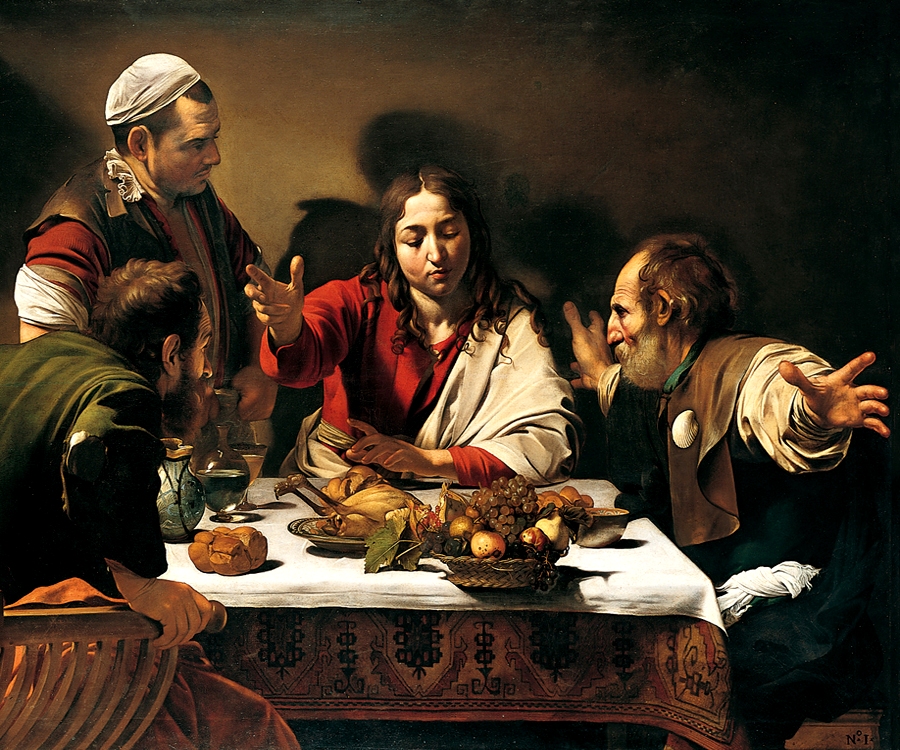
Dinner at Emmaus – Caravaggio


Let’s be with those disciples today and find ourselves in their story. Let’s attend to the “bread” of our dailyness as Jesus breaks it, and let our eyes be opened:

… while he was with them at table,
he took bread, said the blessing,
broke it, and gave it to them.
With that their eyes were opened and they recognized him…

Luke 24:30-31

Poetry: Witness – Denise Levertov

Sometimes the mountain
is hidden from me in veils
of cloud, sometimes
I am hidden from the mountain
in veils of inattention, apathy, fatigue,
when I forget or refuse to go
down to the shore or a few yards
up the road, on a clear day,
to reconfirm
that witnessing presence.


Music: Open My Eyes, Lord – Jesse Manibussan

Water and Pork Chops

Saturday of the Second Week of Easter
April 22, 2023

Today’s Readings:

https://bible.usccb.org/bible/readings/042223.cfm

Today, in God’s Lavish Mercy, little “disruptions” pop up in the center of both our readings.

In Acts, some of the Greek Christians think they are getting the short end of the stick when it comes to food distribution.

Believe me, I can picture the situation using personal experience. When I was an 18 year old postulant, I was a tall, skinny athlete — and I ate a lot of food. I wasn’t used to living in community, and I hadn’t noticed how my voracious appetite might be affecting those around me at the table.

In those “olden days”, the fifty-two of us freshly minted mini-nuns sat “in rank”, i.e according to age. The food was passed down the table from oldest to youngest. When I came to supper one night, the sister below me in rank had moved up a seat to be before me. I thought she just got mixed up about where her chair was so I asked her about it.

She told me she moved up in order to get a pork chop before I took them all!


Well, that’s what the Hellenists are doing in today’s reading which illustrates that living in community is a practical exercise as well as a spiritual one. That practicality calls upon us to make prudent arrangements for the community such as the disciples did in appointing more presbyters led by Stephen.

For us in our various communities today, the reading reminds us to think about the “pork chops” – who needs what and are they getting what they need. This principle holds for both spiritual and material needs and goods. Like the new presbyters, we each have a part to play in achieving that equity within our communities – including families, neighborhoods, churches, workplaces, and the world we share with all Creation.


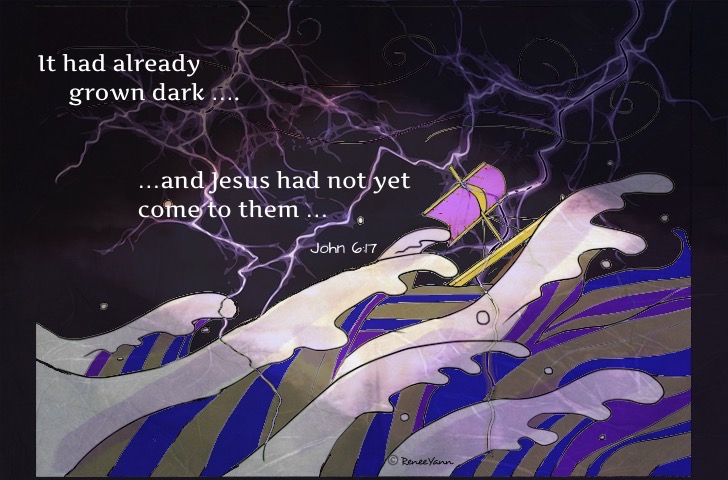
While our Gospel event is narrated in both Matthew and Mark, John gives us his own colorful version of the story of Jesus walking on the water. John highlights the conditions of the sea and atmosphere: darkness, the gusty wind, a turbulent ocean, and the absence of Jesus from the boat:

When it was evening, the disciples of Jesus went down to the sea,
embarked in a boat, and went across the sea to Capernaum.
It had already grown dark, and Jesus had not yet come to them.
The sea was stirred up because a strong wind was blowing.

John 6:16-18

So John makes it clear that it was the customary “dark and scary night“. But the disciples, tossed in the tumult, never express fear until they see Jesus walking across the water toward them. It seems they are less afraid of nature’s power than they are of the power of God!

Jesus sees their fear and tells them not to be afraid. In a phrase reminiscent of God’s self-revelation to Moses ( I am Who am), Jesus simply says, “It is I” — I am God. I am with you. Do not be afraid.


The disciples are still a little nervous and seem to prefer a less omnipotent Jesus . They ask him to get into the boat (in other words, “Be normal – not a Water-Walker”). But Jesus ignores the invitation and simply transports the boat to shore. One might picture the Twelve, tossed up on the shore, mouths agape and beginning to realize that their whole world was being turned upside-down in Christ!


Maybe we’re a little bit like the disciples sometimes. Sometimes we like God in small doses – not in a brilliant revelation or an irresistible call. Jesus snoozing beside us in the boat is comfortable. A radiant God coming to us in our life’s storms is a little harder to adjust to.

Our readings today remind us that God is present in every aspect of our lives – the daily practicalities and the topsy-turvy revelations. God may sit beside us in the boat, or might drag us stunned into another graced shore. But we should not be afraid in any case. Just prayerfully listen for the assurance, “It is I!”


Poetry: Walking on Water – Mark Jarmon

       Always the same message out of Matthew.
The water Jesus walks on is life’s turbulence.
        He calms our trouble and lifts us up again.

To walk on water? That’s what’s puzzling—
        that feat of antimatter, defeat of physics,
those beautiful unshod feet of cosmic truth

        for whom the whole performance is child’s play.
And unless one becomes as a little child
        the kingdom’s inaccessible by any route.

That water, then, its broken surface tension,
        collision of fracturing waves, apparent chaos,
its fractals turning infinite and weaving

        the netted skin between worlds, that web
of light and gravity which underpins our faith,
        water, a substance, stormy or pacific,

we know a myriad ways to get across it.
        But simply walking on it? Literally?
How far do you think you’d go before you fell

        through that convergence between time and space?
The water Jesus walked on wasn’t water
        only. It was the storm that made it rock.

Music: Walk on Water – Elevation Rhythm

A Good Heart, an “Easter-ed Heart”

Thursday of the Second Week of Easter
April 20, 2023

Today’s Readings:

https://bible.usccb.org/bible/readings/042023.cfm

Today, in God’s Lavish Mercy, the post-Resurrection Apostles continue their unstoppable testimony to Jesus Christ. Their persistence “infuriates” the Sanhedrin who fear the blood of Christ being called down upon them!

“We gave you strict orders did we not,
to stop teaching in that name.
Yet you have filled Jerusalem with your teaching
and want to bring this man’s blood upon us.”
But Peter and the Apostles said in reply,
“We must obey God rather than men. 
The God of our ancestors raised Jesus,
though you had him killed by hanging him on a tree.
God exalted him at his right hand as leader and savior
to grant Israel repentance and forgiveness of sins.
We are witnesses of these things,
as is the Holy Spirit whom God has given to those who obey him.”

Acts 5: 28-33

There is an interesting play in the words and concepts of this reading from Acts.

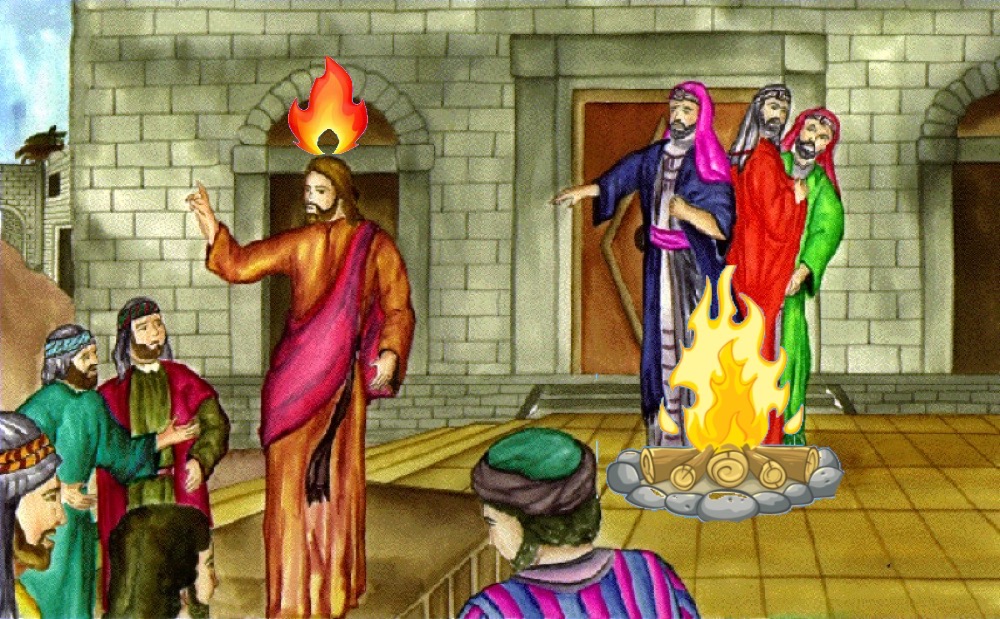
  • While the Sanhedrin are infuriated, or filled with the fire of denial and sin, the Apostles are inflamed with the unquenchable Fire of the Holy Spirit.
  • While the Sanhedrin fear the blood of Christ called down upon them, the disciples hearts are transformed by its power.

The contrast in their responses to God’s Word is stunning.


In our Gospel, John captures this contrast in a nutshell:

The one who comes from above is above all.
The one who is of the earth is earthly
and speaks of earthly things.

John 3:31

In other words, those transformed in the power of the Resurrection see the world with God’s eyes — “from above”. Those unconverted by that Power still see the world in godlessness.


Our Gospel calls us to be like the disciples not like the Sanhedrin.  It calls us to open our hearts:

  • to see the Truth Who is Jesus Christ
  • to believe that the Truth of his Resurrection lives in us
  • to become that Truth through the witness of our lives.

The Gospel calls us to live a whole-hearted faith which allows the Holy Spirit to be expressed in every aspect of our lives. Jesus does not ration the gift of the Spirit, nor should we:

Whoever does accept Christ’s testimony certifies that God is trustworthy.
For the one whom God sent speaks the words of God.
He does not ration his gift of the Spirit.

John 3:33-34

How do we live such a life of Christian witness? Do we have to shout the witness out loud with every action of our lives?  I don’t think so.

Brother David Steindl-Rast describes believers like this:

People who have faith in life are like swimmers who entrust themselves to a rushing river. They neither abandon themselves to its current nor try to resist it. Rather, they adjust their every movement to the watercourse, use it with purpose and skill, and enjoy the adventure.


And the great St. Teresa of Avila blesses believers with this prayer:

May today there be peace within.
May you trust God that you are exactly where you are meant to be.
May you not forget the infinite possibilities that are born of faith.
May you use those gifts that you have received,
and pass on the love that has been given to you.
May you be content knowing you are a child of God.
Let this presence settle into your bones,
and allow your soul the freedom to sing, dance, praise and love.
It is there for each and every one of us.


Poetry: Little Summer Poem Touching The Subject Of Faith by Mary Oliver

Every summer
I listen and look 
under the sun’s brass and even
into the moonlight, but I can’t hear

anything, I can’t see anything — 
not the pale roots digging down, nor the green 
stalks muscling up,
nor the leaves
deepening their damp pleats,

nor the tassels making,
nor the shucks, nor the cobs.
And still,
every day,

the leafy fields
grow taller and thicker — 
green gowns lofting up in the night,
showered with silk. 

And so, every summer,
I fail as a witness, seeing nothing — 
I am deaf too
to the tick of the leaves, 

the tapping of downwardness from the banyan feet — 
all of it
happening
beyond any seeable proof, or hearable hum. 

And, therefore, let the immeasurable come.
Let the unknowable touch the buckle of my spine.
Let the wind turn in the trees,
and the mystery hidden in the dirt

swing through the air.
How could I look at anything in this world
and tremble, and grip my hands over my heart?
What should I fear? 

One morning
in the leafy green ocean
the honeycomb of the corn’s beautiful body
is sure to be there.


Music: A Good Heart – Marc Enfroy