Holy Week: The Sacred Invitation

April 10, 2022
Palm Sunday

Today, in God’s Lavish Mercy, we begin a familiar journey.

palm sunday

In a warring, dystopian world, the rites of Holy Week offer us a reassuring pattern for our prayer. As we begin these rituals, we already know where we will joyfully finish. It is a feeling so opposite from our current global concerns which leave us questioning how peace and joy can be restored to the human family.


Through the solemnities of Holy Week, we are reminded that there is nothing we experience not already patterned in the Paschal Mystery. There is nothing we suffer or hope for not already etched on the heart of Jesus Christ.

These liturgies are an invitation to enter into that Sacred Heart, to place our experiences beside those of Jesus. No matter where we find ourselves on the journey, Jesus is with us:

  • In the confusion of Palm Sunday, tossed between loyalty and betrayal 
  • In the suggestive silence of Holy Monday and Tuesday, when plotters whisper and friends weaken
  • In the discomfort of Spy Wednesday, when we realize suffering is inevitable 
  • In the profound communion of Holy Thursday
  • In the loneliness of a decisive Garden and the angst of a resisted outcome
  • In the inexorable solitude of dying and death
  • In the other-worldly contemplation of a silent Saturday 
  • In the sunrise of a promise, longed for and believed in

These are profound sacred mysteries which invite us to sink into their depths and be renewed. Let’s be intentional about the time and practices we will give to this invitation.

We are invited into the Life and Passion of Jesus Who, in turn, wants to be with us in our experience of this journey. Each day, let us listen – let us become “obedient” (which means “listening”) – for the very personal whisper of grace in our souls. And even though we may pray alone, let us pray for the whole world suffering and rising with our beloved Savior.

phil cantic

I think today’s reading from Philippians is the most beautiful and pregnant passage in all of scripture. May it guide our prayer during this Holy Week when we all so hunger for God’s presence and healing.


Music: Philippians Hymn – John Michael Talbot
(Lyrics below)

And if there be therefore any consolation
And if there be therefore any comfort in his love
And if there be therefore any fellowship in spirit
If any tender mercies and compassion

We will fulfill His joy
And we will be like-minded
We will fulfill His joy
We can dwell in one accord
And nothing will be done
Through striving or vainglory
We will esteem all others better than ourselves

This is the mind of Jesus
This is the mind of Our Lord
And if we follow Him
Then we must be like-minded
In all humility
We will offer up our love

Though in the form of God
He required no reputation
Though in the form of God
He required nothing but to serve
And in the form of God
He required only to be human
And worthy to receive
Required only to give

This is the mind of Jesus
This is the mind of Our Lord
And if we follow Him
Then we must be like-minded
In all humility
We will offer up our love
In all humility
We will offer up our love
Lent: Closer to the Cross

April 9, 2022
Saturday of the Fifth Week of Lent

Today, in God’s Lavish Mercy, worlds are splitting apart, but the Word of God comes to heal them.

In our first reading, we share in the experience of the prophet Ezekiel.

Ezekiel and his wife lived during the Babylonian Captivity on banks of the Chenab River which is in modern day Iraq. He lived during the siege of Jerusalem in 589 BC. In Ezekiel’s day the northern kingdom had been conquered and destroyed 150 years earlier.

In other words, Ezekiel, like his contemporary Jeremiah, had his heart torn apart along with the homeland they cherished as God’s promise to them. 

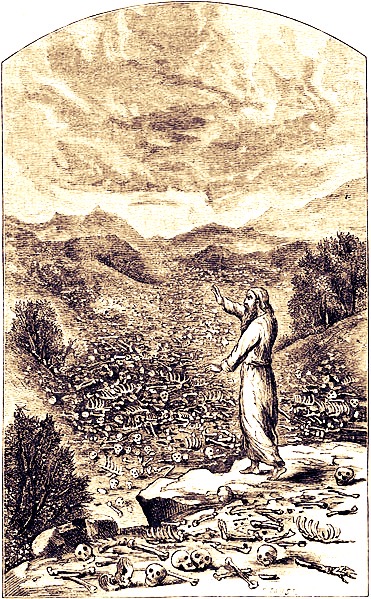
dry bones
The Valley of the Dry Bones – artist unknown

In today’s reading, which comes immediately after his vision of the Dry Bones, Ezekiel prophesies a message of hope and restoration to a fragmented and devastated nation.


In our Gospel, Jesus is the new Ezekiel. He stands in the midst of the bigger “nation” of all God’s Creation which has been fragmented by the failure to love. Like Ezekiel, Jesus offers a message of hope and restoration to sinners.

In this Gospel, Jesus himself is the “Temple” about to destroyed. The prophecy of its destruction is unwittingly delivered by the high priest Caiaphas:

Caiaphas,
who was high priest that year, 
said to the Pharisees and Sanhedrin,
“You know nothing,
nor do you consider that it is better for you
that one man should die instead of the people,
so that the whole nation may not perish.”
He did not say this on his own,
but since he was high priest for that year,
he prophesied that Jesus was going to die for the nation,
and not only for the nation,
but also to gather into one the dispersed children of God.

John 11: 49-52

Within Christ’s new law of love, these “children of God” go far beyond the Jewish nation. They are you and me, and every other creature with whom we share this time and universe. The fragmentations which separate and alienate us are dissolved in the Passion, Death and Resurrection of Jesus Christ.


holy week

Holy Week will begin tomorrow when all believers will intensify their desire to join Christ in his final journey to Resurrection, to understand our own lives anew in the power of Paschal Grace.

Let’s pray for one another, dear friends, for the grace we need to be deepened in the life of Jesus, and for that deepening to bless and heal our suffering world.


Poetry: The New Ezekiel – Emma Lazarus

What, can these dead bones live, whose sap is dried 
        By twenty scorching centuries of wrong? 
    Is this the House of Israel, whose pride 
        Is as a tale that’s told, an ancient song? 
    Are these ignoble relics all that live 
        Of psalmist, priest, and prophet? Can the breath 
    Of very heaven bid these bones revive, 
        Open the graves and clothe the ribs of death? 

    Yea, Prophesy, the Lord hath said. Again 
      Say to the wind, Come forth and breathe afresh, 
  Even that they may live upon these slain, 
      And bone to bone shall leap, and flesh to flesh. 
  The Spirit is not dead, proclaim the word, 
      Where lay dead bones, a host of armed men stand! 
  I ope your graves, my people, saith the Lord, 
      And I shall place you living in your land.


Music:  Make Us One – featuring James Loynes. Written by Sally DeFord
(Lyrics below)

Lyrics

How shall we stand amid uncertainty?
Where is our comfort in travail?
How shall we walk amid infirmity,
When feeble limbs are worn and frail?
And as we pass through mortal sorrow,
How shall our hearts abide the day?
Where is the strength the soul may borrow?
Teach us thy way.

Chorus:
Make us one, that our burdens may be light
Make us one as we seek eternal life
Unite our hands to serve thy children well
Unite us in obedience to thy will.
Make us one! teach us, Lord, to be
Of one faith, of one heart
One in thee.
Then shall our souls be filled with charity,
Then shall all hate and anger cease
And though we strive amid adversity,
Yet shall we find thy perfect peace
So shall we stand despite our weakness,
So shall our strength be strength enough
We bring our hearts to thee in meekness;
Lord, wilt thou bind them in thy love?

(Repeat chorus)

Take from me this heart of stone,
And make it flesh even as thine own
Take from me unfeeling pride;
Teach me compassion; cast my fear aside.
Give us one heart, give us one mind
Lord, make us thine
Oh, make us thine!
(Repeat chorus)

Lent: Toward a Future Unimagined

April 7, 2022
Thursday of the Fifth Week of Lent

Abraham
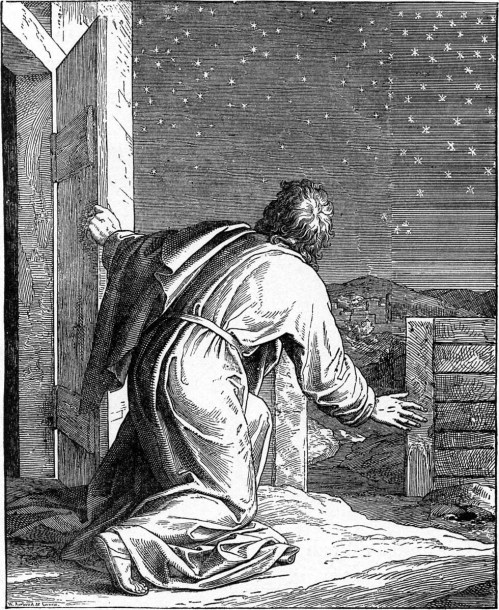
Abraham Looks to the Heavens from Bible Pictures by Charles Foster (1897)

Today, in God’s Lavish Mercy, Yahweh is very clear with Abram that he is now in a life-changing situation:

My covenant with you is this:
you are to become the father of a host of nations.
No longer shall you be called Abram;
your name shall be Abraham,
for I am making you the father of a host of nations.

Genesis 17: 3-4

pregnant

Having witnessed how young fathers are upended by the news of impending fatherhood, I can’t even imagine what Abraham felt like when he heard this:

I will render you exceedingly fertile;
I will make nations of you;
kings shall stem from you.

But aside from the practical ramifications of God’s promise, what Abraham is invited to is a whole new outlook on the world.  God lays out before him a vision of the ages, infinitely beyond the confines of Abraham’s current understanding.

dangles

It is an existence beyond time and human definition. It is the infinite place of God’s timelessness, where we all exist, but forget when we are born. Our lifetime is a spiritual journey back to remembrance.


In our Gospel, Jesus uses a rather cryptic phrase as he challenges his listeners to look beyond their circumscribed perspectives:

Amen, amen, I say to you,
whoever keeps my word will never see death….
Abraham your father rejoiced to see my day;
he saw it and was glad.

John 8:51
Jn8_56 Abraham

By fully embracing his covenant with God, Abraham saw beyond death.  The vision of heaven was opened to him and he lived his life by its power. He lived then within the Day of the Lord, not within any small confined perspective.

Jesus offers us the same invitation. We can choose to see with God’s eyes, or with only our own. We can choose to live within God’s infinity, or in only our own earthbound borders.

In our current global situation, where some humans have lost the sense of anything beyond themselves, it may be a good time to remember the eternal character of our heart.  It may be time to have a sit-down with God about our covenant, like the conversation God had with Abraham.


Poetry: The Unwavering Nomad – Jessica Powers

I love Abraham, that old weather-beaten
unwavering nomad; when God called to him
no tender hand wedged time into his stay.
His faith erupted him into a way
far-off and strange. How many miles are there
from Ur to Haran? Where does Canaan lie,
or slow mysterious Egypt sit and wait?
How could he think his ancient thigh would bear
nations, or how consent that Isaac die,
with never an outcry nor an anguished prayer?
I think, alas, how I manipulate
dates and decisions, pull apart the dark
dally with doubts here and with counsel there,
take out old maps and stare.
Was there a call after all, my fears remark.
I cry out: Abraham, old nomad you,
are you my father? Come to me in pity.
Mine is a far and lonely journey, too.

Music: In the Day of the Lord  – M.D. Ridge

Refrain:
In the day of the Lord, the sun will shine
like the dawn of eternal day.
All creation will rise to dance and sing
the glory of the Lord!

1.
“And on that day will justice triumph,
on that day will all be free:
free from want, free from fear, free to live! Refrain

2.
Then shall the nations throng together
to the mountain of the Lord:
they shall walk in the light of the Lord! Refrain

3.
And they shall beat their swords to plowshares;
there will be an end to war:
one in peace, one in love, one in God! Refrain

4.
For Israel shall be delivered,
and the desert lands will bloom.
Say to all, “Do not fear. Here is your God!” Refrain

5.
And on that day of Christ in glory,
God will wipe away our tears,
and the dead shall rise up from their graves! Refrain

6.
O give us eyes to see your glory,
give us hearts to understand.
Let our ears hear your voice ’til you come! Refrain

Lent: Stop Pretending

April 2, 2022
Saturday of the Fourth Week of Lent

Today, in God’s Lavish Mercy, danger continues to escalate for Jesus.

Our first reading from Jeremiah foreshadows Jesus’s situation. Some powerful people didn’t want to hear what Jeremiah preached. And we can understand why: Jeremiah prophesied the destruction of Jerusalem because of Israel’s unfaithfulness. It’s a message that was hard to swallow.

jeremiah

The core of Jeremiah’s teaching was this:
You people have to change. This is not the way God created the world to be.

But the people couldn’t listen. They had let the skewed reality of their lives become normal and needed. They couldn’t accept the world of mutual love and justice that God imagined for them.


Jesus meets the same kind of stonewalling.

In today’s passage, the hard-hearted rationalize their resistance:

“The Christ will not come from Galilee, will he?
Does not Scripture say that the Christ will be of David’s family
and come from Bethlehem, the village where David lived?”

But their antagonism isn’t really about geography and lineage. It’s about blind comfort in a world balanced toward their advantage. It’s about the fear of grace-inspired change.

Lk8_generous heart


Isn’t it the truth that we’ll use almost any argument to resist what demands our conversion? I understand why these guys “each went to his own house”, as the Gospel says in closing. They took refuge from grace in the little roofed pretense of their own control.

They didn’t have the courage to open their hearts to Jesus. Do we?


Poetry: LOVE IS THE MASTER – RUMI

Love is the One who masters all things;
I am mastered totally by Love.
By my passion of love for Love
I have ground sweet as sugar.
O furious Wind, I am only a straw before you;
How could I know where I will be blown next?
Whoever claims to have made a pact with Destiny
Reveals himself a liar and a fool;
What is any of us but a straw in a storm?
How could anyone make a pact with a hurricane?
God is working everywhere his massive Resurrection;
How can we pretend to act on our own?
In the hand of Love I am like a cat in a sack;
Sometimes Love hoists me into the air,
Sometimes Love flings me into the air,
Love swings me round and round His head;
I have no peace, in this world or any other.
The lovers of God have fallen in a furious river;
They have surrendered themselves to Love’s commands.
Like mill wheels they turn, day and night, day and night,
Constantly turning and turning, and crying out.

Music:  Spirit, Open My Heart –  Alfred V. Fedak

Lent: God Remembers

March 30, 2022
Wednesday of the Fourth Week of Lent

Today, in God’s Lavish Mercy, our readings offer us the deeply comforting image of God as a mother, vigilant and caring for us even in our unawareness.

In our reading from Isaiah, the Israelites recently have been freed from their long sojourn in Babylon and have returned to Jerusalem. It is a time of great joy, but also of reorientation and reflection. God, Who may have seemed to abandon them to captivity, is assuring them that is not so:

Thus says the LORD:
In a time of favor I answer you,
on the day of salvation I help you;
and I have kept you and given you as a covenant to the people,
To restore the land
and allot the desolate heritages,
Saying to the prisoners: Come out!

Isaiah 49: 8-9

We too may have times when we think God isn’t paying attention to us, or to the world that seems to be falling apart around us. We may be tempted to think that Divine attention is turned to us only when we demand it by intense prayer of supplication.

In Isaiah 49, God – through a outlay of abundant promises, – tells us otherwise:

But Zion said, “The LORD has forsaken me;
my Lord has forgotten me.”
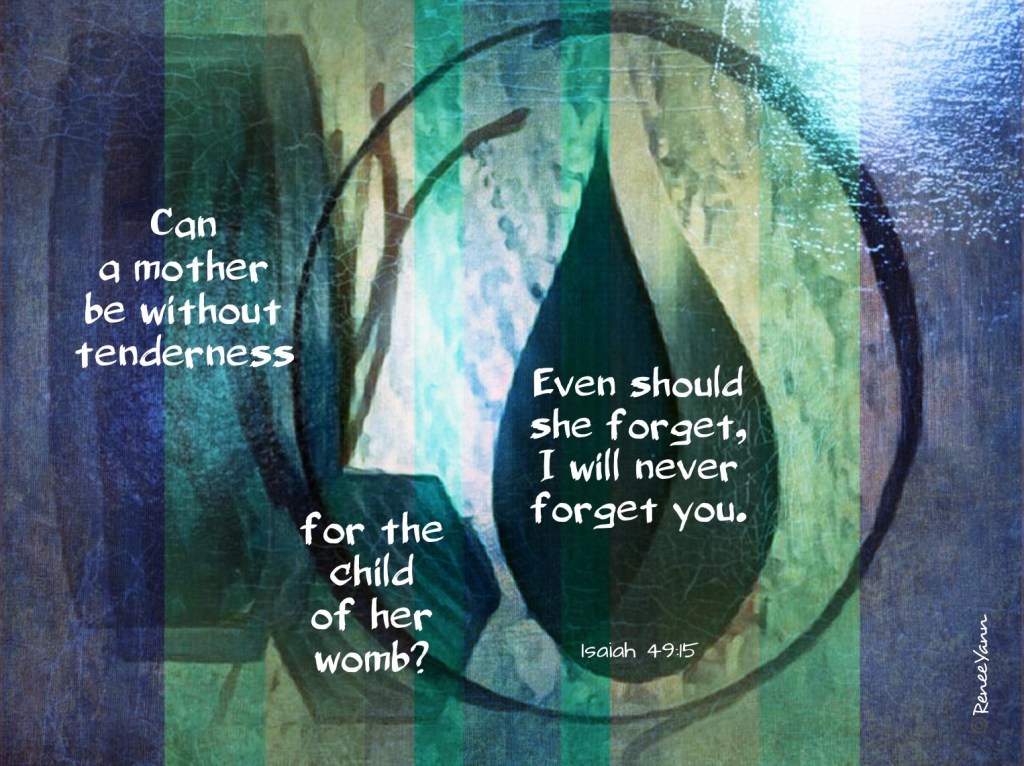
Can a mother forget her infant,
be without tenderness for the child of her womb?
Even should she forget,
I will never forget you.

Isaiah 49:14-15

In our Gospel, Jesus tells us the same things in a little bit of a different way.

My Father is at work until now, so I am at work.

John 5: 17

When he says this, Jesus is in the midst of the recalcitrant, vengeful Pharisees who have placed their faith only in their own arrogance – who have come to depend only on their own wealth and power rather than on the mercy and love of God.

Jesus offers his own outlay of Divine promises, showing how he and God the Creator are One in their constant desire for each of us to share fully in the Divine Life, even to the point of taking flesh to redeem us:

For just as the Father has life in himself,
so also he gave to the Son the possession of life in himself.
And he gave him power to exercise judgment,
because he is the Son of Man.
Do not be amazed at this,
because the hour is coming in which all who are in the tombs
will hear his voice and will come out,
those who have done good deeds
to the resurrection of life …

John 5: 26-29

We might ask in our prayer today to be deepened in our awareness of God’s constant, loving Presence in our lives. There is no moment or circumstance that doesn’t offer us an invitation to greater grace and holiness. But, unlike the Pharisees, we must open our hearts to trust God’s Presence in all things and to find that path to God’s heart.


In these final weeks of Lent, and in this particular passage from John, we see Jesus doing exactly what we must do. As Calvary began to loom unrelentingly on the horizon, Jesus could not have found it easy to accept the path unfolding before him. But he trusted. He knew the Father was with him. He believed that he walked toward Resurrection even though all he could see was a dark lonely hill.

May our Lenten prayer let us learn from Jesus.


Poetry: Forgetting by Joy Ladin

Zion says, “The LORD has forsaken me, my Lord has forgotten me.” Can a woman forget her baby, or disown the child of her womb? Though she might forget, I never could forget you.
—Isaiah 49:14–15

You never remember anything, do you?
How I formed you in your mother’s womb;
nursed you; bathed you; taught you to talk;

led you to springs of water?
I sang your name before you were born.
I’m singing your name now.

You’re clueless as an infant.
When I tell you to shout for joy,
you hear a bicycle, or a cat.

Sometimes, memories of me come back
like children you forgot you had:
a garden; a bride; an image of  your mother,

your best friend, your brother, or a cop, or snow, or afternoon.
The heavens shout; mountain becomes road;
gardenias burst into song.

Whose are these? you wonder.
Then you forget, and feel forgotten,
like an infant who falls asleep

at a mother’s breast
and wakes up hungry again.
Your mother might forget you, child,

but I never forget.
I’ve engraved your name
on the palms of my hands.

I show you trees, I lay you down in the grass,
I shower you with examples of my love—
sex and birds, librarians and life skills, emotions, sunlight, compassion.

Nothing connects.
Every dawn, every generation,
I have to teach you again:

this is water; this is darkness;
this is a body
fitting your description;

that’s a crush;
these are bodily functions;
this is an allergic reaction.

This is your anger.
This is mine.
This is me

reminding you to eat.
Turn off the stove.
Take your medication.

This is the realization
that I am yours and you are mine. This is you
forgetting.

Music: Will Never Forget You – Carey Landry

Lent: Faith’s Legacy

March 23, 2022
Wednesday of the Third Week of Lent

Today, in God’s Lavish Mercy, our readings lead us to thank God for our heritage of faith. They remind us how precious that heritage is.


Moses, after reiterating the history of God’s goodness to Israel, enjoins the People:

Take care and be earnestly on your guard
not to forget the things which your own eyes have seen,
nor let them slip from your memory as long as you live,
but teach them to your children and to your children’s children.

Deuteronomy 4:6

Jesus, too, acknowledges the importance of his religious heritage:

Do not think that I have come to abolish the law or the prophets.
I have come not to abolish but to fulfill.
Amen, I say to you, until heaven and earth pass away,
not the smallest letter or the smallest part of a letter
will pass from the law,
until all things have taken place.

Matthew 5:17

Readings such as these move us to remember, consider and appreciate our own faith story – that personal unfolding of grace-filled circumstances which have led us to our present relationship with God.

For many of us, faith planted itself in us through the seeds of our family. We simply “inherited” the faith from our parents, grandparents and extended family. That community of blessings was extended through our parish and through our Christian education.

Take time to remember:

  • Who taught you your childhood prayers?
  • Who told you Bible stores?
  • Who prepared you for the sacraments?
  • Who served as a example to you of what a good Christian is like?

The answers will not be some big religious events. They will be simple memories that, at the time, you might not have even recognized as important to your faith life. I remember, for example, that every day in Lent my father walked with me to 6:30 AM Mass. Because many of the laborers had to be in work by 7:00 AM, the priest distributed communion for them before the Mass began. Just after the Gospel, Dad and all the other workmen would quietly exit to get to work on time. No fanfare. No preachy words. Just deep faith and devotion.

I can’t exactly put that lesson into words. All I know is that it deeply affected my faith and my profound appreciation for the Eucharist — and for my Dad.


And as you grew up and grew older:

  • Who has sincerely engaged with you on your questions of faith and morality?
  • Who has encouraged you to live a life of Christian service and social justice?
  • Who has modeled everyday holiness for you?
  • Who challenges and invites you to deeper spirituality and Christian witness?

The names and faces who have come into your prayer as you considered these questions — these people are the “fathers” and “mothers’ of your faith.


And of course, these questions may lead us
to ask ourselves how we have done these things
for the generations now depending on us
for the transmission of faith?


Poetry: On Religion – Kahlil Gibran (1883-1931)

And an old priest said, Speak to us of Religion.
And he said:
Have I spoken this day of aught else?
Is not religion all deeds and all reflection,
And that which is neither deed nor reflection, but a wonder and a surprise ever springing in the soul, even while the hand hew the stone or tend the loom?
Who can separate his faith from his actions, or his belief from his occupations?
Who can spread his hours before him, saying, “This for God and this for myself’ This for my soul, and this other for my body?”
All your hours are wings that beat through space from self to self.
He who wears his morality but as his best garment were better naked.
The wind and the sun will tear no holes in his skin.
And he who defines his conduct by ethics imprisons his song-bird in a cage.
The freest song comes not through bars and wires.
And he to whom worshipping is a window, to open but also to shut, has not yet visited the house of his soul whose windows are from dawn to dawn.

Your daily life is your temple and your religion.
Whenever you enter into it take with you your all.
Take the plough and the forge and the mallet and the lute,
The things you have fashioned in necessity or for delight.
For in revery you cannot rise above your achievements nor fall lower than your failures.
And take with you all men:
For in adoration you cannot fly higher than their hopes nor humble yourself lower than their despair.

And if you would know God be not therefore a solver of riddles.
Rather look about you and you shall see Him playing with your children.
And look into space; you shall see Him walking in the cloud, outstretching His arms in the lightning and descending in rain.
You shall see Him smiling in flowers, then rising and waving His hands in trees.


Music: e Will Serve the Lord

Lent: A Man of Sorrows

March 18, 2022
Friday of the Second Week of Lent

Today, in God’s Lavish Mercy, there is a great sadness in our readings.

The poignant opening line from Genesis immediately strikes us:

Israel loved Joseph best of all his sons,
for he was the child of his old age.
Genesis 37:3

Joseph

We picture young Joseph in his beautiful rainbow coat and, under an olive tree’s shade, old Jacob(Israel) proudly, tenderly, watching him play.

As the story ensues to reveal the later betrayal of Joseph’s jealous brothers, we are left astounded. Such treachery, especially among brothers, sickens the heart.


Our Gospel picks up the sad theme because Joseph and his brothers are archetypes of Christ’s story with humankind.

800px-The_Wicked_Husbandman_(The_Parables_of_Our_Lord_and_Saviour_Jesus_Christ)_MET_DP835802
The Wicked Husbandman by John Everett Millais shows the owner’s murdered son

Jesus tells a parable in which he is actually the unnamed main character. He is the Son sent by a loving Father. He is the one rejected, beaten and killed by the treacherous tenants of his Father’s garden.


We know from our familiarity with Scripture that both these stories ultimately come to glorious conclusions. But today’s readings do not take us there. They leave us standing, mouths dropped open, at the dense meanness of the human heart, at the soul’s imperviousness to grace, at the profound sadness Jesus felt at this point in his ministry.


In our prayer today, let’s just be with Jesus, sharing his sadness for the meanness still poisoning our world. We might pray today for Jesus suffering in the Ukrainian people and throughout the many war-infested parts of our world.

May our prayers comfort Jesus with our desire to be open to God’s Grace and Mercy. May they lead us to actions of peace and justice on behalf of our suffering sisters and brother.


Poetry: Despised and Rejected – Christina Rossetti

My sun has set, I dwell
In darkness as a dead man out of sight;
And none remains, not one, that I should tell
To him mine evil plight
This bitter night.
I will make fast my door
That hollow friends may trouble me no more.

“Friend, open to Me.”–Who is this that calls?
Nay, I am deaf as are my walls:
Cease crying, for I will not hear
Thy cry of hope or fear.
Others were dear,
Others forsook me: what art thou indeed
That I should heed
Thy lamentable need?
Hungry should feed,
Or stranger lodge thee here?

“Friend, My Feet bleed.
Open thy door to Me and comfort Me.”
I will not open, trouble me no more.
Go on thy way footsore,
I will not rise and open unto thee.

“Then is it nothing to thee? Open, see
Who stands to plead with thee.
Open, lest I should pass thee by, and thou
One day entreat My Face
And howl for grace,
And I be deaf as thou art now.
Open to Me.”

Then I cried out upon him: Cease,
Leave me in peace:
Fear not that I should crave
Aught thou mayst have.
Leave me in peace, yea trouble me no more,
Lest I arise and chase thee from my door.
What, shall I not be let
Alone, that thou dost vex me yet?

But all night long that voice spake urgently:
“Open to Me.”
Still harping in mine ears:
“Rise, let Me in.”
Pleading with tears:
“Open to Me that I may come to thee.”
While the dew dropped, while the dark hours were cold:
“My Feet bleed, see My Face,
See My Hands bleed that bring thee grace,
My Heart doth bleed for thee,
Open to Me.”

So till the break of day:
Then died away
That voice, in silence as of sorrow;
Then footsteps echoing like a sigh
Passed me by,
Lingering footsteps slow to pass.
On the morrow
I saw upon the grass
Each footprint marked in blood, and on my door
The mark of blood forevermore.

Music:  Handel: Messiah – He was despised and rejected – sung by Jakub Józef Orliński

“He was despised and rejected of men; a man of sorrows, and acquainted with grief.
(Isaiah 53, v.3)
“He gave his back to the smiters, and his cheeks to them that plucked off the hair: he hid not his face from shame and spitting.” (Isaiah 50, v.6)

Lent: To Drink from the Cup

March 16, 2022
Wednesday of the Second Week of Lent

Today, in God’s Lavish Mercy, we learn a lesson in humble leadership, thanks once again to “Mrs. Zebedee”.

Mk 10_38 cup

Our Gospel recounts the story of the mother of James and John interceding for her sons with Jesus. Like many overprotective mothers, she intervenes even into their adult lives. She wants to make sure they get the best deal for their investment with Jesus.


Listen, I understand and love her! I would be the same way with my kids if I had any. I often say it’s best I had none because “Overprotective Me” would have had to shadow them to school, dances, playgrounds etc. until they were about 35 years old!

But the point of this Gospel story isn’t Mrs. Zebedee’s overprotectiveness.  It has little to do with Mrs. Zebedee at all.


The point is that “Mrs. Zebedee” (like many of us) has missed the whole POINT. The Gospel story is about US and the integrity of our choice to live a life in the pattern of Jesus.

Christ’s disciples have decided to follow a man who says things like this:

  • The last shall be first and the first, last.
  • Unless you lay down your life, you cannot follow me.
  • Whoever takes the lowly position of a child is the greatest in the Kingdom of Heaven.

The seats at Christ’s right and left, which Mrs. Zebedee requests for her sons, will bring them rewards only through humility and sacrificial service.


Here’s the way a 14th century artist imagined the Zebedee family. (Dad looks happy!)

sons of zebedee
Mary Salome and Zebedee with their Sons James the Greater and John the Evangelist
(c.1511) by Hans von Kulmbach, Saint Louis Art Museum

Jesus is gentle with “Mrs. Zebedee”. He understands how hard it is for any of us to comprehend the hidden glory of a deeply Christian life. We are surrounded by a world that screams the opposite to us:

  • Me first!
  • Stand your ground!
  • Good guys finish last!

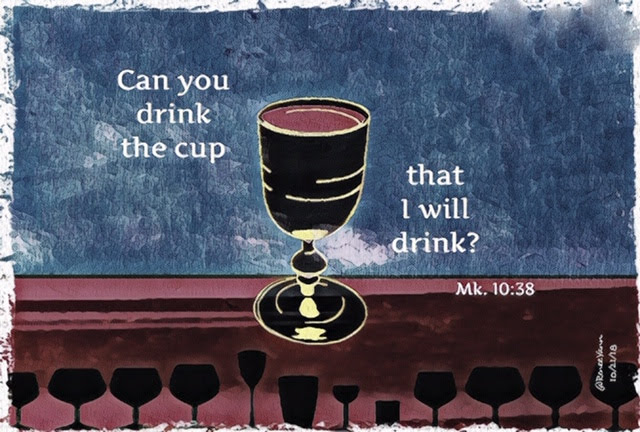
So Jesus turns to James and John (and to us). One can imagine the bemused look on Christ’s face. He knows the hearts of his disciples. He knows they have already given themselves to him. So he asks them for a confession of faith, “Can you drink the cup that I will drink?”

veronese-le-christ-rencontrant-la-femme-et-les-fils-de-zebedee_-_grenoble
The meeting of Christ with Zebedee’s wife and sons by Paolo Veronese

Their humble, faith-filled answer no doubt stuns their mother. She is left in wonder at the holy men her sons have become. Perhaps it is the beginning of her own deep conversion to Christ.

As we pray with this passage,
where do we find ourselves in this scene?
How immediate, sincere, and complete
is our response to Jesus’ question:
“Can you drink the cup….?”

Prose: by Henri J.M. Nouwen, Can You Drink the Cup?

Drinking the cup that Jesus drank
is living a life in and with the spirit of Jesus,
which is the spirit of unconditional love.
The intimacy between Jesus and Abba, his Father,
is an intimacy of complete trust,
in which there are no power games,
no mutually agreed upon promises,
no advance guarantees.
It is only love
—pure, unrestrained, and unlimited love.
Completely open, completely free.
That intimacy gave Jesus the strength to drink his cup.
That same intimacy Jesus wants to give us
so that we can drink ours.


Music: The More I Seek You – Kari Jobe

Live in Truth

February 25, 2022
Friday of the Seventh Week in Ordinary Time

Today, in God’s Lavish Mercy, our readings instruct us on one of life’s most important realities: truthful relationship – with God, nature, other people, and ourselves.

James reminds us that the prophets spoke the truth at great personal cost.

Take as an example of hardship and patience, brothers and sisters,
the prophets who spoke in the name of the Lord.
Indeed we call blessed those who have persevered.

James 5:10

Culture sometimes characterizes a “prophet” as one who can foresee the future, one who has a greater capacity than the normal person. And indeed there are great leaders who fit that understanding. They see things rightly and help us to realign our vision.


But, in an everyday sense, a prophet is simply someone who sees the truth and is unafraid to speak it. A prophet doesn’t pretend, deflect, lie, ignore, hide, distort or abuse Truth. The call to this kind of prophecy is one that we all share.

Such a call requires that we are honest, first and foremost, with God and with ourselves. It asks that we live a discerning and courageous life, reverently telling our truth as best we understand before God:

… let your “Yes” mean “Yes” and your “No” mean “No,”
that you may not incur condemnation.

James 5:12

In our Gospel, we find the Pharisees trying trip up Jesus with their pretend concern for the Law. Instead, what they are really concerned about is that they could lose their hold on power if the people turn to Jesus and his teaching.


Jesus calls them “hard of heart” because they are not open to the Spirit. They hide in a labyrinth of minutiae rather than the clarity of Love and Truth.

Living in the Truth of God’s grace and mercy, we grow in our ability to be prophetic. It means that people know they will get the truth from us — not opinion or advice; not bluntness or unnecessary critique — but a discernment offered in love, reverence, and mutual hope.

Like the biblical prophets, and like Jesus himself, we will meet people who don’t want that kind of truth. They haven’t been able to espouse it in themselves, so they don’t want to hear it from us. We see this played out daily in a sham political world that continually creates its own version of reality to suit its selfish ends.

In such situations, James would offer us this encouragement:

You have heard of the perseverance of Job,
and you have seen the purpose of the Lord,
because the Lord is compassionate and merciful.

And our Alleluia Verse offers us a prayer for such times:

Your word, O Lord, is truth;
consecrate us in the truth.


So persevere.
Seek your truth in prayer.
Give it to the world generously
with compassion and mercy.

Poetry: A Legend of Truth – Rudyard Kipling
“A Friend of the Family”
From “Debits and Credits” (1919-1923)

Once on a time, the ancient legends tell,
Truth, rising from the bottom of her well,
Looked on the world, but, hearing how it lied,
Returned to her seclusion horrified.
There she abode, so conscious of her worth,
Not even Pilate’s Question called her forth,
Nor Galileo, kneeling to deny
The Laws that hold our Planet ‘neath the sky.
Meantime, her kindlier sister, whom men call
Fiction, did all her work and more than all,
With so much zeal, devotion, tact, and care,
That no one noticed Truth was otherwhere.

Then came a War when, bombed and gassed and mined,
Truth rose once more, perforce, to meet mankind,
And through the dust and glare and wreck of things,
Beheld a phantom on unbalanced wings,
Reeling and groping, dazed, dishevelled, dumb,
But semaphoring direr deeds to come.

Truth hailed and bade her stand; the quavering shade
Clung to her knees and babbled, “Sister, aid!
I am–I was–thy Deputy, and men
Besought me for my useful tongue or pen
To gloss their gentle deeds, and I complied,
And they, and thy demands, were satisfied.
But this–” she pointed o’er the blistered plain,
Where men as Gods and devils wrought amain–
“This is beyond me! Take thy work again.”

Tablets and pen transferred, she fled afar,
And Truth assumed the record of the War…
She saw, she heard, she read, she tried to tell
Facts beyond precedent and parallel–
Unfit to hint or breathe, much less to write,
But happening every minute, day and night.
She called for proof. It came. The dossiers grew.
She marked them, first, “Return. This can’t be true.”
Then, underneath the cold official word:
“This is not really half of what occurred.”

She faced herself at last, the story runs,
And telegraphed her sister: “Come at once.
Facts out of hand. Unable overtake
Without your aid. Come back for Truth’s own sake!
Co-equal rank and powers if you agree.
They need us both, but you far more than me


Music: Beautiful Truth – Angela Predhomme

Pepper and Salt

February 24, 2022
Thursday of the Seventh Week in Ordinary Time

Today, in God’s Lavish Mercy, both James and Jesus pepper us with some fire and brimstone.

James is preaching against the sin of exploitation, especially as it relates to economic justice, the sanctity of work, and reverence for the worker.

Come now, you rich, weep and wail over your impending miseries…
Behold, the wages you withheld from the workers who harvested your fields are crying aloud; and the cries of the harvesters have reached the ears of the Lord of hosts.

James 5: 1;4

James, in his time, is condemning a sin that has endured throughout history. In a 2020 address, Pope Francis confronted the same evil:

The pandemic has exposed and aggravated social problems, above all that of inequality…These symptoms of inequality reveal a social illness; it is a virus that comes from a sick economy. And we must say it simply: the economy is sick. It has become ill. It is the fruit of unequal economic growth — this is the illness: the fruit of unequal economic growth — that disregards fundamental human values. In today’s world, a few wealthy people possess more than all the rest of humanity. I will repeat this so that it makes us think: a few wealthy people, a small group, possess more than all the rest of humanity. This is pure statistics. This is an injustice that cries out to heaven!

General Audience, August 26, 2020

James and Francis – speaking the same message for different times.


In our Gospel, Jesus teaches that the rewards of a well-lived life are measured in mutuality and generosity, not dollars:


In concluding his above referenced address, Pope Francis, like Jesus, focused on children:

Let us think about the children. Read the statistics: how many children today are dying of hunger because of broken distribution of riches, because of a sick economic system; and how many children today do not have the right to education for the same reason. May this image of children in want due to hunger and the lack of education help us understand that after this pandemic crisis we must learn and do better.


Jesus too measured a soul’s health by its effect on children:

Whoever causes one of these little ones who believe in me to sin,  it would be better for him if a great millstone were put around his neck and he were thrown into the sea.

Mark 9:42

These readings teach hard lessons, lessons which society still seems unable to learn. Let’s ask for the grace to see our own role in helping to realize the sacred balance of goods that Jesus, James, and Francis call for.

Let us not tire in advocating for social Justice because, as our Gospel warns:

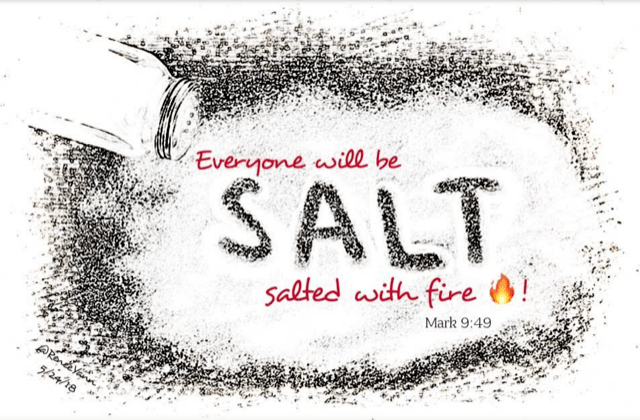
Everyone will be salted with fire. Salt is good,
but if salt becomes insipid,
with what will you restore its flavor?

Mark 9:49

Poetry and Music: Salt of the Earth – The Rolling Stones
In this song, Mick Jagger writes an anthem to the working class. But in a twice-repeated stanza, the singer professes a distance from this very group, perhaps loosing touch because of his own material success:

And when I search a faceless crowd
A swirling mass of grey and black and white
They don’t look real to meIn fact, they look so strange

The song uses a quote that refers to a passage in the Bible where Jesus encourages people to give the best of themselves:

You are the salt of the earth; but if the salt loses its flavor, how shall it be seasoned ? It is then good for nothing but to be thrown out and trampled underfoot.

Matthew 5:13