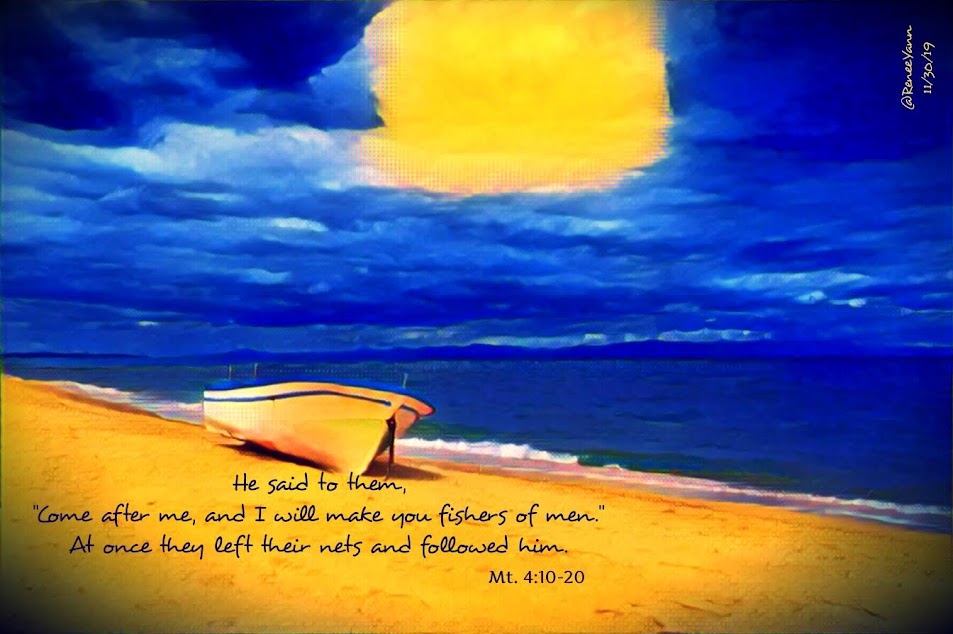
Hear God Speak Your Name

February 22, 2022
Feast of the Chair of St. Peter

Today, in God’s Lavish Mercy, our readings invite to consider God’s naming us – calling us.

We celebrate wonderful Saint Peter – so fully human, so fully holy, so fully in love with God! As we pray the Gospel of Peter’s naming, may we deepen in understanding our own naming by God.

Once, Jesus asked Peter what he believed. Peter answered, simply and magnificently:
“YOU ARE THE CHRIST, THE SON OF THE LIVING GOD.”
Peter was an ordinary man who responded to Jesus with a clear and extraordinary faith.


One June morning, nearly fifty years ago, I sat in a sun-drenched field in the Golan Heights of Israel at a spot called Caesarea Philippi. Thirty other pilgrims composed the group as we heard today’s Gospel being read. Listening, I watched the rising sun grow brilliant on the majestic rock face in the near distance.

I thought how Peter might have watched his day’s sun playing against the same powerful cliffs as Jesus spoke his name:

Jesus said to him,
You are Peter (which means “Rock”),
and upon this Rock
I will build my Church.


A few years later, I stood at the center of St. Peter’s Basilica in the Vatican. Looking up, I saw these words emblazoned around the awesome rotunda dome:

Tu es Petrus,
et super hanc petram
aedificabo ecclesiam.

On that sunlit afternoon two-thousand years ago,
Peter could never have imagined
what God already saw for him.
Yet, Peter responded – with his whole life.
This is what makes a Saint.

Jesus calls us to be saints too. He lovingly speaks our name into a sacred future we cannot even imagine. But if, like Peter, we trust and believe, God does the rest.


Poetry: Peter by John Poch.
The poem captures the transformation of Peter’s humanness into God’s hope for him – the “changing” of his name.


There are three things which are too wonderful for me,
Yes, four which I do not understand.
The way of an eagle in the air,
The way of a serpent on a rock,
The way of a ship in the heart of the sea,
And the way of a man with a maid

–Prov. 30:18, 19

I
Contagious as a yawn, denial poured
over me like a soft fall fog, a girl
on a carnation strewn parade float, waving
at everyone and no one, boring and bored.
There actually was a robed commotion parading.
I turned and turned away and turned. A swirl
of wind pulled back my hood, a fire of coal
brightened my face, and those around me whispered:
You’re one of them, aren’t you? You smell like fish.
And wine, someone else joked. That’s brutal. That’s cold,
I said, and then they knew me by my speech.
They let me stay and we told jokes like fisher-
men and houseboys. We gossiped till the cock crowed,
his head a small volcano raised to mock stone.

II
Who could believe a woman’s word, perfumed
in death? I did. I ran and was outrun
before I reached the empty tomb. I stepped
inside an empty shining shell of a room,
sans pearl. I walked back home alone and wept
again. At dinner. His face shone like the sun.
I went out into the night. I was a sailor
and my father’s nets were calling. It was high tide,
I brought the others. Nothing, the emptiness
of business, the hypnotic waves of failure.
But a voice from shore, a familiar fire, and the nets
were full. I wouldn’t be outswum, denied
this time. The coal-fire before me, the netted fish
behind. I’m carried where I will not wish.


Music: Peter’s Song – Face to Face – Michael O’Brien

I recall
something in the way
you called my name,
an ordinary fisherman you called me friend and took me in.
How everything had changed
because then I knew I’d never be the same.

Love came and rescued me.
I gave up my everything to follow.
Now I know.
All that I was before
won’t matter anymore
for I am a new man
because I have seen my Savior
face-to-face.

I recall
standing in the courtyard by the fire,
words still ringing in my head,
three times before the break of dawn
you would be denied.
And yet I saw no judgment in your eyes.

Love came and died for me.
I gave up my everything,
gave up my everything to follow.
Now I know
all that I was before
is dead and it lives no more
for I am a new man
because I have seen
my savior face-to-face.

The dark night, the new day –
The stone was rolled away –
my Savior, You are the Light
You are alive! Ascended to heaven.
I know that you will come again.

That moment I will arise
to worship before your throne,
to bow down for you alone are worthy,
so worthy
and there with saints of old,
I’ll sing a brand new song in heaven
forever
where I will see my Savior face-to-face.

It’s Not Easy

February 18, 2022
Friday of the Sixth Week in Ordinary Time

Today, in God’s Lavish Mercy, James actually made me chuckle out loud! In today’s celebrated passage about faith and works, James – ever direct and uncompromising – really takes it home. Get this verse:

Do you want proof, you ignoramus,
that faith without works is useless?

James 2:20

OK, James! Tell us what you really think!😂

Well, here’s what he really thinks:

For just as a body without a spirit is dead,
so also faith without works is dead.

James 2:26

In our Gospel, Jesus says that living a life of good works is hard. He did it through the Cross and says we must follow his example:

Whoever wishes to come after me must deny himself,
take up his cross, and follow me.
For whoever wishes to save his life will lose it,
but whoever loses his life for my sake
and that of the Gospel will save it.

Mark 8:34-35

The Gospel Jesus is talking about, and the “works” James refers to,  are summarized like this:

Corporal Works of Mercy

feed the hungry.
give water to the thirsty.
clothe the naked.
shelter the homeless.
visit the sick.
visit the imprisoned, ransom the captive.
bury the dead.

Spiritual Works of Mercy

instruct the ignorant.
counsel the doubtful.
admonish the sinners.
bear patiently those who wrong us.
forgive offenses.
comfort the afflicted.
pray for the living and the dead.


If we live by these admonitions,
we will find the Cross
– but we will also surely find the Crown.


Poetry: Listen to RS Thomas read his own poem about the struggle to live a Christian life:


Music: Lose My Soul – TobyMac, a multi-award winning Christian hip-hop singer.

Living the Cross

February 17, 2022
Thursday of the Sixth Week in Ordinary Time

Today, in God’s Lavish Mercy, two disciples of Jesus are our teachers. James advises us on what to do. Beloved Peter, as so often is the case, shows us what not to do.

James tells us to show no partiality. He makes clear that he is talking about impartiality toward those who are materially poor. It’s a maxim that Jesus gave us time and again in the Gospel.

James reminds us that Jesus is not just impartial toward those who are poor, he actually has a preferential love for them. So Jesus was partial to the poor, right? Hmm!

Yes, I think that’s right. In order to balance our human inclination to the richest, best, strongest, etc., Jesus teaches us to go all out in the other direction.

It’s like this great cartoon that popped up on Facebook a while ago:


Our Gospel picks up the theme.

Because of his great love for the poor and his passion for mercy, Jesus tells his followers that suffering is coming. Peter doesn’t like hearing that. Can you see Peter take Jesus aside and say, “Listen, Jesus, negative talk is going to hurt your campaign. You’re God! You can just zap suffering out of your life!”


Jesus responds to Peter definitively: “Get thee behind me, Satan!”

James Tissot: Get Thee Behind me, Satan

Wow! That must have stung! But that’s how important it was to Jesus that his followers understood his mission: to preach Mercy to the poor, sick, and broken by sharing and transforming their experience.

Jesus wants us to understand that too.


Prose: from St. Oscar Romero

It is no honor for the Church 
to be on good terms with the powerful.
The honor of the Church consists in this,
that the poor feel at home in her,
that she fulfils her mission on earth,
that she challenges everyone,
the rich as well,
to repent and work out their salvation,
but starting from the world of the poor,
for they, they alone are the ones who are blessed.

Music: Beauty for Brokenness – Graham Kendrick

Joyful Calculation

February 14, 2022
Monday of the Sixth Week in Ordinary Time

Today, in God’s Lavish Mercy, Lent is just a little over two weeks away. We will spend the intervening time in good company with daily insights from James, Peter and Mark. Today we begin the Epistle of James.

The Epistle of James- Chapter 1: Illustration provided to Wikimedia Commons by Distant Shores Media/Sweet Publishing as part of a cooperation project. Sweet Publishing released these images, which are taken from now-out-of-print Read’n Grow Picture Bible Illustrations (Biblical illustrations by Jim Padgett, courtesy of Sweet Publishing, Ft. Worth, TX, and Gospel Light, Ventura, CA. Copyright 1984.), under new license, CC-BY-SA 3.0

This letter is one of the very earliest of the New Testament. Scholars are mixed about exactly which “James” wrote it, but agree that it was one of several who were very close to Jesus – perhaps one of “the brothers of Jesus” mentioned in several New Testament passages:

  • Matthew 12:46-50
  • Mark 3:31
  • Luke 8:19
  • John 2:12
  • Acts 1:14
  • 1 Corinthians 9:5
  • and specifically “the Lord’s brother James” in Galatians 1:19

James writes in the style of Wisdom Literature, those Old Testament books that give advice, proverbs, and insights for living a holy life. His immediate audience was a community of dispersed Christian Jews whose world was filled with increasing upheaval and persecution.


When I read the following description I thought how germane James’s letter could be for our world today. His themes echo the teachings of Pope Francis for our chaotic time:

The epistle is renowned for exhortions on fighting poverty and caring for the poor in practical ways (1:26–27; 2:1-4; 2:14-19; 5:1-6), standing up for the oppressed (2:1-4; 5:1-6) and not being “like the world” in the way one responds to evil in the world (1:26-27; 2:11; 3:13-18; 4:1-10). Worldly wisdom is rejected and people are exhorted to embrace heavenly wisdom, which includes peacemaking and pursuing righteousness and justice (3:13-18).

Jim Reiher, “Violent Language – a clue to the Historical Occasion of James.”Evangelical Quarterly. Vol. LXXXV No. 3. July 2013

Here is the golden advice James gives us today:

  • Be joyful in trials.
  • Let trials increase your perseverance not discourage you.
  • Doing this is a sign of wisdom.
  • When your wisdom is depleted, ask God for more with an open and trusting heart.
  • Honor all people, high or low in circumstances
  • Don’t be fooled by riches. They fade away.

In our Gospel, Jesus is frustrated with the Pharisees who insincerely demand a magical sign from him. They demonstrate none of the spiritual wisdom and openness to grace that James describes.

When we think about our own faith, where does it fall on the scale of sincerity, on the spectrum joy, justice, and faithful perseverance?


Poetry: On Joy and Sorrow – Kahlil Gibran

Then a woman said, Speak to us of Joy and Sorrow.
And he answered:
Your joy is your sorrow unmasked.
And the selfsame well from which your laughter rises 
was oftentimes filled with your tears.
And how else can it be?
The deeper that sorrow carves into your being, 
the more joy you can contain.
Is not the cup that holds your wine 
the very cup that was burned in the potter’s oven?
And is not the lute that soothes your spirit, 
the very wood that was hollowed with knives?
When you are joyous, look deep into your heart 
and you shall find it is only that which has given you sorrow 
that is giving you joy.
When you are sorrowful look again in your heart, 
and you shall see that in truth you are weeping for 
that which has been your delight.
Some of you say, “Joy is greater than sorrow,” 
and others say, “Nay, sorrow is the greater.”
But I say unto you, they are inseparable.
Together they come, 
and when one sits alone with you at your board, 
remember that the other is asleep upon your bed.
Verily you are suspended like scales 
between your sorrow and your joy.
Only when you are empty 
are you at standstill and balanced.
When the treasure-keeper lifts you 
to weigh his gold and his silver, 
needs must your joy or your sorrow rise or fall.

Music: Count It All Joy

Witness for ?

February 6, 2022
Fifth Sunday in Ordinary Time

I bet I know the first word that popped into your mind when you read today’s headline: PROSECUTION!

But today, in God’s Lavish Mercy, our readings invite us to consider WITNESS — not for the prosecution, but for the RESURRECTION!

In our first reading, we see Isaiah dramatically commissioned to WITNESS to the vision of faith in his heart. He responds wholeheartedly:

Then I heard the voice of the Lord saying,
“Whom shall I send? Who will go for us?”
“Here I am,” I said; “send me!”

Isaiah 6:8

Our second reading, Paul describes how Christ appeared to him and commissioned him, “the least of the Apostles” to be his WITNESS. Paul, too, responds wholeheartedly:

He appeared to me.
Therefore, … so we preach and so you believed.

1 Corinthians 15:11

In our Gospel, Simon Peter, James and John are awed by the miraculous power of Jesus as their nets pull hundreds of fish from the otherwise unproductive sea. Jesus tells them that, by their WITNESS, they will attract hundreds of souls to his message. They also respond wholeheartedly:

When they brought their boats to the shore,
they left everything and followed him.

Luke 5:11

Macrina Wiederkehr, OSB, in her beautiful book, “Seven Sacred Pauses”, describes the level of WITNESS in the first disciples:

They were impelled to continue proclaiming the Gospel in the face of opposition. 
They were zealous in preaching because they felt passionate 
about being entrusted with the sacred message.

Think of this often-heard philosophical conundrum:

Photo by Vasilis Karkalas on Pexels.com

If a tree falls in the forest,
and no one is there to hear it,
does it make a sound?

Logic tells us that it does. But what does it matter if no one hears it?


If the Resurrection happened, and no one bears witness to it, what does it matter? That is the importance of our call to WITNESS – just like Isaiah, Paul, Peter, James, John, and two millennia of believers who carry on the sound of that tomb bursting open to eternal life.

How will we witness to our faith today –
not by preachy words or empty opinions,
but by our active passion for justice and mercy
in the world, and in our own everyday choices?


Poetry: In Whom We Live and Move and Have Our Being – Denise Levertov

Birds afloat in air's current,
sacred breath? No, not breath of God,
it seems, but God
the air enveloping the whole
globe of being.
It's we who breathe, in, out, in, in the sacred,
leaves astir, our wings
rising, ruffled -- but only the saints
take flight. We cower
in cliff-crevice or edge out gingerly
on branches close to the nest. The wind
marks the passage of holy ones riding
that ocean of air. Slowly their wake
reaches us, rocks us.
But storms or still,
numb or poised in attention,
we inhale, exhale, inhale,
encompassed, encompassed.

Music: I Will Stand as a Witness

Come Away Awhile

February 5, 2022
Memorial of Saint Agatha, Virgin and Martyr

Today, in God’s Lavish Mercy, in our readings, both Solomon and Jesus seek a quiet place to pray, reflect, recenter, and commune with God.

Solomon went to Gibeon to sacrifice there,
because that was the most renowned high place.
Upon its altar Solomon offered a thousand burnt offerings.
In Gibeon the LORD appeared to Solomon in a dream at night.
God said, “Ask something of me and I will give it to you.”

1 Kings 3:4
Dream of Solomon – Luca Giordano

Solomon’s retreat is characterized by his sincere humility and gratitude. In this, his first documented encounter with God, Solomon hits a homer in relationship. God is pleased with Solomon’s self-abnegating request for only wisdom to benefit others.

O LORD, my God, you have made me, your servant,
king to succeed my father David;
but I am a mere youth, not knowing at all how to act.
I serve you in the midst of the people whom you have chosen,
a people so vast that it cannot be numbered or counted.
Give your servant, therefore, an understanding heart
to judge your people and to distinguish right from wrong.
For who is able to govern this vast people of yours?”

1 Kings 3:7-9

In his prayer, Solomon has been able to get himself out of the way in order to really see and hear God – to fully receive God’s Presence in his life.


In our Gospel, Jesus seeks retreat for himself and his disciples because of the pressures of their ministries and the recent gut-punch news of John the Baptist’s execution.

Turns out, they don’t really get much of a chance for a “holy chill”. As with many of us, the responsibilities are so pressing that they conspire to find us no matter what.

So they went off in the boat by themselves to a deserted place.
People saw them leaving and many came to know about it.
They hastened there on foot from all the towns
and arrived at the place before them.

When Jesus disembarked and saw the vast crowd,
his heart was moved with pity for them,
for they were like sheep without a shepherd;
and he began to teach them many things.

Mark 6: 32-34

We too, like Solomon and Jesus, need times of retreat and dedicated prayer in our lives. But sometimes, our responsibilities and work follow us as we attempt to find that sacred space.

How can we free ourselves for such spiritual renewal? By planning, asking for assistance, disciplining our time and choices. But the key is that we really have to want that precious deserted place for meeting God in a special way.

These “retreats” must be a way of life for us, consistent choices to bring our busy lives before God, humbly open our hearts, and ask to see ourselves in a new and graced way.

Our “going off to rest awhile” in God can be as short as a few minutes morning and evening, or as long as a 30 day retreat. But they must be a consistent and disciplined desire of our hearts.


“Discipline” may seem like a hard word for it, especially if we think of our high school demerits when we hear that word🤪 But remember, without disciple music would be just noise, art would be just scribble, dance would be contortion, and conversation would be babble.

When you consider “discipline”, think instead of the elegant balance of a beautiful dance and let God lead, or of the sweet perfection of glorious music and let God sing to you.


Prose: A treasured thought of the Jesuit Pedro Arrupe suggests itself here:

Nothing is more practical than
finding God, than
falling in Love
in a quite absolute, final way.
What you are in love with,
what seizes your imagination, will affect everything.
It will decide
what will get you out of bed in the morning,
what you do with your evenings,
how you spend your weekends,
what you read, whom you know,
what breaks your heart,
and what amazes you with joy and gratitude.
Fall in Love, stay in love,
and it will decide everything.

Music: These Alone Are Enough – Dan Schutte

Baggage Fees?

February 3, 2022
Thursday of the Fourth Week in Ordinary Time

Today, in God’s Lavish Mercy, “journey” is a central theme. David takes his final journey after commissioning his son Solomon as his successor. In our Gospel, Jesus commissions the disciples for their first missionary journey.


Each of these journeys has its own “baggage requirements”.

David’s situation is easy and can be stated in a phrase we are all familiar with:

“You can’t take it with you.”

The writer of Job expresses the same sentiment:

And Job said,
“Naked I came from my mother’s womb,
and naked shall I return.
The LORD gave,
and the LORD has taken away;
blessed be the name of the LORD.”

Job 1:2


Back in my early days of business flying, when there were no baggage fees, some passengers took everything but the kitchen sink on their journeys. I have a clear picture of petite women, and a few guys, hauling suitcases bigger than themselves over to the check-in counter.

So often in life we carry a lot of baggage, both material and mental, that we don’t need. Some of it is good stuff we just can’t part with, and some of it is junk we should have tossed long ago. The point is that it’s all weight we don’t need if we want to reach our desired destination easily.


Jesus drives that point home to his disciples in today’s Gospel:

He instructed them to take nothing for the journey but a walking stick
– no food, no sack, no money in their belts.


Now that’s a pretty stringent packing list! So what might it mean for our spiritual journey?

Let’s ask ourselves this:

  • What weighs me down from being a loving, generous, joyful, just and merciful person?
  • Are there things I won’t let go of because I am fearful, insecure, or selfish?

When the disciples heeded Jesus’s advice, their ensuing freedom made them capable of miracles. Might such courage do the same thing for us?


Poetry: let it go – e.e. cummings

let it go – the
smashed word broken
open vow or
the oath cracked length
wise – let it go it
was sworn to
go
let them go – the
truthful liars and
the false fair friends
and the boths and
neithers – you must let them go they
were born
to go
let all go – the
big small middling
tall bigger really
the biggest and all
things – let all go
dear
so comes love

Music: Have a little fun this morning with this great old country song. Apologies to all grammarians who will spot the blatant contradiction in the title!

I Wouldn’t Take Nothing for My Journey Now – Goodman Revival

Refrain:
Well, I wouldn’t take nothin’ for my journey now
Gotta make it to Heaven somehow
Though the devil tempt me and he tried to turn me around
He’s offered everything that’s got a name
All the wealth I want and worldly fame
If I could still I wouldn’t take nothin’ for my journey now

Well, I started out travellin’ for the Lord many years ago
I’ve had a lot of heartache and I met a lot of grief and woe
But when I would stumble then I would humble down
And there I’d say, I wouldn’t take nothin’ for my journey now

Oh, there’s nothin’ in this world that’ll ever take the place of God’s love
All the silver and gold wouldn’t buy a touch from above
When the soul needs healin’ and I begin to feelin’ His power
Then I can say, thank the Lord, I wouldn’t take nothing for my journey now

Oh, I wouldn’t take nothin’ for my journey now
Gotta make it to Heaven somehow
Though the devil tempts me and he tried to turn me around
He’s offered everything that’s got a name
All the wealth I want and worldly fame
If I could still I wouldn’t take nothin’ for my journey now.

My eyes have seen …

February 2, 2022
Feast of the Presentation of Our Lord

Today, in God’s Lavish Mercy, we begin with a reading from the prophet Malachi, a hurler of fire and brimstone in the 4th-5th century before Christ. The reading is an interesting choice and begs the question of how it relates to this Feast when a little baby comes to be blessed in the Temple.

Presentation of Our Lord – Ambrogio Lorenzetti

Ah, perhaps that’s the hinge – the Temple, both actual and symbolic.

Malachi writes at a time when the second Temple has been restored. In other words, God is about giving the people a second chance to behave according to the Covenant. But they’re not doing such a good job — especially those in charge, the priests:

A son honors his father,
and a servant fears his master;
If, then, I am a father,
where is the honor due to me?
And if I am a master,
where is the fear due to me?
So says the LORD of hosts to you, O priests,
who disdain my name.

Malachi 1:6

Through a series of prophetic oracles, Malachi admonishes the people to repent before it is too late because no unrepentant soul will withstand the judgement.

Handel interpreted the Malachi passage below, sung here by the prize winning countertenor, Jakob Orlinski.

Yes, he is coming, says the LORD of hosts.
But who will endure the day of his coming?
And who can stand when he appears?
For he is like the refiner’s fire,
or like the fuller’s lye.


In the passage from Hebrews, Paul presents the perfect priest, Jesus Christ. In taking flesh, Christ’s Body becomes the new Temple of our redemption. We stand before judgement already saved by his Passion, Death, and Resurrection.


In our Gospel, two aged and venerable prophets wait in the Temple for the Promised One. Their extended years of prayer already have proven them faithful. Now, Simeon’s and Anna’s long and complete fidelity is rewarded by seeing their Savior. They know Him because they have already created a place for him in the temple of their hearts. Now, they will meet their judgement in total peace. As Simeon’s prays:

“Now, Master, you may let your servant go
in peace, according to your word,
for my eyes have seen your salvation,
which you prepared in the sight of all the peoples:
a light for revelation to the Gentiles,
and glory for your people Israel.”

Luke 2:29-32

The Nunc Dimittis is a beautiful,

total-hearted prayer!

Don’t we all hope to be able

to offer something like it

when the time comes?

Poetry: A Song for Simeon – T. S. Eliot

Lord, the Roman hyacinths are blooming in bowls and
The winter sun creeps by the snow hills;
The stubborn season has made stand.
My life is light, waiting for the death wind,
Like a feather on the back of my hand.
Dust in sunlight and memory in corners
Wait for the wind that chills towards the dead land.
Grant us thy peace.
I have walked many years in this city,
Kept faith and fast, provided for the poor,
Have taken and given honour and ease.
There went never any rejected from my door.
Who shall remember my house, where shall live my children’s children
When the time of sorrow is come ?
They will take to the goat’s path, and the fox’s home,
Fleeing from the foreign faces and the foreign swords.
Before the time of cords and scourges and lamentation
Grant us thy peace.
Before the stations of the mountain of desolation,
Before the certain hour of maternal sorrow,
Now at this birth season of decease,
Let the Infant, the still unspeaking and unspoken Word,
Grant Israel’s consolation
To one who has eighty years and no to-morrow.
According to thy word,
They shall praise Thee and suffer in every generation
With glory and derision,
Light upon light, mounting the saints’ stair.
Not for me the martyrdom, the ecstasy of thought and prayer,
Not for me the ultimate vision.
Grant me thy peace.
(And a sword shall pierce thy heart,
Thine also).
I am tired with my own life and the lives of those after me,
I am dying in my own death and the deaths of those after me.
Let thy servant depart,
Having seen thy salvation.

Music: Music: Nunc Dimittis – Taizé (Latin and English text below)

Nunc dimittis servum tuum,
Now dismiss your servant
Domine, Domine,
Lord, Lord,
Secundum verbum tuum in pace.
according to your word in peace
Domine.
Lord.

The Flame

January 26, 2022
Memorial of Saints Timothy and Titus, Bishops

Today, in God’s Lavish Mercy, we have the beautiful letter from Paul to Timothy, filled with tenderness, encouragement, hope and the sweet suggestion of loving memories.

Paul, an Apostle of Christ Jesus by the will of God
for the promise of life in Christ Jesus,
to Timothy, my dear child:
grace, mercy, and peace from God the Father
and Christ Jesus our Lord.

2 Tim 1:1

On life’s road, what an indescribable blessing to have even one companion who loves us the way Paul loved Timothy — to care for our whole life, our whole soul, and our whole “forever”.


Timothy and His Mother, Eunice – Henry Lejeune

In his letter, Paul reveals that Timothy has been immensely blessed with such love throughout his life. Timothy’s mother and grandmother, Eunice and Lois have already – for many years – tendered Timothy in the faith.

I think gratefully of my own mother today, on the 34th anniversary of her death. How indescribably blessed I have been by her love and faith!


In this heartfelt epistle, Paul notes that he prays for Timothy daily. Perhaps as you read his words you may, like me, think of those who have nurtured and cared for you in a way similar to Paul’s love for Timothy; to Eunice’s and Lois’s love for him.

Do we pray for those who have blessed us and loved us in our lives? Do we tell them so, if they are living? Do we thank and remember them if they have gone home to God?


Paul closes this part of his letter with such a powerful charge to Timothy:

For this reason,
I remind you to stir into flame
the gift of God that you have
through the laying on of my hands.

In other words, it is not enough just to be grateful for such gifts. We must use them to light and warm a next generation of believers and faith-filled lovers.

Many people have rested the hands
of blessing on our spirits, our hearts.
May we be filled with generous gratitude
today and everyday.


For those who have done otherwise, may we forgive them and, as best we can, release them to God’s Mercy. Perhaps they, by the grace of God, have left us with another kind of “gift” — as Mary Oliver has written:

Someone I loved once gave me
a box full of darkness.
It took me years to understand
that this, too, was a gift.

Poetry: God’s Grandeur – Gerard Manley Hopkins

The world is charged with the grandeur of God.
    It will flame out, like shining from shook foil;
    It gathers to a greatness, like the ooze of oil
Crushed. Why do men then now not reck his rod?
Generations have trod, have trod, have trod;
    And all is seared with trade; bleared, smeared with toil;
    And wears man's smudge and shares man's smell: the soil
Is bare now, nor can foot feel, being shod.

And for all this, nature is never spent;
    There lives the dearest freshness deep down things;
And though the last lights off the black West went
    Oh, morning, at the brown brink eastward, springs —
Because the Holy Ghost over the bent
    World broods with warm breast and with ah! bright wings.


Music: for your remembering prayer: James Last – Coulin

Paul’s Conversion

January 25, 2022
Feast of the Conversion of Saint Paul, Apostle

Today, in God’s Lavish Mercy, we read about Paul’s “enlightening” ride on the road to Damascus. I have blogged about the feast several times, and you can access one of those blogs if you wish by searching on the right-hand side of the webpage.

Caravaggio – The Conversion of St. Paul

Before my own prayer today, I read a masterful poem by John Keble and listened to beautiful music by Felix Mendelssohn. I’d like to share them with you for today’s reflection.


Poetry: The Conversion of St. Paul – John Keble, an English churchman and poet, one of the leaders of the Oxford Movement. Keble College, Oxford, was named after him.

And he fell to the earth, and heard a voice saying unto him,
Saul, Saul, why persecutest thou Me? 
And he said, Who art Thou, Lord? 
And the Lord said, I am Jesus whom thou persecutest. 
Acts ix. 4, 5. (KJV)

The mid-day sun, with fiercest glare,
Broods o’er the hazy twinkling air:   
Along the level sand
The palm-tree’s shade unwavering lies,
Just as thy towers, Damascus, rise   
To greet you wearied band.

The leader of that martial crew
Seems bent some mighty deed to do,   
So steadily he speeds,
With lips firm closed and fixèd eye,
Like warrior when the fight is nigh,   
Nor talk nor landscape heeds.

What sudden blaze is round him poured,
As though all Heaven’s refulgent hoard  
 In one rich glory shone?
One moment—and to earth he falls:
What voice his inmost heart appalls?—   
Voice heard by him alone.

For to the rest both words and form
Seem lost in lightning and in storm,   
While Saul, in wakeful trance,
Sees deep within that dazzling field
His persecuted Lord revealed,   
With keen yet pitying glance:

And hears time meek upbraiding call
As gently on his spirit fall,   
As if th’ Almighty Son
Were prisoner yet in this dark earth,
Nor had proclaimed His royal birth,   
Nor His great power begun.

“Ah! wherefore persecut’st thou Me?
”He heard and saw, and sought to free   
His strained eyes from the sight:
But Heaven’s high magic bound it there,
Still gazing, though untaught to bear   
Th’ insufferable light.

“Who art Thou, Lord?” he falters forth:—
So shall Sin ask of heaven and earth   
At the last awful day.
“When did we see Thee suffering nigh,
And passed Thee with unheeding eye?   
Great God of judgment, say!”

Ah! little dream our listless eyes
What glorious presence they despise,   
While, in our noon of life,
To power or fame we rudely press.—
Christ is at hand, to scorn or bless,   
Christ suffers in our strife.

And though heaven’s gate long since have closed,
And our dear Lord in bliss reposed,   
High above mortal ken,
To every ear in every land
(Thought meek ears only understand)   
He speaks as he did then.

“Ah! wherefore persecute ye Me?’
Tis hard, ye so in love should be   
With your own endless woe.
Know, though at God’s right hand I live,
I feel each wound ye reckless give   
To the least saint below.

“I in your care My brethren left,
Not willing ye should be bereft   
Of waiting on your Lord.
The meanest offering ye can make—
A drop of water—for love’s sake,   
In Heaven, be sure, is stored.”

O by those gentle tones and dear,
When thou hast stayed our wild career,   
Thou only hope of souls,
Ne’er let us cast one look behind,
But in the thought of Jesus find   
What every thought controls.
As to Thy last Apostle’s heart
Thy lightning glance did then impart  
Zeal’s never-dying fire,
So teach us on Thy shrine to lay
Our hearts, and let them day by day  
Intenser blaze and higher.
And as each mild and winning note
(Like pulses that round harp-strings float   
When the full strain is o’er)
Left lingering on his inward ear
Music, that taught, as death drew near,   
Love’s lesson more and more:

So, as we walk our earthly round,
Still may the echo of that sound   
Be in our memory stored
“Christians! behold your happy state:
Christ is in these, who round you wait;   
Make much of your dear Lord!”

Music: Paulus – Felix Mendelssohn – the Overture from the Oratorio