Peter’s Kiss

Feast of Saint Mark, evangelist

April 25, 2020

Click here for readings

Today, in Mercy, we celebrate Saint Mark the Evangelist.
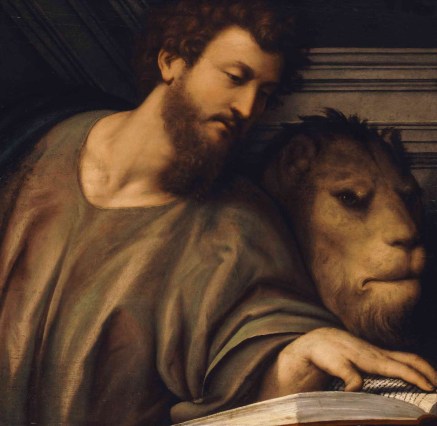
Pordenone: M‡rk evangelista
Mark the Evangelist by Il Pordenone (c. 1484-1539)

Who exactly that person was hides in the mists of early Church history. Several possible “Marks” are mentioned at various points in the New Testament. Whether they are the same or different persons and which, if any, is the author of Mark’s Gospel are questions scripture detectives have chased for centuries.


What the readings offer us today is a young man whom Peter loved and who absorbed the Good News under Peter’s own tutelage.

In today’s passage from Acts, Peter writes to Christians scattered throughout Asia Minor at the time of the persecutions. His teaching is clearly that of the universal leader of the Church helping the scattered flock to hold on to the faith.

Your opponent the Devil is prowling around like a roaring lion
looking for someone to devour.
Resist him, steadfast in faith,
knowing that your brothers and sisters throughout the world
undergo the same sufferings.

It isn’t hard to read these ancient words and imagine Pope Francis speaking them to all of us across the empty reaches of St. Peter’s Square. The suffering of the pandemic tests our faith and resolve. It too is a crucible which can either deepen or fracture our relationship with God.

Peter’s assurance can strengthen us:
The God of all grace
who called you to his eternal glory through Christ Jesus
will himself restore, confirm, strengthen, and establish you
after you have suffered a little.
To him be dominion forever.  Amen.

Mark, who sat at the feet of Peter’s strong and loving leadership, himself went on to become a devoted leader of Christ’s flock. How Mark must have cherished Peter’s brave and tender words to the young suffering Church and harkened back to them so often over the course of his life:

The chosen one (early Christian code for “the whole Church”)
sends you greeting, as does Mark, my son.

Greet one another with a loving kiss.
Peace to all of you who are in Christ.

1Peter5_14 kiss

That gracious “kiss” from Peter carried the the love and power of every Christian, just as we carry it today in our constant prayer for and encouragement of one another.

Music: He Will Make You Strong – hymn based on 1 Peter

Faith Has No Blueprint

Friday of the Second Week of Easter

April 24, 2020

Click here for readings

Today, in Mercy, we meet Gamaliel, the revered rabbinical teacher and early mentor of St. Paul.

Rembrandt_-_Old_Rabbi_-_WGA19186
The Old Rabbi by Rembrandt

With his patient wisdom, Gamaliel famously intervened  to save Peter and John from the Sanhedrin’s wrath.

“Fellow children of Israel,
be careful what you are about to do to these men….
…I tell you,
have nothing to do with these men, and let them go.
For if this endeavor is of human origin,
it will destroy itself.
But if it comes from God, you will not be able to destroy them;
you may even find yourselves fighting against God.”

Biblical scholars have interpreted Gamaliel’s intervention in various and even contradictory ways. Some see in him a hesitancy which will believe only that which is proven and successful. Others suggest that Gamaliel was already a believer who maintained his Sanhedrin position in order to assist the early Christians. In the Catholic canon, Gamaliel is venerated as a saint whose feastday is August 30.

Thinking about Gamaliel may lead us to the question, “What do I need in order to believe?” 

  • Do I, like the Sanhedrin, need to see proven success?
  • Do I, like some of the crowd fed in today’s Gospel, need miracles?
  • Do I, like the rich young man, need answers to all of my questions?
  • Do I, like Thomas, need to see and touch the Resurrected Christ?

In other words, am I looking for a faith that is a fail-proof blueprint, or is my faith a living journey with Christ, as was Peter’s and John’s?

John4_4 bread word

The Apostles’ faith and trust were so complete that they saw even persecution as evidence of God’s plan and power:

So the Apostles left the presence of the Sanhedrin,
rejoicing that they had been found worthy
to suffer dishonor for the sake of the name.
And all day long, both at the temple and in their homes,
they did not stop teaching and proclaiming the Christ, Jesus.

When we are completely given to God in faith, all our life experiences bring us closer to God. All circumstances reveal God to the deeply believing heart.

May we grow every day in that kind of faith.

Music: Increase Our Faith – David Haas

Lord, increase our faith.
With all our heart, may we always follow you.
Teach us to pray always.

So I say to you,
Ask you shall receive.
Seek and you will find.
Knock,  it shall be opened to you.

Whoever asks,
they will receive.
Whoever seeks shall find.
Whoever knocks, the door will be opened.

If you with all your sins know how to give
how much more will God give
to those who cry from their hearts.

The Challenge to Believe

Thursday of the Second Week of Easter

April 23, 2020

Click here for readings

Today, in Mercy, our readings demonstrate how hard it is for some people to believe – because deepening belief usually requires a soul-change.

disputebeforesanhedrin1700
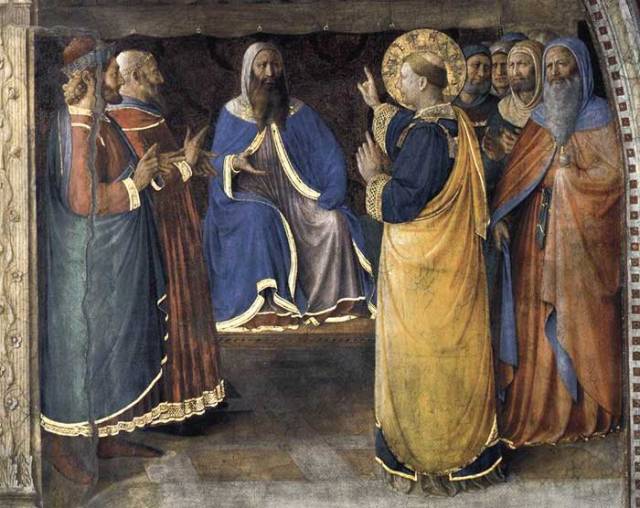
Fra Angelico, Dispute before Sanhedrin, Cappella Niccolina, Palazzi Pontifici, Vatican

In our first reading, the high priest and Sanhedrin just don’t get it. No matter how severe the oppression, Peter and the Apostles are not going to stop sharing the Good News. Even miracles and inexplicable prison escapes do not convince them that maybe the Apostles have some special blessing to offer them.

Why won’t the Sanhedrin listen? Why are they in such denial about what they are witnessing?

The Sanhedrin were members of a privileged class. They had things set up nicely to their material benefit. Jesus was a bombshell turning their comfortable world upside down. So they resorted to any tool possible to eradicate him: denial, oppression, persecution, even murder.

But the Good News of Jesus Christ is ineradicable.

Jn3_believe

In our Gospel, John minces no words about the fate of unbelievers:

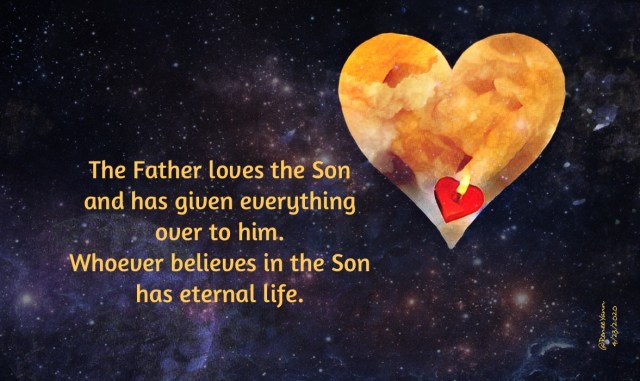
The Father loves the Son
and has given everything over to him.

Whoever believes in the Son has eternal life,
but whoever disobeys the Son will not see life,
but the wrath of God remains upon him.

When I look at our world, I see a lot of that “wrath”, don’t you? I see situations of pain, injustice, greed, and irreverence for Creation that could not exist in a truly believing world.

Seeing these things, I examine my own life for the places where faith has not converted me, for the kinds of resistant behaviors that prevented the Sanhedrin from receiving the greatest gift possible – a fully faithful and compassionate heart.


Here’s a little extra thought from Shakespeare whose birth we celebrate today. The quote from Henry V seems appropriate for the topic.

Henry V

Music: A Faithful Heart – Libera
(I imagine that this lovely song is usually interpreted as a marriage canticle, but I think it perfectly describes the sacred covenant between God and the faithful believer.)

The Seesaw of Faith

Tuesday of the Second Week of Easter

April 21, 2020

Click here for readings

Nicodemus

Today, in Mercy, we meet two towering figures of the early Christian story, Barnabas and Nicodemus.

In our first reading, Barnabas is cited as a devout member of the community of believers which …

… was of one heart and mind,
and no one claimed that any of his possessions was his own,
but they had everything in common.


Our Gospel brings us Nicodemus who “came to Jesus under cover of the night”.  Nicodemus, obviously Ph.D. material, has a long exchange with Jesus in the attempt to come to intellectual comfort with Jesus’s message.

Nicodemus wants his faith to make logical sense before committing to it,  to the point that Jesus sounds a little astounded at the effort:

You are the teacher of Israel
and you do not understand
what I am saying to you?


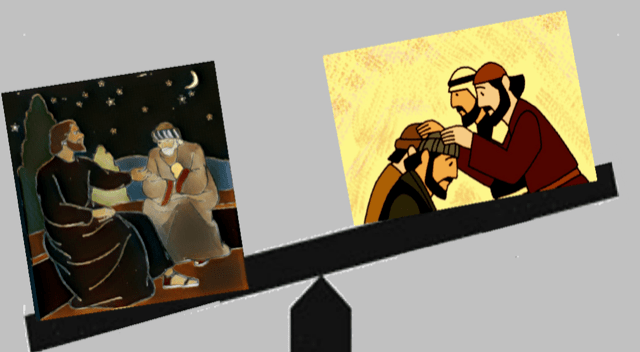
I think a little bit of both Barnabas and Nicodemus lives within each of us.

barnabas seesaw

Like Nicodemus, we do believe, but we would like to understand more. We grapple with concepts of “God’s plan”, with the problem of evil, with what seems the random mercilessness of nature, and myriad other inexplicable realities.

Still, like Barnabas, we trust and are willing to lay our lives at the feet of Christ to be his agents in the world.

That balancing of trust with anxiety is the story of faith for most of us. And it’s OK.  Both Nickie and Barnie turned out to be giants for Christ.  And so will we with God’s help.

Music: Ye Must Be Born Again – sung by The Sensational Nightingales, a beloved Black Gospel Quartet that, with several membership changes, has been popular for over seven decades.  (Lyrics below)

Ye Must Be Born Again
written by William T. Sleeper in 1877

A ruler once came to Jesus by night,
To ask Him the way of salvation and light;
The Master made answer in words true and plain,
“Ye must be born again!”
“I verily, verily say unto thee,
Ye must be born again!”

Ye children of men, attend to the word
So solemnly uttered by Jesus, the Lord,
And let not this message to you be in vain,
“Ye must be born again.”

Oh, ye who would enter that glorious rest,
And sing with the ransomed the song of the blest;
The life everlasting if ye would obtain,
“Ye must be born again.”

Shaken to Life

Monday of the Second Week of Easter

April 20, 2020

Click here for readings

Today, in Mercy, our readings are filled with the sanctifying unrest of the Holy Spirit.

In Acts we read that, despite the internal peace of the early Christian community, they faced a hostile surrounding environment. Nevertheless, they were impelled by the Spirit within them to continue to proclaim Jesus Christ.

shook


Our Gospel remembers Nicodemus, a ruler of the Jews. Grace burned in him too, but it was a subtle light shaded by his early fear. He came to Jesus in the shadows of the night to test the flame in his soul.

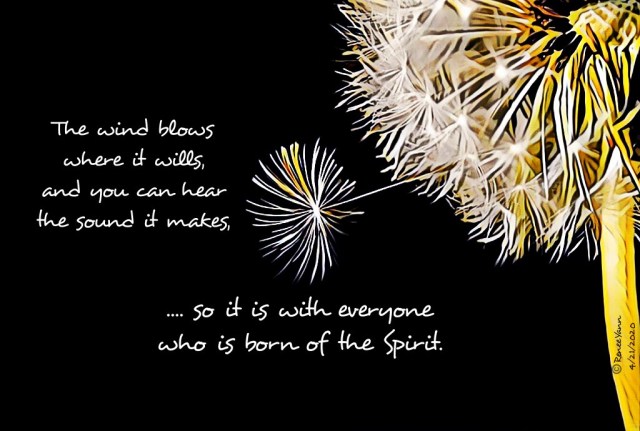
Jesus answered and said to him,
“Amen, amen, I say to you,
unless one is born from above,
he cannot see the Kingdom of God.

balletAgain and again in salvation history, the world is “turned upside down and shaken” by God’s renewing power.  We human beings find ourselves struggling to get our feet under us again as circumstances spin to a new truth. Like graceful ballet dancers pirouetting in space, we must keep our eyes on the fixed point of God’s immovable love.

The early disciples did this. Nicodemus did this. As our world now shakes into a changed reality, it is our turn to lock our hearts on God, opening to the new dream God has for all Creation.

wave

Music: Shake – by Mercy Me (You been sittin’ in that chair a while? Here’s a song you can get up and dance-pray!)

Reborn in God

Second Sunday of Easter

April 19,2020

Click here for readings

Today, in Mercy, our readings offer us a snapshot of the infant Church – a joyful, loving, generous community confidently sharing the Good News of Jesus Christ.

Eucharist

Our Responsorial Psalm, written centuries before their time, prophetically captures their grateful Resurrection prayer:

R. Alleluia.
The stone which the builders rejected
has become the cornerstone.
By the LORD has this been done;
it is wonderful in our eyes.
This is the day the LORD has made;
let us be glad and rejoice in it.


Our second reading from Peter voices the community’s amazed gratitude:

Blessed be the God and Father of our Lord Jesus Christ,
who in his great mercy gave us a new birth to a living hope
through the resurrection of Jesus Christ from the dead,


Friends, how we need that living hope today, in these times that test our souls!

It is true that everyday of our lives we are reborn in God.  New grace, new challenge, new blessing comes to us daily. But the need for that newness has seldom felt so momentous as it does in these pandemic times.

We are challenged:

  • to find God in clouded realty
  • to be a channel of God’s love even in suffering
  • to build the generous community despite isolation
  • to be the touch of Mercy in a touchless world

We may feel a little like Thomas as we pray with these challenges. It must have been so hard for him to touch the wounds of Jesus! And it must have been shocking for him to feel them — these apparent talismans of suffering –  now charged with an infinite transformative power!

My Lord

What changed for Thomas to make him a devout believer? Not his circumstances. Not the reality around him.  Not the challenges before him.

The change came within him because he believed. By looking through suffering to glory, Thomas believed.

May we have that kind of faith in these times that so hunger for it! That kind of faith allows us to be reborn!

(Speaking of being reborn, I am sending a short second reflection today. Today is my 75th birthday and the Psalm is my way of celebrating with all of you.)

Music: Thomas Song – Halleal (Lyrics below)

Thomas’ Song – Hallal

Jesus you were all to me,
Why did you die on Calvary?
O Lamb of God, I fail to see
How this could be part of the plan.

They say that you’re alive again
But I saw death and every sin
Reach out to claim their darkest whim
How could this part if the plan?

If I could only
Hold your hand
And touch the scars
Where nail were driven,
I would need
To feel your side
Where holy flesh
A spear was riven,
Then I’d believe,
Only then I’d believe
Your cruel death
Was part of a heavenly plan.

Holy presence, holy face
A vision filling time and space
Your newness makes my spirit race
Could this be part of the plan?
I see the wounds that caused the cry
From heaven, ocean, earth, and sky
When people watched their savior die
Could this be part of the plan?

Reaching out
To hold your hand
And touch the scars
Where nails were driven
Coming near
I feel your side
Where holy flesh
A spear was riven
Now I believe
Jesus now I believe
Your cruel death
Was part of a heavenly plan
I proudly say
With blazen cry
You are my Lord and my God!


Recognized by Love

Saturday in the Octave of Easter

April 18, 2020

Click here for readings

Today, in Mercy, our readings are about appearances and recognitions.

Acts_recognizedJPG

We pray this morning with the pioneers of our Christian Faith: Mary Magdalen, Peter, John, and all the Eleven. The scriptures tell us the story of their post-Resurrection discipleship – a time of joyous, dynamic commitment to build the faith community, to share the wonder of the eternally living Jesus with all people.

These first Easter Christians were shining with faith…. so much so that it could be said:

Observing the boldness of Peter and John
and perceiving them to be uneducated, ordinary men,
the leaders, elders, and scribes were amazed,
and they recognized them as the companions of Jesus.

Our Gospel summarizes the fact that, for a brief time, the Risen Jesus remained with these disciples to shore up their confidence and commitment. In this passage, He appeared first to beloved Mary Magdalen, then to the unnamed two who journeyed a country road, and finally to the Eleven gathered at dinner.

He had different messages at each appearance:

  • the intimate commission of Mary to be his first announcer
  • the companionable accompaniment of the two distraught disciples from Emmaus
  • the scolding of the “hard-hearted” Eleven with the uncompromising charge

“Go into the whole world
and proclaim the Gospel
to every creature.”


Dear Friends, that charge is meant for each of us as well. For our times, we are the ones commissioned to proclaim that Christ is risen, that the Good News of God’s love is alive in us! Damn the Corona – We are a Resurrection People!

Our prayer today may lead us to consider:

  • Would we, like Mary, recognize the voice of Jesus calling us to deeper discipleship?
  • Would we, like the Emmaus travelers, listen beyond our fears to hear the Truth of Jesus in our circumstances?
  • Would we, like the hesitant Eleven, rebound through our failures to a stronger faith?
  • Would we, like Peter and John, by our faith-filled words and actions, be recognizable as companions of Jesus?

Music: They Will Know We Are Christians- This is a 60s song, reminiscent of the kind of music that flooded the Church after the breakthroughs of Vatican II.  It’s not great music — but I always love hearing it, because it reminds of the joy and enthusiasm of those times when we first realized WE were the Church Alive in the world!

Look to the Other Side!

Friday in the Octave of Easter

April 17, 2020

Click here for readings

jn21_6-cast-net

Late April and the sweet fullness of a spring morning pours down on the silver water. It had been a fruitless night for the weary fishermen, but not an unpleasant one. They had distracted one another from their labors by singing their ancient folksongs and telling the stories of their recent epiphanies. As dawn cracked through darkness, they trailed their fingers in the gentle wake and turned their tired souls towards shore.

And He stood there, misted in diffused radiance. “The starboard side”, he called. “Why?,” they thought; and then again, “Why not?”. With just that small opening in the closed door of their hopelessness, they were overwhelmed with the stunning presence of possibility.

How could these seasoned fishermen have failed to notice the abundance swimming at their side? How could they, so accustomed to the rocking sea, have been narcotized by its lulling darkness?

When we have abandoned hope and tired of the rolling waves; when we have turned the bow toward shore in acquiescence to a hungry morning, remember these disciples. Like them, may we listen for the soft suggestion, “Children…the starboard side…”.

There is always another side, another path to the fullness of life. The hopeless dirges we repeat in our darkness are the devil’s deceptions. The truth is that life runs beside us and with in us, just below the surface of our fears. Love stands on the shore and encourages us to go back for a moment into the darkness, to look again for the hidden blessing, and then to come to the feast in Love’s abiding presence.

Today, in the midst of pandemic’s long night, we are the Apostles. What bold command is Jesus calling to us in the morning mist?

Music: Edward Elgar – The Apostles – a long, beautiful piece you may want to play in the background if you have a quiet space in your day.


Through the Question to the Mystery

Thursday in the Octave of Easter

April 16, 2020

Click here for readings

luke-24_questions

Today, in Mercy, Jesus asks his disciples, “Why do questions arise in your heart?”

Honestly, Lord? How could they not? You have, after all, just RISEN FROM THE DEAD! We’re not used to that, and we’re not sure how to handle it!

And about that Last Supper, when you said the bread and wine were your Body and Blood? It’s a pretty amazing statement, and we’re still trying to comprehend it.

Besides all that, Lord, just now the whole world is languishing in the midst of a pandemic, and we’re not sure exactly where You are!

We’re just human beings, Lord. Our minds naturally work to solve problems. That’s why we have questions – we like answers.

Only now, as Resurrection People, are we beginning to learn that you are much more the “The Answer”.

You will always be “The Mystery” – the Infinity we are invited to –  where there is no end, only deeper, always deeper.

Help us to learn that our faith and our doubts are the same thing – they are our attempts to embrace the Question. Help us transform our doubts to faith by our unequivocal trust in your Mystery.


For God does not want to be believed in,
to be debated and defended by us,
but simply to be realized through us.”
― Martin Buber

Mystery is not to be construed
as a lacuna in our knowledge,
as a void to be filled,
but rather as a certain plentitude.
— Gabriel Marcel


Music: The Mystery of God – Dan Schutte


The Precious Name

Wednesday in the Octave of Easter

Click here for readings

Today, in Mercy, our passage from Acts describes a sacred practice of the early Church – the invocation of the Name of Jesus as a source of spiritual power.

acts3_6 Name

Peter said, “I have neither silver nor gold,
but what I do have I give you:
in the name of Jesus Christ the Nazorean, rise and walk.”


These first Christians were so invested in the Gospel of Jesus Christ that they claimed the right to act in his Name. They also clearly believed that they had no power themselves, but only in that blessed Name.

To call someone by their given name is an act of familiarity, if not intimacy. For those closest to us, we often have nicknames or pet names, conveying a unique understanding of each other.

Calling God by name is an act of both intimacy and worship. In the book of Exodus, God takes the first step in that deeper friendship:

God also said to Moses, “I am the Lord.
I appeared to Abraham, to Isaac and to Jacob
as God Almighty,
but by my name “the Lord”
I did not make myself fully known to them.


With the Incarnation of Jesus, God took the ultimate step in loving friendship with us. To help us understand the nature of this friendship, Jesus gives himself some “nicknames” throughout the Gospel:

  • Good Shepherd
  • Lamb of God
  • the Vine
  • the Way, the Truth, the Life
  • the Bread of Life
  • the Light of the World

Each of these names helps us to enter more deeply into the infinite love God has for us.


Do you have a special name for God? Sometimes, early in the morning when First Light touches my window, I pray with that Name. I ask my Bright God to light my life and the lives of those I love this day. At night, that same window is full of Sweet Darkness, a Name I call God as I ask that we all find a peaceful, protected sleep.

We might also ask if God has a special name for us. At different moments and moods of your life, does God speak to you with a personal, loving “nickname”? If you haven’t heard it yet, why not ask God to whisper it to you in your next prayer?

Jesus, Jesus
Let all creation bend the knee to the Lord.

In Him we live, we move and have our being;
In Him the Christ, In Him the King!
Jesus the Lord.

Though Son, He did not cling to Godliness,
But emptied Himself, became a slave!
Jesus the Lord.

He lived obediently His Father’s will
Accepting His death, death on a cross!
Jesus the Lord.