Becoming “Gospel Real”

Monday of the Fifth Week of Easter
May 8, 2023

Today’s Readings:

https://bible.usccb.org/bible/readings/050823.cfm

Today, in God’s Lavish Mercy, Paul and Barnabas get into a bit of a pickle – actually two pickles.

1- The passage from Acts opens with a planned attempt on their lives:

There was an attempt in Iconium
by both the Gentiles and the Jews,
together with their leaders,
to attack and stone Paul and Barnabas.

Acts 14:5

2- They escape that attempt and flee to Lycaonia where the residents, rather than stoning them, want to idolize them:

When the crowds saw what Paul had done,
they cried out in Lycaonian,
“The gods have come down to us in human form.” 
They called Barnabas “Zeus” and Paul “Hermes,”
because he was the chief speaker.
And the priest of Zeus, whose temple was at the entrance to the city,
brought oxen and garlands to the gates,
for he together with the people intended to offer sacrifice.

Acts 14: 11-13

In both these situations, the listeners cannot accept the good news being preached to them – One Living God who indwells them and all Creation:

We proclaim to you good news
that you should turn from these idols to the living God,
who made heaven and earth and sea and all that is in them.

Acts 14:15

In our Gospel, Jude asks Jesus about this. He wants to know why he has received the gift of faith and others haven’t:

Jesus said to his disciples:
“”Whoever has my commandments and observes them
is the one who loves me.
Whoever loves me will be loved by my Father,
and I will love him and reveal myself to him.””
Judas, not the Iscariot, said to him,
“”Master, then what happened that you will reveal yourself to us
and not to the world?””

John 14:21-22

Jesus tells Jude that it’s pretty simple. You have to love God and do God’s work. If you don’t, no deal:

Jesus answered and said to him,
“”Whoever loves me will keep my word,
and my Father will love him,
and we will come to him and make our dwelling with him.
Whoever does not love me does not keep my words;
yet the word you hear is not mine
but that of the Father who sent me.

John 14:23-24

In Acts, the two resistant crowds resort to stones as means to reject the invitation to a Gospel life.

  • The gang from Iconium would use stones to kill the bearers of the Word.
  • The Lystra crowd wants to “idolize” Paul and Barnabas, a word which means “to convert to an image”, like a stone statue.

When we try to kill or to idolize something or someone, we distance ourselves from it. We make it “other”, unlike us, unattainable to relationship.


Jesus is real, not stone. He wants to live in us, not be enshrined.

The Gospel is real and needs to be expressed in our real lives – in our actions, choices and relationships.

We must look deep into ourselves for even the smallest place where we kill or petrify the Infinite Love that calls us to become Real within It’s Heart.


Prose: ― Margery Williams Bianco, The Velveteen Rabbit

“Real isn’t how you are made,’ said the Skin Horse.
‘It’s a thing that happens to you.
When a child loves you for a long, long time,
not just to play with, but REALLY loves you,
then you become Real.’

‘Does it hurt?’ asked the Rabbit.

‘Sometimes,’ said the Skin Horse,
for he was always truthful.
‘When you are Real you don’t mind being hurt.’

‘Does it happen all at once,
like being wound up,’ he asked, ‘or bit by bit?’

‘It doesn’t happen all at once,’ said the Skin Horse.
‘You become. It takes a long time.
That’s why it doesn’t happen often to people who break easily,
or have sharp edges,
or who have to be carefully kept.
Generally, by the time you are Real,
most of your hair has been loved off,
and your eyes drop out
and you get loose in the joints and very shabby.
But these things don’t matter at all,
because once you are Real you can’t be ugly,
except to people who don’t understand.”


Music:What Is Real – adapted by Glyn Lehman form The Velveteen Rabbit by Margery Williams

Velveteen Rabbit
What is real?
What is real?
And how does it feel?
Does it happen all at once?
Does it happen all at once, or bit by bit?
What is real?
What is real?

Skin Horse
Real is when somebody cares
And you feel alive for the very first time
It won’t happen at once
You will slowly become
You will see yourself through their eyes
See yourself through their eyes

Velveteen Rabbit
What is real?
What is real?
And how does it feel?
Does it hurt a little bit?
Does it hurt a little bit to make that change?
To be real
To be real

Skin Horse
Real is when somebody cares
And you feel alive for the very first time
Sometimes real can hurt
But you really won’t mind
If that’s what it takes to be real
What it takes to be real

It’s like magic when you are loved
Though you are worn, your seams are torn
There’s a glow inside
That is real

Velveteen Rabbit
That is real

Skin Horse, Velveteen Rabbit
That is real

Plug In!

Fifth Sunday of Easter
May 7, 2023

Today’s readings:

https://bible.usccb.org/bible/readings/050723.cfm

Today, in God’s Lavish Mercy, and as we come closer to the end of the Easter season, our Sunday readings repeat essential themes which invite us to the Beloved Community:

  • In Acts, the nascent Christian community grows, organizes, reflects and preaches the Good News.
  • In John’s Gospel, Jesus reiterates his enduring presence and love for all who live in his Word.
  • In his letter, Peter calls the growing community to recognize themselves as God’s dwelling place whose foundation has been secured in Christ.

This Sunday’s readings invite us, for the sake of the whole Church, to draw power for our Christian lives today:

They ask us to reflect on the experience of the early Church
and to learn from the way these Christians grew
in their understanding of faith and discipleship.

As the number of disciples continued to grow…
the Twelve called together the community of the disciples….
The proposal was acceptable to the whole community…
The word of God continued to spread,
and the number of the disciples in Jerusalem increased greatly

Acts 6

They ask us to respond to the timeless call
to be God’s Presence in the world.

Come to him, a living stone, rejected by human beings
but chosen and precious in the sight of God,
and, like living stones,
let yourselves be built into a spiritual house…
acceptable to God through Jesus Christ.

1 Peter 2:4-5

They assure us that Jesus indwells and blesses
our faithful commitment to this call.

Do not let your hearts be troubled.
You have faith in God; have faith also in me.
In my Father’s house there are many dwelling places…

Amen, amen, I say to you,
whoever believes in me will do the works that I do,
and will do greater ones than these,
because I am going to the Father.

John 14:1-2;12

Let’s face it, we live a long way in time from that bubbling little faith community described in Acts. Peter’s and Jesus’ encouragement have to echo down two thousand years to reach us! It’s not easy to stay plugged in to the dynamic power offered in today’s readings. How do we do that?

We have these amazing gifts to draw on:

  • the capacity to pray
  • the indwelling of the Holy Spirit resident in our souls
  • the blessing of a sacramental life
  • the living Word of the scriptures
  • the rich legacy of spiritual writings stored up through history
  • the current library of spiritual and theological literature
  • the sacred gifts of poetry, music and art
  • the beauty of God’s Creation in nature
  • the witness of our surrounding faith communities both living and dead

How unfortunate if we fail to recognize these gifts, given as means to open our hearts to our shared call to holiness!


Poetry: Mysteries, Yes – Mary Oliver

Truly, we live with mysteries too marvelous
to be understood.
How grass can be nourishing in the
mouths of the lambs.
How rivers and stones are forever
in allegiance with gravity
while we ourselves dream of rising.
How two hands touch and the bonds will
never be broken.
How people come, from delight or the
scars of damage,
to the comfort of a poem.

Let me keep my distance, always, from those
who think they have the answers.

Let me keep company always with those who say
“Look!” and laugh in astonishment,
and bow their heads.

Music: One Love – Bob Marley

This Day I Have Begotten You

Friday of the Fourth Week of Easter
May 5, 2023

Today’s Readings:

https://bible.usccb.org/bible/readings/050523.cfm

Today, in God’s Lavish Mercy, our readings again draw our hearts to the power of the Resurrection to transform our lives.

The passage from Acts gives us the first half of Paul’s sermon in Pisidian Antioch, to a gathering of both Jews and Gentiles. Paul, who did not know Christ before the Resurrection, calls on the witness of the original disciples who shared earthly ministry with Jesus:

For even though (the inhabitants of Jerusalem and their leaders) 
found no grounds for a death sentence,
they asked Pilate to have Jesus put to death,
and when they had accomplished all that was written about him,
they took him down from the tree and placed him in a tomb. 
But God raised him from the dead,
and for many days he appeared to those
who had come up with him from Galilee to Jerusalem. 
These are now his witnesses before the people.

Acts 13:28-31

These witnesses attest to the primordial element of our faith:

Jesus Christ conquered death
and, in doing so,
gave all of us
the gift of eternal life in him.

This amazing truth is not something outside or distant from us. This truth is the core of our lives in faith. By believing it, remembering it, calling its dynamism into our dailyness, we are endowed with the power of God to live beyond death even in the midst of it.


In the life of my religious community, spring is always a time of Jubilee – a time to acclaim God’s rejuvenation of nature and life.

Just after Easter, we capture Alleluia grace to celebrate our sisters and their decades of fidelity. These Silver, Golden and Diamond years unfold in a perpetual wave from the time of Catherine McAuley. At Jubilee, we bathe in their awesome and unwordable grace. Last Friday evening, we held this year’s celebration, one bursting with the sentiments of “L’chiam” – To Life!


But just on that same Friday afternoon, one of our venerable sisters had died after living over 70 years in Mercy. I know the contrasting emotions struck many of us in our jubilant chapel. These feelings became even more evident as we read the back cover of our program naming all those Jubilarians who had preceded us to heaven.

Will we all meet in heaven?

O what joy even to think of it.

Catherine McAuley: Letter to Teresa White February 3, 1841


And that, my dear friends, is the key word: HEAVEN – another word for the eternal life given us in the Resurrected Christ. We don’t always realize it but, through Easter grace, we are living in heaven right now. Death, transformed forever in Jesus, is the unmasking which allows our full realization.


This is what Jesus conveyed to his disciples in today’s Gospel. Don’t be afrain of anything – not even death. I am already completely with you.

Jesus said to his disciples:
“Do not let your hearts be troubled. 
You have faith in God; have faith also in me. 
In my Father’s house there are many dwelling places.
If there were not,
would I have told you that I am going to prepare a place for you?
And if I go and prepare a place for you,
I will come back again and take you to myself,
so that where I am you also may be.
Where I am going you know the way.”

John 14:1-4

In Greek, the phrase for “do not be troubled” ( ταρασσεσθω – tar-as’-so) pertains particularly to the dread of death natural to the human condition. This is the fear that Jesus wishes to alleviate for his disciples, especially as he moves into the Paschal event.

He wishes to soothe that fear in us as well. We have the inifinite assurance of eternal life. When we face death, the loss of friends, or the overwhelming weight of the passing years, we can reach through any heaviness to that Resurrecting Light. By the life-giving invitation of Christ, we – and all whom we ever love – are already residents in the mansion of God.

Alleluia – Jubilate


The Jubilarian celebrants, most in the video above, are:

75 years: Sister Mary Jude DiSciascio, Sister Mary Klock, Sister Eileen Trinity

70 years: Sister Maryann Burgoyne, Sister Maria Madonna Johnson, Sister Joanne McIlhenney, Sister Rosemary Powers

60 years: Sister Sara Anne Condart, Sister Maureen Crissy, Sister Georgia Greene, Sister LaVerne Marie King, Sister Patricia Leipold, Sister Dorothea Maholland, Sister Mary Mulholland, Sister Beverly Palumbo, Sister Benvinda Ann Pereira, Sister Elaine Schaeffer, Sister Monica Sheehy, Sister Bonita Marie Smith, Sister Renee Yann

50 Golden Years: Maureen Roe, Terry Saetta, Susan Walsh and Regina Ward.


Poetry: Near Sunset on the Shore – Renee Yann, RSM


Four o’clock, life’s waning autumn afternoon;
daylight spent against the salted sea.
Tide, this moment, turns to imperceptible ebb.
Evening imagines its own midnight, indigo.

Same shore; same horizon. Only
sky, drunk deep, betrays change.
Jigger of sunset, rubied brandy,
introduced to unintoxicated day.

Now come the memories, wave
upon wave, inviting immersion. Now come
the lingering hopes, vortex of longing for
all that has or might have been loved.

Now in near-dusk, understanding,
feeble at first, then determined.
Can so little really have mattered?
Can the one truth simply have been

riveted presence, moment by moment,
to pain and to joy; fascination, ennui?
Has Sacred Fire smoldered so long
In such innocent ashes?

The question, or is it the answer, hovers and stills.
Sweet, purple evening rises like smoke from the embers
Of the inessential and shorn. Once, some distant morning,
hearts were set to this moment in brilliant, unproven vows.

The ocean of years, in hypnotic cadence,
Allowed, then rescinded, distraction.
Now, under its waves, tenacious and constant,
deep diving down in the luminous darkness of God.


Music: Divine Mystery – Heather Houston (lyrices below)


Oh I am opening up for a dance with Divine Mystery
Oh I am trusting the path that’s unfolding before me with ease

Just let go now, trust the flow
Just let go now, then you’ll know

Right on time now, I’ve arrived
Right on time now, I’m aligned

Athanasius in Spring

Memorial of Saint Athanasius, Bishop and Doctor of the Church
May 2, 2023

Today’s Readings:

https://bible.usccb.org/bible/readings/050223.cfm

Today, in God’s Lavish Mercy, we celebrate the feast of St. Athanasius, and since our readings repeat themes we have prayed with for a few days, I thought we might focus our prayer today on Athanasius.

Living in 4th century Egypt, Athanasius was a Church Father – one of the ancient and influential Christian theologians and writers who established the intellectual and doctrinal foundations of Christianity. (For insight into the often uncelebrated Church Mothers, see this excellent article: https://www.ncronline.org/news/opinion/simply-spirit/honor-mothers-early-christianity-during-womens-history-month )


During his lifetime, the Church struggled with the heresy of Arianism which questioned whether Jesus was really God. Athanasius was named a Doctor of the Church for his steadfast defense of the doctrine of the divinity of Christ. Some of Athanasius’s writings are suggestive of the theology of our great modern theologians, and so necessary for our spirituality today.

The Self-revealing of the Word
is in every dimension –
above, in creation;
below, in the Incarnation;
in the depth, in Hades;
in the breadth, throughout the world.
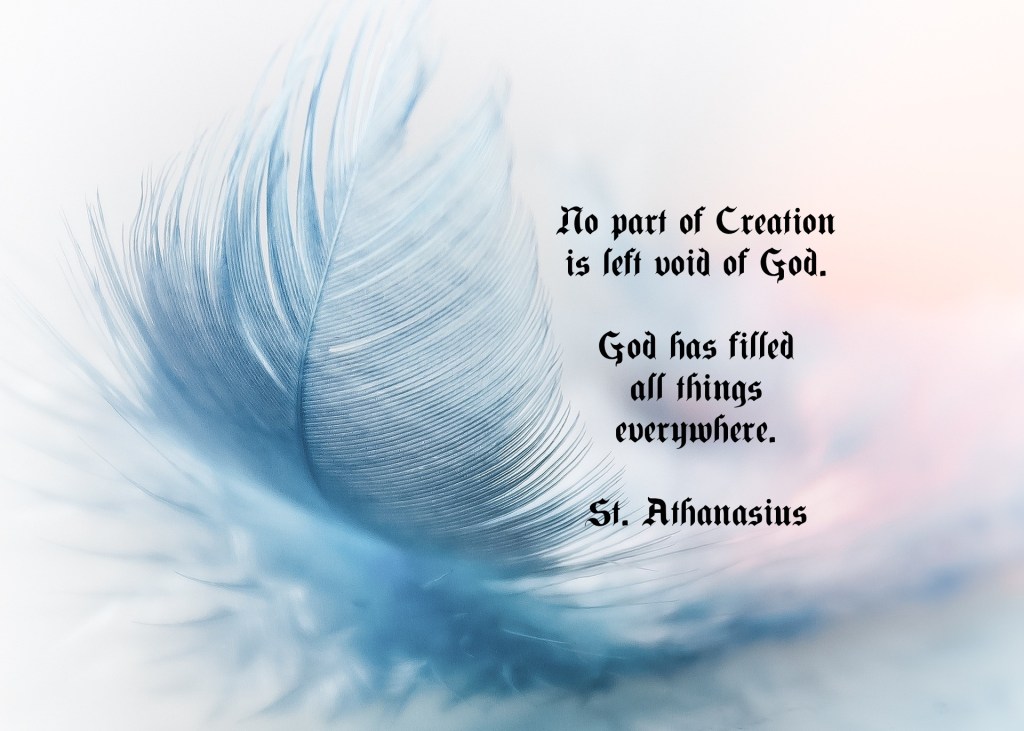
All things have been filled
with the knowledge of God.

St. Athanasius

Pierre Teilhard de Chardin, the revered Jesuit theologian of the early 20th century, writes in a tone suggestive of Athanasius:

If we live at a distance from God, the universe remains neutral or hostile to us. But if believe in God, immediately all around us the elements, even the irksome, organize themselves into a friendly whole, ordered to the ultimate success of life.

Pierre de Chardin, SJ in Christianity and Evolution

More recently, beloved Pope Francis teaches with the same sacred appreciation of the “mystical” depths of Creation:

The universe unfolds in God, who fills it completely. Hence, there is a mystical meaning to be found in a leaf, in a mountain trail, in a dewdrop, in a poor person’s face. The ideal is not only to pass from the exterior to the interior to discover the action of God in the soul, but also to discover God in all things.

Pope Francis in Laudato Sí, 84)

As we pray in these early days of May, still drenched in the glory of Easter, may we hear God speaking to us in the infinitely new and ever-evolving power and beauty of all Creation.

The occurrence of chance in the world in its own finite way reflects the infinite creativity of the living God, endless source of fresh possibilities. The indwelling Creator Spirit grounds not only life’s regularities but also the novel occurrences that open up the status quo, igniting what is unexpected, interruptive, genuinely uncontrolled, and unimaginably possible. As boundless love at work in the universe, the Spirit embraces the chanciness of random mutations, being the source not only of order but also of the unexpected breaks in order that ensure freshness. Divine creativity is much more closely allied to the outbreak of novelty than our older order-oriented theology ever imagined

Elizabeth Johnson, CSJ – Distinguished Professor of Theology at Fordham University in her book, Ask the Beasts: Darwin and the God of Love

Poetry: Spring – Mary Oliver

Somewhere
a black bear
has just risen from sleep
and is staring
down the mountain.
All night
in the brisk and shallow restlessness
of early spring
I think of her,
her four black fists
flicking the gravel,
her tongue
like a red fire
touching the grass,
the cold water.
There is only one question:
how to love this world.
I think of her
rising
like a black and leafy ledge
to sharpen her claws against
the silence
of the trees.
Whatever else
my life is
with its poems
and its music
and its glass cities,
it is also this dazzling darkness
coming
down the mountain,
breathing and tasting;
all day I think of her -—
her white teeth,
her wordlessness,
her perfect love.

Music: Spring from The Four Seasons – Antonio Vivaldi

The Noble Shepherd

Monday of the Fourth Week of Easter
May 1, 2023

Today’s Readings:

https://bible.usccb.org/bible/readings/050123.cfm

Today, in God’s Lavish Mercy, our Gospel invites us, once again, to pray in the company of the Good Shepherd. (The Greek phrase could better be translated as “The Noble Shepherd“)


Just a bit earlier in his sermon, Jesus delivered this blockbuster to the gathered crowd:

I came so that you might have life
and have it more abundantly.

John 10:10

I don’t know how those on the ancient hillside received this stunning announcement, but I know that I have heard and read it a thousand times with a dull and stupid heart.


We let ourselves get used to the scriptures. We hear the priest humdrumming the words while we entertain a tumble of distractions in our foggy heads. We pray the words in our quiet rooms while sleep nibbles away at their astounding meaning.

But here’s what our Gospel shouts to us this morning:

I am here to give you abundant life!
For heaven’s sake, let your heart and soul stand up,
open your arms, and embrace the gift I offer you.


Several deep lessons reside within today’s reading, but we might choose to focus on this:

I am the good shepherd,
and I know mine and mine know me,
just as the Father knows me and I know the Father;
and I will lay down my life for the sheep.

John 10: 11-12

Jesus is telling us
that he is our “good shepherd” for this reason:
because he knows and loves us with the same intensity
that he and the Father know and love each other.

In other words, Jesus loves us with a love that absorbs us into the heart of God. There, we are fed with that love and given an infinitely abundant life – a life that demands to be given and shared.


Jesus tells us that he will lay down his life for his sheep, because this is the nature of Divine Love — it is fully self-giving. The Creator gave everything for us in the gift of Jesus. Jesus gave everything for us in the Paschal Gift. We, recipients of these infinite gifts, are called to give everything for the sake of God’s love in the world.

Does this mean we all have to run out and try to be martyrs? Certainly not. It might be even harder to respond to this call with consistent dailyness than it would be to do so with martyrish abandon.


Our reading from Acts helps us understand what this divine love looks like in an ordinary life. It looks like openness to the Holy Spirit, willingness to change for the sake of others’ good, inclusion of all people in the loving community, actions that build unity and reverence for one another.


The Good Shepherd is a Giving Shepherd who teaches us that we have such an abundance of life in him that we are safe giving our small portion of life for others. We do not need to bury, fortify, protect, and squirrel away our life like misers and hoarders – because, in God, all that we give is continually replaced with even greater plentitude.

We do not have to be first, smartest, prettiest, richest, most powerful, always right or all the other perfectionisms we sometimes are deluded by.

What we have to be is kind, merciful, open, forgiving, honest, generous and humble. These are the true currencies of abundant life in Christ. With the amazing gift we have been given, we are called to allow God to “shepherd” through us in our own particular “sheepfold”.


In his transcendent love, Jesus laid his life down willingly for our sake, and that utter willingness allowed him to take it up again in glory. We might be invited to do a little “life-laying down” ourselves today. Can we find Christ’s invitation, promise, and power within that ordinariness?


The Good Shepherd by James Tissot


Poetry: On Generosity – Walter Brueggemann

On our own, we conclude:
there is not enough to go around
we are going to run short
of money
of love
of grades
of publications
of sex
of beer
of members
of years
of life
we should seize the day
seize our goods
seize our neighbours goods
because there is not enough to go around
and in the midst of our perceived deficit
you come
you come giving bread in the wilderness
you come giving children at the 11th hour
you come giving homes to exiles
you come giving futures to the shut down
you come giving easter joy to the dead
you come – fleshed in Jesus.
and we watch while
the blind receive their sight
the lame walk
the lepers are cleansed
the deaf hear
the dead are raised
the poor dance and sing
we watch
and we take food we did not grow and
life we did not invent and
future that is gift and gift and gift and
families and neighbours who sustain us
when we did not deserve it.
It dawns on us – late rather than soon-
that you “give food in due season
you open your hand
and satisfy the desire of every living thing.”
By your giving, break our cycles of imagined scarcity
override our presumed deficits
quiet our anxieties of lack
transform our perceptual field to see
the abundance………mercy upon mercy
blessing upon blessing.
Sink your generosity deep into our lives
that your muchness may expose our false lack
that endlessly receiving we may endlessly give
so that the world may be made Easter new,
without greedy lack, but only wonder,
without coercive need but only love,
without destructive greed but only praise
without aggression and invasiveness….
all things Easter new…..
all around us, toward us and
by us
all things Easter new.
Finish your creation, in wonder, love and praise. Amen.

Music: The Lonely Shepherd – written by James Last and played here by Louis Grosari

The Narrow Gate

Fourth Sunday of Easter
April 30, 2023

Today’s Readings:

https://bible.usccb.org/bible/readings/043023.cfm

Today, in God’s Lavish Mercy, Jesus tells us the he is “the gate”. If he were here, preaching to us in person today, the symbol wouldn’t work as well as it did in his own time. In the countryside of the Gospels, there were gates all over the place protecting flocks from the multiple threats around them.

But my guess is that you haven’t seen one of these things recently or likely EVER.


So what have we seen that might bring home the essence of the Gospel to us? I’ll tell you what came to my mind.

On occasion, we buy bulk candy for our Sisters at our nursing facility. The candy factory has been around for decades and, as in some neighborhoods of the old city, the area surrounding it has become a residential and commercial desert. With that isolation, the property has become unsafe, an unfortunate target for thieves and vandals.

And so the site has been fortified – metal shields, wired windows, old sealed doors. Just try to get inside without the right directions, information, invitation or credentials! See that little red door about the middle of the photo? It doesn’t open for everyone! You have to know the way to get to the sweets inside!


Jesus is telling us that the same thing is true for those seeking salvation. There is only one way, and it is through Jesus – the Gate.

Jesus refers to this symbol frequently so he must be pretty serious about it!

Enter through the narrow gate.
For wide is the gate
and broad is the road that leads to destruction,
and many enter through it.
But small is the gate and narrow the road
that leads to life, and only a few find it.

Matthew 7:13-14

Strive to enter through the narrow door.
For many, I tell you, will seek to enter
and will not be able.

Luke 13:24

Today’s readings remind us about just how serious Jesus is. The folks in Jerusalem, hearing Peter and scared for their complicity in the Crucifixion, want to get directions for passage through the Gate. Peter tells them:

Repent and be baptized, every one of you,
in the name of Jesus Christ for the forgiveness of your sins;
and you will receive the gift of the Holy Spirit.

Acts 2:38

In his letter today, Peter tells us that repentance translates to imitation of Christ in our lives

If you are patient when you suffer for doing what is good,
this is a grace before God.
For to this you have been called,
because Christ also suffered for you,
leaving you an example that you should follow in his footsteps.
He committed no sin, and no deceit was found in his mouth.

1 Peter 2:20-22

In our Gospel, Jesus says that the Gate is available to everyone, but only through him:

I am the gate.
Whoever enters through me will be saved,
and will come in and go out and find pasture.

John 19:7-8

Bottom line? How do I pass through the Gate to the richness inside?

  • Believe
  • Repent – Turn from anything that blocks me from living the Gospel
  • Imitate Christ in my own life

Poetry: A Gate – Donna Mancini – the recipient of a National Endowment for the Arts Fellowship and a New York Foundation for the Arts Grant. She is a professor of English at Hunter College. The poem portrays the poet ,at a spiritually vulnerable time in her life, seeking the Gate to peace.

I have oared and grieved,
grieved and oared,
treading a religion
of fear. A frayed nerve.
A train wreck tied to the train
of an old idea.
Now, Lord, reeling in violent
times, I drag these tidal
griefs to this gate.
I am tired. Deliver
me, whatever you are.
Help me, you who are never
near, hold what I love
and grieve, reveal this green
evening, myself, rain,
drone, evil, greed,
as temporary. Granted
then gone. Let me rail,
revolt, edge out, glove
to the grate. I am done
waiting like some invalid
begging in the nave.
Help me divine
myself, beside me no Virgil
urging me to shift gear,
change lane, sing my dirge
for the rent, torn world, and love
your silence without veering
into rage.

Music: Shepherd Me – Ann Sweeten

Believe and Abide in Me

Friday of the Third Week of Easter
April 28, 2023

Today’s Readings:

https://bible.usccb.org/bible/readings/042823.cfm

Today, in God’s Lavish Mercy, we have two powerful and life-changing readings.

The Conversion of St. Paul – Nicolas Bernard Lepicie


Paul’s conversion is high drama. And Jesus’ invitation to “consume” him is both pivotal and a bit confounding. Both accounts make clear that living our faith is not a walk in the park. It is a wholehearted, dynamic commitment to render the vital presence of Jesus in our lives.


We can probably find ourselves rather easily in Paul’s story, so let’s take on Jesus’ more complex challenge in our prayer today.

The setting is after the miracle of the loaves and fishes. The crowd presses Jesus for another miracle. They like miracles and they like to eat. Hey, I understand!

But Jesus realizes that they’re missing the point. The tsunami of bread and fish was just a sign not the essence of Jesus’ message. His message was, “Now you must BELIEVE!”

The Jews quarreled among themselves, saying,
“How can this man give us his Flesh to eat?”
Jesus said to them,
“Amen, amen, I say to you,
unless you eat the Flesh of the Son of Man and drink his Blood,
you do not have life within you.

John 6:52-53

So Jesus tells them that it was not enough to eat the miracle bread. He says that now they must consume him, make him their source of sustenance, live in such a way that they cannot live without him


Just as food feeds our emptiness and becomes one with us, so Jesus nourishes our spirit and unites with us. And this happens, not by physical consumption, but by our deep and transcendent believing in Jesus.

Whoever eats my Flesh and drinks my Blood
has eternal life,
and I will raise them on the last day.
For my Flesh is true food,
and my Blood is true drink.
Whoever eats my Flesh and drinks my Blood
remains in me and I in them.

John 6:53-54

Jesus’ words threw a powerful challenge to the hungry crowd as they do to us. We can’t just make ourselves believe. Faith is a gift, and sometimes the channels that allow it to pour into our hearts get a little clogged with worldly junk. How can we open those channels up a bit to release the power of faith in our lives?

Perhaps a prayer like this might help:

I exist because of You and within You.
I have nothing and am nothing without You.
You breathe Your life into every moment of my own.
May I see You, trust You, hear Your loving hints to me.
May I make room for You in my heart 
by my choices, prayer, and generosity.
May I abide in You as You so completely abide in me.

Poetry: If Only – Rainer Maria Rilke

If only there were stillness, full, complete.
If all the random and approximate
were muted, with neighbors’ laughter, for your sake,
and if the clamor that my senses make
did not confound the vigil I would keep —
Then in a thousandfold thought I could think
you out, even to your utmost brink,
and (while a smile endures) possess you, giving
you away, as though I were but giving thanks,
to all the living.

Music: Abide – Aaron Williams

Taught By God …

Thursday of the Third Week of Easter
April 27, 2023

Today’s Readings:

https://bible.usccb.org/bible/readings/042723.cfm

Today, in God’s Lavish Mercy, we read the fascinating account of the conversion of the Ethiopian eunuch. The story, filled with heavenly manifestations, may seem “other-worldly” to us and, in a way, that’s just what it is.

There is a new world – a New Covenant – sprung from Christ through the power of his Resurrection. The Acts of the Apostles is the proclamation of that New World given to us in a series of stories and miracles generated through the Holy Spirit.

And the story of the Ethiopian eunuch is a powerful one, offering a spectrum of interpretations and applications to our own spiritual life. However, using today’s Gospel as a lynchpin, let’s explore one particular concept.


In the passage from John, Jesus tells the crowds:


“No one can come to me
unless the Father who sent me draw him,
and I will raise him on the last day.
It is written in the prophets:
They shall all be taught by God.
Everyone who listens to my Father
and learns from him comes to me.

John 6:44-45

In other words, in order to truly understand our reality, we must allow the Spirit of God to enter our hearts and minds — because there is more to what is than meets the eye!

We cannot truly interpret our world with only our own intellectual resources. Our knowledge and understanding must be fed by God so that we may see the deep Spirit living under our otherwise thin perception of life.


The Baptism of the Eunich – Rembrandt

In our passage from Acts, the Ethiopian is a person of faith, a worshipper who seeks God. But he has hit a wall. He realizes that he cannot fully understand God’s revelation without a Spirit-inspired teacher. And lucky him – the Spirit decides to plunk Philip down in the middle of the desert to be that very teacher!

The context of the story tells us that God wants us all to be fully incorporated into God’s own life —

  • no matter how far out we are in our spiritual “deserts”
  • no matter what physical elements define or limit us
  • no matter what walls we hit when trying to live a faithful life

In our Gospel, Jesus tells us that he is the new and perfect source of nourishment for our yearning spirits. It is the Spirit of Jesus that Philip has brought to the Ethiopian.

Amen, amen, I say to you,
whoever believes has eternal life. 
I am the bread of life. 
Your ancestors ate the manna in the desert, but they died;
this is the bread that comes down from heaven
so that one may eat it and not die. 
I am the living bread that came down from heaven;
whoever eats this bread will live forever;
and the bread that I will give
is my Flesh for the life of the world.”

John 6:47-51

Now I doubt that we’re going to find Philip waiting by our “chariot” out in the driveway tomorrow morning. So how are we to be “taught by God“. Here are some ways that I think can help:

  • faithful prayer informed by good spiritual reading
  • devoted scripture study and prayer
  • spiritual retreat and reflection
  • spiritual companionship with others sincerely seeking God

Poetry: Soliloquy of the Ethiopian Eunuch – Robert Phillips

The miracle began with a miracle.
I was sitting in my gold-trimmed chariot
(well, not exactly my chariot—like all
my accoutrements, it belongs to her—
Candace, Queen of all the Ethiopians.
But since she put me in charge of her treasure,
I have the opportunity to live high.
Beauty has its privileges, and I don't mean
Candace. I'm here to tell you: That girl
Wasn't around when they passed out looks).
There I was, biding my time in the chariot,
near Jerusalem where I'd gone to worship.
I'd just passed Gaza, a real cultural desert.
I was studying Isaiah the Prophet
when suddenly this white man was translated—
there's absolutely no other word for it—
he literally was translated from wherever
to right next to me. It was the damndest thing!
He just stood there, ahuffing and apuffing.
Then he says with the greatest impertinence.
"Do you understand that book you're reading?"
His meaning was undeniable: the fact
that I'm black must have implied I'm illiterate,
or ignorant at best, despite my purple
silk robe and heavily gilded chariot.
I said, "This Isaiah is a heavy dude.
Perhaps you can shed some light on this passage?"
He was led as a sheep to the slaughter;
and like a lamb dumb before her shearer,
so opened he not his mouth . … "So who's the he?"
I asked. "Is this Isaiah talking
about himself, or is he palavering about
somebody else?" And Whitey (his real name was
Philip; it means Lover of Horses—ha!)
Whitey explained to me the "he" was Jesus,
and began to preach about the humiliation
of Jesus, and how his judgment was taken
away before his life on earth was taken,
and how he said not one word to save himself.
And now, in order to be saved, a body
must be baptized in the holy name of God.
I took it all in. Then he clambered inside
the chariot, and we commenced riding north,
which was where he came from before translated.
Presently we came upon a teensy pond.
"Here's some H20. So what's to keep you from
baptizing me on the spot?" That set him off
preaching some more: "If you believe with all
your heart that Jesus Christ is the Son of God,
blah blah blah, I'll do it." Seems this Jesus cat
charged him and a bunch of other honkies
to preach all nations about this Jesus stuff.
I told him with my dusky skin I qualified as
"all nations." So I stopped the chariot,
and we both sashayed down to the water hole.
And hallelujah, he baptized me! In the name
of the Father, and the Son, and the Holy Ghost.
Like to drowned me. The waters of salvation
ran down my dreadlocks. My gloomy skin took on
a peaceful hue. My black soul became dove white.
Then that lover of horses disappeared—poof!
It was enough to make my head spin, popping
in and out of the desert like that. Later
I heard Philip was preaching in this city
and that, creating real photo opportunities.
When I got back to the palace, I camped it up
about being saved, being washed in the blood
of the Lamb, and how this black soul now was white
as snow. (Though I confess I've never seen snow.
It's just one of those things you take on faith.)
Queen Candace had a hissy fit, stomped her foot
because she hadn't been baptized and her eunuch
had. I told her she'd just have to wait until
Philip or one of that gang of ten others
came her way. But she never did. I don't think
they thought hateful ugly queens much worth saving .
Now don't think being a eunuch is easy.
It was done so I could better serve my God
and my queen. I continued to lust in my heart.
But now I'm saved, I sleep the sleep of the just.

Music: Immortal, Invisible, God Only Wise – Walter C. Smith

A Dynamic Faith

Wednesday of the Third Week of Easter
April 26, 2023

Today’s Readings:

https://bible.usccb.org/bible/readings/042623.cfm

Today, in God’s Lavish Mercy, our readings allow us to experience the dynamic nature of faith, as it was experienced in the early Church.And it wasn’t always pretty!

The Stoning of St. Stephen – Rembrandt

Acts tells us of a rising violence toward the Christians, especially those considered “Hellenistic Jews”. There was prejudice against them among the Pharisees even before these Jews converted to Christianity. They were “outsiders “:

The Hellenistic Jews are those who speak mainly Greek, and formerly lived outside of Judea and Galilee. But they had settled in Jerusalem — retired, as it were, to the homeland. Nevertheless, they still have affinities with lands of the Jewish dispersion from which they came. The Hebraic Jews are those who speak mainly Aramaic, and were born in Jerusalem or Judea.

Michael Morrison, PhD, professor of Biblical Studies at Grace Communion Seminary


Stephen, the first Christian martyr, was a Hellenist, as was Philip mentioned today as the first Christian missionary. He is a different Philip from the Apostle who remained in Jerusalem according to the passage.


As I picture the forces at work in the early Church, I am reminded of the ocean, ever-changing in its flow from peace to storm, yet ever-constant in its tides.

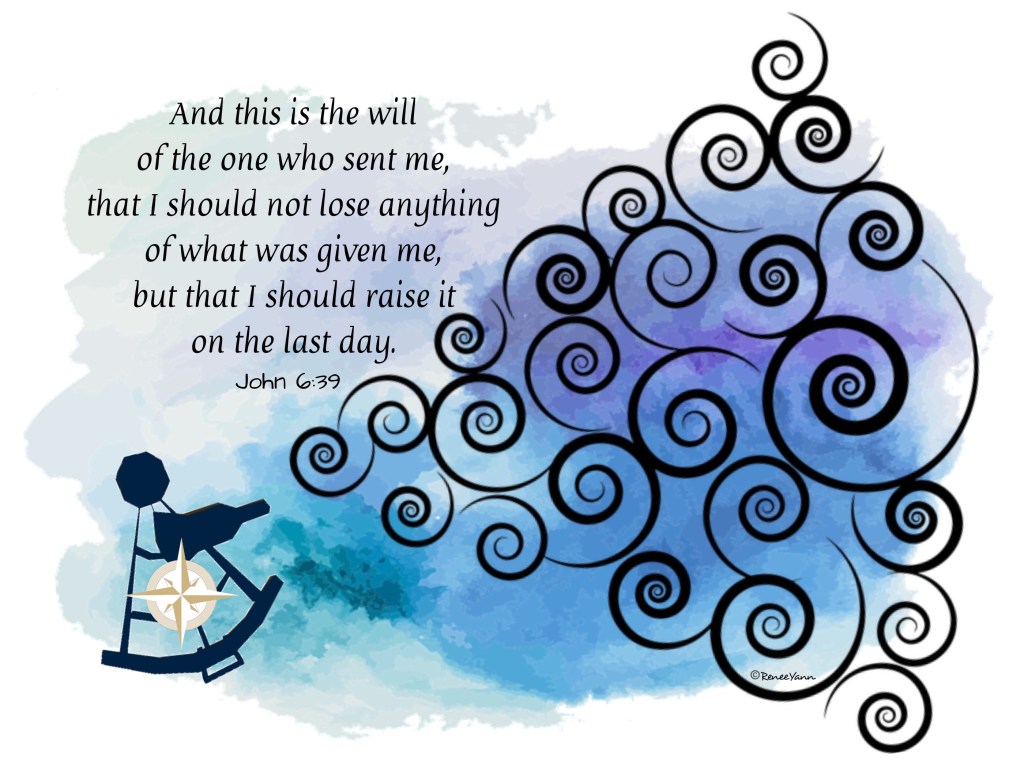
Faith is the anchor holding us steady in the waves, the sextant pointing us toward Christ’s Promise. As our Gospel says:

And this is the will of the one who sent me,
that I should not lose anything of what he gave me,
but that I should raise it on the last day.
For this is the will of my Father,
that everyone who sees the Son and believes in him
may have eternal life,
and I shall raise him on the last day.

John 6: 39-40

Stephen had this vital and tenacious faith, and died for it. Philip had it and shared it. The Apostles had it and held it steady for the rest of us.

How is the vital and dynamic faith living in me? How deeply do I believe and live the Promise? Let’s ask God today to strengthen our faith and to keep our focus on the Promise of eternal life.


Poetry: In Whom We Live and Move and Have Our Being – Denise Levertov 

Birds afloat in air's current,
sacred breath?  No, not breath of God,
it seems, but God
the air enveloping the whole
globe of being.
It's we who breathe, in, out, in, in the sacred,
leaves astir, our wings
rising, ruffled -- but only the saints
take flight.  We cower
in cliff-crevice or edge out gingerly
on branches close to the nest.  The wind
marks the passage of holy ones riding
that ocean of air.  Slowly their wake
reaches us, rocks us.
But storms or still,
numb or poised in attention,
we inhale, exhale, inhale,
encompassed, encompassed.

Music: The Promise – Marc Enfroy

Living the Gospel

Feast of Saint Mark, evangelist
April 25, 2023

Today’s Readings:

https://bible.usccb.org/bible/readings/042523.cfm

Today, in God’s Lavish Mercy, on the feast of St. Mark, our readings instruct and nourish us on how to live the Gospel.

As devout lovers of the Gospel, we have heard this phrase a thousand times: “the Gospel according to Mark…”.

But who was this “Mark”, and how was he motivated to become one of the four Evangelists who have given the Gospel to the ages?

According to Eusebius of Caesarea (260-339 A.D.), Herod Agrippa I, in his first year of reign over the whole of Judea (AD 41), killed James, son of Zebedee and arrested Peter, planning to kill him after the Passover. Peter was saved miraculously by angels, and escaped out of the realm of Herod (Acts 12:1–19). Peter went to Antioch, then through Asia Minor (visiting the churches in Pontus, Galatia, Cappadocia, Asia, and Bithynia, as mentioned in 1 Peter 1:1), and arrived in Rome in the second year of Emperor Claudius (AD 42). Somewhere on the way, Peter encountered Mark and took him as travel companion and interpreter. Mark the Evangelist wrote down the sermons of Peter, thus composing the Gospel according to Mark, before he left for Alexandria in the third year of Claudius (AD 43).

Wikipedia on the Historia Ecclesiastica of Eusebius

Peter dictating the Gospel to Mark
This finely-carved ivory from the 7th century
is in the Victoria and Albert Museum in London.

Our first reading from Peter’s letters gives us an intimate insight into the conversations between Peter and Mark as they traveled those roads in Asia Minor. These were real people reflecting on their call to preach the Gospel to all the world:

Clothe yourselves with humility
in your dealings with one another, for:

God opposes the proud
but bestows favor on the humble.


So humble yourselves under the mighty hand of God,
that he may exalt you in due time.
Cast all your worries upon him because he cares for you.

1 Peter :5-7

While Peter offers these words for the sake of the churches in Asia Minor, picture him sitting only with Mark as Mark diligently scribes Peter’s words. Mark is a young man, maybe still a teenager. His heart is fired with the story of Jesus to the point that he has left his home to travel and learn from this one man who was closest to Jesus himself.

Peter’s stories burn into Mark’s soul and inspire him. Eventually, his own preaching and discipleship will carry the Gospel to the church of Alexandria years after Peter has died, and to us through the written word he inspired.

Our devout and consistent prayer and study of the scriptures allows us to be transformed by that same Sacred Fire – the power of the Holy Spirit given at Pentecost. We, too, can sit beside Peter and Mark and learn from their ardent spirituality.


Dr. Mary Healy is professor of Scripture at Sacred Heart Major Seminary in Detroit. She is a general editor of the Catholic Commentary on Sacred Scripture and author of two of its volumes, The Gospel of Mark and Hebrews. She says this:

What we have not fully taken into account is the first evangelisation – the explosive growth of Christianity in the ancient world, when a handful of fishermen, tax collectors, and ordinary people turned the world upside down for Christ, even while undergoing waves of state-sanctioned persecution.

The beginnings of that story are told in the New Testament, and it’s there that we find the secret to becoming the missionary disciples we are called to be.


Jesus appeared to the Eleven and said to them:
“Go into the whole world
and proclaim the Gospel to every creature.
Whoever believes and is baptized will be saved;
whoever does not believe will be condemned.
These signs will accompany those who believe:
in my name they will drive out demons,
they will speak new languages.
They will pick up serpents with their hands,
and if they drink any deadly thing, it will not harm them.
They will lay hands on the sick, and they will recover.”

Mark 16:15-18

I think that most of us, when we read today’s Gospel, do not see ourselves standing with the Eleven, receiving the ability to “cast out demons, …speak new languages,… handle serpents, … and drink poison…”.

But think about it:

  • How are we called to respond with Gospel grace when we encounter the demon of injustice in our world?
  • How are we called to speak new languages of peace, kindness, and respect for human life in a culture that has normalized violence and deception?
  • How are we called to handle and confront meanness, prejudice, gossip, and hatred when these slither like snakes into our conversations and opinions?
  • How do we help ourselves and others recognize and avoid the poisons of a dishonest and manipulative culture when they threaten our familial, economic, political, educational, religious, and medicinal constructs?

Indeed, we are called to love, learn and live the Gospel in our own particular time and circumstances — just like Mark and Peter were. Let’s pray with them today and ask them to strengthen us in a courageous response to that glorious call.


Poetry: Mark – a sonnet by Malcolm Guite

A wingèd lion, swift, immediate
Mark is the gospel of the sudden shift
From first to last, from grand to intimate,
From strength  to weakness, and from debt to gift,
From a wide deserts haunted emptiness
To a close city’s fervid atmosphere,
From a voice crying in the wilderness
To angels in an empty sepulcher.
And Christ makes the most sudden shift of all;
From swift action as a strong Messiah
Casting the very demons back to hell
To slow pain, and death as a pariah.
We see our Saviour’s life and death unmade
And flee his tomb dumbfounded and afraid.

Music: My God, I Love Thee from St. Mark Passion by Charles Wood (lyrics below)

My God, I love Thee: not because
I hope for heaven thereby,
Nor yet because who love Thee not
Are lost eternally.
Thou, O my Jesus, Thou didst me
Upon the Cross embrace;
For me didst bear the nails, and spear,
And manifold disgrace,

And griefs and torments numberless,
And sweat of agony;
Yea, death itself; and all for me
Who wast Thine enemy.
Then why, most loving Jesus Christ,
Should I not love Thee well?
Not for the sake of winning heaven,
Or of escaping hell;
Not from the hope of gaining aught, 
Not seeking a reward;
But as Thyself has lovèd me,
O ever­loving Lord?
So do I love Thee, and will love,
Who such a love hast showed Only because
Thou art my King,
Because Thou art my God