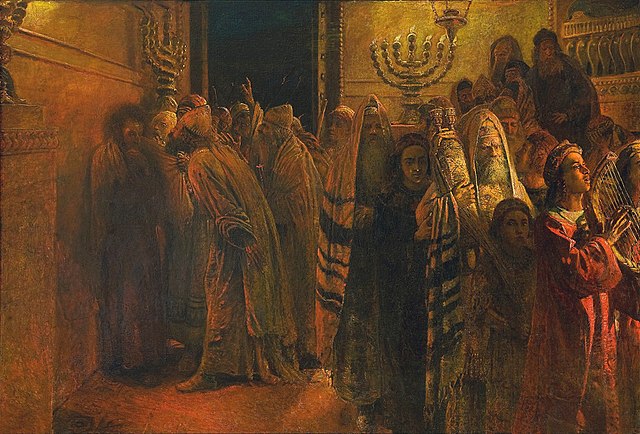
… that you believe…

Monday of the Third Week of Easter
April 24, 2023

Today’s Readings:

https://bible.usccb.org/bible/readings/042423.cfm

Today, in God’s Lavish Mercy, our readings remind us that being a Christian is simple, but not easy.

Stephen, presented to us in our reading from Acts, must have been a beautiful, simple person — almost angelic according to Acts’ description:

Stephen, filled with grace and power,
was working great wonders and signs among the people.

Acts 6:8

All those who sat in the Sanhedrin looked intently at him
and saw that his face was like the face of an angel.
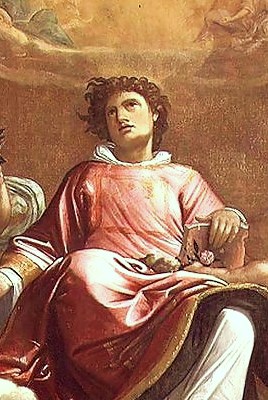
Acts 6:15

St. Stephen – Giacomo Cavedone – c. 1601


Despite his goodness, Stephen became an object of hate and persecution by many:

Certain members of the so-called Synagogue of Freedmen,
Cyreneans, and Alexandrians,
and people from Cilicia and Asia,
came forward and debated with Stephen,
but they could not withstand the wisdom and the Spirit with which he spoke.
Then they instigated some men to say,
“We have heard him speaking blasphemous words
against Moses and God.”

Acts 6:9-11

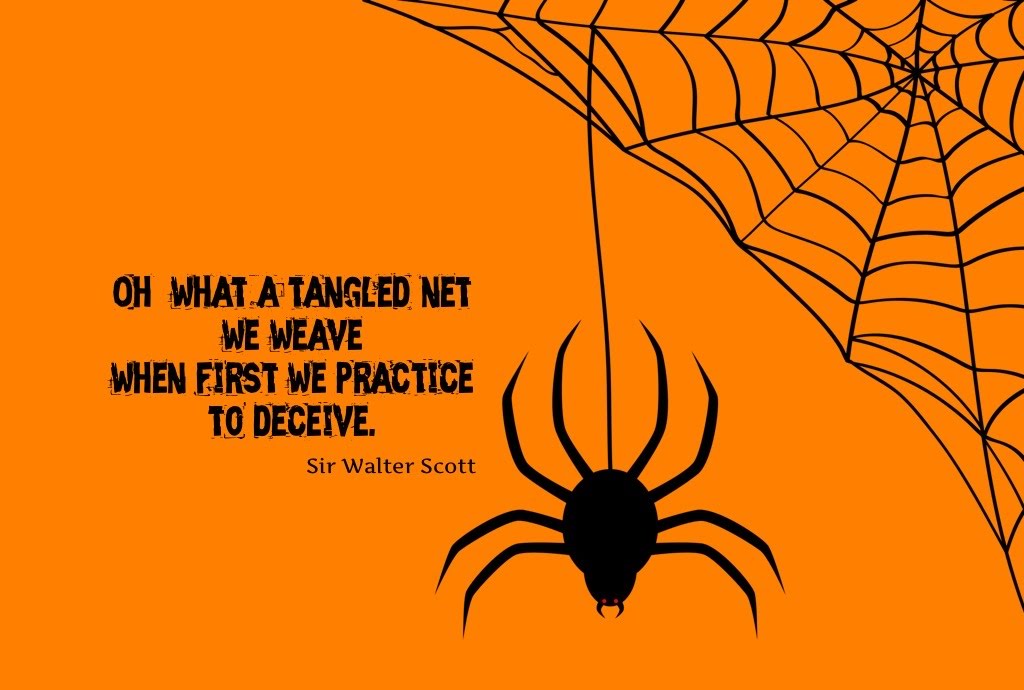
This is such a revealing passage! Stephen’s persecutors cannot challenge his preaching themselves, so they create a web of poisonous lies and entangle some other men in its venom. They instigate these men to spread false allegations against Stephen which will eventually lead to his martyrdom.


There is a vital lesson here for us. Truth matters. Lies matter. They are the engines that drive not only our relationships and actions, but our very culture. And a hard look at our modern culture suggests that we are becoming a culture of lies.

I don’t need to give examples here. We know just from glancing at the newspaper, or perhaps – unfortunately – from reflecting on our own experiences.

We know the people who pretend they are what they are not.

We know who pretends that they are not what they actually are.

Jesus is a Truth Teller. In our Gospel, he gently confronts a bunch of people who are “pretending” their faith. Jesus tells them they’re not so much interested in the Truth he preaches as in the food he provided just yesterday. After all, everybody loves a good picnic!

Jesus answered them and said,
“Amen, amen, I say to you, you are looking for me
not because you saw signs
but because you ate the loaves and were filled.
Do not work for food that perishes
but for the food that endures for eternal life,
which the Son of Man will give you. 
For on him the Father, God, has set his seal.” 

John 6: 26-27

These bread seekers in our Gospel hear Jesus’s challenge so they ask him

“What can we do to accomplish the works of God?”
Jesus answered and said to them,

“This is the work of God,
that you believe in the one he sent.”

Just believe. Doing so will lead us to Truth and to a holy simplicity like that which radiated from Stephen. It’s that simple …. and that hard.


Poetry: A Christmas Hymn – by Richard Wilbur

Although the following poem is out of season, and does not mention Stephen, its refrain references his method of martyrdom: “every stone shall cry”. The poem is also a succinct and lyrical summary of the life of Christ and its meaning for us — a good thing to consider during this Eastertide.

A stable lamp is lighted
whose glow shall wake the sky;
the stars shall bend their voices,
and every stone shall cry.
And every stone shall cry,
and straw like gold shall shine;
a barn shall harbour heaven,
a stall become a shrine.
This child through David’s city
shall ride in triumph by;
the palm shall strew its branches,
and every stone shall cry.
And every stone shall cry,
though heavy, dull and dumb,
and lie within the roadway
to pave his kingdom come.
Yet he shall be forsaken,
and yielded up to die;
the sky shall groan and darken,
and every stone shall cry.
And every stone shall cry
for gifts of love abused;
God’s blood upon the spearhead,
God’s blood again refused.
But now, as at the ending,
the low is lifted high;
the stars shall bend their voices,
and every stone shall cry.
And every stone shall cry
in praises of the child
by whose descent among us
the worlds are reconciled.

Music: Every Stone Shall Cry – Steve Bell musically interprets Wilbur’s poem.

Who? Me?

Third Sunday of Easter
April 23, 2023

Today’s Readings:

https://bible.usccb.org/bible/readings/042323.cfm

Today, in God’s Lavish Mercy, our readings invite us to consider any unrecognized blindness in our lives.

In the passage from Acts, Peter confronts the Israelites with an appalling truth to which they had been blind:

Jesus the Nazarene was a man commended to you by God
with mighty deeds, wonders, and signs,
which God worked through him in your midst, as you yourselves know.
This man, delivered up by the set plan and foreknowledge of God,
you killed, using lawless men to crucify him.

Acts 2:22-23

Peter Preaching in Jerusalem – Charles Poërson -c. 1642

Peter left his audience no outs, no excuses. He put the harsh fact before them and asked them to acknowledge it so that they might move forward in faith.


In our second reading, Peter counsels the early converts to recognize that they were rescued from a spiritually fatal blindness:

… conduct yourselves with reverence during the time of your sojourning,
realizing that you were ransomed from your futile conduct ..

1 Peter 1:17-18

Pilgrims on the Road to Emmaus – James Tissot

Luke’s Gospel gives us the warmly accessible Emmaus story. We have walked beside these beloved, crest-fallen disciples for years, haven’t we? But each year might reveal something different and deeper about the “blindness” that prevented them from recognizing Jesus who walked right beside them.

These progressive revelations can challenge us about how readily we recognize God’s Presence in our lives.

  • Were these otherwise faithful disciples just disappointed that their faith had not been rewarded with the results they expected?
  • Were they angry that they had wasted time trusting an apparent “failure”?
  • Were they only shallow believers anyway who had not really invested in Jesus?
  • Were they riddled with false expectations about the Messiah?
  • Were they so confined by old religious habits that they just couldn’t imagine an “Easter Jesus”?
  • Or were they just tired, hungry and caught on a dark road, thinking they could find an answer all by themselves?

Maybe we’ve been in a spot like theirs sometime in our lives. 


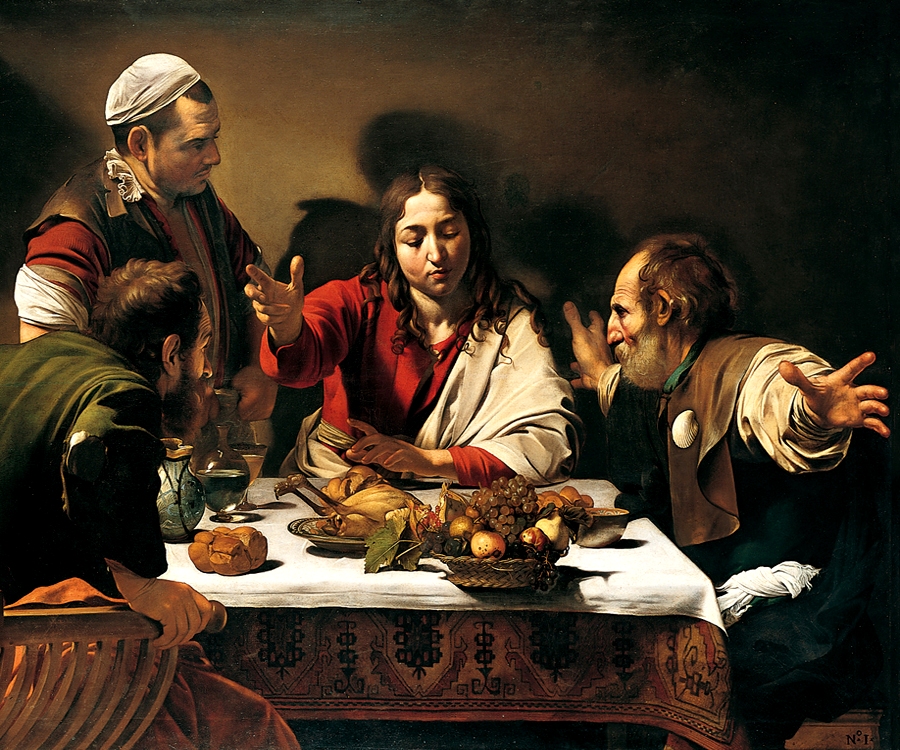
Dinner at Emmaus – Caravaggio


Let’s be with those disciples today and find ourselves in their story. Let’s attend to the “bread” of our dailyness as Jesus breaks it, and let our eyes be opened:

… while he was with them at table,
he took bread, said the blessing,
broke it, and gave it to them.
With that their eyes were opened and they recognized him…

Luke 24:30-31

Poetry: Witness – Denise Levertov

Sometimes the mountain
is hidden from me in veils
of cloud, sometimes
I am hidden from the mountain
in veils of inattention, apathy, fatigue,
when I forget or refuse to go
down to the shore or a few yards
up the road, on a clear day,
to reconfirm
that witnessing presence.


Music: Open My Eyes, Lord – Jesse Manibussan

Water and Pork Chops

Saturday of the Second Week of Easter
April 22, 2023

Today’s Readings:

https://bible.usccb.org/bible/readings/042223.cfm

Today, in God’s Lavish Mercy, little “disruptions” pop up in the center of both our readings.

In Acts, some of the Greek Christians think they are getting the short end of the stick when it comes to food distribution.

Believe me, I can picture the situation using personal experience. When I was an 18 year old postulant, I was a tall, skinny athlete — and I ate a lot of food. I wasn’t used to living in community, and I hadn’t noticed how my voracious appetite might be affecting those around me at the table.

In those “olden days”, the fifty-two of us freshly minted mini-nuns sat “in rank”, i.e according to age. The food was passed down the table from oldest to youngest. When I came to supper one night, the sister below me in rank had moved up a seat to be before me. I thought she just got mixed up about where her chair was so I asked her about it.

She told me she moved up in order to get a pork chop before I took them all!


Well, that’s what the Hellenists are doing in today’s reading which illustrates that living in community is a practical exercise as well as a spiritual one. That practicality calls upon us to make prudent arrangements for the community such as the disciples did in appointing more presbyters led by Stephen.

For us in our various communities today, the reading reminds us to think about the “pork chops” – who needs what and are they getting what they need. This principle holds for both spiritual and material needs and goods. Like the new presbyters, we each have a part to play in achieving that equity within our communities – including families, neighborhoods, churches, workplaces, and the world we share with all Creation.


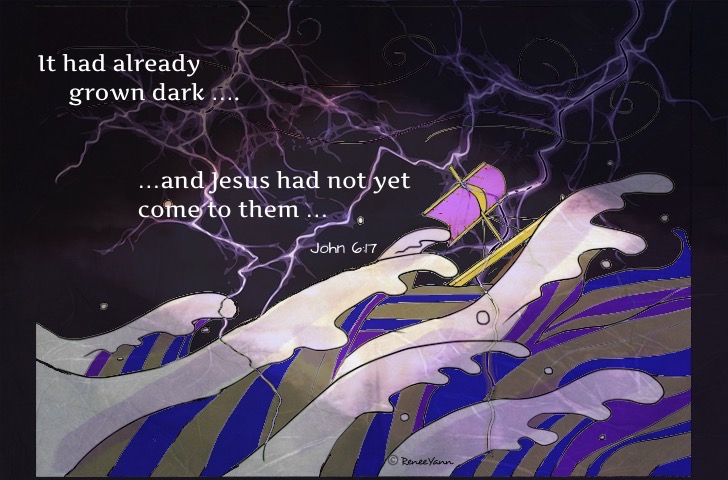
While our Gospel event is narrated in both Matthew and Mark, John gives us his own colorful version of the story of Jesus walking on the water. John highlights the conditions of the sea and atmosphere: darkness, the gusty wind, a turbulent ocean, and the absence of Jesus from the boat:

When it was evening, the disciples of Jesus went down to the sea,
embarked in a boat, and went across the sea to Capernaum.
It had already grown dark, and Jesus had not yet come to them.
The sea was stirred up because a strong wind was blowing.

John 6:16-18

So John makes it clear that it was the customary “dark and scary night“. But the disciples, tossed in the tumult, never express fear until they see Jesus walking across the water toward them. It seems they are less afraid of nature’s power than they are of the power of God!

Jesus sees their fear and tells them not to be afraid. In a phrase reminiscent of God’s self-revelation to Moses ( I am Who am), Jesus simply says, “It is I” — I am God. I am with you. Do not be afraid.


The disciples are still a little nervous and seem to prefer a less omnipotent Jesus . They ask him to get into the boat (in other words, “Be normal – not a Water-Walker”). But Jesus ignores the invitation and simply transports the boat to shore. One might picture the Twelve, tossed up on the shore, mouths agape and beginning to realize that their whole world was being turned upside-down in Christ!


Maybe we’re a little bit like the disciples sometimes. Sometimes we like God in small doses – not in a brilliant revelation or an irresistible call. Jesus snoozing beside us in the boat is comfortable. A radiant God coming to us in our life’s storms is a little harder to adjust to.

Our readings today remind us that God is present in every aspect of our lives – the daily practicalities and the topsy-turvy revelations. God may sit beside us in the boat, or might drag us stunned into another graced shore. But we should not be afraid in any case. Just prayerfully listen for the assurance, “It is I!”


Poetry: Walking on Water – Mark Jarmon

       Always the same message out of Matthew.
The water Jesus walks on is life’s turbulence.
        He calms our trouble and lifts us up again.

To walk on water? That’s what’s puzzling—
        that feat of antimatter, defeat of physics,
those beautiful unshod feet of cosmic truth

        for whom the whole performance is child’s play.
And unless one becomes as a little child
        the kingdom’s inaccessible by any route.

That water, then, its broken surface tension,
        collision of fracturing waves, apparent chaos,
its fractals turning infinite and weaving

        the netted skin between worlds, that web
of light and gravity which underpins our faith,
        water, a substance, stormy or pacific,

we know a myriad ways to get across it.
        But simply walking on it? Literally?
How far do you think you’d go before you fell

        through that convergence between time and space?
The water Jesus walked on wasn’t water
        only. It was the storm that made it rock.

Music: Walk on Water – Elevation Rhythm

God of Abundance

Friday of the Second Week of Easter
April 21, 2023

Today’s Readings:

https://bible.usccb.org/bible/readings/042123.cfm

Today, in God’s Lavish Mercy, our readings offer us two very human, accessible stories.

The first, from Acts, is about the Pharisee named Gamaliel. Gamaliel was a big deal. An esteemed authority in the powerful Sanhedrin, he was the son and grandson of highly respected Jewish teachers. He was wise, prudent, honest and practical. Gamaliel was the “real deal” himself, and he recognized it in others.

Gamaliel and Nicodemus Mourn the Death of Stephen – Carlo Saracini -1615 AD

In today’s reading, Gamaliel intervenes in the Sanhedrin’s relentless pursuit of the early disciples. He basically tells his colleagues, “Hey, wait a minute. If these guys are “the real deal”, there is nothing we can do to undermine them. If they are not, they will undermine themselves. So just cool it for a while.”

While there is scant verifiable evidence to the fact, tradition holds that Gamaliel converted to Christianity. He is venerated as a saint in both the Roman Catholic and the Orthodox traditions.


Our Gospel tells us the familiar yet still amazing account of the miracle of the loaves and fishes.

It’s a wonderful story. I mean just put yourself in this noisy, curious, hungry crowd of 5000 people! Picture Jesus going up the mountainside so they could – maybe – hear what he might say.

Imagine that you’re Philip when Jesus turns to him and asks,
“Where will we get enough food for this crowd?”

Do you see the unspoken answers written all over Philip’s face,
“How should I know? Why are you asking ME!!!!”

The passage says that Jesus was testing Philip, but it was more like a tease when I picture it. Can’t you see the mischievous little smile on Jesus’s face? Jesus knew what he was going to do about the crowd’s hunger. He wanted to be sure his disciples paid strict attention to what was about to happen. So he got them involved with his testing questions.


God wants us to pay attention, too, to what happens when we bring our hungers before God’s merciful goodness. Like the few fish and loaves, God takes the smallest parts of us and builds them up with the gift of grace. God finds the willing fragments of faith, hope and love in us and multiplies them with God’s own power.


With this miracle, Jesus shows his followers and all of us, that there is a sacred reality and Truth beyond the thin scarcities we at first perceive. Deep faith allows us to plumb that reality and to live in its expansive promise. Walter Brueggemann puts it this way:

The feeding of the multitudes … is an example of the new world coming into being through God. When the disciples, charged with feeding the hungry crowd, found a child with five loaves and two fishes, Jesus took, blessed ,broke and gave the bread. These are the four decisive verbs of our sacramental existence. Jesus conducted a Eucharist, a gratitude. He demonstrated that the world is filled with abundance and freighted with generosity. If bread is broken and shared, there is enough for all. Jesus is engaged in the sacramental, subversive reordering of public reality.

Walter Brueggemann, The Liturgy of Abundance, The Myth of Scarcity

Gamaliel opened his heart to this Truth,
as did the first disciples.
It’s our turn now.

(Insert your name), where will we get the food
to feed these hungers in our world?


Poetry: Miracles – Walt Whitman

Why, who makes much of a miracle?
As to me I know of nothing else but miracles,
Whether I walk the streets of Manhattan,
Or dart my sight over the roofs of houses toward the sky,
Or wade with naked feet along the beach just in the edge of the water,
Or stand under trees in the woods,
Or talk by day with any one I love, or sleep in the bed at night with any one I love,
Or sit at table at dinner with the rest,
Or look at strangers opposite me riding in the car,
Or watch honey-bees busy around the hive of a summer forenoon,
Or animals feeding in the fields,
Or birds, or the wonderfulness of insects in the air,
Or the wonderfulness of the sundown, or of stars shining so quiet and bright,
Or the exquisite delicate thin curve of the new moon in spring;
These with the rest, one and all, are to me miracles,
The whole referring, yet each distinct and in its place.
To me every hour of the light and dark is a miracle,
Every cubic inch of space is a miracle,
Every square yard of the surface of the earth is spread with the same,
Every foot of the interior swarms with the same.

To me the sea is a continual miracle,
The fishes that swim—the rocks—the motion of the waves—the
ships with men in them,
What stranger miracles are there?


Music: God of Abundance – Kat Mills

A Good Heart, an “Easter-ed Heart”

Thursday of the Second Week of Easter
April 20, 2023

Today’s Readings:

https://bible.usccb.org/bible/readings/042023.cfm

Today, in God’s Lavish Mercy, the post-Resurrection Apostles continue their unstoppable testimony to Jesus Christ. Their persistence “infuriates” the Sanhedrin who fear the blood of Christ being called down upon them!

“We gave you strict orders did we not,
to stop teaching in that name.
Yet you have filled Jerusalem with your teaching
and want to bring this man’s blood upon us.”
But Peter and the Apostles said in reply,
“We must obey God rather than men. 
The God of our ancestors raised Jesus,
though you had him killed by hanging him on a tree.
God exalted him at his right hand as leader and savior
to grant Israel repentance and forgiveness of sins.
We are witnesses of these things,
as is the Holy Spirit whom God has given to those who obey him.”

Acts 5: 28-33

There is an interesting play in the words and concepts of this reading from Acts.

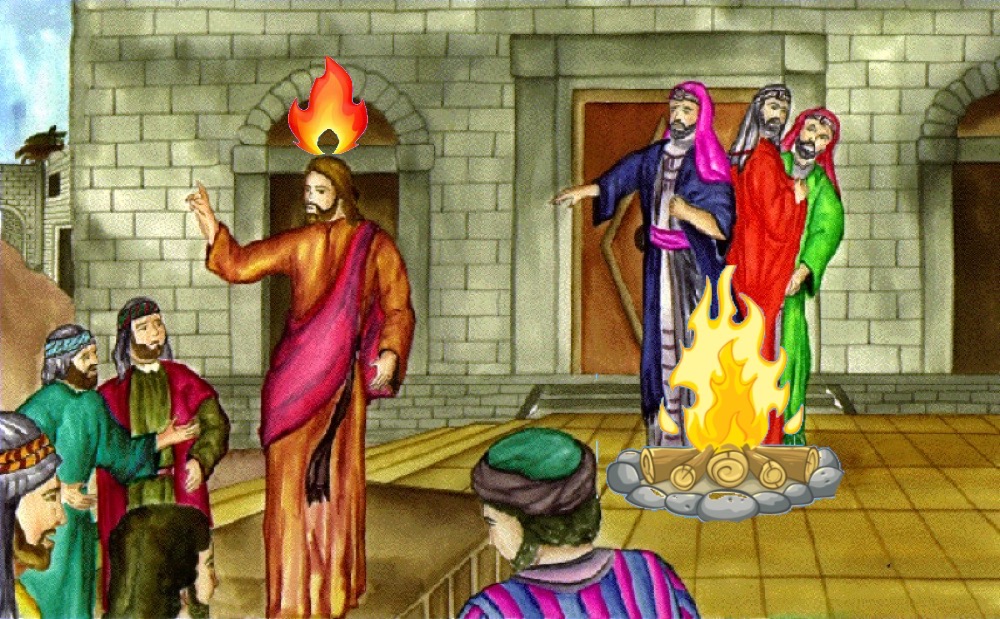
  • While the Sanhedrin are infuriated, or filled with the fire of denial and sin, the Apostles are inflamed with the unquenchable Fire of the Holy Spirit.
  • While the Sanhedrin fear the blood of Christ called down upon them, the disciples hearts are transformed by its power.

The contrast in their responses to God’s Word is stunning.


In our Gospel, John captures this contrast in a nutshell:

The one who comes from above is above all.
The one who is of the earth is earthly
and speaks of earthly things.

John 3:31

In other words, those transformed in the power of the Resurrection see the world with God’s eyes — “from above”. Those unconverted by that Power still see the world in godlessness.


Our Gospel calls us to be like the disciples not like the Sanhedrin.  It calls us to open our hearts:

  • to see the Truth Who is Jesus Christ
  • to believe that the Truth of his Resurrection lives in us
  • to become that Truth through the witness of our lives.

The Gospel calls us to live a whole-hearted faith which allows the Holy Spirit to be expressed in every aspect of our lives. Jesus does not ration the gift of the Spirit, nor should we:

Whoever does accept Christ’s testimony certifies that God is trustworthy.
For the one whom God sent speaks the words of God.
He does not ration his gift of the Spirit.

John 3:33-34

How do we live such a life of Christian witness? Do we have to shout the witness out loud with every action of our lives?  I don’t think so.

Brother David Steindl-Rast describes believers like this:

People who have faith in life are like swimmers who entrust themselves to a rushing river. They neither abandon themselves to its current nor try to resist it. Rather, they adjust their every movement to the watercourse, use it with purpose and skill, and enjoy the adventure.


And the great St. Teresa of Avila blesses believers with this prayer:

May today there be peace within.
May you trust God that you are exactly where you are meant to be.
May you not forget the infinite possibilities that are born of faith.
May you use those gifts that you have received,
and pass on the love that has been given to you.
May you be content knowing you are a child of God.
Let this presence settle into your bones,
and allow your soul the freedom to sing, dance, praise and love.
It is there for each and every one of us.


Poetry: Little Summer Poem Touching The Subject Of Faith by Mary Oliver

Every summer
I listen and look 
under the sun’s brass and even
into the moonlight, but I can’t hear

anything, I can’t see anything — 
not the pale roots digging down, nor the green 
stalks muscling up,
nor the leaves
deepening their damp pleats,

nor the tassels making,
nor the shucks, nor the cobs.
And still,
every day,

the leafy fields
grow taller and thicker — 
green gowns lofting up in the night,
showered with silk. 

And so, every summer,
I fail as a witness, seeing nothing — 
I am deaf too
to the tick of the leaves, 

the tapping of downwardness from the banyan feet — 
all of it
happening
beyond any seeable proof, or hearable hum. 

And, therefore, let the immeasurable come.
Let the unknowable touch the buckle of my spine.
Let the wind turn in the trees,
and the mystery hidden in the dirt

swing through the air.
How could I look at anything in this world
and tremble, and grip my hands over my heart?
What should I fear? 

One morning
in the leafy green ocean
the honeycomb of the corn’s beautiful body
is sure to be there.


Music: A Good Heart – Marc Enfroy

So Loved …

Wednesday of the Second Week of Easter
April 19, 2023

Today’s Readings:

https://bible.usccb.org/bible/readings/041923.cfm

Today, in God’s Lavish Mercy, we continue what we began on Monday, a long immersion in John’s Gospel which will not conclude until Pentecost.

As a guide in praying with the glorious Gospel, I am using a book from the series “A Catholic Commentary on Sacred Scripture”. This particular volume is “The Gospel of John” by Francis Martin and William M. Wright. These authors open their work with this beautiful introduction:

Pope St. Gregory the Great compared Scripture to
a “smooth, deep river
in which a lamb may walk
and an elephant may swim.


These words certainly apply to the Gospel of John.
Within its pages are found divine teachings
articulated with simple images such as water and light,
memorable stories composed with literary and dramatic skill,
and glimpses into the very mystery of God,
proceeding from the most profound mystical illumination.
Like the loaves and fishes multiplied by Jesus,
the Gospel of John provides a superabundance
of spiritual teaching, edification, and challenges to all its readers,
whether beginners or experienced.


Our Gospel today gives us the central point inspiring John’s entire Gospel:

God so loved the world that he gave his only-begotten Son,
so that everyone who believes in him might not perish
but might have eternal life.

John 3:16

As we go deeper into our post-Easter journey, on the way to the confirmation of Pentecost, we need to keep repeating this amazing truth to ourselves …

And it helps to remind ourselves as well that “God so loved ME … that God gave God’s ALL for me.”


As we pray with John’s Gospel over the next several weeks, we will be doing the same work that the Apostles are doing in our first reading from Acts.  We will be telling the story of Love – the story of Jesus who lived, died and rose from the dead to save us.

Each little part of that story can teach us and change us.  By our choice to believe, and to act on that faith, we are transformed from darkness to Light in the power of the Resurrection.

And this is the verdict,
that the light came into the world,
but people preferred darkness to light,
because their works were evil.
For everyone who does wicked things hates the light
and does not come toward the light,
so that his works might not be exposed.
But whoever lives the truth comes to the light,
so that his works may be clearly seen as done in God.

John 3:19-21

For today, we may want to consider any darkness in our world or in ourselves that we wish to carry into God’s amazing Light and Love. There, let us lay the darkness down and pray to live the truth which John encourages us to live.


Poetry: “Truth”, said a traveller by Stephen Crane

“Truth," said a traveller,
“Is a rock, a mighty fortress;
“Often have I been to it,
“Even to its highest tower,
“From whence the world looks black.”

“Truth," said a traveller,
“Is a breath, a wind,
“A shadow, a phantom;
“Long have I pursued it,
“But never have I touched
“The hem of its garment.”

And I believed the second traveller;
For truth was to me
A breath, a wind,
A shadow, a phantom,
And never had I touched
The hem of its garment.

Music: God So Loved the World – Sir John Stainer

God so loved the world,
that He gave His only-begotten Son,
that whoso believeth in Him should not perish,
but have everlasting life.
For God sent not His Son into the world
to condemn the world;
but that the world through Him
might be saved. Amen.

Not So Easy to Be Born Again!

Tuesday of the Second Week of Easter
April 18, 2023

Today’s Readings:

https://bible.usccb.org/bible/readings/041823.cfm

The words in today’s readings are little explosives camouflaged in familiarity.

We are used to reading how the earliest Christians formed a loving and mutual community. We might admire how they held everything in common. We might think how nice and comforting that must have been for everyone.

The community of believers was of one heart and mind,
and no one claimed that any of his possessions was his own,
but they had everything in common.
With great power the Apostles bore witness
to the resurrection of the Lord Jesus,
and great favor was accorded them all.

Acts 4:32

But, friends, I don’t think it was all that comforting! I think it was hard! People who had worked tirelessly to build secure lives had to rethink that security. Whether in material goods or established reputations, they had to give up houses, businesses, rabbi-ships, and political offices to truly be part of this radical new “community”.

They had to split the last two matzah balls with some dude who never worked a day in his life. It’s not easy!


Picture the heated conversations between someone choosing this “community” and a spouse who preferred to keep their big boat and villa by the seaside.

Imagine the rumbling synagogue crowd when the beloved old rabbi told them just to call him “brother”! Hear the distressed uproar when he announced that the Holy Law he had confidently taught them now must be rethought in Gospel light!

I’m pretty sure it wasn’t as smooth as Acts seems to imply. There is a small acknowledgment of that in the notoriety given to astoundingly generous Joseph. He stood out for buying in completely to this new community. ( We’ll hear more about him later under his new name “Barnabas”).

Thus Joseph, also named by the Apostles Barnabas
(which is translated “”son of encouragement””),
a Levite, a Cypriot by birth,
sold a piece of property that he owned,
then brought the money and put it at the feet of the Apostles.

Acts 4:36-37

By Henry Ossawa Tanner

The Gospel story of Nicodemus confirms the struggle to really become a Gospel person. It should be profoundly unsettling to those of us  -and I think that is ALL of us – who sometimes thrive on security, status, and control.

Nicodemus had “made it” in Jewish society. He was considered a good, learned, influential and wealthy man. But Jesus challenges him on every level of his success to test what he values and builds his life on.

  • Is Nicodemus really “good” in light of the Beatitudes?
  • Is he really “learned” in living the law of radical love?
  • Is he really “rich” in holy grace?

  • Or is his “goodness” tinged with judgement?
  • His “learning” mired in self-righteousness?
  • His “wealth” rooted in complacency with systemic injustice?

Jesus tells Nicodemus that the Spirit of God will not be tamed or controlled by these supposed “successes” of his life. Rather, Nicodemus must start all over again to be transformed in God:

Jesus said to Nicodemus:
“‘You must be born from above.’
The wind blows where it wills, and you can hear the sound it makes,
but you do not know where it comes from or where it goes;
so it is with everyone who is born of the Spirit.”

John 3:7-8

And here’s the really hard thing. We must make the “Nicodemus Choice” every day of our lives. Every circumstance invites us either to be “born again” or to choose the old securities we are so falsely comfortable with. Those securities can blind us with the complacency of one who has forgotten how to see.

Jesus answered and said to him,
“You are the teacher of Israel and you do not understand this?
Amen, amen, I say to you,
we speak of what we know and we testify to what we have seen,
but you people do not accept our testimony.
If I tell you about earthly things and you do not believe,
how will you believe if I tell you about heavenly things?

John 3:10-12

Poetry: Nicodemus – Mary Elizabeth Coleridge (1861-1907) 

With slow and stealthy steps he trod 
— The darkening and deserted streets; 
— And no one in the market greets 
The man upon his way to God. 

By night he left the splendid home 
— That sheltered many a sleeping guest. 
— One and another lay at rest — 
The master of the house would roam. 

Was there a single soul that knew? 
— No! For he feared the eye of scorn, 
— The crooked laugh of anger born. 
Only the bats about him flew. 

The broidered borders of his gown 
— He covered o’er, that none might see. 
— Shall good come out of Galilee? 
This were the mock of all the town. 

But in the City named for Peace 
— No peace his weary heart had known, 
— And ever in the crowd alone 
He waged a war that would not cease. 

He came by night — and yet he came. 
— And He that was Himself the Way 
— Shall own him in the Judgment Day, 
And to the world confess his name.


Music: Nicodemus – Graham Kendrick

Born Again

Monday of the Second Week of Easter
April 17, 2023

Today’s Readings:

https://bible.usccb.org/bible/readings/041723.cfm

Today, in God’s Lavish Mercy, our readings open with the disciples praying for courage in the midst of surrounding threats – and the Holy Spirit hears them!

Peter and John had been imprisoned by the priests, the captain of the temple guard, and the Sadducees. And the memory of Jesus horrendous trials is still fresh in the community’s mind. Fear nips at their spirits and so they prayed.

After their release Peter and John went back to their own people
and reported what the chief priests and elders had told them.
And when they heard it,
they raised their voices to God with one accord …
And now, Lord, take note of their threats,
and enable your servants to speak your word
with all boldness, as you stretch forth your hand to heal,
and signs and wonders are done
through the name of your holy servant Jesus.

Acts 4:23-23;29-30

The disciples were asking people to change. And many people don’t like change, especially change that asks them to shake off old, comfortable ways. Even life-giving change is often rejected for the sake of unexamined custom and unwarranted fear.


Just look at Nicodemus in our Gospel. Here is a good man whose heart aches to open to Jesus’s call. But he just can’t imagine himself beyond the old definitions he has allowed to define him for decades.

“Rabbi, we know that you are a teacher who has come from God,
for no one can do these signs that you are doing
unless God is with him.”
Jesus answered and said to him,
“Amen, amen, I say to you,
unless one is born from above, he cannot see the Kingdom of God.” 
Nicodemus said to him,
“How can a man once grown old be born again?’

John 3:2-4

Our Easter-life in Christ calls us to be reborn too. It calls us to be our best selves in light of the Gospel. Often this means breaking through a worldly interpretation of love, justice or wealth to witness the Gospel definition of these things our lives:

Jesus answered,
“Amen, amen, I say to you,
unless one is born of water and Spirit
he cannot enter the Kingdom of God.
What is born of flesh is flesh
and what is born of spirit is spirit.
Do not be amazed that I told you,
‘You must be born from above.’

John 3: -7

What Jesus says to Nicodemus may be hard for us to understand too, but Christ made it very clear and simple in the Sermon on the Mount. Maybe Nicodemus had been there on that earlier day, beginning to wonder about this amazing man. Maybe he will remember and find the courage to respond now that he has actually sought Jesus out for advice.

We will let those crystal clear Beatitudes be our poetry for today, maybe inspiring us to have a Nicodemus style sit-down with Jesus ourselves.


Blessed are the poor in spirit,
    for theirs is the kingdom of heaven.

Blessed are those who mourn,
    for they will be comforted.

Blessed are the meek,
    for they will inherit the earth.

Blessed are those who hunger and thirst for righteousness,
    for they will be filled.

Blessed are the merciful,
    for they will be shown mercy.

Blessed are the pure in heart,
    for they will see God.

Blessed are the peacemakers,
    for they will be called children of God.

Blessed are those who are persecuted because of righteousness,
    for theirs is the kingdom of heaven.

Matthew 5:1-12

Music: Born of God – Steven Kapp Perry

Even When We Do Not See

Second Sunday of Easter
(Sunday of Divine Mercy)
April 16, 2023

Today’s Readings:

https://bible.usccb.org/bible/readings/041623.cfm

Today, in God’s Lavish Mercy, we read about the “Golden Years” of Christianity, those early days when Resurrection glory still lay fresh and warm over the nascent Church:

Awe came upon everyone,
and many wonders and signs were done through the apostles.
All who believed were together and had all things in common;
they would sell their property and possessions
and divide them among all according to each one’s need.
Every day they devoted themselves
to meeting together in the temple area
and to breaking bread in their homes.
They ate their meals with exultation and sincerity of heart,
praising God and enjoying favor with all the people.
And every day the Lord added to their number those who were being saved.

Acts 2: 43-47

Have you had times like that in your life where circumstances merged to make life a little piece of heaven? The right time, the right people, the right work to share? Perhaps the effort was taxing, but the merged joy and enthusiasm carried you through.

Some of my wonderful friends sharing a joyful project together

We cherish such times when we have them. And we remember their stories with tenderness, laughter and gratitude. This kind of remembering is what Luke, Peter, and John offer in our readings. They invite to experience the “indescribable joy” of our “new birth in Christ“ just as they experienced it.


Of course, we weren’t with the disciples in that first post-Easter glow. We might struggle a little, like absent Thomas did, to enthusiastically believe. He demanded to SEE before he would give his heart over:

Thomas, called Didymus, one of the Twelve,
was not with them when Jesus came.
So the other disciples said to him, “We have seen the Lord.”
But he said to them,
“Unless I see the mark of the nails in his hands
and put my finger into the nailmarks
and put my hand into his side, I will not believe.”

John 20:24-25

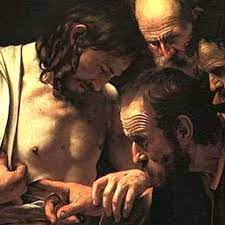
Jesus was so kind to Thomas, wasn’t he – allowing Thomas not only to see, but to touch his sacred wounds.

Jesus is kind to us too. Through our Baptism, we are invited to see and touch Christ’s wounds in our own time and, like the gloriously joyous disciples, to be healers in God’s name.

In this you rejoice, although now for a little while
you may have to suffer through various trials,
so that the genuineness of your faith …
may prove to be for praise, glory, and honor
at the revelation of Jesus Christ.

Although you have not seen him you love him;
even though you do not see him now yet believe in him,
you rejoice with an indescribable and glorious joy,
as you attain the goal of your faith, the salvation of your souls.

1 Peter 1:6-8

Poetry: from “Sounding of the Seasons” by Malcolm Guite

“We do not know… how can we know the way?”
Courageous master of the awkward question,
You spoke the words the others dared not say
And cut through their evasion and abstraction.

Oh doubting Thomas, father of my faith,
You put your finger on the nub of things
We cannot love some disembodied wraith,
But flesh and blood must be our king of kings.

Your teaching is to touch, embrace, anoint,
Feel after Him and find Him in the flesh.
Because He loved your awkward counter-point
The Word has heard and granted you your wish.

Oh place my hands with yours, help me divine
The wounded God whose wounds are healing mine.

Music: Surely God Is With Us – Rich Mullins 

Impossible Not to Speak the Name

Saturday in the Octave of Easter
April 15, 2023

Today’s Readings:

https://bible.usccb.org/bible/readings/041523.cfm

Today, in God’s Lavish Mercy, the reasonable Sanhedrin try to deal with Peter and John’s “bold” testimony for Christ.

Observing the boldness of Peter and John
and perceiving them to be uneducated, ordinary men,
the leaders, elders, and scribes were amazed,
and they recognized them as the companions of Jesus.
Then when they saw the man who had been cured standing there with them,
they could say nothing in reply.

Acts 4: 13-14

The Sanhedrin was an assembly of elders or rabbis appointed to sit as a tribunal in every city in the ancient Israel. As a body, they claimed powers that lesser Jewish courts did not have. As such, they were the only ones who could try the king, extend the boundaries of the Temple and Jerusalem, and were the ones to whom all questions of law were finally put.

from Wikipedia

Peter Before the Sanhedrin by Nikolai Ge (1892)

These men existed on the ultimate power they had over the people. It was the source of their influence, wealth and independence. Now this Jesus and his bold buddies come along trying to upset the apple cart. The old familiar, comfortable world is threatened and they don’t like it.

Their solution is overly simplistic. They tell Peter and John to just shut up:

The Sanhedrin conferred with one another, saying,
“What are we to do with these men?
Everyone living in Jerusalem knows that a remarkable sign
was done through them, and we cannot deny it.
But so that it may not be spread any further among the people,
let us give them a stern warning
never again to speak to anyone in this name.”
So they called them back
and ordered them not to speak or teach at all in the name of Jesus.

Acts 4: 15-17

Peter and John say “sorry guys”! Easter-inspired faith doesn’t work that way:

Peter and John, however, said to them in reply,
“Whether it is right in the sight of God
for us to obey you rather than God, you be the judges.
It is impossible for us not to speak about what we have seen and heard.

Acts 4:18

Peter and John make it sound simple too, don’t they. They tell us that it is impossible not to live our witness to the Gospel.

But I think we all know that it’s not that simple. Witnessing our faith in a morally complex world takes courage, insight, humility and wisdom. 

We are not passive participants in the often crippled world around us. Like Peter and John, we are called to pay attention to suffering, and to be healers. We are called to be witnesses to the Resurrection by the faithful generosity of our lives.


Prose: Marianne Williamson – from A Return to Love

Our deepest fear is not that we are inadequate. 
Our deepest fear is that we are powerful beyond measure. 
It is our light not our darkness that frightens us. 
We ask ourselves 'who am I to be brilliant, gorgeous, talented and fabulous?'
Actually, who are you not to be?

You are a child of God. 
You’re playing small doesn't serve the world. 
There's nothing enlightened about shrinking 
so that other people won't feel insecure around you. 
We were born to make manifest the glory of God that is within us.

It's not just in some of us; its in everyone. 
And as we let our own light shine, 
we unconsciously give other people permission to do the same.
As we are liberated from our own fear,
our presence automatically liberates others

Music: Speak the Name – Koryn Hawthorne 

Extra Song: I can’t help thinking of — Perry Como singing “Impossible”. Of course, this is a romantic song, but the same principles hold in our devotion to God, and God’s to us. Think about it 🙂