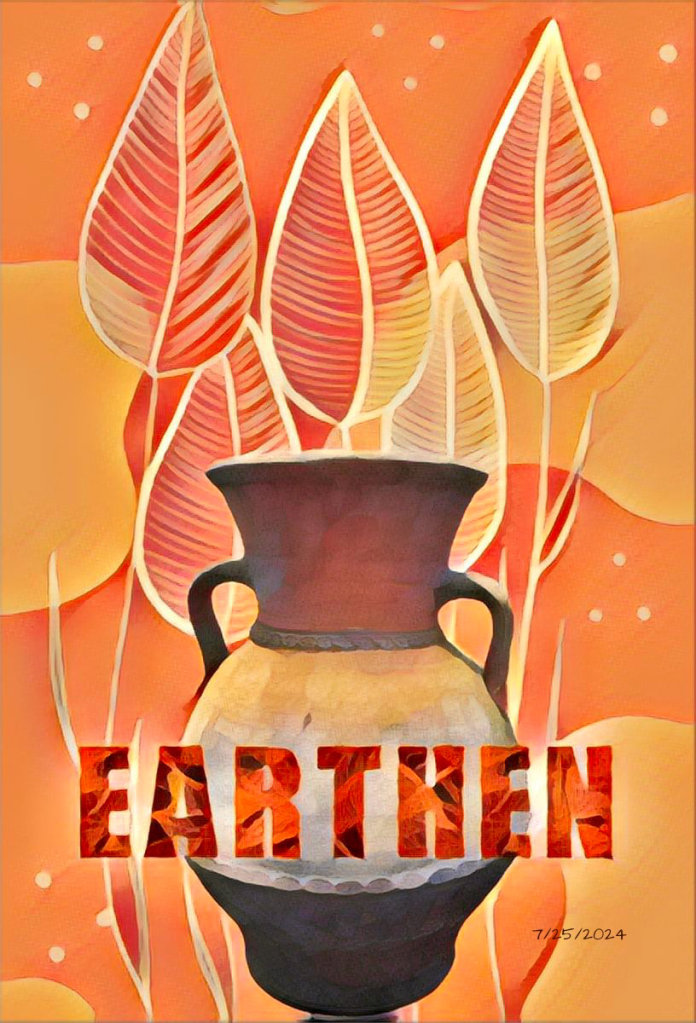
We hold this treasure in earthen vessels, that the surpassing power may be of God and not from us. We are afflicted in every way, but not constrained; perplexed, but not driven to despair; persecuted, but not abandoned; struck down, but not destroyed; always carrying about in the body the dying of Jesus, so that the life of Jesus may also be manifested in our body. For we who live are constantly being given up to death for the sake of Jesus, so that the life of Jesus may be manifested in our mortal flesh. 2 Corinthians 4:7-11
Today’s passage from Corinthians reminds us that any beauty and goodness in us is a gracious gift from God. That gift strengthens us beyond any human or personal capacity so that our lives may give God glory.
Today, in God’s Lavish Mercy: We prayerfully relax in the Potter’s hands Who shapes our lives according to Mercy. We realize with Paul that, even in affliction, we give glory to God by our fidelity and trust.
Poetry: Within this earthen vessel – Kabir, (1398–1518) a well-known Indian mystic poet and saint.
Within this earthen vessel are bowers and groves, and within it is the Creator: Within this vessel are the seven oceans and the unnumbered stars. The touchstone and the jewel-appraiser are within; And within this vessel the Eternal soundeth, and the spring wells up. Kabir says: “Listen to me, my Friend! My beloved Lord is within.”
The Bride says: On my bed at night I sought him whom my heart loves– I sought him but I did not find him. I will rise then and go about the city; in the streets and crossings I will seek Him whom my heart loves. I sought him but I did not find him. The watchmen came upon me, as they made their rounds of the city: Have you seen him whom my heart loves? I had hardly left them when I found him whom my heart loves. Song of Songs 3:1-48
This exquisite poem from the Song of Songs captures the spirit of Mary Magdalen who, throughout her life, sought a deep and transformative relationship with God.
When she anointed his feet, when she relentlessly sought him at the tomb, Mary longed for the Presence of Jesus. When she found Him whom she had sought, this premier Apostle of the Resurrection preached the first Easter news to her companions.
Today, in God’s Lavish Mercy:
We honor Mary Magdalen, so long mischaracterized in Church history. We ask to be inspired by her deep love of Jesus and resolute desire to be united with him.
Poetry: The Magdalen, a Garden, and This – Kathleen O’Toole
She who is known by myth and association as sinful, penitent, voluptuous perhaps… but faithful to the last and then beyond.
A disciple for sure, confused often with Mary, sister of Lazarus, or the woman caught in adultery, or she who angered the men
by anointing Jesus with expensive oils. She was the one from whom he cast out seven demons-she’s named in that account.
Strip all else away and we know only that she was grateful, that she found her way to the cross, and that she returned
to the tomb, to the garden nearby, and there, weeping at her loss, was recognized, became known in the tender invocation
of her name. Mary: breathed by one whom she mistook for the gardener, he who in an instant brought her back to herself-
gave her in two syllables a life beloved, gave me the only sure thing I’ll believe of heaven, that if it be, it will consist
in this: the one unmistakable rendering of your name.
Music: I Know That My Redeemer Liveth – G. F. Handel
Today’s Alleluia Verse encapsulates the theme of all the readings:
My sheep hear my voice, says the Lord; I know them, and they follow me.
John 10:27
Today, in God’s Lavish Mercy: We LISTEN – one of the hardest things to do in life. Really listen – to what we hear with our ears, but more importantly, what we hear with our hearts. God is always speaking to us. May we listen.
Poetry: You, Neighbor God – Ranier Maria Rilkë
You, neighbor god, if sometimes in the night I rouse you with loud knocking, I do so only because I seldom hear you breathe and know: you are alone. And should you need a drink, no one is there to reach it to you, groping in the dark. Always I hearken. Give but a small sign. I am quite near.
Between us there is but a narrow wall, and by sheer chance; for it would take merely a call from your lips or from mine to break it down, and that without a sound.
The wall is builded of your images.
They stand before you hiding you like names. And when the light within me blazes high that in my inmost soul I know you by, the radiance is squandered on their frames.
And then my senses, which too soon grow lame, exiled from you, must go their homeless ways.
Isaiah answered King Hezekiah: “This will be the sign for you from the LORD that he will do what he has promised: See, I will make the shadow cast by the sun on the stairway to the terrace of Ahaz go back the ten steps it has advanced.” So the sun came back the ten steps it had advanced. Isaiah 38:7-8
Walter Brueggemann, writing about this passage from Isaiah, entitles the chapter “Faithful King, Faithful God“. Hezekiah was a good king, observant of the David Covenant and of God’s commands. When Hezekiah lay in the shadow of death, that faithful relationship remained true.
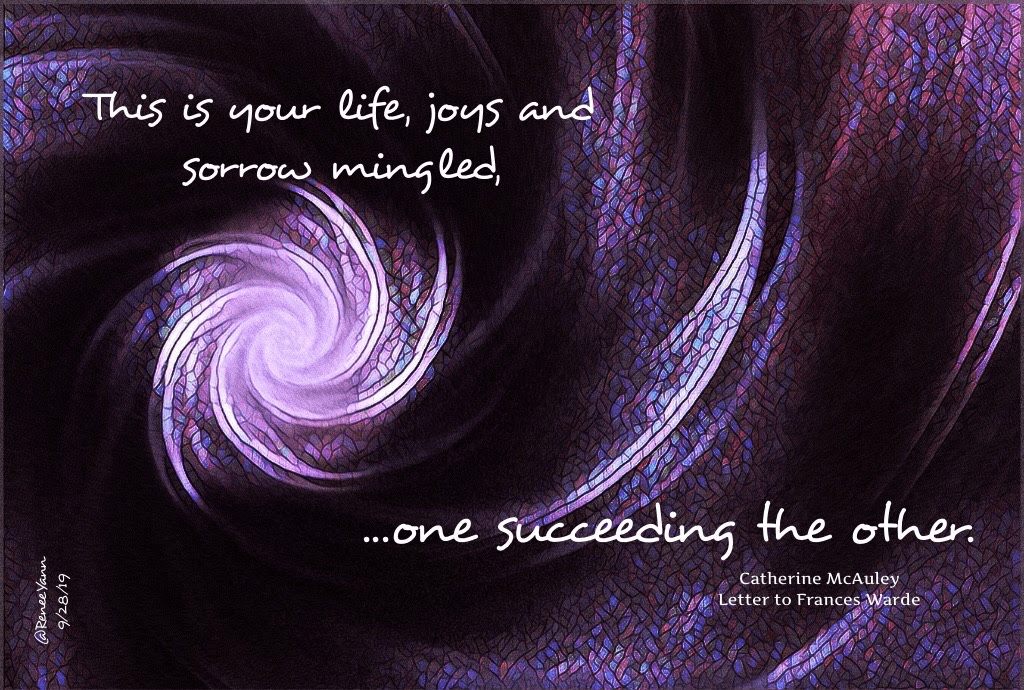
Today, in God’s Lavish Mercy: We realize that life is a series of lights and shadows. And God is faithful in each circumstance. Catherine McAuley put it this way:
Let’s listen for God’s faithful presence in our lives, whether at this moment we are in light or shadow.
Poetry: Shadows by D.H. Lawrence
And if to-night my soul may find her peace in sleep, and sink in good oblivion, and in the morning wake like a new-opened flower then I have been dipped again in God, and new created.
And if, as weeks go round, in the dark of the moon my spirit darkens and goes out, and soft strange gloom pervades my movements and my thoughts and words then shall I know that I am walking still with God, we are close together now the moon’s in shadow.
And if, as autumn deepens and darkens I feel the pain of falling leaves, and stems that break in storms and trouble and dissolution and distress and then the softness of deep shadows folding, folding around my soul and spirit, around my lips so sweet, like a swoon, or more like the drowse of a low, sad song singing darker than the nightingale, on, on to the solstice and the silence of short days, the silence of the year, the shadow, then I shall know that my life is moving still with the dark earth, and drenched with the deep oblivion of earth’s lapse and renewal.
And if, in the changing phases of man’s life I fall in sickness and in misery my wrists seem broken and my heart seems dead and strength is gone, and my life is only the leavings of a life:
and still, among it all, snatches of lovely oblivion, and snatches of renewal odd, wintry flowers upon the withered stem, yet new, strange flowers such as my life has not brought forth before, new blossoms of me, then I must know that still I am in the hands of the unknown God, he is breaking me down to his own oblivion to send me forth on a new morning, a new man.
Music: Only a Shadow – Carey Landry, sung by Sean DeBurca at the beautiful Galway Cathedral
I love the way Sean plays the piano in this video.
In all wisdom and insight, God has made known to us the mystery of the Divine Will in accord with the favor set forth in Christ as a plan for the fullness of times, to sum up all things in Christ, in heaven and on earth. Ephesians 1:9-10
In this tiny passage from Ephesians, Paul describes infinite realities – that our Creator has shared with us a Divine Mystery that we will never fully understand in this life. The Mystery has been embodied in the life and Person of Jesus Christ so that we may see and imitate what Divine Love looks like. That alignment with Love is the Will of our God for us.
Today, in God’s Lavish Mercy:
We ask that our simple faith may open itself to the Mystery of God’s Love. God is not a problem to be solved. Nor are God’s ways fully comprehensible to us. But Jesus has lived Love in our midst so that we can see the only thing we need to understand.
Poetry: Love’s Choice – Malcolm Guite
This bread is light, dissolving, almost air, A little visitation on my tongue, A wafer-thin sensation, hardly there. This taste of wine is brief in flavour, flung A moment to the palate’s roof and fled, Even its aftertaste a memory. Yet this is how He comes. Through wine and bread Love chooses to be emptied into me. He does not come in unimagined light Too bright to be denied, too absolute For consciousness, too strong for sight, Leaving the seer blind, the poet mute; Chooses instead to seep into each sense, To dye himself into experience.
Music: The Mystery – Michael Card and John Michael Talbot
Could you be findin’ the mystery You have been lookin’ for A kingdom where servants will come to be kings Are you lookin’ for And you’ll know That the sweet paradoxes unfold And the mystery will clearly show And you’ll know And you’ll know
Jesus, paint my life (Could you be findin’ the mystery) Jesus, paint my life (Could you be findin’ the mystery) Jesus, paint my life (Could you be findin’ the mystery)
And we know You are the Master of painters Comin’ the true Prince of Peace And we know You are the Tue Creator Comin’ the King of kings
Jesus, paint my life with charity Paint my life with mercy Paint my life
Can you be the light of the world Can you be the light Then take the light that’s given to you Can you be the light
Can you give your love to the world Can you give your love Take the love that’s given to you Can you give your love
Jesus, paint my life with charity Paint my life with mercy Paint my life Paint my life
I saw the Lord seated on a high and lofty throne, with the train of his garment filling the temple. Seraphim were stationed above; each of them had six wings: with two they veiled their faces, with two they veiled their feet, and with two they hovered aloft.
They cried one to the other, “Holy, holy, holy is the LORD of hosts! All the earth is filled with his glory!” Isaiah 6:1-3
There are times in life when we are graced to see through appearances to find the Holy – maybe the gaze of a newborn, the kindness of a stranger, the moment someone dies, the deep aloneness of nature.
Isaiah experiences such a moment in this reading – and it was supercharged! The trappings of earth fell away as Isaiah stood praying in the Temple. He saw the Seraphim singing praise to the Holiest of Beings. In that astounding light, Isaiah found a new self, one drenched in the Divine Presence and Will. It was in this moment that Isaiah truly became a prophet!
Today, in God’s Lavish Mercy:
We ask that our hearts be opened to the very real Presence of God in our ordinary lives. Let us trust that angels accompany us even though we do not see them. Let us listen to their song in those rare moments when we can almost touch the Holy under the surface of our lives.
Poem: I Saw the Seraphim – Robert Wagner
I saw the Seraphim one summer’s night Reaping it seemed a field of endless wheat. I heard their voices through the fading light Wild, strange and yet intolerably sweet. The hour such beauty first was born on earth A dawn of sifting had that day begun For some would not endure love’s second birth Preferring their own darkness to that sun. And still love’s sun must rise upon our night For nothing can be hidden from its heat And in that summer evening’s fading light I saw his angels gather in the wheat. Like beaten gold their beauty smote the air And tongues of flame were streaming in their hair.
Music: I Saw the Seraphim – the poem set to music by JAC Reford
I will heal their defection, says the LORD, I will love them freely; for my wrath is turned away from them. I will be like the dew for Israel: he shall blossom like the lily; He shall strike root like the Lebanon cedar, and put forth his shoots. His splendor shall be like the olive tree and his fragrance like the Lebanon cedar. Again they shall dwell in his shade and raise grain; They shall blossom like the vine, and his fame shall be like the wine of Lebanon. Hosea 14:5-8
Hosea describes God’s love for Israel – and for us – in tender, lavish images. We can picture the droughty land longing for refreshment the way a human heart longs for ease in suffering. God promises Israel a turn toward new life, fresh hope, the rooted security of covenantal relationship.
Today, in God’s Lavish Mercy: God promises the same to us, pouring the dew of Lavish Mercy over our longing spirits. Our part is to open our hearts to that promise, to wait, and to receive.
Poetry: Inversnaid by Gerard Manley Hopkins
This darksome burn, horseback brown, His rollrock highroad roaring down, In coop and in comb the fleece of his foam Flutes and low to the lake falls home.
A windpuff-bonnet of fáwn-fróth Turns and twindles over the broth Of a pool so pitchblack, féll-frówning, It rounds and rounds Despair to drowning.
Degged with dew, dappled with dew Are the groins of the braes that the brook treads through, Wiry heathpacks, flitches of fern, And the beadbonny ash that sits over the burn.
What would the world be, once bereft Of wet and of wildness? Let them be left, O let them be left, wildness and wet; Long live the weeds and the wilderness yet.
Wednesday of the Fourteenth Week in Ordinary Time July 10, 2024
Jesus sent out these Twelve after instructing them thus, “Do not go into pagan territory or enter a Samaritan town. Go rather to the lost sheep of the house of Israel. As you go, make this proclamation: ‘The Kingdom of heaven is at hand.’” Matthew 10: 5-7
In this passage, Jesus is concerned with those who were offered faith in One God but have lost touch with it — “lost sheep of the house of Israel”. He wants these lost believers to be given the message, “The Kingdom of heaven is at hand.”
While the message conveys a sense of urgency (Hurry up and get your act together), it also offers a calming security. When something is “at hand”, we can touch it. We can hold on to it for balance. We can feel support and accompaniment as we we hold hands with a Loving Presence.
Today, in God’s Lavish Mercy: We may hear Jesus’s words either as a warning or an invitation to intimacy. Love is at hand for us, even if our faith has become distracted and our direction “lost”. We are invited to reach out to the God Who waits for us.
Poetry:
“The Beloved is with you in the midst of your seeking! God holds your hand wherever you wander.
Rumi
Music: Hold to God’s Unchanging Hand – Jennie Bain Wilson (1857) Sung here by Lynda Randle
Time is filled with swift transition, Naught of earth unmoved can stand, Build your hopes on things eternal, Hold to God’s unchanging hand. Refrain: Hold to God’s unchanging hand, Hold to God’s unchanging hand; Build your hopes on things eternal, Hold to God’s unchanging hand.
Trust in Him who will not leave you, Whatsoever years may bring, If by earthly friends forsaken Still more closely to Him cling.
When your journey is completed, If to God you have been true, Fair and bright the home in glory Your enraptured soul will view.
The disciples of John approached Jesus and said, “Why do we and the Pharisees fast much, but your disciples do not fast?” Jesus answered them, “Can the wedding guests mourn as long as the bridegroom is with them? The days will come when the bridegroom is taken away from them, and then they will fast. No one patches an old cloak with a piece of unshrunken cloth, for its fullness pulls away from the cloak and the tear gets worse. People do not put new wine into old wineskins. Otherwise the skins burst, the wine spills out, and the skins are ruined. Rather, they pour new wine into fresh wineskins, and both are preserved.” Matthew 9:14-17
Jesus tells the Baptist’s questioning disciples that his is a new world. The confines of the Old Law will no longer contain the new grace of the Paschal Mystery and the Gospel.
Old wineskins become brittle with overuse. The analogy is applicable to many realities in life. Often, as time passes, we pay less attention to some important things or people. We may take them for granted, over-depend on their effectiveness, fail to effectively communicate, surrender to that famous “contemptuous familiarity”.
Today, in God’s Lavish Mercy: Immobilizing constriction can affect our faith too. Jesus encourages us to keep faith “fresh” by prayer, communal reflection, and practice. Neither our personal nor our communal faith is static. Grace offers us the invitation to become ever deeper in our understanding of God. The current Synodal process within the Catholic Church is a wonderful example of openness to fresh, new “wineskins” for our faith.
Poetry: Wine Skins – Evelyn McNulta This is a simple poem with devout sentiments, but what struck me most about it is where I found it – in a public newspaper, The Atlanta Chronicle. The poem reminded me of a poet some of my older local readers might remember – James Metcalfe. His “Daily Poem Portraits” were published in The Philadelphia Evening Bulletin during the 1950s. They were a great favorite of my Dad.
My hands are uplifted in homage to Him, They're not empty. They hold loosely those sins that cause separation of His spirit and mine.
Dear Father, take them and fill me with new wine. The wine skins of my life are brittle and hard, They can't hold your new wine because they are marred. Please replace them with supple new skins
That can be distended again and again. These wine skins are vessels that hold Your concerns, Help me remember the things I have learned. The more I am emptied of selfish desires,
The more You can cleanse me with Your cleansing fire. You'll burn away malice, ill-temper and greed, And open my eyes to Your people in need. You'll put unforgiveness also in Your fire,
And fill my heart with the burning desire To worship, to honor, to praise Your dear name. Your new wine remakes hearts, they're never the same. Take mine, Holy Father, change what you will,
I'm nothing without You, I need You to fill Each crevice, and corner and nook of my heart. There's much to be changed, I'm asking, please start.
So the other disciples said to him, “We have seen the Lord.” But Thomas said to them, “Unless I see the mark of the nails in his hands and put my finger into the nailmarks and put my hand into his side, I will not believe.” John 20:25
There’s that tiny word for which, despite a magnanimously holy life, Thomas remains famous:
Unless …
At that particular moment in his life, Thomas’s faith was conditional. He would not believe Jesus was alive unless he saw and touched him.
I doubt that Thomas was alone in his “conditionality”. The faith of many of those scared disciples was probably a bit shaky. Thomas was just more forthcoming in his doubts and hadn’t, like some of them, already seen the Risen Lord.
Today, in God’s Lavish Mercy:
We all know what it’s like to have doubts – about big things, like our faith, and about little things like our appearance. It feels like we’re being dropped into a safety net that might have a hole in it. Will it hold, or will it fall through? And what happens to us in either case!
Decades ago, when I taught eighth grade, one of my brightest students asked me this: “Sister, you’ve dedicated your whole life for the faith. What if, in the end, there is no God or heaven?”
I’m not going to tell you my answer. I’m going to suggest that you consider what your own answer would be. Is your faith conditional or unconditional?
Poetry: St. Thomas the Apostle – Bishop Edward Henry Bickersteth (1825-1906)
The Paschal feast was ended. Multitudes, Unweeting what was done, that day had left The gates of Zion for their far-off homes; And there was silence, where but yesterday Had been the hum of thousands. Olivet Slept calmly underneath the waning moon, And darkening shadows fell across the steeps And hollows of Jerusalem. Deep night Had drench'd the eyes of thousands. But, behold, Within the upper room where Jesus broke The bread of life, and pour'd the mystic wine The night before He suffer'd, once again The little band of those who loved Him most Were gather'd. On the morrow morn they thought To leave the holy city, holier now Than ever in their eyes, and go to meet Their Lord upon the Galilean hill.
All bosoms swell'd with gladness, all save one; One heart amid that group of light and love Was desolate and dark: nine weary days Of doubt, which shadow'd all eternity, Had written years of suffering on his brow. The worst he fear'd to him was realized, Life quench'd, for ever quench'd, and death supreme. Jesus was dead. And vainly others told, How they had seen and heard their risen Lord; Himself had seen the lifeless body hang Upon the cross; and, till he saw like them And like them touch'd the prints in hands and side, He would not, for he could not, hope again.
But there has been enough of sorrow now For that true mourner, sorely tried but true: And as they communed of an absent Lord Jesus was there, though doors were shut and barr'd, There in the midst of them; and from His lips, Who is Himself our Peace, the words of peace Fell as of old like dew on every heart, But surely sweetest, calmest, tenderest On one most torn and tost. The waves were still; Day broke; the shadows fled: nor this alone, Love offer'd all which bitterest grief had ask'd, And laying bare the inly bleeding wound Heal'd it, which haply else had bled afresh In after years, till faith adoring claim'd In One, whom sense no longer sought to touch, The Lord of life, the everlasting God.
O Master, though our eyes have never look'd Upon Thy blessèd face and glorious form, Grant us to trust Thee with a perfect trust, And love Thee and rejoice in Thee unseen, And prove the heaven of Thy beatitude On those who, though they see Thee not, believe.
Music: When I Survey The Wondrous Cross – Keith & Kristyn Getty