Loved

Fourth Sunday of Lent 
March 10, 2024

Today’s Readings:

https://bible.usccb.org/bible/readings/031024-YearB.cfm


For God so loved the world that he gave his only Son,
so that everyone who believes in him might not perish
but might have eternal life.
For God did not send his Son into the world to condemn the world,
but that the world might be saved through him.

John 3:16-17

For some of us, it’s hard to believe in a God we do not see. This passage from John suggests that God understands how hard it is. So that believers might not “perish” in their natural doubts, God made Divinity visible in Jesus Christ. The reason? Infinite Love for and desire to be one with us.

Today, in God’s Lavish Mercy:

Let’s rest in the confidence and gratitude this passage ignites in our hearts. God loves us — loves you — enough to become like you so that you might become like God.


Poetry: Infinite Love – Julian of Norwich, who was an English anchoress of the Middle Ages. Her writings, now known as Revelations of Divine Love, are the earliest surviving English language works by a woman. They are also the only surviving English language works by an anchoress. ( An anchoress is someone who, for religious reasons, withdraws from secular society to be able to lead an intensely prayer-orientated, ascetic, or Eucharist-focused life.)

Infinite Love

Because of the great,
infinite love which God has for all humankind,
he makes no distinction in love
between the blessed soul of Christ
and the lowliest of the souls that are to be saved . . . .
We should highly rejoice that God dwells in our soul
and still more highly should we rejoice
that our soul dwells in God.
Our soul is made to be God’s dwelling place,
and the dwelling place of our soul
is God who was never made.

Music: God So Loved the World – Mormon Tabernacle Choir

Piety

Saturday of the Third Week of Lent
March 9, 2024

Today’s Readings:

https://bible.usccb.org/bible/readings/030924.cfm


Your piety is like a morning cloud,
like the dew that early passes away.

Hosea 6:4

_______

… the tax collector stood off at a distance
and would not even raise his eyes to heaven
but beat his breast and prayed,
‘O God, be merciful to me a sinner.’
I tell you, the latter went home justified, not the former;
for everyone who exalts himself will be humbled,
and the one who humbles himself will be exalted.”

Luke 18: 13-14

I think the word “Piety” has taken on a rather saccharine connotation because we mistake it for an overly sentimental, and sometimes insincere, devotion. However, the word piety comes from the Latin word pietas, the noun form of the adjective pius (which means “devout” or “dutiful”).

Today, in God’s Lavish Mercy:

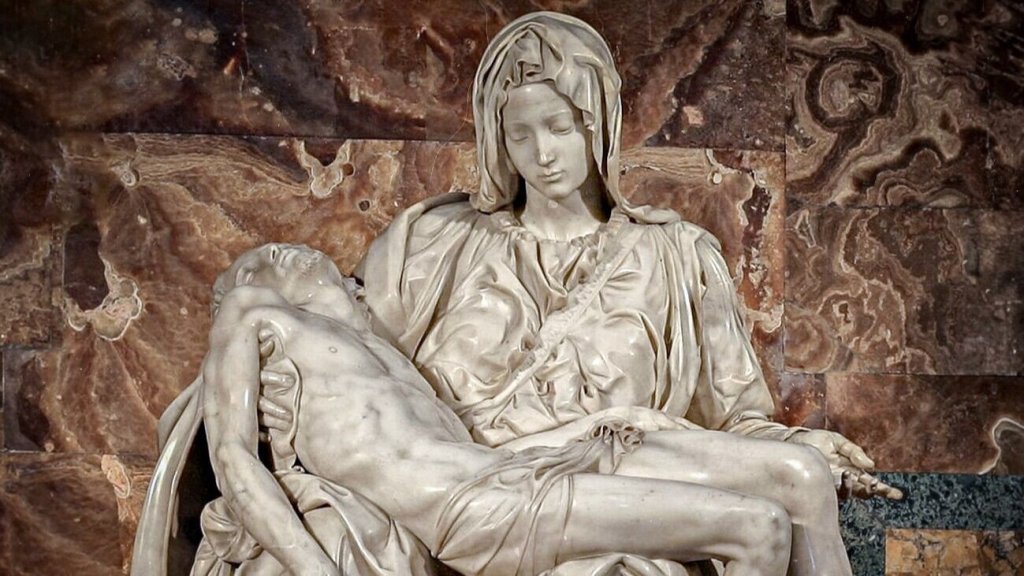
Picture Michelangelo’s Pieta. Let yourself feel the emotion captured in the heart of that sculpture. That is pietas/piety – a deep, penetrating presence and love that cannot fully be put into words. A humble, sincere prayer like that of the tax collector is the fruit of such piety.

Most of us are not great sinners. We just make some mean – and perhaps continual – choices that can block the flow of grace into our hearts. God stands beside us as we make such choices, ready to hear us when we turn and ask for the Mercy that will free and deepen us.


Prose: from Point Counterpoint by Aldous Huxley

Aldous Huxley (1894 – 1963) was an English writer and philosopher. His bibliography spans nearly 50 books, including novels and non-fiction works, essays, narratives, and poems.
By the end of his life, Huxley was widely acknowledged as one of the foremost intellectuals of his time. He was nominated for the Nobel Prize in Literature nine times.

From the quote below, Huxley obviously had strong opinions about religion but especially about false piety. Although Jesus would never have put it this way, the sentiments echo those in today’s readings.


“In the abstract you know that music exists and is beautiful. But don’t therefore pretend, when you hear Mozart, to go into raptures which you don’t feel. If you do, you become one of those idiotic music-snobs … unable to distinguish Bach from Wagner, but mooing with ecstasy as soon as the fiddles strike up. 

It’s exactly the same with God. The world’s full of ridiculous God-snobs. People who aren’t really alive, who’ve never done any vital act, who aren’t in any living relation with anything; people who haven’t the slightest personal or practical knowledge of what God is. But they moo away in churches, they coo over their prayers, they pervert and destroy their whole dismal existences by acting in accordance with the will of an arbitrarily imagined abstraction which they choose to call God.

Just a pack of God-snobs. They’re as grotesque and contemptible as the music-snobs … but nobody has the sense to say so. The God-snobs are admired for being so good and pious and Christian. When they’re merely dead and ought to be having their bottoms kicked and their noses tweaked to make them sit up and come to life.” 

Division

Thursday of the Third Week of Lent
March 7, 2024

Today’s Readings:

https://bible.usccb.org/bible/readings/030724.cfm


Jesus was driving out a demon that was mute,
and when the demon had gone out,
the mute man spoke and the crowds were amazed.
Some of them said, “By the power of Beelzebul, the prince of demons,
he drives out demons.”
Others, to test him, asked him for a sign from heaven.
But he knew their thoughts and said to them,
“Every kingdom divided against itself will be laid waste
and house will fall against house.

Luke 11: 14-17

Today’s readings point us to the virtue of spiritual integrity. Several times in the Gospel, Jesus proclaims that we can’t give our allegiance to two contradictory worlds. (Remember, “One can’t serve God and mammon.”?)

Today, in God’s Lavish Mercy:
As our Verse before the Gospel advises, God wants our whole heart. We can’t be “with” God sometimes. We’re either with God or we’re not – always. Our challenge in life is to make sure we recognize those elements pretending to be gods, so that we don’t give our hearts foolishly.


Poetry: My Kingdom – Louisa May Alcott whom you will recognize as the author of Little Women. Alcott was the daughter of strong transcendentalists. Her father’s opinions on education, severe views on child-rearing, and moments of mental instability shaped young Louisa’s mind with a desire to achieve perfection, a goal of the transcendentalists. (cf: wikipedia) Those sensibilities are reflected in the pious 19th-century style of this poem. Still the poem captures the struggles and awarenesses many have in understanding the Kingdom of Heaven within us.

A little kingdom I possess
Where thoughts and feelings dwell,
And very hard I find the task
Of governing it well;
For passion tempts and troubles me,
A wayward will misleads,
And selfishness its shadow casts
On all my words and deeds.
How can I learn to rule myself,
To be the child I should,
Honest and brave, nor ever tire
Of trying to be good?
How can I keep a sunny soul
To shine along life's way?
How can I tune my little heart
To sweetly sing all day?
Dear Father, help me with the love
That casteth out my fear;
Teach me to lean on thee, and feel
That thou art very near,
That no temptation is unseen
No childish grief too small,
Since thou, with patience infinite,
Doth soothe and comfort all.
I do not ask for any crown
But that which all may win
Nor seek to conquer any world
Except the one within.
Be thou my guide until I find,
Led by a tender hand,
Thy happy kingdom in myself
And dare to take command.

Music: Monastery of La Rabida – Vangelis

Observe

Wednesday of the Third Week of Lent
March 6, 2024

Today’s Readings:

https://bible.usccb.org/bible/readings/030624.cfm


Moses spoke to the people and said:
“Now, Israel, hear the statutes and decrees
which I am teaching you to observe,
that you may live, and may enter in and take possession of the land
which the LORD, the God of your ancestors, is giving you.”

Deuteronomy 4:1

The word “observe” carries several meanings. We may, for example,

  • observe by giving full attention
  • observe by stating our assessment of something
  • observe a holiday or birthday by sending a card
  • observe an order from a superior
  • observe the sacred by a ritual of practice, silence, or waiting

Today, in God’s Lavish Mercy:

Let’s take the final sense of sacred observing, placing our lives before God in faith, hope, and love. Each day that we live is a ritual of praise to the One Who created us. By living God’s Law of Love, we offer the praise for which God made us.


Poetry: from First Love by Denise Levertov

In the excerpt, Levertov “observes” by giving, and receiving, full attention.

`Convolvulus,' said my mother. 
Pale shell-pink, a chalice
no wider across than a silver sixpence.
It looked at me, I looked
back, delight
filled me as if
I, not the flower,
were a flower and were brimful of rain.
And there was endlesness.
Perhaps through a lifetime what I've desired
has always been to return
to that endless giving and receiving, the wholeness
of that attention,
that once-in-a-lifetime
secret communion.

Music: Touch of the Spirit – Nadama

Foolishness

Third Sunday of Lent
March 3, 2024

Today’s Readings:

https://bible.usccb.org/bible/readings/030324-YearB.cfm


… We proclaim Christ crucified, …
… Christ the power of God and the wisdom of God.
For the foolishness of God is wiser than human wisdom,
and the weakness of God is stronger than human strength.

1 Corinthians 1: 22-25

This is a great mystery of our faith: that the all-powerful One chose to redeem us by assuming our human weakness, suffering torment, and dying an ignominious death.

When my three-year-old grand-niece visited our convent, she enjoyed walking through the huge motherhouse pointing out every statue of Our Lady of Mercy.

With each discovery she would pronounce the title: “Jeezie and his Mommy”. At the end of a very long corridor, we came to a life-size wooden carving of Jesus Crucified. Little Claire studied it, looked up at me and asked, “Who is that?”.

I simply said, “I don’t know” because her sweet little heart could not bear to learn, or to possibly understand, what happened to her “Jeezie”.

Today, in God’s Lavish Mercy:

Lent is the time to deepen our understanding of what happened to Jesus because of the “foolishness of God”. That Omnipotent Love suffered, died, and rose for us so that we would understand and embrace the meaning of Love in our own lives.

Let’s pray today for a fuller awareness that our lives are a continuing participation in the Great Love. Let us use these Lenten days to find the pattern of the Cross in our world, and to look within it for the Light of the Resurrection.


Poetry: The Foolishness of God – Luci Shaw

Perform impossibilities
or perish. Thrust out now
the unseasonal ripe figs
among your leaves. Expect
the mountain to be moved.
Hate parents, friends, and all
materiality. Love every enemy.
Forgive more times than seventy-
seven. Camel-like, squeeze by
into the kingdom through
the needle’s eye. All fear quell.
Hack off your hand, or else,
unbloodied, go to hell.
Thus the divine unreason.
Despairing now, you cry
with earthy logic – How?
And I, your God, reply:
Leap from your weedy shallows.
Dive into the moving water.
Eyeless, learn to see
truly. Find in my folly your
true sanity. Then Spirit-driven,
run on my narrow way, sure
as a child. Probe, hold
my unhealed hand, and
bloody, enter heaven.

Music: The Cross is Foolishness – John Michael Talbot (lyrics below)

CHORUS:
The Cross is foolishness to those who perish
But for us it has become the wisdom of God
The Cross is foolishness to those who perish
But for us it is salvation and power from God

Some look for miracles, some look for wisdom
But we preach only Jesus crucified
It seems absurdity, it seems so foolish
But to us it is the wisdom of God

(CHORUS)

(CHORUS)

Eye has never seen, ear has never heard
Nor has it dawned on the limits of the mind
What God has surely prepared
For those who love Him
He reveals this wisdom through the Spirit of God

Prodigal

Saturday of the Second Week of Lent
March 2, 2024

Today’s Readings:

https://bible.usccb.org/bible/readings/030224.cfm


Who is there like you, the God who removes guilt
and pardons sin for the remnant of his inheritance;
Who does not persist in anger forever,
but delights rather in clemency,
And will again have compassion on us,
treading underfoot our guilt?

Micah 7:18-19

We are all familiar with the powerful story of the Prodigal Son.

The word “prodigal”, like many words, can have both light and dark connotations. Its definition, according to Oxford Languages, is twofold:

  • spending resources recklessly
  • giving on a lavish scale

On the darker side, many of us interpret the parable from the viewpoint of the son, considering him “prodigal” because he is excessive in the abuse of his inheritance.
Others see the “Father” as an expression of God’s Lavish Mercy and Prodigal Love toward us even when we make life-changing mistakes.

Today, in God’s Lavish Mercy:

We might choose to pursue both understandings of the word “prodigal” in our prayer today:

  • to ask God’s forgiveness and healing for any sinful prodigality in our lives
  • to imitate God’s Prodigal Generosity in our interactions and relationships

Poetry: The Prodigal – Nancy Cardozo

Prodigal of prayer am I,
Prodigal of tear,
But I have used God sparingly —
I think He does not hear.
Stars to wish on flicker flash
And I know stars will wear;
But I doubt and if I weep,
Stars will never care.
I have let my prayer sift down
Through a starry sieve;
Will God gather up the dust
If I believe?

Music: He Ran To Me’ (The Prodigal Son) – Phillips, Craig and Dean

Barren

Thursday of the Second Week of Lent
February 29, 2024

Today’s Readings:

https://bible.usccb.org/bible/readings/022924.cfm


Cursed is the one who trusts in human beings,
who seeks strength in flesh,
whose heart turns away from the LORD.
Such a person is like a barren bush in the desert
that enjoys no change of season,
But stands in a lava waste,
a salt and empty earth.

Jeremiah 17: 5-6

Have you encountered a person who is spiritually languishing, or even dead? The light of their spirit has gone out. There is no joy, hope, delight, or generosity in them. Sometimes their barrenness is buried under false hilarity or bravado, but after leaving them we find ourselves confused, saddened, empty, tired, or even a little angry.

Today, in God’s Lavish Mercy:

Let’s pray for any barren spirit we have encountered. They badly need our prayers.
And let’s ask God for the merciful freshening of our own spirit, seeking it by prayer, loving silence, and honest reflection on our choices and actions.


Poetry: What the Fig Tree Said – Denise Levertov

Literal minds! Embarrassed humans! His friends
were blurting for Him
in secret: wouldn’t admit they were shocked.
They thought Him
petulant to curse me!—yet how could the Lord
be unfair?—so they looked away,
then and now.
But I, I knew that
helplessly barren though I was,
my day had come. I served
Christ the Poet,
who spoke in images: I was at hand,
a metaphor for their failure to bring forth
what is within them (as figs
were not within me). They who had walked
in His sunlight presence,
they could have ripened,
could have perceived His thirst and hunger,
His innocent appetite;
they could have offered
human fruits—compassion, comprehension—
without being asked,
without being told of need.
My absent fruit
stood for their barren hearts. He cursed
not me, not them, but
(ears that hear not, eyes that see not)
their dullness, that withholds
gifts unimagined.

Music: Happy Sad Empty Full – The Gothard Sisters

Cup

Wednesday of the Second Week of Lent
February 28, 2024

Today’s Readings:

https://bible.usccb.org/bible/readings/022824.cfm


Then the mother of the sons of Zebedee approached Jesus with her sons
and asked …
“Command that these two sons of mine sit,
one at your right and the other at your left, in your kingdom.”
Jesus said in reply,
“You do not know what you are asking.
Can you drink the chalice that I am going to drink?”
They said to him, “We can.”
He replied,
“My chalice you will indeed drink,
but to sit at my right and at my left,
this is not mine to give
but is for those for whom it has been prepared by my Father.”

Mark 10:20-23

In our Gospel, Jesus makes it clear that the path to heavenly glory is bound by a spiritual discipline that, in this contrary world, will cause us suffering. The cup is that chasm in life where we must choose peace over violence, generosity over selfishness, mercy over judgment, truth over deception, love over indifference. There will be resistance, both within us and around us, when we make such choices.

Today, in God’s Lavish Mercy:

Let’s be honest with ourselves as we answer Jesus’s question:
“Can you drink the cup that I will drink?”
Let’s pray for the grace to drink that cup as it comes to us in the particularities of our own lives.
Let’s ask for the spiritual confidence and understanding that the cup – our cup – leads to eternal life.


Poetry: Can You Drink the Cup? – by Scott Surrency, O.F.M. Cap. (2015)

I found this poem on the website https://thejesuitpost.org/2015/10/can-you-drink-the-cup/

Can you drink the cup?
Drink, not survey or analyze,
ponder or scrutinize –
from a distance.
But drink – imbibe, ingest,
take into you so that it becomes a piece of your inmost self.
And not with cautious sips
that barely moisten your lips,
but with audacious drafts
that spill down your chin and onto your chest.
(Forget decorum – reserve would give offense.)
Can you drink the cup?
The cup of rejection and opposition,
betrayal and regret.
Like vinegar and gall,
pungent and tart,
making you wince and recoil.
But not only that – for the cup is deceptively deep –
there are hopes and joys in there, too,
like thrilling champagne with bubbles
that tickle your nose on New Year’s Eve,
and fleeting moments of almost – almost – sheer ecstasy
that last as long as an eye-blink, or a champagne bubble,
but mysteriously satisfy and sustain.
Can you drink the cup?
Yes, you — with your insecurities,
visible and invisible.
You with the doubts that nibble around the edges
and the ones that devour in one great big gulp.
You with your impetuous starts and youth-like bursts of love and devotion.
You with your giving up too soon – or too late – and being tyrannically hard on yourself.
You with your Yes, but’s and I’m sorry’s – again.
Yes, you – but with my grace.
Can you drink the cup?
Can I drink the cup?
Yes.

Music: We Will Drink the Cup

We will drink the cup.
We will win the fight.
We will stand against the darkness of the night.
We will run the race
And see God’s face,
And build the Kingdom of love.

Do not fear for I am with you.
Be still and know that I am God.

You will run and not grow weary,
For I your God will be your strength.
Refrain

We are the Church, we are the Body.
We are God’s great work of art.

And build the Kingdom of love.

Snow …

Tuesday of the Second Week of Lent
February 27, 2024

Today’s Readings:

https://bible.usccb.org/bible/readings/022724.cfm


Come now, let us set things right,
says the LORD:
Though your sins be like scarlet,
they may become white as snow;
Though they be crimson red,
they may become white as wool.

Isaiah 1:18

The greatest among you must be your servant.
Whoever exalts himself will be humbled;
but whoever humbles himself will be exalted.

Matthew 22:12

Today’s readings are studies in contrasts – white/scarlet; exaltation/humility.

Isaiah promises a transformative grace changing scarlet sins to snow-white goodness. In our Gospel, Jesus teaches the crowds that the way to holiness is in exact contrast to the practices of the Pharisees. The Gospel turns the patterns of the world upside down. Lent is the time to enter that turning.

Today, in God’s Lavish Mercy:

Let’s pray for the humility that will allow us to open ourselves to God’s transforming grace – that wash of insight over our spirits, cleansing us of spiritual confusion.

Humility can be a tricky virtue. Its essence is not a sense of worthlessness or “less-ness”. Humility is instead a profound awareness that all belongs to God, and that we are privileged to share in that Abundant Life. Humility does not concentrate on the Self. It looks at the Other in grateful and expectant obedience.


Poetry: A Woman in Winter – from In Wisdom’s Path: Discovering the Sacred in Every Season by Jan L. Richardson.

A woman in winter
is winter:
turning inward,
deepening,
elemental force,
time’s reckoning;
sudden frost
and fire’s warming,
depth of loss
and edge of storming.
She is avalanche,
quiet hungering,
utter stillness,
snowfall brewing;
hollowed, hallowed,
shadows casting,
field in fallow,
wisdom gathering.
Waiting, watching,
darkness craving,
shedding, touching,
reaching, laboring;
burning, carrying fire
within her,
a woman turning,
becoming winter.

Music: White As Snow – Maranatha Singers

Measure

Monday of the Second Week in Lent
February 26, 2024

Today’s Readings:

https://bible.usccb.org/bible/readings/022624.cfm


Jesus said to his disciples:
“Be merciful, just as your Father is merciful.

“Stop judging and you will not be judged.
Stop condemning and you will not be condemned.
Forgive and you will be forgiven.
Give and gifts will be given to you;
a good measure, packed together, shaken down, and overflowing,
will be poured into your lap.
For the measure with which you measure
will in return be measured out to you.”

Luke 6: 36-38

How many times in our lives have we realized that, in giving or serving, we have received much more than we have given? No material recompense can rival the gift of another’s gratitude and trust. When we are merciful as God is merciful, we know a joy beyond measure.


Today, in God’s Lavish Mercy:

A wise older friend said this to me long ago, challenging me to live my life by the abundance of Divine Measure. You might like to reflect on her phrase as you pray today’s Gospel:

Never resist
a generous impulse.


Prose: from Gratitude by David Whyte

Thankfulness finds its full measure
in generosity of presence,
both through participation and witness.
We sit at the table as part of every other person’s world
while making our own world without will or effort,
this is what is extraordinary and gifted,
this is the essence of gratefulness,
seeing to the heart of privilege.
Thanksgiving happens when our sense of presence
meets all other presences.
Being unappreciative might mean
that we are simply not paying attention.

Music: Measureless – Shelly E. Johnson