Today, in God’s Lavish Mercy, both our readings are replete with images regarding how we earn or access our heavenly reward.
Malachi presents us with the image of a record book wherein the names of the just are recorded:
Then they who fear the LORD spoke with one another, and the LORD listened attentively; And a record book was written before him of those who fear the LORD and trust in his name. And they shall be mine, says the LORD of hosts, my own special possession, on the day I take action. And I will have compassion on them, as a man has compassion on his son who serves him.
Malachi 3: 16-17
It’s an image that has stuck with people throughout the centuries. Kind of reminds you of Santa Claus, doesn’t it – “making a list, checking it twice. Gonna find out who’s naughty and nice.” We’ve all seen depictions of St. Peter, at the “pearly gates”, checking that Book for someone who seems to have forgotten their reservation!
Such images illustrate our natural desire to understand the afterlife and its relationship to our moral choices. And guess what! Forget it! We are never going to comprehend or control that dynamic, because God isn’t Santa Claus, doesn’t have a little black book, and there are no gates in heaven.
In our Gospel today, Jesus tells us the only thing we can be sure of – that God is our Friend and desires to be one with us in the Holy Spirit.
If you then, who are wicked, know how to give good gifts to your children, how much more will the Father in heaven give the Holy Spirit to those who ask him?”
Luke 11:13
And Jesus says it’s not all that hard – just ask, seek, and knock. Of course, it matters what we are asking, seeking, and knocking FOR. It must be FOR deeper intimacy with God lived out in a grateful and generous life. This kind of holy relationship eradicates any need to manufacture worries about a record book or locked gates.
I tell you, ask and you will receive; seek and you will find; knock and the door will be opened to you. For everyone who asks, receives; and the one who seeks, finds; and to the one who knocks, the door will be opened.
Luke 11: 9-10
Poetry: You, Neighbor God – Rainer Maria Rilke
You, neighbor God, if sometimes in the night
I rouse you with loud knocking, I do so
only because I seldom hear you breathe
and know: you are alone.
And should you need a drink, no one is there
to reach it to you, groping in the dark.
Always I hearken. Give but a small sign.
I am quite near.
Between us there is but a narrow wall,
and by sheer chance; for it would take
merely a call from your lips or from mine
to break it down,
and that without a sound.
The wall is builded of your images.
They stand before you hiding you like names.
And when the light within me blazes high
that in my inmost soul I know you by,
the radiance is squandered on their frames.
And then my senses, which too soon grow lame,
exiled from you, must go their homeless ways.
Music: God Hears Our Prayers – Mandy Lining
I think this song is very beautiful in its simplicity. I hope you like it.
Today, in God’s Lavish Mercy, we pray with Psalm 80, rather a desperate plea in the midst of devastation.
… the vineyard which you planted … Why have you broken down its walls, so that every passer-by plucks its fruit, The boar from the forest lays it waste, and the beasts of the field feed upon it?
Psalm 80: 13-14
Angelus – Jean Francois Millet
Among my readers there are probably not too many farmers, but there may be a few serious gardeners. You would know what it feels like to lose a valued and tendered crop. And all of us have probably seen a movie or two where early settlers lose the crop which sustained their existence, or a news story of the same tragedy in real life. No words.
So Isaiah tells us that Israel, and by extension the People of God, is that precious vineyard, lovingly planted in hope by the Creator. The prophet paints the image of a deeply disappointed God:
The vineyard of the LORD of hosts is the house of Israel, and the people of Judah are his cherished plant; he looked for judgment, but see, bloodshed! for justice, but hark, the outcry!
Isaiah 5:7
But Psalm 80 calls out to that “disappointed” God and asks for forgiveness and restoration. The psalmist is inspired by the same kind of relentless hope Paul encourages in our second reading:
Have no anxiety at all, but in everything, by prayer and petition, with thanksgiving, make your requests known to God. Then the peace of God that surpasses all understanding will guard your hearts and minds in Christ Jesus.
Philippians 4:6-7
Our Gospel demonstrates for us that the cycle continues throughout history: hope – sin – devastation- repentance – forgiveness – renewed hope. It continues in individuals, families, societies, churches.
But that cycle has been forever absorbed into the Passion, Death and Resurrection of Christ who once and for all redeemed us from its clutches. In the grace of Jesus Christ, we can never remain devastated or bereft of life. This is the glory of our Baptism into Christ, if we will but claim it!
Paul guides us, himself like a tender gardener, in this passage that is so worth our quiet reflection. It will be our “poem” for today!
Finally, brothers and sisters, whatever is true, whatever is honorable, whatever is just, whatever is pure, whatever is lovely, whatever is gracious, if there is any excellence and if there is anything worthy of praise, think about these things. Keep on doing what you have learned and received and heard and seen in me. Then the God of peace will be with you.
Music: Shen Khar Venakhi ( You are a Vineyard ) A hymn of praise to God’s perfect vineyard, the Virgin Mary who brought forth Christ
You are a vineyard newly blossomed. Young, beautiful, growing in Eden, A fragrant poplar sapling in Paradise. May God adorn you. No one is more worthy of praise. You yourself are the sun, shining brilliantly.
Thou Art a Vineyard (Georgian: შენ ხარ ვენახი, transliterated: Shen Khar Venakhi) is a medieval Georgian hymn. The text is attributed to King Demetrius I of Georgia (1093–1156). The composer of the music is unknown. Supposedly Demetrius wrote it during his confinement as a monk in the monastery. The hymn is dedicated to Georgia and the patronage of the Virgin Mary: it is also a prayer of praise to Mary in the Georgian Orthodox Church
As the lyrics did not mention any saints or gods, this was the only church-song that was permitted to be performed in the anti-religious Soviet Union. There are East Georgian (Kartli-Kakhetian) and West Georgian (Gurian) versions of this chant with very different musical compositions.
Today, in God’s Lavish Mercy, Paul gives the Church a job description for bishops. Obviously, there was a time when the worshipping community had significant input into the choice of its spiritual leaders. Therefore, Paul counsels the community to look for appointees who are well-balanced at:
the family level
the ministry level
the societal level
While directed toward bishops and deacons, Paul’s words could serve as an examen for anyone who professes to minister in God’s name.
However, it is the Gospel story of the widow of Nain where my prayer rests today. Reading it, I remember standing by a large walkway window at the Louisville Airport on a sweltering July day nearly twenty years ago.
Down on the heat-softened tarmac, a small bevy of soldiers stood at attention. Slowly, a flag-draped casket was lowered into their waiting arms. Just to the side, a huddled family waited as well. Two children clung to either side of their young mother. An older couple stood behind her, hands gentled on her shoulders.
At the window with me, several other travelers gathered in silence. A few teenage boys removed their inverted baseball caps when they noticed a distinguished older gentleman stand tall and hold a salute.
No one who witnessed that brief ceremony will ever forget it. The grief, reverence and astonishment at life’s fragility emblazoned the moment on every witnessing heart.
When Jesus passed the gates of Nain on that ancient morning, he had a like experience. He saw this “only son of a widowed mother”. Once again, shaken to his roots with compassion –splancha– he pulled heaven down to heal heart-breaking loss.
How I wished Jesus were flying out of Louisville that day in 2005! But then I realized He was there. The miracle was hidden, but still real. The Divine Compassion flowed through me, through the reverent gathering beside me, through the soldiers’ honoring arms, through the long prayerful memory we would all forever share.
That young man from Nain was raised from the dead… but only for a while. He, like all of us, eventually died. The miracle was not about him and the restoration of his life. The miracle was the visible sign of God’s infinite compassion for his mother, and for all of us – God’s “feeling-with-us” in all our experiences. That compassion, whether miraculously visible or not, is always with us.
It just took a different form that day in Louisville.
Poetry: First Born Sons and the Widow of Main by Irene Zimmerman, OSF
Jesus halted on the road outside Nain
where a woman’s wailing drenched the air.
Out of the gates poured a somber procession
of dark-shawled women, hushed children,
young men bearing a litter that held
a body swathed in burial clothes,
and the woman, walking alone.
A widow then—another bundle
of begging rags at the city gates.
A bruised reed!
Her loud grief labored and churned in him till
“Halt!” he shouted.
The crowd, the woman, the dead man stopped.
Dust, raised by sandaled feet,
settled down again on the sandy road.
Insects waited in shocked silence.
He walked to the litter, grasped a dead hand.
“Young man,” he called
in a voice that shook the walls of Sheol,
“I command you, rise!”
The linens stirred.
Two firstborn sons from Nazareth and Nain
met, eye to eye.
He placed the pulsing hand into hers.
“Woman, behold your son,” he smiled.
Music: I was reminded of this consoling country song for today’s prayer. Like much country music, it hits the heart where it matters, even if the theology is a little frayed.
God Only Cries – written by Tim Johnson, sung here by Diamond Rio Lyrics below
On an icy road one night A young man loses his life They marked the shoulder with a cross An’ his family gathers round On a piece of Hallowed ground Their hearts are heavy with their loss As the tears fall from their eyes There’s one who’ll always sympathise
God only cries for the living ‘Cause it’s the living that are left to carry on An’ all the angels up in Heaven They’re not grieving because they’re gone There’s a smile on their faces ‘Cause they’re in a better place than… They’ve ever known.
God only cries for the living ‘Cause it’s the living that are so far from home
It still makes me sad When I think of my Grand-dad I miss him each and every day But I know the time will come When my own grandson Wonders why I went away Maybe we’re not meant to understand Till we meet up in the Promised Land
Today, in God’s Lavish Mercy, our two readings connect to remind us of an essential truth: stay faithful to God’s Word in order to live in peace, justice, and joy.
The passage from Judges recounts the topsy-turvy history of Israel around 800 years before Christ. It was a time when various Judges served as leaders before the eventual establishment of the kingdom under Samuel.
The Twelve Judges of Israel (in technicolor!)
These were tough times for Israel. One after another, hostile forces rose against them. During each threat, someone would emerge as a deliverer and, with their heroic success, endure for a while as the Judge.
The writer equates Israel’s ups and downs with God’s pleasure or displeasure with the people. When the people broke faith, God punished them with political turmoil. When the people were repentant, God provided a deliverer.
Of course, this is an overly simplified interpretation of events. By infusing God with the human qualities of anger and appeasement, the writer explains complex history as a simple quid pro quo: You’re bad, you get zapped. You’re good, you get rewarded.
We know that our God does not vacillate between angry punishment and satisfied recompense. God is always loving, forgiving, and nurturing. So what can this passage teach us about our own faith life and the spiritual culture of our times?
I found a key reflection point in the passage’s initial phrase: The children of Israel offended the LORD by serving the Baals.
The “Baals” are false gods erected by those who manipulate “faith” to advance their self-absorbed agendas. In the time of the Judges, these Baals might have been represented by carved idols, or natural phenomena such as the moon or stars. In the end, this idolatry – like all idolatries – rewarded some hidden promoter with money, power, or influence.
But what are the “Baals” of our culture? What is our modern idolatry?
Britannica Dictionary offers this definition of idolatry: “A person becomes guilty of a more subtle idolatry, however, when, although overt acts of adoration are avoided, he attaches to a creature the confidence, loyalty and devotion that properly belong only to the Creator.”
As we pray with this passage, we might look to our own society with its infectious materialism, nationalism, consumerism, racism, sexism. These and other imposed societal shackles serve to bind some in order to exalt others to idol status. As it is with any communicable disease, some of these systems – acknowledged or not – may be lurking within us.
Worship of these “isms” falsly legitimizes:
the usurpation of the poor in a credit-bound economic system (e.g. how many times have you been offered “revolving credit” which makes money on ever-increasing interest rates)
the armed control of the defenseless (e.g. the insurmountable influence of the gun lobby to produce weapons of mass destruction despite the repeated massacres of our children)
the supersession of the haves over the have-nots (e.g. college placement of moneyed descendants over academically superior disadvantaged applicants)
the veiled acquiescence to white-advantage (e.g. entrenched indifference to colorless board rooms, executive suites, and other decision-making forums)
the subtle second-classism toward and objectification of women (e.g. the range of systemic oppressions suffered by women, from Taliban terrors and sex trafficking to indefensible Church exclusions)
Our Gospel clearly states the antidote to such idolatry:
Jesus answered the young man:
There is only One who is good. If you wish to enter into life, keep the commandments: (Love God above all things, and your neighbor as yourself.)
Jesus tells him further that if he wishes to be perfect, he will:
dispossess himself of anything that distracts him from God
follow Jesus and the Gospel with all his heart
I never read that Gospel without realizing that, just like that young man, I have a lot of work to do on my own often idolatrous soul.
Poetry: Sell All You Have – Malcolm Guite
To whom, exactly, are you speaking Lord?
I take it you’re not saying this to me,
But just to this rich man, or to some saint
Like Francis, or to some community,
The Benedictines maybe, their restraint
Sustains so much. But I can’t bear this word!
I bought the deal, the whole consumer thing,
Signed up and filled my life with all this stuff,
And now you come, when I’ve got everything,
And tell me everything is not enough!
But that one thing I lack, I cannot get.
Sell everything I have? That’s far too hard
I can’t just sell it all… at least not yet,
To whom exactly, are you speaking Lord?
Music: Simple Living (A Rich Young Man) – Keith & Kristyn Getty, Stuart Townend
Today, in God’s Lavish Mercy, our readings continue to take us through Deuteronomy, and for the next two weeks, through Joshua, Judges, and Ruth.
The word “Deuteronomy” means “second law” because the book is a reiteration and refinement of the Law given in Exodus. The Book of Deuteronomy is basically three big speeches by Moses, the commissioning of Joshua as Israel’s next leader, and a recounting of the death of Moses.
Today’s speech is powerful and beautiful. Moses calls on the people to remember and give thanks for the immense blessings they have received at the hand of God.
Ask now of the days of old, before your time, ever since God created man upon the earth; ask from one end of the sky to the other: Did anything so great ever happen before? Was it ever heard of? Did a people ever hear the voice of God speaking from the midst of fire, as you did, and live?
Deuteronomy 4:32-33
At length, Moses recounts the sacred history of the people and tells them that, because of it, they are called to respond in covenanted fidelity.
This is why you must now know, and fix in your heart, that the LORD is God in the heavens above and on earth below, and that there is no other. You must keep his statutes and commandments which I enjoin on you today, that you and your children after you may prosper, and that you may have long life on the land which the LORD, your God, is giving you forever.”
Deuteronomy 4: 39-40
Moses offered these encouraging and directive speeches because he sensed he was near the end of his life and that Israel was moving into a new phase of its life.
In our Gospel, Jesus feels the same way. In the section immediately preceding today’s reading, Matthew says this:
From that time on, Jesus began to show his disciples that he must go to Jerusalem and suffer greatly from the elders, the chief priests, and the scribes, and be killed and on the third day be raised
In today’s passage, Jesus calls his disciples to live in covenanted fidelity by imitating his life.
Whoever wishes to come after me must deny himself, take up his cross, and follow me. For whoever wishes to save his life will lose it, but whoever loses his life for my sake will find it. What profit would there be for one to gain the whole world and forfeit his life? Or what can one give in exchange for his life?
Matthew 16: 25-26
I’ve read this Gospel passage a thousand times in the past sixty or seventy years. And I ask myself each time, “Do you really take this seriously? Do you really understand that your life is not for yourself but for God and all of God’s beloved creatures?”
It takes radical courage to live that kind of understanding. But continually remembering God’s Presence and Promises throughout our own lives strengthens us. That’s what Moses was trying to tell his people. That’s what Jesus is encouraging his disciples to recognize.
Jesus promises that, at the end of time, each will be repaid according to the level of their generosity. But the repayment doesn’t wait for the end times. Remembering our lives in grateful prayer will convince us of this: there is no true happiness, no deep joy, unless we learn to live beyond our own self-interests.
Poetry: Unless a Grain of Wheat Falls into the Ground and Dies – Malcolm Guite
Oh let me fall as grain to the good earth
And die away from all dry separation,
Die to my sole self, and find new birth
Within that very death, a dark fruition,
Deep in this crowded underground, to learn
The earthy otherness of every other,
To know that nothing is achieved alone
But only where these other fallen gather.

If I bear fruit and break through to bright air,
Then fall upon me with your freeing flail
To shuck this husk and leave me sheer and clear
As heaven-handled Hopkins, that my fall
May be more fruitful and my autumn still
A golden evening where your barns are full.
Music: Unless a Grain of Wheat – Bernadette Farrell
Unless a grain of wheat shall fall upon the ground and die, it remains but a single grain with no life.
If we have died with him then we shall live with him; if we hold firm, we shall reign with him. Unless a grain of wheat shall fall upon the ground and die, it remains but a single grain with no life.
If anyone serves me then they must follow me; wherever I am my servants will be. Unless a grain of wheat shall fall upon the ground and die, it remains but a single grain with no life.
Make your home in me as I make mine in you; those who remain in me bear much fruit. Unless a grain of wheat shall fall upon the ground and die, it remains but a single grain with no life.
If you remain in me and my word lives in you, then you will be my disciples. Unless a grain of wheat shall fall upon the ground and die, it remains but a single grain with no life.
Those who love me are loved by my Father; we shall be with them and dwell in them. Unless a grain of wheat shall fall upon the ground and die, it remains but a single grain with no life.
Peace I leave with you, my peace I give to you; peace which the world cannot give is my gift. Unless a grain of wheat shall fall upon the ground and die, it remains but a single grain with no life.
Today, in God’s Lavish Mercy, our scripture passages focus on how God dwells with us and calls us to ever greater intimacy.
In Exodus, Moses meticulously performs God’s instructions to build a holy dwelling place – the Ark of the Covenant. When Moses’s work is finished, God settles in among the Israelites and begins the new work of leading them to the promised land. It is a “Finished. What’s Next” scenario.
The “next” is this: by manipulating a visible cloud, God signals when it is time to rest and when it is time to move forward on the journey.
Whenever the cloud rose from the Dwelling, the children of Israel would set out on their journey. But if the cloud did not lift, they would not go forward; only when it lifted did they go forward.
Exodus 40:35-36
Verse 33, not included in today’s selection, says this:
Finally, Moses set up the court around the tabernacle and the altar and hung the curtain at the gate of the court. Thus Moses finished all the work.
Exodus 40:33
The italicized phrase should ring a bell with us. It is reminiscent of this familiar phrase in Genesis:
By the seventh day God had finished the work he had been doing; so on the seventh day he rested from all his work.
Genesis 2:2
And it is predictive of this solemn phrase in John’s Gospel:
When he had received the sour wine, Jesus said, ‘It is finished,’ and he bowed his head and gave up his spirit.
John 19:30
Praying with Exodus today, we might consider how God continually finishes chapters in history and in our lives. With each completion, a new dynamic is initiated which reveals God’s deeper Presence to us. If our hearts are open, God always invites us deeper – thatis the journey.
God enacts this ever-renewing revelation in the Scriptures as well as in our lives.
In Genesis, God comes to dwell in the Creation.
In Exodus, God comes to dwell in Presence.
In the Incarnation, God comes to dwell in our flesh.
In Pentecost, God comes to dwell in our spirits, giving us the capabilty of opening ourselves to the inexhaustible bounty of God’s Love.
God keeps coming to us anew, not with a new Face, but with a Face that, earlier, we may not have had the depth to recognize.
A word from the Hebrew, first encountered in ancient rabbinic literature, captures the concept of the eternal generative Presence dwelling among us: Shekhinah. The word means “dwelling” or “settling” and denotes the presence of God, as it were, in a particular place.
In today’s Gospel passage, Jesus finishes a significant chapter of his ministry. In five succinct parables, Jesus has painted a picture of our “next” – the Kingdom of Heaven.
Closing today’s lesson, Jesus charges the future teachers of the faith to remember the whole history of God’s indwelling as they guide the people to God’s penultimate revelation. As we move forward to a Parousia we can only imagine, we can be encouraged and consoled by the stories of God’s Presence in the past, and imaged for us in the parables.
“Then every scribe who has been instructed in the Kingdom of heaven is like the head of a household who brings from his storeroom both the new and the old.”
Before today, we may never have thought of ourselves as God’s “scribes”. But just as God used our first parents, and Moses, and the early disciples, God is using us to write the current and future story of God’s love for all Creation.
The chapter with your name will not be included in the Bible, but it will be written large in the Book of Life. It will be read by those who love you, depend on you, work with you, or need you. Each of our lives, in its own way, is a scipture for our times.
Poetry: Wellfleet Shabbat – Marge Piercy
The hawk eye of the sun slowly shuts.
The breast of the bay is softly feathered
dove grey. The sky is barred like the sand
when the tide trickles out.

The great doors of Shabbat are swinging
open over the ocean, loosing the moon
floating up slow distorted vast, a copper
balloon just sailing free.

The wind slides over the waves, patting
them with its giant hand, and the sea
stretches its muscles in the deep,
purrs and rolls over.

The sweet beeswax candles flicker
and sigh, standing between the phlox
and the roast chicken. The wine shines
its red lantern of joy.

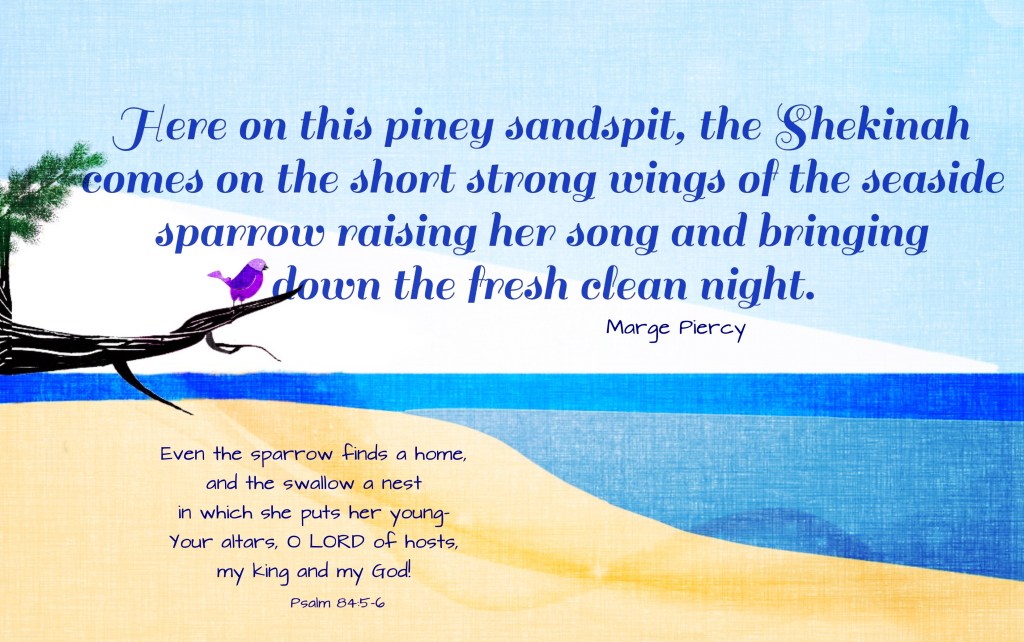
Here on this piney sandspit, the Shekinah
comes on the short strong wings of the seaside
sparrow raising her song and bringing
down the fresh clean night.
Today, in God’s Lavish Mercy, our readings pose an eternal question:
Are we wise enough to cherish the treasure of God’s Kingdom?
The kind of life we live comes down to what we treasure. I won’t start a list here, but you might want to. For what do you sacrifice your time, attention, and effort? Where do you place the resources of your mind, body, and spirit?
In our first reading, Solomon has a dream in which he gets the amazing genie-like opportunity to actually name his treasure. He does so in an extremely clever prayer that woos God into acquiescence.
In the full version of this passage, Solomon has married the enemy Pharoah’s daughter, and has just finished sacrificing to false gods on the high mountain. He then falls asleep and has this dream in which he reminds God that, despite his marriage and worship practices, he is still like his ancestor David whom God loved completely for his faithfulness.
Solomon further shmoozes God by proclaiming himself an uniformed, youthful innocent who carries immense responsibilities on God’s behalf:
Now, LORD, my God, you have made me, your servant, king to succeed David my father; but I am a mere youth, not knowing at all how to act—
God falls for Solomon’s persuasions and ennobles him even beyond his request:
The LORD was pleased that Solomon made this request. So God said to him: “Because you have asked for this— not for a long life for yourself, nor for riches, nor for the life of your enemies, but for understanding so that you may know what is right— I do as you requested. I give you a heart so wise and understanding that there has never been anyone like you up to now, and after you there will come no one to equal you.”
1 Kings 3:10-13
In our second reading from Romans, Paul assures us that God already has in place for us the will and design for our good. We don’t have to make a wish in a dream the way Solomon did, nor proclaim ourselves patterned on the heritage of David.
Our salvation is accomplished in the person of Jesus Christ:
We know that all things work for good for those who love God, who are called according to his purpose. For those he foreknew he also predestined to be conformed to the image of his Son, so that he might be the firstborn among many brothers and sisters.
Romans 8:28-29
In our Gospel, Jesus reminds us that, although God has predestined a plan for our salvation, we must choose to participate in it. Finding the “treasure” should give us incomparable joy. Finding the “pearl” should impel us to give everything for its possession.
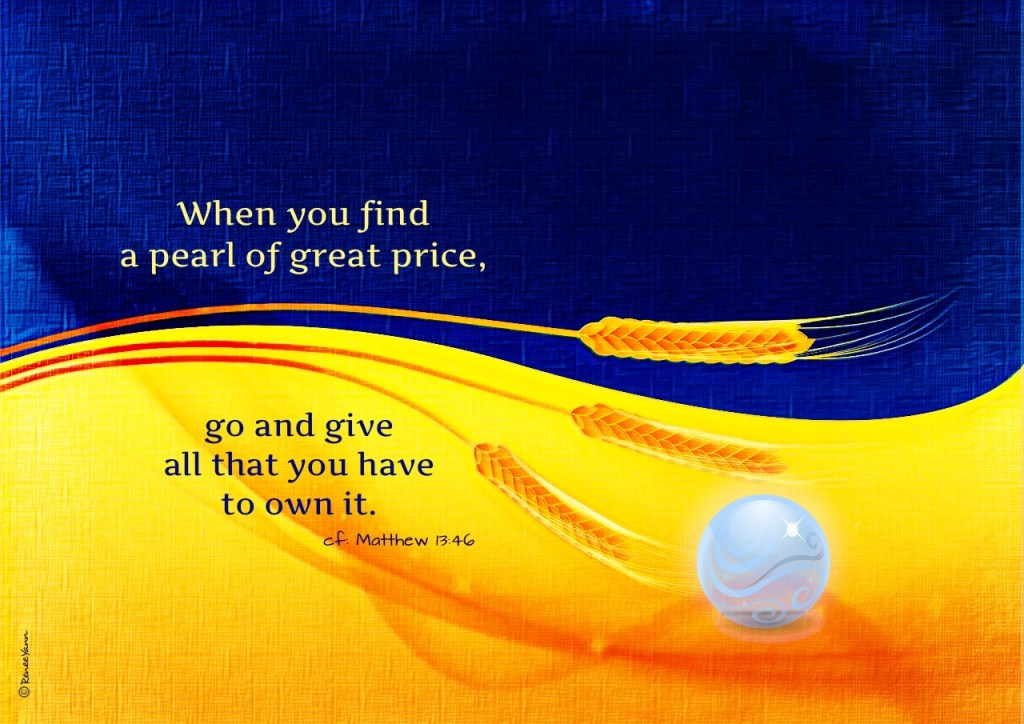
The kingdom of heaven is like a treasure buried in a field, which a person finds and hides again, and out of joy goes and sells all that he has and buys that field. Again, the kingdom of heaven is like a merchant searching for fine pearls. When he finds a pearl of great price, he goes and sells all that he has and buys it.
Matthew 13:44
History tells us that Solomon had his challenges holding on to the treasures granted in his dream. Paul offers his advice in Romans 8 to encourage the early Christians suffering persecution for the sake of their spiritual treasures. Jesus emphasizes that everybody find or hold on to their pearls until the end of time.
We can infer from these three facts that finding the pearl isn’t enough. Preserving its integrity and beauty is the work of a faithful lifetime.
Poetry: The Bright Field – R.S. Thomas
I have seen the sun break through
to illuminate a small field
for a while, and gone my way
and forgotten it. But that was the
pearl of great price, the one field that had
treasure in it. I realise now
that I must give all that I have
to possess it. Life is not hurrying
on to a receding future, nor hankering after
an imagined past. It is the turning
aside like Moses to the miracle
of the lit bush, to a brightness
that seemed as transitory as your youth
once, but is the eternity that awaits you.
Music: Treasure in a Field – Dan Schutte, sung by Josephina Albuquerque, RJM
Today, in God’s Lavish Mercy, we pray with three beloved friends of Jesus. And I mean real, down-to-earth buddies, heart-companions like the ones we seek out in the peaks and valleys of our lives. Jesus loved these three friends as John tells us in his Gospel:
Jesus loved Martha, and her sister Mary, and Lazarus.
John 11:5
Like many of the inspirational Bible figures, we know little about Martha, Mary and Lazarus. But the little we know goes deep when we consider it in prayerful reflection. For today’s prayer, I am focusing on Martha.
Martha is the doer – the wise, practical, and somewhat anxious member of the family. I think Martha had to have been the oldest, the big sister who watched over her younger siblings. She was the one who made sure the house was clean, the shopping done, the meal prepared. And, probably, she got a little annoyed when the others took these important responsibilities for granted. She obviously felt a bit unappreciated at times. Martha was confident in how she wanted things to be and worked to make them so.
Everyone needs a friend like Martha, even though they are sometimes a little annoying. They help keep us on the right track by their honest assessment of reality and their robust engagement of its demands. They prod us to recognize the call within our circumstances and the grace it will yield if attended to.
The Church offers us two readings to choose from today recounting incidents in the life of this family. In one of them, Martha even prods Jesus to do what needs to be done:
When Martha heard that Jesus was coming, she went to meet him; but Mary sat at home. Martha said to Jesus, “Lord, if you had been here, my brother would not have died. But even now I know that whatever you ask of God, God will give you.
John 11:20-22
In the other reading choice, Martha (by tattling to Jesus) prods contemplative Mary to be a little more practical in their domestic situation.
Jesus entered a village where a woman whose name was Martha welcomed him. She had a sister named Mary who sat beside the Lord at his feet listening to him speak. Martha, burdened with much serving, came to him and said, “Lord, do you not care that my sister has left me by myself to do the serving?
Luke 10:38-40
Finally, in a monumental unwillingness to let unwanted things be as they are, Martha won’t even let Lazarus rest in peace. She wants him raised from the dead, and so she prods Jesus with the veiled request cited above.
The Raising of Lazarus – by Duccio di Buoninsegna c.1513 (note the practical guy in the yellow cloak holding his nose!)
We can use our imagined insights into Martha’s nature to help us understand our own approach to the presence of God in our lives. What can guide us in such a meditation is the key component of this Gospel reading – the response of Jesus to Martha’s search for balance in her life:
Jesus said to her, “Your brother will rise.” Martha said to him, “I know he will rise, in the resurrection on the last day.” Jesus told her, “I am the resurrection and the life; whoever believes in me, even if he dies, will live, and anyone who lives and believes in me will never die. Do you believe this?” She said to him, “Yes, Lord. I have come to believe that you are the Christ, the Son of God, the one who is coming into the world.”
John 11:23-27
Jesus asks Martha to shift her perspective from practical knowledge to unquestioning faith. In a very real sense, Jesus is raising Martha to new life before he raises Lazarus. Ultimately, Jesus does what Martha asks, but not because she thinks it’s a good idea. The miracle is released from Christ’s heart by Martha’s unqualified faith.
And so it is with us when we pray. If our “prayer” is a dictation of how we would like God to behave, it will not engender the transformative grace of new life. That miracle is accomplished only if our prayer is an expression of absolute faith in God’s loving Will.
Poetry: The Raising of Lazarus – Rainer Maria Rilke, translated by Hanz Wright This poem, unpublished in the poet’s lifetime, appears in a notebook that the Austro-German Rilke (1875–1926) kept while in Ronda, Spain, in 1913. The translation was begun by Wright decades ago (“I have been working on it, in a hundred versions, since I was in college,” he says). – source: Boston College Magazine
Evidently, this was needed. Because people need
to be screamed at with proof.
But Jesus knew his friends. Before they were,
he knew them; and they knew
that he would never leave them
desolate here. So he let his exhausted eyes close
at first glimpse of the village.
And immediately he seemed
to be standing in their midst.
Here was Martha, the dead boy’s sister.
He knew he would always find her
at his right hand, and beside her
Mary. They were all here.
Yet opening his eyes it was not so.
He was standing apart,
even the two women
slowly backing away,
as if from concern for their good name.
Then he began to hear voices
muttering under their breath
quite distinctly; or thinking,
Lord, if you had been hereour friend might not have died.
(At that, he seemed to reach out
to touch someone’s face
with infinite gentleness,
and silently wept.) He asked them the way
to the grave. And he followed
behind them, preparing
to do what is not done
to that green silent place
where life and death are one.
Merely to walk down this road
had started to feel like a test,
or a poorly prepared-for performance
with actors unsure of their lines,
or which play they were supposed to be in;
a feverish outrage rising inside him
at the glib ease with which words like “living”
and “being dead” rolled off their tongues.
And awe flooded his body
when he hoarsely cried,
“Move the stone!”
“By now he must stink,”
somebody helpfully shouted.
(And it was true, the body
had been lying in the tomb
four days.) But he was far away,
too far away inside himself
to hear it, beginning
to fill with that gesture
which rose through him:
no hand this heavy
had ever been raised, no human hand
had ever reached this height
shining an instant in air, then
all at once clenching into itself
at the thought all the dead might return
from that tomb where
the enormous cocoon
of the corpse was beginning to stir.
In the end, though, nobody stood
there at its entrance
but the young man
who had freed his right arm
and was pulling at his face,
at small strips of grave wrappings.
Peter looked across at Jesus
with an expression that seemed to say
You did it, or What have you done? And all
saw how their vague and inaccurate
life made room for him once more.
Today, in God’s Lavish Mercy, our readings revolve around the dynamic of hope – God’s hope planted in our spirits and our hope entrusted to God’s Mercy.
As we pray with these passages, it helps to remind ourselves of the true definition of “hope”. It is a word that many of us use carelessly to the point that we may have lost the power of its meaning – as in when we say things like, “I hope it doesn’t rain”. What we really mean is that we wish it wouldn’t rain.
Hope is not the same as wishing. Wishing is a mental activity that has no power to make its object come true. Hope, on the other hand, is a resident condition of our spirits that frees us to live with enthusiasm and gratitude despite whatever outcome may arise.
Wishing dissapates when conclusions pass. Hope is eternal because it draws its energy from faith in God’s Infinite Mercy and the promise of eternal life.
The Book of Wisdom’s author understood the Source from which hope springs:
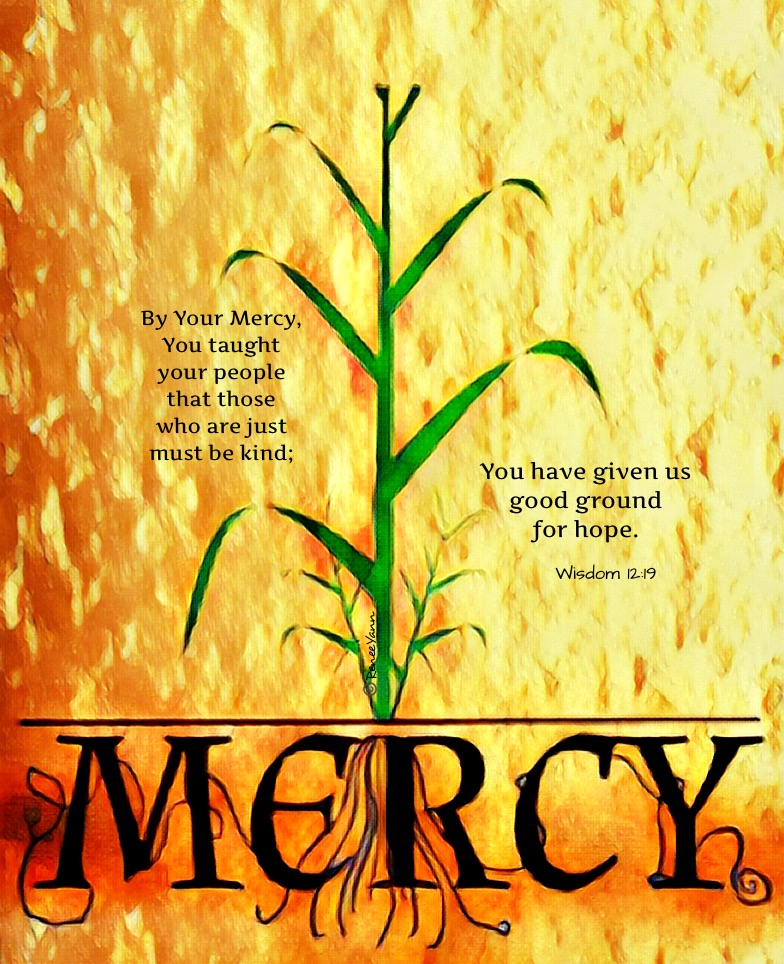
Though you are master of might, you judge with clemency, and with much lenience you govern us; for power, whenever you will, attends you. And you taught your people, by your deeds, that those who are just must be kind; and you gave your children good ground for hope that you would permit repentance for their sins.
Wisdom 12:18-19
Paul, in another passage from magnificent Romans 8, acknowledges that we can sustain hopeful hearts only by the power of the Holy Spirit who lifts us up and prays within us when we are too overwhelmed to do so ourselves.
The Spirit comes to the aid of our weakness; for we do not know how to pray as we ought, but the Spirit intercedes with inexpressible groanings. And the one who searches hearts knows what is the intention of the Spirit, because Spirit intercedes for the holy ones according to God’s will.
Romans 8:26-27
Jesus gives us a great parable for understanding hope. How discouraged might that farmer have been when the enemy tried to ruin his crop! But instead, the farmer realized that his field, like life, can sustain both the wheat and the weeds. If we live hopefully and faithfully, the wheat can be gathered from the harvest, and the weeds ultimately cast aside.
How many times in our own lives have we nearly been overwhelmed by the weeds! There is no life which passes without its hurts, disappointments, confusions, and dashed wishes! Some experience a sparse scattering of these weeds, and some lives are thick with difficulty. How surprising that it is often in the latter circumstance that hope rises up and sustains hearts.
As our Responsorial Psalm reminds us, those who live simply and sincerely are most able to tap deeply into the mysterious power of hope.
Blessed are you, Father, Lord of heaven and earth; you have revealed to little ones the mysteries of the kingdom.
Poetry: From “Odes”– George Santayana was a Spanish-American philosopher known more for his aphorisms than his poetry. He came up with lines like, ‘Those who cannot remember the past are doomed to repeat it”, and “Fanaticism consists in redoubling your effort when you have forgotten your aim.”
IV
Slowly the black earth gains upon the yellow,
And the caked hill-side is ribbed soft with furrows.
Turn now again, with voice and staff, my ploughman,
Guiding thy oxen.
Lift the great ploughshare, clear the stones and brambles,
Plant it the deeper, with thy foot upon it,
Uprooting all the flowering weeds that bring not
Food to thy children.
Patience is good for man and beast, and labour
Hardens to sorrow and the frost of winter.
Turn then again, in the brave hope of harvest,
Singing to heaven.
Music: Weed and Wheat – Silayio Kirisua is a Maasi woman who represented Kenya in the Voice of Holland singing competition. After winning the competition, she has become an international sensation.
Today, in God’s Lavish Mercy, God is actively at work in both our scripture passages.
In our reading from Exodus, God instructs Moses in the Divine plan for Israel’s deliverance. It’s as if they’re sitting together at a drawing table laying out the course of history! Moses has some trepidation about how the people will accept this audacious plan. He asks for more detail on the game plan and God gives him a powerful answer:
Moses, hearing the voice of the LORD from the burning bush, said to him, “When I go to the children of Israel and say to them, ‘The God of your fathers has sent me to you,’ if they ask me, ‘What is his name?’ what am I to tell them?” God replied, “I am who am.” Then he added, “This is what you shall tell the children of Israel: I AM sent me to you.”
Forever after God’s revelation to Moses, Moses is tied heart-to-heart with God in the unfolding plan of Creation. It is an image similar to the one Jesus uses in today’s Gospel.
Jesus asks us to be tied heart-to-heart with him, yoked to him as we seek our salvation. Jesus assures us that in that unity we will find rest and peace. The assumption might be that Jesus carries most of the weight and labor while we, conjoined with him in trust, benefit from his salvific action. The yoke is the sacred discipline of sincere openness to God’s Will wrought by prayer and Gospel living.
Jesus says all this within another “I am” statement – but this time God’s Name is given in descriptors rather than nomenclature: I ammeek and humble of heart …
Jesus said: “Come to me, all you who labor and are burdened, and I will give you rest. Take my yoke upon you and learn from me, for I am meek and humble of heart; and you will find rest for yourselves. For my yoke is easy, and my burden light.”
Matthew 11:28-30
Poem Prayer: from Prayer Seeds by Joyce Rupp
Unnameable God, I feel you with me at every moment. You are my food, my drink, my sunlight, and the air I breath. (Psalm 16; Stephen Mitchell)
with each refreshing rain each slant of sunshine each beam of moonlight each whisper of wind
in every spiraling thought every turning of the heart every spoken and written word every action large and small
you stead, you lead you encourage, you guide you embrace, you never let go
one with my soul, one with my life one with me in the first breath one with me in the last
you know me now you will know me always and forever













 Lavish Mercy