Bearing Fruit

Memorial of Saint Irenaeus, Bishop and Martyr
Wednesday of the Twelfth Week in Ordinary Time
June 28, 2023

Today, in God’s Lavish Mercy, both our readings speak to the call to bear holy fruit for God.

In the passage from Genesis, we are witnesses to a delightful conversation between Abraham and the Lord. The homey tone and mutuality of their exchange reveals Abraham’s great comfort in God’s Presence – to the point of his feeling free to give God some advice:

The Lord said, “Fear not, Abram!
I am your shield;
I will make your reward very great.”

But Abram said,
“O Lord GOD, what good will your gifts be,
if I keep on being childless
and have as my heir the steward of my house, Eliezer?”
Abram continued,
“See, you have given me no offspring,
and so one of my servants will be my heir.”

Genesis 15:1-3

Like many of us, what Abraham doesn’t realize is that God already has him covered. God has a desire and plan for Abraham’s fruitfulness – a dream far beyond any that Abraham can himself conceive.

God took him outside and said:
“Look up at the sky and count the stars, if you can.
Just so,” he added, “shall your descendants be.”
Abram put his faith in the LORD,
who credited it to him as an act of righteousness.

Genesis 15:5-6

The “act of righteousness” described here in Genesis is an offering God asks of each of us in our lives: confident faith expressed in loving action.

Think about it. Abraham and Sarah have waited and waited (for five chapters now) for God’s promise of fruitfulness to transform their barren lives. It hasn’t happened yet! Abraham asks God, “What’s going on????”


Brueggemann says:

The large question (posed in this chapter) is that the promise does delay, even to the point of doubt. It is part of the destiny of our common faith that those who believe the promise and hope against barrenness nevertheless must live with the barrenness.


… the promise does delay,
even to the point of doubt

Oh, my dears, have we not all been there? Have we not all, at some time or another, anguished over the questions of our own fruitfulness, destiny, meaning, survival, relevance in this life? Have we not sometimes wondered if God is even there?


But God is, and will arise out of any barreness or darkness if we can be faithful. God says to us, as to Abraham, “Take it easy, Abe. I gotcha’. Trust me and believe. The “fire pot” and the “flaming torch” are coming. Keep your heart ready!”

When the sun had set and it was dark,
there appeared a smoking fire pot and a flaming torch,
which passed between those pieces.
It was on that occasion that the LORD made a covenant with Abram,
saying: “To your descendants I give this land,
from the Wadi of Egypt to the Great River the Euphrates.”

Genesis 15:17-18

Poetry: The Night Abraham Called to the Stars – Robert Bly

Do you remember the night Abraham first saw
The stars? He cried to Saturn: "You are my Lord!" 
How happy he was! When he saw the Dawn Star,

He cried, "You are my Lord!' 
How destroyed he was 
When he watched them set. 

Friends, he is like us:
We take as our Lord the stars that go down.
We are faithful companions to the unfaithful stars.

We are diggers, like badgers; we love to feel 
The dirt flying out from behind our back claws.
And no one can convince us that mud is not 

Beautiful. It is our badger soul that thinks so.
We are ready to spend the rest of our life
Walking with muddy shoes in the wet fields.

We resemble exiles in the kingdom of the serpent.
We stand in the onion fields looking up at the night.
My heart is a calm potato by day, and a weeping

Abandoned woman by night. 
Friend, tell me what to do,
Since I am a man in love with the setting stars.

Music: Promise Keeper – David Joost

The Other Cheek

Monday of the Eleventh Week in Ordinary Time
June 19, 2023

Today’s Readings:

https://bible.usccb.org/bible/readings/061923.cfm


Today, in God’s Lavish Mercy, Matthew hits us right between the eyes with one of the most difficult Gospel passages to defend, to explain, and – most certainly – to practice.

Jesus said to his disciples:
“You have heard that it was said,
An eye for an eye and a tooth for a tooth.
But I say to you, offer no resistance to one who is evil.


“Oh, wow’, we might think. “Did Jesus have any idea what kind of a world I’d be living in someday?!”


Violence is so rampant in our society that some of us have stopped looking at the news because we can’t stand it! Here in the U.S., we are traumatized by statistics around the number and kind of artillery in our neighborhoods and who dies as a result – children, worshippers, movie-goers, picnickers. Are these the “enemy” for whom we have designed our lethal weapons?

We see gunpoint carjackings, drive-by shootings, and unlicensed militia defending their political prejudices. We see children afraid to go to school. Mothers afraid to go shopping. Believers afraid to go to their place of worship. We have even seen an assault on the American government stoked by a nationalistic rhetoric of hostility, hatred, and aberrant machismo.

There are so many guns now on American streets that we may think the best response is to carry our own. The “law” allows that. We may consider ourselves valiant if we “stand our ground”, legally shooting some innocent bystander who happened to wander onto our property or drive into our traffic lane!

So what, in God’s Name, does this Gospel have to say to us who have descended almost beyond recue into the chasm of violence?


Remember, Jesus has just finished talking about the Law. He has assured his followers that he has come to fulfill the Law rather than to abolish it. Jesus honors and recognizes the Law as the framework that has held in place Israel’s centuries-long relationship with God.

But Jesus indicates that following the letter of the Law while not fulfilling its spirit is contradictory to the Reign of God. We can use the “law” as an excuse for our complacency – keeping in place those unexamined tenets that make us comfortable, rich, and more powerful to the detriment of others. This is what the Pharisees and Saducees had done.


In each of the five situations listed in today’s Gospel, Jesus isn’t telling us to lie down like a doormat and let ourselves be walked on. What he’s saying is that with God’s help, there is a better way, a deeper response that we can give to the conflicts in our lives.

Jesus encourages his followers not to meet the other with resistance. So often, resistance is our first defense rather than patience, negotiation, honesty, listening, or forgiveness. Jesus is asking us to stand still for a moment before lashing back – and in that moment move toward a more graced and courageous resolution. He is counseling us to listen, to imagine mutuality, and to work together for an equilibium of justice with mercy.

It must be admitted that sometimes this just doesn’t seem to work. Those with the power to make positive change can block the way, just as they did for Jesus. We can end up looking like “losers” – or even die – like Jesus did. But even though he had the power – the Omnipotence to do so – Jesus did not resist. If we really understand the Paschal Mystery and believe in the Resurrection, we will know why, and we will try to imitate him.


So where do we start? I think it starts with:

  • the level of reverence in our everyday interactions,
  • our attitudes toward “the other” – someone different from me in race, ethnicity, religion, sexuality, nationality, economic status, or opinion.
  • with our efforts toward reasonable gun legislation, educational equity for all children, universally available mental health services, and the eradication of abysmal poverty in our cities.

Can I do something to advance these changes? Not all by myself. But as a community of faith, Christians can bring amazing influence to these issues. Today’s Gospel is telling me to act on that belief.


Poem: Some – Daniel Berrigan, SJ

Some stood up once and sat down.
Some walked a mile and walked away.
Some stood up twice and sat down
I’ve had it, they said.
Some walked two miles and walked away
It’s too much, they cried.
Some stood and stood and stood.
They were taken for dummies
They were taken for fools
They were taken for being taken in.
Some walked and walked and walked.
They walked the earth
They walked the waters
They walked the air.
Why do you stand?
they were asked, and
Why do you walk?
Because of the children, they said, and
Because of the heart, and
Because of the bread.
Because
the cause
is the heart’s beat
and the children born
and the risen bread.

Music: Where Have All the Flowers Gone – written by Pete Seeger, sung by Joan Baez

God Has Always Been in Love with Us!

Eleventh Sunday in Ordinary Time
January 18, 2023

Today’s Readings:

https://bible.usccb.org/bible/readings/061823.cfm


Today, in God’s Lavish Mercy, our beautiful readings this Sunday paint the picture of a God Who is eternally in love with us.

The writer of Exodus twenty-five hundred years ago knew this.

Then the LORD called to Moses and said,
“Thus shall you say to the house of Jacob;
tell the Israelites:
You have seen for yourselves how I treated the Egyptians
and how I bore you up on eagle wings
and brought you here to myself.
Therefore, if you hearken to my voice and keep my covenant,
you shall be my special possession,
dearer to me than all other people
,
though all the earth is mine.

Exodus 19:3-5

Yes, God is eternally in love with us. Paul knew this when he wrote to the Romans about a half-century after Jesus lived on earth.

For Christ, while we were still helpless,
yet died at the appointed time for the ungodly.
Indeed, only with difficulty does one die for a just person,
though perhaps for a good person one might even find courage to die.
But God proves his love for us in that
while we were still sinners Christ died for us
.

Romans 5:6-8

And Matthew knew that God is eternally in love with us when he recorded this memory of his beloved Jesus:

At the sight of the crowds, Jesus’ heart was moved with pity for them
because they were troubled and abandoned,
like sheep without a shepherd.
….
Jesus sent out these twelve after instructing them thus,
“Do not go into pagan territory or enter a Samaritan town.
Go rather to the lost sheep of the house of Israel.
As you go, make this proclamation: ‘The kingdom of heaven is at hand.’
Cure the sick, raise the dead, cleanse lepers, drive out demons.

Matthew 9:36; 10:5-8

If God has loved us this long and this much, isn’t it time for us to really love God back?

In the above situations, and in our own lives, all that God ever asks for is faithfulness – through ups and downs, through ins and outs – God longs for our unwavering relationship.

A deep loving relationship like that requires our complete attention toward the Beloved.

How’re you doing with that?

It’s a question I’ll be asking myself – and God – in my prayer today.


Poetry: from Love’s Fire: Re-Creations of Rumi by Andrew Harvey

It is He who suffers his absence in me 
Who through me cries out to himself.
Love’s most strange, most holy mystery--
We are intimate beyond belief.

Music: The Everlasting Love of God – Matt Boswell and Matt Papa

Jesus, the Eternal “Yes”

Memorial of Saint Anthony of Padua
June 13, 2023

Today’s Readings:

https://bible.usccb.org/bible/readings/061323.cfm


Today, in God’s Lavish Mercy, our readings are about Truth, Spiritual Vigor, Holy Light.

For the Son of God, Jesus Christ, whom we proclaimed to you
was not “yes” and “no,” but only “Yes”.
For however many are the promises of God,
their Yes is in Jesus Christ …

2 Corinthians 1:19-20

A good friend of mine has taught me a lot about “Yes”, the kind of “Yes” I think Paul is describing in this passage. Sometimes, as with all friends, we might need a favor from each other – picking up a quart of milk, typing out a letter, providing transportation to a doctor.

I usually begin such a request with the phrase, “Could you do ^ me a favor…?” Somewhere in between “do” and “me”, my friend always shouts, “YES!!!” even before she hears what the favor is. Her “Yes”, rooted in loving friendship, is complete, unqualified, and inexhaustible.


God’s “Yes” to us, incarnate in the Gift of Jesus Christ, is eternally complete, unqualified, and inexhaustible!

Wow! Just think about that! Believing it can release immense power in our relationship with God! It can drag our Light out from under the bushel basket and into the world which is aching in darkness!


Our Gospel today, which continues Jesus’ Sermon on the Mount, describes what a Christian looks like who is trying to live their own “yes” back to God.

Such a believer is like salt, like light, like an elevated city calling us higher.

  • Salt – which releases and accents the good already inherent in our nature
  • Light – which makes the sacred path discoverable even in life’s shadows
  • City on the hilltop – which not only assures us that the journey can be accomplished, but turns to beckon and encourage us in our climb

Poetry: love is a place – e.e.cummings

love is a place
& through this place of
love move
(with brightness of peace)
all places

yes is a world
& in this world of
yes live
(skillfully curled)
all worlds

Music: Salt and Light – Lauren Daigle

The Gift of Eternal Life

Solemnity of the Body and Blood of Christ
June 11, 2023

Today’s Readings:

https://bible.usccb.org/bible/readings/061123.cfm

Today, in God’s Lavish Mercy, we celebrate the Body and Blood of Christ present to us in Eucharist and in the Church. This is one of the great and unfathonable mysteries of our faith. It is also the source of our greatest blessing in Christ because through this gift Jesus continues to live among us and within us.


No life can be sustained without food. This is true of our physical life but even more so of our spiritual life. God has invited all of us to live in eternal life through the gift of Jesus Christ. We are fed for this Life by Christ’s own Body and Blood.

As our Gospel indicates, from the very beginning, some people gave Jesus a hard time about this gift.

Jesus said to the Jewish crowds:
“I am the living bread that came down from heaven;
whoever eats this bread will live forever;
and the bread that I will give
is my flesh for the life of the world.”

The Jews quarreled among themselves, saying,
“How can this man give us his flesh to eat?”
Jesus said to them,
“Amen, amen, I say to you,
unless you eat the flesh of the Son of Man and drink his blood,
you do not have life within you.

John 6: 51-53

In all honesty, Jesus’s statement is not easy to accept if we hear it only on the level of our practical, tactical experience. But there are many other invisible levels within us and within our world. These deeper levels allow us to move beyond the explicable dimension into the mysteries which defy definition.


I’m not talking about big theological mysteries. I’m talking about the everyday wonders that make our lives beautiful and sublime. Let’s consider a newborn baby. We know all the mechanical and medical reasons why a new life comes into the world. But can we explain the infant eyes that seem to carry profound mysteries, or the first smile that causes us to tear up in thanksgiving. Can we define the immediate love and life-giving protection we willingly give this child perhaps before we even know his or her name? Can we truly analyze the desire and hope we feel for this newborn’s future?

All of these unwordable realities are generated from a place we cannot see but which is nonetheless real. The scriptures describe it as “Eternal Life” – “the God-place” that transcends our comprehension. It is from this place that we learn to live in faith and mystery. We come to understand that we will never really understand in a worldly sense. By accepting that fact in trust, we actually embrace a deeper wisdom that no longer needs definitions.


Jesus wanted his listeners to meet him in that place of sacred mystery and faith so that he could gift them with a gift beyond price. Some were able to do so; others were not.

Whoever eats my flesh and drinks my blood
has eternal life,
and I will raise them on the last day.

John 6:54

Today’s feast looks forward to the Last Supper when Jesus will bring his promise to fruition. The beautiful sequence “Lauda Sion” gives us a poetic remembrance of the institution of the Eucharist. The sequence was written by St. Thomas Aquinas when he also composed Pange Lingua, Sacris Solemniis, and Verbum Supernum Prodiens, prayers which are used in the Divine Office.

As we pray with today’s readings and sequence, may our hearts be opened to that deep faith which allows Christ to unite us with him in the fullness of eternal life even as we live within this world.


Music: Lauda Sion – Felix Mendelssohn


Poetry: Lauda Sion – Thomas Aquinas

Latin text
Lauda Sion Salvatórem
Lauda ducem et pastórem
In hymnis et cánticis.
Quantum potes, tantum aude:
Quia major omni laude,
Nec laudáre súfficis.
Laudis thema speciális,
Panis vivus et vitális,
Hódie propónitur.
Quem in sacræ mensa cœnæ,
Turbæ fratrum duodénæ
Datum non ambígitur.
Sit laus plena, sit sonóra,
Sit jucúnda, sit decóra
Mentis jubilátio.
Dies enim solémnis ágitur,
In qua mensæ prima recólitur
Hujus institútio.
In hac mensa novi Regis,
Novum Pascha novæ legis,
Phase vetus términat.
Vetustátem nóvitas,
Umbram fugat véritas,
Noctem lux elíminat.
Quod in cœna Christus gessit,
Faciéndum hoc expréssit
In sui memóriam.
Docti sacris institútis,
Panem, vinum, in salútis
Consecrámus hóstiam.
Dogma datur Christiánis,
Quod in carnem transit panis,
Et vinum in sánguinem.
Quod non capis, quod non vides,
Animósa firmat fides,
Præter rerum ordinem.
Sub divérsis speciébus,
Signis tantum, et non rebus,
Latent res exímiæ.
Caro cibus, sanguis potus:
Manet tamen Christus totus,
Sub utráque spécie.
A suménte non concísus,
Non confráctus, non divísus:
Integer accípitur.
Sumit unus, sumunt mille:
Quantum isti, tantum ille:
Nec sumptus consúmitur.
Sumunt boni, sumunt mali:
Sorte tamen inæquáli,
Vitæ vel intéritus.
Mors est malis, vita bonis:
Vide paris sumptiónis
Quam sit dispar éxitus.
Fracto demum Sacraménto,
Ne vacílles, sed memento,
Tantum esse sub fragménto,
Quantum toto tégitur.
Nulla rei fit scissúra:
Signi tantum fit fractúra:
Qua nec status nec statúra
Signáti minúitur.
Ecce panis Angelórum,
Factus cibus viatórum:
Vere panis filiórum,
Non mitténdus cánibus.
In figúris præsignátur,
Cum Isaac immolátur:
Agnus paschæ deputátur
Datur manna pátribus.
Bone pastor, panis vere,
Jesu, nostri miserére:
Tu nos pasce, nos tuére:
Tu nos bona fac vidére
In terra vivéntium.
Tu, qui cuncta scis et vales:
Qui nos pascis hic mortáles:
Tuos ibi commensáles,
Cohærédes et sodáles,
Fac sanctórum cívium.
Amen. Allelúja.

English Translation
Sion, lift up thy voice and sing:
Praise thy Savior and thy King,
Praise with hymns thy shepherd true.
All thou canst, do thou endeavour:
Yet thy praise can equal never
Such as merits thy great King.
See today before us laid
The living and life-giving Bread,
Theme for praise and joy profound.
The same which at the sacred board
Was, by our incarnate Lord,
Giv’n to His Apostles round.
Let the praise be loud and high:
Sweet and tranquil be the joy
Felt today in every breast.
On this festival divine
Which records the origin
Of the glorious Eucharist.
On this table of the King,
Our new Paschal offering
Brings to end the olden rite.
Here, for empty shadows fled,
Is reality instead,
Here, instead of darkness, light.
His own act, at supper seated
Christ ordain’d to be repeated
In His memory divine;
Wherefore now, with adoration,
We, the host of our salvation,
Consecrate from bread and wine.
Hear, what holy Church maintaineth,
That the bread its substance changeth
Into Flesh, the wine to Blood.
Doth it pass thy comprehending?
Faith, the law of sight transcending
Leaps to things not understood.
Here beneath these signs are hidden
Priceless things, to sense forbidden,
Signs, not things, are all we see.
Flesh from bread, and Blood from wine,
Yet is Christ in either sign,
All entire, confessed to be.
They, who of Him here partake,
Sever not, nor rend, nor break:
But, entire, their Lord receive.
Whether one or thousands eat:
All receive the self-same meat:
Nor the less for others leave.
Both the wicked and the good
Eat of this celestial Food:
But with ends how opposite!
Here ‘t is life: and there ‘t is death:
The same, yet issuing to each
In a difference infinite.
Nor a single doubt retain,
When they break the Host in twain,
But that in each part remains
What was in the whole before.
Since the simple sign alone
Suffers change in state or form:
The signified remaining one
And the same for evermore.
Behold the Bread of Angels,
For us pilgrims food, and token
Of the promise by Christ spoken,
Children’s meat, to dogs denied.
Shewn in Isaac’s dedication,
In the manna’s preparation:
In the Paschal immolation,
In old types pre-signified.
Jesu, shepherd of the sheep:
Thou thy flock in safety keep,
Living bread, thy life supply:
Strengthen us, or else we die,
Fill us with celestial grace.
Thou, who feedest us below:
Source of all we have or know:
Grant that with Thy Saints above,
Sitting at the feast of love,
We may see Thee face to face.
Amen. Alleluia.

Give It All You’ve Got

Saturday of the Ninth Week in Ordinary Time
June 10, 2023

Today’s Reading:

https://bible.usccb.org/bible/readings/061023.cfm

Today, in God’s Lavish Mercy, we come to nearly the last chapter in the Book of Tobit. We hear a passage from Tobit only once again in the entire liturgical year. So if you want to know the whole story, you’ll have to pick up your Bible and do some reading!


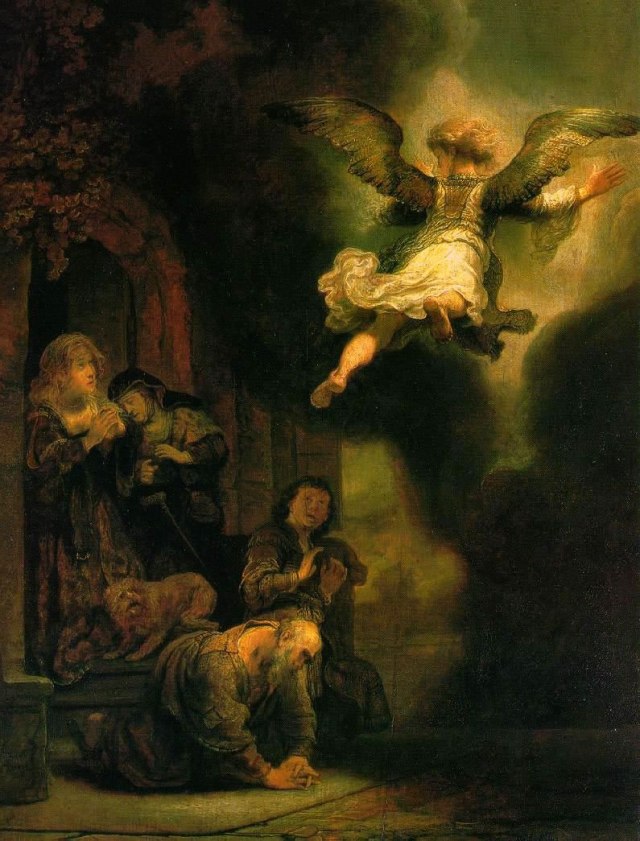
Archangel Raphael Leaves Tobias’s Family – Rembrandt

In today’s passage, Raphael reveals himself as God’s elite angel sent in answer to Tobit’s and Anna’s prayers. Before leaving to return to heaven, Rafael gives the family a bundle of advice about righteousness and sanctity. In reality, it is the author of Tobit giving his audience this advice as they cope with the anxieties of the diaspora.


In our Gospel, Jesus finishes up a chapter too. The scribes, Sadducees, and Pharisees have been wrangling with Jesus throughout the week’s readings. Today, rather than enter into debate with them, Jesus uses a visual example to make his point.

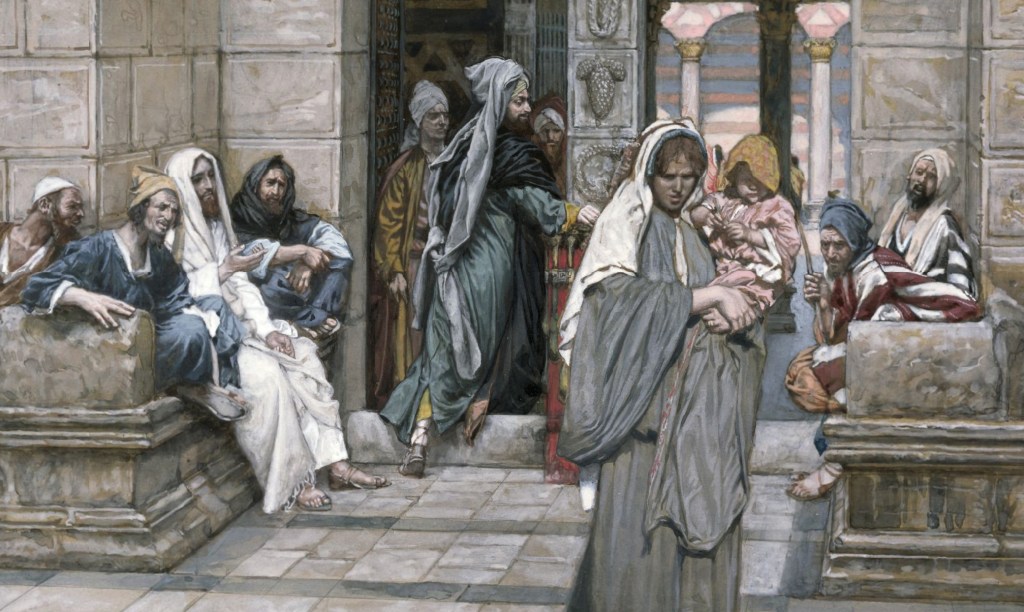
Where Jesus sits debating with these elitist religionists, there is a “poor box” to make offerings. The rich and privileged pass by, maybe tossing in a few left over coins from their marketing. But a poor widow approaches the box with a nearly invisible yet momumental gift. Jesus seizes the moment to make a consummate point with an economy of words:

Many rich people put in large sums.
A poor widow also came and put in two small coins worth a few cents.
Calling his disciples to himself, he said to them,
Amen, I say to you, this poor widow put in more
than all the other contributors to the treasury.
For they have all contributed from their surplus wealth,
but she, from her poverty, has contributed all she had,
her whole livelihood
.”

The Widow’s Mite – James Tissot


Humble Tobit and the Generous Widow teach us volumes about how to love and serve God. They teach us about righteousness and spiritual wealth, about justice and freedom, about fidelity and hope.

As we close this week of wonderful readings, let’s sit with these teachers, and with Jesus, to discern the most important lessons for us.


Poetry: The Widow’s Mites – Richard Crashaw

Two mites, two drops, yet all her house and land,
Fall from a steady heart, though trembling hand :
The other's wanton wealth foams high, and brave ;
The other cast away, she only gave.

Music: Give It All You’ve Got – 3rd Force

Not Far

Thursday of the Ninth Week in Ordinary Time
June 8, 2023

Today’s Readings:

https://bible.usccb.org/bible/readings/060823.cfm

Today in God’s Lavish Mercy, our first reading invites us to a wedding and our Gospel shows us the way to heaven.

The marriage of Tobiah and Sarah is a nail-biter! Seven would-be husbands have already died in the honeymoon chamber! Sarah’s father is so convinced that Tobiah will be the eighth that, after the couple goes to bed, he digs a grave just in case. But Tobiah, like his father Tobit, is a good and just man. His heart is pure. Before they make love, Tobiah and Sarah pray and God hears their prayer, allowing Raphael to dispel the demon that has plagued Sarah’s earlier disastrous marriage attempts.


So what is happening here in terms of scriptural inspiration? Is this just a great beach book for the Jews scattered after the Assyrian captivity? Certainly not. The Book of Tobit offered spiritual stability to the uncertain world of the Jews in exile. In a clever story, the narrator outlines the essential guideposts for the believer to hold fast to their identity and faith – primarily with these concepts:

  • God is in charge and will remain faithful even if we do not. Imagine that!
  • Our faithfulness is demonstrated by religious fidelity, humility, prayer, patience and good works.
  • God’s faithfulness is demonstrated by bringing good even out of chaos and misfortune.

Our modern understandings are not that different from those of Tobit’s ancient author. In some sense, we all live “in exile”, at least from our final heavenly home. And God, of course, is still in charge. But we see God’s power in our lives not as preordained management but rather as a steadfast companionship in our own life’s unfolding drama.

Our life is not a book God has already written. In a mystery we cannot comprehend, our Omnipotent God chooses to live our lives with us, its direction unfolding as we continue to mature in God’s Love.


Our Gospel tells the story of a scribe deepening in that maturing process. He asks Jesus what is most important to live a good life. Jesus says what’s most important is love – love of God and love of neighbor. When the scribe responds in agreement, Jesus tells him that he is not far from the kingdom of God.

Perhaps our prayer today could be this: May deepening Love carry each of us all the way home to God’s heart.


Poetry: Heaven-Haven by Gerard Manley Hopkins

(A nun takes the veil)
I have desired to go
Where springs not fail,
To fields where flies no sharp and sided hail
And a few lilies blow.
And I have asked to be
Where no storms come,
Where the green swell is in the havens dumb,
And out of the swing of the sea.


Music: A Walk in Paradise – Darlene Koldenhaven

What Will Heaven Be Like?

Wednesday of the Ninth Week in Ordinary Time
June 7, 2023

Today’s Readings:

https://bible.usccb.org/bible/readings/060723.cfm

Today, in God’s Lavish Mercy, both Tobit and Sarah stand on the edge of a psychological cliff:

  • Tobit – because he has lost his ability to see, both physically and spiritually
  • Sarah – because she is ridiculed and accused of killing seven husbands

The beautiful thing about both of them is that in their desperation they turn to God. Ultimately, God hears them and gives healing.


Sarah’s Marriage to Tobiah after Raphael Kills Demon- Jan Steen


In our Gospel, the Sadducees present Jesus with a puzzle reminiscent of Sarah’s situation.

Now there were seven brothers.
The first married a woman and died, leaving no descendants.
So the second brother married her and died, leaving no descendants,
and the third likewise.
And the seven left no descendants.
Last of all the woman also died.
At the resurrection when they arise whose wife will she be?

Mark 12:20-23

The Sadducees could not have been more insincere in their question. They didn’t even believe in life after death, so why were they posing the question? The Sadducees accepted only the first five books of the Bible as scripture. They rejected the inspirations of the prophets and wisdom writers where the first Biblical ideas of an afterlife arise.

Given their rejection of the developing insights into God and God’s dealings with his people over the intervening centuries, and expressed so beautifully in the prophets and much of the wisdom literature, they did not accept any possibility of life after death. Persons lived on through descendants. The centrality of descendants was the reason also for their obsession with property rights and inheritance. The consequences of human behavior did not echo into eternity. Their horizons were firmly limited to the here and now.

Father John McKinnon – revered Australian priest and teacher

Jesus clearly saw the intention of the Sadducees’s question. Feeling their elite status to be threatened by his teaching, they wished to trap Jesus in an indefensible position. If they could undermine his authority and influence, their own would be bolstered.

Jesus unperturbedly but directly tells them that they are not only wrong in their calculations, but are clueless regarding God and the scriptures:

Jesus said to them, “Are you not misled
because you do not know the Scriptures or the power of God?
When they rise from the dead,
they neither marry nor are given in marriage,
but they are like the angels in heaven.

Mark 12:24-25

Haven’t you wondered what heaven will be like? Jesus’ answer gives us a little insight. I really like how Father McKinnon describes Jesus’s perception:

Jesus’ view of resurrection was of unbelievable qualitative difference, beyond the capacity of people to imagine or understand. It would be the power of God at work: pure gift. 

Father John McKinnon

We may want to spend some prayer time imagining that “unbelievable qualitative difference”, an imagining which ultimately saved Tobit and Sarah from their desperation.


Poetry: The World is not Conclusion – Emily Dickinson

This World is not Conclusion.
A Species stands beyond -
Invisible, as Music -
But positive, as Sound -
It beckons, and it baffles -
Philosophy, dont know -
And through a Riddle, at the last -
Sagacity, must go -
To guess it, puzzles scholars -
To gain it, Men have borne
Contempt of Generations
And Crucifixion, shown -
Faith slips - and laughs, and rallies -
Blushes, if any see -
Plucks at a twig of Evidence -
And asks a Vane, the way -
Much Gesture, from the Pulpit -
Strong Hallelujahs roll -
Narcotics cannot still the Tooth
That nibbles at the soul -

Music: Can Only Imagine – MercyMe

O My `Three’, My All

The Solemnity of the Most Holy Trinity
June 4, 2023

Today’s Readings:

https://bible.usccb.org/bible/readings/060423.cfm

Today, in God’s Lavish Mercy, we are wrapped in the loving mystery of the Holy Trinity. This mystery encompasses the Generative, Salvific, and Indwelling nature of the one true God.

The Trinity is a mystery we approach with our hearts and souls, not with our minds. It is a Reality we fall in love with, and Which falls in love with us. John O’Donohue describes it like this:

The Christian concept of God as Trinity is the most sublime articulation of otherness and intimacy, an eternal interflow of friendship. This perspective discloses the beautiful fulfillment of our immortal longing in the words of Jesus, who said, Behold, I call you friends. Jesus, as the son of God, is the first Other in the universe. . . . In friendship with him, we enter the tender beauty and affection of the Trinity. In the embrace of this eternal friendship, we dare to be free.

from Anam Cara: A Book of Celtic Wisdom

In our first reading, Moses encounters the Creator, first Person of the Blessed Trinity and invites God into his company.

Having come down in a cloud, the LORD stood with Moses there
and proclaimed his name, “LORD.”
Thus the LORD passed before him and cried out,
“The LORD, the LORD, a merciful and gracious God,
slow to anger and rich in kindness and fidelity.”
Moses at once bowed down to the ground in worship.
Then he said, “If I find favor with you, O Lord,
do come along in our company.


In our second reading, Paul tells us how to invite God into our company:

Brothers and sisters, rejoice.
Mend your ways, encourage one another,
agree with one another, live in peace,
and the God of love and peace will be with you.


And in our Gospel, Jesus utters the iconic verse which is the foundation of our faith:

God so loved the world that he gave his only Son,
so that everyone who believes in him might not perish
but might have eternal life.


Each of our readings allows us to reflect on the wonder that we touch God in many different ways, just as God touches us.

  • Sometimes we invoke the Source of our life to guide and protect us.
  • At other times, we look to the Incarnate Word to teach us how to live.
  • Still there are other times when we reach deep into our hearts and pray without words in the Holy Spirit about things too deep to describe.

Prose: Prayer of St. Elizabeth of the Trinity – (excerpt from Drink of the Stream: Prayers of Carmelites compiled by Penny Hickey)

“O my God, Trinity whom I adore, let me entirely forget myself that I may abide in you, still and peaceful as if my soul were already in eternity; let nothing disturb my peace nor separate me from you, O my unchanging God, but that each moment may take me further into the depths of your mystery ! Pacify my soul! Make it your heaven, your beloved home and place of your repose; let me never leave you there alone, but may I be ever attentive, ever alert in my faith, ever adoring and all given up to your creative action.
O my beloved Christ, crucified for love, would that I might be for you a spouse of your heart! I would anoint you with glory, I would love you - even unto death! Yet I sense my frailty and ask you to adorn me with yourself; identify my soul with all the movements of your soul, submerge me, overwhelm me, substitute yourself in me that my life may become but a reflection of your life. Come into me as Adorer, Redeemer and Savior.
O Eternal Word, Word of my God, would that I might spend my life listening to you, would that I might be fully receptive to learn all from you; in all darkness, all loneliness, all weakness, may I ever keep my eyes fixed on you and abide under your great light; O my Beloved Star, fascinate me so that I may never be able to leave your radiance.
O Consuming Fire, Spirit of Love, descend into my soul and make all in me as an incarnation of the Word, that I may be to him a super-added humanity wherein he renews his mystery; and you O Father, bestow yourself and bend down to your little creature, seeing in her only your beloved Son in whom you are well pleased.
O my `Three', my All, my Beatitude, infinite Solitude, Immensity in whom I lose myself, I give myself to you as a prey to be consumed; enclose yourself in me that I may be absorbed in you so as to contemplate in your light the abyss of your Splendor!”

Music: Oh, Late Have I Loved You – Prayer of St. Augustine interpreted by Roc O’Conner, SJ

A Godly Person

Friday of the Eighth Week in Ordinary Time
June 2, 2023

Today’s Readings:

https://bible.usccb.org/bible/readings/060223.cfm

The Family Tree


Today, in God’s Lavish Mercy, Sirach sounds like he has been using Ancestry.com! As he comes close to the conclusion of his long meditation on God, the Universe, and Nature, he closes now with a reflection on humanity.

Now will I praise those godly men and women,
our ancestors, each in their own time.


In my childhood home, there was a fascinating table whose secrets I learned only when I got to about fifth or sixth grade. I had thought it was just a spot to place a pretty vase, but it was really a classic games table whose top swiveled to store the cards or games inside.

I lived with that table for years, and by the time I was ten or eleven years old, I had never seen that top swiveled nor the inside displayed. Reading Sirach today makes me remember why.

Stored in the table since the time of my grandmother’s death were all the tender remembrances of my deceased family members. Dried funeral flowers wrapped in faded wax paper. The war office telegram saying Uncle Jim had died on Iwo Jima. Black rimmed death announcements from another era – aunts, uncles and great-grands. There were cards from neighbors extolling my grandmother’s courage and goodness.

One day, my mother opened the table and we sat togather as she recounted the stories of the ancestors I never knew. I think it made her both happy and sad to finally share the stories with me. Reliving the losses made her sad. But placing the memories in me made her happy for the very reasons Sirach elaborates in today’s reading.

… these also were godly people
whose virtues have not been forgotten;
Their wealth remains in their families,
their heritage with their descendants;
Through God’s covenant with them their family endures,
their posterity, for their sake.


Our Gospel includes a description of Jesus’s encounter with the poor fig tree. Failing to bear fruit, the tree was cursed by Jesus. It seems like an uncharacteristically mean thing for Jesus to do until we realize that the fig tree is a symbol of the “ungodly” people Jesus has met in the Temple area.

He overturned the tables of the money changers
and the seats of those who were selling doves.
He did not permit anyone to carry anything through the temple area.
Then he taught them saying, “Is it not written:

My house shall be called a house of prayer for all peoples?
But you have made it a den of thieves.”


So our readings today give us two contrasting readings. Sirach tells us what makes a person “godly”, rememberable, and worthy of eternal life. Jesus shows us the fruitlessness and faithlessness that eternally nullifies and condemns a life.

Jesus tells us what faithfulness consists of and how we are to become a godly person – a person worth remembering. Praying with these scriptures, I remember my faith-filled ancestors who rest, not only in a hidden drawer, but in me and in how I live my life because of their legacy.

Jesus said to them in reply, “Have faith in God.
Amen, I say to you, whoever says to this mountain,
‘Be lifted up and thrown into the sea,’
and does not doubt in his heart
but believes that what he says will happen,
it shall be done for him.
Therefore I tell you, all that you ask for in prayer,
believe that you will receive it and it shall be yours.
When you stand to pray,
forgive anyone against whom you have a grievance,
so that your heavenly Father may in turn
forgive you your transgressions.”


Poetry: The Other Kingdoms – Mary Oliver

Consider the other kingdoms. The
trees, for example, with their mellow-sounding
titles: oak, aspen, willow.
Or the snow, for which the peoples of the north
have dozens of words to describe its
different arrivals. Or the creatures, with their
thick fur, their shy and wordless gaze. Their
infallible sense of what their lives
are meant to be. Thus the world
grows rich, grows wild, and you too,
grow rich, grow sweetly wild, as you too
were born to be.

Music: Memories of Blue – Vangelis