Today, in God’s Lavish Mercy, we come to nearly the last chapter in the Book of Tobit. We hear a passage from Tobit only once again in the entire liturgical year. So if you want to know the whole story, you’ll have to pick up your Bible and do some reading!
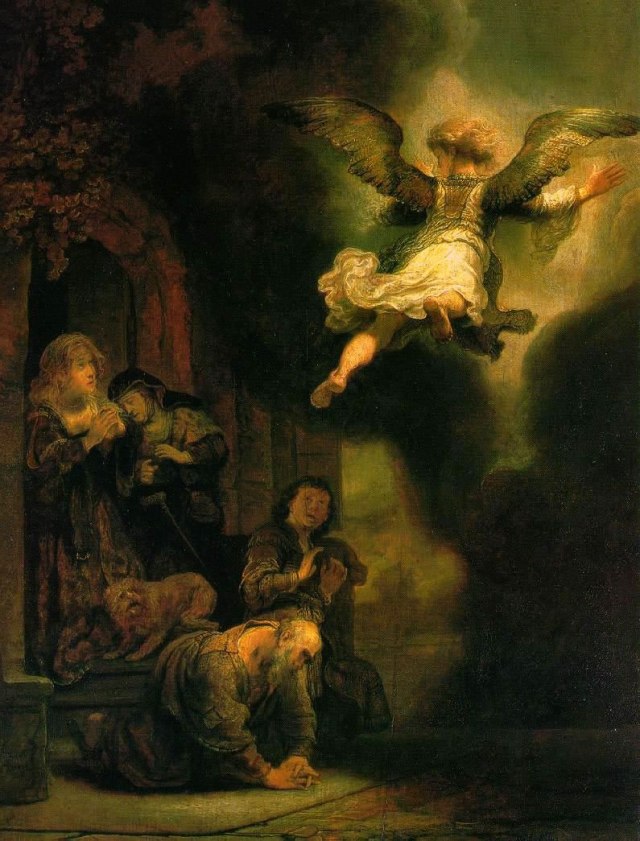
Archangel Raphael Leaves Tobias’s Family – Rembrandt
In today’s passage, Raphael reveals himself as God’s elite angel sent in answer to Tobit’s and Anna’s prayers. Before leaving to return to heaven, Rafael gives the family a bundle of advice about righteousness and sanctity. In reality, it is the author of Tobit giving his audience this advice as they cope with the anxieties of the diaspora.
In our Gospel, Jesus finishes up a chapter too. The scribes, Sadducees, and Pharisees have been wrangling with Jesus throughout the week’s readings. Today, rather than enter into debate with them, Jesus uses a visual example to make his point.
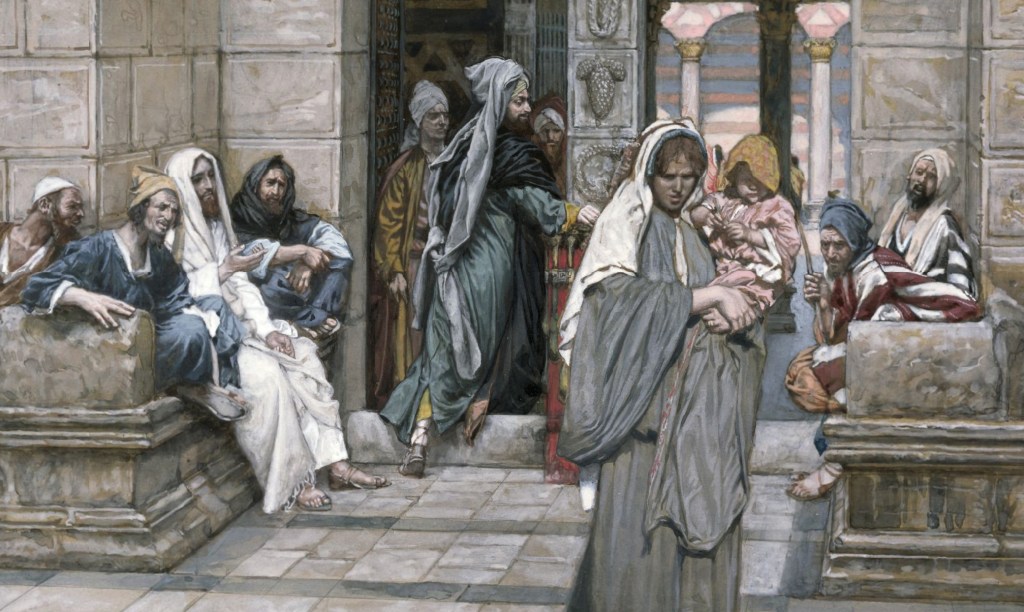
Where Jesus sits debating with these elitist religionists, there is a “poor box” to make offerings. The rich and privileged pass by, maybe tossing in a few left over coins from their marketing. But a poor widow approaches the box with a nearly invisible yet momumental gift. Jesus seizes the moment to make a consummate point with an economy of words:
Many rich people put in large sums. A poor widow also came and put in two small coins worth a few cents. Calling his disciples to himself, he said to them, “Amen, I say to you, this poor widow put in more than all the other contributors to the treasury. For they have all contributed from their surplus wealth, but she, from her poverty, has contributed all she had, her whole livelihood.”
The Widow’s Mite – James Tissot
Humble Tobit and the Generous Widow teach us volumes about how to love and serve God. They teach us about righteousness and spiritual wealth, about justice and freedom, about fidelity and hope.
As we close this week of wonderful readings, let’s sit with these teachers, and with Jesus, to discern the most important lessons for us.
Poetry: The Widow’s Mites – Richard Crashaw
Two mites, two drops, yet all her house and land,
Fall from a steady heart, though trembling hand :
The other's wanton wealth foams high, and brave ;
The other cast away, she only gave.
Today in God’s Lavish Mercy, our first reading invites us to a wedding and our Gospel shows us the way to heaven.
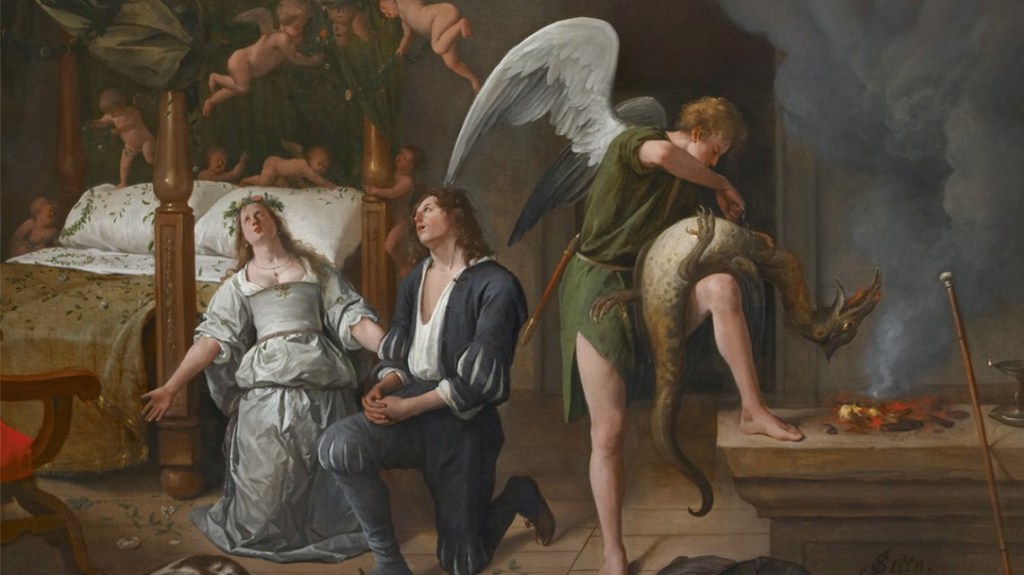
The marriage of Tobiah and Sarah is a nail-biter! Seven would-be husbands have already died in the honeymoon chamber! Sarah’s father is so convinced that Tobiah will be the eighth that, after the couple goes to bed, he digs a grave just in case. But Tobiah, like his father Tobit, is a good and just man. His heart is pure. Before they make love, Tobiah and Sarah pray and God hears their prayer, allowing Raphael to dispel the demon that has plagued Sarah’s earlier disastrous marriage attempts.
So what is happening here in terms of scriptural inspiration? Is this just a great beach book for the Jews scattered after the Assyrian captivity? Certainly not. The Book of Tobit offered spiritual stability to the uncertain world of the Jews in exile. In a clever story, the narrator outlines the essential guideposts for the believer to hold fast to their identity and faith – primarily with these concepts:
God is in charge and will remain faithful even if we do not. Imagine that!
Our faithfulness is demonstrated by religious fidelity, humility, prayer, patience and good works.
God’s faithfulness is demonstrated by bringing good even out of chaos and misfortune.
Our modern understandings are not that different from those of Tobit’s ancient author. In some sense, we all live “in exile”, at least from our final heavenly home. And God, of course, is still in charge. But we see God’s power in our lives not as preordained management but rather as a steadfast companionship in our own life’s unfolding drama.
Our life is not a book God has already written. In a mystery we cannot comprehend, our Omnipotent God chooses to live our lives with us, its direction unfolding as we continue to mature in God’s Love.
Our Gospel tells the story of a scribe deepening in that maturing process. He asks Jesus what is most important to live a good life. Jesus says what’s most important is love – love of God and love of neighbor. When the scribe responds in agreement, Jesus tells him that he is not far from the kingdom of God.
Perhaps our prayer today could be this: May deepening Love carry each of us all the way home to God’s heart.
Poetry: Heaven-Haven by Gerard Manley Hopkins
(A nun takes the veil) I have desired to go Where springs not fail, To fields where flies no sharp and sided hail And a few lilies blow. And I have asked to be Where no storms come, Where the green swell is in the havens dumb, And out of the swing of the sea.
Today, in God’s Lavish Mercy, both Tobit and Sarah stand on the edge of a psychological cliff:
Tobit – because he has lost his ability to see, both physically and spiritually
Sarah – because she is ridiculed and accused of killing seven husbands
The beautiful thing about both of them is that in their desperation they turn to God. Ultimately, God hears them and gives healing.
Sarah’s Marriage to Tobiah after Raphael Kills Demon- Jan Steen
In our Gospel, the Sadducees present Jesus with a puzzle reminiscent of Sarah’s situation.
Now there were seven brothers. The first married a woman and died, leaving no descendants. So the second brother married her and died, leaving no descendants, and the third likewise. And the seven left no descendants. Last of all the woman also died. At the resurrection when they arise whose wife will she be?
Mark 12:20-23
The Sadducees could not have been more insincere in their question. They didn’t even believe in life after death, so why were they posing the question? The Sadducees accepted only the first five books of the Bible as scripture. They rejected the inspirations of the prophets and wisdom writers where the first Biblical ideas of an afterlife arise.
Given their rejection of the developing insights into God and God’s dealings with his people over the intervening centuries, and expressed so beautifully in the prophets and much of the wisdom literature, they did not accept any possibility of life after death. Persons lived on through descendants. The centrality of descendants was the reason also for their obsession with property rights and inheritance. The consequences of human behavior did not echo into eternity. Their horizons were firmly limited to the here and now.
Father John McKinnon – revered Australian priest and teacher
Jesus clearly saw the intention of the Sadducees’s question. Feeling their elite status to be threatened by his teaching, they wished to trap Jesus in an indefensible position. If they could undermine his authority and influence, their own would be bolstered.
Jesus unperturbedly but directly tells them that they are not only wrong in their calculations, but are clueless regarding God and the scriptures:
Jesus said to them, “Are you not misled because you do not know the Scriptures or the power of God? When they rise from the dead, they neither marry nor are given in marriage, but they are like the angels in heaven.
Mark 12:24-25
Haven’t you wondered what heaven will be like? Jesus’ answer gives us a little insight. I really like how Father McKinnon describes Jesus’s perception:
Jesus’ view of resurrection was of unbelievable qualitative difference, beyond the capacity of people to imagine or understand. It would be the power of God at work: pure gift.
Father John McKinnon
We may want to spend some prayer time imagining that “unbelievable qualitative difference”, an imagining which ultimately saved Tobit and Sarah from their desperation.
Poetry: The World is not Conclusion – Emily Dickinson
This World is not Conclusion.
A Species stands beyond -
Invisible, as Music -
But positive, as Sound -
It beckons, and it baffles -
Philosophy, dont know -
And through a Riddle, at the last -
Sagacity, must go -
To guess it, puzzles scholars -
To gain it, Men have borne
Contempt of Generations
And Crucifixion, shown -
Faith slips - and laughs, and rallies -
Blushes, if any see -
Plucks at a twig of Evidence -
And asks a Vane, the way -
Much Gesture, from the Pulpit -
Strong Hallelujahs roll -
Narcotics cannot still the Tooth
That nibbles at the soul -
Today, in God’s Lavish Mercy, we are wrapped in the loving mystery of the Holy Trinity. This mystery encompasses the Generative, Salvific, and Indwelling nature of the one true God.
The Trinity is a mystery we approach with our hearts and souls, not with our minds. It is a Reality we fall in love with, and Which falls in love with us. John O’Donohue describes it like this:
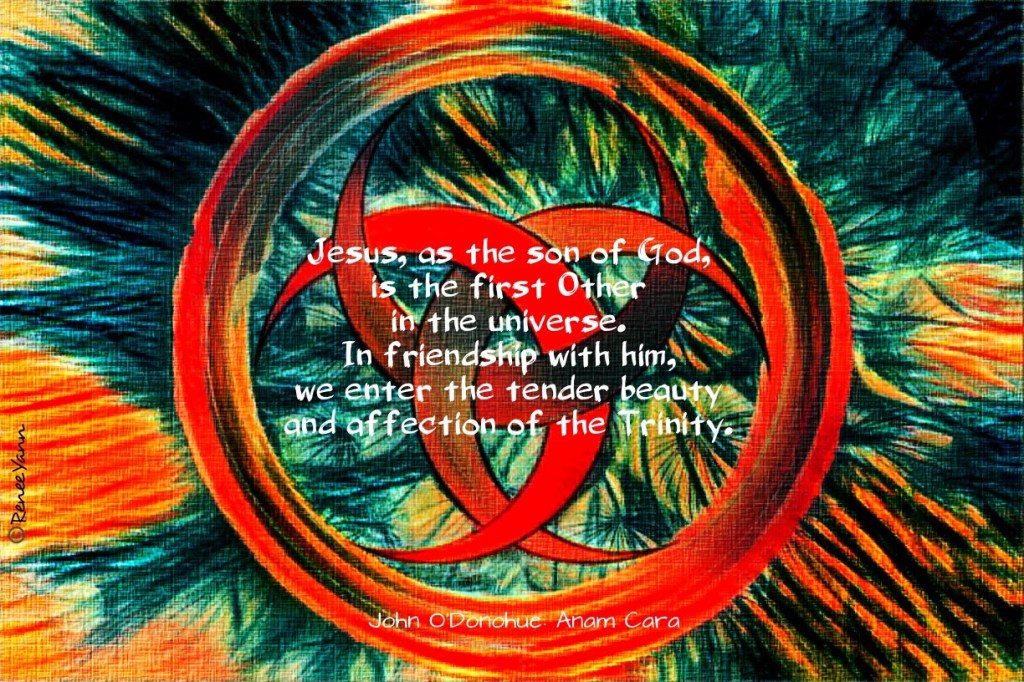
The Christian concept of God as Trinity is the most sublime articulation of otherness and intimacy, an eternal interflow of friendship. This perspective discloses the beautiful fulfillment of our immortal longing in the words of Jesus, who said, Behold, I call you friends. Jesus, as the son of God, is the first Other in the universe. . . . In friendship with him, we enter the tender beauty and affection of the Trinity. In the embrace of this eternal friendship, we dare to be free.
from Anam Cara: A Book of Celtic Wisdom
In our first reading, Moses encounters the Creator, first Person of the Blessed Trinity and invites God into his company.
Having come down in a cloud, the LORD stood with Moses there and proclaimed his name, “LORD.” Thus the LORD passed before him and cried out, “The LORD, the LORD, a merciful and gracious God, slow to anger and rich in kindness and fidelity.” Moses at once bowed down to the ground in worship. Then he said, “If I find favor with you, O Lord, do come along in our company.
In our second reading, Paul tells us how to invite God into our company:
Brothers and sisters, rejoice. Mend your ways, encourage one another, agree with one another, live in peace, and the God of love and peace will be with you.
And in our Gospel, Jesus utters the iconic verse which is the foundation of our faith:
God so loved the world that he gave his only Son, so that everyone who believes in him might not perish but might have eternal life.
Each of our readings allows us to reflect on the wonder that we touch God in many different ways, just as God touches us.
Sometimes we invoke the Source of our life to guide and protect us.
At other times, we look to the Incarnate Word to teach us how to live.
Still there are other times when we reach deep into our hearts and pray without words in the Holy Spirit about things too deep to describe.
Prose: Prayer of St. Elizabeth of the Trinity – (excerpt from Drink of the Stream: Prayers of Carmelites compiled by Penny Hickey)
“O my God, Trinity whom I adore, let me entirely forget myself that I may abide in you, still and peaceful as if my soul were already in eternity; let nothing disturb my peace nor separate me from you, O my unchanging God, but that each moment may take me further into the depths of your mystery ! Pacify my soul! Make it your heaven, your beloved home and place of your repose; let me never leave you there alone, but may I be ever attentive, ever alert in my faith, ever adoring and all given up to your creative action.
O my beloved Christ, crucified for love, would that I might be for you a spouse of your heart! I would anoint you with glory, I would love you - even unto death! Yet I sense my frailty and ask you to adorn me with yourself; identify my soul with all the movements of your soul, submerge me, overwhelm me, substitute yourself in me that my life may become but a reflection of your life. Come into me as Adorer, Redeemer and Savior.
O Eternal Word, Word of my God, would that I might spend my life listening to you, would that I might be fully receptive to learn all from you; in all darkness, all loneliness, all weakness, may I ever keep my eyes fixed on you and abide under your great light; O my Beloved Star, fascinate me so that I may never be able to leave your radiance.
O Consuming Fire, Spirit of Love, descend into my soul and make all in me as an incarnation of the Word, that I may be to him a super-added humanity wherein he renews his mystery; and you O Father, bestow yourself and bend down to your little creature, seeing in her only your beloved Son in whom you are well pleased.
O my `Three', my All, my Beatitude, infinite Solitude, Immensity in whom I lose myself, I give myself to you as a prey to be consumed; enclose yourself in me that I may be absorbed in you so as to contemplate in your light the abyss of your Splendor!”
Music: Oh, Late Have I Loved You – Prayer of St. Augustine interpreted by Roc O’Conner, SJ
Today, in God’s Lavish Mercy, Sirach sounds like he has been using Ancestry.com! As he comes close to the conclusion of his long meditation on God, the Universe, and Nature, he closes now with a reflection on humanity.
Now will I praise those godly men and women, our ancestors, each in their own time.
In my childhood home, there was a fascinating table whose secrets I learned only when I got to about fifth or sixth grade. I had thought it was just a spot to place a pretty vase, but it was really a classic games table whose top swiveled to store the cards or games inside.
I lived with that table for years, and by the time I was ten or eleven years old, I had never seen that top swiveled nor the inside displayed. Reading Sirach today makes me remember why.
Stored in the table since the time of my grandmother’s death were all the tender remembrances of my deceased family members. Dried funeral flowers wrapped in faded wax paper. The war office telegram saying Uncle Jim had died on Iwo Jima. Black rimmed death announcements from another era – aunts, uncles and great-grands. There were cards from neighbors extolling my grandmother’s courage and goodness.
One day, my mother opened the table and we sat togather as she recounted the stories of the ancestors I never knew. I think it made her both happy and sad to finally share the stories with me. Reliving the losses made her sad. But placing the memories in me made her happy for the very reasons Sirach elaborates in today’s reading.
… these also were godly people whose virtues have not been forgotten; Their wealth remains in their families, their heritage with their descendants; Through God’s covenant with them their family endures, their posterity, for their sake.
Our Gospel includes a description of Jesus’s encounter with the poor fig tree. Failing to bear fruit, the tree was cursed by Jesus. It seems like an uncharacteristically mean thing for Jesus to do until we realize that the fig tree is a symbol of the “ungodly” people Jesus has met in the Temple area.
He overturned the tables of the money changers and the seats of those who were selling doves. He did not permit anyone to carry anything through the temple area. Then he taught them saying, “Is it not written:
My house shall be called a house of prayer for all peoples? But you have made it a den of thieves.”
So our readings today give us two contrasting readings. Sirach tells us what makes a person “godly”, rememberable, and worthy of eternal life. Jesus shows us the fruitlessness and faithlessness that eternally nullifies and condemns a life.
Jesus tells us what faithfulness consists of and how we are to become a godly person – a person worth remembering. Praying with these scriptures, I remember my faith-filled ancestors who rest, not only in a hidden drawer, but in me and in how I live my life because of their legacy.
Jesus said to them in reply, “Have faith in God. Amen, I say to you, whoever says to this mountain, ‘Be lifted up and thrown into the sea,’ and does not doubt in his heart but believes that what he says will happen, it shall be done for him. Therefore I tell you, all that you ask for in prayer, believe that you will receive it and it shall be yours. When you stand to pray, forgive anyone against whom you have a grievance, so that your heavenly Father may in turn forgive you your transgressions.”
Poetry: The Other Kingdoms – Mary Oliver
Consider the other kingdoms. The
trees, for example, with their mellow-sounding
titles: oak, aspen, willow.
Or the snow, for which the peoples of the north
have dozens of words to describe its
different arrivals. Or the creatures, with their
thick fur, their shy and wordless gaze. Their
infallible sense of what their lives
are meant to be. Thus the world
grows rich, grows wild, and you too,
grow rich, grow sweetly wild, as you too
were born to be.
Today, in God’s Lavish Mercy, we return to the Ordinary Time of the Church liturgical year. We might picture Ordinary Time as that great cycle of life which carries us through our “ordinary days”, the holy companion that helps us find God in our dailyness.
We left the ordinary cycle way back on February 22nd, when we launched into Lent, Holy Week, and Eastertide. Now we pick up where we left off and, over the next two weeks, will finish the Gospel of Mark and the Book of Tobit which we were reading in February.
How has your life been in the meantime?
As we begin our scriptural prayer today, we might want to list the ups and downs, the ins and outs of the past few months. Have we walked through these round-about days holding fast to the anchor of scriptural prayer? How have we changed, grown or deepened in the process?
I know it has been a time of immense change for me. The “me” who was reading Mark’s Gospel on February 21st was a different “me” from the one who will pick it up today.
Realizing the pattern and constancy of our liturgical cycle can be a stabilizing influence in our spiritual lives. The liturgical year is steadily revolving under the frenzied whirling of the world. The unfolding of the scriptures is constant and true at the still core of our sometimes spiraling lives.
As we left Mark in February, the rich young man had just walked away sad and Jesus was talking about a camel passing through the needle’s eye. The metaphor was meant to teach us how hard it can be to live the Christian life well. In today’s reading, Peter begins to ask how much harder can it get for them because the disciples have already given up everything for Jesus.
But Jesus doesn’t even let Peter finish before assuring him that his life will be blessedly different because of all that he has given over to Christ. It will not be without difficulty, but it will be eternally vital and confirmed in God. As we pray with this holy Gospel – in our ordinary time – may we be blessed with the same assurance.
Peter began to say to Jesus, ‘We have given up everything and followed you.” Jesus said, “Amen, I say to you, there is no one who has given up house or brothers or sisters or mother or father or children or lands for my sake and for the sake of the Gospel who will not receive a hundred times more now in this present age… … with persecutions, and eternal life in the age to come. But many that are first will be last, and the last will be first
Mark 18:28-31
Poetry: initial verses frrom Burnt Norton by T.S. Eliot
Burnt Northon is the first of the Four Quartets, a series of magnifcent (and at times confounding) poems that are well worth contemplating. Below Burnt Norton is a link to the whole work if you are interested.
segment from BURNT NORTON (No. 1 of ‘Four Quartets’)
Time present and time past
Are both perhaps present in time future,
And time future contained in time past.
If all time is eternally present
All time is unredeemable.
What might have been is an abstraction
Remaining a perpetual possibility
Only in a world of speculation.
What might have been and what has been
Point to one end, which is always present.
Footfalls echo in the memory
Down the passage which we did not take
Towards the door we never opened
Into the rose-garden. My words echo
Thus, in your mind.
Music: Blessed Assurance – written by Fanny J. Crosby, (1820 – 1915), was an American mission worker, poet, lyricist, and composer. She was a prolific hymnist, writing more than 8,000 hymns and gospel songs, with more than 100 million copies printed. She is also known for her teaching and her rescue mission work. By the end of the 19th century, she was a household name. Crosby was known as the “Queen of Gospel Song Writers” and as the “Mother of modern congregational singing in America”, with most American hymnals containing her work.
Today, in God’s Lavish Mercy, Jesus prays for those he loves.
In our Gospel. we come to the last section of John 17, the High-Priestly Prayer of Jesus. In his prayer, Jesus prays for three things:
God’s glory,
the spiritual strength of his disciples
for us and all who will believe in him down through history
Today’s passage is the third part. It is about us, and the long line of believers preceding and following our lifetimes. Listen to how Jesus loves us all and begs the Creator to enfold us in the same Abundant Unity whch holds the Trinity together in Love :
(I pray) for those who will believe in me through their word, so that they may all be one, as you, Father, are in me and I in you, that they also may be in us, that the world may believe that you sent me. And I have given them the glory you gave me, so that they may be one, as we are one, I in them and you in me, that they may be brought to perfection as one, that the world may know that you sent me, and that you loved them even as you loved me.
John 17:20-23
This is such a powerful passage. It tells us that when we truly love one another, with a love like God’s, we generate the image of God for our own time. That image is realized among us in many ways: Church, family, community, friendship, sisterhood, brotherhood. These are the constructs through which the human community experiences, learns ,and practices the Love which is Christ’s Gift to us.
Walter Brueggemann desribes this kind of love as “neighborliness” – that discipline of heart, mind, and spirit through which we are so connected to God’s Abundance that we willingly pass it along to one another. in a sacred mutuality of being. Brueggemann writes extensively and inspiringly on the topic, but I found some of his thoughts outlined in this excellent paper that you might want to reflect on someday at your leisure:
In his prayer, Jesus is tapping into the Infinite Generosity we call God,
that Generosity Who has loved us so much that we came into being,
that Generosity Who continues to love us eternally
into the abundance of life we call Heaven.
Being loved like this, can we be anything but generous in our love for others? It’s a good question to ask ourselves when we reflect on our day before we fall asleep each night.
Poetry: Neighbors by Rudyard Kipling – Kipling gives us an enjoyable interpretation of the Golden Rule to love our neighbors.
The man that is open of heart to his neighbor,
And stops to consider his likes and dislikes,
His blood shall be wholesome whatever his labor,
His luck shall be with him whatever he strikes.
The Splendor of Morning shall duly possess him,
That he may not be sad at the falling of eve.
And, when he has done with mere living, God bless him!
A many shall sigh, and one Woman shall grieve!
But he that is costive of soul toward his fellow,
Through the ways, and the works, and the woes of this life,
Him food shall not fatten, him drink shall not mellow;
And his innards shall brew him perpetual strife.
His eye shall be blind to God's Glory above him;
His ear shall be deaf to Earth's Laughter around;
His Friends and his Club and his Dog shall not love him;
And his Widow shall skip when he goes underground!
Music: Bring Him Home – original music by Claude-Michel Schönberg Lyrics written by Alain Boublil, Herbert Kretzmer
The sentiments of the beautiful song from Les Misérables are very similar in tone to the prayer that Jesus prays near the end of his life. Jesus wants his followers to live eternally. The singer seems to want the same thing.
Today, in God’s Lavish Mercy, we begin a week of final and powerful readings which close both the Acts of the Apostles and the Gospel of John. These readings proclaim the inherent centrality of the Holy Spirit in the life of the Church and of every Chrisitan believer.
In Acts, Paul has traveled deeper into the heart of Asia Minor, where he meets “disciples” who have never even heard of the Holy Spirit. They have much to learn about the faith and how it will live in them now, after the conclusion of Christ’s life on earth.
“Did you receive the Holy Spirit when you became believers?” They answered him, “We have never even heard that there is a Holy Spirit.” He said, “How were you baptized?” They replied, “With the baptism of John.”
Acts 19:2-3
The baptism of John was a sacred ritual of the Old Testament which prepared its recipients to open their hearts to a new understanding of God. That new understanding is manifested in the life, death and Resurrection of Jesus. It is then in Jesus’ Name, and in our communion with him, that we are able to receive the fullness of the Holy Spirit, just as the disciples did on Pentecost.
So the process looks like this:
In Scripture:
In our lives:
Baptism of John
we desire to believe and deepen our life in God
Incarnation of God in Christ
we learn what God is like and how to love God through the life and teachings of Jesus
Manifestation of God on Pentecost
we are immersed in the Holy Spirit, God’s life living eternally within us
In our Gospel today, Jesus continues to lead his disciples to the awareness that he is returning to God and that the Spirit will come. They express their reliance on him, but he tells them that that is not enough. In his physical absence, that reliance will be sorely tested and they will retreat into their own fragile securities.
However, Jesus assures them that his transcendent relationship with the Creator in the Holy Spirit will sustain him. His disciples should find peace in that knowledge and the strength to overcome whatever has weakened and “scattered” them.
(the disciples said) “Now we realize that you know everything and that you do not need to have anyone question you. Because of this we believe that you came from God.” Jesus answered them, “Do you believe now? Behold, the hour is coming and has arrived when each of you will be scattered to his own home and you will leave me alone. But I am not alone, because the Father is with me. I have told you this so that you might have peace in me.
John 16:30-33
As we read these profound and pivotal passages, we must remember that every word in Scripture also speaks to us. We too are approaching the great epiphany of Pentecost when our hearts are renewed in God’s incandescent Eternal Love. Filled with the peace Jesus offers in our Gospel, let us respond in synchonicity with our Alleluia Verse today:
Alleluia! Alleluia! If then you were raised with Christ, seek what is above, where Christ is seated at the right hand of God.
Colossians 3:1
Poetry: To Live with the Spirit of God – Jessica Powers
To live with the Spirit of God is to be a listener.
It is to keep the vigil of mystery,
earthless and still.
One leans to catch the stirring of the Spirit,
strange as the wind’s will.
The soul that walks where the wind of the Spirit blows
turns like a wandering weather-vane toward love.
It may lament like Job or Jeremiah,
echo the wounded hart, the mateless dove.
It may rejoice in spaciousness of meadow
that emulates the freedom of the sky.
Always it walks in waylessness, unknowing;
it has cast down forever from its hand
the compass of the whither and the why.
To live with the Spirit of God is to be a lover.
It is becoming love, and like to Him
toward Whom we strain with metaphors of creatures:
fire-sweep and water-rush and the wind’s whim.
The soul is all activity, all silence;
and though it surges Godward to its goal,
it holds, as moving earth holds sleeping noonday,
the peace that is the listening of the soul.
Today, in God’s Lavish Mercy, the stone-throwers finally get to Paul, but their acted-out fear is ineffective:
In those days, some Jews from Antioch and Iconium arrived and won over the crowds. They stoned Paul and dragged him out of the city, supposing that he was dead. But when the disciples gathered around him, he got up and entered the city. On the following day he left with Barnabas for Derbe.
Acts 14:19-20
Paul is amazingly resilient. He just got the stuffing beaten out of him to the point of appearing DOA, but he departs on a preaching pilgrimage the very next day! So what’s the story?
I think it is unlikely that Paul just “got up and entered the city'” after the vicious assault upon him.
The supernatural presence of the Holy Spirit permeated that little Lycaonian alleyway. Note the “disciples gathered around him“. Imagine a reiki-like power eminating from these ardent believers. Visualize that power drawing Paul back to his full self in the Name of Jesus Christ.
We believers today are not unlike those gathered disciples. I’ll bet every one of us, after some devasting blow to our spirit, has had our heart put back by someone who loved and believed in us.
And I hope that every one of us has been that person who gathers with the fallen, failed, and frustrated to lift and remind them of Love’s Promise to those who believe.
That’s the kind of community Jesus wants us to be, drawing our strength for it from his awesome promise in today’s Gospel:
“Peace I leave with you; my peace I give to you. Not as the world gives do I give it to you. Do not let your hearts be troubled or afraid. You heard me tell you, ‘I am going away and I will come back to you.’
John 14:27-28
Jesus faced a very dismal future as he finished these consoling words at the Last Supper. Judas had already gone out to pursue his dark agenda. Jesus knew what would come next:
And now I have told you this before it happens, so that when it happens you may believe. I will no longer speak much with you, for the ruler of the world is coming. He has no power over me, but the world must know that I love the Father and that I do just as the Father has commanded me.”
John 14:29-31
We will face our own Gethsemane’s as we try to live and to share Gospel Truth. Sometimes, our lights will dim from both internal and external shadows. But Jesus has anointed us with his profound assurance that God, Creator-Redeemer-Spirit, hovers over us in eternal rekindling.
Poetry: The Peace of Wild Things – Wendell Berry
When despair for the world grows in me
and I wake in the night at the least sound
in fear of what my life and my children’s lives may be,
I go and lie down where the wood drake
rests in his beauty on the water, and the great heron feeds.
I come into the peace of wild things
who do not tax their lives with forethought
of grief. I come into the presence of still water.
And I feel above me the day-blind stars
waiting with their light. For a time
I rest in the grace of the world, and am free.
Today, in God’s Lavish Mercy, our readings again draw our hearts to the power of the Resurrection to transform our lives.
The passage from Acts gives us the first half of Paul’s sermon in Pisidian Antioch, to a gathering of both Jews and Gentiles. Paul, who did not know Christ before the Resurrection, calls on the witness of the original disciples who shared earthly ministry with Jesus:
For even though (the inhabitants of Jerusalem and their leaders) found no grounds for a death sentence, they asked Pilate to have Jesus put to death, and when they had accomplished all that was written about him, they took him down from the tree and placed him in a tomb. But God raised him from the dead, and for many days he appeared to those who had come up with him from Galilee to Jerusalem. These are now his witnesses before the people.
Acts 13:28-31
These witnesses attest to the primordial element of our faith:
Jesus Christ conquered death and, in doing so, gave all of us the gift of eternal life in him.
This amazing truth is not something outside or distant from us. This truth is the core of our lives in faith. By believing it, remembering it, calling its dynamism into our dailyness, we are endowed with the power of God to live beyond death even in the midst of it.
In the life of my religious community, spring is always a time of Jubilee – a time to acclaim God’s rejuvenation of nature and life.
Just after Easter, we capture Alleluia grace to celebrate our sisters and their decades of fidelity. These Silver, Golden and Diamond years unfold in a perpetual wave from the time of Catherine McAuley. At Jubilee, we bathe in their awesome and unwordable grace. Last Friday evening, we held this year’s celebration, one bursting with the sentiments of “L’chiam” – To Life!
But just on that same Friday afternoon, one of our venerable sisters had died after living over 70 years in Mercy. I know the contrasting emotions struck many of us in our jubilant chapel. These feelings became even more evident as we read the back cover of our program naming all those Jubilarians who had preceded us to heaven.
Will we all meet in heaven?
O what joy even to think of it.
Catherine McAuley: Letter to Teresa White February 3, 1841
And that, my dear friends, is the key word: HEAVEN – another word for the eternal life given us in the Resurrected Christ. We don’t always realize it but, through Easter grace, we are living in heaven right now. Death, transformed forever in Jesus, is the unmasking which allows our full realization.
This is what Jesus conveyed to his disciples in today’s Gospel. Don’t be afrain of anything – not even death. I am already completely with you.
Jesus said to his disciples: “Do not let your hearts be troubled. You have faith in God; have faith also in me. In my Father’s house there are many dwelling places. If there were not, would I have told you that I am going to prepare a place for you? And if I go and prepare a place for you, I will come back again and take you to myself, so that where I am you also may be. Where I am going you know the way.”
John 14:1-4
In Greek, the phrase for “do not be troubled” ( ταρασσεσθω – tar-as’-so) pertains particularly to the dread of death natural to the human condition. This is the fear that Jesus wishes to alleviate for his disciples, especially as he moves into the Paschal event.
He wishes to soothe that fear in us as well. We have the inifinite assurance of eternal life. When we face death, the loss of friends, or the overwhelming weight of the passing years, we can reach through any heaviness to that Resurrecting Light. By the life-giving invitation of Christ, we – and all whom we ever love – are already residents in the mansion of God.
Alleluia – Jubilate
The Jubilarian celebrants, most in the video above, are:
75 years: Sister Mary Jude DiSciascio, Sister Mary Klock, Sister Eileen Trinity
70 years: Sister Maryann Burgoyne, Sister Maria Madonna Johnson, Sister Joanne McIlhenney, Sister Rosemary Powers
60 years: Sister Sara Anne Condart, Sister Maureen Crissy, Sister Georgia Greene, Sister LaVerne Marie King, Sister Patricia Leipold, Sister Dorothea Maholland, Sister Mary Mulholland, Sister Beverly Palumbo, Sister Benvinda Ann Pereira, Sister Elaine Schaeffer, Sister Monica Sheehy, Sister Bonita Marie Smith, Sister Renee Yann
50 Golden Years: Maureen Roe, Terry Saetta, Susan Walsh and Regina Ward.
Poetry: Near Sunset on the Shore – Renee Yann, RSM
Four o’clock, life’s waning autumn afternoon; daylight spent against the salted sea. Tide, this moment, turns to imperceptible ebb. Evening imagines its own midnight, indigo.
Same shore; same horizon. Only sky, drunk deep, betrays change. Jigger of sunset, rubied brandy, introduced to unintoxicated day.
Now come the memories, wave upon wave, inviting immersion. Now come the lingering hopes, vortex of longing for all that has or might have been loved.
Now in near-dusk, understanding, feeble at first, then determined. Can so little really have mattered? Can the one truth simply have been
riveted presence, moment by moment, to pain and to joy; fascination, ennui? Has Sacred Fire smoldered so long In such innocent ashes?
The question, or is it the answer, hovers and stills. Sweet, purple evening rises like smoke from the embers Of the inessential and shorn. Once, some distant morning, hearts were set to this moment in brilliant, unproven vows.
The ocean of years, in hypnotic cadence, Allowed, then rescinded, distraction. Now, under its waves, tenacious and constant, deep diving down in the luminous darkness of God.
















 Lavish Mercy