Heaven in My Window

Tuesday of the Thirtieth Week in Ordinary Time
October 25, 2022

Today’s Readings:

https://bible.usccb.org/bible/readings/102522.cfm

Edited in Prisma app with Trophy

Today, in God’s Lavish Mercy, Jesus begins a lesson to the disciples by asking a question many of us ask ourselves:

What is the Kingdom of God like?

As he so often does, Jesus uses nature to help his listeners understand the otherwise incomprehensible Love he has come to reveal.

Jesus said, “What is the Kingdom of God like?
To what can I compare it?
It is like a mustard seed that a man took and planted in the garden.
When it was fully grown, it became a large bush
and the birds of the sky dwelt in its branches.”


In the northern hemisphere, nature slowly rolls toward winter. The gentle downward path through autumn is lined with glory bursting from the trees and splashed against October’s brilliant blue skies. I think if Jesus were preaching in my front yard today, he might say something like this:

Look at that maple tree! Look at that chestnut! Just as their colors explode in beauty, so God’s love washes over you every moment of your lives. That love is the Kingdom of Heaven — and it is right here within you waiting to be recognized. Let the trees teach you! Let the skies teach you!


Each one of you, dear readers, may be experiencing your own season – either in nature or in your spirit. in Australia, it is spring! Jacarandas and wildflowers blossom across the land as koala and kangaroo joeys begin to venture out of their mothers’ pouches for the first time. In Peru, October spring is a “shoulder season”, slowly moving from its beautiful dry days toward the wet winter.

At the same time, no matter where we live, our hearts may experience their own seasons as our inner world rotates through our life experiences. Still, no matter the season, each displays something of the abiding mystery of God’s love and presence.


Jesus recognized these inner seasons too. Sometimes, like the baker in his lesson, we have to work a little to find the hints of grace around us. She had to take the latent yeast and mix it with the unleavened flour. She had to reach for the graces available to her.

To what shall I compare the Kingdom of God?
It is like yeast that a woman took
and mixed in with three measures of wheat flour
until the whole batch of dough was leavened.

Through our prayer and silent hopeful presence to God, we ready ourselves for the “yeast” of sacred grace. We open our unleavened lives to the wonder of the Kingdom of Heaven already living within us

Perhaps today, we might take a little walk outside — or a stroll through our heart — to appreciate the season we are in, to let it open our spirits to the power of God’s life around and within us. As Mary Oliver describes her contemplative experience:

FOOLISHNESS? NO, IT’S NOT – from A Thousand Mornings by Mary Oliver (2021, Penguin)

Sometimes I spend all day trying to count leaves on a single tree. To do this I have to climb branch by branch and write down the numbers in a little book. So I suppose, from their point of view it’s reasonable that my friends say: what foolishness! She’s got her head in the clouds again!

But it’s not. Of course I have to give up, but by then I am half crazy with the wonder of it – the abundance of the leaves, the quietness of the branches, the hopelessness of my effort. And I am in that delicious and important place, roaring with laughter, full of earth-praise.


Poetry: Autumn Fires – Robert Louis Stevenson

In the other gardens
   And all up in the vale,
From the autumn bonfires
   See the smoke trail!

Pleasant summer over, 
   And all the summer flowers,
The red fire blazes,
   The grey smoke towers.

Sing a song of seasons!
   Something bright in all!
Flowers in the summer,
   Fires in the fall! 


Music: Flowers in October – Tim Janis
Did You Buy a Ticket?

Memorial of Saint Ignatius of Antioch, Bishop and Martyr
October 17, 2022

Today’s Readings:

https://bible.usccb.org/bible/readings/101722.cfm

Today, in God’s Lavish Mercy, our readings are all about riches. How appropriate that seems in a world where we’re always trying to get a little bit richer!

Take, for instance, our “lottery mania”. Whenever there is a big national jackpot, I like to think what I might do with the prize money. Don’t you?
(Of course, my Dad always told me that the first thing you have to do is buy a ticket — which I usually fail to do!)

News bits will often show interviews with John and Jane Q. Public, informing us of how they might use such winnings. Of course, all describe an amazingly altruistic response to a winning ticket. It seems everyone will help her unfortunate brother-in-law, and buy his mail carrier new shoes. Hmm? I wonder?

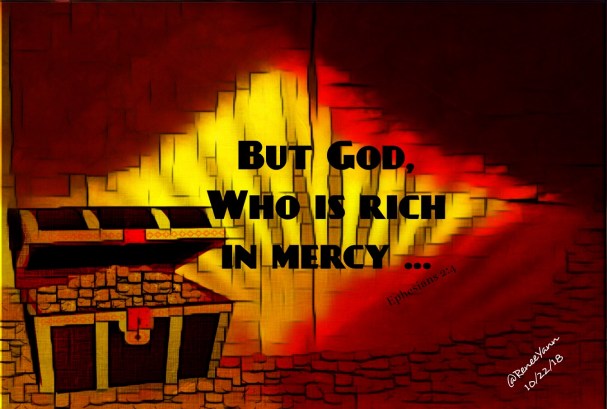
Eph 9_4 God rich

Not so with Gospel Farmer today. He hits the jackpot in the fields and, as many of us might, decides to keep every last grain for himself. Oops! On the night of that decision, he dies, leaving the grain behind along with his selfish legacy.

Jesus tells us:

Take care to guard against all greed,
for though one may be rich,
one’s life does not consist of possessions.

Paul tells us what it does consist of:

God, who is rich in mercy, because of the great love he had for us,
… brought us to life with Christ,
raised us up with him …

We are to live among one another as mirrors of this Divine kindness and richness — not holding on to every last – very transitory- grain of our “possessions”.

Friends, every one of us, through our Baptism, already holds the winning ticket to the only treasure that lasts – eternal life. May our lives reflect that immense grace in deeds of love and mercy.


Poetry:The Summer Day – Mary Oliver

Who made the world?
Who made the swan, and the black bear?
Who made the grasshopper?
This grasshopper, I mean —
the one who has flung herself out of the grass,
the one who is eating sugar out of my hand,
who is moving her jaws back and forth instead of up and down —
who is gazing around with her enormous and complicated eyes.
Now she lifts her pale forearms and thoroughly washes her face.
Now she snaps her wings open, and floats away.
I don't know exactly what a prayer is.
I do know how to pay attention, how to fall down
into the grass, how to kneel down in the grass,
how to be idle and blessed, how to stroll through the fields,
which is what I have been doing all day.
Tell me, what else should I have done?
Doesn't everything die at last, and too soon?
Tell me, what is it you plan to do
with your one wild and precious life?

Music: Earthen Vessels – St. Louis Jesuits

Spicing Up Your Spirit

Wednesday of the Twenty-eighth Week in Ordinary Time
October 12, 2022

Today’s Readings:

https://bible.usccb.org/bible/readings/101222.cfm

Today, in God’s Lavish Mercy, our readings continue the theme of sincere faith versus hypocritical practices.

Paul really lets the Galatian community have it. Apparently, their behavior had slipped pretty low!  Paul’s list of things to be avoided contains some shocking stuff, like orgies, bursts of fury, and drinking bouts. Sounds bad! A lot worse, I hope, than any list he might make about us if he were writing now. I wonder?

Lk 11_42 spices

In our Gospel, Jesus lets loose on some of the Pharisees too. He points out that they practice the tiniest, visible observances so that people see them as holy. But they ignore the more important requirements of love, justice and mercy. In other words, they look good but don’t do good.

As we pray with these readings, we could try to address the small hypocrisies in our own lives – a kind of “weed the garden” approach. Surely it would help our spiritual life to get rid of anything like orgies, fury and drunkenness. But I think most of us, dear readers, are pretty much beyond that. 

I prefer to take my cues from Paul’s accompanying list of virtues to be pursued: love, joy, peace, patience, kindness, generosity, faithfulness, gentleness, self-control. How obvious are these things in my life? When I rest my head on the pillow at night, are these the things I remember about my day? Have I given these gifts to others? Have I received them with gratitude?

As we read about the tithes of mint, rue and other garden herbs, the cooks among us might like to imagine life as a great bouillabaisse, perfectly seasoned for God with all the spices on Paul’s menu. What little herb do you need to add right now?

Poetry: from “Lines Scribbled on an Envelope While Riding the 104 Broadway Bus” by Madeleine L’Engle

There is too much pain
I cannot understand
I cannot pray
Here I am
and the ugly man with beery breath beside me reminds me that
it is not my prayers that waken your concern, my Lord;
my prayers, my intercessions are not to ask for your love
for all your lost and lonely ones,
your sick and sinning souls,
but mine, my love, my acceptance of your love.
Your love for the woman sticking her umbrella and her expensive
parcels into my ribs and snarling, “Why don’t you watch where
you’re going?”
Your love for me, too, too tired to look with love,
too tired to look at Love, at you, in every person on the bus.
Expand my love, Lord, so I can help to bear the pain…

Music: The Fruits of the Spirit ~ Selah

Mystery

Wednesday of the Twenty-sixth Week in Ordinary Time
September 28, 2022

Today’s Readings:

https://bible.usccb.org/bible/readings/092822.cfm

Today, in God’s Lavish Mercy, Job proves his faith in God. His tremendous troubles will not shake him from his deep loyalty to an awesome God.

As well as remaining steadfast, Job uses his circumstances to deliver both a stirring, poetic description of an Omnipotent Creator, and an personal testament to an intimate Companion.

Job9_11

Reading slowly through this beautiful passage, let’s open our imaginations to see the Mountain Mover, the Sun Commander, the Ocean Walker, the Star Designer Who is Job’s God.

If our prayer is caught in some old, small image of God, this passage encourages us to reach for the awesome Presence of the God Who loves us – and to trust that Love with an utter simplicity like Job’s.


Poetry: The Great Mystery – Jessica Powers

My uncle had one sober comment for 
all deaths. Well, he (or she)
has, he would say, solved the great mystery. I tried as child to pierce the dark unknown, straining to reach the keyhole of that door,
massive and grave, through which one slips alone. 
A little girl is mostly prophecy.
And here, as there before,
when fact arrests me at that solemn door,
I reach and find the keyhole still too high,
though now I can surmise that it will be
light (and not darkness) that will meet the eye.

Music: Where Were You – Mars Hill Music

Shun Indifference!

Twenty-sixth Sunday in Ordinary Time
September 25, 2022

Today’s Readings:

https://bible.usccb.org/bible/readings/092522.cfm

Today, in God’s Lavish Mercy, our readings will challenge us in ways we might rather not hear.

In our first reading, feisty Amos lambastes the Israelites for their sumptuous lifestyle which is indifferent to the plight of those who are poor. He calls them “complacent”, “at ease” in their prosperous, privileged existence, a condition that has numbed them to the harrowing inequities from which others suffer.


Woe to the complacent in Zion!
 Lying upon beds of ivory,
 stretched comfortably on their couches,
 they eat lambs taken from the flock,
 and calves from the stall!

Amos 6:4-5

In our second reading, Paul gives a final, impassioned charge to his dear protégé Timothy. He tells him not just to avoid, but to flee such complacency and the greedy materialism which feeds it. He outlines the elements of a Christian life, enjoining Timothy to “pursue righteousness, devotion, faith, love, patience, and gentleness”.


Paul gives Timothy the key to true Christian life:

Keep the commandment without stain or reproach …

…. “the commandment” being to love God above all, and love neighbor as self.


Dives
Dives and Lazarus by Bonifazio di Pitati The National Gallery – London

Our Gospel is, perhaps painfully, familiar to all of us – the story of Lazarus and Dives. It is a parable which puts the economic divide under the crystalline light of the Gospel, challenging us as to where we fit in it.

Most of us like comfort. We would rather be “haves” than “have nots”. But we struggle within our comfortable lives to discern our responsibility for others. We’re certainly not intentionally hard-hearted, “lying on ivory couches” and “drinking wine from bowls” while modern day Lazarus languishes right beside us.

We do try, in many ways, to respond to the call for charity and service. But don’t we still measure ourselves after hearing this Gospel? Don’t we still worry about any “Lazarus” unnoticed at our door?


Amos, Paul, and Jesus are charging us – just as they charged their immediate listeners – to live a life based in Biblical and Gospel justice. Justice seeks fullness of life for all the community. Jesus teaches us that “the community” is all Creation, and that how we treat the community is how we treat him.

Every day we might remind ourselves that, however hard we try, Christian love does not allow us to say, “It is enough”. We must keep on peeling away any indifference or blindness we have to the injustices of our culture and times, our economic and political systems. And we too must flee them, running toward justice, righteousness, and mercy.

We must ask ourselves this hard question:

Does my “wealth” 
– however large or small, 
material or immaterial- 
nourish the community or only consume it?


Poetry: Regret – Robert William Service

It's not for laws I've broken
That bitter tears I've wept,
But solemn vows I've spoken
And promises unkept;
It's not for sins committed
My heart is full of rue,
but gentle acts omitted,
Kind deeds I did not do.

I have outlived the blindness,
The selfishness of youth;
The canker of unkindness,
The cruelty of truth;
The searing hurt of rudeness .
By mercies great and small,
I've come to reckon goodness
The greatest gift of all.

Let us be helpful ever
to those who are in need,
And each new day endeavor
To do some gentle deed;
For faults beyond our grieving,
What kindliness atone;
On earth by love achieving
A Heaven of our own.

Music: Five Variants of Dives & Lazarus – Ralph Vaughn Williams’s beautiful interpretation of the folk song “Dives and Lazarus”.

Presence

Memorial of Saints Andrew Kim Tae-gŏn, Priest, and
Paul Chŏng Ha-sang, and Companions, Martyrs
September 20, 2022

Today’s Readings:

https://bible.usccb.org/bible/readings/092022.cfm

Today, in God’s Lavish Mercy, our readings instruct us on what it means to belong to God – heart and soul.

Proverbs tosses out a series of minstrel-like two-liners that, because of their simplicity, might be overlooked for their beauty and depth. For example, the first couplet says: 

Like a stream is the king’s heart
in the hand of the LORD;

wherever it pleases God, God directs it.

Would we all not desire that kind of heart, where our thoughts and choices are so directed by God’s power and grace – held and guided into freedom by God’s loving hand? How confident, peaceful and joyful our lives would be!

Psalm 199 discern

Today’s Psalm 119 is a passionate prayer to be guided through an entangling world by our deep loyalty to God’s own truth, learned by meditating day and night on God’s goodness.


Our Gospel, in an often misinterpreted incident, shows us how Jesus considers his true disciples as close to him as his own mother and family.

So today, to deepen our own closeness to God, let us practice making our ordinary life into a constant prayer – allowing it to flow, like water, over God’s tender, guiding hand. 

We can do this by gratefully noticing God’s Presence in nature, in our companions, in the opportunities for kindness, honesty and service  that come to us today. 

Or, sadly, our experiences today might cause us to notice God’s absence in these places. This offers us an incentive to invite, beg and pester God to transform the desert places in our lives and world.

Whichever approach we take, it will open up a constant conversation with God about our life as we experience it at each moment. We begin to listen better to the Word of God revealing itself in our daily life. We begin to live more consciously in God’s Presence… in God’s dear family.

God’s Law is already written deep in the fabric of our lives. We pray for discernment to discover that guiding grace by opening our hearts to God’s Presence in our every experience.


Poetry: All Things – by Hadewijch

All things
are too small
to hold me,
I am so vast
In the Infinite
I reach
for the Uncreated
I have
touched it,
it undoes me
wider than wide
Everything else
is too narrow
You know this well,
you who are also there.

Music: Morning Prayer – Kitaro

Lessons in Love and Light

Monday of the Twenty-fifth Week in Ordinary Time
September 19, 2022

Today’s Readings

https://bible.usccb.org/bible/readings/091922.cfm

Today, in God’s Lavish Mercy, our readings encourage us to live lives of Charity and Light.

Today’s first reading opens two weeks of inspiration from the Wisdom Literature of the Hebrew Scriptures. These books include Job, Proverbs, Ecclesiastes, Song of Solomon, and parts of Psalms.

Wisdom literature differs from other books in the Old Testament in that the authors were sages rather than prophets or priests. Priests and prophets typically dealt with religious and moral concerns whereas sages generally focused on the practical aspects of how to live and the intellectual challenges that arise when contemplating the human experience. 

from: compellingtruth.org

Our passage from Proverbs offers a good dose of that sage advice with these basics of mutual charity:

  • Refuse no one the good on which they have a claim
  • Plot no evil against your neighbor,
  • Quarrel not with someone without cause,
  • Envy not lawless persons
  • Choose not their ways …

If we all followed that list, the world would be in pretty good shape. And, in Luke’s Gospel, Jesus says that once we get that shaped-up, we can take it up a notch — into the Light:

No one who lights a lamp conceals it with a vessel
or sets it under a bed;
rather, you place it on a lampstand
so that those who enter may see the light.

Matthew’s version adds this line:

Let your light shine before others,
that they may see your good deeds 
and glorify God in heaven.

So how do I let Charity kindle God’s Light in me? The list from Proverbs can get me started, but what might my own “Charity Challenges” look like?

Poetry: Charity — The Greatest of All Three – Robert Morris

The soul serene, impenetrably just, 
Is first in CHARITY; we love to muse 
On such a model; knit in strictest bonds 
Of amity with spirits like disposed; 
Aiming at truth for her own sake, this one 
Passes beyond the golden line of Faith, 
Passes beyond the precious line of Hope, 
And sets foot unmoved on CHARITY . 
“A soul so softly radiant and so white, 
The track it leaves seems less of fire than light.”


Music: Lampstand – Ben Bigelow

(Spoiler alert: Those who are still able may want to dance by the end of this video!🤩 I just did a very good finger-snapping routine)

Earthshine & Bling!

Twenty-fifth Sunday in Ordinary Time
September 18, 2022

Today’s Readings:

https://bible.usccb.org/bible/readings/091822.cfm

Today, in God’s Lavish Mercy, our readings make one thing very clear: we cannot serve both God and “mammon”.

The problem is that we have a hard time figuring out what mammon is. Experience tells us that it’s a lot more than just money, because there are people with money who do a good job serving God.

It seems to me that “mammon” is more the illusion that we are only our “possessions” — our money, house, car, looks, degrees, physical abilities — and that we (or anybody else) is nothing without them.

This misperception is so intrinsic to our inability to live the Gospel that it cripples our souls. The love of “mammon” becomes an overwhelming, incurable addiction that feeds on the well-being of our neighbor.

As our first reading tells us, living by this addiction invokes God’s eternal anger. Describing the abuse heaped upon the poor, God warns the abusers:

The LORD has sworn by the pride of Jacob:
Never will I forget a thing they have done!

Amos 8:7

Our Gospel tells us that we can’t have it both ways. We either live within the generosity and inclusivity of God, or we’re outside it:

No servant can serve two masters.
He will either hate one and love the other,

or be devoted to one and despise the other.

Luke 16:13

This is a challenging but fundamental teaching of the Gospel. It is essential that we consider how we live it.

Walter Bruggemann, in his book Money and Possessions says this:

Jesus said it … succinctly. You cannot serve God and mammon. You cannot serve God and do what you please with your money or your sex or your land. And then he says, “Don’t be anxious, because everything you need will be given to you.” But you must decide. Christians have a long history of trying to squeeze Jesus out of public life and reduce him to a private little Savior. But to do this is to ignore what the Bible really says. Jesus talks a great deal about the kingdom of God—and what he means by that is a public life reorganized toward neighborliness. . . .

Let’s have the courage to pray with that thought today. Although challenging, the question is rather simple: how do we use what we have to live a Gospel life, the essence of which Jesus stated like this:

Love God above all things

and your neighbor as yourself.

Mark 12:30-31


Poetry: Cullen in the Afterlife – P. K. Page

(This poet is new to me. She is a Canadian poet whose work is noted for its vibrant images. I liked this poem in which she imagines the experience of finding oneself in the afterlife. She notes the difficulty of embracing Love when hampered by “mammon” which she called “Earthshine”.

And how partake of such a gift when he
was handicapped by Earthshine—wore the stars,
badges and medals of privilege and success?
Desensitizers, brutalizers—all 
the tricks that mammon plays to make one sleep.


Cullen in the Afterlife – P. K. Page

He found it strange at first. A new dimension.  
One he had never guessed. The fourth? The fifth? 
How could he tell, who’d only known the third?
Something to do with eyesight, depth of field.
Perspective quite beyond him. Everything flat
or nearly flat. The vanishing point 
they’d tried to teach at school was out of sight
and out of mind. A blank.

Now, this diaphanous dimension—one
with neither up nor down, nor east nor west,
nor orienting star to give him north.
Even his name had left him. Strayed like a dog. 
Yet he was bathed in some unearthly light,
a delicate no-color that made his flesh
transparent, see-through, a Saran-Wrap self.
His body without substance and his mind
with nothing to think about—although intact—
was totally minus purpose. He must think.

Think of a Rubens, he said to himself. But where
Rubens had been there was a void, a vast
emptiness—no opulence. And then
Cézanne who broke all matter up—
made light of it, in fact. And mad Van Gogh
who, blinded by the light, cut off his ear.
Gone—that shadowy assembly—vanished, done. 
Gone without substance. Like himself. A shell.
Insensate in a flash. (What was that flash—
bereft of all but essence?) Was it death?
He wondered about the word, so filled with breath
yet breathless, breathless, breathless. A full stop.

“Divino Espirito Santo,” he had said
once in Brazil, “Soul of my very soul.”
He’d prayed in Portuguese, an easier tongue—
for newly agnostic Anglos—than his own,
burdened with shibboleths and past beliefs.
“Alma de minha alma”—liquid words
that made a calm within him. Where within?
Was there a word for it? Was it his heart?

Engulfed by love. Held in a healing beam
of love-light. Had he earned such love?
And how partake of such a gift when he
was handicapped by Earthshine—wore the stars,
badges and medals of privilege and success?
Desensitizers, brutalizers—all 
the tricks that mammon plays to make one sleep.
He must wake up. He must expose and strip
successive layers to find his soul again.
Where had the rubble come from? He was like
a junkyard—cluttered, filled with scrap iron, tin.
As dead as any metal not in use.
So he must start once more. He had begun
how many times? Faint glimmerings and dim
memories of pasts behind the past
recently lived—the animal pasts and vague
vegetable pasts—those climbing vines and fruits;
and mineral pasts (a slower pulse) the shine
of gold and silver and the gray of iron.
The “upward anguish.”
                                   What a rush of wings
above him as he thought the phrase and knew 
angels were overhead, and over them
a million suns and moons.

Music: a simple mantra, but powerful if we can live it: Love God, Love Neighbor by Dale Sechrest

Choose to Believe

Saturday of the Twenty-fourth Week in Ordinary Time
September 17, 2022

Today’s Readings:

https://bible.usccb.org/bible/readings/091722.cfm

Today, in God’s Lavish Mercy, Paul strongly confronts the doubts of the Corinthian community regarding the Resurrection.

Someone may say, “How are the dead raised? 
With what kind of body will they come back?”
You fool!

1 Corinthians 15:35

Remember that these post-Resurrection Christians had expected an immediate Parousia, or end of time. They thought that with the completion of Christ’s redemptive act, that was it! Time for heaven for all us believers. Yippee!

Well, not so fast!

When Parousia didn’t happen, the people grew a little confounded. They began to awaken to  the hard lesson  that redemption is not time-bound, but continues in the timeless gift of grace given to new generations. It is up to us to work through our own lives to become one with the Pascal Mystery of Christ.

In the miracle of God’s eternity, each of us has the chance to engage the power of Christ’s Passion, Death and Resurrection by the faithful living of our own lives – no matter if we have lived in the first or the twenty-first century. 


God doesn’t do “time” and doesn’t have a calendar.

But still I feel for those struggling Corinthians! It’s hard to believe sometimes, don’t you agree? It’s hard to wade through the sometimes tumultuous unfolding of our lives and history to find God.

When I taught eighth graders many years ago, one intelligent young girl asked me this question:

What if everything you believe is wrong? 
Was the way you live your life worth it?

It was a powerful question and it has stayed with me for half a century. I continue to ask myself versions of the same question especially when I can’t find God in the circumstances of my life or world – when children are sick, or old people suffer, or human beings dreadfully hurt one another – and I have no answers.

Like the early Corinthians, I ask God, “Where are You? I thought your Resurrection healed all this? I thought You had redeemed our suffering world! 


Paul and Jesus, in our readings today, give us images to help us mature in a long and lasting faith that doesn’t answer but receives these questions with trust and hope.

What you sow is not brought to life unless it dies.
And what you sow is not the body that is to be
but a bare kernel of wheat, perhaps, or of some other kind.

So also is the resurrection of the dead.
It is sown corruptible; it is raised incorruptible.
It is sown dishonorable; it is raised glorious.
It is sown weak; it is raised powerful.
It is sown a natural body; it is raised a spiritual body.
If there is a natural body, there is also a spiritual one.

1 Corinthians 15

By faith, the power of Christ’s Resurrection has been sown in us like a seed. Because we are creatures of time, that power needs time to root itself in every aspect of our lives – our choices, actions, our very nature.

Jesus tells us that God is sowing the seeds of the Resurrection in our lives. Our job is simply provide good soil by choosing to believe and act on God’s Word.

“This is the meaning of the parable. 
The seed is the word of God.
Those on the path are the ones who have heard,
but the Devil comes and takes away the word from their hearts
that they may not believe and be saved.
Those on rocky ground are the ones who, when they hear,
receive the word with joy, but they have no root;
they believe only for a time and fall away in time of temptation.
As for the seed that fell among thorns,
they are the ones who have heard, but as they go along,
they are choked by the anxieties and riches and pleasures of life, 
and they fail to produce mature fruit.
But as for the seed that fell on rich soil,
they are the ones who, when they have heard the word,
embrace it with a generous and good heart,
and bear fruit through perseverance.”

Luke 8:5-11

Poetry: Flickering Mind – Denise Levertov

Lord, not you
it is I who am absent.
At first
belief was a joy I kept in secret,
stealing alone
into sacred places:
a quick glance, and away -- and back,
circling.
I have long since uttered your name
but now
I elude your presence.
I stop
to think about you, and my mind
at once
like a minnow darts away,
darts
into the shadows, into gleams that fret
unceasing over
the river's purling and passing.
Not for one second
will my self hold still, but wanders
anywhere,
everywhere it can turn.  Not you,
it is I am absent.
You are the stream, the fish, the light,
the pulsing shadow.
You the unchanging presence, in whom all
moves and changes.
How can I focus my flickering, perceive
at the fountain's heart
the sapphire I know is there?

Music: Out of Time – Liz Story

Heartfelt Mercy

Memorial of Saint John Chrysostom, Bishop and Doctor of the Church
Tuesday, September 13, 2022

Today’s Readings

https://bible.usccb.org/bible/readings/091322.cfm

Today, in God’s Lavish Mercy, Paul reminds us and calls us to live as Christ’s Body.

As a body is one though it has many parts,
and all the parts of the body, though many, are one body,
so also Christ.
For in one Spirit we were all baptized into one Body,
whether Jews or Greeks, slaves or free persons,
and we were all given to drink of one Spirit.
Now the body is not a single part, but many.
Now you are Christ’s Body, and individually parts of it.

1 Corinthians 12:12-14

Our prayer might lead us to ask ourselves, “How exactly have I been part of Christ’s Body in my life today?”.


The Gospel story of the widow of Nain could help us answer. Reading it, I remember standing by a large walkway window at the Louisville Airport on a sweltering July day in 2005.

Down on the heat-softened tarmac, a small bevy of soldiers stood at attention. Slowly, a flag-draped casket was lowered into their waiting arms. Just to the side, a huddled family, waited as well. Two children clung to either side of their young mother. An older couple stood behind her, hands gentled on her shoulders.

At the window, several other travelers gathered in silence. A few teenage boys removed their inverted baseball caps when they noticed a distinguished older gentleman stand tall and hold a salute.

No one who witnessed that brief ceremony will ever forget it. The grief, reverence and astonishment at life’s fragility emblazoned the moment on every witnessing heart.


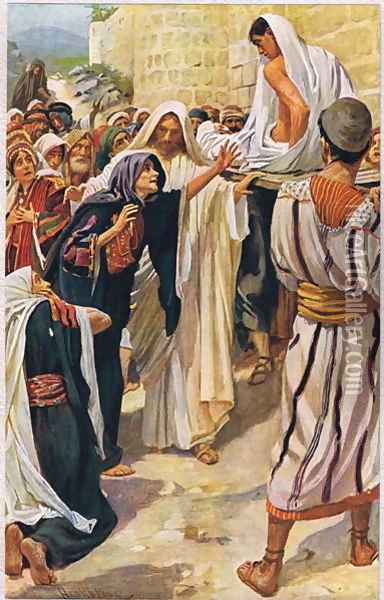
When Jesus passed the gates of Nain on that ancient morning, he had a like experience. He saw this “only son of a widowed mother”. Once again, shaken to his roots with compassion –splancha, he pulled heaven down to heal heart-breaking loss.

As Jesus drew near to the gate of the city
a man who had died was being carried out,
the only son of his widowed mother.

How I wished Jesus were flying out of Louisville that day in 2005! But then I realized He was there. The miracle was hidden, but still real. The Divine Compassion flowed through me, through the reverent gathering beside me, through the soldiers’ honoring arms, through the long prayerful memory we would all forever share.

That young man from Nain was raised from the dead… for a while. He, like all of us, eventually died. The miracle was not about him and his life. The miracle was the visible sign of God’s Lavish Mercy for us – God’s “feeling-with-us” in all our experiences. That compassion, whether miraculously visible or not, is always with us. It just took a different form that day in Louisville.

The baptismal commission to be Christ’s Body in the world calls each of us to the same type of compassion, of “being with” those who suffer, of honoring the God-given life of every person, and of believing in its ultimate resurrection.

Poetry: FIRSTBORN SONS AND THE WIDOW OF NAIN (LUKE 7:11–15)
by Irene Zimmerman, OSF

Jesus halted on the road outside Nain
where a woman’s wailing drenched the air.
Out of the gates poured a somber procession
of dark-shawled women, hushed children,
young men bearing a litter that held
a body swathed in burial clothes,
and the woman, walking alone.

A widow then—another bundle
of begging rags at the city gates.
A bruised reed!

Her loud grief labored and churned in him till
“Halt!” he shouted.
The crowd, the woman, the dead man stopped.
Dust, raised by sandaled feet,
settled down again on the sandy road.
Insects waited in shocked silence.
He walked to the litter, grasped a dead hand.
“Young man,” he called
in a voice that shook the walls of Sheol,
“I command you, rise!” The linens stirred.
Two firstborn sons from Nazareth and Nain
met, eye to eye. He placed the pulsing hand into hers.
“Woman, behold your son,” he smiled.

Music:  The Body of Christ – Sarah Hart