Prodigal: Another Word for “Lavish”

Twenty-fourth Sunday in Ordinary Time
September 11, 2022

Today’s Readings:

https://bible.usccb.org/bible/readings/091122.cfm

Today, in God’s Lavish Mercy, Exodis tells a story of Moses’ intervention to save the people from God’s wrath. It is a story of God’s relenting … a theme which repeats itself endlessly in the Hebrew Scriptures.

This is the way we sometimes characterize the astonishment of Grace – God’s overwhelming passion to love and forgive us over and over. We just can’t imagine such mercy, such infinite generative love!

And so we imagine instead that Moses made God do it! Yeah, I don’t think so. 😉


We imagine that God cannot tolerate our sinful pursuits because we cannot tolerate them in ourselves or in others. But God is mercy, forgiveness, reconciliation, wholeness, love. God can’t help loving us!

Of course, we shouldn’t be stupid and take advantage of the divine largesse… not because it would hurt God, but because it so damages us and limits our capacity for wholeness. But nevertheless, whether we’re stupid or not, God will always welcome us home.

Today’s readings are example of a word we’ve used few times in Lavish Mercy 

splancha

– that “gut love” that so describes God’s prodigal passion for us. We find the word again today in the heart-wrenching parable of the Prodigal Son.
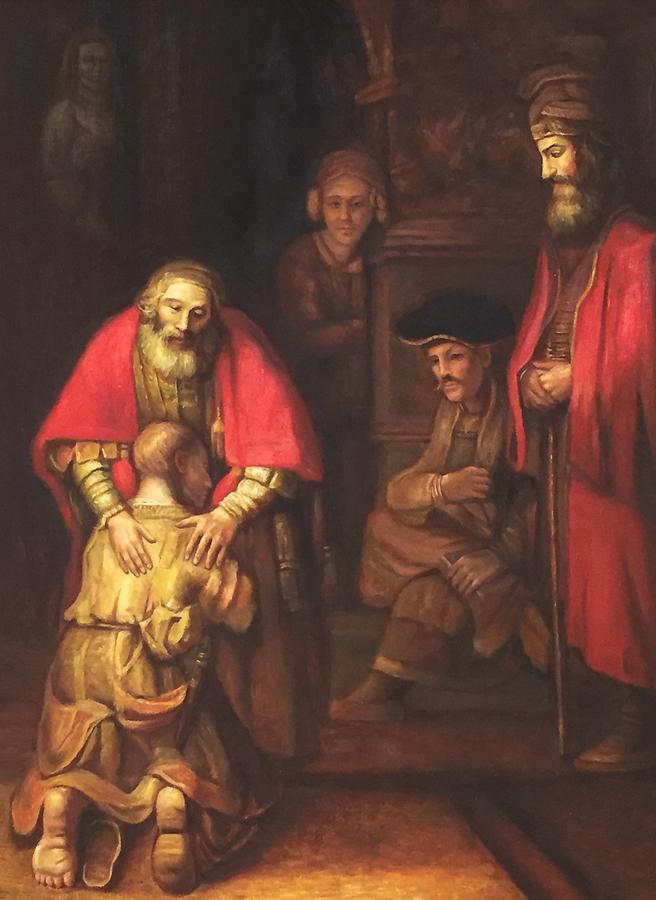
prodigal son

You know the story. Near the end, as the devastated son returns seeking mercy…

While he was still a long way off,
his father caught sight of him,
and was filled with compassion — with splancha – esplanchnisthē
Luke 15:20

Our God is a Love that is filled, overflowing – with no room for retribution or condemnation.

Indeed, our God, like the Prodigal Father, is soft-hearted, an easy mark, a pushover for our sincere repentance, trust, and hope. Our God would bleed for us — just as Jesus did!


This short but powerful scene from George Balanchine’s ballet, Prodigal Son, may inspire our prayer today. The father is steadfast, a monolith of strength and love. The son is broken, naked in his desperation. Let their magnetic reunion take you to God’s heart. Let God wrap you too in the mantle of Love for any hurt or emptiness that is within you.

George Balanchine “Prodigal Son” – Final Scene (Son- Barishnikov)

Claude Debussy also wrote a beautiful piece on this parable. If you have a contemplative space sometime this week, you may want to listen to Debussy’s moving opera (with my all-time fav Ms. Jessye Norman.)

Click here for full opera

If you have only a little time, do try this – short, and oh so beautiful!

Music: Debussy The Prodigal Son – Prelude

Alleluia: New Wine, Holy Changes

Friday of the Twenty-second Week in Ordinary Time
September 2, 2022

Today’s Readings:

https://bible.usccb.org/bible/readings/090222.cfm

Alleluia, alleluia.
I am the light of the world, says the Lord;
whoever follows me will have the light of life.

Today, in God’s Lavish Mercy, Jesus changes the narrative for living a good and holy life. He offers the Pharisees “new wine”, the freedom of his law of love over their accustomed law of requirements.

Lk5_38 Wine

Have you ever found yourself in circumstances where you’re saying or hearing things like this:

  • It’s the law
  • That’s the way we’ve always done it
  • Sorry. They’re the rules.
  • Doesn’t matter. No exceptions.

In such situations, we are experiencing a code of limitations where we are defined either by what we must do or must not do. 

The Pharisaical law had become such a code, its spirit and freedom worn away by ages of control, authoritarianism, and brittle institutionalization.

Jesus preaches the new law of love, which can sound a little squishy and self-indulgent at first, because our navel-gazing culture has so eviscerated the meaning of love.

But real Christian love is the hardest “code” we will ever practice. Patterned on Jesus’ life, it is a discipline of mercy, self-sacrifice, radical inclusivity, non-violence, and forgiveness. Such a love will die for the sake of the beloved’s life in God.

Drinking this “new wine” brings us a profound freedom in God Who loves us like this — but infinitely.


Poetry:

Music: New Wine – Hillsong

Alleluia: Everyone’s Invited

Twenty-second Sunday in Ordinary Time
August 28, 2022

Today’s Readings:

https://bible.usccb.org/bible/readings/082822.cfm

Today, in God’s Lavish Mercy, our readings share the common theme of humility, instructing us that the virtue is essential to our salvation.

Lk14_11 humbled

Alleluia, alleluia.
Take my yoke upon you, says the Lord,
and learn from me, for I am meek and humble of heart.

Humility, of course, gets a bad rap in our dominating, “me” culture. We tend to think of humiliation, servitude, inelegance rather than the actual root of the word: humus -“of the earth”.

I was fascinated a few years ago by a small fracas arising from the unconsidered remarks of one of our Phillies baseball players. The team had been running hot and cold – with a little bit too much cold for some fans. The famous Philly “boos” had been flying. Frustrated with these, then outfielder Sean Rodriguez referred to the disgruntled fans as “entitled”. 

angry

Uh oh! They didn’t like that. We prefer to think of ourselves as “deserving “, right?

Humility is that virtue which helps us realize that we are not “entitled” or “deserving” of anything over and above other human beings. It roots us in the respect for each other that refuses to rank the worth of other human beings. 

The social leverage that comes from wealth, power, and influence can beguile us. We become lost in a maze of stereotypes, rankings and prejudices which are the foundation of social injustice.


Do we ever hear among ourselves justifying phrases for our entitlement like these. Maybe the thoughts go unexpressed, but the attitude is unmistakably there:

  • well, I earned what I have
  • at least I paid for what I have
  • they” need to work if they want to have …(food, healthcare, housing…)
  • it’s their own fault for … (dropping out of school, taking drugs, ….)
  • that’s just the way it is in “those” countries. The people are …(lazy, stupid, violent …)
  • they” don’t need what I need. “They” are used to being … (poor, disabled, sick …)

And probably the most dangerous of all the phrases:

  • it’s not my problem
  • I’m not the one exiling, bombing, blocking, trafficking, enslaving “them”

Today’s readings enjoin us: it is my problem. My attitude, choices, vote, conversation, and lifestyle matter at the banquet of life we are all meant to share.

My intention to humbly join and rejoice with all Creation, to take a seat beside and never above my sister and brother – this is my only “entitlement” to the one banquet that matters.

When you hold a banquet,
invite the poor, the crippled, the lame, the blind;
blessed indeed will you be because of their inability to repay you.
For you will be repaid at the resurrection of the righteous.


Prose – from Mary Oliver in Upstream (Penguin Press, 2016)

Understand from the first this certainty. Butterflies don’t write books, neither do lilies, or violets. Which doesn’t mean they don’t know, in their own way, what they are. That they don’t know they are alive – that they don’t feel, that action upon which all consciousness sits, lightly or heavily.

Humility is the prize of the leaf-world.
Vainglory is the bane of us, the humans.  

Sometimes the desire to be lost again, as long ago, comes over me like a vapor. With growth into adulthood, responsibilities claimed me, so many heavy coats. I didn’t choose them, I don’t fault them, but it took time to reject them. Now in the spring I kneel, I put my face into the packets of violets, the dampness, the freshness, the sense of ever-ness. Something is wrong, I know it, if I don’t keep my attention on eternity. May I be the tiniest nail in the house of the universe, tiny but useful. May I stay forever in the stream. May I look down upon the windflower and the bull thistle and the coreopsis with the greatest respect. 


Music:  A Place at the Table – Lori True and Shirley Elena Murray

Alleluia: Wake Up!

Thursday of the Twenty-First Week in Ordinary Time
August 25, 2022

Today’s Readings:

https://bible.usccb.org/bible/readings/082522.cfm

Alleluia, alleluia.
Stay awake!  
For you do not know when the Lord will come.

Today, in God’s Lavish Mercy, our readings offer us beautiful blessings and vigorous encouragement for our spiritual lives. 

Paul begins his letter of instruction to the Corinthians with a stirring reminder of the spiritual gifts they have received:

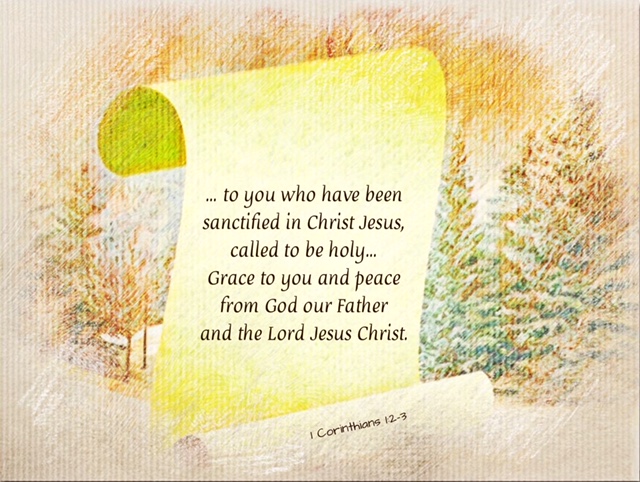
… to you who have been sanctified in Christ Jesus, called to be holy,
with all those everywhere who call upon the name of our Lord Jesus Christ…

1 Corinthians 1:1

As we read these words, we open our hearts to allow Paul to speak to us who have received the same call and blessings as the Corinthians:

I give thanks to my God always on your account
for the grace of God bestowed on you in Christ Jesus,
that in him you were enriched in every way,
with all discourse and all knowledge,
as the testimony to Christ was confirmed among you,
so that you are not lacking in any spiritual gift
as you wait for the revelation of our Lord Jesus Christ.

1 Corinthians 1: 2-4

Wow! What if we really believed that blessing? What if we lived our lives like the fortified, invigorated Christians Paul describes!

What if we really woke up to the graces we have received and lived a life that witnessed to them!


That kind of awakened living is what Jesus calls us to in the Gospel.

Jesus said
“Stay awake!
For you do not know on which day your Lord will come.
Be sure of this: 
if the master of the house
had known the hour of night when the thief was coming,
he would have stayed awake
and not let his house be broken into.
So too, you also must be prepared,
for at an hour you do not expect, the Lord will come.

Matthew 24: 42-44

We often relate this Gospel to the final coming of Christ at the end of time when we don’t want to be caught off guard. But there is a much more extensive call in this powerful parable.

The Spirit of God comes to us in every moment of our lives. It reaches out to us with every breath through which we share in God’s eternal cosmic Inspiration. Jesus invites us not to miss God’s Presence in each moment – not simply the last one in our earthly lives.

As our day passes – as our lives pass – there are no vacuums where God is absent. God is there even in darkness and suffering. God is there even in the mindless bliss that can render us unconscious of our blessings. 


Poetry: Psalm 145 – Opening Heart by Christine Robinson

Let us pray to be fully awake to God’s Presence as we pray today’s Responsorial Psalm as rendered by Pastor Robinson.

I exalt you, Holy One, and open my heart to you
by remembering your great love.
Your expansiveness made this beautiful world
in a universe too marvelous to understand.

Your desire created life, and you nurtured
that life with your spirit.
You cherish us all—and your prayer
in us is for our own flourishing.

You are gracious to us
slow to anger and full of kindness
You touch us with your love—speak to us
with your still, small voice, hold us when we fall.

You lift up those who are oppressed
by systems and circumstances.
You open your hand
and satisfy us.

You ask us to call on you—
and even when you seem far away, our
longings call us back to you.
Hear my cry, O God, for some days, it is all I have.

Music: Psalm 145: I Will Praise Your Name

Alleluia: Who’s Coming to the Party?

Twenty-first Sunday in Ordinary Time
August 21, 2022

Today’s Readings:

https://bible.usccb.org/bible/readings/082122.cfm

Alleluia, alleluia.
I am the way, the truth and the life, says the Lord;
no one comes to the Father, except through me.

Today, in God’s Lavish Mercy, we glimpse what the great gathering in heaven might be like.

The Kingdom of Heaven by Frank Bramley

Have you ever gotten an e-vite in your email? Perhaps an invitation to a gala event or a birthday party? All you need do to respond is to click a “Yes” or “ No” button. And then you can look to see who else has been invited and what response each has clicked. You can get a pretty clear picture of what the party will be like – chummy, snobby, noisy, elegant, boring, mind-blowing ….


Isaiah records a guest list for us of all who will be invited to God’s party. That “party” described in Isaiah 66 imagines a restored Jerusalem and a rebuilt Temple. It is an image of what Creation will look like when enveloped in God at the end times. It’s pretty cool!

They shall bring all your brothers and sisters from all the nations
as an offering to the LORD,
on horses and in chariots, in carts, upon mules and dromedaries,
to Jerusalem, my holy mountain, says the LORD…

Isaiah’s community really needed to hear that encouraging vision because the Temple-less Jerusalem they were living in had been devastated by the Babylonian invasions. For the Israelites, the Temple and the Holy City modeled the Kingdom to come. They had a long way to go before their environment was restored to Isaiah’s predicted dimensions. Isaiah helps them journey through present reality for the sake of future hope.


In our second reading, Paul gives a similar kind of encouragement to Hebrew converts who were finding difficulties in the pursuit of their new Christian faith. They too had to learn to suffer through in order to realize their hope.

At the time,
all discipline seems a cause not for joy but for pain,
yet later it brings the peaceful fruit of righteousness
to those who are trained by it.
So strengthen your drooping hands and your weak knees. 
Make straight paths for your feet,
that what is lame may not be disjointed but healed.


When questioned about heaven, Jesus says it’s not a piece of cake to get in. You have to “know somebody”, and that somebody is the God of your heart.

Jesus answered them,
“Strive to enter through the narrow gate,
for many, I tell you, will attempt to enter
but will not be strong enough. 

Jesus echoes Isaiah in describing the glorious mix of guests at the heavenly party:

And people will come from the east and the west
and from the north and the south
and will recline at table in the kingdom of God. 
For behold, some are last who will be first,
and some are first who will be last.

Christ Surrounded by Singing and Music – Hans Hemling

I know I want to be at that party. And we all want to see one another there, right?!

So let’s help each other:

  • get on our “horses, chariots, carts, mules, dromedaries” or any other assistance for our journey
  • strengthen our drooping hands to reach for righteousness
  • find the narrow gate and pass through it
  • finally recline at the table

Poetry: God – Khalil Gibran

In the ancient days, when the first quiver of speech came to my lips, I ascended the holy mountain and spoke unto God, saying, “Master, I am thy slave. Thy hidden will is my law and I shall obey thee for ever more.”

But God made no answer, and like a mighty tempest passed away.

And after a thousand years I ascended the holy mountain and again spoke unto God, saying, “Creator, I am thy creation. Out of clay hast thou fashioned me and to thee I owe mine all.”

And God made no answer, but like a thousand swift wings passed away.

And after a thousand years I climbed the holy mountain and spoke unto God again, saying, “Father, I am thy son. In pity and love thou hast given me birth, and through love and worship I shall inherit thy kingdom.”

And God made no answer, and like the mist that veils the distant hills he passed away.

And after a thousand years I climbed the sacred mountain and again spoke unto God, saying, “My God, my aim and my fulfilment; I am thy yesterday and thou are my tomorrow. I am thy root in the earth and thou art my flower in the sky, and together we grow before the face of the sun.”

Then God leaned over me, and in my ears whispered words of sweetness, and even as the sea that enfoldeth a brook that runneth down to her, he enfolded me.

And when I descended to the valleys and the plains God was there also.


Music: Paradise by Mehdi – a beautiful composition to put a little kick in your step on the way up the Mountain! 🙂

Alleluia: At Home in God

Memorial of Saint Bernard, Abbot and Doctor of the Church
Saturday, August 20, 2022


Today’s Readings:

https://bible.usccb.org/bible/readings/082022.cfm

Alleluia, alleluia.
You have but one Father in heaven;
you have but one master, the Christ.

Today, in God’s Lavish Mercy, we come to our final reading from Ezekiel for this liturgical year. I think he is a challenging prophet to read with visions, images, and language that sometimes shock and astound.

But when we consider his circumstances of exile and captivity, we see more clearly how his own angst and suffering – as well as his people’s – spawned his compelling prophecies.


Ezekiel takes the Israelites through a curriculum common to many of the biblical prophets.

  1. You people have been sinful so you’re in trouble.
  2. Your persecutors and conquerors are also rotten sinners.
  3. God is going to fix all of you one way or another.
  4. Repent and your hope for restoration will be realized.

These themes are common to our lives too especially when we’re in spiritual discomfort like Ezekiel was.

  1. We examine ourselves for what’s out of kilter.
  2. We fixate on all the people and circumstances around us that are troubling us.
  3. We finally acknowledge our responsibility for our situation and accept what we can and cannot change.
  4. We reimagine a possible future and reclaim our hope

As with Ezekiel and his community, all this self-renewal happens only when we perceive, acknowledge and engage God’s loving will for us. Without that, we continue to live in spiritual exile from our true home in God.

Our Alleluia Verse and Gospel invite us to be fully at home in the Trinity just as they are at home in One Another.

Alleluia, alleluia.
You have but one Father in heaven;
you have but one master, the Christ.


Prayer of St. Elizabeth of the Trinity

Make my soul…
Your cherished dwelling place, 
Your home of rest.  
Let me never leave You there alone, 
but keep me there 
absorbed in You, 
in living faith, 
adoring You.

Music: Jesu Dulcis Memoria – written by St. Bernard of Clairvaux whose feast we celebrate today.

Jesu, dulcis memoria, dans vera cordis gaudia, sed super mel et omnia, eius dulcis praesentia.JESU, the very thought of Thee, with sweetness fills my breast, but sweeter far Thy face to see, and in Thy presence rest.
Nil canitur suavius, nil auditur iucundius, nil cogitatur dulcius, quam Iesus Dei Filius.Nor voice can sing, nor heart can frame, nor can the memory find a sweeter sound than Thy blest Name, o Savior of mankind!.
Iesu, spes paenitentibus, quam pius es petentibus! quam bonus te quaerentibus! sed quid invenientibus?O hope of every contrite heart o joy of all the meek, to those who fall, how kind Thou art! how good to those who seek!
Nec lingua valet dicere, nec littera exprimere: expertus potest credere, quid sit Iesum diligere.But what to those who find? Ah this nor tongue nor pen can show: the love of Jesus, what it is none but His loved ones know.
Sis, Iesu, nostrum gaudium, qui es futurus praemium: sit nostra in te gloria, per cuncta semper saecula. Amen.Jesu, our only joy be Thou, As Thou our prize wilt be: Jesu, be Thou our glory now, And through eternity. Amen.

Alleluia: The Invitation

Thursday of the Twentieth Week in Ordinary Time
August 18, 2022

Today’s Readings:

https://bible.usccb.org/bible/readings/081822.cfm

Alleluia, alleluia.
If today you hear his voice,
harden not your hearts.

Today, in God’s Lavish Mercy, we see how the soul becomes “dressed” or prepared for the kingdom.

In our passage from Ezekiel, God does a major makeover for Israel, as a matter of fact, God actually recreates Israel:

I will sprinkle clean water upon you
to cleanse you from all your impurities,
and from all your idols I will cleanse you.
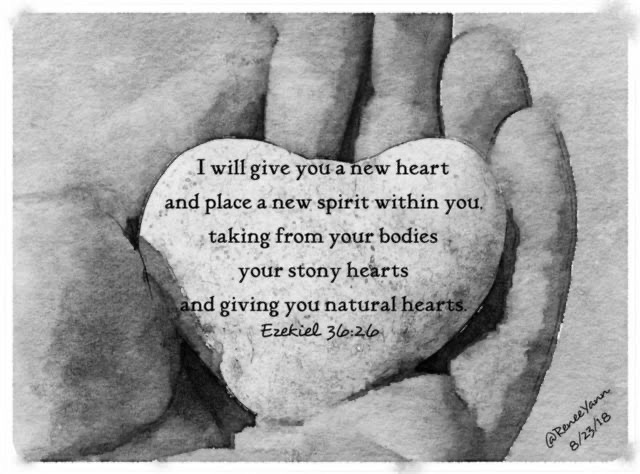
I will give you a new heart and place a new spirit within you,
taking from your bodies your stony hearts
and giving you natural hearts.
I will put my spirit within you and make you live by my statutes,
careful to observe my decrees.

Ezekiel’s God is fed up with Israel’s sinfulness and decides to “make them live by my statutes”. According to Ezekiel, this rejuvenation is done for God’s sake, not Israel’s.

Thus says the LORD:
I will prove the holiness of my great name, 
profaned among the nations, 
in whose midst you have profaned it.
Thus the nations shall know that I am the LORD, says the Lord GOD,
when in their sight I prove my holiness through you.


The king in our Gospel gets pretty fed up too with people rejecting his invitation to the wedding. When his recalcitrant invitees killed his servants, the king blew a gasket. He even took a snap on the poor schlep who showed up in business-casual attire!

No Wedding Garment

How are we to interpret these dramatic
(and kinda mean)
images of God and of God’s
invitation to the Kingdom? 

As when praying with all scripture passages, we must receive them in light of the circumstances and culture in which they were written. Our prayer, rooted in our own relationship with God, will allow us to peel away the cultural layers to discover the unchanging message which pertains to us.

What I found in today’s passages are these thoughts:

  • God loves us so much and would do anything to hold us in faithful relationship 
  • If our spiritual life had died, or is on life support, God will do a heart transplant if we repent and open ourselves to grace.
  • We are all invited to eternal life with God, but we can get so distracted by our entanglements that we miss or ignore the invitation.
  • Turn down the noise in your life so that you can hear God’s ringtone on your heart.
  • It matters how we respond to this amazing invitation. We need to put on our best “clothes” – our best selves – so that we can fully welcome God’s life.

Poetry and Music: Here’s a simple but delightful representation of today’s Gospel. Enjoy it, friends.

Alleluia: God is God; We Are Not

Tuesday of the Twentieth Week in Ordinary Time
August 16, 2022

Today’s Readings:

https://bible.usccb.org/bible/readings/081622.cfm

Alleluia, alleluia.
Jesus Christ became poor although he was rich
So that by his poverty you might become rich.

Today, in God’s Lavish Mercy, our readings confront us with a few spiritual cautions.

In our first reading, Ezekiel lets the Prince of Tyre know that he has really messed up his spiritual life:

Thus says the Lord GOD:

Because you are haughty of heart,
you say, “A god am I!
I occupy a godly throne
in the heart of the sea!”—
And yet you are a man, and not a god,
however you may think yourself like a god.

This Tyrian prince Ithobalus reigned over a wealthy and politically powerful nation – a nation which had become arrogant and domineering in its relationship to other peoples. The word Ezekiel uses describes the condition perfectly: haughty. The prince was so haughty that he considered himself equal to — and in no need of — God.

We, of course, can learn a lesson from vainglorious Ithobalus. No material possession or personal strength makes us equal to God or renders us independent of God’s governance and care. According to Ezekiel, old Itho was about to find that out the hard way!


In our Gospel, Jesus talks about how we can get caught up in ourselves similarly to Ithobaal.

Jesus said to his disciples:
“Amen, I say to you, it will be hard for one who is rich
to enter the Kingdom of heaven.
Again I say to you,
it is easier for a camel to pass through the eye of a needle
than for one who is rich to enter the Kingdom of God.”

When we read this passage, I think most of us picture material riches. And certainly the saying holds true in that case. But it also holds true for other types of “riches” – strengths or possessions that we use in arrogance and indifference toward others’ needs.


Prose: Pope Francis preached about such things in a homily on this passage from the prophet Amos:

Woe to the complacent in Zion, to those who feel secure … lying upon beds of ivory! . They eat, they drink, they sing, they play and they care nothing about other people’s troubles. (Am 6:1,4)

How does something like this happen? How do some people, perhaps ourselves included, end up becoming self-absorbed and finding security in material things which ultimately rob us of our face, our human face? This is what happens when we become complacent, when we no longer remember God. “Woe to the complacent in Zion”, says the prophet. If we don’t think about God, everything ends up flat, everything ends up being about “me” and my own comfort. Life, the world, other people, all of these become unreal, they no longer matter, everything boils down to one thing: having. When we no longer remember God, we too become unreal, we too become empty; like the rich man in the Gospel, we no longer have a face! Those who run after nothing become nothing – as another great prophet Jeremiah, observed (cf. Jer 2:5). We are made in God’s image and likeness, not the image and likeness of material objects, of idols!

Pope Francis – September 29, 2013

Music: Jesu, Joy of Our Desiring – J.S. Bach, interpreted by Daniel Kobialka

Alleluia: Green Grapes!

Saturday of the Nineteenth Week in Ordinary Time
August 13, 2022

Today’s Readings:

https://bible.usccb.org/bible/readings/081322.cfm

Today, in God’s Lavish Mercy, the core of our readings is about innocence and authenticity. But you have to dig a little to get to that. Maybe, like me, you finished  our first reading asking, “So what’s with the green grapes!?”

A common expression in ancient Israel suggested that people’s bad luck was a punishment for their parent’s sins. It was a handy way of avoiding responsibility for one’s own foolish actions, often the actual source of one’s misfortune.

Ezekiel uses the expression to teach a lesson about the nature of God’s love and forgiveness. God loves us completely – without prejudice, without vengeance. There is no record of faults to “set our teeth on edge”. There are no “green grapes” on God’s table. God only wants our wholeness.

Therefore I will judge you, house of Israel,
each one according to their own ways, says the Lord GOD.
Turn and be converted from all your crimes,
that they may be no cause of guilt for you.
Cast away from you all the crimes you have committed,
and make for yourselves a new heart and a new spirit.


God will not let us hide behind excuses like a bogus “Green Grapes Theory”. As in any loving relationship, we must be honest with God, own our faults, seek forgiveness, and love ardently.

Jesus uses the example of a little child to show us how to do this. Each one of us is born with a core of innocence and authenticity. These are the attributes of God’s life in us. Throughout our lives there are times when we hide these blessings under our sinfulness. Some people bury them so deep that they lose touch with their own sacred integrity.

Jesus calls us back out of our excuses and our excesses, just as the Lord called Ezekiel’s community. We are invited to an eternal covenant rooted in the gift of divine innocence and authenticity given to us at our creation.

Jesus said:
Let the children come to me,
and do not prevent them;
for the Kingdom of heaven
belongs to such as these.

Poetry: The Pursuit – Henry Vaughn

LORD ! what a busy, restless thing
Hast Thou made man !
Each day and hour he is on wing,
Rests not a span ;
Then having lost the sun and light,
By clouds surpris’d,
He keeps a commerce in the night
With air disguis’d.
Hadst Thou given to this active dust
A state untir’d,
The lost son had not left the husk,
Nor home desir’d.
That was Thy secret, and it is
Thy mercy too ;
For when all fails to bring to bliss,
Then this must do.
Ah, Lord ! and what a purchase will that be,
To take us sick, that sound would not take Thee !

Music: Tender Hearted – Jeanne Cotter

Alleluia: Blessed

Memorial of Saint Clare
August 11, 2022

Today’s Readings:

https://bible.usccb.org/bible/readings/0811-memorial-saintclare.cfm

Alleluia, alleluia.
Blessed are the poor in spirit;
the Kingdom of heaven is theirs!

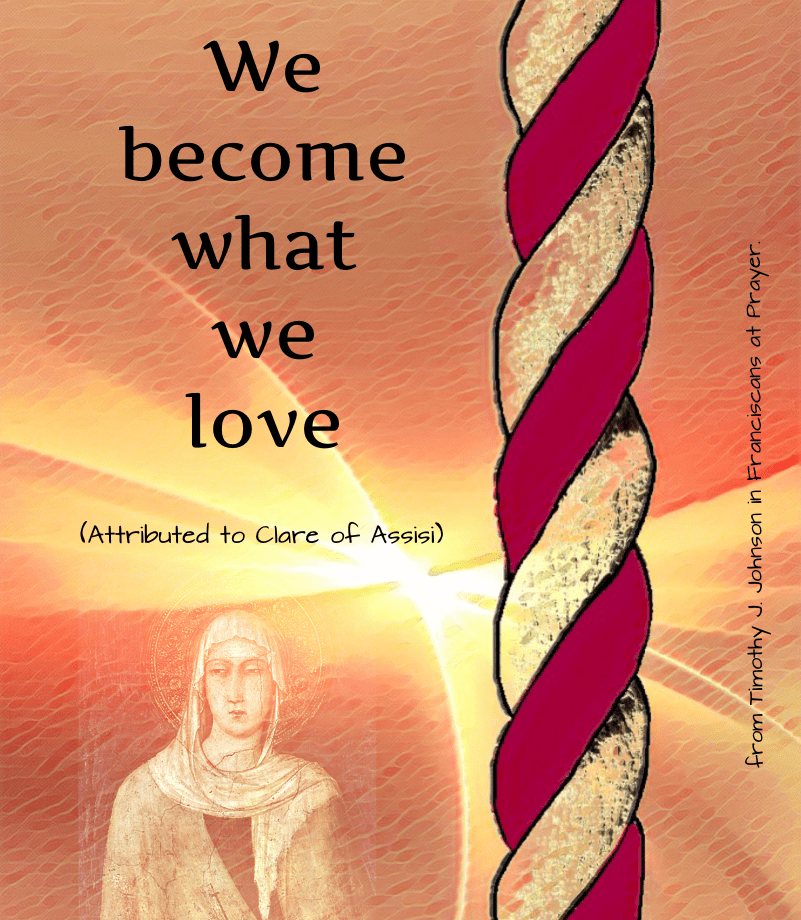
Today, in God’s Lavish Mercy, we’ll pray with the readings for St. Clare of Assisi. Clare, like Francis, was a luminous prophet of the Christian era.

Clare of Assisi (born Chiara Offreduccio, 16 July 1194 – 11 August 1253) was an Italian saint and one of the first followers of Francis of Assisi. She founded the Order of Poor Ladies, a monastic religious order for women in the Franciscan tradition, and wrote their Rule of Life, the first set of monastic guidelines known to have been written by a woman.

Wikipedia

By the life Clare lived, she gave testimony to a sacred reality which continues to enrich the life of the Church.

As I learned about Clare, I discovered a woman who was original and innovative in her own right. She was profoundly mystical and charismatic, unyielding and radical in her commitment to poverty; a model of servant leadership; determined despite years of ailing health; courageous in the face of danger. In short, she was a saint…with or without Francis.

Bret Thoman, O.F.S., – an American Catholic lay writer, secular third order Franciscan. His latest book is St. Clare of Assisi: Light from the Cloister

Today before I wrote this reflection, our own Mercy Sister Clare was buried. As our sisters are carried to the cemetery, the death knell slowly tolls out over the whole surrounding neighborhood. Some may hear it as a solemn reminder as did the poet John Donne:

No man is an island,
Entire of itself.
Each is a piece of the continent,
A part of the main.
If a clod be washed away by the sea,
Europe is the less.
As well as if a promontory were.
As well as if a manor of thine own
Or of thine friend's were.
Each man's death diminishes me,
For I am involved in mankind.
Therefore, send not to know
For whom the bell tolls,
It tolls for thee.

Instead, I choose to hear the hallowed sound as a salute to one who understood and chose what is most important in life:

Happy the soul to whom it is given to attain this life with Christ, 
to cleave with all one’s heart to him
whose beauty all the heavenly hosts behold forever,
whose love inflames our love,
the contemplation of whom is our refreshment,
whose graciousness is our delight,
whose gentleness fills us to overflowing,
whose remembrance makes us glow with happiness,
whose fragrance revives the dead,
the glorious vision of whom will be the happiness
of all the citizens of the heavenly Jerusalem.
For he is the brightness of eternal glory,
the splendor of eternal light,
the mirror without spot.
Clare of Assisi

Our Gospel today reinforces the lesson that a life given fully to Christ and the Gospel, as was both these precious Clare’s, is returned to the giver a hundredfold:

Peter said to Jesus,
“We have given up everything and followed you.
What will there be for us?”
Jesus said to them, “Amen, I say to you
that you who have followed me, in the new age,
when the Son of Man is seated on his throne of glory,
will yourselves sit on twelve thrones,
judging the twelve tribes of Israel.
And everyone who has given up houses or brothers or sisters
or father or mother or children or lands
for the sake of my name will receive a hundred times more,
and will inherit eternal life.”


Music: Let the Love That Dwells in Your Hearts

Let the love that dwells in your hearts shine forth in your deeds. (St. Clare)