How Do You Know Me?

Feast of Saint Bartholomew, Apostle

Saturday, August 24, 2019

Click here for readings

Today, in Mercy, we celebrate the Apostle Bartholomew, thought by some to be the same man as our Gospel’s Nathaniel. This Nathaniel has been my prayer companion since 1964 when I received his name at my Religious Reception.

Tissot
Nathaniel Under the Fig Tree by James Tissot (1836-1902)

At first we were surface friends. I imagined what he might have been doing under the fig tree. I was a little shocked at his easy banter with Jesus. I thought about his skepticism, trying to discern how it could eventually yield his sanctity. I wondered if he ever achieved that vision of “angels of God ascending and descending ...”

But as the years passed, and I prayed beside him more often, we came to understand each other better. Nathaniel began to teach me about Jesus and, with that, Jesus began to teach me through Nathaniel.

It was all about being honest with God and opening my perspective to God’s vision.

You see, we are all under various “fig trees” at points in our lives, those small but confining perimeters of shadow which veil God. Sometimes the shadow consists of an event or experience that makes us says, “How can God possibly be in this?” Sometimes the shadow comes from all the obstacles we have placed in Light’s way. Sometimes it is simply the waning energy required by faith’s long journey.

Whatever its source, the shadow captures us in its incarcerating grasp, isolating us from the outrageous hope and possibility of God awaiting us in every circumstance.

Then a voice – our particular “Philip” – suggests we just step away from the umbra.  A person, a book, a memory, a prayerful insight – A GRACE – invites us to “Come and see” more deeply, to let go of all that we thought secured us, to yield to hope, trust, and an incredible new vision.

Jn1_51 NathanielJPG

It is an irreversible moment of unconditional love. It is the moment we make our own proclamation, not unlike Nathaniel’s:

Rabbi, you are the Son of God;
you are the King of Israel.

Nathaniel’s guileless, faith-filled surrender to Jesus opens the way for his transformation. Jesus tells him, “You will see greater things…”. In other words,

God is so much bigger than you think at this moment.
Open your heart and soul to that Infinity!
Your life in Christ is all about going deeper,

(as the Angel invites us in our first reading from Revelation).

We don’t hear much about Nathaniel after that day. Like many of the other Apostles, he lived out his ministry beyond written records. But we can trust that this man “without duplicity” deepened in his honest dialogue with the God he met and embraced on that amazing Judean afternoon.

Music: Touch of Heaven- Hillsong Worship

Vow

Memorial of the Queenship of the Blessed Virgin Mary

August 22, 2019

Click here for readings

Today, in Mercy, the Book of Judges offers us the story of Jephthat and his daughter – and it is a doozy!

885
The Daughter of Jephthat – Edgar Degas

Again, in a nutshell, Jephthat is recruited to lead an army against the Ammonites. He makes an obviously unconsidered vow that, if he is victorious, he will make a burnt offering to God of “whatever comes first out of his door” upon his return. Unfortunately, the first thing out his door is his only daughter. After giving his daughter the time she requests to “mourn her virginity”, Jephthat fulfills his vow.

Treatises have been written about how to interpret this troublesome passage – from St. John Chrysostom, to St. Ambrose, to modern Biblical scholars. No clear, single answer emerges. And for the purpose of prayer, it needn’t.

One thing the passage does make clear is that vows are critically important and have consequences.

Danielle-signing-vows
Sisters of Mercy – Perpetual Profession of Vows

We make all kinds of “vows” in our lives. Some are foolish ones, like Jephthat’s, where we promise God something simply to get our way. We glorify such promises by calling them vows. They are really one-sided bargains we make to fuel our self-interested goals.

A true vow is the tying of our heart and soul to a Love, Truth, and Hope beyond ourselves.  It is the binding of our life and future to a power we will understand only with the long fidelity of time and shared experience. It is a giving that, even if rescinded, still will change our character forever. It is a giving that, if sustained, will transform us into the very Love, Truth, and Hope which first embraced us.

Our Gospel makes clear that God takes our vows seriously.  They are our invitations to the banquet, whether they come in the form of Baptismal vows, marriage vows, religious vows, or others forms of commitment to love and service.  Once we have engaged these vows, we need to respond and to enflesh the Spirit of God within them. If we don’t, if we ignore the holy invitation within our life circumstances, we will end up in a “darkness” outside of God’s hope for us.

But if, as God hopes, we fully embrace the spirit and depth of God’s invitation, we become whole in God, “the chosen”, the beloved.


I have always loved this poem by Alice Meynell, “ The Neophyte”. It fills me with a holy awe and exuberant joy at the mysterious power of being in love with God

The Neophyte – Alice Meynell

Who knows what days I answer for to-day?
   Giving the bud I give the flower. I bow
   This yet unfaded and a faded brow;
Bending these knees and feeble knees, I pray.

 Thoughts yet unripe in me I bend one way,
   Give one repose to pain I know not now,
   One check to joy that comes, I guess not how.
I dedicate my fields when Spring is grey.

 O rash! (I smile) to pledge my hidden wheat.
   I fold to-day at altars far apart
Hands trembling with what toils? In their retreat
   I seal my love to-be, my folded art.
I light the tapers at my head and feet,
   And lay the crucifix on this silent heart.


(Appropriately, as we talk about faithfulness to vows, this date marks the anniversary of the arrival of the Sisters of Mercy in Philadelphia in 1861 – our Philadelphia Foundation Day. In a later post today, I will share a brief reflection of thanksgiving and challenge for this anniversary.)

Music: Center of My Life – Paul Inwood

Do or Do Not

Monday of the Twentieth Week in Ordinary Time

August 19, 2019

Click here for readings

Today, in Mercy, our readings are about possessions – in every sense of that word.

In today’s reading from Judges, the first of a few this week, we see Israel in the years between entering the Promised Land to the rise of Saul as king. During these four hundred years, a series of judges tries to keep Israel on track with God. It is a frustrating assignment!

As today’s passage describes, the Israelites get caught in an endlessly repeating cycle:

  • worship false gods
  • get zapped by true God
  • feel really bad, say sorry
  • be forgiven
  • repeat cycle

Hmm! I’ve seen this pattern somewhere before. Oh, yeah! It’s just like the one describing all my good intentions that never quite materialized!

do or do not

Many of us can identify with the rich young man in the Gospel. We want to take our relationship with God up a notch. We would like to be better, holier people. But we may also, like the young man, like the ancient Israelites, be caught in a cycle of behaviors and choices which inhibit us.

Mt19_22many possessions

Jesus tells this young man to get rid of his possessions, freeing him to really follow Jesus.

What possesses us, holding us back from that radical following? 

It is not always material goods. They are easy to identify and dispatch. It is our tightly held and hidden illusions, resentments, prejudices, assumptions, entitlements, fears, jealousies, disappointments, angers. These are the heavy chains that cling to us as we try to move deeper into God.

May we be inspired by Matthew’s young man to recognize and break through the cycles that bind us by hearing God’s invitation to wholeness – an invitation always deep within our life circumstances.

Music: Out of the Deep – Julie Bernstein

Unless…

Feast of Saint Lawrence, Deacon and Martyr

August 10, 2019

Click here for readings

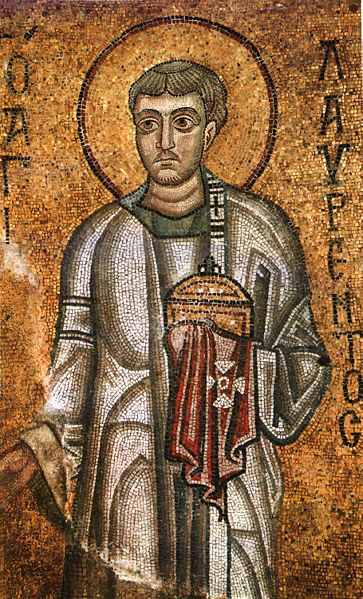
St. Lawrence
Saint Lawrence. Mosaic from the Saint Sophia Cathedral in Kiev.

Today, in Mercy, we celebrate the feast of St. Lawrence who is noted for his love for those who were poor. Legend has it that Lawrence was demanded, before his martyrdom, to turn over the Church’s riches to the emperor Valerian. Instead, he distributed all the resources among the poor. Lawrence then gathered all these people, presenting them before Valerian with these words:

Behold in these poor persons
the treasures which I promised to show you –
these are the true treasures of the Church.

Lawrence was likely inspired by readings like today’s. In Corinthians, Paul encourages us to be cheerful givers. He says this delights God, the Giver of Divine Abundance, whom we are imitating.

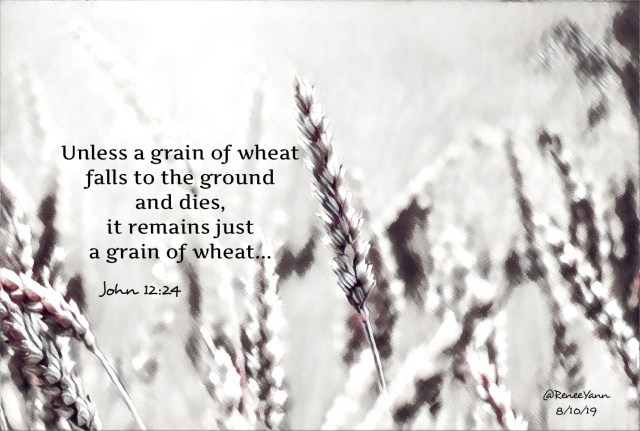
John12_24 grain wheat

In our reading from John, Jesus says that only in dying to ourselves do we live – the ultimate generosity. He says that only by doing this can we truly follow him.

While these readings are clear and simple, they are so profound that we can hardly take in their message. What they ask of us is daunting! The encouragement Jesus gives us to respond to his challenge is this:

The Father will honor whoever serves me.

St. Lawrence believed and lived this promise. What about us?

Music: Before the Bread – Elizabeth Alexander

We all want our lives to be full and complete – to be “bread”. But there are many steps before the grain of wheat becomes bread, as captured in this elegant acapella canon.

Crossing the Line

Wednesday of the Eighteenth Week in Ordinary Time

August 7, 2019

Click here for readings

Today, in Mercy, our reading from Numbers is about trust versus fear.  The Israelites have finally made it to the front door of the Promised Land. But they hesitate to go in. They get Moses to bargain with God to allow scouts to go ahead of them, checking out the lay of the land. These scouts return with a mixed report: arable land, but ferocious current residents! The community freezes in fear, refusing to go farther.

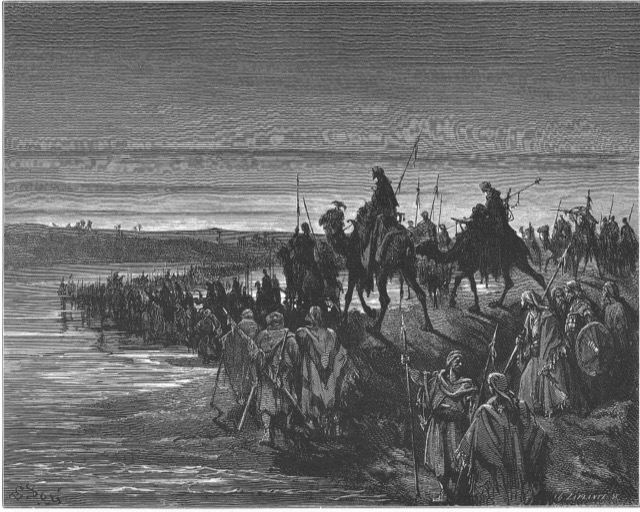
Israelites into Canaan
The Israelites Cross the Jordan River by Gustave Doré 1832-1883

So what’s this all about for us? Is it wrong for us to be deliberate about our decisions, reversing them when the situation becomes threatening? No, of course not. So what’s the difference here in our Numbers community?

At this moment in Israel’s history, God has made clear what is expected of them. They are in covenant with God – “all in” to follow God’s plan for their lives. God has demonstrated his commitment to them in numerous ways, and forgiven earlier disloyalties. 

The question before them now is have they given God their whole hearts.

Or will this be a sham covenant in which they pick and choose when they will be for God and when they will be just for themselves?

The life of deep spiritual commitment to God is not always smooth. We get really mixed up sometimes in our self-concerns and fears. Many years ago, one of my eighth grade students asked me this: what if there really is no God and you’ve wasted your life believing there was?

It was quite a question, and I’ll bet you want to know my answer.

I said that I wouldn’t change a thing about how I have chosen to live my life. Trusting God and giving my life to him has given me a freedom beyond the limits of this world. Even if, at the end, her doubt proved true, I would have had a blessed and joyous life.

Psalm 106

The fact is that we, just like those Israelites standing on the edge of Canaan, don’t know what will happen to us if we trust God. Life and the future is an intimidating open border that challenges our faith and resolve.

But if we constantly hedge our self-gift to God, we will never be capable of receiving the fullness of God’s gift in return.

Today, let’s pray for the trust to step over into God’s country by our acts of faith, hope, love, mercy, generosity, truthfulness, hospitality and courage.

This beautiful reinterpretation of today’s Responsorial Psalm may inspire you as it did me. It is from the website of Christine Robinson, a Unitarian Universalist minister: Click here for Psalm renderings

Psalm 106: Returning
“Give thanks to God, who is good
whose mercy endures forever.”

We stand in awe of an infinity
which we cannot begin to comprehend
We set ourselves to live in tune with the universe—
that we may be glad with the gladness of people of faith.
Yes, time and time again we have gone astray,

We have despoiled this beautiful, wonderful world
dealt unjustly with our compadres
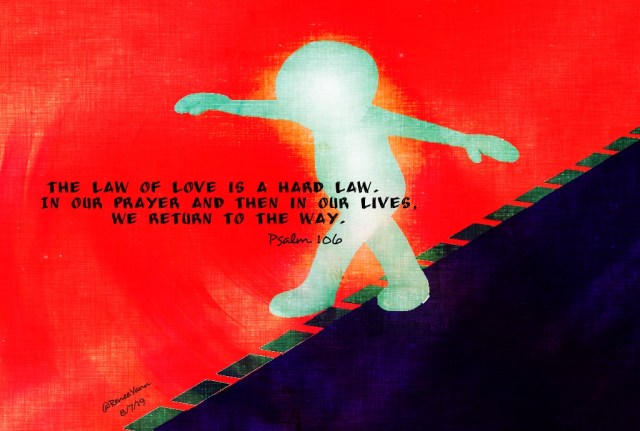
The law of love is a hard law.
In our prayer and then in our lives,
we return to the Way.

Music: Trust God – Rick Muchow 

Transfigured!

Feast of the Transfiguration of the Lord

August 6, 2019

Click here for readings

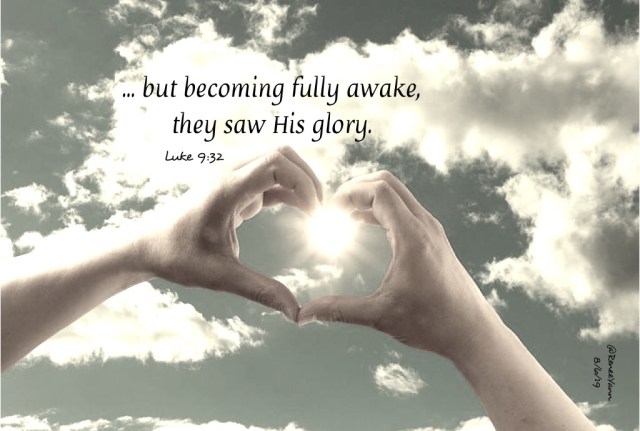
Today, in Mercy, we celebrate the Feast of the Transfiguration, that moment when the Godly glory of Jesus shone in all its splendor before a few very blessed disciples.

Lk9_32 transfiguration

On that blessed day, Peter, James and John went with Jesus to a “very high mountain”. Many scholars identify the site as Mt. Tabor, where the Franciscan Church of theTransfiguration is today. 


Aside:

church


It was interesting to me that, just the other day as I thought about this reflection, I noticed a news alert that a huge fire had broken out on this mountain.

fire


The Franciscans were evacuated and, fortunately, there were no human injuries.


Some theologians suggest that these three disciples were afforded this magnificent gift so that their faith would be sufficiently strengthened to endure the coming sufferings.

“Transfiguration” is a word without a true synonym. It is a unique experience for a being to be completely infused with the glory of God. When this happened to Jesus, something equally unique happened to Peter, James and John as well. They too became new beings, never the same after that glorious and -yes- shocking moment.

Once they descended that mountain, everything changed. In a sense, they too had been “transfigured”. They had seen Jesus clearly in the beauty of his Godliness, and they would now see everything else in that Light.

Sometimes in our lives, God gives us “mini-transfigurations”. Something we had seen only in ordinary terms suddenly becomes an insight into the sacred. It may be a person, a situation, a natural phenomenon. We see through the external trappings and find the glorious Face of God.

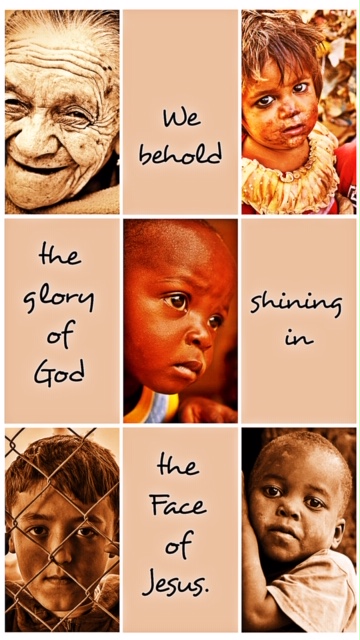
Jesus invites us to experience this kind of soul-change by loving God in the poor, sick, uneducated, displaced, suffering, stigmatized people of this world. He asks us to be with them, in word and deed, and to allow God’s light in them to change our hearts and souls.

Music: Transfiguration/We Behold the Splendor of God – Carey Landry (Lyrics below)

“Transfiguration”faces
[Chorus]
We behold the splendor of God shining on the face of Jesus.
We behold the splendor of God shining on the face of the Son.

[Verse1]
And oh, how his beauty transforms us, the wonder of presence abiding.
Transparent hearts give reflection of Tabor’s light within, of Tabor’s light within.

[Verse 2]
Jesus, Lord of Glory, Jesus, Beloved Son, oh, how good to be with you;
how good to share your light; how good to share your light

Who Do You See in the Mirror?

Eighteenth Sunday in Ordinary Time

August 4, 2019

Click here for reading

Today, in Mercy, our readings focus on “vanity” – its threats and remedies.

Often, we think of vanity as a physical emotion – that Narcissistic self-absorption that keeps us in front of a mirror for inordinate amounts of time. Our culture promotes this kind of vanity by working endlessly to convince us that without certain products we are “not enough” on our own. 

mirror statue

Historically, this kind of rhetoric was directed primarily toward women, spawning a nearly $500 billion global cosmetic market! But men are catching up! The men’s market is forecasted to reach nearly $30 billion by 2023.

Several years ago, while flying home from a business trip, I was seated across from two young women. As we approached home, the one nearest me, began to prepare for landing. She initiated an elaborate cosmetic ritual that involved no fewer than ten brushes plus an array of tubes and compacts. At first, it struck me really funny. Then I realized how very sad it was.

This maturing child was no more than eighteen. She was naturally beautiful with the vigor of youth. But she had obviously spent a lot of money and time not believing in her natural beauty.

Society considers vanity as a kind of pride and pomposity. I think just the opposite. I think vanity is really fear, self-dissatisfaction, anxiety and pain because something has convinced us that we are inadequate.

Vanity damages souls as well as bodies. It makes us behave in greedy, self-absorbed and careless ways toward our neighbors. It makes us pretend we are more than we think we are. It saps us of the strength to be generous, trusting and hopeful.

Paul, in his letter to the Colossians, tells us to get over this kind of vanity:

Put to death, then, the parts of you that are earthly:
immorality, impurity, passion, evil desire,
and the greed that is idolatry.
Stop lying to one another,

since you have taken off the old self with its practices
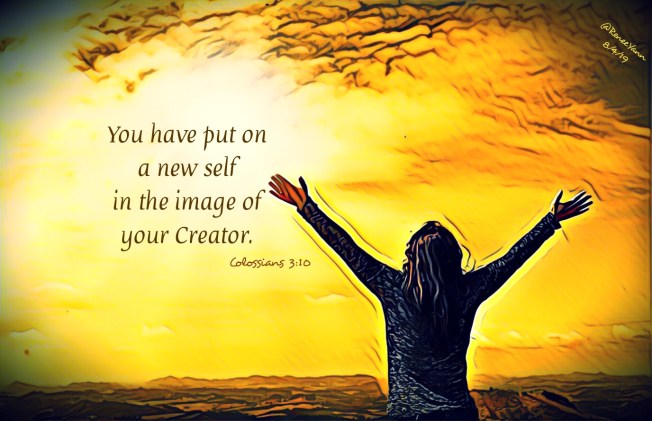
and have put on the new self,
which is being renewed, for knowledge,
in the image of its creator. 

Col3_10 new image

What if that sweet girl on Flight 419 had been able to look in her mirror and see the image of her Creator? What if we could all do that? How might we spend our time and money differently if we were convinced of how beautiful we are to God?

Music: How Could Anyone Ever Tell You – Shaina Nell

I have added two versions of this beautiful song. Let God sing it to you in your prayer today.


Marking the Hours

Friday of the Seventeenth Week in Ordinary Time

August 2, 2019

Click here for readings

Today, in Mercy, we begin a few days of reading Leviticus. The reading today provides a long list of when and how the community should gather to worship. It is a lexicon on how to honor the sacred presence in their lives. Such honoring includes aspects of celebration, decoration, sharing, remembering and hoping together.

Lv23_37 hoursJPG

While the particular enjoinments detailed in Leviticus might not pertain to us, their spirit does. It is a spirit that encourages us to cherish the gift of time – moments, days, years – as precious opportunities to encounter God.

Down through the ages, people seeking holiness have used various, ritualized practices to remember and honor God’s omnipresence in their lives. They include morning and nighttime prayers, Grace before Meals, the Blessing of the Hour, the Angelus at noontime, the great liturgical practices of Advent and Lent, and the Divine Office. Each of these spiritual practices helps us to be more intentional about the true meaning and purpose of our daily life. 

Macrina Wiederkehr, a Benedictan monastic, has published a beautiful book to help people mark the hours of their day. She says this in Seven Sacred Pauses:


When I speak of “the hours” I am referring to those times of the day that the earth’s turning offers us: midnight, dawn, midmorning, noon, midafternoon, evening, and night. Although every hour is sacred, these special times have been hallowed by centuries of devotion and prayer…..

The daily and nightly dance of the hours is a universal way of honoring the earth’s turning as well as the sacred mysteries that flow out of our Christian heritage.


I think this is exactly what our Leviticus passage is doing as well. Our time is so precious and it flows so quickly! What a tragedy if we fail to stop and realize that it is the holy river on which we are meant to float to God!

robson-hatsukami-morgan-454S_xB0ReA-unsplash
Photo by Robson Hatsukami Morgan on Unsplash

Music: Teach Us to Number Our Days – Marty Goetz

Dwelling Place for God

Memorial of Saint Alphonsus Liguori, Bishop and Doctor of the Church

August 1, 2019

Click here for today’s readings

Today, in Mercy, we finish our several weeks’ journey through Exodus. Like all great books, this one closes with a powerful final chapter – one that assures us that the story has not ended.

Have you ever read a book that you wish would never end? Of course, they all do – but bits of some live in us forever.

fav books

With sacred scripture, the Living Word remains with us by inspiring us to live out its spirit in our lives. That Holy Word bonds with the Spirit already dwelling within us through our Creation and Baptism.

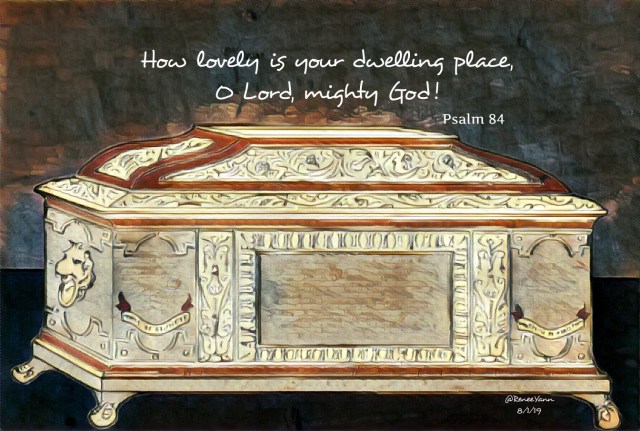
Psalm 84_Ark

For the Exodus community, this Indwelling was given visible expression in the tabernacle Moses built. God chose to fill that tabernacle with Abiding Presence.

Each one of us, and every human being, is a dwelling place of God’s love and hope for us. We are tabernacles of God’s Spirit, breathed into us in an act of divine desire for us to be God’s eternal beloved.

Pretty overwhelming, isn’t it! 

So much so that, just as for the Israelites, our vision of God’s Presence is often clouded by the frenzy of our lives. It is only when we still our souls in worship that we recognize God living with and within us!

Music: This Alone – Tim Manion, SJ ( Photos are The Abbey of Mont-Saint-Michel / Normandy, in the Manche department in France.)

Radical Joy

Memorial of Saint Ignatius of Loyola, Priest

Ignatius
by Francisco de Zubarán (1598–1664)

July 31, 2019

Click here for readings


Today, in Mercy, Exodus tells us:

Exodus34_29 Radiant

Obviously, I haven’t met Moses personally. 😂 But I have met many wonderful human beings who have reflected a similar radiance.

It is a mirrored glory that comes from friendship with God. 

It glows in the innocence of children and the layered wisdom of the elderly. It blazes in those seeking social justice and in those silently, unwaveringly praying for it. It lights the hope of the living and the dying. It is that mysterious, unquenchable candle shining in both joy and sorrow. Its other holy names are Faith, Hope and Love.

 No one need tell us. We know when we are in the presence of such Light. It needs no words.

Rumi radiant

Today, let’s pray for the blessing of this Radiance all over our shadowed world. Let’s pray for it to shine within us.

Music: Radiant God – Hannah Ford