Song of Deliverance

Wednesday, April 10, 2019

Click here for readings

Today, in Mercy, our first reading tells us the captivating story of Shadrach, Meshach, and Abednego. These young men were enslaved Hebrews in Babylon. Their Hebrew names – Hanania, Mishael, and Azaria – had been changed to the Babylonian forms we find in the story.
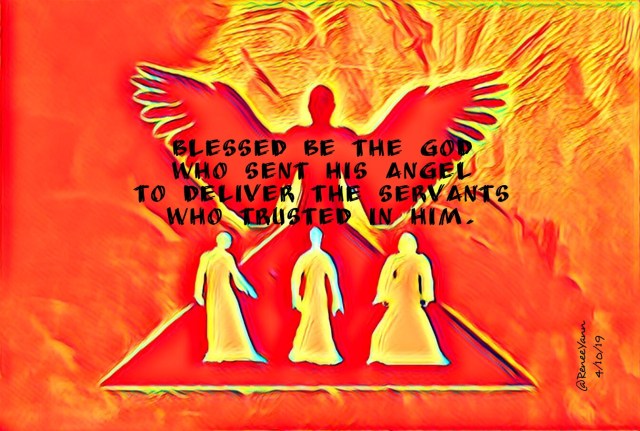
Dan_Abednego

When coerced by King Nebuchadnezzar to worship a false God, these three faithful men refused. They were thrown into a roaring furnace as capital punishment. But a fourth figure appeared in their midst and saved them from death.

The story assures us that God delivers those who are faithful.

In our Gospel, Jesus reiterates this assurance:

“If you remain in my word, you will truly be my disciples,
and you will know the truth, and the truth will set you free.”

On a personal level, many of us can attest to God’s faithfulness which has delivered us from any number and forms of crises. But the core point of our readings today, so close to Passiontide, is to remind us of that quintessential deliverance given us on Calvary. We now live in an eternal, inextinguishable freedom of grace and love.

It is fitting that we share the jubilant prayer offered by the delivered Shadrach, Meshach, and Abednego:
The Song of the Three Holy Youths – The Greek Orthodox Choir

The “Song of the Three Holy Youths” is part of the hymn called a canon sung during the Matins and other services in Orthodoxy. It can also be found in the Church of England Book of Common Prayer as the canticle called the Benedicite and is one of the traditional canticles that can follow the first scripture lesson in the Order of Morning Prayer. It is also an optional song for Matins in Lutheran liturgies, and either an abbreviated or full version of the Song is featured as the Old Testament Canticle in the Lauds liturgy for Sundays and Feasts in the Divine Office of the Catholic Church.

Also, can’t resist this classic, just for the beat!
Ford Leary Sings – From an old 1939 Vitaphone Jazz short “Larry Clinton & His Orchestra”
When the Hour Comes…

Friday, April 5, 2019

Click here for readings

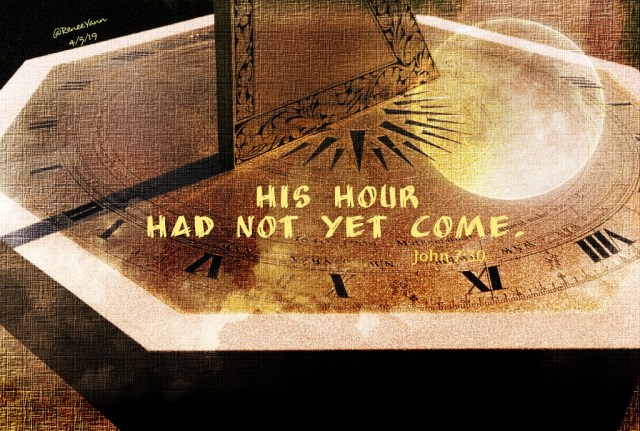
Today, in Mercy, John let’s us know how difficult things were for Jesus. Even very early in John’s Gospel, doubt, criticism, jealousy, and hatred swirl around Jesus. He realizes that people are trying to kill Him. All this because he does good and preaches love! How can that be?

Jn7_30 hourJPG

Jesus upset the apple cart, and many people didn’t like that. They preferred control over love, familiarity over faith. There were others who wanted a more violent shake-up, a political overthrow rather than a spiritual transformation. Basically, people wanted to remake Jesus’s message in their own design. And we’ve been doing the same thing ever since.

Eventually these opposing forces meet in the contradiction of the Cross – that place where Love seems to lose, and Life seems to die. But when Jesus’s hour comes – that timeless moment when Eternal Love and Life break open in the Resurrection – our faith in Christ will be confirmed.

We pray today for all those experiencing great trauma or testing in their lives. May their faith sustain, restore and surprise them.

We pray for ourselves that, like Jesus, when our “hour comes” we are ready because we have already deepened and steadied our hearts in prayer and fidelity.

Music: I Need Thee Every Hour – Annie Hawks (May 28, 1836 – January 3, 1918), an American poet and Gospel hymnist who wrote a number of hymns with her pastor, Robert Lowry.

In 1872, the hymn by which Hawks is most widely known, “I Need Thee Every Hour”, was written. It is said to have been translated into more foreign languages than any other modern hymn at the time of her death. Hawks stated:— “For myself, the hymn was prophetic rather than expressive of my own experiences, for it was wafted out to the world on the wings of love and joy, instead of under the stress of personal sorrow.”

Be Light!

Thursday, April 4, 2019

Click here for readings

Jn5_35 light

Today, in Mercy, the Gospel gives us Jesus claiming his throne. He is setting his disciples straight before he is no longer with them. He drives home each of the pillars of his Messiahship, like so many stakes in the ground:

  • I have testimony greater than John’s.
  • The works that the Father gave me to accomplish,these works that I perform testify on my behalf that the Father has sent me.
  • The Father has testified on my behalf.
  • I came in the name of my Father.

Jesus is saying these things to his persecutors, but he says them for the benefit of his surrounding disciples. He wants them to remember these things to sustain them in the dark times to come.

In this passage, Jesus also pays a glorious compliment to John the Baptist:

He was a burning and shining lamp.

Now Jesus wants his followers, fired by their faith, to burn with an even greater light. He wants us to do the same, to burn with a flame steadied by Christ’s assurances, by the stunning testimony of his Passion, Death and Resurrection.

Music:  But Who May Abide the Day of His Coming – Handel

But who may abide the day of His coming, and who shall stand when He appeareth? For He is like a refiner’s fire.

God Remembers Us

Wednesday, April 3, 2019

Click here for readings

Today, in Mercy, we have, from Isaiah, one of most beloved and comforting passages in Scripture:

But Zion said, “The LORD has forsaken me;
my Lord has forgotten me.”
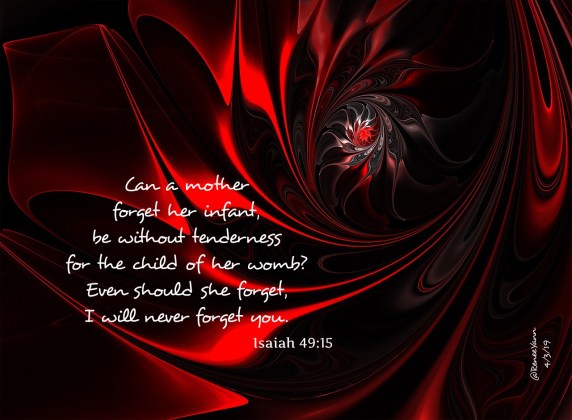
Can a mother forget her infant,
be without tenderness for the child of her womb?
Even should she forget,
I will never forget you.

Isaiah49_15 Mother

Not to forget is to remember. And to “re-member” is to put back together all the pieces that have fallen apart.

Because God “remembers” us at every moment in our lives, we are held together in that Divine Memory through all the exigencies of time. We are held together in the wholeness of our Creation, in the fullness of grace that God imagines for us. Even when we cannot feel or believe it, God continues to dream us into Eternal Life.

Whenever we feel in our hearts a lament like Zion’s

“The Lord has forsaken me…” 

let us place ourselves in the heart of our Mother God Who cradles us with infinite, unconditional affection and tenderness, Who is alway re-membering us.

Music: God Our Mother – The Litugists

This song, though short, is a good one to repeat as a mantra as we pray. Lyrics below

God our Father
Giver of daily bread
Blessing our hands and covering our heads

God our Mother
Leading us into peace
Drawing and comforting all those in need

Hallowed, hallowed be thy name
Hallowed, hallowed be thy name in all the earth

Jesus, brother, guiding our very step
Deliver us and grant places of rest
Jesus, savior, grabbing us from the grave
Cheating the fall and bringing the light of day

Law or Love?

Tuesday, April 2, 2019

Click here for readings

Today, in Mercy, our readings bring to mind the role of religion in our spiritual life.

take up mat 2

The dictionary defines religion as a particular system of faith and worship. The origin of the word “religion” is from the Latin “religare”: to bind.

In the magnificent passage from Ezekiel, we are given a metaphorical description of grace flowing from the Temple, the locus of faith for Israel. Ezekiel is led by a radiant vision to this source of abundant life symbolized by water. Slowly and incrementally, this abundance deepens for Ezekiel, until he is swimming in its grace. 

Ezekiel’s vision demonstrates what happens in us when religion, ritual and law enhance grace. The beauty, power and architectural symmetry of the Temple symbolize the great benefits of religious practice.

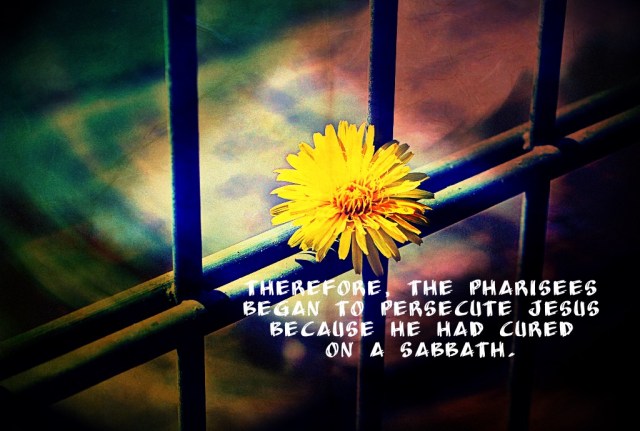
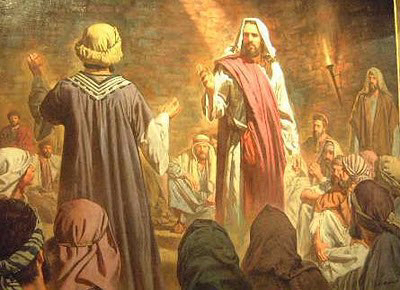
Our Gospel, on the other hand, shows us a Pharisaical religion built on empty practice and bereft of heart. When Jesus cures on the Sabbath, he moves beyond these skeletal boundaries to mercy, which is the reason for all religious practices.

take up mat
Jesus Cures on the Sabbath

Jesus shows us that when religion – and its ensuing ritual and law – bind grace, it needs to be set aside. His whole life was predicated on a faith which generated mercy, not sacrifice. The alleviation of suffering and need always supersede observance – even on the Sabbath.

When we see any so-called faith or religion which places law over mercy, we see an empty temple where the river of grace has run dry. Our culture is filled with fake holiness that measures, condemns and ostracizes others. We see religion distorted into political bullying. We see it redefined as an excuse for excessive wealth. We even see it used as legitimization for nationalism, violence, racism, and war.

Today’s readings tell us to be on guard. The forces which twist religion are very subtle and pervasive in our culture. They dress themselves in impressive words and practices, just like the Pharisees did, but their costumes hide an ugly hate and fear.

To the fearful and weak, these forces preach power – but it is a power over not for others.

Jesus has shown us what faithful practice looks like: mercy and love. It is vulnerable, courageous, inclusive, and humble. It sees the suffering of others and responds. It waters the Temple of our hearts to make them verdant with hope, joy and generosity.

Music: Come to the Water – John Foley, SJ and Matt Maher

Don’t You Love Something New?

Monday, April 1, 2019

Click here for readings.

Today, in Mercy, our readings speak to our innate desire to have another chance, to start fresh.

IMG_8789

Don’t you love to get something new? A new outfit that refashions not only your appearance but your attitude? A fresh coat of paint on a room that has grown commonplace? A few new plantings in your winter-dried flower boxes?

Even as a kid, didn’t you treasure that new box of crayons? That unscuffed baseball when the season started? That second piece of construction paper when your first effort flopped?

Isaiah knows how we feel. He is speaking, in today’s passage, to a people bereft by their circumstances and recent history. They have suffered invasion, exile, tribal strife, and the destruction of the Temple. The faith of the masses had been weakened almost beyond repair.

But Isaiah challenges his listeners to renew their hearts. God is greater than all they have suffered. And God is offering them that second chance, that fresh sheet of paper, that  box of whole crayons:

Instead, there shall always be rejoicing and happiness
in what I create;
For I create Jerusalem to be a joy
and its people to be a delight;
I will rejoice in Jerusalem
and exult in my people.

What we have to understand from this passage is that God is talking to us! We are Jerusalem! Any suffering in our lives, the pain, disappointment, brokenness, heartache and sin that might burden us is going to be transformed. In the Eternal Creation, all will be joy and fullness of life.

And we don’t have to wait until we die to experience that new creation. Our faith, ever deepened by God’s grace, lets us live in that joy even in the midst of our everyday challenges.

This is the profound lesson Jesus is about to teach us by his Passion, Death and Resurrection. This week’s readings, in a dynamic mix of joy and sorrow, lead us more deeply into that understanding.

Music:  O Day of Peace That Dimly Shines –  Carl P. Daw

A New Day Awaits

Sunday, March 31, 2019

Click here for readings

1 Cor new creation

Today, in Mercy,  halfway through Lent, we see in our readings glimpses of new life.

The captivity in Egypt had been TOUGH on Israel. During those many decades, they had appeared to be abandoned and forgotten by God.  It was a harsh reckoning for them … hard to be forgotten. Even then, when they thought they had found freedom, they still wandered for forty years in the desert.

But now Israel stands at a new horizon.  Moses has died and Joshua has become Israel’s leader.  God tells him that it is a new day:

“Today I have removed the reproach of Egypt from you.”

In our second reading, Paul tells us:

Whoever is in Christ is a new creation:
the old things have passed away;
behold, new things have come.

And in our revered Gospel story of the Prodigal Son, Jesus tells us:

This beloved child of mine was dead, and has come to life again;
was lost, and has been found.

All of these passages speak to us in our Lenten journey, and in our Life journey.  We have experienced our own “Egypts”, times when we felt disconnected, even abandoned, by God.  We have sometimes felt we were journeying aimlessly toward an unknown goal. We have at times wandered, like the prodigal son, from the path of God’s love. We have darknesses in our memories that still long for Light.

This poem from Mary Oliver might capture the feeling for us:

Someone I loved once gave me
a box full of darkness.
It took me years to understand
that this, too, was a gift.
~ Mary Oliver ~

In today’s readings, God is reminding us that the Light awaits us. Forgiveness, reconciliation, new energy and grace are the gifts of Easter – the gifts where we must keep our eyes focused as we journey.

So let us do as e.e.cummings encourages us in this poem:

Let It Go – e.e. cummings

let it go – the
smashed word broken
open vow or
the oath cracked length
wise – let it go it
was sworn to
go

let them go – the
truthful liars and
the false fair friends
and the boths and
neithers – you must let them go they
were born
to go

let all go – the
big small middling
tall bigger really
the biggest and all
things – let all go
dear

so comes love


Music: Remember Not the Things of the Past – Bob Hurd
(Lyrics below)

Remember not the things of the past;
now I do something new,
do you not see it?
Now I do something new, says the Lord.

In our distress God has grasped us by the hand,
opened a path in the sea, and we shall pass over,
we shall pass over, free at last.

In our parched land of hypocrisy and hate,
God makes a river spring forth,
a river of mercy, truth and compassion; come and drink.

And who among us is sinless in God’s sight?
Then who will cast the first stone, when he who was sinless
carried our failings to the cross?

Pressing ahead, letting go what lies behind,
may we be found in the Lord, and sharing his dying,
share in his rising from the dead.

God’s Loving Promises

Friday, March 29, 2019

Click here for readings.

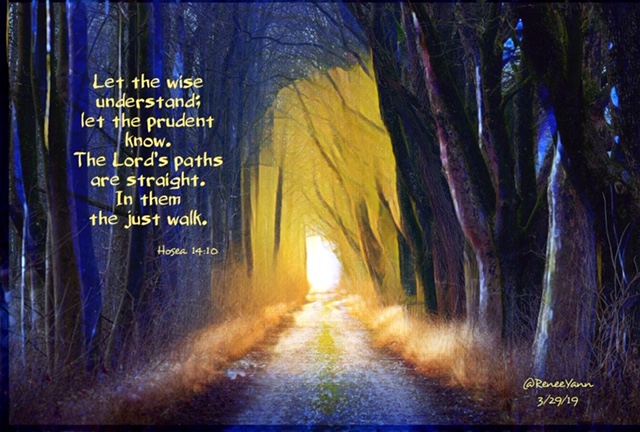
Hosea14

Today, in Mercy, Hosea, the composer of passionate love songs, tells us this:

I will heal your weaknesses, says the LORD,
I will love you freely;
for my wrath is turned away.
I will be like the dew for you:
you shall blossom like the lily;
You shall strike root like the Lebanon cedar,
and put forth your shoots.
Your splendor shall be like the olive tree
and your fragrance like the Lebanon cedar.
Again you shall dwell in the shade
and raise grain;
You shall blossom like the vine,
and your fame shall be like the wine of Lebanon.

The passage sings of new life, strength, vigor – the hope of Easter! Today as we pray, what withering branches in our lives do we wish to place in the warmth of this promise?

Mc 12,28-34 e
You are not far from the kingdom of God

In our Gospel, the good scribe asks for Jesus’s confirmation that he is on the right track to holiness. Jesus blesses him by saying:

You are not far from the kingdom of God

God is so good to us. Let us ask God’s generous help as we seek to grow in holiness, goodness and peace this Lent, so that we may be blessed by the same promises.

Music: Good to Me – Audrey Assad 

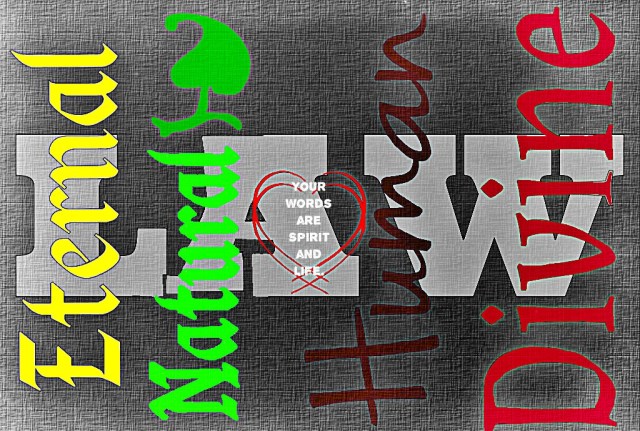
It’s the Law … hmmm!

Wednesday, March 27, 2019

Click here for readings

Today, in Mercy, our readings are all about “law”.

law,JPG

  • Deuteronomy talks about the Law of Moses as he received it from God.
  • Psalm 147 talks about God’s law as it is expressed in nature and human understanding.
  • In Matthew, Jesus talks about his New Law as a development, not a contradiction, of the Old Law.

All this talk of “law” seems coincidental, doesn’t it, in these days after the Mueller report and what is within, above and beyond “the law”. So many definitions and concepts of “law”!

So, as we pray these scriptures, we might ask ourselves, “What exactly is “law”, especially in terms of my spiritual life and development?”

St. Thomas Aquinas may be a good place to start. Here are his definitions, simplified:

oh boy

  • Eternal Law = God’s will and guidance which orders all creatures toward the good of the universe.
  • Natural Law = our self-ordering, by reason, toward this universal good.
  • Human Law = particular statutes instituted in accord with human reason for the good of civil society.
  • Divine Law = the revealed law of God as found in Scripture

Praying with these concepts is different from studying them.

If we pray with the concept of eternal law, we might offer praise for God’s unchanging Presence in our lives, assuring us that we are eternally loved.

If we pray with the concept of natural law, we might say of a prayer of supplication for the grace to be attuned to God in all our natural thoughts, words and actions.

If we pray with the concept of human law, we might pray in contrition for all the ways we humans mistake law for justice.

If we pray with the concept of divine law, we might offer thanks for God’s generous revelation which allows us to contemplate and grow in relationship with God.

We want our understanding and living of law to be rooted in the heart of God, according to these verse from John 6:

Your words, Lord, are Spirit and life;
you have the words of everlasting life.

Let’s pray for that rootedness today.

Music: I Will Delight in the Law of the Lord – Maranatha

This One’s Pretty Difficult!

Monday, March 18, 2019

Click here for readings

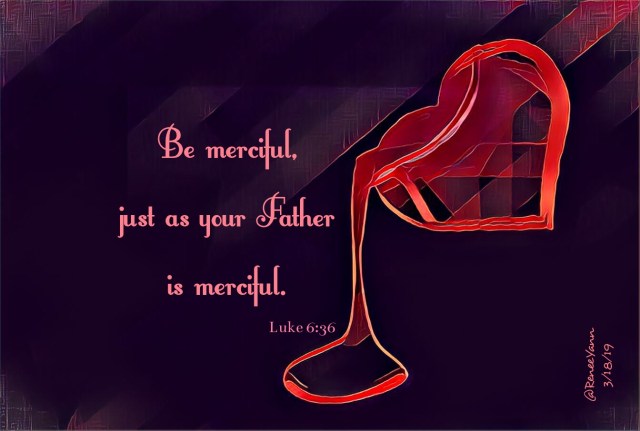
Today, in Mercy, Jesus tells us to be merciful, as God is merciful.

I think that’s really hard.

Lk6_36 be merciful

Being merciful is not too hard with poor, unfortunate souls for whom life is one tragedy after another.

It’s not too hard when someone innocent is suffering unjustly.

But, gosh, it’s difficult to be merciful in the face of meanness, stupidity, selfishness and arrogance.

Yet God is merciful to me when I’m like that.

The Gospel’s message is painfully straightforward. It calls me to examine all my judgmental thoughts and actions and to reverse them.

I don’t know about you, but I’m going to be busy for a while working on this one.

Music: The Mercy Song – Paul Alexander