Today, in Mercy, we remember the beloved Holy Souls who have gone before us. They are never far from us. Some of us may visit cemeteries today. Some will place a list of names upon the altar. But all of us will whisper their names: grandparents, parents, spouses, children, brothers, sisters and beloved friends — meeting each name in a sacred memory.
May those memories, whatever they contain, be transformed by our loving prayers. May whatever grief remains in us be blessed by the grace of faith and thanksgiving. And may the Holy Ones we honor today brighten us with some of their overwhelming Eternal Light in God.
Music: Lux Aeterna- Eternal Light – Michael Hoppé
Lux aeterna Lux aeterna luceat eis, Domine, cum sanctis tuis in aeternum, quia pius es.
Requiem aeternam dona eis, Domine, et lux perpetua luceat eis.
May light eternal shine upon them, O Lord, with Your saints forever,
for You are Mercy.
Eternal rest
give to them, O Lord,
and let perpetual light shine upon them.
Today, in Mercy, on this Solemnity of All Saints, let us pray especially for our recent saints and martyrs – victims of hate, violence and irresponsible policy. Let us know them to be now in the arms of Love, a Love Whom we beg to heal us who remain, impelling us to true justice and mercy.
As we pray, let us reflect on the following hymn for the Holy Innocents, resolving to protect sacred life in ALL its manifold ages and expressions.
1.Salvete, flores Martyrum,
In lucis ipso lumine
Quos sevus ensis messuit,
Ceu turbo nascentes rosas.
2.Vos prima Christi victima,
Grex immolatorum tener,
Aram sub ipsam simplices
Palma et coronis luditis.
3.Qui natus es de Virgine
Jesu, tibi sit gloria,
Cum Patre, cumque Spiritu,
In sempiterna secula.
1. Flowers of martyrdom, all hail!
Smitten by the tyrant foe On life’s threshold – as the gale Strews the roses ere they blow.
2. First to bleed for God, sweet lambs! In innocence you died!
Rising with your wreath and palms At the very altar-side!
3. Honor, glory, virtue, merit, Be to Thee, O Living God, With Creator, and the Spirit While eternal ages run. – Amen.
Music: Salvete, Flores Martyrum -Tomás Luis de Victoria · Lluis Vich
Today, in Mercy, Jesus sets out a stringent formula for entrance into the Kingdom of Heaven.
Strive to enter through the narrow gate,
for many, I tell you, will attempt to enter
but will not be strong enough.
Jesus goes on to say that some will get to the threshold of the kingdom and be denied entrance because they are not recognized. These petitioners will be shocked, saying, “But we ate and drank in your company and you taught in our streets.”
The passage teaches us that there is more to faith than religion, more to prayer than words, more to relationship than ritual. We may be the most observant Catholic, Lutheran, or Jew. We may stay praying in church longer than anyone else. We may know the catechism by heart. But if our deep heart hasn’t touched God’s, we will not be recognized at the narrow gate.
Where will we find God’s heart? The Gospel seems to suggest that we would do best to look among those who are considered “last” – those who are poor, humble, suffering, marginalized. At “the gate”, they will be “first” – so they must have the secret to that stringent formula.
There is little or nothing between these blessed ones and the touch of God – no power, pride or wealth. Their strength lies in their utter dependence on God – God knows them in that dependence.
It is hard for us to reach that place of trust and unity with God. Our possessions and accomplishments get in the way. Our independence and self-reliance get in the way. Our pride and penchant for control get in the way. It is a very narrow gate through these things that lets us find God – our God Who is not far … Who waits in the spaces between our self-importance.
Music: Enter the Narrow Gate! – John Michael Talbot
Enter the narrow gate
The gate that leads to life
His yoke is easy and His burden is light.
Pray for your enemies Those who abuse you
Love them and do not hate And love will follow you.
Enter the narrow gate
The gate that leads to life
His yoke is easy and His burden is light.
Forgive those who offend And seek their forgiveness And when you bring your gift You will be forgiven.
Today, in Mercy, Jesus poses a question to his followers:
“What is the Kingdom of Heaven like?” It is rhetorical question and he goes on to explain, in beautiful symbols, the joy and fullness of heaven.
But were Jesus walking physically among us today, He might answer his own question by saying:
This is what it is NOT like:
the killing of innocents because of their faith, heritage, lifestyle or politics
the starvation and incarceration of children from Yemen to Mexico to Syria
the fueling of war by an economy of arms sales
the destruction of an environment given to us in trust
the systematic dehumanization of humanity through violence, lies, greed, and political arrogance
the ignorant indifference in “good” people which blindly fosters such dehumanization
Indeed, Rachel weeps for her beloved martyrs in Pittsburgh, for her dear children in Jeffersonville – as do all of decent and loving heart. And she weeps also for thousands who die daily from the failure of love. She weeps for all of us. In a society this sick with violence and hate, we are all victims.
Let us all choose the only survival — to act in mercy, justice and love. Let us do so to the memory of these martyrs and the many whom they follow.
Today, in Mercy, our Gospel presents the blind man, Bartimeus. He is an otherwise unknown character in scripture. Yet this short passage suggests so much about him.
It is stated that he was the son of Timeus, apparently someone of note in the community – otherwise, why mention his name? And yet this notable man’s blind son is left to begging on the side of the road. Had disability driven father and son apart? Was Dad unable to accept a son with a physical challenge?
The passage also reveals that Bartimeus knew about Jesus. Perhaps while begging in the public square, he talked and listened. He daydreamed about what he planned to do if he should ever have a chance to meet Jesus!
His cronies in the marketplace were not very supportive. They told him to shut up, even as he pathetically cried for Jesus’s mercy. Still, Bartimues persisted and Jesus heard him.
When he comes to Jesus, Jesus asks, “What do you want me to do for you?” It has always struck me as a strange question. The man is obviously blind, stumbling through the crowd on some disciple’s arm. Why did Jesus bother to ask what Bartimeus wanted?
This might be the lesson hidden in this Gospel. We need to name and claim our needs before God can reach through and transform them. If we don’t even know we’re “blind”, how can we know we’re cured? If we don’t present our needs to God, how can we believe that it is God Who has healed us?
The freshly cured Bartimeus, eyes wide open in grace, now follows along the path with Jesus. All the “shut-uppers” are silenced. Perhaps, Timeus weeps off in a doorway to see the power of his son’s faith and Jesus’s love.
How might our lives be changed if we had that kind of faith… that kind of love?
Music: Don’t Pass Me By – Fred Hammond (lyrics below)
There was a blind man on the road side, and he heard a commotion
It was Jesus passing by with a crowd and it stirred his emotions
He’d been displaced his whole life, should he even try
Don’t bother Jesus (they say you have nothing)
You have nothing to offer (stay in your place)
Right then he knew(he had to choose)
He had nothing to lose
So he cried Jesus (Jesus), I need you, please don’t pass me by
He cried out Jesus, I’m not ashamed(to tell you) I need you in my life
(I need you in my life)
I’m not much different from that man, and this is the honest truth
Could this sinful one, with this messed up life, could I ever serve you
people and things clutter my mind, should I even try
Don’t bother Jesus (they say you have nothing)
You have nothing to offer (stay in your place)
Right then he knew (he had to choose)
He had nothing to lose
So I cry Jesus(Jesus), I need you
Please don’t pass me by
I’m crying out Jesus, I’m not ashamed to tell you I need you in my life
As the deer (as the deer panted)
Thirsty for the water yeah(thirsty for the water)
My soul desires and longs to be(to be with you)
Jesus, I need you, please don’t pass me by
I don’t mean to waste your time but I can’t listen to the crowd, Situations in my life telling me to keep it down
But I need you
I know I’m broken, but you can heal me, Jesus, Jesus I’m calling you
(I might not be worth much)might not be worth much, but I’m still willing Jesus, Jesus, I’m calling you
Songwriters: Fred Hammond / Kim Rutherford / Tommie Walker
Today, in Mercy, our readings are not reassuring. They basically tell us that it’s a tough world out there, and it might get us – body and/or soul. They tell us to straighten up and live right before it’s too late!
I don’t really like the “in your face” readings, but they certainly are clear and effective. Just picture that poor fig tree, trying like crazy – for three years – to bear fruit! I know that I’ve been trying my whole life to overcomes some of my fruitlessness. I certainly hope God continues to be patient with me!
Nevertheless, the message of today’s Gospel is clear. Don’t take that patience for granted.Repent of any small godlessness you’re clinging to.
Forgive the recent and long ago hurts you’ve locked up inside.
Make amends for any meannesses you can remember.
“Show and Tell” your love to the people who love you.
Show and Tell your blessing to the people who don’t.
Today, in Mercy, we are gifted with another magnificently beautiful prayer from Ephesians. Friends, there are times when simply nothing more can be said.
Let your heart kneel in God’s Presence as you savor this powerful prayer:
I kneel before the Father, from whom every family in heaven and on earth takes its name, that he may grant you in accord with the riches of his glory to be strengthened with power through his Spirit in your inner self, and that Christ may dwell in your hearts through faith; that you, rooted and grounded in love, may have strength to comprehend with all the holy ones what is the breadth and length and height and depth, and to know the love of Christ that surpasses knowledge, so that you may be filled with all the fullness of God.
Now to him who is able to accomplish
far more than all we ask or imagine, by the power at work within us, to him be glory in the Church and in Christ Jesus to all generations, forever and ever. Amen.
Today, in Mercy,Paul proclaims his mission to the Gentiles, announcing that through the Gospel, salvation is offered to all people. He says that, by grace, he became a minister of this Gospel – called to preach “the inscrutable riches of Christ”.
And Paul certainly did an extraordinary job. He had been given much by God, and he gave it back wholeheartedly.
In the Gospel, Jesus talks about that same kind of investment. In answer to Peter’s confusion about the call to be ready for God, Jesus tells the story of wily steward.
This servant had been given much: trust, responsibility, power and probably higher pay. But when the master is away, the trusted servant fails him, acting cruelly and greedily in his own interest.
Jesus ends the story with a pronouncement that has always shaken me a little:
For unto whomever much is given, much will be required.
I know I’ve been given a stunning abundance by God: faith, family, friends and a thousand other graces. But my will and ability to give back sometimes feels as fragile as a decaying leaf. Ever feel like that?
It turns out that even Paul, great Apostle to the Gentiles, felt that way too. He says so in his letter to the Corinthians. Paul asks God to remove his fragility.
But He said to me, “My grace is sufficient for you, for my power is made perfect in weakness.”
Let’s pray today to be good stewards of the amazing riches God has given us – in Creation, Faith, Grace and Community. Let us invite God’s power to perfect our weakness, all for the sake of God’s glory.
Even a lacy leaf can be beautiful when it is filled with Light.
Music: My Grace is Sufficient for You – Keith and Amy Amano
Today, in Mercy,Luke’s Gospel describes the expectant fidelity God gives us and desires from us.
The master of the house was away on a long journey. Likely he would have tried to return home in daylight, because the ancient roads were dark and menacing at night. Perhaps the evening meal was already prepared in anticipation of his arrival. But he does not appear over the distant rise where all the household’s eyes are trained.
You know how they waited. You’ve waited for loved ones coming home in bad weather. You’ve waited for beloved holiday guests when flights are delayed or traffic is snarled.
You watch for headlights cresting down the far road. You listen for the sound of a car door closing. Minutes seem like hours. The perfectly prepared meal cools, and your energy slackens as you pick at the olives and breadsticks.
Sometimes our prayer life feels like that. We do all the things necessary to welcome God’s grace, but instead we feel distant from the Divine Presence. We long for God’s warm blessing over the feast of our life, but God tarries somewhere at the other edge of our hope.We feel like these Gospel servants who wait, exhausted, even into the early morning hours.
But we don’t give up. Our hope remains steadfast because God has promised. And it is in that fidelity that our eyes are opened to realize that God had been present all along — just not looking as we had expected.
It turns out that God is the One who had been waiting… waiting for us to see.
Music: A country tune today, maybe overly simple. But I find some country music has a profound nugget of truth buried in the twang. I hope you can enjoy it.
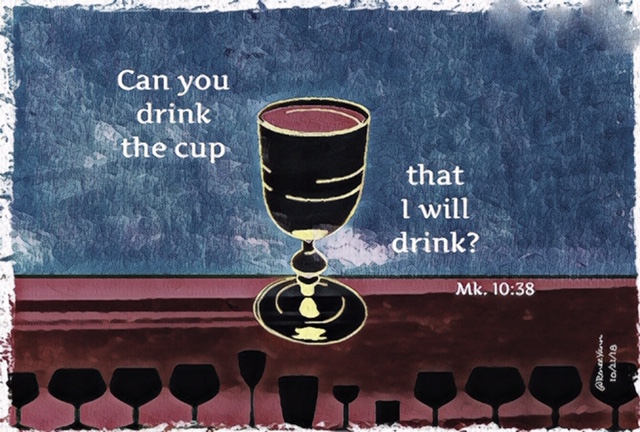
Today, in Mercy, our readings from Isaiah and Mark sound almost Lenten in tone. Isaiah gives us the image of a broken Jesus, crushed by a “suffering that justifies many”.
Mark recounts the story of the two rather oblivious disciples asking to sit in glory beside Jesus. They do not realize that the path to this glory is through Gethsemane and Calvary.
Jesus asks them the same question he asks us throughout our lives:
“Can you drink the cup that I will drink?”
We know that there are sacrificial cups of many sizes and shapes among us. Just this past week, with the canonization of St. Oscar Romero, we were reminded of the immense sacrifices of Romero and the Salvador people to practice their faith in dignity.
Each of our sufferings and sacrifices may seem so much smaller by comparison. But when they are united with Christ in faith and hope, they too are redemptive.
We will be asked, as Jesus was, to lay down our life.
It may be in the unselfish raising of a family, or the humble pastoring of a church community.
It may be in the long-term care of an elderly parent or neighbor.
It may be in a ministry of healing, teaching, or encouragement where another requires our labor, patience and mercy.
It may be as a public servant who actually serves, or as a private nurse who tenderly nurses.
It may be as a community member who builds life by respect, responsibility, and mutuality.
We will come to realize, as did the ambitious sons of Zebedee, that true discipleship is not flash and glam. It is the daily choice to quietly lift the cup we have been given, and raise it to the honor of God – in openness, trust, joy and delight that we are called to share in the life of Christ.
Music: The Cup of Salvation ~Shane & Shane (Lyrics below.)
I love the Lord for He heard my voice
And answered my cry for mercy
Because He listened to me
I will call upon Him as long as I live
CHORUS
What shall I render to the Giver of life and who all things are made What shall I render to the One who paints the oceans blue Jesus Christ
I will lift up a cup of salvation Call on the Name of the Lord How do I repay the life that You gave I’ll call on the Name of the Lord Lift up a cup, You have already poured
What kind of rendering is found in this taking
Found in this drinking of love
Love so abundant He meets me in depravity
With one thing to give
CHORUS
You have delivered my soul from death
My eyes from tears
My feet from stumbling
And I will walk before the Lord
In the land of the living








 Lavish Mercy