Trinity: Incomprehensible Love

Sunday, May 27, 2018

Readings:  http://www.usccb.org/bible/readings/052718.cfm

Trinity

Today, in Mercy, we celebrate the Solemnity of the Most Holy Trinity, one of the most profound mysteries of our faith. The first reading shows us that human beings have been trying to understand this mystery ever since the time of Moses! The readings from both Romans and Matthew describe the power of God’s triune love in those who believe. But none of the readings really explain the Holy Trinity.

And that’s the whole point. “Mystery” cannot be explained.. We fumble around with human words in an attempt to capture a reality beyond words, beyond analysis – but not beyond faith. Mystery can only be encountered in humble and undemanding faith.

Today, as Christians, we profess our belief in a God Who is incomprehensible Infinite Love creating, redeeming and sanctifying all Creation. This Infinite Love is so pure and complete that, within its Unity, it both embraces and frees the three Persons of the Trinity.

Pope Francis has said, “The Christian community, though with all its human limitations, can become a reflection of the communion of the Trinity, of its goodness and beauty.”  Our prayer today is to grow in our capacity to love in imitation of the Trinity. May we, as individuals and as a Church, increase in that merciful inclusivity and wholeness which reflects the triune love of God, at once embracing and freeing all that we love.

Music: Grace ~ Michael Hoppè – May this reflective piece offer us the space to enter into God’s Presence.

Pray

Saturday, May 26, 2018

Readings: http://www.usccb.org/bible/readings/052618.cfm

James 5_pray

Today, in Mercy, in our first reading, James tells us to pray. In the Gospel, Jesus gives us a wonderful clue about how to pray – with the innocence and openness of a child. Throughout our lives, as we deepen in our spiritual life, prayer becomes simpler. More often it is silence rather than words; presence rather than petition; quiet trust rather than expectation.

As with all relationships, the more comfortable we are with our companion, the fewer words are necessary. It is enough to sit quietly with someone we love to savor each other’s presence. So it is with prayer.  It is in this sense that St. Paul tells us to “pray always”. We are always in the loving presence of God Who delights in us and wills our good.

It is in this sense, as well, that our prayers are always answered. Our prayers are not requests or demands. They are the opening of our experience to the Presence of God so that God pervades our life with grace and holy understanding.

Because wordless music is a good analogy for prayer, please enjoy this rich orchestral rendition of Bach’s Arioso from Cantata 156, conducted by Leopold Stokowski, renowned conductor of the Philadelphia Orchestra in the early and mid-1900s.

God Willing!

Wednesday, May 23, 2018

Readings: http://www.usccb.org/bible/readings/052318.cfm

Today, in Mercy, we read from the epistle of James. There are multiple, unresolvable theories about who this “James” was, as three are mentioned in the Gospel. All I can say is that when I read this particular passage, I think that my Irish Great-Grandmother was the reincarnation of this writer, whichever one he was!

Each night, when we would innocently say, “Goodnight, Nana, see you in the morning”, Nana would ominously respond, “God willing.” I would creep up to bed convinced in my 3-year-old mind that God might be waiting to snatch me in my sleep. Upon awakening the next morning, I was glad God was “willing” to let me have another day.

Nana didn’t know the turmoil she created in me, but James’s warning is intended to disturb. Through his entire letter, he weaves the themes of humility over pride, grace over concupiscence, a holy integrity in face of evil. There is an urgency for holiness in James which can inspire us all. As our hymn says:

Our life as a dream, our time as a stream

Glide swiftly away,

And the fugitive moment refuses to stay.

Now is the time to “do the right thing.” (James 4: 17)

Music: Come, Let Us Anew ~ written by Charles Wesley in the 1700s. Sung here by the Mormon Tabernacle Choir ( The slide show appears to have been prepared by a Christian Jew)

Clash

Tuesday, May 22, 2018

Readings: http://www.usccb.org/bible/readings/052218.cfm

Today, in Mercy, we officially re-enter the Church’s Ordinary Time, those large time frames in the liturgical year which fall outside the major seasons. We have just left the glorious cycle of Lent, Passion and Eastertide. And now we get to show how all those special graces will impact our ordinary lives. It’s rather like coming back from free-floating outer space and landing in the gravity-laden ocean where we have to be rescued.

In our readings today, James and Mark are our rescuers. And they’re tough on us! Both point out that the clash of good and evil in our lives is rooted in our pride and unruly passions. In other words, we tend to focus on protecting and promoting our own interests in this life, sometimes to the point of stepping on others.

Our readings challenge us to place our well-being in the hands of God; to humbly turn our attention outward; to find our wealth and security in service to God’s most needy ones – because that is where God dwells.

It may be called Ordinary Time, but it is by no means ordinary. It is the glorious and dangerous daily journey into the heart of God. Travel in grace, my friends!

Music: Strength for the Journey ~ Michael John Poirier

What About the Other Guy?

Saturday, May 19, 2018

Readings: http://www.usccb.org/bible/readings/051918.cfm

Today, in Mercy, we walk with the Risen Jesus and his dearest disciples along the seashore.  Jesus has just cooked breakfast for the fellas.  He then tells Peter that he is to take Jesus’ place as “shepherd of the lambs and sheep”. Jesus tells Peter that he is to follow in the way of Jesus.  That’s a pretty profound command! Peter knows full well what happened to Jesus.

And dear, earthy, impulsive Peter, turns aside distractedly and notices John.  Peter says, “What about him?” You can almost see Jesus take hold of Peter’s face, turn his eyes directly into Jesus’ own eyes and say, ”Pay attention.  I’m talking to YOU – not him.”

We can love Peter because we’ve all been like him numerous times in our lives.  God is calling, or giving us a message and we distract ourselves from its power by worrying about things that are unimportant or none of our business. We start asking a million questions when there is only one answer: respond with trust.

Jesus’ final words to Peter are ones we might ponder: ”You follow me.”  The implication is that, if we do, then God will take care of the other guy – and everything else.

John 21_21

Music: Follow Me  by Casting Crowns

In this song, you will hear echoes of Jesus’ call to many people throughout the Gospel: the first disciples, the woman taken in adultery, the good thief and, perhaps, even to us.

Do You Love Me?

Friday, May 18, 2018

Readings http://www.usccb.org/bible/readings/051818.cfm

Today, in Mercy, Jesus extracts a pledge from Peter with the question, “Do you love me?” This is a brave question on Jesus’ part. What if Peter’s answer is half-hearted?  But the full-spirited Peter does not disappoint. “Of course, I love You,” he avows. But then, Jesus ups the ante with some “prove it” clauses: “Feed my lambs and my sheep.”

This passage always reminds me of a wonderful scene from Fiddler on the Roof.


What about us? Do we really love Jesus? Pope Gregory the Great says this:

The proof of love is in the works.
Where love exists, it works great things.
But when it ceases to act, it ceases to exist.

Music: If You Love Me ~ Cyprian Consiglio, OSB

I Greet the Holy within You

Wednesday, May 16, 2018

Readings: http://www.usccb.org/bible/readings/051618.cfm

Today, in Mercy, in our reading from Acts, Paul continues his prayer for those who will safeguard and carry the faith into the future. In the Gospel, Jesus does the same thing. Both Jesus and Paul talk about the “consecration“ of those they are praying for.

Consecration is the act of making something sacred – setting it apart in God. Each one of us, by our Baptism, has been so consecrated. Jesus tells us that “the world” (read: the influences of greed, power, and self-absorption) will challenge what is sacred in us. These influences will fight against the Truth that we, and every other creature, are holy because Christ died for us.

On occasion, at very special liturgies, the celebrant will venerate the altar and the congregation with incense from a thurible. At funeral liturgies, the body of our loved one is so venerated. These acts recognize the holiness within us. In Hindu culture, the greeting, “Namaste” captures this understanding because it literally means, “I greet the Holy in you.” I was deeply moved to learn this word, many years ago, from one of our missionary Sisters returning from India.

Today’s readings encourage us to reflect on this question: Is my life an act of veneration to the sacred within me and everyone I meet?

Acts 20_32

Song: Holy Now by Peter Mayer

The Empty Chair

Tuesday, May 15, 2018

Readings:  http://www.usccb.org/bible/readings/051518.cfm

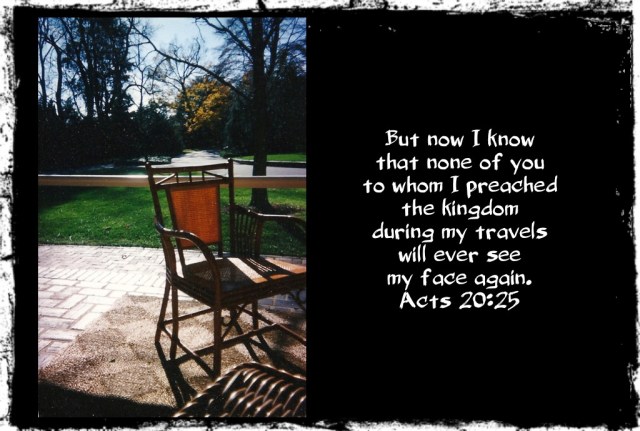
Today, in Mercy, both Paul and Jesus give a farewell discourse.  They are both saying goodbye to their friends and disciples as their ministry draws to a close. 

Such conversations are charged with emotion – love, hope, gratitude, sadness and loss interplay with one another in a poignant turmoil.  

We may have known such times when moving on from a job or neighborhood;  leaving school or work to begin something new. We may have held the hand of a loved one as they prepared for death, assuring each other of our love and thanks. Whatever the cause, there will be empty chairs in our lives where once there were beloved friends and family.  Even happy times such as weddings and distant job opportunities can hold the nugget of loss for us and those we love

We can learn from Jesus and Paul in today’s readings how to say goodbye.  A faithful, committed presence to our lives, our responsibilities, and our loved ones will sustain us when time or circumstance calls for change – even the ultimate change of dying.

Acts20_25

Music: How to Say Goodbye – Michael W. Smith

Second String

Monday, May 14, 2018

Readings: http://www.usccb.org/bible/readings/051418.cfm

Today, in Mercy, on this feast of St. Matthias, we read about his election into the company of the Apostles.  Matthias was a bench player, a second stringer.   He had been with the disciples from the very beginning.  But, it was Judas Iscariot who was originally chosen for the A-team! Ultimately, through his faithful and enduring commitment, Matthias emerged as the one to take up the slack when Judas failed so miserably. His humble fidelity was recognized.

If we have ever felt like a second string, we can find consolation in Matthias.  And we might consider how important a second string is in music. Not only can the phrase indicate a back-up string should one break, it also is the name for the D string on musical instruments. Imagine how the great music of the world would be changed if second strings did not exist!

Act 1_26 Matthias

Music: Mstislav Rostropovich playing Cello Adagio in D minor by Alessandro Marcello

Can Suffering and Sacrifice Lead to Glory?

Friday, May 11, 2018

Readings: http://www.usccb.org/bible/readings/051118.cfm

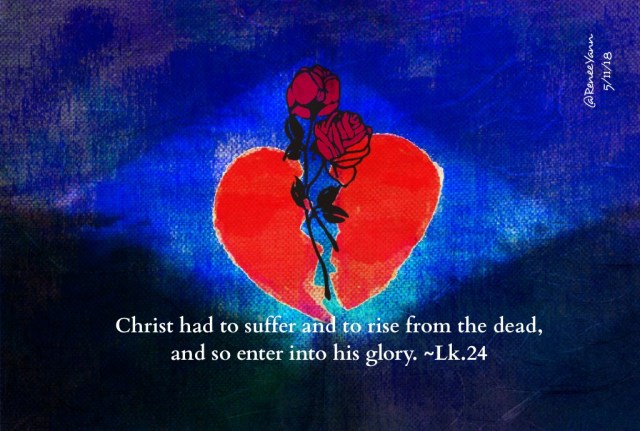
Today, in Mercy, Acts continues to describe the development of the early Church. Paul spends 18 months in Corinth, working with the new Christians through the many twists of a growing community. Luke’s Gospel reminds us of a key teaching for this, and our, community: If we really live like Christ, we will suffer, and die to ourselves before any hope of glory.

A true Christian life is not without sacrifice (which comes by choice) nor suffering (which comes by imposition). 

We sacrifice because we love. Consider all that parents sacrifice for their children’s sake.

When we suffer, we must also love, but add the hope for healing in ourselves and in anyone who causes our suffering.

This is to live like Christ.

Luke 24